What is Behance Maximalist Portfolio?
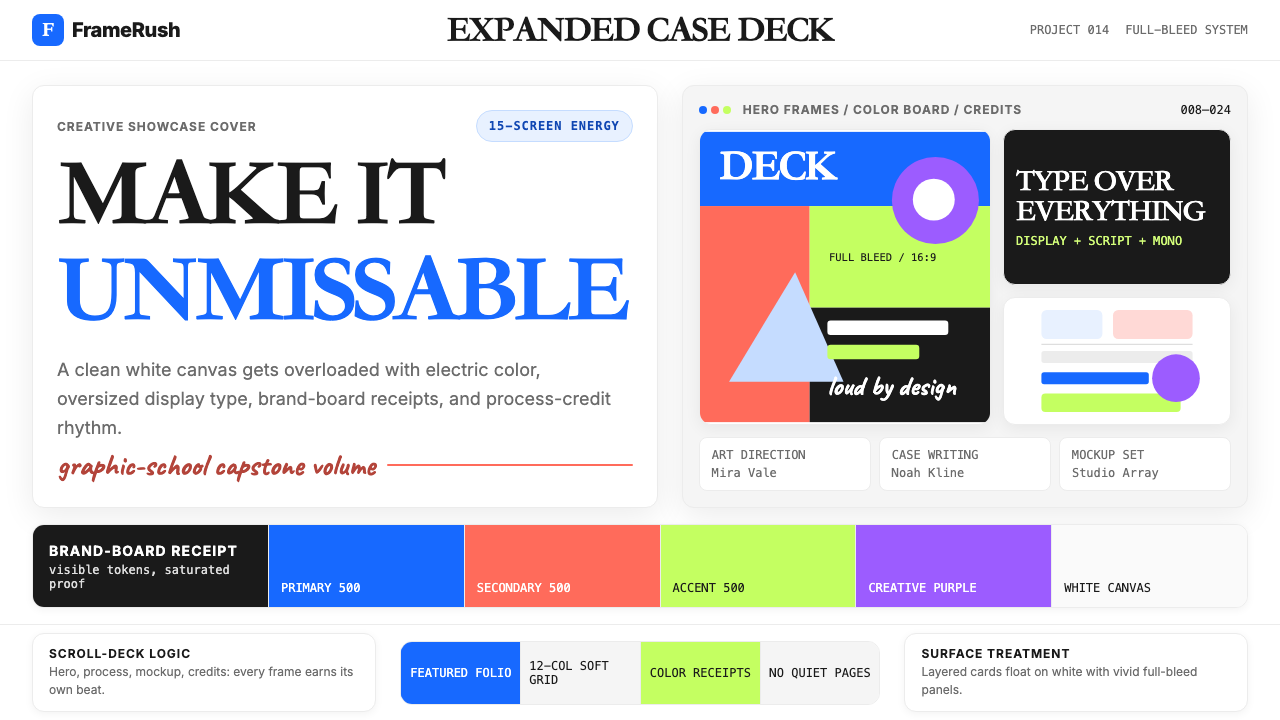
Behance Maximalist Portfolio turns the creative case study into a full-bleed spectacle — vivid brand palettes, extreme type contrast, and glossy mockup photography stacked fifteen screens deep.
Behance Maximalist Portfolio in brief
Behance Maximalist Portfolio is the dominant visual aesthetic of Adobe's flagship creative showcase platform. It describes the way designers present completed projects to the global design community: as long, scrollable case-study decks that unfold hero imagery, brand-color swatches, process sketches, real-world mockup photography, and generous credits sections, one after another, at full browser width. It is graphic-design-school capstone energy reproduced at internet scale.
The style is defined by abundance rather than restraint. Where minimalist portfolio schools strip away everything non-essential, Behance Maximalism adds — more colors, more typeface contrast, more surface texture in the mockup photography, more contextual depth in the process documentation. The white or near-white canvas is not a statement of austerity; it is a neutral stage whose sole function is to make the saturated brand-board colors detonate against it.
Visually, the aesthetic reads as controlled loudness. Display type set at an enormous scale sits above body text set at a whisper, creating a contrast ratio that would be considered aggressive in editorial contexts but is expected and celebrated on the platform. Electric blue — the signature color of Behance's own interface — appears throughout as a navigational and interactive anchor, lending even highly individualized project presentations a faint family resemblance.

Where does Behance Maximalist Portfolio come from?
Behance was founded in New York City in 2006 by Scott Belsky and Matias Corea, who set out to solve what they saw as a structural problem in the creative professions: talented designers had no reliable, permanent online home for their work. Portfolios lived on personal websites that went offline, on PDFs that circulated by email, or on agency sites that buried individual credits. Behance proposed a platform — openly searchable, free to join, and linked to a professional network — where every project could be discovered by art directors, clients, and peers alike.
In its early years, Behance was a relatively sparse environment. Projects were uploaded as image galleries, and the visual conventions were heterogeneous — whatever the designer chose to photograph or export. The shift toward the maximalist case-study format accelerated roughly between 2012 and 2016, driven by several converging forces: the rise of high-resolution retina displays that rewarded high-quality mockup photography, the proliferation of free and premium mockup templates that made product photography accessible to designers without studio budgets, and the competitive dynamics of the platform itself, where Featured Projects needed to arrest a viewer's attention within the first two screens or be scrolled past entirely.
Adobe acquired Behance in 2012 for a reported one hundred million dollars and integrated it tightly into Creative Cloud, making a Behance presence nearly automatic for subscribers. This dramatically expanded the platform's user base and introduced the electric blue of Adobe's interface language into the shared visual vocabulary of Behance portfolios — an ambient branding that, over time, became part of the style's signature palette rather than merely a navigational affordance.
By the mid-2010s, a set of informal conventions had calcified into something close to a standard. The Featured Projects that earned the most appreciation and top designer recognition shared consistent traits: full-bleed hero images cropped to exacting aspect ratios, brand-board spreads that displayed color swatches, logotype lockups, and typography specimens side by side, lifestyle mockup photography staged on natural-material surfaces — raw wood grain, pale concrete, linen — and a consistent rhythm of alternating full-width imagery with tighter text and process sections. This format was not mandated by Adobe; it emerged from the community's collective optimization for visual impact and comprehensiveness.
What defines the Behance Maximalist Portfolio look?
Vivid Multi-Color Brand Palettes
Unlike styles that restrict themselves to a single accent color, Behance Maximalism celebrates the brand-board spread: three to six colors displayed as large swatches, typically ranging from an electric or cobalt blue anchor through warm coral or terracotta and an acidic lime or chartreuse. These palettes are presented as explicit design decisions, not ambient backgrounds. The colors are saturated to the point of visual pressure, meant to communicate the energy and distinctiveness of the brand being presented, and they appear both in the brand-board section and echoed throughout the mockup photography and typographic treatments.
Extreme Typographic Contrast
The defining typographic move in Behance Maximalism is scale contrast pushed to its outer limit. A project title or section header rendered at display size — occupying much of the screen's vertical height — sits immediately above or beside body text set several grades smaller, with no intermediate hierarchy to soften the jump. A second layer of contrast comes from style mixing: a heavy, geometric display sans paired with a fluid cursive or script face, where the two typefaces share space on the same line or the same spread. This combination is borrowed from contemporary brand identity practice and signals the kind of client work that earns platform recognition.
Glossy Lifestyle Mockup Photography
Mockup photography is the engine of Behance Maximalism's persuasive power. Designs are presented not as flat exports but as objects inhabiting real surfaces: a brand identity appears on business cards fanned across raw oak; a packaging design is photographed against pale concrete with soft natural side-lighting; a mobile app interface glows inside a device resting on linen. The photography itself is crafted to suggest premium production values — sharp focus, rich but not oversaturated tones, and a deliberate material palette of wood, stone, paper, and fabric that connotes craft and quality.
Full-Bleed Compositional Rhythm
A Behance case study is structured as a rhythmic sequence of compositional registers. Full-bleed images — extending edge to edge without margin — alternate with contained text sections; wide-format brand spreads give way to tight process grids showing sketches and iterations. This rhythm is not accidental; it mirrors the pacing conventions of editorial design, giving the viewer peaks of visual richness followed by quieter passages that convey methodological depth. The full-bleed moments carry the emotional charge; the process sections carry the professional credibility.
White Canvas as Neutral Amplifier
Despite its association with maximalism, Behance portfolio work typically places saturated content against a white or near-white background rather than stacking vivid elements against dark grounds. The white canvas functions as a neutral amplifier: it makes the brand palette read at maximum brightness, keeps the mockup photography from competing with the interface chrome, and signals the clean, professional presentation expected by the art directors and clients who browse the platform as a talent-discovery tool. The whiteness is not a restrained aesthetic choice — it is a strategic one.
Process Documentation as Credibility Signal
A complete Behance Maximalist case study includes not just polished final deliverables but visible evidence of the thinking behind them: hand-drawn ideation sketches, logo construction grids, color-exploration boards, and before-and-after comparisons. This documentation serves a dual purpose. For the audience, it demonstrates strategic and conceptual ability, not just execution skill. For the visual composition, the process materials — their organic lines, imperfect edges, and handmade quality — provide textural contrast against the high-polish mockup photography, preventing the presentation from becoming purely a glossy catalog.
Credits and Context Generosity
Behance Maximalist presentations typically conclude with an expansive credits section that names every contributor — art directors, copywriters, photographers, motion designers, developers — along with client context, timeline, and sometimes measurable outcomes. This convention distinguishes the format from traditional portfolio presentation, where credits were often buried or omitted. On Behance, generosity with attribution is both a professional norm and a practical strategy: named collaborators share the project to their own networks, compounding the presentation's reach and driving the platform's social mechanics.

Who shaped Behance Maximalist Portfolio?
Belsky co-founded Behance in 2006 with the mission of organizing the creative world's work and making it universally discoverable. His book 'Making Ideas Happen' (2010) articulated the philosophy behind the platform: that creative professionals needed systems and visibility, not just talent. After the Adobe acquisition, Belsky served as Adobe's Chief Product Officer, steering the integration of Behance into Creative Cloud and expanding the platform's reach to tens of millions of creatives globally. His vision of portfolio as professional infrastructure rather than personal archive shaped the platform's culture of comprehensive, highly produced case studies.
Corea served as Behance's co-founder and Creative Director, and was responsible for shaping the platform's own visual identity and user experience during its formative years. His background as a designer meant that Behance's interface was conceived by someone who understood the needs of the community it was built for. The platform's clean white interface, its emphasis on large imagery, and the featured-project grid that rewards high-production presentation were all design decisions made under Corea's creative direction. In this sense, the visual conventions of Behance Maximalism were partly seeded by the platform's own aesthetic choices.
The informal cohort of designers awarded Adobe's top platform recognition — Featured on Behance, Adobe Design Achievement Awards recognition, and invitations to the Behance Review boards — form a kind of distributed creative faculty whose collective output defined the aesthetic norms of the platform. These practitioners, concentrated in design hotbeds including New York, São Paulo, London, Warsaw, and Mumbai, absorbed and re-exported the visual conventions of Behance Maximalism through their own highly circulated projects. The aesthetic did not emanate from a single school or manifesto but from the aggregate influence of several hundred designers whose work the platform's algorithm consistently surfaced.
A largely uncredited but structurally decisive contributor to Behance Maximalism was the emergence, from roughly 2011 onward, of a commercial ecosystem of photorealistic mockup templates sold through marketplaces such as Creative Market, Envato Elements, and later Gumroad. These templates — smart-object PSD files that allow a designer to drop flat artwork into a photograph of a product in a styled scene — democratized a type of presentation that had previously required either a real product, a commercial photographer, and a prop stylist, or exceptional retouching skill. By making studio-quality mockup photography available to every designer with a Creative Cloud subscription, the mockup industry normalized and then mandated the visual language of high-production portfolio presentation.
How do you use Behance Maximalist Portfolio today?
Behance Maximalist Portfolio translates most naturally into any context where the goal is to communicate creative range, production craft, and brand confidence simultaneously. The style is inherently demonstrative — it shows rather than argues — which makes it well suited to visual-first presentations where the audience is already design-literate and expects to be impressed rather than persuaded with words.
For presentation slides, the style works across both cover and case-study content pages. A cover slide benefits from a full-bleed hero image at the top third of the canvas, with a display-scale project title dropped below in a contrasting type treatment — a bold geometric sans against a flourishing script, or an oversized wordmark in the primary brand color. Content slides should adopt the same full-bleed-then-contained rhythm of a Behance scroll: one slide carries a single large mockup image with minimal text, the next contains a tight grid of process thumbnails or color swatches, the next returns to a full-bleed lifestyle photograph. Data slides — particularly for brand metrics or campaign results — work well in this style when charts are treated as graphic objects: bars colored in the brand palette, backgrounds swapped to a deep version of the primary color so the data reads as part of the brand world rather than a separate reporting layer.
For web interfaces, Behance Maximalism is most at home in portfolio landing pages, agency homepages, and creative tool dashboards where visual richness signals competence. Applied to a pricing or feature page, the style works when each tier or feature block is distinguished by a full-bleed band of a different brand color, with the product interface or mockup photography embedded within. Navigation should be typographic and confident — large, clearly weighted wordmarks and labels — with interactive states communicated by a shift to the platform's electric blue or a saturated complementary color rather than by icon-heavy decoration. On dashboard interfaces, the maximalist palette functions best when it is reserved for status indicators, data highlights, and calls to action, while structural chrome stays near-white.
For editorial and marketing work, the full-bleed compositional vocabulary of Behance Maximalism produces strong visual anchors. A marketing hero section built in this style leads with an image that bleeds to all four edges, overlaid by a headline at display scale in a color pulled directly from the brand palette — never a generic black or gray. Section breaks use the brand palette boldly: a full-width band of electric blue or coral, reversed-out in white, announces a new chapter rather than relying on a thin rule. For editorial article layouts, the style suggests wide outer margins used for pull quotes or metadata, body text set at a comfortable reading measure, and section openers that combine a large numeral or initial capital with a brand-color geometric shape behind it.
The most common mistake when applying Behance Maximalism is mistaking quantity for quality. The style rewards deliberate excess, not random accumulation. Stacking six brand colors without a compositional hierarchy produces noise rather than richness; mixing three typefaces without a clear logic creates clutter rather than contrast. The underlying structure of a successful Behance case study is as disciplined as a Swiss grid — the maximalism operates within a firm skeleton of full-bleed zones, contained text sections, and a limited palette used at maximum saturation. Remove the discipline and the loudness becomes incoherence. Apply the discipline and the loudness becomes authority.

Behance Maximalist Portfolio — FAQ
Is Behance Maximalism a coherent design movement or just a platform convention?
It sits somewhere between the two. It lacks the theoretical foundation of a movement — there is no manifesto, no founding school, and no named set of principles — but it is far more than an arbitrary collection of trends. The conventions of Behance Maximalism are self-reinforcing: the platform's algorithm rewards high-production work, high-production work sets the visual standard that newcomers emulate, and the emulation deepens the convention. This feedback loop has produced something functionally equivalent to a house style — coherent enough to be immediately recognizable, stable enough to have evolved through several phases since the early 2010s, and influential enough to shape how brand presentations are pitched in client meetings well beyond the platform itself.
How does Behance Maximalism differ from Memphis or other maximalist design styles?
Memphis and Behance Maximalism share high color saturation and a rejection of restraint, but their logics are opposite. Memphis (1980s Milan) was deliberately anti-functional, using pattern, surface decoration, and color irony to subvert the earnest utility of modernist design. Behance Maximalism is deeply earnest — every element exists to demonstrate professional skill, communicate brand values, or establish credibility. Its excess is in service of persuasion, not subversion. Memphis celebrates surface; Behance Maximalism celebrates process. Memphis is ironic; Behance Maximalism is sincere to the point of self-seriousness.
Can this style work outside the creative industry context — for example, for a tech product or a financial service?
It can, with selective adaptation. The full-bleed compositional structure, the typographic scale contrast, and the use of bold brand-palette color blocks all transfer cleanly to tech and financial contexts. What does not transfer without careful editing is the lifestyle mockup aesthetic — raw wood and linen surfaces carry craft-studio connotations that can undermine authority in financial or enterprise contexts. A tech or financial application of this style works best when the mockup photography is replaced by device-in-context photography on neutral or architectural surfaces, and when the multi-color brand palette is reduced to two: one primary saturated color and one neutral. The visual energy of the style remains; the artisanal coding is removed.
What is the difference between a Behance Maximalist case study and a design portfolio slide deck?
The core difference is narrative structure. A slide deck is designed for linear, presenter-driven delivery — each slide advances a sequential argument, and the presenter controls pace and emphasis with spoken commentary. A Behance case study is designed for autonomous, viewer-driven scroll — it must communicate at multiple speeds simultaneously, because a viewer might pause on a hero image for thirty seconds or skim the entire project in five. This produces different compositional demands: the slide deck can afford context established verbally; the Behance case study must embed every layer of context visually. When adapting a Behance case study into slides, the key transformation is converting implicit visual narrative into explicit sectional structure.
Does this style age well, or does it risk looking dated quickly?
The structural conventions of Behance Maximalism — full-bleed composition, typographic scale contrast, brand-board presentation — are durable because they are grounded in communication logic rather than surface trend. What ages quickly within the style are the specific mockup aesthetics: the raw-wood surface that was fresh in 2014 began to feel familiar by 2018 and can now read as a period marker. Similarly, specific typeface pairings cycle in and out of currency with the broader type landscape. The practical implication is that a Behance Maximalist presentation built on structural conventions will age slowly; one built primarily around a trending mockup surface or a fashionable script pairing will carry a timestamp. Invest in the composition; treat the surface choices as variables.
Related design styles
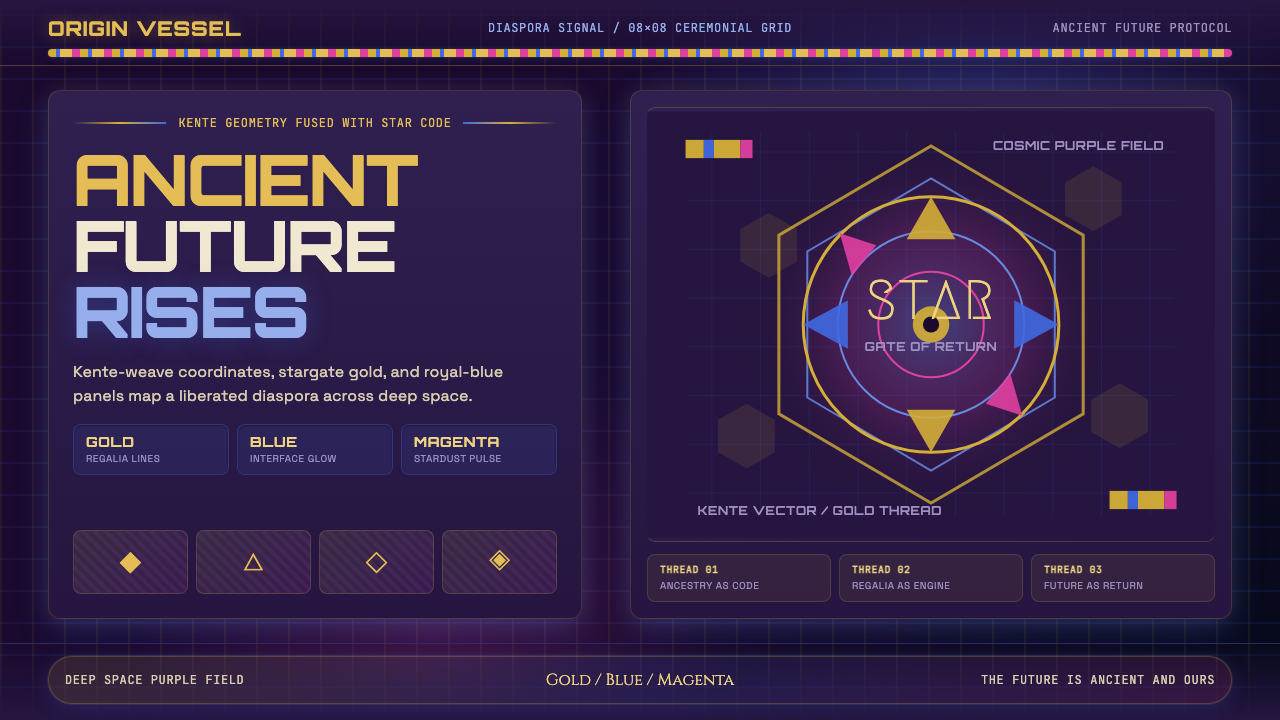 AfrofuturismAncient future, fully luminous. Gold kente grids cut through cosmic purple an…
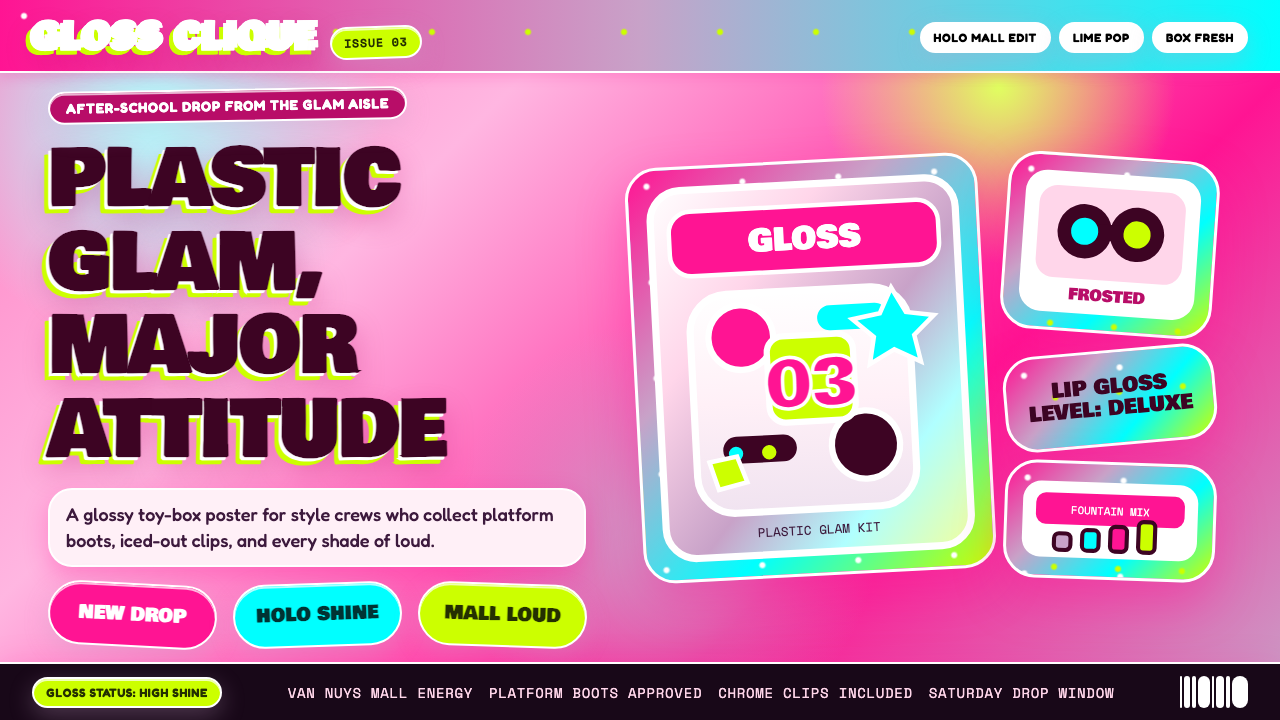 Bratz Doll 2003Y2K maximalism, mall-glossy. Hot-pink gradients, holographic lavender, chunky…
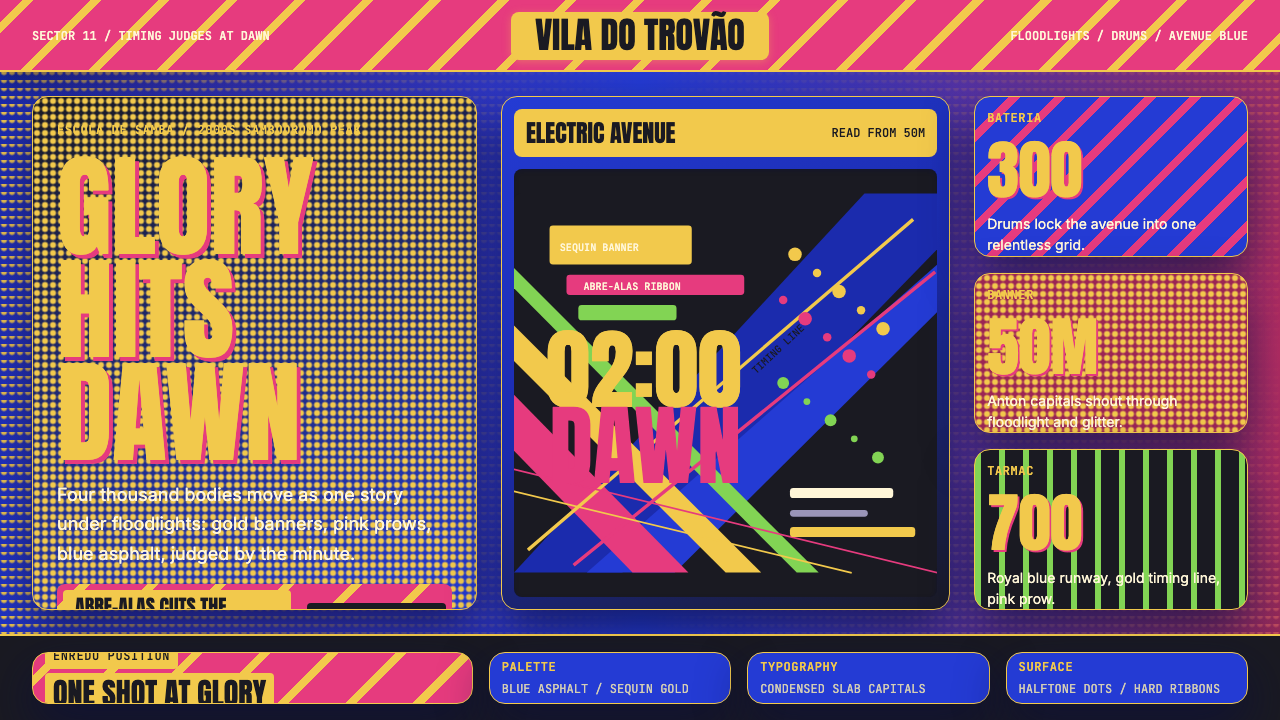 Brazilian Samba School (2000s Carnaval)Parade at floodlight volume. Royal blue asphalt, sequin gold type, pink ribbo…
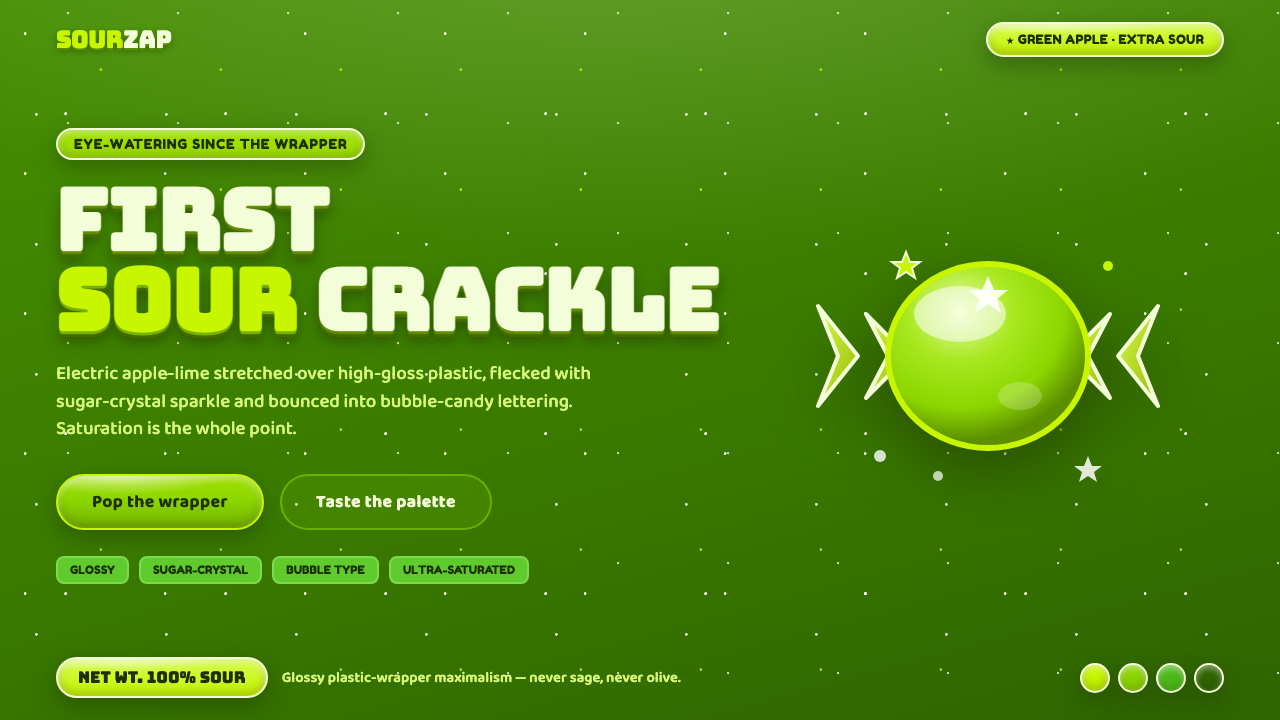 Sour Apple Candy GreenSaturation is the point. Electric apple-green on glossy plastic, sugar-crysta…
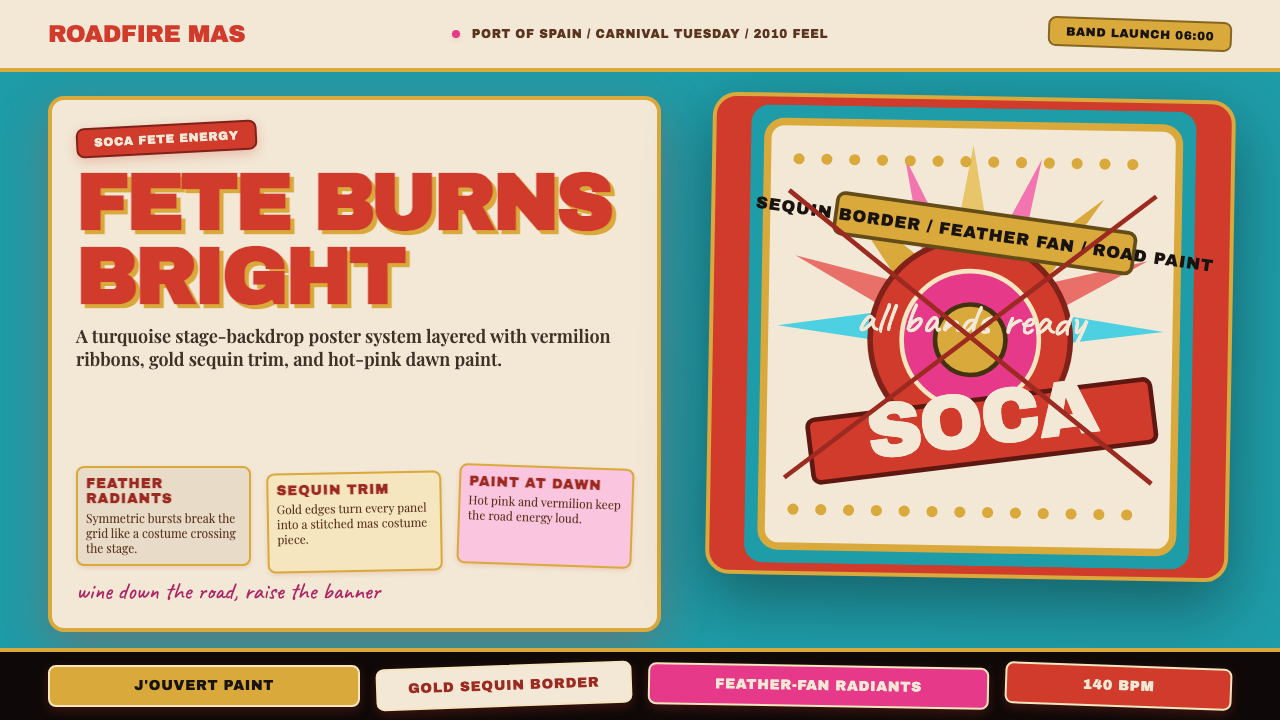 Trinidad Carnival Soca (2010)Joy overload. Turquoise field, vermilion banners, gold sequins, feather-fan g…
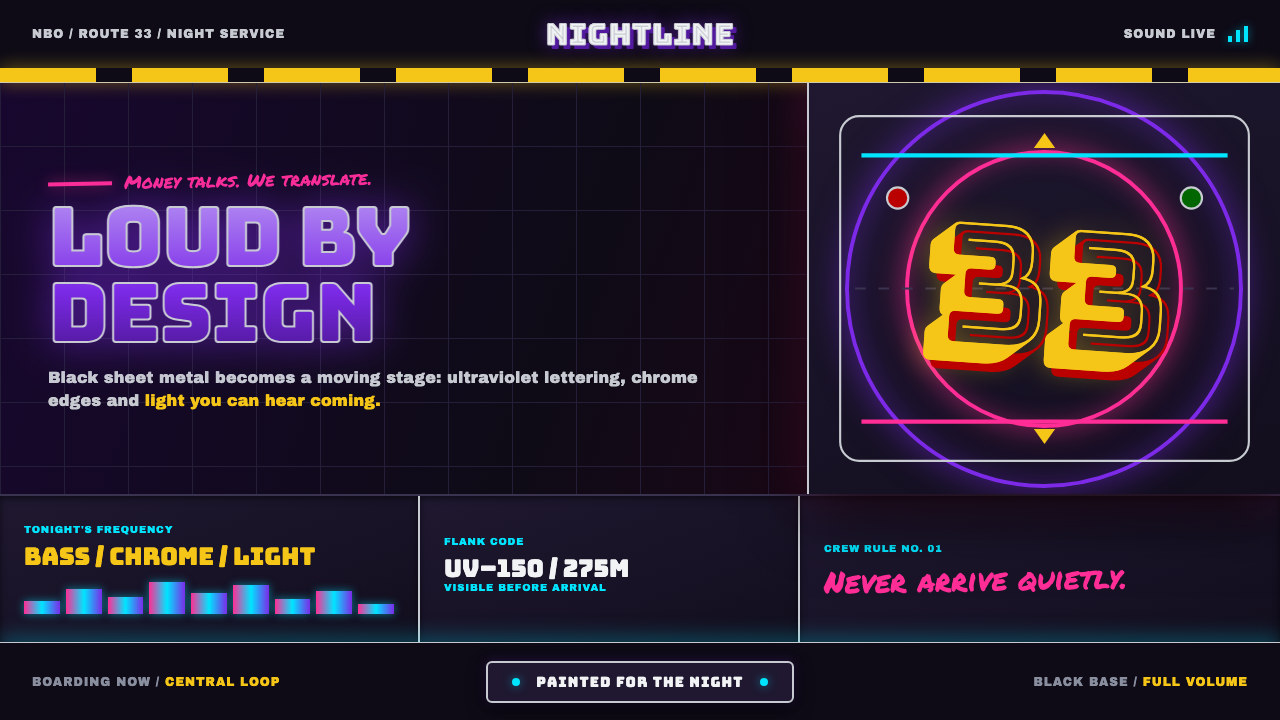 Nairobi Matatu ArtBuilt to be unmissable. Neon airbrush and chrome blaze across night-black hor…