What is Afrofuturism?
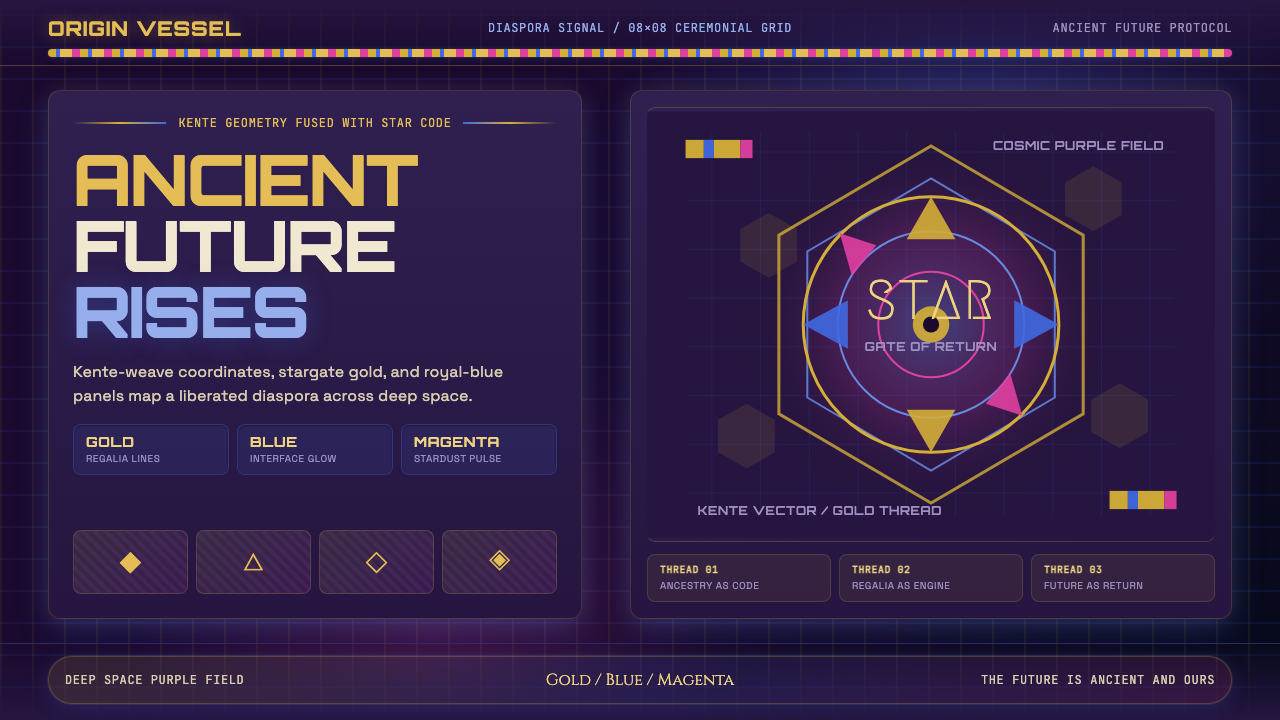
Afrofuturism declares that the future is ancient and luminous — gold kente grids cut through cosmic purple, and the Black diaspora has always belonged among the stars.
Afrofuturism in brief
Afrofuturism is a cultural and aesthetic movement that fuses African and African diaspora heritage with science fiction, speculative imagination, and futurist technology. It insists that African traditions — geometric kente patterns, Dogon cosmology, Adinkra symbols, ancestral oral histories — are not relics of the past but living blueprints for imagined futures. The visual result is simultaneously ancient and interstellar: deep cosmic purples and blacks grounded by royal golds and vibranium blues, luminous glow effects suggesting both celestial light and cybernetic energy.
As a design aesthetic, Afrofuturism is bold and ceremonial without being decorative for its own sake. Its geometry carries cultural weight: the concentric rings, angular kente grids, and interlocking diamond patterns trace back to West African textile traditions. Metallic sheens — warm gold, cool copper, electric blue — evoke both regal regalia and spacecraft hulls. Typography oscillates between monumental inscriptions evoking ancient stone carvings and sleek space-age letterforms that suggest holographic interfaces.
What distinguishes Afrofuturism from generic sci-fi aesthetics is its insistence on cultural specificity. The cosmic imagery is not neutral — it is reclaimed Black space, populated by figures who wear crowns and command starships equally. Every design decision carries this dual identity: earthy and celestial, historical and speculative, ancestral and alien.

Where does Afrofuturism come from?
The term 'Afrofuturism' was coined in 1993 by cultural critic Mark Dery in his essay 'Black to the Future,' but the sensibility it names reaches back several decades further. Sun Ra — the jazz musician and self-proclaimed cosmic traveler from Chicago — had been staging his Arkestra in pharaonic headdresses and space-age robes since the 1950s, performing a mythology in which ancient Egypt and interstellar jazz were the same journey. His message was explicit: Black people did not arrive in America on slave ships; they arrived from Saturn.
Octavia Butler's speculative fiction, beginning in the 1970s, gave Afrofuturism its literary spine. Her novels imagined Black protagonists navigating alien civilizations, time travel, and biological transformation — always with an unflinching eye on power, identity, and survival. Simultaneously, George Clinton's Parliament-Funkadelic collective was building a parallel mythology: the Mothership Connection, a funk cosmology in which the oppressed would be rescued by a spaceship piloted by Dr. Funkenstein. P-Funk concerts in the mid-1970s were theatrical spectacles that felt like Afrofuturist religious ceremonies.
Visual Afrofuturism crystallized through album art, film, and fashion throughout the 1980s and 1990s. The painter Jean-Michel Basquiat, though not strictly an Afrofuturist, contributed a visual vocabulary of crowns, wiring diagrams, and anatomical symbols that later artists absorbed. Janelle Monáe's Metropolis concept albums from 2007 onward brought the aesthetic to a new generation — android personas, tailored tuxedos, retro-futurist staging that drew equally from Fritz Lang and James Brown.
The mainstream arrival came in 2018 with Marvel's Black Panther, for which costume designer Ruth E. Carter created the visual identity of Wakanda by systematically researching and reinterpreting textile and jewelry traditions from across sub-Saharan Africa. The film's production design demonstrated that Afrofuturism could operate at blockbuster scale, its vocabulary of kente weaves, Ndebele beadwork, Maasai color blocking, and Zulu ring headdresses rendered in vibranium-enhanced metallic form. The film provoked a massive global conversation about representation, worldbuilding, and the politics of imagined futures, cementing Afrofuturism as a recognized design system with international reach.
What defines the Afrofuturism look?
Cosmic Color Palette
The palette is anchored in deep space: rich purple-black grounds suggest the depth of interstellar night, layered with royal gold carrying the warmth of kente weave and ceremonial regalia. Luminous electric blue — reminiscent of bioluminescence and energy fields — functions as both accent and atmospheric glow. Warm copper and bronze tones bridge the earthly and the celestial. The result is jewel-toned and radiant, heavy with symbolic weight: colors that feel simultaneously regal and otherworldly.
Geometric Cultural Patterns
The geometry is never arbitrary — it is culturally encoded. Kente cloth's interlocking rectangular strips translate into bold grid overlays and interlaced band patterns. Adinkra symbols — the visual proverbs of the Akan people — appear as motifs within larger compositions, each carrying philosophical meaning. Ndebele geometric murals, with their bold concentric shapes and high-contrast angular fills, inform the way surfaces are subdivided. These patterns are not decorative flourishes layered onto a design; they are the design's structural skeleton.
Metallic Luminosity
Metal is the material language of Afrofuturism — not the cold chrome of generic sci-fi, but warm, cultured metals that evoke both crown jewels and alien alloys. Gold glows against dark backgrounds with ceremonial authority. Copper and bronze suggest age and craftsmanship. A fictional vibranium-blue sheen — neither silver nor steel, but something more luminous — reads as technology that has been consecrated. This metallic quality is achieved not through photorealistic rendering but through bold, saturated tonal contrast: deep shadow against radiant highlight.
Dual Typography Registers
Afrofuturism typography operates in two registers held in deliberate tension. The first is monumental and inscriptional — letterforms that carry the weight of carved stone, processional banners, and ancient titling, evoking the authority of royal proclamation. The second is space-age and technical — clean geometric letterforms that suggest navigation readouts, mission briefings, and holographic displays. Placing these together in a single composition creates the movement's characteristic temporal layering: the sense that an ancestral civilization has developed its own advanced technology, and that the past and the future are the same moment.
Celestial and Organic Texture
Where Bauhaus forbids texture and Swiss Style controls it rigorously, Afrofuturism embraces it as atmosphere. Stardust particle fields, nebula-like color blends, and soft luminous halos give compositions a sense of inhabited cosmic space. Organic forms — flowing garment silhouettes, natural fiber patterns, the rounded contours of sculptural jewelry — introduce bodily warmth into what might otherwise feel cold and technological. The balance is careful: texture enriches but never overwhelms the bold geometric structure underneath.
Crown and Portal Motifs
Certain recurring symbols anchor the visual grammar: crowns as assertions of sovereignty rather than nostalgia, cosmic portals and circular apertures that frame transition between worlds, sun discs evoking both Ra and interstellar energy sources, and the circle as a universal sign of completeness and cyclical time. These motifs are not decorative references — they are argumentative. Each crown says that the figure wearing it rules by birthright, not by permission. Each portal implies that departure and arrival are equally possible.
High Contrast and Luminous Glow
Afrofuturism compositions place luminous elements against very dark grounds, creating a radiance effect that evokes both bioluminescent organisms and the light of distant stars. This is not the soft glow of ambient lighting but a concentrated, almost sacred luminosity — as if certain elements are lit from within. The extreme contrast between the near-black cosmic ground and the incandescent gold or electric blue foreground gives the work its visual drama and its sense of revelation: something precious and alive in the darkness.

Who shaped Afrofuturism?
Born Herman Poole Blount in Birmingham, Alabama in 1914, Sun Ra claimed origins on Saturn and built a complete cosmology around that self-mythologizing. As bandleader of the Arkestra, he staged performances that were total environments — musicians in robes, capes, and Egyptian-inflected headdresses playing extended compositions that moved through free jazz, electronic experimentation, and ancient chant. His 1972 film Space Is the Place is the foundational Afrofuturist text in moving image, positing outer space as a site of Black liberation. His influence on visual Afrofuturism — the legitimacy he gave to cosmic self-fashioning as political act — cannot be overstated.
Octavia Butler (1947–2006) wrote science fiction that treated power, race, and survival not as metaphors to be decoded but as the actual texture of imagined futures. Her Patternist series, Kindred, and the Parable books created Black protagonists who were not observers of futurism but its architects. Butler's specific contribution to Afrofuturism was intellectual rigor: she refused wish-fulfillment fantasy in favor of speculative realism, insisting that any imagined future must grapple honestly with the systems of domination that shaped the past. Her work gave the movement a tradition of skeptical, critical futurism alongside its celebratory aesthetics.
Janelle Monáe brought Afrofuturism into contemporary pop culture through her Metropolis concept project, which began as an EP in 2007 and expanded through multiple albums into an elaborate science-fiction narrative about an android named Cindi Mayweather. The visual world she constructed — severely tailored black-and-white tuxedos as uniform, retro-futurist stage architecture, album art that quoted both Fritz Lang's Metropolis and Black Power iconography — demonstrated that Afrofuturism could be simultaneously rigorous and commercially legible. Her work also introduced queer identity as a native element of Afrofuturist self-making.
Ruth E. Carter is the costume designer who won the Academy Award for Black Panther (2018), the first such award for a Marvel film. Her approach to Wakanda's visual identity was systematic and scholarly: she spent months researching textiles, jewelry, and ceremonial dress from more than a dozen African cultures, then synthesized these into a coherent fictional world where tradition and advanced technology had evolved together rather than one replacing the other. The Dora Milaje warriors in their red and gold armor, T'Challa's vibranium suit transformations, the market scene's riot of regional textile traditions — Carter's work is the most widely seen application of Afrofuturist design principles in history.
Kenyan-American artist Wangechi Mutu creates collage, sculpture, and immersive installation work that engages directly with Afrofuturist themes: the hybrid body, colonial archives, ecological transformation, and the African female form as a site of both damage and power. Her work is distinctive for its material specificity — she has used torn fashion magazine pages, medical diagrams, and found organic matter to construct figures that are simultaneously monstrous and beautiful, alien and deeply human. Mutu's contribution is the dark and troubled underside of Afrofuturist optimism: the movement's reckoning with what was actually done to Black bodies in history.
How do you use Afrofuturism today?
Afrofuturism is among the most visually potent design systems available precisely because it is not neutral — it carries cultural charge and aesthetic conviction in equal measure. Applying it well requires genuine engagement with its logic: the palette is cosmic and ceremonial, not simply dark-with-gold; the geometry is culturally encoded, not just decorative pattern-making. When those principles are understood, the aesthetic transfers powerfully across a range of contemporary design contexts.
For presentation slides, Afrofuturism excels at cover pages that need to command authority and attention simultaneously. A cover built in this language uses a deep cosmic ground, a bold kente-derived grid overlay rendered in luminous gold, and a headline in monumental inscriptional type. The effect is processional — the audience feels summoned rather than merely informed. Content slides should commit to the high-contrast typographic hierarchy: crisp near-white type on dark grounds, section markers borrowed from the geometric symbol vocabulary. Data visualizations in this aesthetic reward boldness — charts rendered in the primary cosmic palette, with gold used to indicate the most important datum, become more legible and more arresting than their neutral counterparts.
For web interfaces, Afrofuturism is particularly well-suited to dashboards where authority and sophistication are the desired emotional register. The dark cosmic ground keeps screen fatigue low across long sessions, and the luminous accent colors — electric blue for interactive elements, gold for achievement states or key metrics — create an intuitive hierarchy without relying on standard conventions. Pricing pages benefit from the ceremonial register: tier differentiators presented with the visual weight of royal insignia feel premium without being cold. Navigation should be typographically bold, with symbol-derived elements used sparingly to mark transitions.
For editorial and marketing work, the aesthetic supports storytelling with cultural depth and visual drama. A long-form editorial feature in this language uses a dark-field layout for hero sections — large type in gold or electric blue against the cosmic ground — transitioning to a lighter, more readable field for body content. Marketing campaigns aimed at audiences who value heritage, cultural specificity, and futurist optimism respond strongly to this aesthetic. Album art, cultural event identities, brand campaigns for technology companies with Black founders or explicit cultural commitments — all of these are natural homes for Afrofuturist design principles.
A common mistake is treating Afrofuturism as a surface texture — applying gold glows and dark backgrounds without engaging the geometric and symbolic logic that gives the aesthetic its coherence. The result looks like generic dark sci-fi with gold highlights. The deeper error is cultural: using the visual language without acknowledging its origins produces designs that feel hollow or, worse, appropriative. When this aesthetic is engaged thoughtfully — with awareness of the traditions it draws from and the argument it is making — it produces work of genuine power and specificity.

Afrofuturism — FAQ
Is Afrofuturism only appropriate for Black-owned brands or African cultural organizations?
The movement itself is clear that Afrofuturism is not an exclusionary aesthetic — its theorists have consistently argued for engagement over avoidance. The important distinction is between informed engagement and surface appropriation. A non-Black designer or brand applying Afrofuturism superficially — borrowing the dark-and-gold palette without engaging the cultural logic, the symbolic geometry, or the argumentative dimension — produces work that is at best generic and at worst disrespectful. Applied with genuine knowledge of the tradition, acknowledgment of its origins, and purpose that aligns with the aesthetic's values, the aesthetic can be used thoughtfully across cultural contexts. The question to ask is not 'am I allowed' but 'do I understand what I'm doing and why.'
How does Afrofuturism differ from generic dark sci-fi aesthetics?
Generic dark sci-fi aesthetics — think blue-tinted control rooms, neon-on-black cyberpunk interfaces — are typically culturally rootless. They draw from mid-twentieth-century Western science fiction illustration, manga and anime visual conventions, and Hollywood production design. Afrofuturism is rooted in specific cultural traditions: the geometry comes from West and southern African textile and architectural design, the color symbology from ceremonial and royal traditions, the mythological framework from African diaspora cosmologies. Where generic sci-fi is cool and distanced, Afrofuturism is warm and celebratory. Where generic sci-fi implies a smooth, seamless technological future, Afrofuturism insists on the presence of cultural continuity and historical memory within that future.
Can Afrofuturism work in light-background layouts, or does it require dark grounds?
The deep dark cosmic ground is not an absolute requirement, but it is the aesthetic's native environment. The luminous glow effects, the radiant metallic accents, and the sense of jewel-toned richness are most effectively achieved against dark grounds — the contrast creates the radiance. A light-background interpretation is possible and sometimes practically necessary, but it requires deliberate adjustment. On a light ground, the palette should shift toward warm parchment or aged cream rather than white, the gold should function as a rich primary accent rather than a glow, and the geometric patterns should be rendered with sufficient weight to maintain cultural legibility. The result will read as Afrofuturist-informed rather than fully Afrofuturist — a lighter, more accessible interpretation of the system's core vocabulary.
What are the most common mistakes when applying this aesthetic?
Three mistakes appear most frequently. The first is palette reduction: treating Afrofuturism as simply dark background plus gold and missing the full chromatic range — the electric blues, the warm coppers, the deep purples that give the system its depth and variation. The second is geometric superficiality: adding decorative kente-inspired stripes without understanding the interlocking structural logic of the original textile traditions, which results in pattern that looks borrowed rather than built. The third, and most significant, is tonal incoherence: applying cosmic visual language to a product or message that has no meaningful relationship to the aesthetic's values — futurism, heritage, speculative imagination, cultural pride. Afrofuturism is an argumentative aesthetic; without an argument to make, the visual language rings hollow.
How does Afrofuturism relate to other African-rooted design traditions like Afrocentrism or Pan-Africanist visuals?
Afrocentrism as a design aesthetic tends to look backward: it prioritizes the re-centering and celebration of pre-colonial African history, culture, and knowledge systems, and its visual language often emphasizes earth tones, traditional textile patterns used in historical context, and imagery drawn from specific ancient civilizations. Pan-Africanist visual design emphasizes political solidarity and uses the red, black, and green flag palette as a primary symbol. Afrofuturism is distinct in its temporal orientation: it is not nostalgic or strictly political, but speculative and forward-looking. It takes African heritage as its raw material and projects it into imagined futures, technological possibility, and cosmic space. The three traditions share cultural roots but diverge significantly in their purpose, palette, and the kinds of futures they imagine.
Related design styles
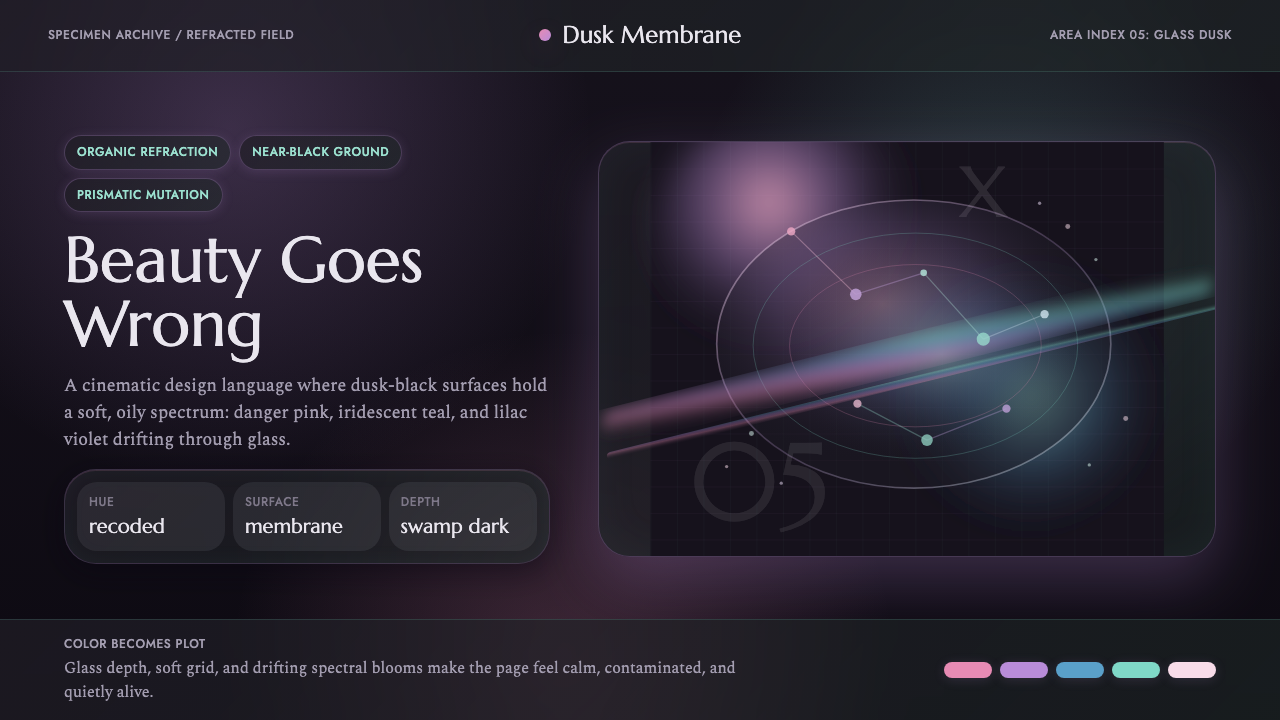 Annihilation (The Shimmer)Beautifully wrong. Dusk black carries pink, teal, and lilac refraction throug…
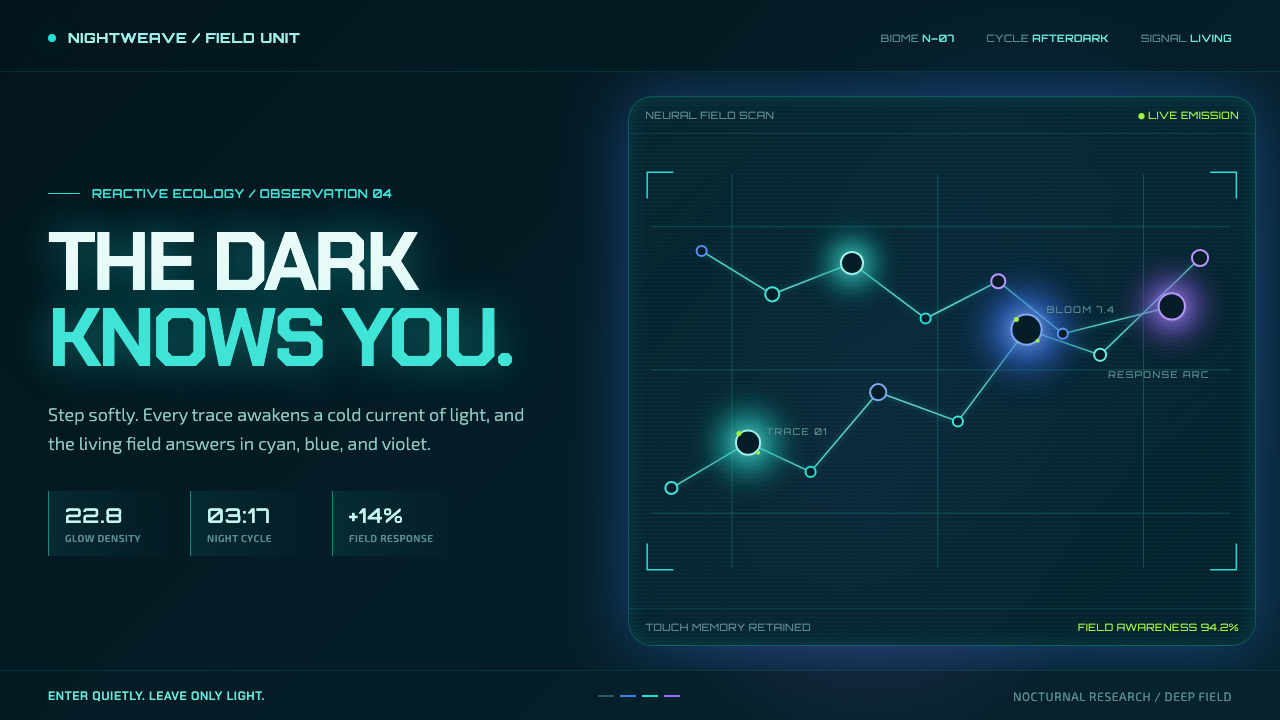 Avatar — Pandora Bioluminescence (2009)The forest knows you are there. Cyan light blooms across a deep-teal living f…
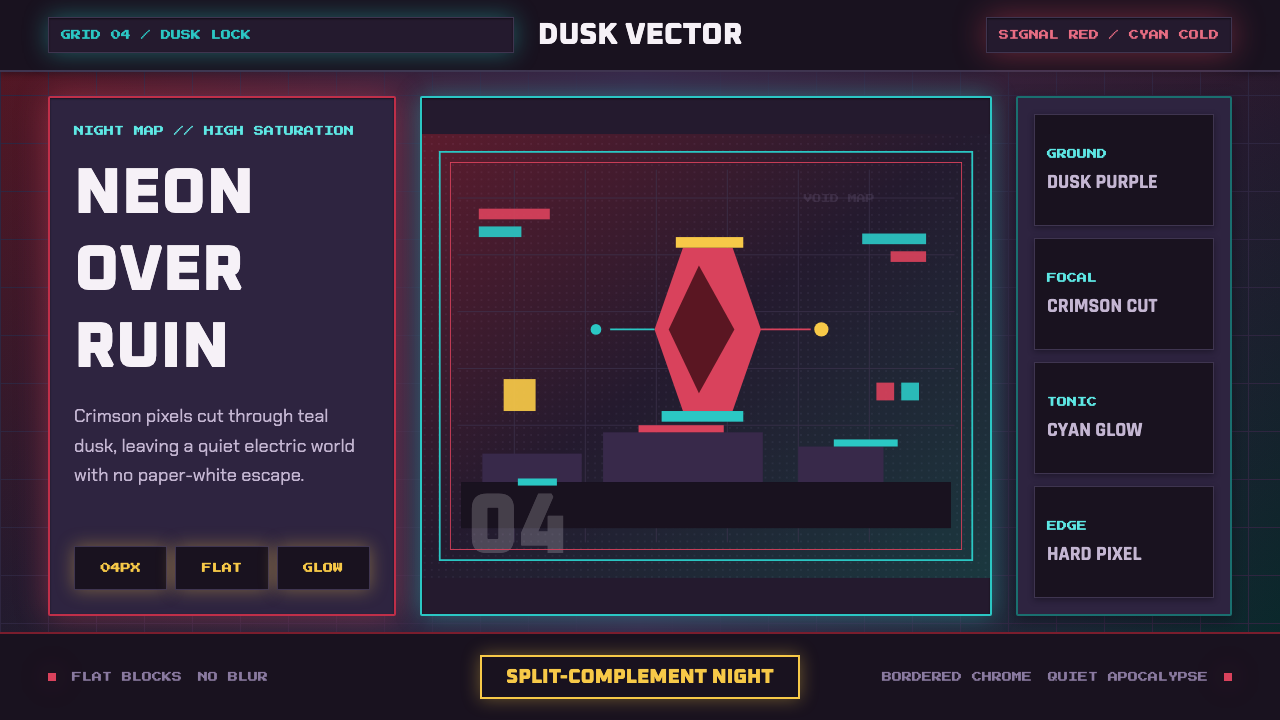 Hyper Light DrifterBeautiful ruin glows. Dusk purple holds crimson pixels and cyan grid light.
 Behance Maximalist PortfolioPortfolio volume at max. Electric blue, coral and lime stack into a full-blee…
 Icelandic Aurora TourismMidnight tourism turns mythic. Basalt black, aurora magenta-green, saga serif…
 Monster Energy Claw (2002)Aggression, not refreshment. Matte black and neon-green claw slashes cut the…