What is Icelandic Aurora Tourism?
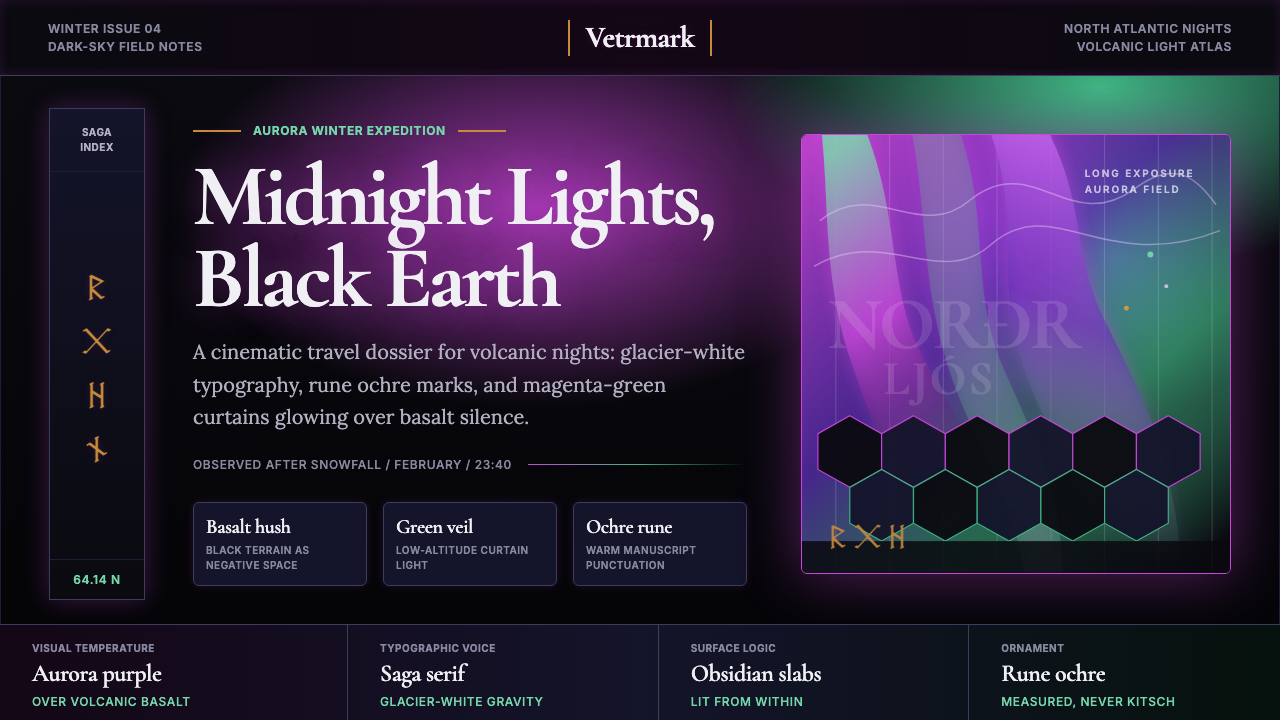
Iceland's aurora-tourism visual language transforms a volcanic sky into a brand — midnight-dark surfaces ablaze with curtains of magenta-to-green light, saga-weight type, and the cinematic silence of a February glacier.
Icelandic Aurora Tourism in brief
Icelandic Aurora Tourism is a contemporary visual identity system built around the phenomenon of the northern lights as experienced in Iceland's extreme-latitude landscape. At its core, the system pairs near-black volcanic surfaces with saturated aurora gradients — sweeping bands of magenta, jade green, and violet that read simultaneously as natural wonder and crafted brand mark. The darkness is not neutral background; it is basalt-black, the specific depth of a lava field at two in the morning, and every luminous element is set against it with theatrical deliberateness.
What makes this aesthetic distinct from generic 'dark mode' or generic 'space' design is its grounding in real Icelandic geography and mythology. The compositions draw from long-exposure aurora photography taken at sites like Þingvellir, Jökulsárlón, and Vík — locations whose names appear as editorial typography alongside the imagery, carrying the weight of Old Norse geography. Rune-like accent marks and saga-style serif headlines refer to a literary and runic tradition that predates the nation-state by a millennium, giving the brand historical depth that pure spectacle would lack.
The system operates at a scale from tourism posters to airline liveries to social media campaigns, and its versatility comes from a handful of tightly controlled variables: the aurora gradient (always saturated, always moving from warm to cool across the frame), the volcanic dark (never softened to a neutral charcoal), the glacier-white typography (clean and cold), and the cinematic negative space that surrounds every element like the silence between geothermal vents.

Where does Icelandic Aurora Tourism come from?
The visual language now recognizable as Icelandic Aurora Tourism did not arrive fully formed. Its immediate catalyst was the 2010 eruption of Eyjafjallajökull, which grounded European air travel for six days and turned Iceland into the most talked-about name in international news. The eruption was simultaneously a catastrophe for the Icelandic tourist industry and an enormous, unplanned advertisement: the world suddenly knew that Iceland was a place where geology was still alive, where the earth's interior breached the surface without warning. Promote Iceland, the national tourism agency, recognized this moment as a pivot point and commissioned the campaign 'Inspired by Iceland' to reframe the volcanic island not as an obstacle but as a destination for those drawn to the extraordinary.
The 'Inspired by Iceland' campaign, launched in 2010 with Inga Hlín Pálsdóttir as a key creative force, established the editorial grammar that would become the aurora-tourism visual system. Rather than conventional destination photography — sunny coastlines, wholesome families — the campaign leaned into the uncanny: the midnight sun, the geothermal steam, the basalt columns of the coast, and above all the aurora borealis. Long-exposure photography of the northern lights, which requires utter darkness and clear skies and hours of patient waiting, became the signature image type. The long-exposure technique produces the aurora as humans almost never see it with the naked eye — more saturated, more structured, the curtains of light frozen into something closer to a brushstroke — and this mediated, beautified aurora became the brand.
Iceland's relationship with dramatic visual identity has deeper roots. The Scandinavian-noir aesthetic that emerged in editorial photography and Nordic crime fiction during the 2000s primed international audiences for high-contrast, darkness-dominant imagery from northern latitudes. Ólafur Elíasson's large-scale art installations, particularly 'The Weather Project' at Tate Modern in 2003, demonstrated that Icelandic and Nordic artists could translate elemental natural phenomena — light, fog, water — into immersive designed experiences that resonated globally. The aurora-tourism visual system inherits this tradition of transforming nature into designed sensation.
Sigurður Valur Sigurðsson and Ólöf Birna Garðarsdóttir were among the Icelandic creative practitioners who helped shape the photographic and graphic standards that made the system cohesive. Over the decade following the Eyjafjallajökull eruption, the visual language migrated beyond tourism into Icelandic national branding more broadly — used by Icelandair, cultural institutions, music festivals, and export brands. By the time aurora tourism became a global travel category in the mid-2010s, Iceland's visual identity was so strongly established that competitors — Norway, Canada, Finland — were effectively designing in response to an aesthetic Iceland had defined.
What defines the Icelandic Aurora Tourism look?
Aurora Gradient
The defining chromatic element is a curtain-like gradient that sweeps from deep magenta or violet at one edge through cyan into jade or acid green at the other — a spectrum that mirrors the actual plasma physics of solar particles exciting atmospheric gases at different altitudes. Crucially, this gradient is always saturated to a theatrical degree, never softened into pastels, and it always moves across the composition rather than sitting neutrally in the background. It reads simultaneously as scientific phenomenon and handcrafted brushwork.
Volcanic Dark
The background darkness in this system is not generic black but a specific, almost tactile blackness associated with Iceland's basalt lava fields and volcanic rock. It has a quality of absorption — light does not bounce off it, it is swallowed — that makes the aurora gradients and white typography appear to float above the surface rather than sit on it. This dark is used at full intensity; it is never lightened to charcoal or softened to a dark grey, because dilution would collapse the system's essential drama.
Glacier-White Typography
Type in this system is set in pure, cold white — not warm cream or off-white, but the specific luminosity of glacier ice or fresh snowpack. Headline type tends toward serif faces with historical Nordic or editorial weight: sturdy, upright, with a gravitas appropriate to saga literature. The whiteness of the type creates a hard-edged contrast against the volcanic dark, while the typographic choices — spaced letterspacing on subheads, generous leading on body text — introduce an air of ceremony and high-latitude stillness.
Cinematic Negative Space
Compositions in this system are built around vast, uninterrupted expanses of volcanic dark — the silence that separates aurora from horizon, the emptiness of a lava plain stretching toward a mountain. This negative space is not emptiness to be filled but the primary compositional material. A single aurora-lit human figure at the bottom third of a poster-height format, surrounded by dark above and below, conveys both the scale of the landscape and the intimacy of the individual experience within it. The system's dramatic power comes largely from what it withholds.
Old Norse Graphic Accents
Scattered through the system are visual references to Icelandic runic and saga traditions: elongated letterforms that echo Elder Futhark rune shapes, decorative borders derived from medieval manuscript illumination, and occasional use of Icelandic place-name typography in which the special characters — Þ, ð, ö, á — become aesthetic signals of geographic authenticity rather than merely linguistic necessity. These accents prevent the system from reading as generic northern fantasy and anchor it specifically to Iceland's material cultural heritage.
Long-Exposure Photography Logic
Even in contexts without literal photography — illustration, data graphics, motion design — the system imports the aesthetic logic of long-exposure aurora photography: light appears to streak and blur at its edges, colors bleed into one another with soft luminous halos, and the overall image has a slow, contemplative quality that suggests time extended rather than a moment captured. This photographic inheritance gives illustrated or graphic work within the system an atmospheric wetness that counterbalances the hard edges of typography.
Vertical Curtain Composition
Aurora borealis appears in nature as vertical or near-vertical curtains of light descending from the upper atmosphere, and the system honors this by strongly favoring tall, portrait-oriented compositions. Within landscape formats, vertical elements — a column of type, a silhouetted ridge, a narrow banner of aurora — anchor the composition with the same curtain-like rhythm. This vertical emphasis distinguishes aurora-style work from horizontal northern landscapes and gives layouts a poster-like ceremony suited to both digital and physical display.

Who shaped Icelandic Aurora Tourism?
Pálsdóttir was a central creative strategist behind the 'Inspired by Iceland' campaign launched in 2010 in the aftermath of the Eyjafjallajökull eruption. Her work helped establish the campaign's editorial tone — dramatic, mythic, rooted in genuine Icelandic landscape rather than generic Scandinavian cliché — and guided the visual choices that would eventually coalesce into the aurora-tourism aesthetic. The campaign's success in repositioning Iceland as a premium adventure destination within eighteen months of a volcanic crisis represents one of the most effective instances of national brand recovery in contemporary tourism marketing.
The Icelandic-Danish artist Elíasson did not design the aurora-tourism visual system, but his large-scale installations — 'The Weather Project' at Tate Modern in 2003, 'New York City Waterfalls' in 2008, and numerous glacier and northern-light works — demonstrated internationally that Icelandic elemental phenomena could be translated into designed experiences of genuine aesthetic and emotional power. His practice proved the concept that aurora borealis and volcanic landscape were not merely backdrops but primary artistic materials, a proof-of-concept that tourism designers drew on consciously or unconsciously when building the visual language of Inspired by Iceland.
A leading figure in Icelandic graphic and visual design whose work across cultural institutions, publications, and tourism communications helped establish the graphic vocabulary — the particular relationship between Old Norse letterforms, volcanic darkness, and aurora luminosity — that gave the aurora-tourism system its typographic character. His contribution represents the grounding of an international campaign in native aesthetic intelligence, ensuring that the system read as authentically Icelandic rather than as a foreign agency's approximation of Nordic drama.
Garðarsdóttir contributed to the photographic and art-direction standards that made the aurora-tourism visual system internationally legible. Her work helped define the specific photographic grammar — long exposure, minimal human presence, emphasis on geological scale — that distinguished Iceland's aurora imagery from competitor destinations and from the generic travel-photography market. The coherence of the system's photographic look across a decade of varied campaigns owes substantially to practitioners like her who maintained the visual standards under commercial pressure.
How do you use Icelandic Aurora Tourism today?
The Icelandic Aurora Tourism aesthetic is one of the most striking dark-mode visual systems available for contemporary design work, but its power is inseparable from its discipline. Applying it correctly requires committing to its dramatic terms — the volcanic dark must be truly dark, the aurora gradient must be truly saturated, and the white typography must be truly cold — because any softening collapses the system into generic dark-gradient design that resembles neither aurora nor Iceland.
For presentation slides, the system excels on high-stakes cover pages and cinematic section dividers. A cover page benefits from a full-bleed volcanic dark background with a single aurora gradient sweeping diagonally across the upper two-thirds of the frame, the title set in cold white serif type at generous scale in the lower third. Content slides should maintain the volcanic dark but reduce the aurora to a single subtle accent — a glowing edge on a dividing line, a hint of gradient behind a key statistic — rather than competing with the data for attention. Data visualization in this system should treat charts as luminous objects: bars and lines rendered as if internally lit, glowing against the dark ground, with aurora-derived colors distinguishing categories.
For web interfaces and digital products, the system suits immersive marketing pages, editorial long-reads, and experience-booking flows where emotional resonance is more important than rapid scannability. Dashboard and dense-data contexts are challenging: the aurora gradient, if overused, turns decorative rather than functional, and the pure volcanic dark can feel oppressive on screens viewed for extended periods. A practical adaptation keeps the volcanic dark for hero sections and navigation, uses a slightly lightened dark surface for content panels, and reserves the aurora gradient for single high-emphasis elements — a call-to-action button, a progress indicator, a featured price tier.
For editorial and marketing work, the system delivers exceptional impact on event posters, travel campaigns, annual reports for experience-economy brands, and cultural institution communications. A vertical poster format with the aurora gradient at full saturation in the upper third, a silhouetted landscape or figure in the middle, and cold white display type anchoring the lower quarter produces a composition with immediate visual authority. Marketing emails built in this system should be sparse — one aurora hero image, minimal body text in white on the volcanic dark, a single luminous call-to-action — because the system's drama requires space, and clutter extinguishes it.
A common mistake when applying this style is treating the aurora gradient as a general-purpose decorative texture — using it as a background wash behind body text, tiling it across UI components, or applying it at low opacity to soften the volcanic dark. The aurora gradient works because it is exceptional: a single, deliberate, fully saturated presence in a composition that is otherwise austerely dark. When the gradient appears everywhere, it stops reading as northern lights and starts reading as a graphic from the late 2000s. Similarly, the system fails when the volcanic dark is replaced by a common dark grey or navy — the specificity of the darkness is load-bearing, and substituting a generic dark collapses the entire tonal logic.

Icelandic Aurora Tourism — FAQ
Can this style work for brands outside of tourism and travel?
Yes, with appropriate adaptation. The aurora-tourism visual system's core properties — dramatic dark backgrounds, luminous gradient accents, high typographic ceremony — translate well to technology companies emphasizing innovation and frontier thinking, entertainment and gaming brands, cultural institutions presenting blockbuster or immersive experiences, and premium consumer products in the adventure or outdoor category. It struggles in contexts where approachability, warmth, or everyday familiarity are primary values: retail banking, family-oriented services, food and beverage, or health and wellness outside extreme-sport niches. The key test is whether your brand's emotional register is compatible with standing in the dark watching something spectacular happen overhead.
How do I avoid the aurora gradient looking like a generic purple-green gradient?
Three decisions separate authentic aurora aesthetic from generic gradient design. First, the darkness: the volcanic black must be deep and total, not merely dark grey — the gradient is only spectacular against genuine darkness. Second, the direction and sweep: aurora gradients move across the frame in a curtain-like sweep, usually vertical or diagonal, with the transition zone occupying a significant portion of the composition rather than being a narrow band. Third, the tonal anchors: authentic aurora color moves between specific, identifiable hues — not a smooth rainbow but a particular magenta-to-jade or violet-to-green arc — and the warm anchor should feel genuinely warm, the cool anchor genuinely cold, with the chromatic distance between them producing the sense of atmospheric scale.
Does this aesthetic require actual aurora photography, or can it work with illustration?
Illustration can carry the system effectively, provided it respects the photographic logic that underpins it. The long-exposure aurora photography that founded this visual language produces specific qualities — soft luminous haloing at the edges of light, the way brightness bleeds into surrounding darkness, the sense of light as something atmospheric and diffuse rather than crisp and sourceable — and illustration in this system should reproduce those qualities rather than simplify them into clean vectors. Hard-edged, flat geometric aurora shapes read as graphic aurora rather than atmospheric aurora, and the distinction costs the system most of its emotional register. Illustration that mimics the soft-edge luminosity of long-exposure photography, even without photographic technique, preserves the system's core feeling.
What typography approaches work best in this system?
The system historically favors serif display type for headlines — specifically faces with strong vertical stress, minimal bracketing, and a quality of quiet historical authority rather than decorative elaboration. This reflects the saga-literary heritage that underpins the brand. Subheads and UI labels often work well in all-caps with generous letter-spacing, which imposes the ceremonial register without requiring a heavy display face. Body text is typically set in a clean, relatively neutral serif or a humanist sans-serif — something that recedes and lets the aurora visuals dominate. The discipline to avoid is mixing too many typeface families: this system's power depends on typographic restraint, and each additional family dilutes the glacial coldness that makes it distinctive.
How does this style differ from other dark nordic or space-themed aesthetics?
Three distinctions separate Icelandic Aurora Tourism from similar dark aesthetics. First, geography: the aurora-tourism system is anchored to specific Icelandic landscapes — named locations, basalt geology, runic cultural references — whereas generic nordic-dark or space aesthetics are placeless. Second, the gradient character: the aurora gradient has a specific warm-to-cool arc derived from atmospheric optics; space-themed aesthetics tend toward blue-dominant, cool-across-the-board palettes without the warm magenta anchor. Third, typography with literary weight: the saga-serif tradition gives aurora-tourism type a historical gravitas that space and tech aesthetics, which favor geometric sans-serifs, explicitly reject. When all three are present together — specific Icelandic geography, the warm-to-cool aurora arc, and historically grounded serif type — the result is unambiguously aurora-tourism rather than any of its neighbors.
Related design styles
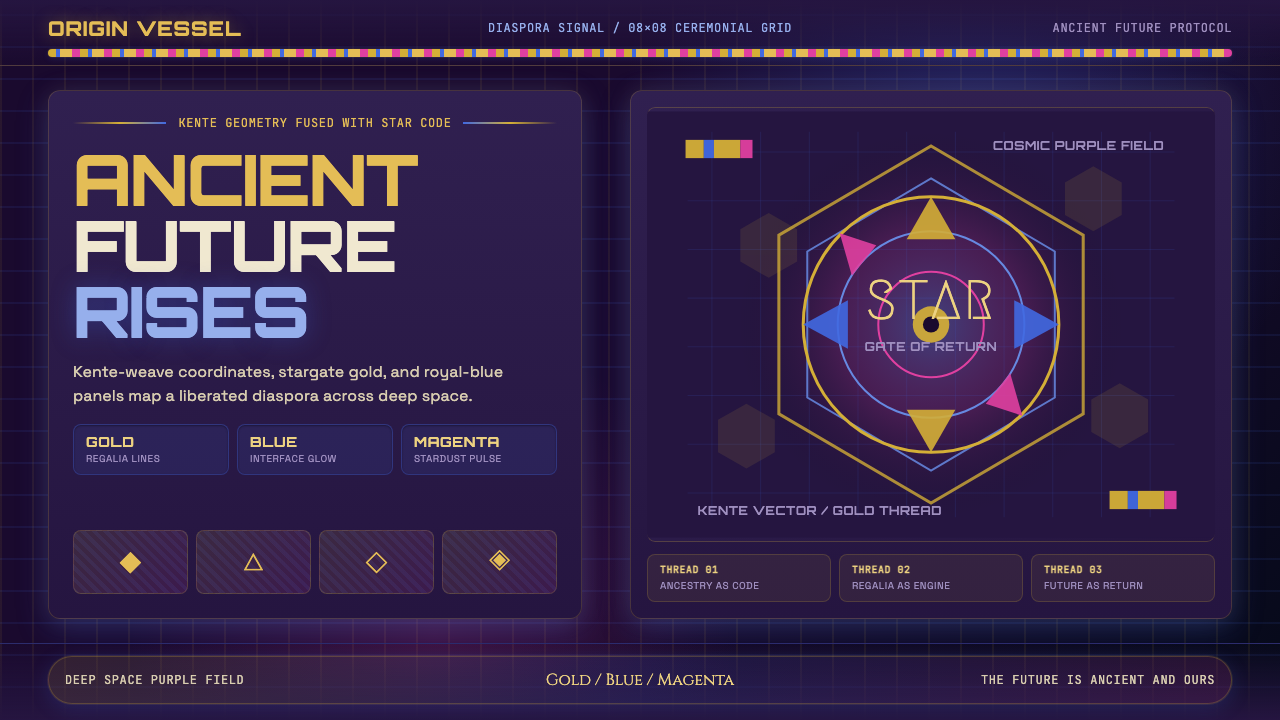 AfrofuturismAncient future, fully luminous. Gold kente grids cut through cosmic purple an…
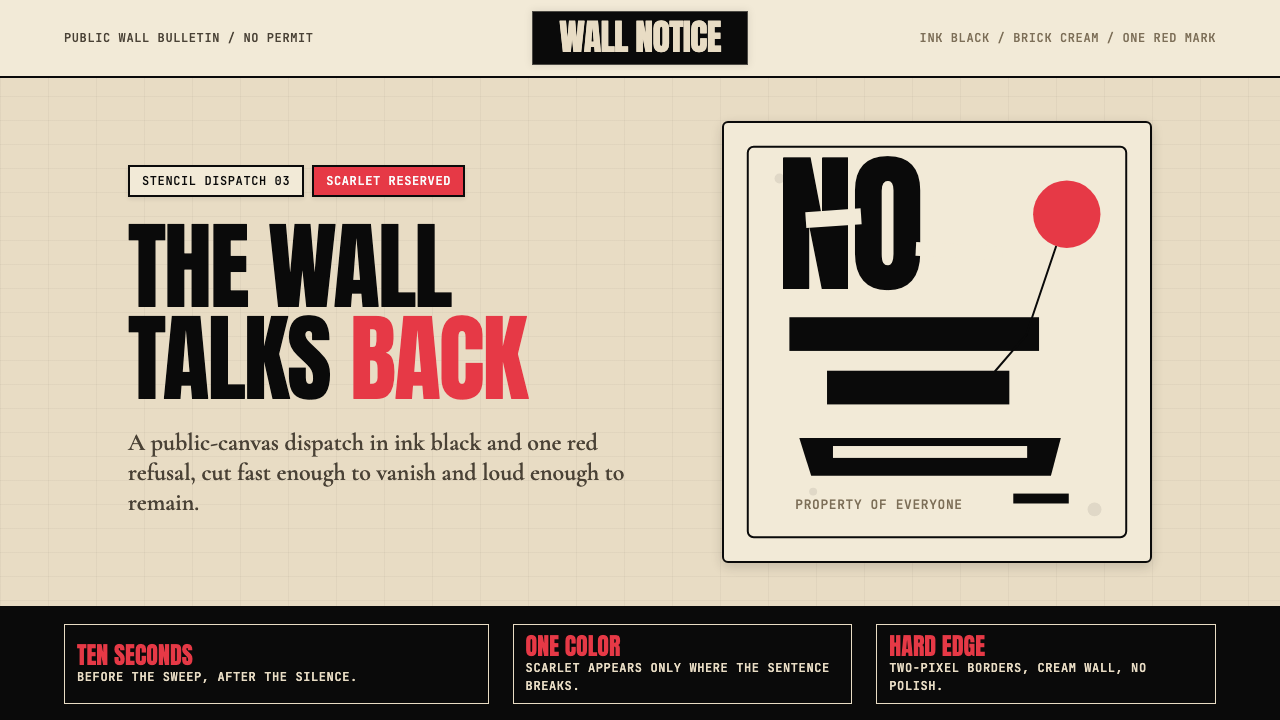 Banksy Stencil GraffitiProtest is reduced to a cut mark. Anton black on brick cream, one scarlet red…
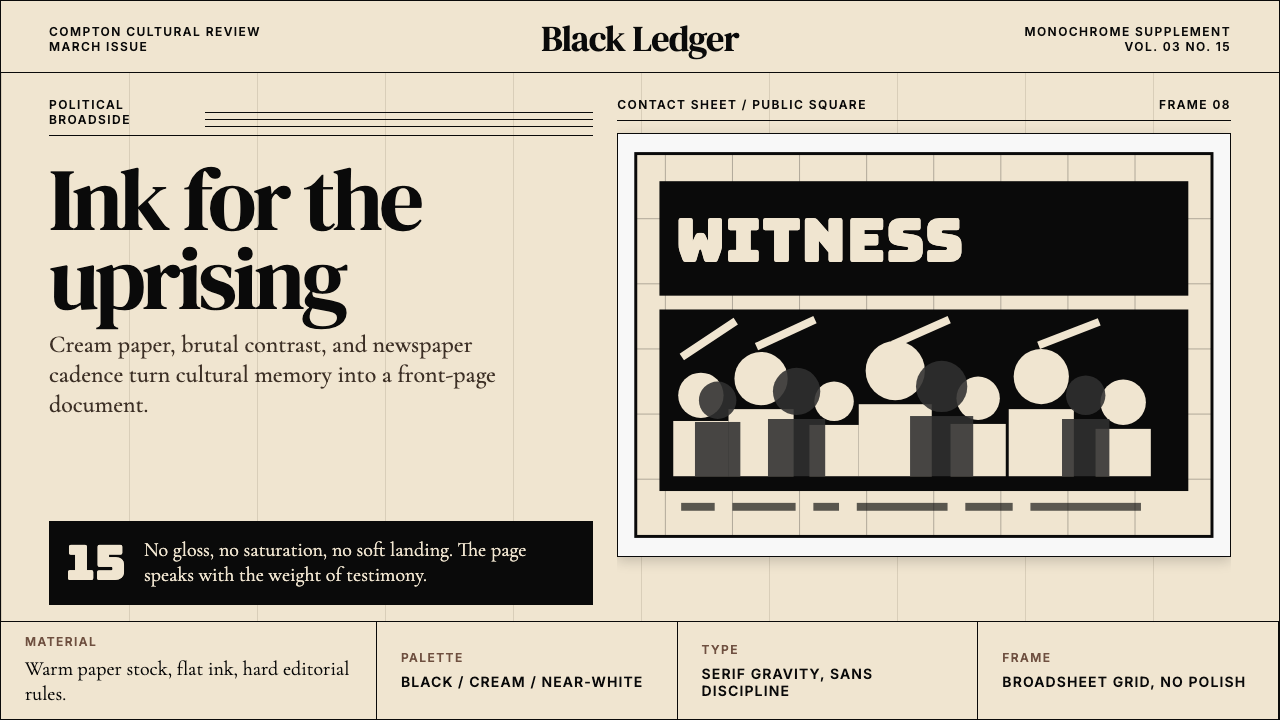 Kendrick — To Pimp a ButterflyPolitical weight, printed cold. Cream paper, hard serif type, monochrome crow…
 Money Heist (La Casa de Papel)Resistance becomes spectacle. Arterial red cuts through graphite grids and ta…
 No Man's SkyA paperback cosmos you can enter. Orange suns, magenta haze, and Jost type fl…
 Avatar — Pandora Bioluminescence (2009)The forest knows you are there. Cyan light blooms across a deep-teal living f…