What is Monster Energy Claw (2002)?
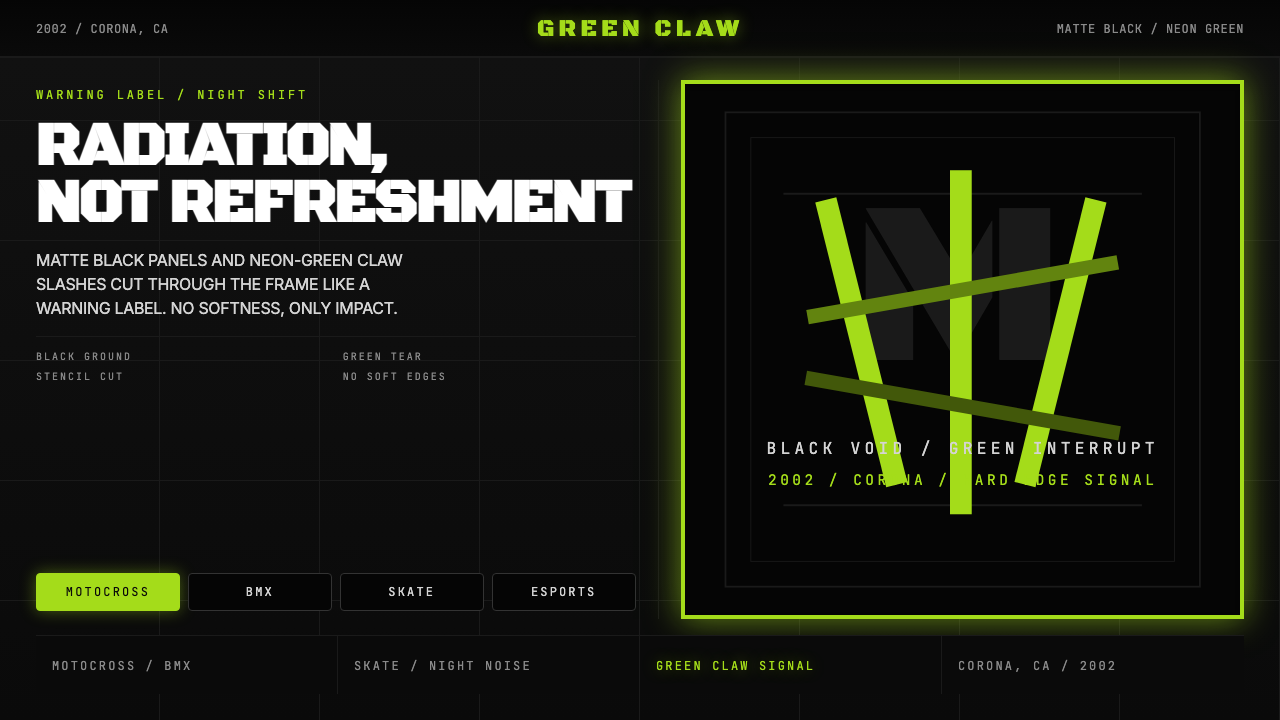
Three neon-green claw slashes tear through matte black — Monster Energy's 2002 visual identity turned a can of liquid into the universal badge of extreme-sport subculture.
Monster Energy Claw (2002) in brief
Monster Energy Claw is a brand visual identity system launched in 2002, built on a strict opposition between two visual extremes: an absolute matte black ground and a violent neon-green mark. The mark itself — three diagonal slashes forming a rough, angular "M" — reads simultaneously as a claw wound and as a letterform, blurring the boundary between symbol and logotype in a way few consumer-goods identities have achieved.
The design language is built entirely on aggression. There are no soft curves, no warm tones, no gradual transitions. Typography is compressed, fully uppercase, and cut in the manner of a military stencil. Every decision in the system communicates the same message: power, danger, speed. The green is not chosen for its associations with nature or freshness — in this context it functions as a radioactive warning signal, the color of something that should not be touched but cannot be ignored.
What makes the system unusually durable is its rigidity. Over more than two decades, the core mark — black ground, three green scratches — has remained essentially unchanged while being applied across aluminum cans, motorsport liveries, esports backdrops, apparel, and digital surfaces. It is a rare example of a consumer brand identity that achieved total subcultural saturation without ever softening its original visual proposition.

Where does Monster Energy Claw (2002) come from?
Monster Energy was created in 2002 by Hansen Natural Corporation, a beverage company based in Corona, California that had previously focused on natural sodas and juice drinks. Co-founders Rodney Sacks and Hilton Schlosberg recognized an opportunity to compete with Red Bull, which had entered the American market in 1997 and was rapidly expanding. Rather than fight Red Bull on its own terms — the slender silver can, the European premium positioning, the calm blue-and-silver palette — they made the opposite choice in every dimension. Where Red Bull was refined, Monster would be raw.
The visual identity was developed by Hansen Natural's in-house design team with a brief that was essentially a list of subcultures to target: motocross, BMX, skateboarding, NASCAR, and the emerging world of competitive gaming. These communities shared an aesthetic language that corporate brand design had largely ignored — the visual vocabulary of tattooing, metal album art, and extreme-sport gear graphics, all characterized by high contrast, aggressive letterforms, and marks that looked hand-torn rather than computer-drawn. The three-claw mark directly references this tradition. It reads as something that has physically damaged its surface.
The choice of black as the dominant ground was deliberate and counterintuitive for a beverage category that had, at the time, been dominated by clear, white, and metallic packaging. Black said premium in certain contexts — luxury goods, audio equipment — but in this case it was chosen not for luxury connotations but for danger ones. Black is the color of asphalt, of night racing, of conditions where visibility is low and the stakes are high. Against that ground, the neon green functions as a warning or a wound rather than a brand color.
The can itself became the primary communication medium. Unlike brands that treat packaging as one element among many in a broader identity system, Monster Energy concentrated virtually all visual investment in a single surface. The can was designed to be readable across a crowded refrigerator shelf, on a racetrack pit wall, on a streaming thumbnail. Its two-color high-contrast system meant it could be reproduced as a sticker, a decal, a tattoo, or an embroidered patch without losing legibility. This medium-agnostic legibility was not a deliberate design philosophy so much as a consequence of extreme restraint — the fewer the elements, the more durable the mark.
What defines the Monster Energy Claw (2002) look?
Color Opposition
The entire palette is built on a single opposition: a matte, light-absorbing black ground against a single acid-green accent that reads as electric, almost bioluminescent. There are no mid-tones, no tertiary colors, no gradual transitions between the two. The black is not merely dark — it is chosen specifically for its deadness, its absence of reflectivity. The green is not merely bright — it is chosen for its clinical, high-voltage quality, closer to the glow of a cathode-ray tube or a radiation warning than to any natural reference. This two-color discipline is the system's greatest structural strength: it cannot be misread, reproduced incorrectly, or diluted by context.
The Claw Mark
The three diagonal slashes that form the central mark are neither perfectly geometric nor freely hand-drawn — they occupy a deliberate middle ground that suggests both speed and violence. Each slash is slightly irregular, tapering at one end, suggesting motion and physical force. Read together, they form a compressed letterform legible as an "M," but the mark functions even when the letterform reading is not consciously made. It operates on two levels simultaneously: brand identifier and damage record. The mark implies that the surface has been attacked, which is an unusual and effective proposition for something sold in convenience stores.
Typography
The wordmark and supporting type are set in heavily compressed, fully uppercase letterforms with the texture of a stencil or a stamp — as if the letters have been cut from a rigid template and applied with force rather than typeset with care. Character spacing is tight, almost no air between letters. This compression creates visual weight and density that reads as urgency. There is no secondary typeface, no script accent, no humanist softening. The type system is entirely about pressure — it looks like something that has been forced onto a surface.
Zero Softness
Every edge in the system is hard. There are no rounded corners on the can geometry, no feathered edges on the claw marks, no ambient glow around the green against the black. Shadows, where they appear in branded contexts, are sharp and directional rather than diffuse. This absolute commitment to hard edges is what gives the identity its confrontational quality. Soft edges communicate friendliness, approachability, safety. Hard edges communicate none of those things — they communicate impact, cut, and the kind of energy that does not ask permission.
Subcultural Legibility
The visual system speaks a language already fluent within its target communities before it was applied to a drink can. The high-contrast mark, the stencil typography, the black-ground presentation, and the claw-wound imagery all have prior references in tattoo flash art, underground music graphics, and action-sport equipment design. This means the identity did not need to explain itself — it arrived already legible as belonging to a specific value system: raw, uncompromising, anti-establishment in affect if not in fact. This native legibility within subculture, combined with total visual consistency, is what enabled subcultural adoption at a scale rarely achieved by corporate brand design.
Medium Independence
Because the system uses only two colors and relies entirely on hard-edged marks, it reproduces accurately across an exceptional range of surfaces and processes: embossed aluminum, printed vinyl, screen-printed fabric, embroidered patches, digital displays, broadcast overlays, and large-format outdoor printing. The mark loses nothing when scaled from a thumbnail to a racecar hood. This medium independence was not engineered for scalability in the contemporary sense — it emerged as a byproduct of extreme formal restraint — but it has proven one of the system's most commercially valuable properties.
Consistency as Identity
For over two decades, the core visual proposition has not changed. While most consumer brands regularly update their visual identity to track cultural trends, Monster Energy has treated its 2002 mark as definitional rather than as a starting point. The consistency itself has become part of the brand's meaning: the mark communicates that it does not change, does not soften, does not negotiate. In a media environment saturated with visual refresh cycles, unchanging marks accrue a kind of institutional gravity. The Monster claw does not look dated — it looks permanent.

Who shaped Monster Energy Claw (2002)?
As co-founder and CEO of Hansen Natural (later Monster Beverage Corporation), Sacks made the strategic decision that Monster would not compete with Red Bull on shared ground. The choice to build the brand around extreme-sport sponsorship rather than lifestyle aspiration advertising shaped every downstream visual decision. Sacks maintained the visual system's rigidity through more than two decades of brand extension, licensing, and media evolution — a commitment to non-dilution that is unusual in consumer packaged goods at Monster's scale.
Schlosberg, co-founder and President, was central to the commercial negotiations that made Monster's sponsorship model viable at scale — the partnerships with motorsport teams, BMX athletes, skateboarders, and esports organizations that deployed the visual identity across a vast array of surfaces and media. The breadth of these sponsorships stress-tested the visual system constantly and confirmed that its medium independence was a genuine operational advantage rather than an aesthetic accident.
The uncredited design team that originated the Monster Energy visual identity in 2002 made decisions whose longevity they could not have anticipated. Their choice to reference subcultural visual languages — specifically the tattooing, heavy-metal, and extreme-sport graphic traditions — rather than conventional beverage design conventions produced a mark with genuine insider credibility. The restraint of the two-color system, which may have been as much a production constraint as an aesthetic choice, proved to be the identity's greatest structural advantage.
Though many athletes carried the Monster mark, Pastrana — motocross and rally driver, action-sports polymath — represents the archetype of talent the brand built its visual identity to serve. His presence across motocross, rally, and Nitro Circus events put the black-and-green mark in front of the exact audiences the identity was designed to speak to, and his crossover appeal demonstrated that the visual system could migrate from niche subculture to mainstream visibility without losing its core credibility.
Monster Energy's expansion into esports sponsorship beginning in the early 2010s represented the most significant test of the visual identity's transferability. Broadcast overlays, team jerseys, stage backdrops, and digital thumbnails required the mark to function at resolutions and in contexts its 2002 designers could not have anticipated. The fact that the two-color system performed correctly across all of these contexts — and that gaming communities received it with the same subcultural affinity as action-sport communities — confirmed that the visual language had genuine cross-subculture resonance, not merely extreme-sport specificity.
How do you use Monster Energy Claw (2002) today?
Monster Energy Claw is one of the more demanding historical styles to apply in presentation or digital work because its power comes from discipline and commitment — half-measures produce neither the brand's aggression nor a legible alternative aesthetic. Applying this style correctly requires a genuine willingness to work in near-total darkness: black or very deep charcoal backgrounds, a single neon or acid accent color, and no softening elements whatsoever. If this feels too extreme for the context, the style is probably not the right choice.
For presentation slides, the Monster Claw approach works best for covers and section dividers where visual impact is the primary goal, rather than for information-dense content slides where legibility and data hierarchy compete with aesthetic intensity. A cover built in this style uses the full black ground, places the most important text in a compressed bold typeface at large scale, and uses the accent color only for a mark, a line, or a single emphasized word — never as a background fill for a content area. Data slides are possible in this system but require care: charts and graphs should be rendered as clean geometric shapes in the accent color against the dark ground, with white or near-white used for labels and values. Decorative complexity of any kind destroys the system's impact.
For web interfaces, this aesthetic is well-matched to dark-mode dashboards, gaming platforms, esports product pages, and any digital product where performance, intensity, and technical credibility are the primary brand values. The pattern: a near-black background, a single accent color used exclusively for interactive states and primary actions, and monochrome white or light gray for all secondary text and structural elements. Card components should have hard borders or hard-shadow offsets — no soft glow, no blur, no glass-morphism effects. Navigation and UI chrome should be typographic, using compressed uppercase labels. The system breaks down immediately if gradients, multiple accent colors, or decorative imagery are introduced.
For editorial and marketing applications, this style produces work with strong poster-like impact in contexts where the audience skews toward gaming, action sports, or youth entertainment. Full-bleed layouts with black grounds, accent-color headline type, and white body text create immediate high contrast. Section breaks should be marked with a horizontal rule or a geometric accent mark rather than whitespace alone. Where photography is used, it should be treated to increase contrast and reduce mid-tones — the goal is to integrate human subjects into the visual system's intensity rather than creating a naturalistic window that contradicts the graphic language.
A common mistake when applying this style is using the accent green (or whichever neon is chosen) at large area. In the Monster system, the accent color is a wound, not a ground — it appears on the mark, on a word, on a border. As soon as the neon becomes a background for a content block or a large decorative element, it loses its violence and becomes merely a color. A second common error is introducing warm mid-tones or gray backgrounds to make the system more readable: this instantly dissolves the confrontational quality that gives the style its character. If content complexity requires more visual breathing room, the correct solution is to increase whitespace or divide content across more screens, not to soften the color system.

Monster Energy Claw (2002) — FAQ
Is this style only for gaming and extreme sports, or can it be applied more broadly?
The style is genuinely specialized. Its visual language encodes specific cultural values — aggression, raw physicality, anti-establishment affect — that are well-aligned with gaming, action sports, motorsport, security software, and certain categories of performance tools. Applied outside these contexts, it tends to create a tone mismatch that is difficult to resolve: a financial services dashboard styled this way reads as reckless rather than powerful, a wellness app reads as threatening rather than energizing. The style can be used for contrast or provocation in editorial contexts, but as a primary UI language for consumer-facing products it has a narrow band of appropriate applications.
The palette is so restrictive — how do you handle a slide deck that needs multiple data series or information types?
This is the central tension in applying a two-color system to data-rich contexts. The solution is a tonal hierarchy rather than a color expansion: use the full-saturation accent color for the most important data series or call-out, reduce saturation significantly for secondary series (moving the accent toward a more muted, darker version of itself), and use white or light gray for tertiary labels and reference lines. The background's darkness gives you a natural depth dimension — brighter elements read as foreground, darker elements as background. Introducing additional hues to resolve data complexity is technically possible but breaks the identity logic entirely. If the data genuinely requires more than three tonal levels, consider whether this visual system is appropriate for the content.
How is Monster Energy Claw different from a generic "dark mode" or "cyberpunk" aesthetic?
The most important difference is restraint. Generic dark-mode design tends to use multiple accent colors, complex gradients, and glowing effects to generate visual richness. Cyberpunk aesthetics typically add chromatic aberration, scanlines, noise textures, and layered neon hues. Monster Energy Claw uses none of these: it is two colors, hard edges, compressed type, and nothing else. The result is more brutal and less decorative than either reference. When designers apply Monster-style thinking and then add purple glow effects, lens flares, or gradient neon, they are blending the Monster system with cyberpunk conventions and losing the disciplinary clarity that makes the original effective.
Can this style work in print, and are there print-specific considerations?
The style is extremely well-suited to print because it was born in print — the can is a printed surface. High-contrast black grounds with a single fluorescent or neon accent color are a standard technique in screen printing and commercial offset printing. The accent green in the original is formulated as a fluorescent ink in many applications, which cannot be reproduced accurately in standard four-color process printing — a digital equivalent typically needs to be chosen for web contexts. For large-format printing such as event banners and signage, the high-contrast system performs at scale without degradation. The compressed type requires careful attention to minimum size — at very small scales, the tight character spacing and compressed letterforms can begin to close up.
Is it possible to use this style without making everything feel threatening or aggressive?
Only partially. The style's aggression is not incidental — it is structural. The choices that generate visual impact (black ground, no softening, compressed type, fluorescent accent) are the same choices that generate the threatening quality. You can reduce the aggression at the margins by increasing white or light content on the page, choosing a slightly warmer or more saturated green that reads as less radioactive, or giving the type slightly more tracking. But each of these adjustments moves you away from the source system. The more you soften, the more generic the result becomes, and at some point it stops being a version of Monster Energy Claw and becomes a dark-themed design that borrows some of its surface qualities. If a gentler version of this energy is what the project needs, it is worth asking whether a different style — one whose structural values are closer to the project's requirements — would produce better results.
Related design styles
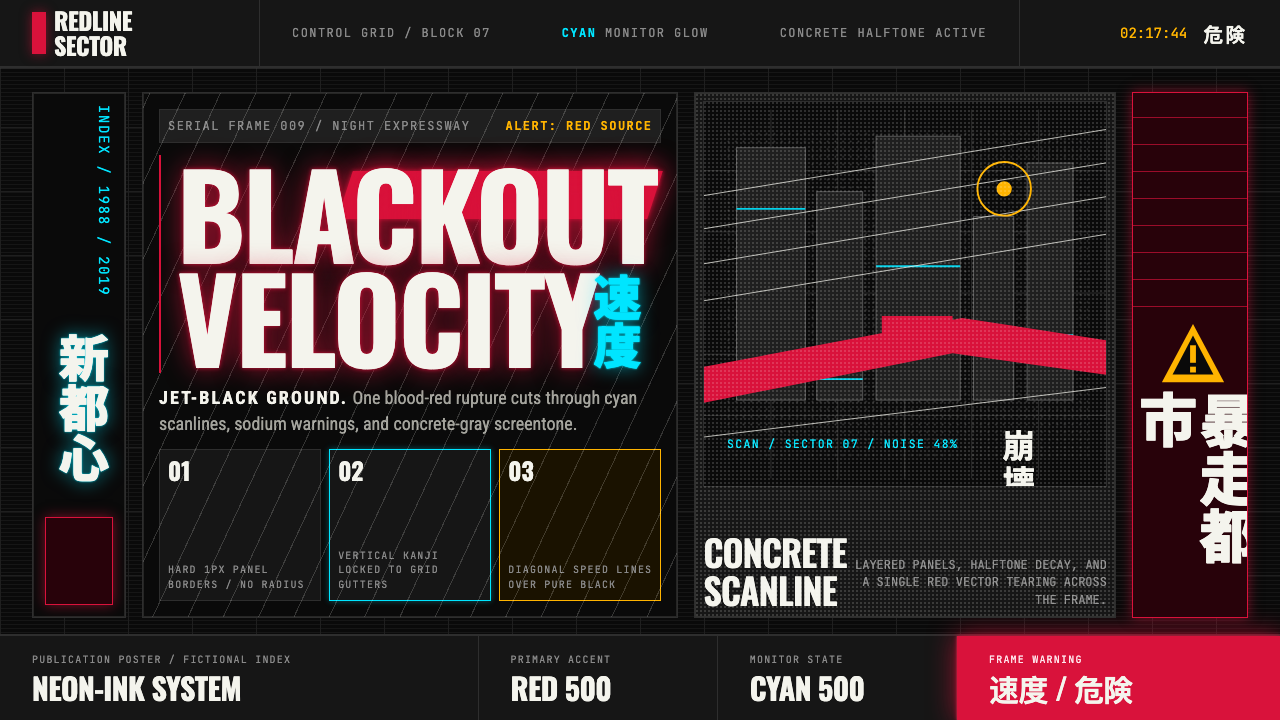 Akira (Otomo)Cyberpunk at impact. Kaneda red, cyan kanji, halftone concrete, and diagonal…
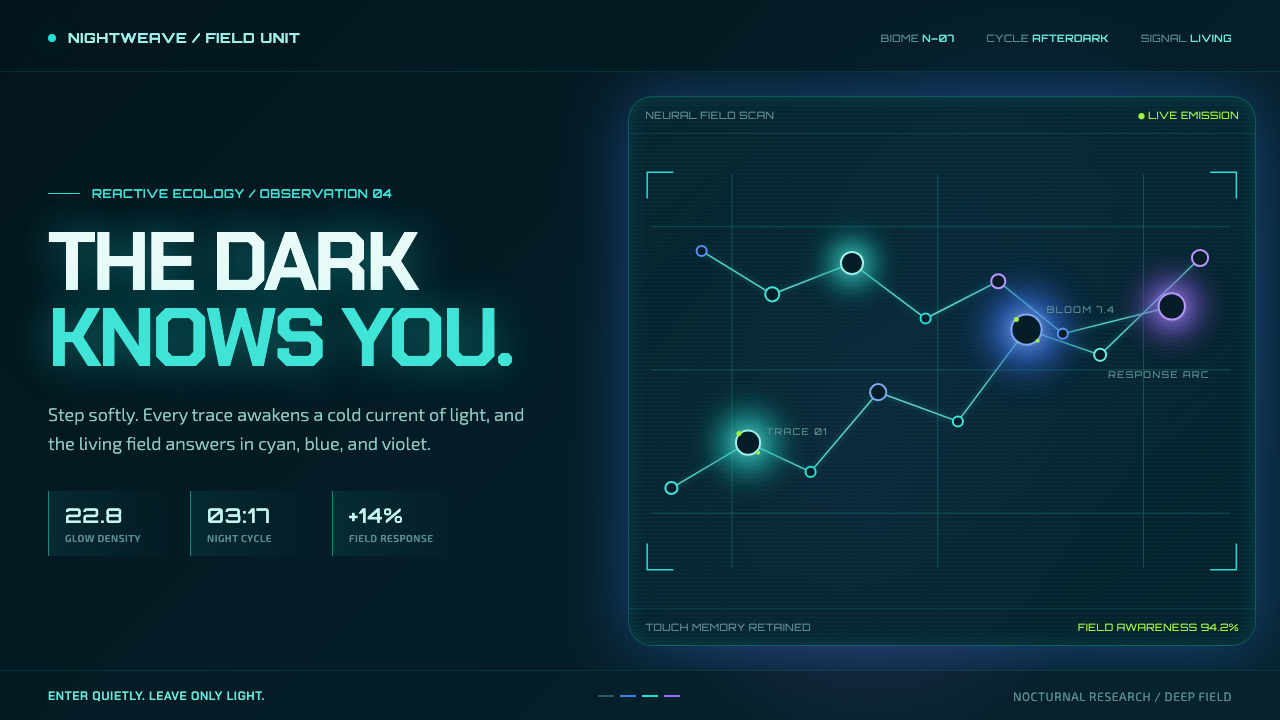 Avatar — Pandora Bioluminescence (2009)The forest knows you are there. Cyan light blooms across a deep-teal living f…
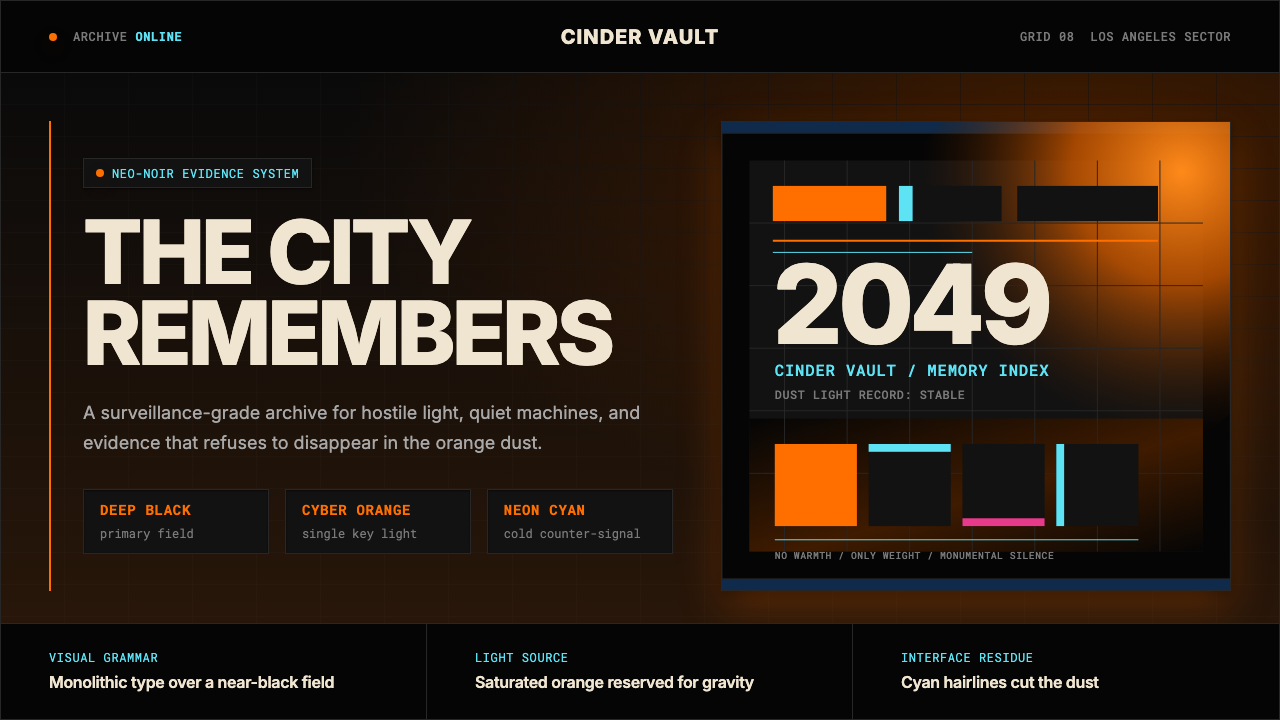 Blade Runner 2049Noir with tectonic weight. Orange dust, cyan hairlines, and monumental Inter…
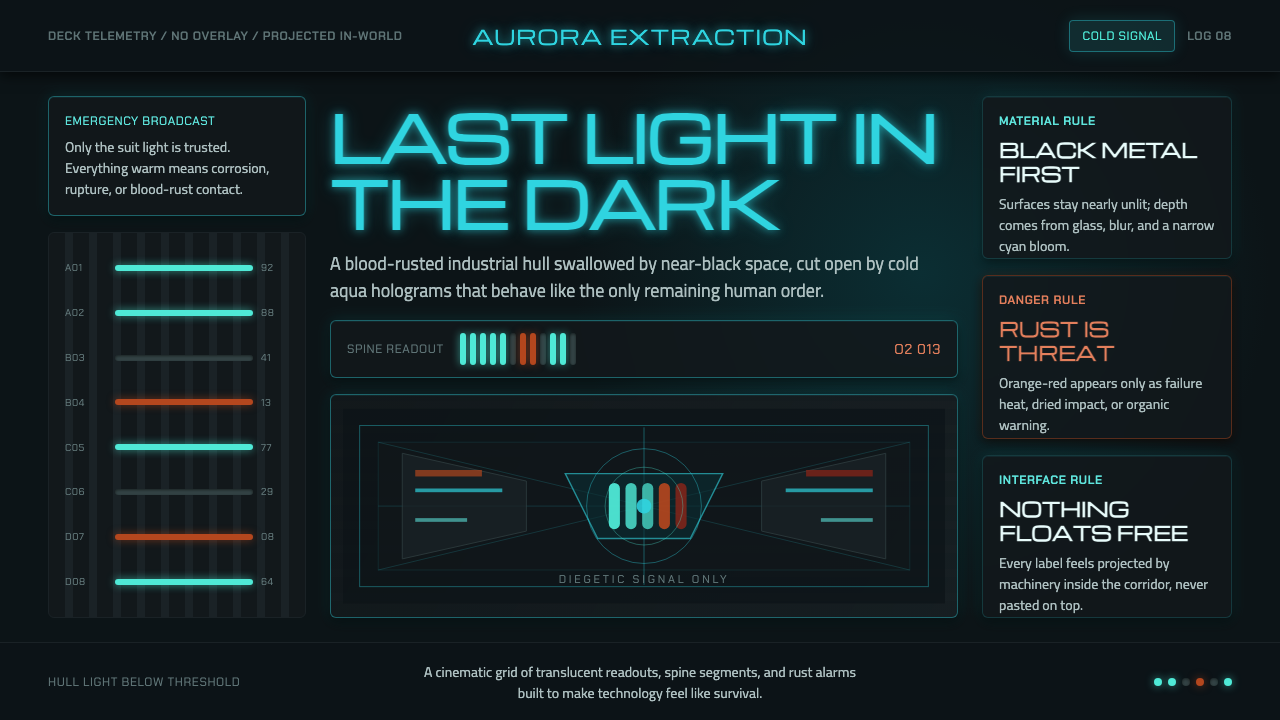 Dead Space IshimuraLast light in the dark. Near-black rust cut by aqua holographic panels.
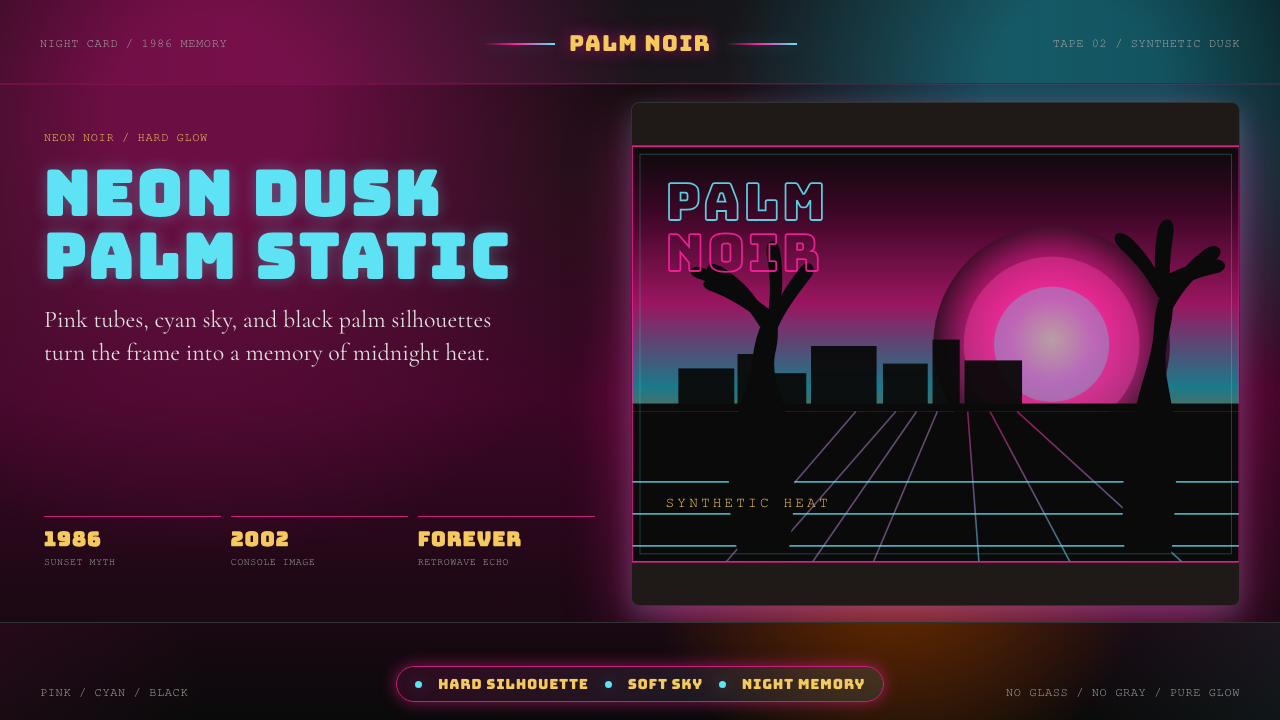 GTA Vice City (2002)Neon-noir nostalgia. Pink-cyan dusk, chunky type, and palm silhouettes.
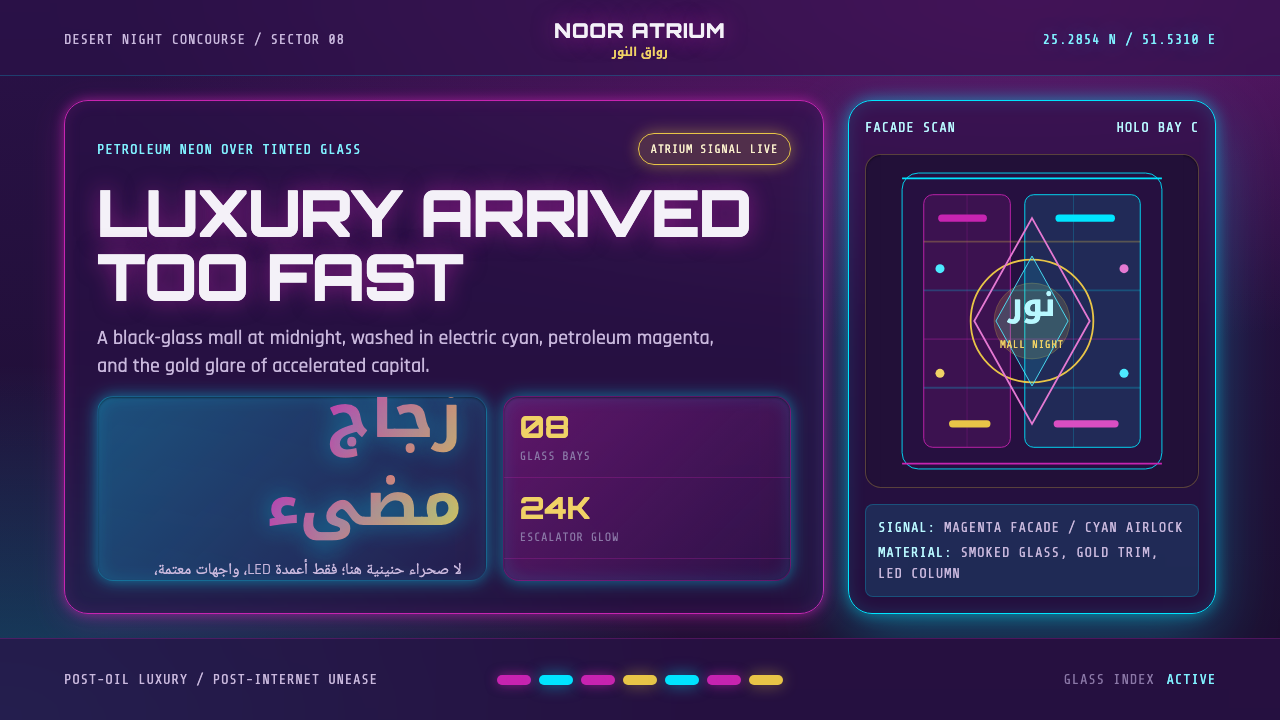 Gulf FuturismLuxury feels accelerated. Magenta-cyan neon cuts glass grids over purple-blac…