What is GTA Vice City (2002)?
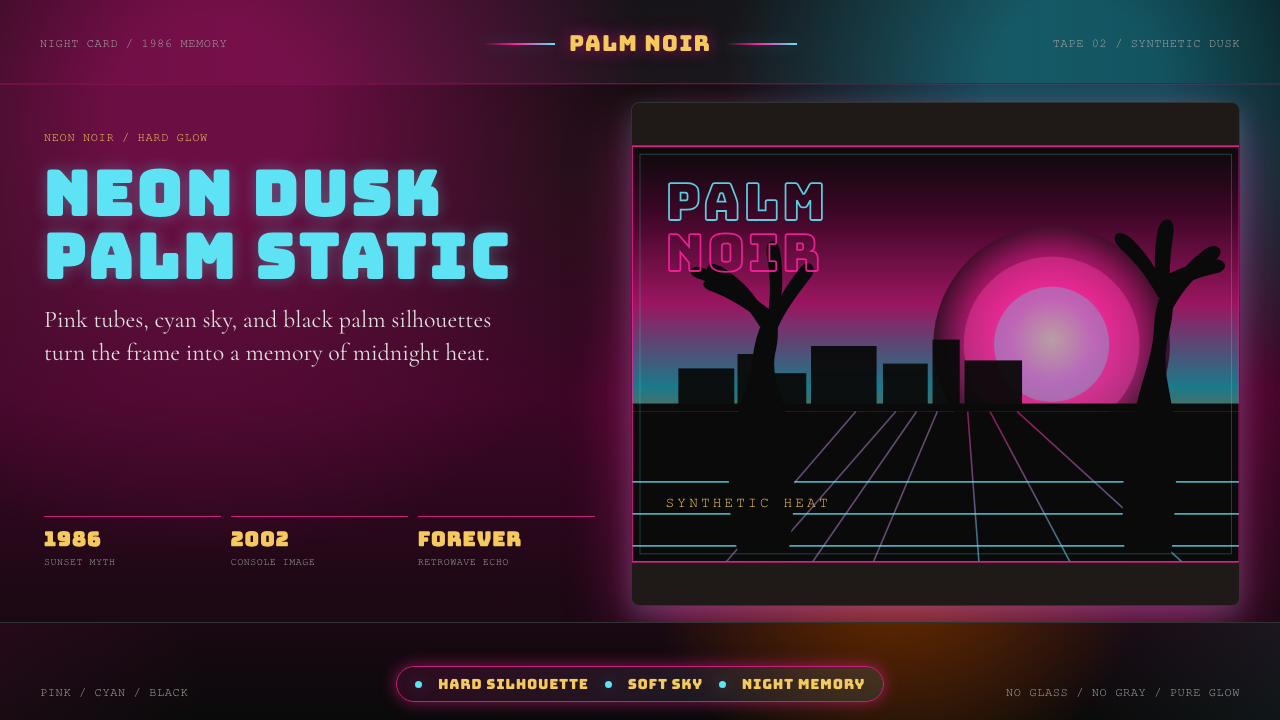
GTA Vice City defined a generation's vision of 1980s Miami — saturated neon-pink dusk, palm silhouettes, and chunky display type that made synthetic nostalgia feel like mythology.
GTA Vice City (2002) in brief
GTA Vice City is the visual grammar of 1980s-Miami-neon-noir as filtered through a 2002 video game — Rockstar North's title gave an entire generation its template for what 'the eighties' look like: magenta sunsets bleeding into electric cyan, neon-pink tubes glowing against deep-black skies, palm-tree silhouettes pressed flat against gradient dusk, and chunky display lettering that carries the swagger of a film title card.
The aesthetic is deliberate, populist, and unapologetically synthetic. It does not reconstruct the 1980s accurately; it reconstructs what the 1980s felt like when viewed through Miami Vice reruns, movie trailers, and a decade of pop-cultural nostalgia already in progress by 2002. Hot neon does the work that white space does in more restrained systems. Chunky type replaces delicacy. Sunset gradients and silhouettes carry the emotional weight that photography or illustration might carry elsewhere.
This visual language has since escaped its original medium entirely. Synthwave album covers, retrowave motion graphics, nostalgia-soaked branding campaigns, and a wave of indie games all draw from the same well that Vice City codified. The style represents one of the clearest cases of a video game aesthetic crossing into broader design culture, becoming a shared visual shorthand for a specific flavor of retro-futurist longing.

Where does GTA Vice City (2002) come from?
GTA Vice City was developed by Rockstar North in Edinburgh and published by Rockstar Games in New York, releasing in October 2002. The game was a direct sequel to Grand Theft Auto III (2001), but where that game's fictional Liberty City drew from a grimy, autumnal New York, Vice City moved south and backward in time — to a fictional Miami stand-in set in 1986. The shift was total: architecture, vehicles, music, and visual identity all changed. The art direction team, led by figures including Sam Houser, Dan Houser, and executive producer Leslie Benzies, built a visual world that treated the 1980s as a mythology rather than a period.
The primary reference points were televisual and cinematic. Miami Vice (the NBC series, 1984–1989) had already canonized a specific look: pastel suits, no socks, speedboats, and — most importantly — the use of twilight as a near-permanent atmospheric condition. The film Scarface (1983) contributed the excess, the operatic violence, and the palm-tree opulence. Countless music videos of the era supplied the neon signage, the club interiors, and the sense that night was the natural state of a certain kind of American city. Vice City synthesized all of this into a single consistent visual system.
The neon-noir aesthetic had deeper roots than its immediate pop-cultural references. The 1980s saw Miami undergo genuine architectural and cultural transformation — the Art Deco revival on South Beach, the arrival of international capital, and the very real visual spectacle of neon lighting in a hot, humid climate where night offered relief from the sun. What Vice City captured was not just the pop-culture image of Miami but also something about the actual sensory texture of that city in that era: warmth, danger, excess, and the specific beauty of artificial light against tropical darkness.
By 2002, nostalgia for the 1980s was already a mature cultural phenomenon. The decade had ended more than ten years earlier, enough time for its surface textures to become objects of affection rather than embarrassment. Vice City arrived at precisely the moment when the 1980s aesthetic was ready to be celebrated rather than merely tolerated, and the game's commercial success — it was one of the best-selling titles of its generation — amplified that aesthetic into mass consciousness. The synthwave and retrowave movements that would crystallize in the late 2000s and 2010s drew heavily from the visual vocabulary Vice City had made iconic, cementing the game's status as a foundational cultural document rather than merely an entertainment product.
What defines the GTA Vice City (2002) look?
Color
The palette is built on a core tension between hot and cool: deep magenta and neon pink on one side, electric cyan and aqua on the other, with both pressed against near-black backgrounds. These are not naturalistic colors — they are the colors of neon tube lighting as seen through the eye of a camera that has already been pushed for drama. Sunset gradients move from warm coral through magenta to violet and finally to the deep indigo of late night. Accent yellows and whites appear as highlights, simulating the bloom of a light source seen directly. The overall impression is of a world lit entirely from within.
Typography
Display type is the primary visual event. Characters are wide, heavy, and spaced with confidence — letterforms that occupy space rather than deferring to it. The genre draws from two sources: the italic slab-serif style of late-1970s and early-1980s logo design, and the brush-script tradition seen in beach-town signage and period advertising. Both share an emphasis on physical weight and visual swagger. Type is rarely set quietly; even secondary information is given generous size. Neon-lit or chromatic display treatments — type that appears to glow, to be outlined in light, or to cast its own color into the surrounding space — are characteristic.
Gradient and Atmosphere
Where Bauhaus forbids gradients on principle, Vice City is built on them. The gradient is not decoration here — it is the primary atmospheric mechanism. Skies move through color as they would at actual dusk: warm at the horizon, cooling and deepening as they rise. Gradients are also used on solid shapes, giving them a sense of being lit by a nearby neon source. The visual logic is cinematic rather than diagrammatic: every surface has a light direction, every scene has a color temperature, and the mood of the whole is established through the quality of that imagined light.
Silhouette and Layering
Palm trees, low-rise Miami architecture, sports cars, and human figures appear as flat black silhouettes pressed against glowing sunset backgrounds. This layering — dark foreground, luminous middle ground of gradient sky, neon accent in the foreground — is the compositional signature of the style. The silhouette technique simultaneously evokes cheaply printed 1980s graphics (where fine detail was lost in mass production), the visual grammar of backlit dusk photography, and the technical constraints of early-era video game rendering. All three references reinforce each other into something that feels both nostalgic and designed.
Surface and Texture
The style trades in surfaces that appear both slick and slightly degraded — chrome that reflects pink light, surfaces that carry a faint scan-line or grain as if viewed on a period television set, neon tubes that bloom and bleed slightly at their edges. This controlled degradation is part of what distinguishes Vice City aesthetics from clean contemporary retrowave: the original 2002 game was made for hardware that imposed visible constraints, and the aesthetic absorbed those constraints into its identity. Applied today, this texture is a deliberate choice rather than a technical limitation, but it still signals authenticity within the genre.
Iconography
A specific set of motifs recurs across all authentic expressions of this style: palm trees (always as silhouettes, never photographically rendered), the Ocean Drive low-rise hotel profile, sports cars of the mid-1980s era, speedboats, flamingos, neon signage in cursive script, and the general vocabulary of Miami's tourist-facing identity. These icons function as shorthand — each one activates a cluster of associations with the era and geography. Used together, they create a scene; used sparingly, each carries enough charge to establish context on its own.
Mood and Register
The emotional register of the Vice City aesthetic is one of confident excess — it is not ironic about its own loudness, nor is it earnestly sincere in the way of genuine 1980s commercial design. It occupies a third position: nostalgic affection for a version of the decade that probably never existed exactly as remembered, delivered with the knowing craft of a designer who can see the period from the outside. The result is warm rather than cold, playful rather than austere, and always slightly larger than life. It invites participation rather than demanding contemplation.

Who shaped GTA Vice City (2002)?
Co-founder and longtime president of Rockstar Games, Sam Houser was the primary creative force behind the GTA franchise's narrative and tonal ambition. His conviction that video games could carry the weight of serious cultural reference — film, music, visual art — drove the Vice City project's commitment to building a fully realized aesthetic world rather than simply a functional game environment. His leadership ensured that the art direction, soundtrack, and writing worked as a unified system, making Vice City a total aesthetic statement rather than a collection of individual design decisions.
Co-founder of Rockstar Games and the principal writer on Vice City, Dan Houser's scripts gave the aesthetic world a narrative architecture that amplified its visual commitments. His approach to writing the 1980s setting was to treat period references — the cocaine trade, the real-estate boom, the music industry — as both subject matter and tonal key. The game's sardonic but affectionate voice helped establish the register that later became the Vice City aesthetic's characteristic emotional note: knowing, excess-embracing, and fundamentally in love with its subject.
As executive producer across the GTA series through this period, Leslie Benzies was responsible for the production coherence that allowed Vice City's art direction to be realized at the fidelity it achieved. Translating an ambitious aesthetic vision into a functional, shippable product within the hardware constraints of 2002 required systematic production discipline. The visual constraints those hardware limits imposed — reduced polygon counts, specific texture resolutions — were absorbed into the style rather than fought against, and Benzies's production management created the conditions for that integration.
Director of Miami Vice (1984–1989) and the film Heat (1995), Michael Mann did not work on Vice City but his visual vocabulary is so completely embedded in the game's aesthetic that any honest account of the style's origins must include him. Mann's use of twilight as an emotional rather than merely atmospheric condition, his insistence on pastel and neon as a serious color system, and his framing of Miami's architecture as both glamorous and menacing established the visual grammar that Vice City directly inherited and amplified for interactive media.
Italian composer and producer Giorgio Moroder was a defining figure in the synthesizer-driven sound of the late 1970s and 1980s, contributing to soundtracks including Scarface and creating the sonic atmosphere that Vice City's radio stations evoked. While Moroder's contribution is primarily auditory, the relationship between this aesthetic and its music is inseparable — the Vice City visual system and the synthwave sound system co-evolved, each amplifying the other. Understanding the visual style in isolation from its sonic context is to understand only half of what makes it culturally powerful.
How do you use GTA Vice City (2002) today?
The Vice City aesthetic is one of the more demanding historical styles to apply correctly in contemporary design work, precisely because its excesses look right only when they are orchestrated rather than accumulated. Applying it correctly requires understanding what the visual system is actually doing: using color temperature and gradient to establish mood, using silhouette to create depth without naturalistic rendering, using chunky display type as a primary structural and emotional element, and using controlled surface degradation to signal authenticity within the genre.
For presentation slides, the style excels on cover pages and divider slides where maximum visual impact is appropriate. A cover built in this language uses a deep near-black background with a full-width sunset gradient at the bottom third — from warm coral through magenta to violet — overlaid with a flat palm-tree silhouette in the foreground and a title set in wide, heavy display type at the top. Content slides require more discipline: keep the background dark and near-solid, use the gradient vocabulary sparingly as accent rather than as the full page treatment, and allow type hierarchy to carry information load. Data slides work well when chart elements are treated as neon-lit objects: bars or segments in magenta and cyan against a dark field, with white labels and minimal grid lines.
For web interfaces, the Vice City aesthetic is best suited to hero sections, landing page covers, event promotions, and entertainment-adjacent product pages — contexts where atmosphere is a feature, not a distraction. Dashboards and dense information interfaces are poor fits; the style's visual intensity undermines scannability in data-heavy environments. When applied to a web hero section, the approach is: full-width dark background, a gradient band establishing the horizon, large typographic headline in a display weight, and one or two iconic silhouette elements. Interactive states can use neon-colored outline treatments — borders and underlines in electric pink or cyan — rather than conventional fill-based hover states.
For editorial and marketing work, the style carries the declarative confidence of a film poster. Magazine covers, music release graphics, event posters, and brand campaign hero images are natural applications. The aesthetic also transfers well to physical print, where the contrast between deep near-black backgrounds and saturated neon colors benefits from the richness of CMYK or spot-color printing. Marketing pages that need to communicate exclusivity or cultural cachet — a festival lineup, a gaming product launch, a nightlife brand — can use this language to establish an atmosphere that pure typography and corporate color systems cannot.
A common mistake when applying this style is treating the neon palette as permission to use every vivid color simultaneously at maximum saturation. Authentic Vice City-derived work typically leads with one or two dominant hues — magenta and deep black, or cyan and near-black — and introduces the complementary accent color sparingly. Overloading the palette produces confusion rather than energy. A second common error is using soft, feathered gradients where the style calls for gradient bands with legible direction and movement: the sky in this aesthetic has a clear horizon and a clear zenith, not an undifferentiated glow. Finally, applying this style to products that depend on clarity, trust, or professional sobriety — legal services, healthcare, financial tools — will undermine those values; the aesthetic communicates excess and pleasure, not reliability.

GTA Vice City (2002) — FAQ
Is Vice City aesthetic the same as synthwave or retrowave?
They are deeply related but not identical. Vice City (2002) is a specific, highly polished instantiation of a broader 1980s-Miami-neon-noir visual culture that predates the game — and the game's cultural impact is partly responsible for how synthwave and retrowave visually developed in the late 2000s and 2010s. Synthwave as a music genre has its own adjacent visual culture, but that culture draws from a wider set of 1980s references including science fiction, Japanese city pop, and European new wave. Vice City's aesthetic is specifically Miami-coded: palm trees and sports cars rather than neon-lit cityscapes or digital grids. The Vice City style also absorbed the specific technical constraints of early-2000s game rendering — silhouettes, limited polygon counts, specific texture qualities — that became part of its authentic signature.
Can this aesthetic work in a professional or corporate context?
In specific niches, yes — but it requires careful calibration. The Vice City aesthetic communicates confidence, cultural awareness, and a willingness to embrace pleasure and excess; these values align well with entertainment brands, gaming companies, nightlife and events, music and creative agencies, and consumer products targeting audiences who identify with the aesthetic's cultural references. It works poorly for industries where the primary communication goal is trust, stability, or professional sobriety: finance, healthcare, legal services, and B2B enterprise software. A middle ground exists for technology products that want to signal cultural relevance alongside capability — a well-crafted Vice City-inflected brand identity can do this if the product genuinely serves the audience the aesthetic addresses.
How do you prevent this style from looking like a costume rather than a design system?
The distinction between a well-applied Vice City aesthetic and a pastiche lies in whether the style's elements are doing structural work or simply providing surface decoration. When a sunset gradient establishes the mood of an entire composition and every other decision flows from that atmospheric anchor, the style is working. When the gradient is applied as a background behind otherwise conventional corporate layout, it is a costume. The same test applies to typography: display type that carries the primary communication load and earns its visual weight is part of the system; heavy display type used as decoration around small, functional body text is not. Committing fully — building the entire design around the visual logic of the style rather than adding Vice City elements to a generic layout — is the only reliable path to an outcome that feels designed rather than dressed.
Does the Vice City aesthetic work in light-background contexts?
The style is fundamentally dark-ground — near-black backgrounds are not a stylistic choice but a structural requirement, because the neon color palette depends on darkness the way neon tube lighting depends on night. Neon pink on a white or cream background is just vivid pink; neon pink against a near-black background is luminous. A light-background variant is technically possible, but it requires substituting the luminous quality with a different mechanism — usually shifting to saturated pastels and leaning more heavily on the flat silhouette and bold typography components of the style, while accepting that the atmospheric glow effect cannot be replicated. The result is recognizably Vice City-adjacent but is better understood as a day-mode or editorial variant than as the authentic expression of the style.
What makes Vice City aesthetics feel dated versus timeless within the retro genre?
The elements that date fastest are those most tied to specific production trends of the early 2000s or mid-2010s retrowave revival: particular lens-flare treatments, specific motion-graphic conventions, or typeface combinations that were novel at a particular moment and became overused. The elements that remain durable are those rooted in the actual 1980s source material: the color relationship between magenta and cyan against darkness, the palm silhouette as compositional device, and the swagger of heavy display type against a gradient sky. Work that draws from the original sources — Miami Vice, Scarface, period advertising and signage — tends to feel more durable than work that draws from the 2010s retrowave revival of those sources. Distance from the original reference produces a copy-of-a-copy quality that erodes quickly; proximity to the original produces something that can remain resonant because it is connected to a genuine cultural moment rather than a trend cycle.
Related design styles
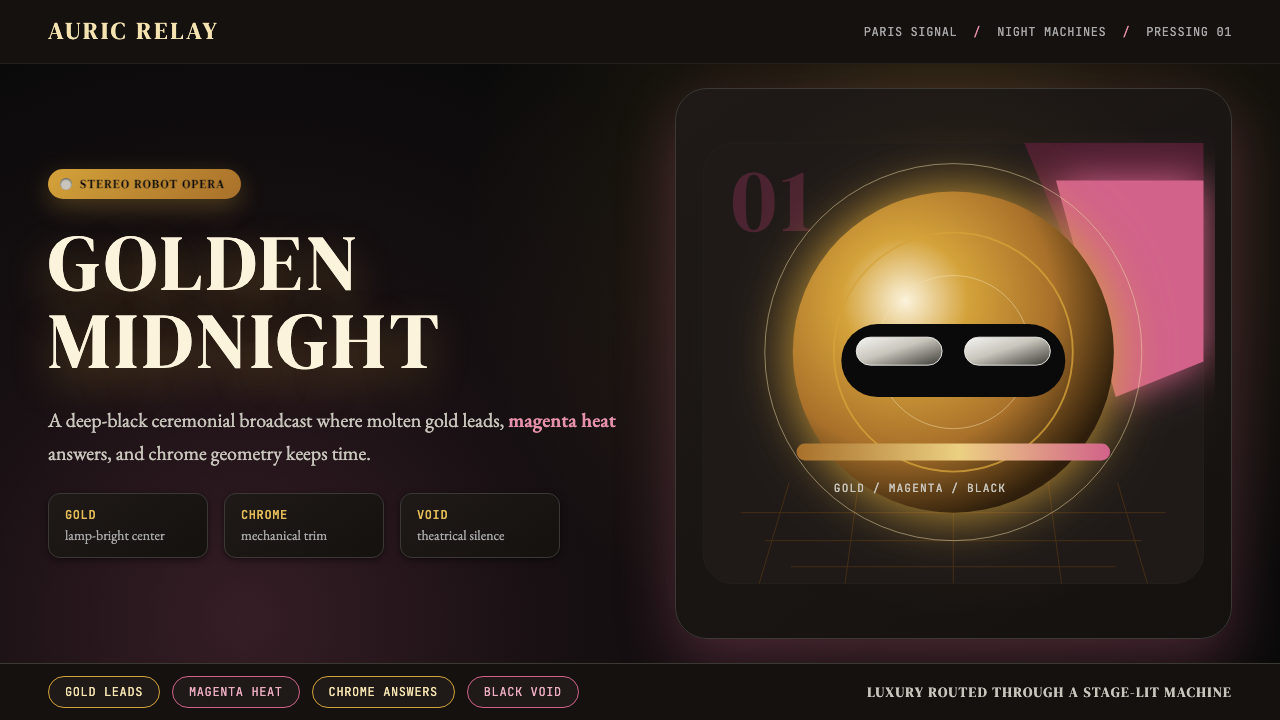 Daft Punk Discovery (Gold-Helmet)Warm sci-fi disco. Gold serif caps orbit a magenta void with chrome-disc geom…
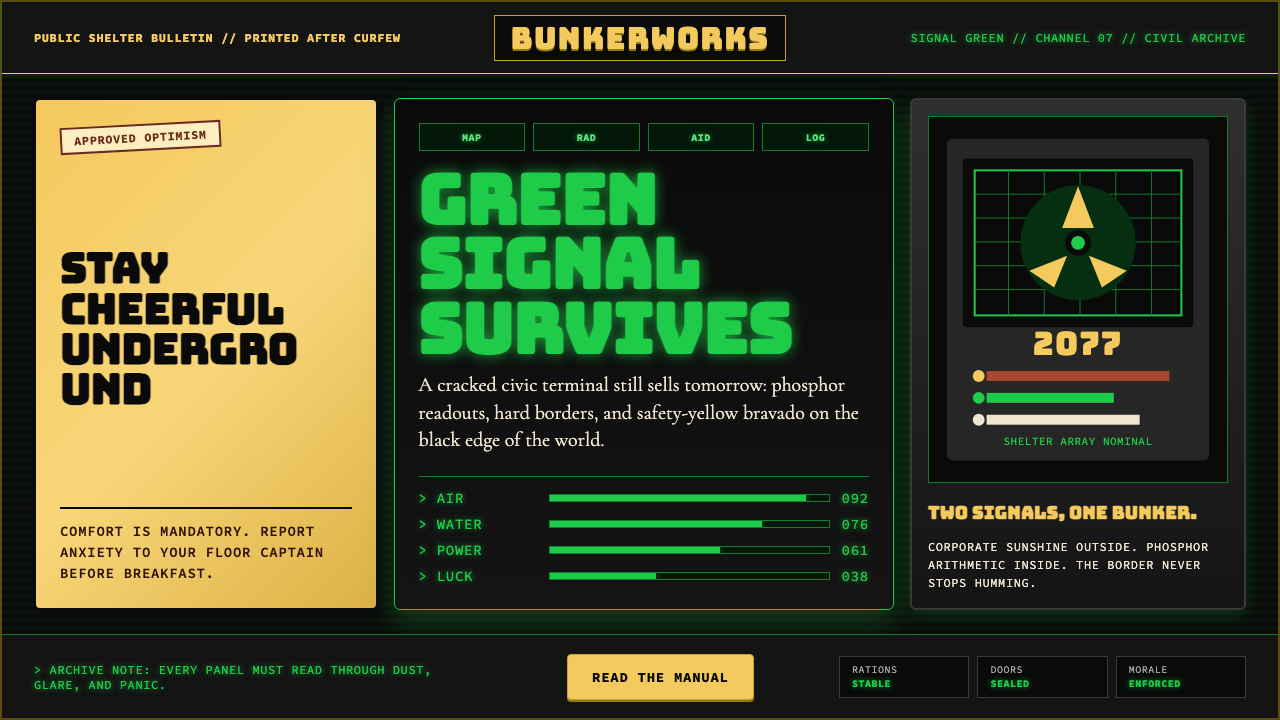 Fallout Vault-Tec Pip-BoyIrradiated optimism. Vault yellow and CRT green lock into a bordered bunker g…
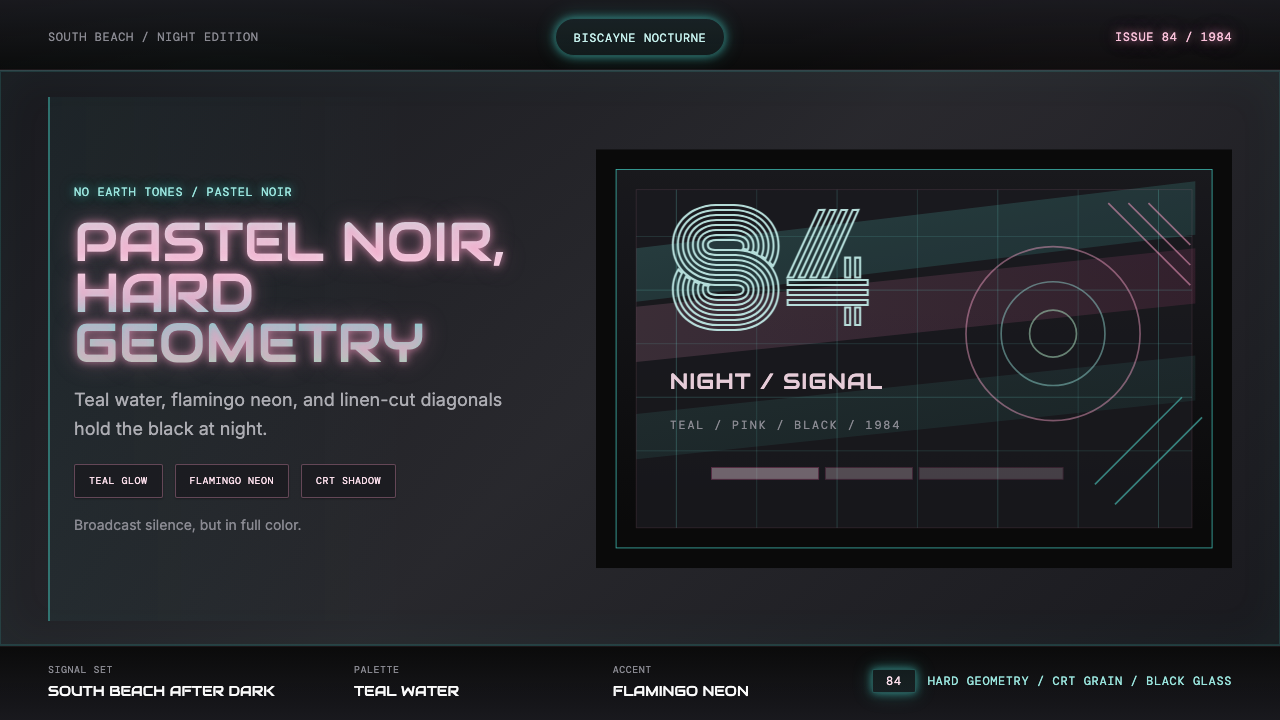 Miami Vice Pastel Teal (1984)Pastel noir, not nostalgia. Teal glow and flamingo pink slice black with geom…
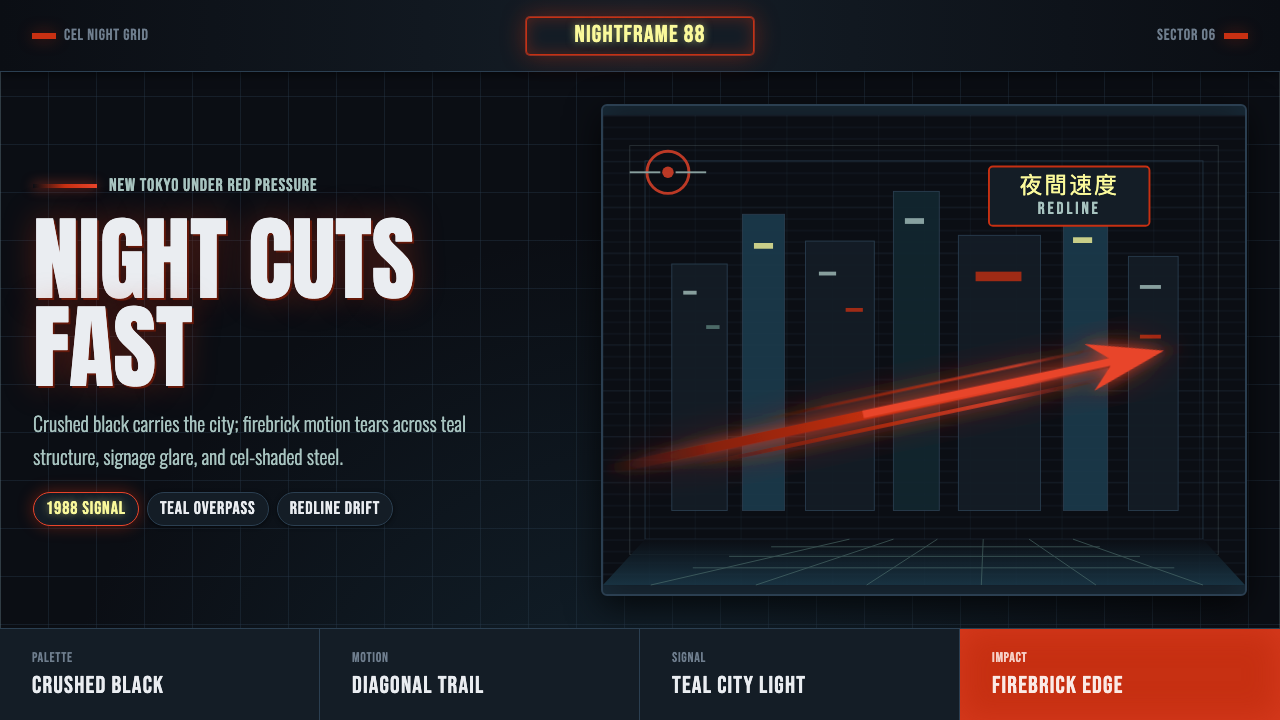 Akira Neo-TokyoNight moves fast. Firebrick trails cut crushed black, teal grids, and condens…
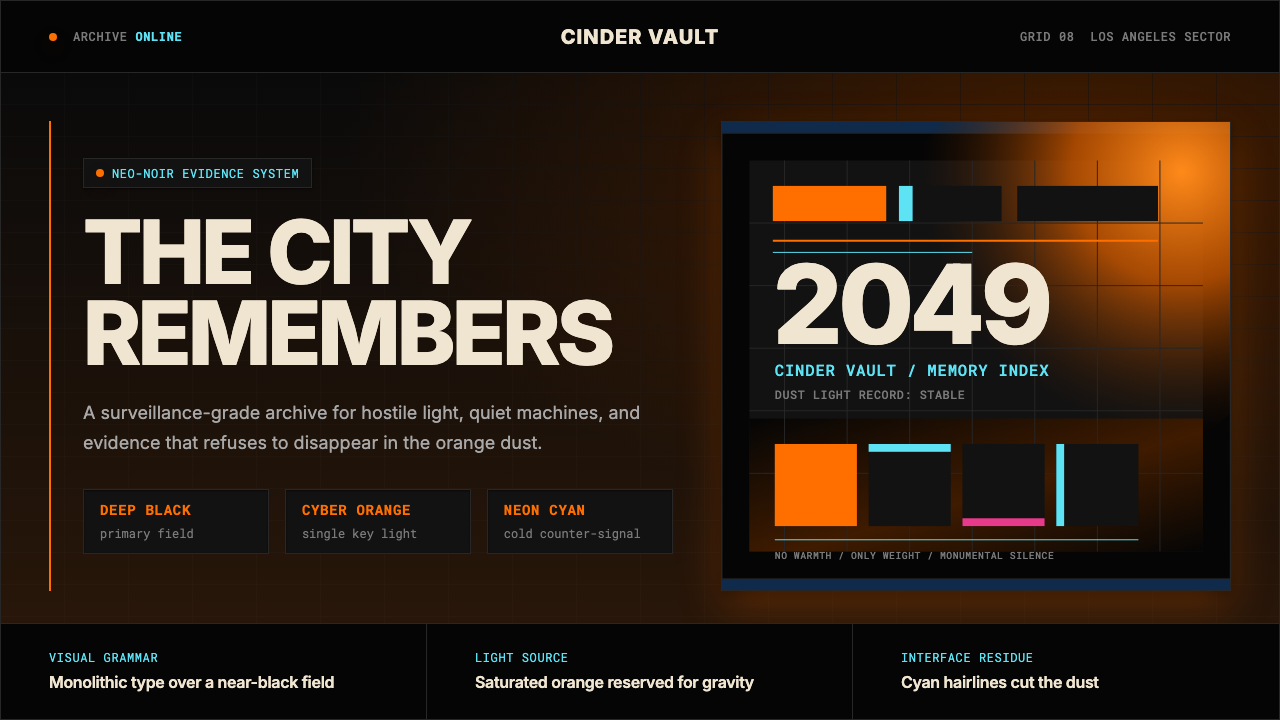 Blade Runner 2049Noir with tectonic weight. Orange dust, cyan hairlines, and monumental Inter…
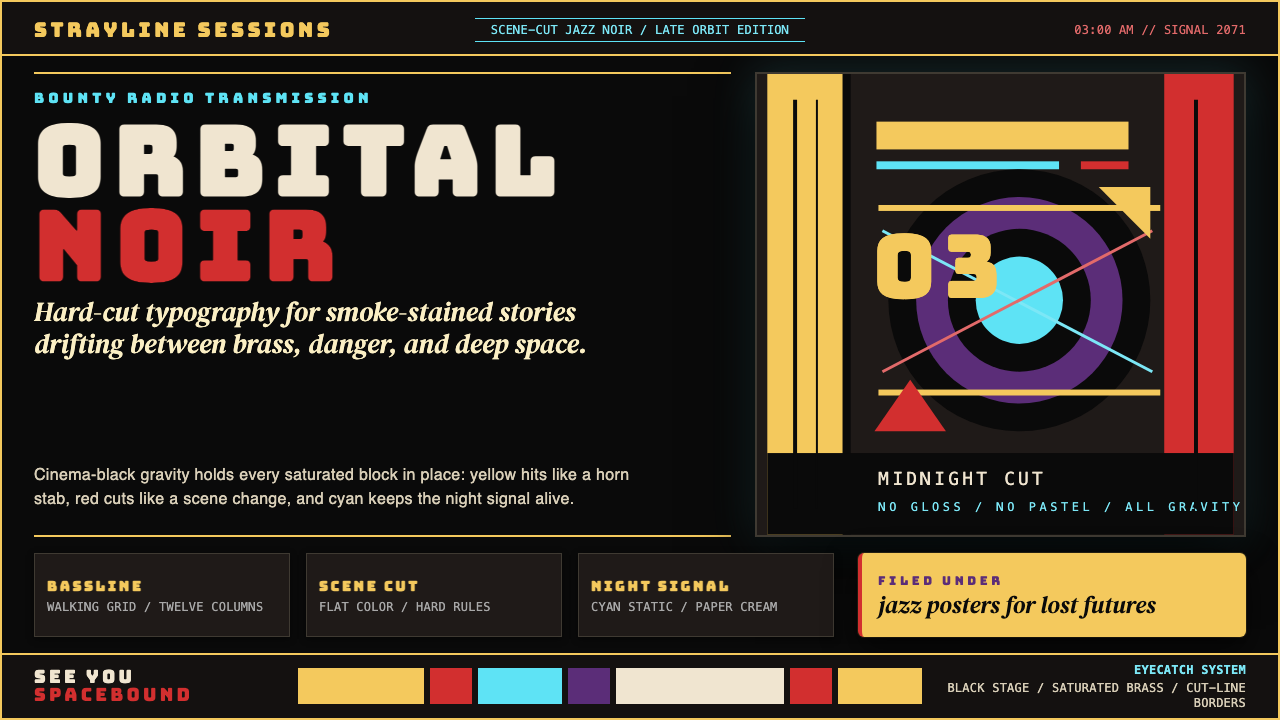 Cowboy Bebop Jazz-NoirCool at 3 AM. Bungee type, jazz yellow, red cuts, and cyan rules hit deep bla…