What is Fallout Vault-Tec Pip-Boy?
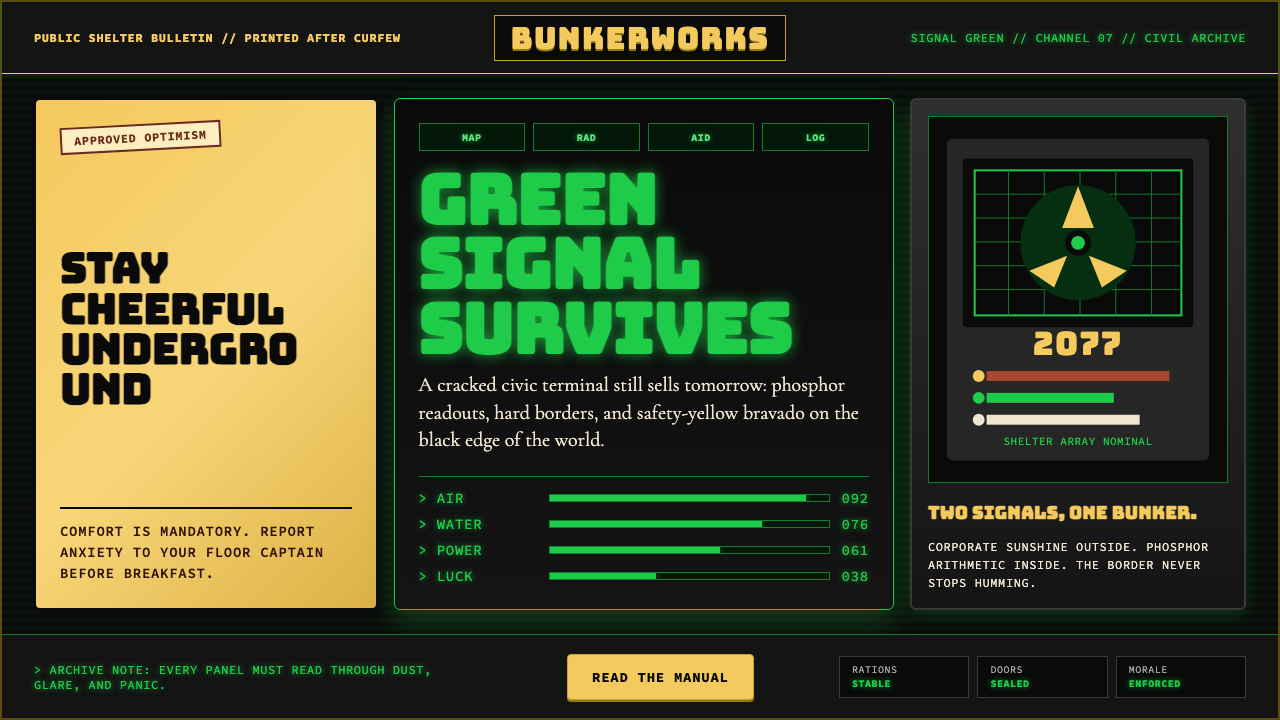
Vault-Tec's Pip-Boy aesthetic is nuclear-age optimism frozen in amber — a 1950s corporate America that never faced the bomb, rendered in phosphor green and propaganda yellow.
Fallout Vault-Tec Pip-Boy in brief
The Fallout Vault-Tec Pip-Boy aesthetic is a post-apocalyptic visual system built from two emotional registers held in deliberate tension: the bright, chirpy confidence of mid-century American corporate propaganda and the corroded, scanline-haunted residue of a civilization that did not survive. It is one of the most immediately recognizable design languages in interactive media — saturated institutional yellow paired with glowing cathode-ray terminal green, set against deep black voids and rust-streaked, parchment-toned surfaces.
The system draws its vocabulary from a specific historical fantasy: the United States circa 1950, imagined as a world where atomic energy fulfilled its promise of infinite abundance, where Googie diners and chrome-finned cars proliferated indefinitely, and where corporate mascots beamed with wholesome confidence. In the Fallout universe, that world was cryogenically preserved by nuclear catastrophe — so its design language arrived two centuries later, brittle and irradiated but structurally intact. Chunky slab-serif and condensed display typefaces recall mid-century advertising; the Vault-Boy cartoon mascot channels the upbeat instructional illustration of workplace safety manuals; and the bordered, grid-locked interface of the Pip-Boy 3000 wearable computer mirrors the physical weight of 1950s consumer electronics.
What makes the aesthetic distinctive as a design system is that both layers — the optimistic surface and the post-collapse patina — are treated as equally real and equally load-bearing. The yellow is not ironic quotation; the rust and the scanlines are not applied distress. Both are part of the same world, and applying the style correctly means holding both registers simultaneously rather than choosing between retro pastiche and gritty post-apocalyptic grunge.

Where does Fallout Vault-Tec Pip-Boy come from?
The Fallout visual identity was born in 1997 at Interplay Productions in Irvine, California, under the creative direction of Tim Cain, Leonard Boyarsky, and Jason Anderson. The team set out to build a post-apocalyptic role-playing game with a specific tonal argument: the apocalypse had not happened in the present or the near future, but in a divergent 1950s timeline where the transistor was never miniaturized and the Cold War escalated to actual nuclear exchange in 2077. This foundational conceit locked the game's design language into a double exposure — the aesthetic of a specific historical moment (postwar American triumphalism) as experienced from two centuries of wreckage.
Interplay's artists drew heavily on two streams of American visual culture. The first was the graphic design of the 1940s through 1960s: government civil defense pamphlets, World's Fair promotional materials, industrial company annual reports, and the bright instructional diagrams of Popular Mechanics and Popular Science. The second was early computing — the amber and green phosphor glow of cathode-ray terminal displays from the late 1970s and early 1980s, which carried connotations of both technological authority and fragile obsolescence. The Pip-Boy 3000, designed as a wrist-mounted personal information device, synthesized these two references into a single object: it looked like something a civil defense warden might have worn in 1957, but its screen displayed the kind of interface a programmer might have encountered on a DEC PDP terminal in 1978.
Bethesda Game Studios acquired the Fallout intellectual property in 2007 and released Fallout 3 in 2008 — a pivotal moment for the visual system. Under art director Istvan Pely and game director Todd Howard, the aesthetic was extended from a 2D isometric context into a fully three-dimensional environment and a detailed first-person Pip-Boy interface. Bethesda codified the palette, refined the Vault-Boy illustration style, and established the scanline-overlaid, amber-tinted screen as the canonical Pip-Boy HUD. Fallout: New Vegas (2010, developed by Obsidian Entertainment), Fallout 4 (2015), and Fallout 76 (2018) each extended the system while preserving its core tension between corporate optimism and post-nuclear decay.
The 2024 Amazon Prime Video television adaptation, produced by Geneva Robertson-Dworet and Graham Wagner, introduced the aesthetic to an audience far larger than the game series had ever reached. Production designer Howard Cummings and his team built physical environments — Vault interiors, surface wastelands, corporate lobbies — that treated the visual system as a practical construction problem rather than a purely digital one. The result confirmed the aesthetic's robustness: the Vault-Tec yellow, the Pip-Boy terminal green, the Vault-Boy mascot, and the grid-bordered institutional signage all translated directly from pixel art and rendered game worlds into physical sets, costumes, and props without losing their structural identity.
What defines the Fallout Vault-Tec Pip-Boy look?
Dual-Palette Structure
The system operates on two foundational color poles that never merge into ambiguity. The first is Vault-Tec institutional yellow — a warm, saturated, high-visibility tone drawn from mid-century safety signage and corporate identity systems. The second is Pip-Boy phosphor green — a cool, slightly ethereal glow associated with cathode-ray terminals and early digital displays. Both colors function at high saturation against the third foundation: a near-total black that suggests both the void of space and the inside of a sealed bunker. Supporting tones — oxidized amber, cream parchment, and iron-rust brown — serve as mid-register surfaces, evoking aged paper and corroded metal without softening the core contrast.
Chunky Display Typography
Headlines and display text in this aesthetic are deliberately heavy and condensed — slab serifs or thick gothic letterforms with strong vertical stress and minimal optical refinement. They evoke the commercial printing of the mid-twentieth century: newspaper wood type, dime-novel covers, and the bold lettering of wartime rationing posters. The weight signals authority, permanence, and institutional confidence rather than elegance or refinement. Body text shifts register completely, delivered in monospaced typefaces that reference the teletype machine and the command-line terminal — functional, unemotional, precise.
CRT Scanline Texture
The scanline — a horizontal banding pattern produced by the electron-gun sweep of a cathode-ray tube monitor — is one of the system's most immediately recognizable surface treatments. Applied as a semi-transparent overlay across screen-displayed content, it simultaneously communicates technological context (this is a display device, not a printed page), temporal aging (this technology predates the current era), and a particular quality of luminosity: the way CRT phosphors glow slightly between pixels rather than simply illuminating a flat plane. Scanlines are never applied to physical environments or printed surfaces within the system — they belong to screen-mediated content only, which makes them a consistent signal of the Pip-Boy interface specifically.
Grid-Bordered Interface Architecture
Every panel, readout, and data field in the Pip-Boy interface is explicitly bordered — enclosed in hard rectangular frames with visible corner joints that recall the physical construction of analog instrumentation. This approach treats information not as floating text but as contained, categorized, and physically housed data. The grid is not merely an organizational device; it is a material metaphor. Information is boxed because it has weight and location, like a physical card in a file cabinet. Layered borders, nested frames, and redundant enclosures are additive rather than subtractive — each additional border reinforces institutional thoroughness rather than visual noise.
Mascot and Propaganda Illustration
The Vault Boy — a round-faced cartoon figure with an oversized thumb raised in cheerful approval — is the affective center of the Vault-Tec visual system. His illustration style derives directly from mid-century American corporate mascots and government safety characters: simplified anatomy, exaggerated facial expression, unambiguous gesture, and a color treatment that prioritizes readability over realism. He appears across the system as a behavioral guide, a certification mark, and a tonal anchor — signaling that even the most grim game-mechanical information (radiation poisoning, limb amputation, starvation) can be delivered with institutional cheer. Supporting propaganda poster formats — bold horizontal rules, large-print statistics, starburst accents, and slogans in condensed capitals — complete the persuasion-design vocabulary.
Patina and Controlled Decay
Unlike purely retro-futurist aesthetics that present mid-century design as pristine and idealized, the Vault-Tec system applies a systematic layer of material aging. Surfaces are scratched, stained, and streaked. Metal shows rust bleed at seams. Paper and parchment tones appear yellowed and brittle. Screen elements flicker and ghost. This decay is not randomized distress texture applied cosmetically — it is structured to reinforce plausibility. The objects and environments look as though they have been in continuous use for two centuries under difficult conditions, which is precisely the narrative premise. The patina is part of the worldbuilding, not a stylistic garnish.
Institutional Tone and Bureaucratic Voice
The Vault-Tec Pip-Boy system has a distinct textual register that is as important as its visual palette. Copy — in signage, on interface labels, in promotional materials — adopts the voice of a mid-century corporate communications department: confident to the point of condescension, optimistic about circumstances that do not warrant optimism, and bureaucratically thorough in ways that reveal absurdist gaps between official language and actual reality. This voice is rendered in all-capitals label text, numbered procedural instructions, corporate slogan formats, and cheerful advisory disclaimers. Matching the visual system without matching this tone produces work that looks right but feels hollow.

Who shaped Fallout Vault-Tec Pip-Boy?
Cain served as lead programmer and producer on the original 1997 Fallout, and is widely credited as the primary architect of the game's world and systems. Working alongside Boyarsky and Anderson, he established the alternate-history 1950s timeline that locked the aesthetic into its mid-century American register. His insistence on tonal consistency — treating the humor and the horror with equal seriousness — established the emotional logic that the visual system had to serve. After leaving Interplay, Cain co-founded Troika Games and later worked at Obsidian Entertainment, where he contributed to Fallout: New Vegas as a designer.
Boyarsky was the art director and co-designer of the original Fallout, responsible for establishing the visual language of the game's world: the Vault-Tec yellow, the Pip-Boy character design, the Vault Boy mascot illustration style, and the specific mixture of 1950s retrofuturism with post-nuclear decay. His training as a fine artist informed the painterly quality of the original game's environment art and character portraits. He later co-created Arcanum: Of Steamworks and Magick Obscura at Troika, then joined Blizzard Entertainment to work on Diablo III, before returning to the Fallout universe at Obsidian for Fallout: New Vegas.
Howard has served as game director at Bethesda Game Studios since Fallout 3 (2008) and is responsible for the three-dimensional translation of the Fallout visual system. Under his direction, Bethesda codified the aesthetic into a fully realized open-world environment: the ruined Washington D.C. of Fallout 3, the Commonwealth wasteland of Fallout 4, and the Appalachian setting of Fallout 76 each extended and stress-tested the system across different geographical and narrative contexts. Howard's production decisions — including the detailed first-person Pip-Boy interface and the extensive use of in-world holotapes and terminal readouts — anchored the CRT-terminal visual register as a core gameplay element rather than mere decoration.
Anderson was the third pillar of the original Fallout creative triad — co-designer and co-writer alongside Cain and Boyarsky. His contributions focused primarily on the game's narrative systems, faction design, and the specific moral ambiguity that distinguished Fallout's post-apocalyptic vision from the morally simpler action games of its era. The institutional cynicism embedded in the Vault-Tec corporate voice — the cheerful promises that mask systemic cruelty — owes much to Anderson's writing sensibility. He left Interplay before Fallout 2 shipped and later worked on various projects including early development on Fallout: New Vegas.
Pely served as lead artist and art director at Bethesda during the development of Fallout 3, making him the primary visual translator of the Fallout aesthetic into three dimensions. His team's work established the specific rendering approach — the desaturated, dust-filtered world surfaces contrasting against the vivid glow of Vault interiors and Pip-Boy screens — that became the visual signature of the Bethesda-era games. Pely's background in illustration and concept art informed the careful balance between environmental decay and legible design: the ruins had to read as ruins while still communicating the optimistic pre-war aesthetic that had decayed into them.
How do you use Fallout Vault-Tec Pip-Boy today?
The Vault-Tec Pip-Boy aesthetic is highly transferable to contemporary design work because its emotional logic — institutional authority meeting visible entropy — is not genre-specific. The system works whenever the desired effect is a sense of something authentic, durable, and slightly worn: a brand that has been around long enough to show marks of use, an interface that prioritizes information density over decorative smoothness, or a communication that deliberately invokes mid-century authority while winking at its own absurdity.
For presentation slides, the aesthetic is particularly effective as a cover treatment and for data-heavy content sections. A cover slide built in this system should feel like a classified briefing document: a heavy condensed headline at high contrast, a bordered frame around the key information block, and a Vault-Tec yellow accent used sparingly for a single focal element. Content slides should lean into the terminal-readout quality: a monospaced or near-monospaced typeface for data labels, explicit borders around data regions, and a phosphor-green or amber accent for values that need emphasis. Charts and graphs take on an almost instrumental quality — bar graphs become analog meter displays, progress indicators become countdown readouts. Avoid smooth gradients in data visualization; flat fills with hard edges maintain the aesthetic logic.
For web interfaces, the system is especially well-suited to dashboards, status monitors, and any interface where the user is expected to read and assess rather than browse and discover. The design approach: a near-black background surface, phosphor-green or amber for active data values, yellow for primary interactive elements, and a strict grid of bordered panels for information architecture. Typography should shift registers deliberately — a heavier slab or gothic display face for section headers, a monospaced face for data readouts, and a clean sans-serif for instructional or navigational text. Scanline texture can be applied as a subtle overlay to interactive panels to reinforce the terminal quality without making the interface illegible. Pricing pages benefit from the institutional-poster framing: bordered tiers, condensed headline treatment for plan names, and stark typographic hierarchy that makes comparison immediate.
For editorial layouts, marketing materials, and social media formats, the propaganda-poster vocabulary provides a strong compositional framework. Full-bleed black or deep-charcoal backgrounds anchor the boldest applications; alternating between deep-black and Vault-Tec yellow grounds across a multi-page document or campaign creates rhythm without requiring complex compositional variation. The Vault Boy illustration style — when appropriately licensed or recreated in the same spirit — can function as a behavioral mascot in instructional or onboarding content: a figure demonstrating the correct action, rendered in the simplified, exaggeratedly cheerful style of mid-century instructional art. Starburst shapes, bold horizontal rules, numbered lists in condensed typefaces, and slogans in all-capitals lock-up formats complete the promotional vocabulary.
A common mistake when applying this aesthetic is treating the decay and distress as purely cosmetic — adding scanlines and rust textures to content that is otherwise clean and corporate, hoping the surface treatment will carry the tonal work. This produces work that looks like a Halloween costume version of the style: the symbols are present but the underlying logic is absent. Authentic application requires that the decay be structural rather than applied: information hierarchies should feel like they were designed for legibility under difficult conditions, not for elegance under ideal ones; the borders and grids should feel like physical enclosures, not decorative dividers; and the tonal register — the institutional cheer that does not quite mask the underlying grimness — must be present in the copy and messaging, not only in the visual treatment.

Fallout Vault-Tec Pip-Boy — FAQ
How is this aesthetic different from general post-apocalyptic or cyberpunk design?
Post-apocalyptic design in general tends toward desaturation, organic decay, and improvised construction — the visual language of things falling apart without a plan. Cyberpunk tends toward neon-on-black high-tech squalor, implying a world of technological abundance maldistributed. The Vault-Tec Pip-Boy system is distinct from both because its central tension is specifically institutional: the decay is happening to a planned, corporate, optimistic system, not to nature or to an anarchic street culture. The yellow and the Vault Boy remain legible as corporate design even as the world crumbles around them. That specificity — corporate optimism outlasting the world it was meant to serve — is what distinguishes the aesthetic and makes it uniquely resonant for commentary on institutional failure.
Can the Pip-Boy phosphor-green screen register be used independently of the Vault-Tec yellow?
Yes, and it is often a more disciplined choice. The phosphor-green terminal register — monospaced type, scanline texture, bordered readout panels on a near-black ground — is fully legible as a standalone system and carries its own specific connotations: early computing, command-line authority, and the slightly uncanny glow of a machine that has been running for a very long time. Used alone, it reads more as retro-computing than as Fallout specifically. Introducing Vault-Tec yellow as an accent tips the system toward the full Fallout association. Designers working on contexts where the Fallout game-brand association is not desired — but the CRT-terminal atmosphere is — can lean on the green register while keeping the yellow minimal or absent.
How do you apply the institutional voice in written copy without making it feel like a joke?
The institutional voice works best when it is played completely straight — not winking at the audience, not breaking frame to signal awareness of its own absurdity. The humor in Vault-Tec copy emerges from the gap between what the language claims and what the audience knows or suspects, not from the writing itself being funny. Practically: write the copy as a sincere mid-century corporate communications professional would write it, then let the context (the decay, the catastrophe, the grimness of what is being described) supply the irony. If the copy itself is jokey or self-aware, the effect collapses into parody. If it is earnest, the contrast between register and reality does all the work.
Is it appropriate for consumer-facing brands outside of gaming?
It is appropriate when the brand values align with what the aesthetic actually communicates: durability, institutional weight, a slight defiance of contemporary smoothness, and the suggestion of a worldview rather than a mere visual style. Craft beverage brands, independent hardware and tools companies, preparedness and outdoor equipment brands, and retro-enthusiast communities have all adopted elements of the system credibly. It struggles in contexts requiring approachability, warmth, or luxury signaling — the aesthetic's authority reads as cold to audiences seeking softness, and its visible aging reads as low-fi to audiences seeking premium. It also risks feeling derivative in any gaming-adjacent context, where the Fallout association will overwhelm whatever independent brand identity is intended.
What is the biggest structural difference between this style and other retro-futurist aesthetics like Space Age or Atompunk?
Space Age and Atompunk aesthetics celebrate the future-optimism of mid-century design as aspirational — they present the flying saucers, bubble helmets, and chrome curves as icons of genuine possibility. The Vault-Tec system does not. It uses the same visual source material but frames it as failed promise: the optimism is structurally intact but historically discredited by the catastrophe that followed. This retrospective irony is built into every element of the system — the cheerful yellow is the yellow of a warning sign, the Vault Boy's grin is the grin of a propaganda poster, and the CRT glow is the glow of a system that outlasted the civilization that built it. Other retro-futurist aesthetics do not carry this embedded critique; Vault-Tec does.
Related design styles
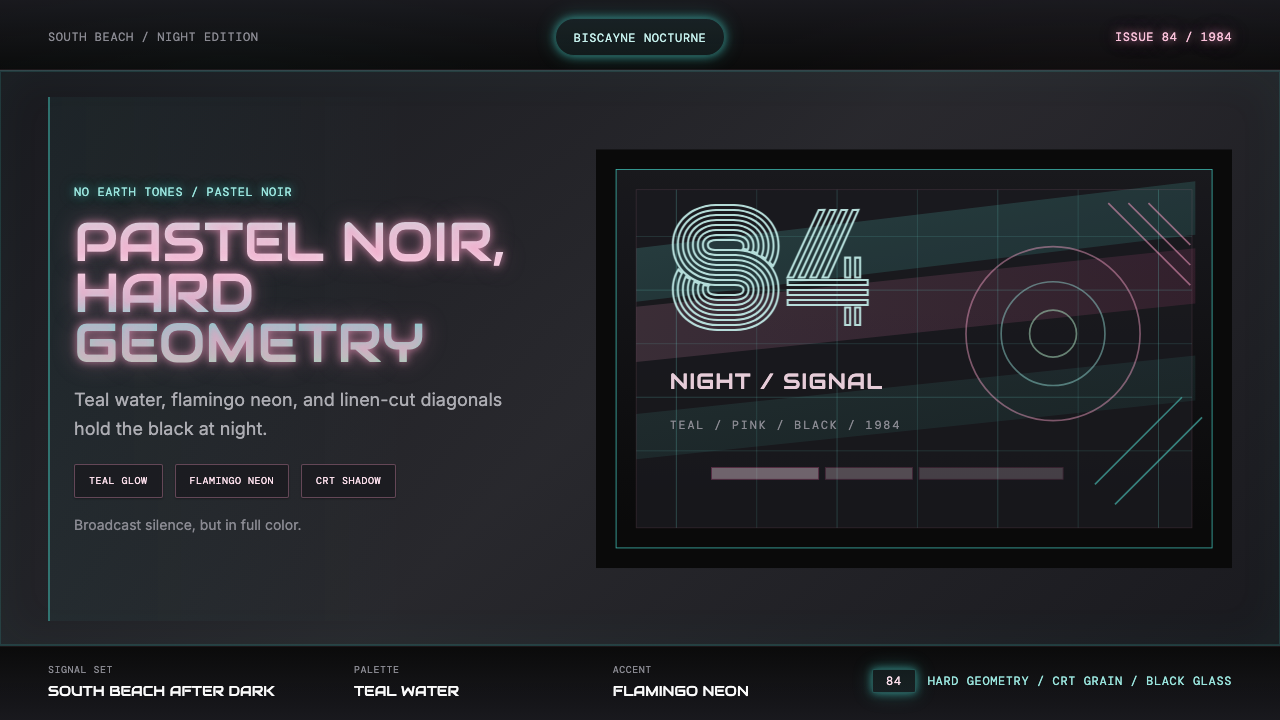 Miami Vice Pastel Teal (1984)Pastel noir, not nostalgia. Teal glow and flamingo pink slice black with geom…
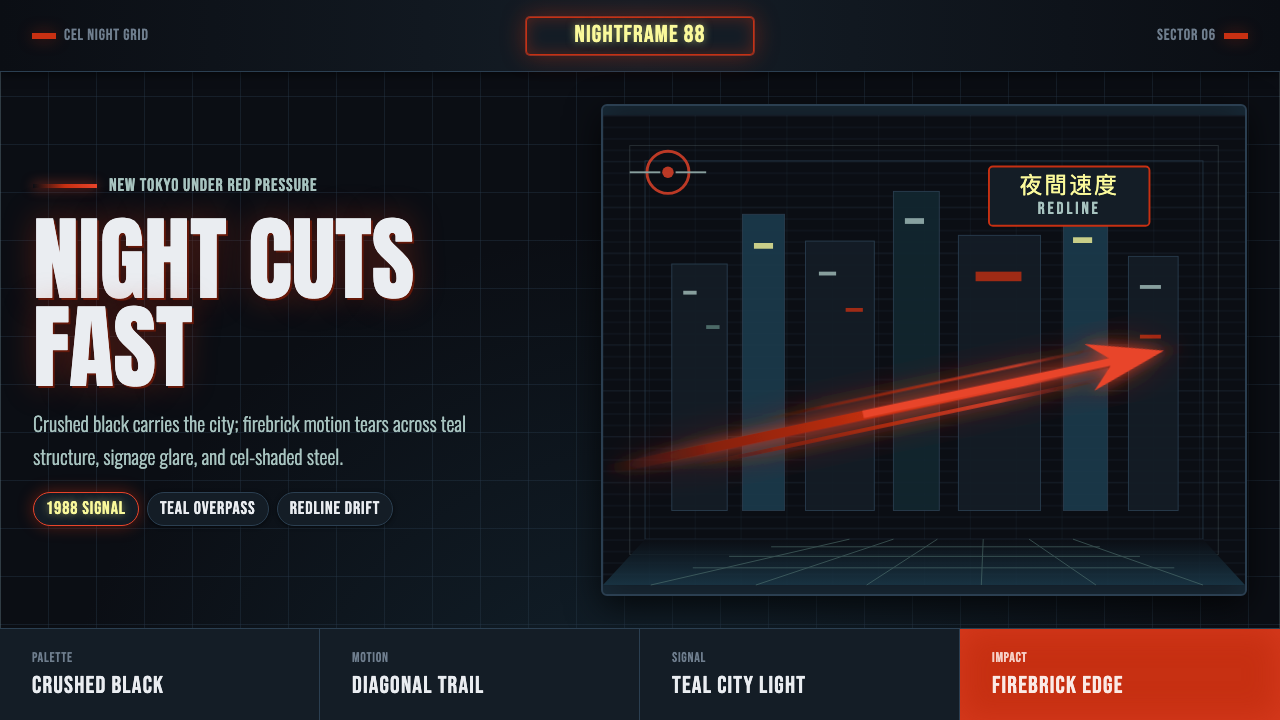 Akira Neo-TokyoNight moves fast. Firebrick trails cut crushed black, teal grids, and condens…
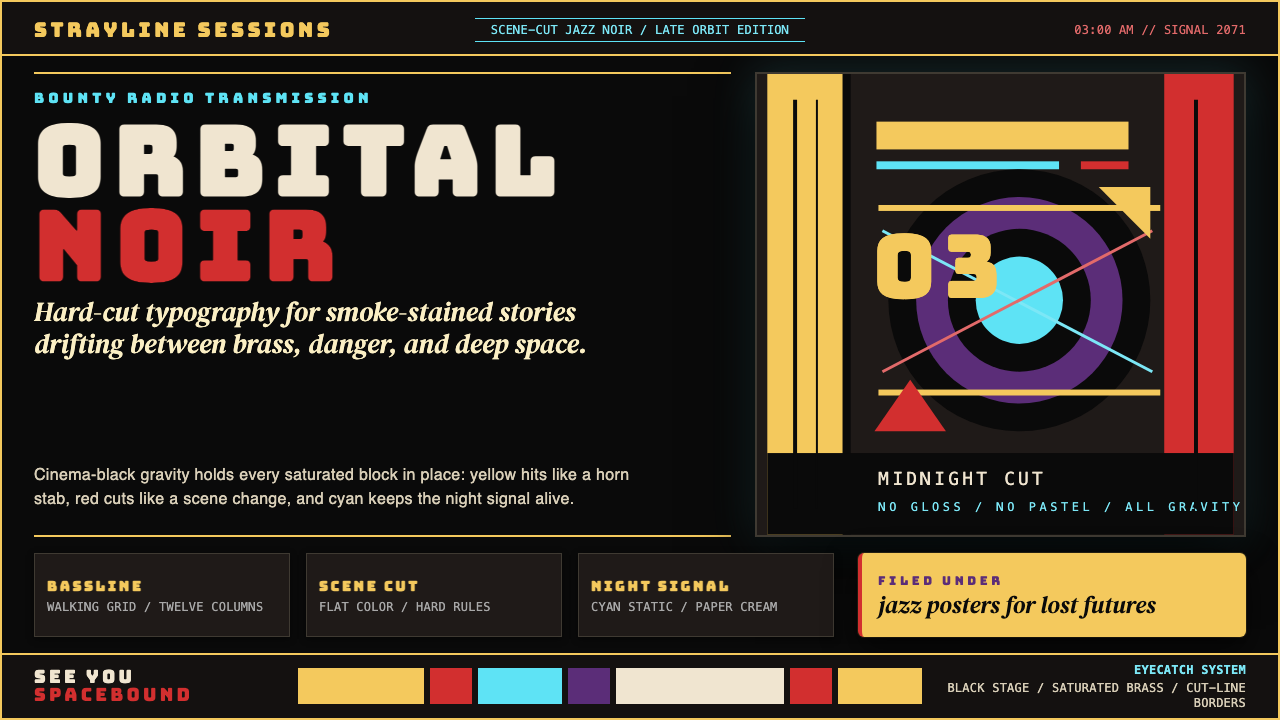 Cowboy Bebop Jazz-NoirCool at 3 AM. Bungee type, jazz yellow, red cuts, and cyan rules hit deep bla…
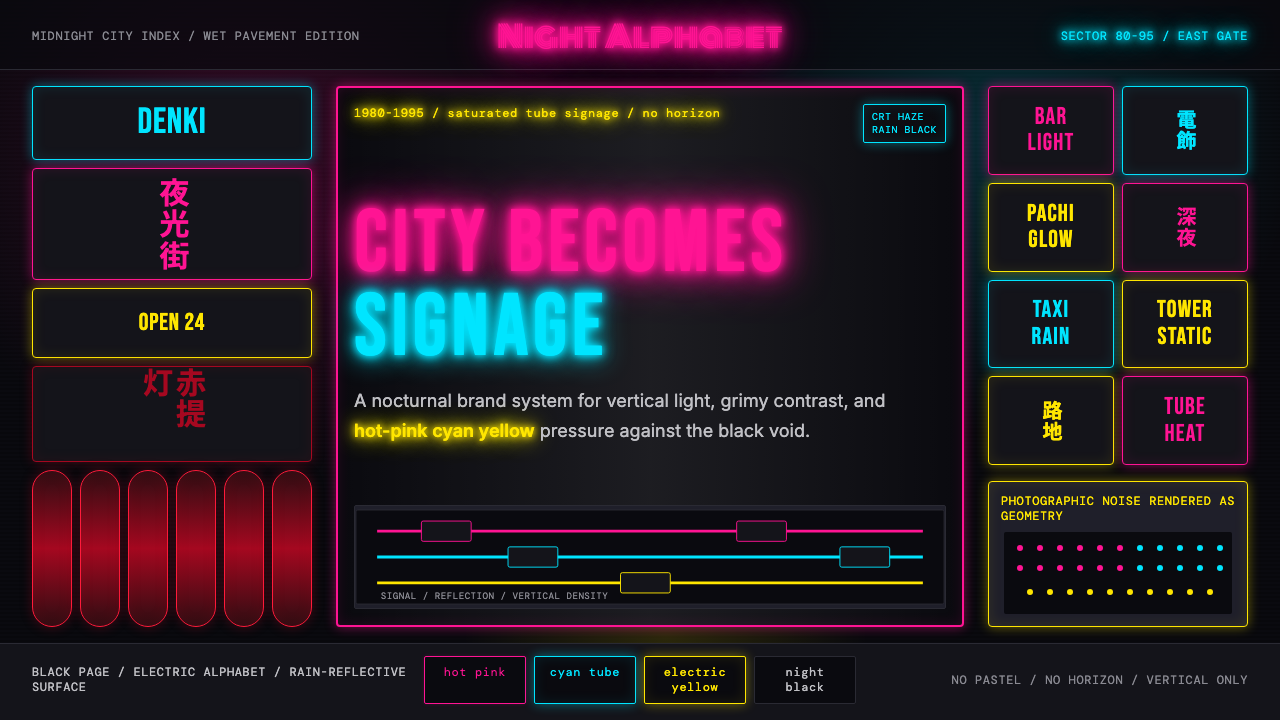 Tokyo Shinjuku Neon (1980)Night turns into alphabet. Hot pink, cyan, and yellow stack as glowing vertic…
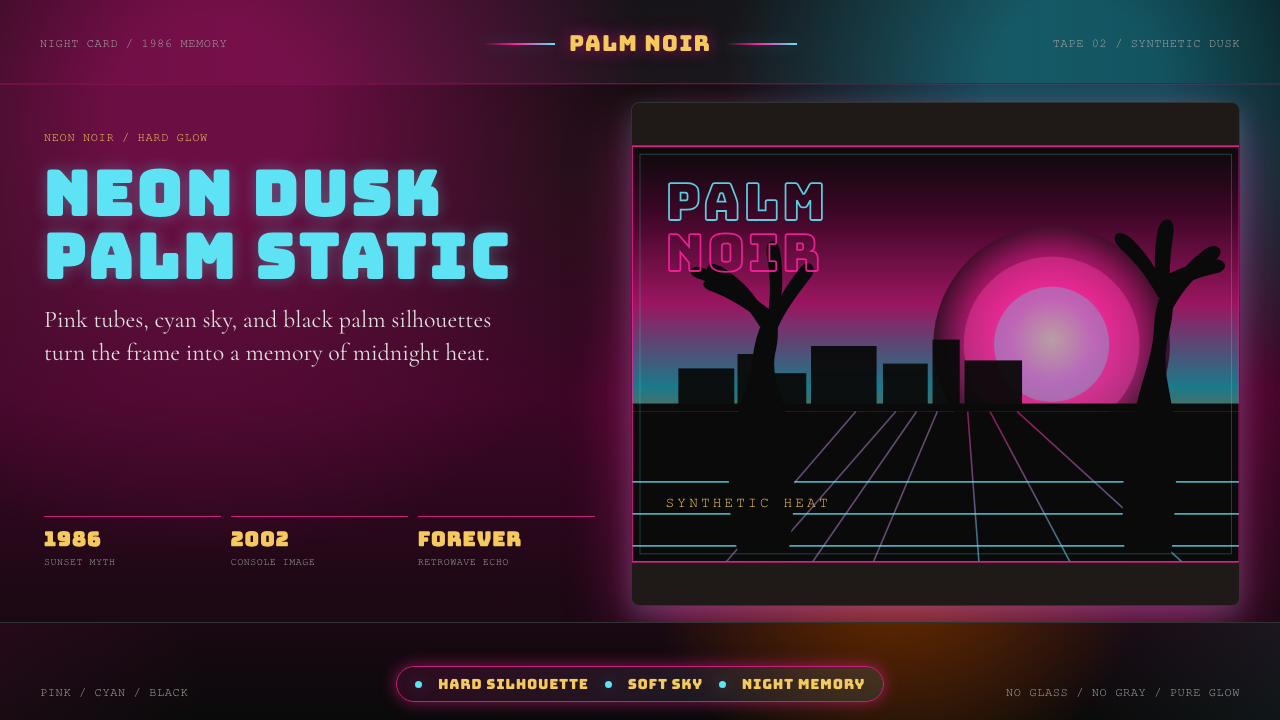 GTA Vice City (2002)Neon-noir nostalgia. Pink-cyan dusk, chunky type, and palm silhouettes.
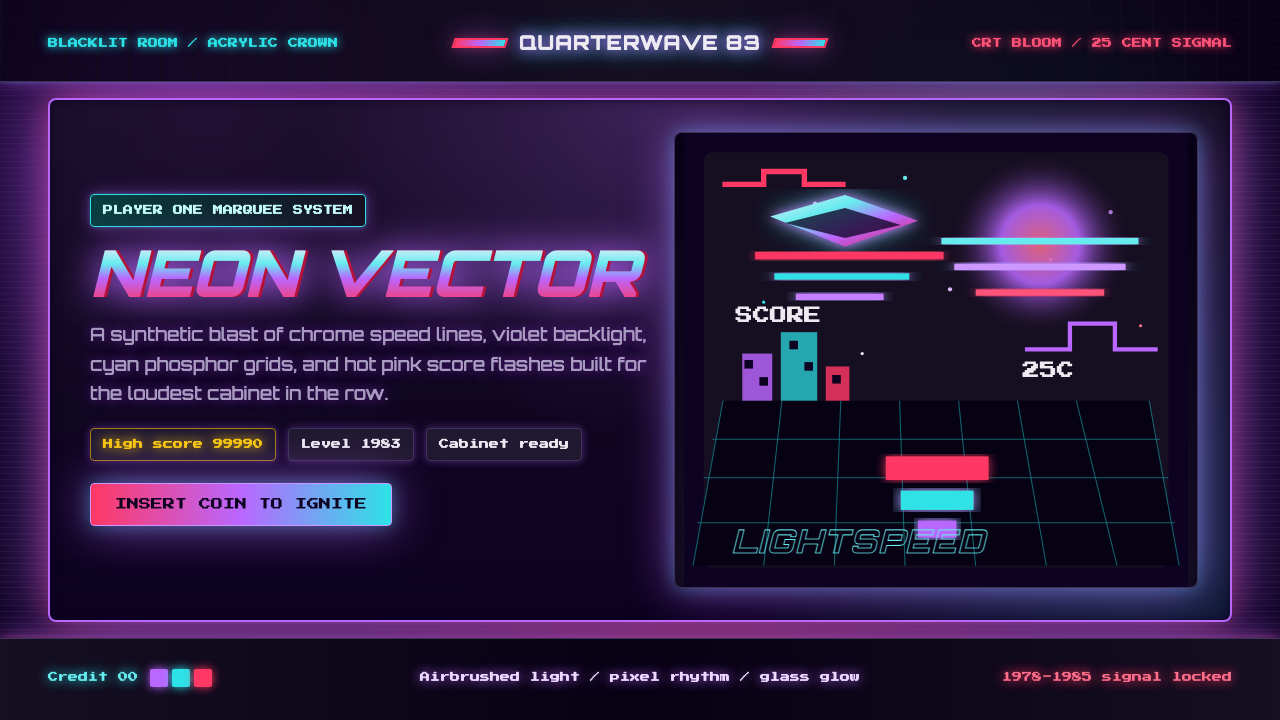 Arcade Cabinet MarqueeToo loud to ignore. Black-indigo glass, violet glow, cyan grids, hot-pink arc…