What is Tokyo Shinjuku Neon (1980)?
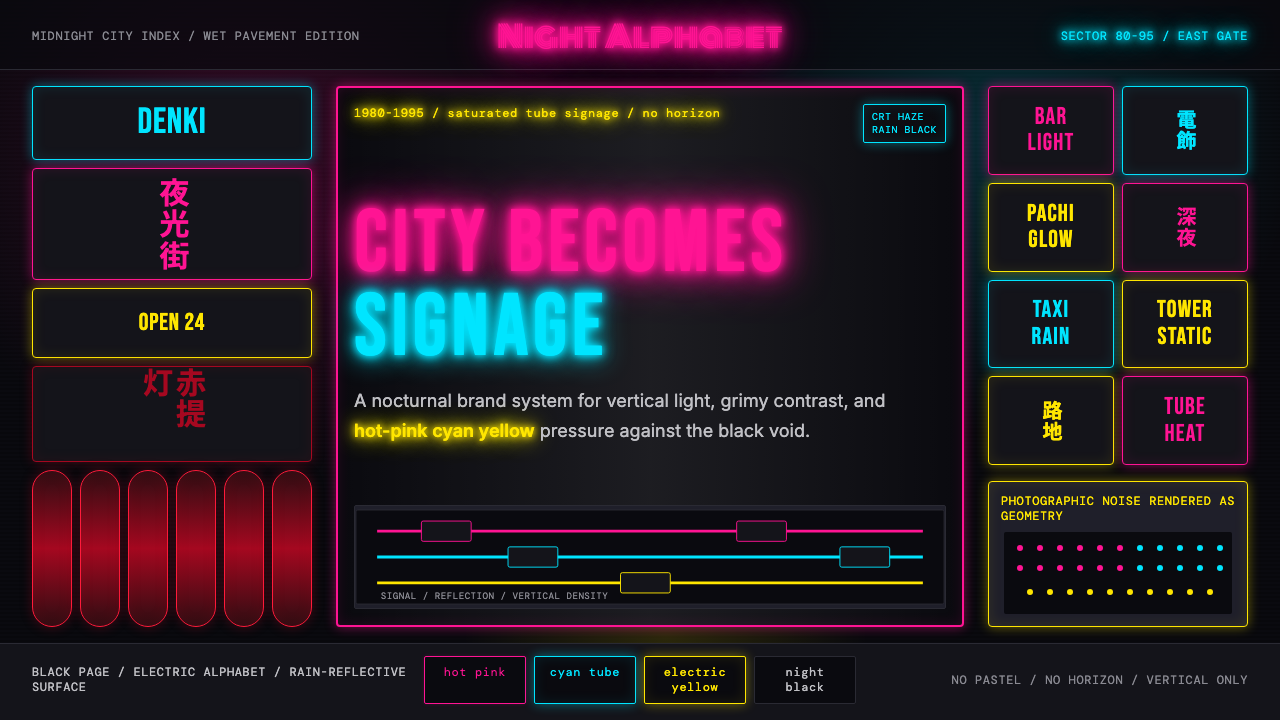
Shinjuku at midnight, 1980: the city stops being a city and becomes pure electric script — hot pink, cyan, and sulfur yellow stacked in vertical columns against absolute black.
Tokyo Shinjuku Neon (1980) in brief
Tokyo Shinjuku Neon (1980) is a design aesthetic rooted in the visual density of Tokyo's entertainment districts during Japan's bubble-era peak — roughly 1980 to 1995. The system is built on extreme contrast: neon-saturated hues of hot pink, electric cyan, and acid yellow burn against backgrounds of near-total blackness, producing the sensation of light carving itself out of darkness rather than illuminating a surface.
Unlike ornamental neon aesthetics that pile on glow effects indiscriminately, Shinjuku Neon derives its power from compression and verticality. The visual logic of Kabukicho's real streetscape — where signage runs floor to ceiling in stacked kanji and katakana columns, every surface competing for the eye — translates into a design language that treats density itself as a compositional principle. Negative space is almost nonexistent; what darkness remains is structural, giving the glowing elements somewhere to live.
The system also carries a secondary warmth layer beneath the dominant cold neon: the amber glow of chochin paper lanterns bleeding out from izakaya doorways, the brownish scan-line haze of CRT monitors in game parlors, the wet-pavement reflections that double every column of light below street level. This layering of warm and cold sources is what separates the style from generic synthwave — it is more photographic, more urban-real, closer to Daido Moriyama's silver-grain Tokyo than to any airbrushed fantasy.

Where does Tokyo Shinjuku Neon (1980) come from?
The visual world that this design system captures existed because of a specific alignment of economic, regulatory, and technological forces in postwar Japan. The 1960s and 1970s saw rapid urbanization and the consolidation of entertainment around train hubs, with Shinjuku emerging as the preeminent after-dark destination west of Tokyo Station. By 1980, Kabukicho — the roughly one-square-kilometer zone north of Shinjuku Station — had become one of the densest concentrations of nightlife signage anywhere on earth. There was no zoning separation between hostess bars, pachinko parlors, cinemas, ramen shops, and love hotels; they stacked vertically, each floor competing for street-level visibility with its own illuminated sign.
Neon as a medium had been commercially available in Japan since the 1930s, but the bubble economy of the 1980s brought both the capital investment and the permissive regulatory environment that allowed Shinjuku's sign density to reach its historical maximum. Japanese neon fabricators of this era were technically sophisticated: they could bend tubes into dense kanji strokes impossible in Western lettering, and they used transformer technology that allowed dozens of signs on a single building face to pulse and sequence in complex patterns. The resulting streetscape was less like individual advertisements and more like a single, collectively authored luminous surface.
The photographers who documented this world most influentially were working within Japanese New Wave photography — a movement that treated the city as raw material for existential inquiry rather than documentary record. Daido Moriyama, shooting Shinjuku obsessively from the late 1960s onward, developed a high-contrast, grainy, almost abraded visual style that made the neon districts look simultaneously seductive and threatening. Nobuyoshi Araki photographed the same streets with a more intimate, diaristic quality. German director Wim Wenders, visiting Tokyo in 1983 to shoot his documentary on director Yasujiro Ozu, captured the neon streetscapes in color in a way that introduced the Shinjuku visual world to a Western art cinema audience. Studio Alta, the commercial complex across from Shinjuku Station's east exit with its giant exterior screen, became an icon of the era visible in countless photographs and films.
After Japan's asset bubble collapsed in the early 1990s, Shinjuku's neon density began a long, slow decline driven by rising electricity costs, stricter sign-height regulations, and the gradual shift of advertising budgets toward digital media. LED replacements arrived through the 2000s and 2010s, changing the quality of light — LEDs produce a harder, colder point-source illumination rather than the diffuse tube-glow of gas-filled neon. By the time preservationists and designers began documenting the remaining neon seriously, around 2010, it had already acquired heritage status. The 1980 to 1995 window is now regarded as the canonical peak: dense enough to feel overwhelming, technically sophisticated enough to achieve complex animation, and photographically documented thoroughly enough to serve as reliable source material.
What defines the Tokyo Shinjuku Neon (1980) look?
Palette
The palette is built on three neon primaries — hot pink (the signature magenta of Kabukicho hostess-bar signs), electric cyan (the blue-green of pachinko parlor tubes), and acid yellow — deployed against backgrounds of near-absolute black. These are not pastel approximations; they are the saturated, slightly over-exposed colors that neon gas tubes produce when photographed on color negative film. A secondary warmth register — amber, ochre, and brown-tinged white — represents the lantern light and CRT-screen glow that bleeds through from indoor sources. The black is not neutral: it is the specific blackness of a wet Tokyo street at two in the morning, carrying the reflections of everything above it.
Verticality and Stacking
The dominant compositional logic is vertical. In the actual Shinjuku streetscape, signs run from street level upward for six or eight floors, each floor adding another layer of kanji columns, LED scrollers, or tube-lit logos. This translates into a design system that favors tall, column-based layouts over horizontal bands. Text elements stack top-to-bottom rather than left-to-right; when multiple languages appear, Japanese script runs vertically while Latin characters turn to read downward. The sense of compression — of more information than the space should contain — is intentional, not a failure of spacing.
Glow and Bloom
Neon tubes do not produce hard-edged light; they produce a luminous body surrounded by a soft bloom that spreads into adjacent surfaces. In photographs, this bloom is exaggerated by film grain and lens flare. The design system translates this into a treatment where bright type and graphic elements appear to radiate softly into the surrounding dark — not as a decorative drop-shadow, but as the natural behavior of colored light against an absorptive background. The bloom should be subtle enough to read as physical light rather than as a Photoshop layer effect.
CRT Texture
The era's omnipresent CRT monitors — in game arcades, love hotel lobbies, news tickers on building facades — introduced a secondary texture layer into the visual world: horizontal scan lines, a slight phosphor afterglow, and a soft focus around bright elements. This scan-line haze reads as a period marker, placing the aesthetic firmly in the analog-to-digital transition of the 1980s rather than in either the purely chemical world before it or the sharp-pixel world after. Used sparingly, the texture adds documentary authenticity; used heavily, it becomes costume.
Kanji as Graphic Element
Japanese script — particularly the dense, high-stroke-count kanji used in establishment names and category labels — functions as both text and visual texture in this system. A column of kanji at large scale reads simultaneously as words (for those who can read them) and as a rhythmic tower of interlocking forms (for those who cannot). When Shinjuku Neon is applied to non-Japanese contexts, the principle translates to treating any dense, high-contrast script as a design element whose texture precedes its readability — headline characters that are visual objects before they are words.
Wet Reflection
Shinjuku at night is almost always shot in or after rain because wet asphalt doubles the sign columns downward, creating a mirror-world that is slightly blurred, slightly color-shifted, and suggestive of infinite depth below street level. In the design system, this translates to a treatment of lower-register elements — the bottom third of a composition — as a zone of diffused, color-bled reflections of the primary sign elements above. This vertical doubling reinforces the sense of total immersion: there is no neutral ground, no unilluminated surface.
Ambient Warmth Underneath Cold
The Shinjuku visual world is not monolithically cold. Beneath and between the blue-white neon and magenta tubes, the street contains warm amber from paper lanterns, yellowish light from ramen shop windows, and the brownish-orange of kerosene heaters glimpsed through open doorways. This warm-cool tension is essential to the aesthetic's emotional range — pure cold neon would be clinical; the warm underlayer makes it feel inhabited. In design applications, this means reserving one tonal register — the warmest amber-to-cream range — for human-scale, intimate content elements, while the cool primaries handle structure and hierarchy.

Who shaped Tokyo Shinjuku Neon (1980)?
Moriyama is the photographer most responsible for codifying the visual grammar of nighttime Shinjuku. Beginning in the late 1960s and continuing through the bubble era, he shot the district obsessively using compact cameras, high-speed film, and often available light alone. His images — grainy, high-contrast, frequently blurred — transformed what could have been mere street documentation into an expressionist record of urban desire and dread. His 1972 series on Shinjuku and his subsequent books established the template for how Western audiences came to imagine Tokyo's neon districts. The aesthetic quality of his photographs — the way neon blooms into grain, the way wet pavement becomes a secondary sky — is the direct photographic ancestor of this design system.
Where Moriyama's Shinjuku is threatening and alienated, Araki's is intimate and carnivalesque. Working from the same streets and the same era, Araki developed a prolific, diary-like practice that situated the neon districts within the full texture of daily urban life — food, sex, grief, and commerce all photographed with equivalent attention. His work established that the Shinjuku visual world was not a singular noir spectacle but a layered, inhabited place where extremes coexisted. For designers working with this aesthetic, Araki's contribution is the permission to include warmth, humor, and human-scale detail rather than maintaining a relentlessly nocturnal gravity.
Wenders visited Tokyo in 1983 to make a documentary about director Yasujiro Ozu. His film, 'Tokyo-Ga', contains extended color sequences of Shinjuku and the surrounding neon districts that were among the most widely circulated Western images of the urban aesthetic before the internet era. Wenders's eye was that of an outsider confronting the city as pure image — he photographed the signs as sculptural objects rather than as commercial communication, and his sustained attention to their formal qualities (the rhythm of vertical columns, the interaction of different color temperatures, the way distant neon clusters into colored fog) provided a filmic grammar that directly influenced how the Shinjuku visual world was translated into graphic design.
Studio Alta is not a person but a building — the commercial complex facing Shinjuku Station's east exit, which installed one of Japan's first large exterior video screens in 1980. The screen became the landmark meeting point of the era ('meet you at Alta') and appears in countless photographs, films, and television broadcasts of 1980s Tokyo. It represents the moment when Shinjuku's visual environment incorporated moving image alongside static neon — the beginning of the transition from gas-tube illumination toward the digital-screen environment that would eventually succeed it. In the aesthetic system, Studio Alta stands for the specific moment of overlap: when the analog and digital coexisted on the same building face.
Hosono, the composer and producer central to Yellow Magic Orchestra, created a sonic world in the late 1970s and early 1980s that is inseparable from the visual aesthetic of the same era. YMO's synthesizer-based electronic music — with its references to Japanoise, Asian exotica, and early computer game sounds — provided the auditory equivalent of neon-lit Shinjuku: densely layered, slightly machinic, simultaneously traditional and futuristic. Hosono's work demonstrates that the Shinjuku Neon aesthetic was not just visual but part of a broader cultural synthesis specific to Japan's bubble-era metropolitan culture. Understanding this musical dimension helps designers avoid treating the visual style as mere surface ornament rather than as the expression of a coherent urban sensibility.
How do you use Tokyo Shinjuku Neon (1980) today?
Shinjuku Neon is a high-intensity aesthetic that rewards commitment and punishes half-measures. It is most effectively applied to contexts where drama, immediacy, and a sense of nocturnal energy are appropriate values — entertainment and gaming brands, nightlife event materials, cyberpunk-adjacent tech products, and any creative work that benefits from an explicit reference to Japan's bubble-era visual culture. Used at partial intensity on a product that calls for restraint, it reads as unintentional kitsch rather than deliberate style.
For presentation slides, the aesthetic works best when applied fully to cover and transition slides, with content slides using a more restrained version of the same palette — the same background darkness, the same color primaries, but with reduced glow and more deliberate negative space to allow data and text to read cleanly. A cover slide built on Shinjuku Neon should feel like stepping into a street at night: a dominant vertical element in one primary color (a column of text, a tall graphic element), the other primaries appearing as secondary sign elements at smaller scale, and the warmth layer reserved for a single human-scale detail — a logotype, a speaker name, a date — that grounds the composition.
For web UI and dashboards, the system translates well to dark-mode interfaces where information hierarchy needs to punch through visual noise. The key discipline is treating color as a communication tool rather than a decoration: one primary for primary actions and critical data, a second for secondary actions and in-progress states, warm amber for human or social elements (user avatars, comments, notifications). Navigation should be largely typographic, with vertical orientation where the layout allows. Data visualization in this system benefits from the neon-on-black contrast: bar charts and line charts with luminous strokes against dark fields have a built-in legibility that standard light-mode charts cannot match at a glance.
For editorial and marketing applications, Shinjuku Neon functions effectively as a poster aesthetic — it is inherently print-poster-scaled thinking applied to screen contexts. Marketing headers can use the vertical stacking logic directly: a tall typographic column in hot pink or cyan on black, with a secondary element crossing it at a slight angle to create tension. Editorial layouts should resist the temptation to use the full color range on every page; instead, establish a dominant single-color thread across a piece — one article in cyan, one in pink — and reserve the multi-color density for moments of intentional climax, such as section openers or key callout blocks.
The most common failure mode with Shinjuku Neon is applying it as a surface treatment — layering glow effects and scan-line textures over a layout that has not been fundamentally rethought for the dark, vertical, dense logic the system requires. A design that is structured for a standard light-mode grid with neon colors and glow effects added on top will look like a costume rather than a coherent visual statement. The second failure is losing the warmth layer entirely and producing a result that is all cold neon and absolute black — technically faithful to one photographic tradition of Shinjuku but emotionally thin. The wet-pavement reflections, the amber lantern glow, the brownish CRT haze: these are not optional texture details, they are the system's emotional register.

Tokyo Shinjuku Neon (1980) — FAQ
How is Shinjuku Neon different from synthwave or vaporwave?
All three aesthetics reference 1980s technology and visual culture, but they come from different source materials and carry different emotional registers. Synthwave is primarily a Western confection — its neon grids and chrome type reference American retrofuturism and movie poster design as much as any real cityscape. Vaporwave is an ironic aesthetic rooted in early internet and mall culture, deploying 1980s and 1990s corporate visual language (Windows 3.1, stock photography, consumer electronics packaging) in a deliberately uncanny way. Shinjuku Neon, by contrast, is photographic and specific: it is derived from a documented real place, at a documented historical moment, and its characteristic textures — grain, scan-line haze, wet-pavement reflection, warm lantern underlayer — come from the actual photographic record of that place. It is denser, warmer in its secondary palette, more vertical in its compositional logic, and less reliant on nostalgia for American technology.
Can the style work on a light background, or does it require darkness?
The style is fundamentally dark-ground. Neon light is defined by its relationship to darkness — the same tube that blazes magenta against black reads as a weak pinkish tint against white. A light-background application of the aesthetic loses its primary mechanism. That said, there are two valid light-context adaptations: first, a daytime-Shinjuku variant that replaces neon with flat graphic primaries on a light neutral ground, using the verticality and density logic without the glow — this is adjacent to Japanese graphic design of the same era rather than to neon photography specifically. Second, a partial application where light-background content sections are framed or headed by dark neon panels, so the neon registers as a structural accent rather than an all-over field. Neither of these is the canonical system; both require explicit intent to read as variations rather than failures.
How do I use Japanese typography without it feeling like appropriation or pastiche?
The distinction lies in whether Japanese script is doing real communicative work or whether it is being used as pure visual texture. When actual Japanese text — real words with real meaning relevant to the content — appears in the design, it functions as authentic bilingual or multilingual communication, which is entirely appropriate. When Japanese characters are selected for their visual density and stroke complexity without regard to meaning (or with fabricated or nonsensical text), it becomes ornamental appropriation. The practical guideline: if the design is for content that has a genuine Japanese-language dimension (translation, Japanese audience, Japanese cultural context), use real Japanese with real meaning. If the content has no Japanese dimension but the designer wants the visual texture of Japanese script, use the structural logic of the style — the verticality, the density, the column-based layout — without the script itself.
What kinds of products and brands should avoid this style?
Shinjuku Neon is a high-specificity aesthetic with a strong cultural and emotional signature. It is poorly suited to: financial services and professional tools where trust and sobriety are primary values; health and wellness brands where the nocturnal, high-stimulation quality works against the desired emotional register; children's and family products; brands where warmth, softness, or natural organic texture are key differentiators; and any product positioning itself around simplicity, quietude, or Scandinavian-adjacent minimalism. The style is also difficult to use without ironic distance for luxury brands, because Shinjuku's visual world is fundamentally populist and commercial — it is the aesthetic of density and competition, not of scarcity and curation.
How do I balance density with readability when applying this style to real content?
The visual density of Shinjuku's actual streetscape works because each sign is a discrete element with its own spatial territory — the overall field is dense, but any individual sign within it is legible. This principle translates to design as a two-level approach: the overall composition should feel dense and immersive, but within that composition, each content zone should have internal clarity. Practically, this means establishing a clear typographic hierarchy with significant size contrast between levels, using the color primaries to differentiate content types rather than to decorate individual elements, and treating glow and texture as field properties that affect the whole rather than as ornaments applied to specific elements. The mistake is applying maximum texture and glow to the text itself, which destroys legibility. The neon quality should be in the environment; the text should be luminous but clean.
Related design styles
 Akira Neo-TokyoNight moves fast. Firebrick trails cut crushed black, teal grids, and condens…
 Cowboy Bebop Jazz-NoirCool at 3 AM. Bungee type, jazz yellow, red cuts, and cyan rules hit deep bla…
 Fallout Vault-Tec Pip-BoyIrradiated optimism. Vault yellow and CRT green lock into a bordered bunker g…
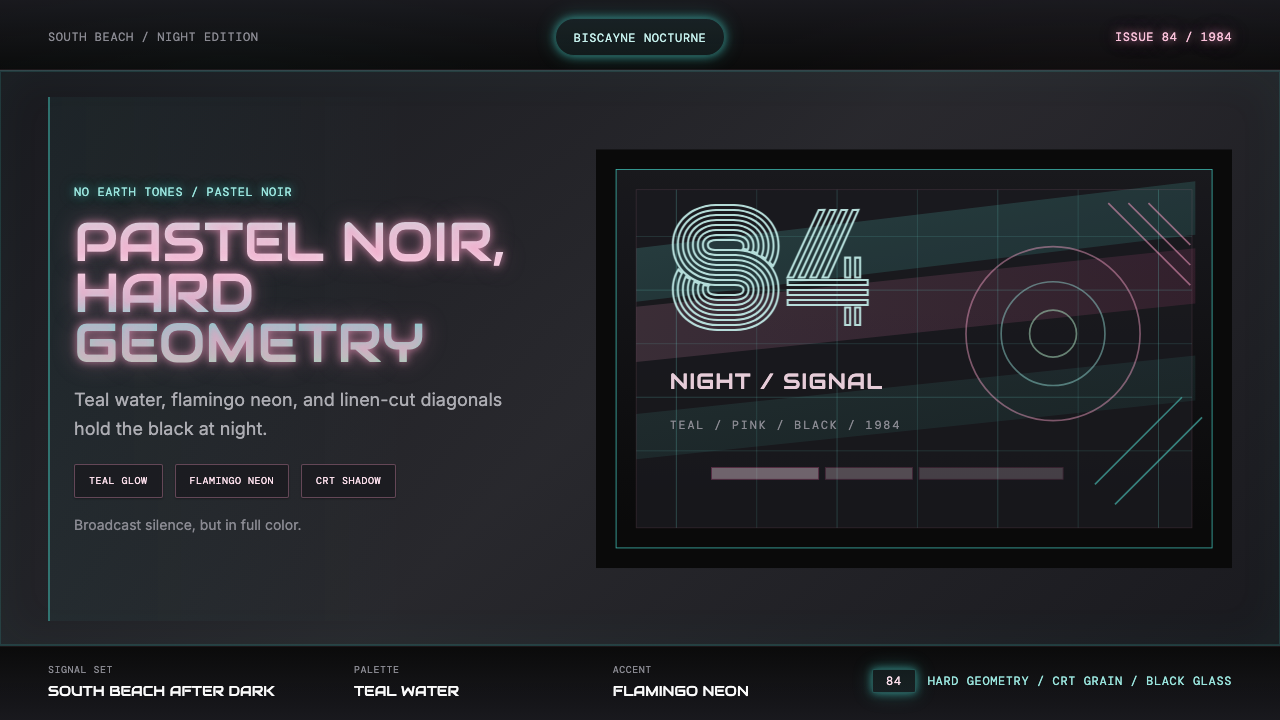 Miami Vice Pastel Teal (1984)Pastel noir, not nostalgia. Teal glow and flamingo pink slice black with geom…
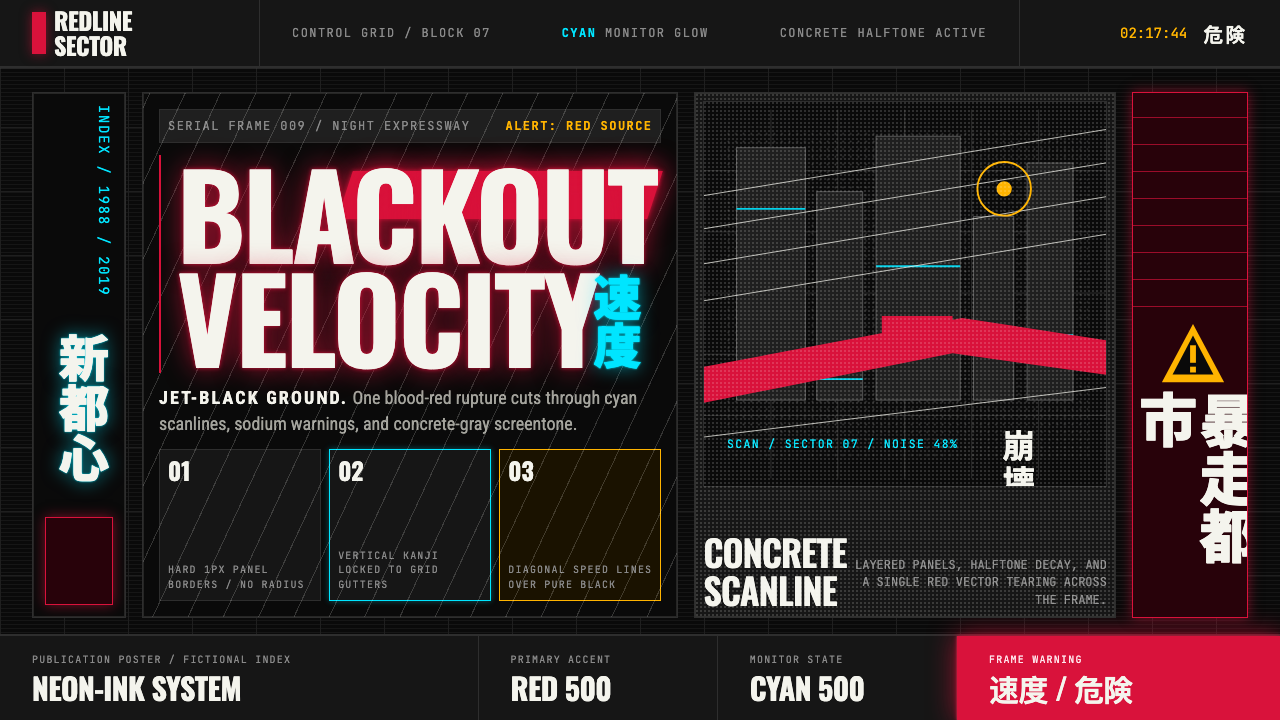 Akira (Otomo)Cyberpunk at impact. Kaneda red, cyan kanji, halftone concrete, and diagonal…
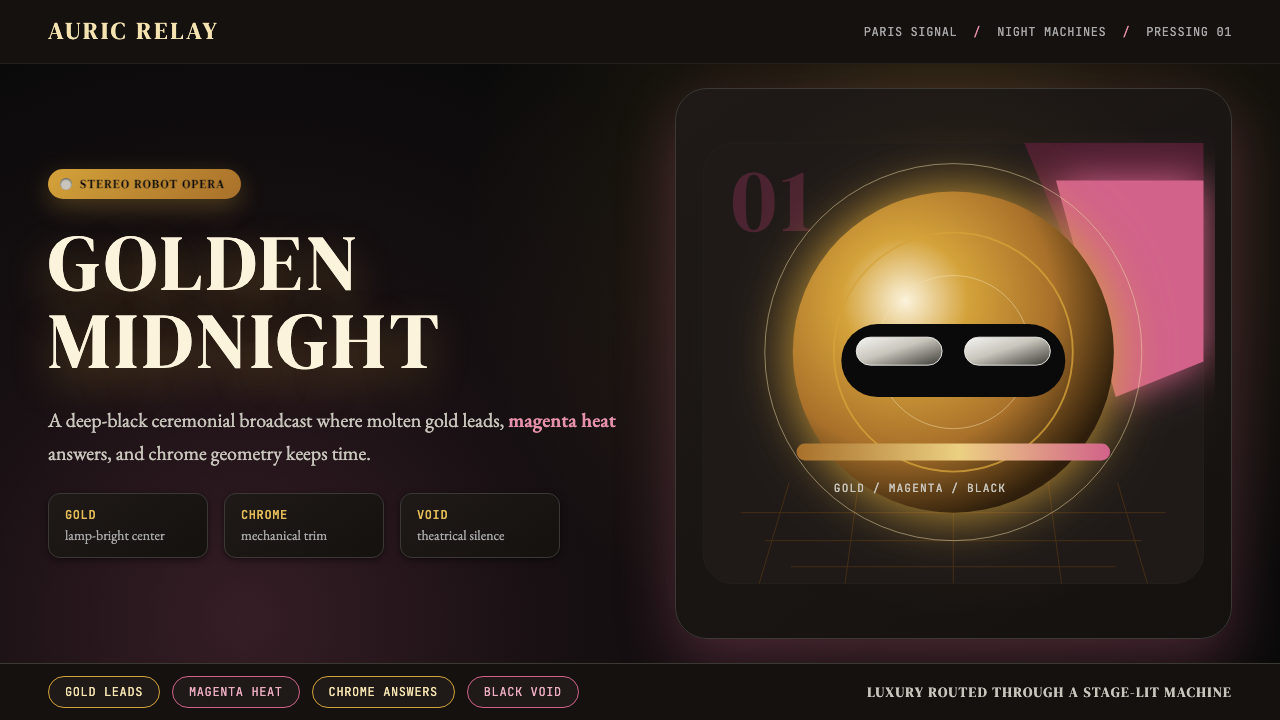 Daft Punk Discovery (Gold-Helmet)Warm sci-fi disco. Gold serif caps orbit a magenta void with chrome-disc geom…