What is Akira (Otomo)?
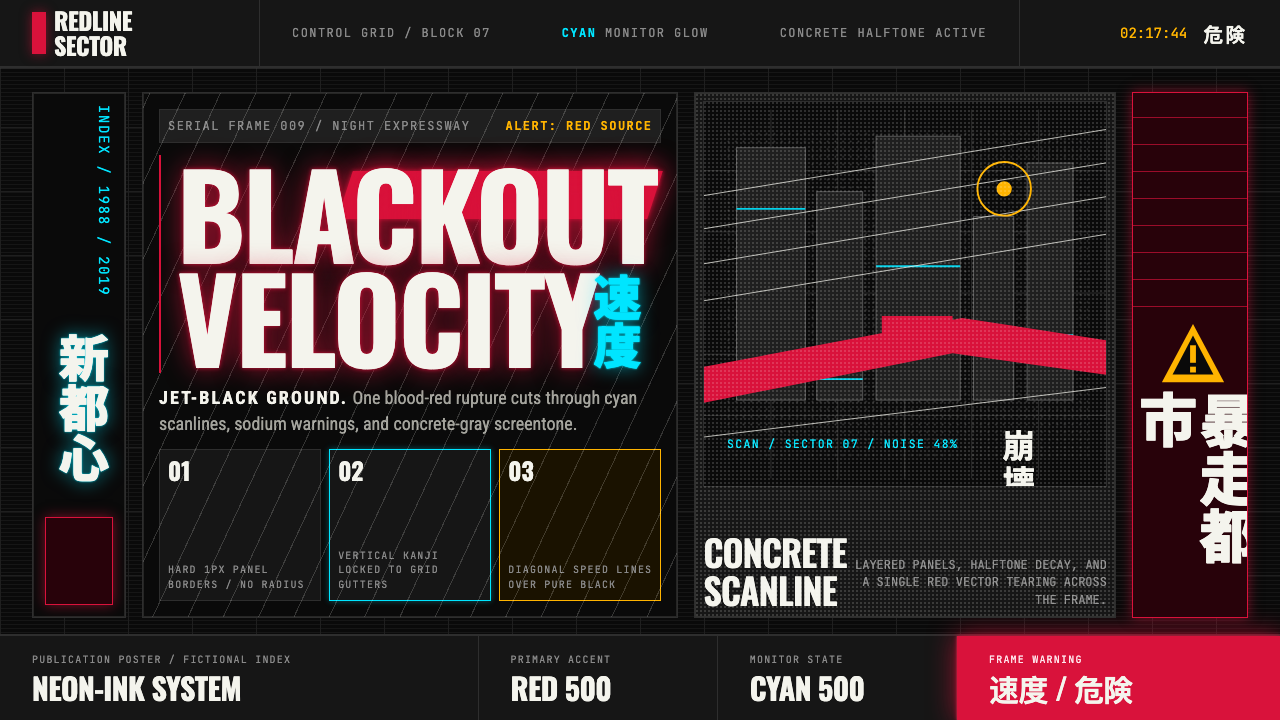
Katsuhiro Otomo's Akira set the visual grammar of cyberpunk Japan: jet-black night skies, a single blood-red accent, obsessive hand-inked detail, and diagonal motion lines that make still images feel like they are already moving.
Akira (Otomo) in brief
Akira (Otomo) is the design language derived from Katsuhiro Otomo's landmark manga serial (1982–1990) and its 1988 animated film — a visual system built on extreme tonal contrast, dense architectural cross-hatching, and a deliberately constrained palette anchored by one blazing accent color against a near-total black field. It is the foundational visual grammar of cyberpunk Japan and the single most imitated aesthetic template the genre has produced.
The style operates on a principle of controlled overload: every surface is maximally detailed — concrete stippled with halftone dots, steel structures rendered with architectural precision, crowds drawn figure by figure — yet the composition never collapses into chaos because the black field acts as an absolute negative-space anchor. The eye always knows where to rest and where to move. Speed lines and motion blur are not decorations; they are structural devices that tell the reader's eye exactly how fast something is traveling and in which direction.
Unlike cyberpunk aesthetics that rely on neon saturation across the entire palette, Akira's color logic is almost monastic in its restraint. The base is black, the ground is gray concrete, and only a single color — the red of Kaneda's motorcycle — is allowed to operate at full intensity. Secondary accents, cyan and amber, are used sparingly as light-source signals rather than compositional color. The result is a style that reads as simultaneously overwhelming in detail and precise in hierarchy.

Where does Akira (Otomo) come from?
Otomo began serializing Akira in Young Magazine (Kodansha) in December 1982, at a moment when Japan's postwar economic miracle had produced both extraordinary technological optimism and deep social anxiety about what that prosperity concealed. Neo-Tokyo — Otomo's fictional metropolis built on the ruins of a city destroyed by a psychic weapon in 1988 — is an architectural diagram of that contradiction: gleaming supertower corridors above, crumbling underpass slums below, all of it rendered with the obsessive documentary precision of an artist who had studied the actual infrastructure of Tokyo with an engineer's eye.
Otomo's visual approach was shaped by a specific lineage within postwar Japanese manga. He absorbed Osamu Tezuka's cinematic panel sequencing but rejected its rounded, expressive character design in favor of a harder, more Western-influenced realism. He studied European bande dessinée — especially the Franco-Belgian tradition of Moebius (Jean Giraud), whose clean-line architectural detail and vast, alienating cityscapes left a clear imprint on Neo-Tokyo's urban geometry. From American underground comix and the then-emerging cyberpunk fiction of writers like William Gibson, Otomo drew a sensibility of systemic failure: technology not as liberation but as infrastructure for oppression and eventual catastrophe.
The 1988 animated film — co-written and directed by Otomo himself, produced by TMS Entertainment with a then-unprecedented budget — translated the manga's black-and-white density into a hand-painted color system that has become equally canonical. The animation studio employed over a thousand individual paint colors and pioneered a technique of recording dialogue after animation was complete, allowing the mouth movements to be precisely synchronized with sound in a way rare for Japanese animation of the period. The film's score, composed by Geinoh Yamashirogumi using a blend of Balinese kecak chanting, orchestral percussion, and synthesizer drones, fused the visual system with a sonic one that is inseparable from the style's cultural identity.
The global impact of Akira on design, film, and visual culture was both immediate and enduring. Released in North America in 1989 and in Europe shortly after, the film introduced Western audiences to a conception of Japan that was neither the traditional aesthetic of ukiyo-e and Zen minimalism nor the cute commercial face of early Nintendo — but something dystopian, hyper-urban, and viscerally modern. The Akira visual system became the reference grammar for an entire generation of game designers, album cover artists, streetwear brands, and motion graphics studios. Films from The Matrix to Ghost in the Shell to Tron: Legacy absorbed its language of vertical city-stacking, monochromatic ground with single-color accent, and diagonal speed as a compositional verb.
What defines the Akira (Otomo) look?
Absolute Black Field
The background in Akira-derived work is not dark gray or navy — it is pure, consuming black, the visual equivalent of the void of outer space or the bottom of a tunnel at full speed. This absolute black functions as the compositional anchor for everything else: it makes moderate-intensity colors appear to glow, it makes white linework vibrate, and it collapses spatial depth into a flat, high-contrast plane. Intermediate values — twilight grays, atmospheric haze — are avoided precisely because they would soften the contrast that gives the style its impact.
Single Blazing Accent
Where most design systems distribute color across multiple elements, Akira concentrates all chromatic intensity into a single object or category — typically a warm, saturated red or a deep, chemical cyan — and lets everything else remain in the achromatic range. This is not a scarcity of color; it is a weaponization of it. The accent color commands absolute attention against the black ground, and because it appears only in one place, the eye treats it as structurally significant rather than decorative. Cyan appears as monitor glow and neon, amber as sodium-vapor streetlight — both used as light-source identifiers, not palette members.
Dense Cross-Hatching and Halftone
The tonal range between the absolute black ground and pure white highlights is built not through gradients but through mark-making: dense cross-hatched pen strokes that create a mid-tone concrete texture, and halftone dot patterns that simulate the mechanical reproduction process of print journalism. These marks are not hidden or smoothed — they are proudly visible as the evidence of hand labor. The cross-hatching on concrete walls, the stipple on asphalt, and the parallel hatching on metal surfaces all communicate material identity through accumulated marks rather than through color or rendered shading.
Diagonal Speed Architecture
Motion in the Akira visual system is rendered through diagonal lines that originate from or converge toward a single vanishing point, creating a powerful directional pull across the frame. These speed lines are not merely decorative convention borrowed from earlier manga traditions — they are compositional infrastructure that establishes both the direction and approximate velocity of every moving element. In still images derived from the style, the same diagonal logic appears as slanted text, raked composition, or asymmetrically angled layout divisions that make static surfaces feel kinetically charged.
Vertical Urban Stacking
Neo-Tokyo's architecture is defined by vertical accumulation: highways layered above each other, advertising towers stacked on rooftops, utility cables crossing at multiple heights, structures built on top of structures. In design applications, this stacking principle translates to compositional depth through overlapping planes at different scales — large background elements, mid-ground structural elements, and small foreground detail all occupying the same frame without a clear separation plane. The result is a sense of density and layered complexity that reads as a city-like system rather than a simple layout.
Condensed All-Caps Type and Kanji Fusion
Text in the Akira visual system operates as a visual mass rather than a purely legibility vehicle. Latin lettering is condensed and set in all capitals, giving it a mechanical, stenciled quality reminiscent of military signage and industrial labeling. Japanese text — when present — appears as vertically set kanji and kana in a bold, brush-influenced weight that creates a strong geometric counter-rhythm against the Latin letterforms. The fusion of these two typographic traditions, each with distinct visual geometry, is part of what gives the style its specifically Japanese-cyberpunk cultural identity.
Controlled Catastrophe
The Akira aesthetic does not depict a clean, aspirational future — it depicts a future that is spectacular and collapsing simultaneously. Structures show stress fractures, surfaces show weathering and decay, crowds are panicked, vehicles are at the edge of control. In design terms, this translates to a deliberate introduction of imperfection: textures that suggest age and use, compositional elements that appear off-balance or under extreme tension, and a general sensibility that the energy on display is barely contained. This quality distinguishes Akira-derived work from cleaner, more stable cyberpunk aesthetics and gives it its emotional charge.

Who shaped Akira (Otomo)?
Otomo began his career as a manga artist in the mid-1970s, developing his signature hyper-detailed architectural drawing style through early works including Domu (1980–1981), a psychic thriller set in a housing project whose dense, isometric apartment complex drawings are direct precursors to Neo-Tokyo. His decision to write and direct the Akira film himself — an unusual move for a manga artist — and to demand the unprecedented production resources required to animate the manga's level of detail, was the act that transformed the style from a print medium into a global visual language. After Akira, Otomo continued directing, most notably the anthology film Memories (1995) and Steamboy (2004), but no subsequent work matched Akira's cultural impact.
Kodansha's Young Magazine provided the institutional context and editorial latitude that allowed Akira to develop without the tonal restrictions that applied to manga aimed at younger audiences. Seinen manga — the category defined by Young Magazine's demographic — permitted graphic violence, moral ambiguity, and political themes that were essential to the Akira narrative and its visual register. Kodansha's subsequent international licensing strategy, which made the manga available in full-color translated editions in the West beginning in the late 1980s, was instrumental in exporting the visual system globally before the internet made such distribution self-organizing.
This Japanese musical collective, led by composer Tsutomu Ohashi, created the Akira soundtrack using a compositional approach that mirrored the film's visual system: layered, dense, rooted in non-Western musical traditions (particularly Balinese kecak and gamelan, Tibetan Buddhist chanting, and Japanese gagaku court music), yet assembled through contemporary electronic processing. The score became inseparable from the visual identity of the film, and the sonic aesthetic it established — aggressive rhythmic complexity combined with otherworldly vocal texture — has influenced electronic music producers, game sound designers, and film composers continuously since 1988.
Though not directly involved with Akira, the French bande dessinée artist Moebius is the most visible Western precursor to Otomo's visual approach. His work on the science fiction anthology Métal Hurlant (Heavy Metal) through the 1970s and early 1980s — vast cityscapes rendered with architectural drafting precision, clean linework against empty grounds, and a conception of the future as monumental and alienating rather than gleaming and aspirational — provided a structural template that Otomo acknowledged and that readers familiar with both bodies of work can trace directly in Neo-Tokyo's urban geometry and environmental design.
The Tokyo Movie Shinsha studio (TMS Entertainment) produced the 1988 Akira film under conditions that were extraordinary for Japanese animation at the time: a production budget that dwarfed any previous animated feature, a team that at its peak employed hundreds of key animators, and a technical approach that prioritized fidelity to Otomo's source drawings over the production shortcuts that were standard in television animation. TMS's production decisions — including the unprecedented use of over a thousand distinct paint colors and the post-recording dialogue method — were engineering solutions to the problem of animating a visual system whose density and precision had been assumed to be unreproducible in motion.
How do you use Akira (Otomo) today?
Applying the Akira visual system well requires understanding its core structural logic before borrowing its surface markers. The style works because it establishes an extreme hierarchy — pure black as the absolute base, a single accent color as the sole point of chromatic intensity, white linework as the primary mark-making medium — and then loads maximum detail into the negative space that hierarchy creates. Importing the speed lines and the dark background without the disciplined color restraint produces clutter, not cyberpunk.
For presentation slides, Akira's visual system is best deployed on cover and section-break slides rather than on dense content pages. A cover using this aesthetic sets a full-bleed black field, places the title in compressed all-caps type, and positions a single graphic element — a diagonal speed-line composition, a partial mechanical form, or a fragmented architectural detail — in the accent color. Content slides should pull back significantly: a dark-but-not-black background, white body type on a dark field, and the accent color reserved exclusively for the one data point or call-out that demands attention. Data visualizations in this style work best when treated as technical diagrams — hard-edged bars and lines, no rounded corners, no gradient fills — with the primary accent color used only for the key metric.
For web interfaces and digital dashboards, the Akira aesthetic is well-suited to contexts where urgency, technical authority, and information density are primary values: security monitoring dashboards, trading interfaces, developer tools, and any application that benefits from the association between dense data and controlled competence. The approach requires committing to a genuinely dark background rather than a softened dark gray, using a single accent color for interactive elements and alert states, and building component borders and separators from hard lines rather than shadows or gradients. Typographically, the system calls for a condensed or narrow typeface for headings and interface labels, with a legible but compact typeface for body and data values.
For editorial and marketing applications, the Akira visual system translates into a poster-logic aesthetic: high-contrast, directional, designed to be read from a distance before it is read up close. A marketing page or editorial spread using this language leads with a full-bleed image or color field in the near-black base, uses the accent color for the one headline or call-to-action that must be seen first, and employs diagonal compositional lines — slanted text, angled image crops, or raked section dividers — to inject motion into a static layout. For physical print applications including merchandise and packaging, the style's limited palette and hard-edged graphic quality reproduce cleanly across screen printing, vinyl, and single-color embossing.
The most common mistake when applying Akira-derived aesthetics is palette overload: adding multiple accent colors — purple, green, orange — on the grounds that cyberpunk is inherently multicolored. The power of the original style comes directly from its color austerity. A second common error is using soft shadows and atmospheric glow effects to simulate the neon-lit environment, which produces a completely different visual logic — ambient, blurry, cinematic — rather than the hard-edged, mark-driven quality of the source material. A third error is applying the speed-line motif as decoration rather than as a structural motion indicator, producing compositions that feel busy and directionless rather than kinetically charged.

Akira (Otomo) — FAQ
How is Akira different from general cyberpunk aesthetics like vaporwave or synthwave?
Vaporwave and synthwave rely on color abundance — multiple saturated hues, chromatic gradients, neon spread across the full palette — to evoke the late-1980s and early-1990s consumer technology aesthetic. Akira's visual system is its structural opposite: it uses near-total color austerity, with one accent against black, and builds its impact through mark density and contrast rather than chromatic richness. Vaporwave is pastel and nostalgic; Akira is severe and kinetic. Synthwave is often warm and aspirational; Akira is cold and catastrophic. They share a historical moment and a broad cyberpunk cultural frame, but they represent fundamentally different visual philosophies.
Can this style work on light backgrounds, or does it require dark fields?
The Akira visual system is structurally dark-field dependent in its canonical form — the absolute black ground is not an ambient choice but the foundation from which the entire contrast logic operates. Light-background inversions are possible but require significant adaptation: the accent color loses its luminous impact when not surrounded by darkness, the speed-line motif reads as busy rather than directional without strong value contrast, and the halftone/cross-hatch textures become muddy rather than crisp against a light ground. A light-field application works best if treated as a deliberate daylight or technical-document variant rather than an attempt to reproduce the full aesthetic — using the graphic marks, condensed type, and diagonal composition while accepting that the style's emotional register will shift from urgent and nocturnal to diagrammatic and controlled.
Is it appropriate to use Akira aesthetics in commercial contexts, and what are the cultural considerations?
The Akira aesthetic has been widely commercialized since the early 1990s, appearing across streetwear, gaming, film production design, and digital products to the point where it has become a recognizable genre template rather than a proprietary visual identity. Commercial use of the design language — as opposed to direct reproduction of specific Otomo-authored images — is broadly practiced. The cultural considerations worth noting are contextual rather than categorical: the style's original narrative context is deeply concerned with state violence, nuclear trauma, youth radicalization, and systemic collapse. Deploying it as a purely decorative layer on products or services that have no relationship to those themes can read as aesthetic extraction — using the visual weight of a serious cultural document to lend borrowed authority to unrelated commercial content. This matters more in some contexts than others, but it is worth naming.
How should motion and animation be handled in Akira-inspired digital work?
Motion in Akira-inspired digital work should follow the same structural logic as the speed lines in the source material: directional, decisive, and originating from or converging toward a clear point. Transitions should be hard cuts or rapid wipes rather than soft fades — the style is not ambient or atmospheric, and dissolves undermine its visual logic. When animating typographic elements, compression and rapid directional entry are appropriate; floating or drifting motion is not. Camera movement (in 3D or video contexts) should favor fast lateral tracking or forward-plunge moves along a clear axis rather than orbital or hovering shots. The most common motion mistake is adding ambient particle effects or slow light-ray animations — these introduce the soft, atmospheric quality that the style structurally excludes.
What types of products and brands is this aesthetic poorly suited for?
The Akira aesthetic is poorly suited to any context where the core value proposition involves warmth, approachability, care, or organic natural quality. Health and wellness products, children's applications, food and beverage brands, financial services aimed at cautious or risk-averse users, and any product whose primary emotional contract with the user is one of safety and reassurance will find that the style's severity, darkness, and density work against the product's intended affect. The aesthetic is also a poor fit for brands that depend on aspirational lightness — luxury fashion, travel, and hospitality — because its visual logic is compressive and urgent rather than expansive and pleasurable. The style's power is real, but it is the power of a compressed spring: it will not relax into warmth.
Related design styles
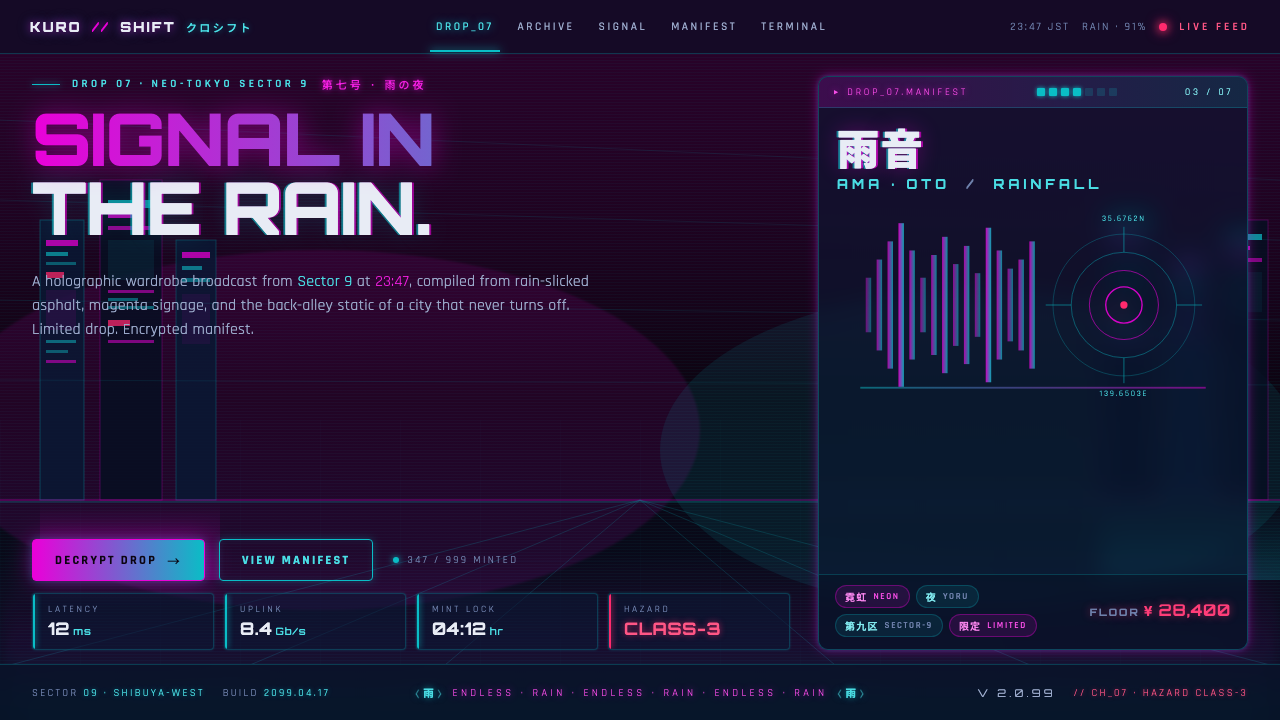 Neo-Tokyo 2099Endless rain, a thousand signs. Magenta vs cyan on near-black asphalt, kana b…
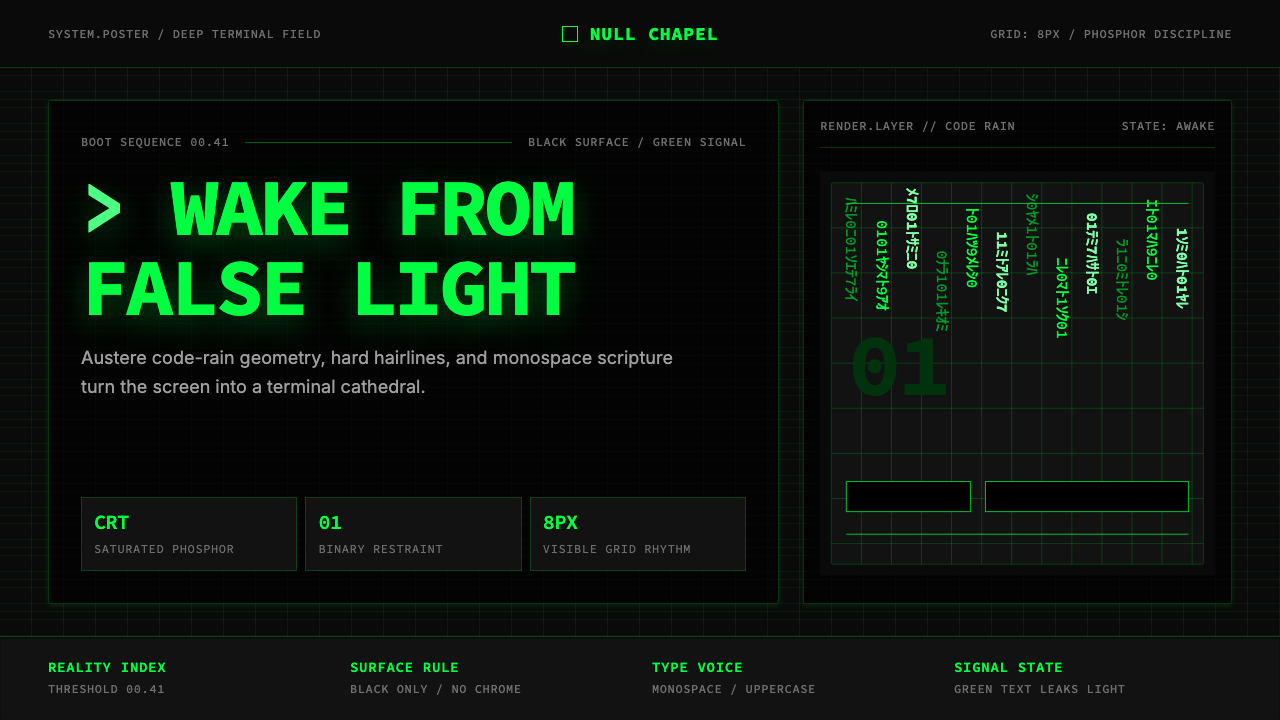 The Matrix (Green-Code)Terminal myth, disciplined. CRT green code rain, black grid, monospace script…
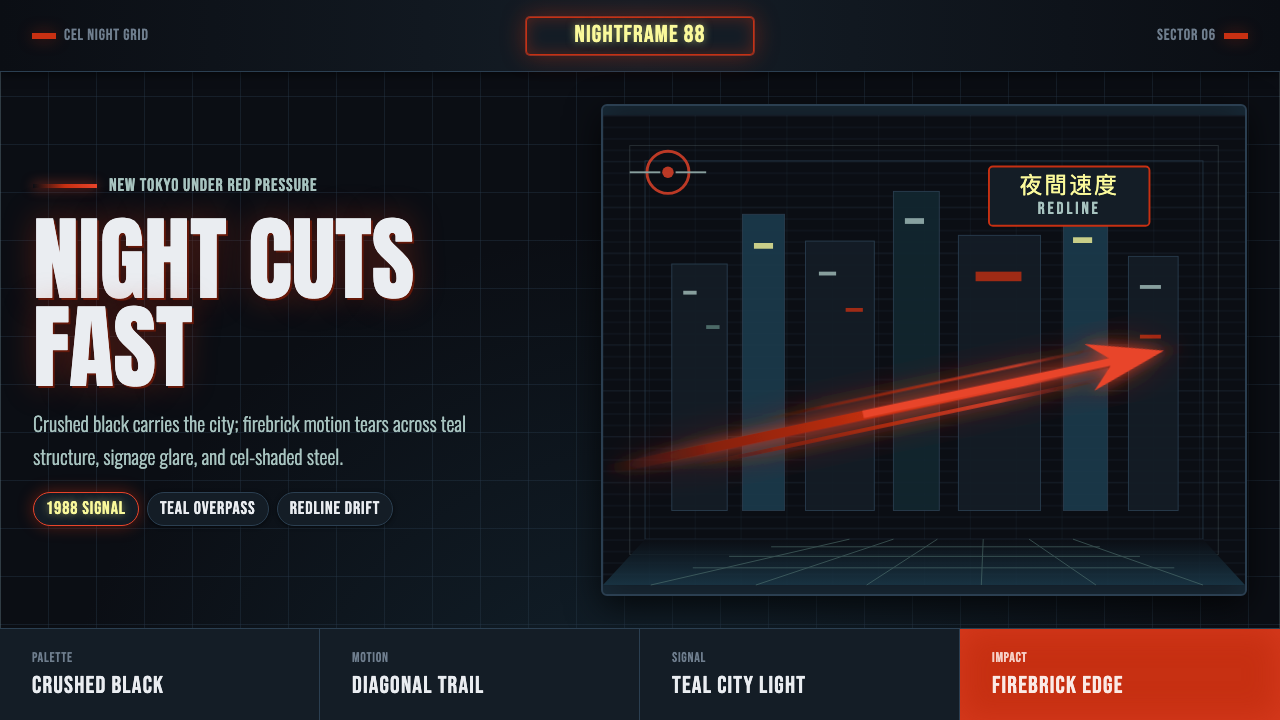 Akira Neo-TokyoNight moves fast. Firebrick trails cut crushed black, teal grids, and condens…
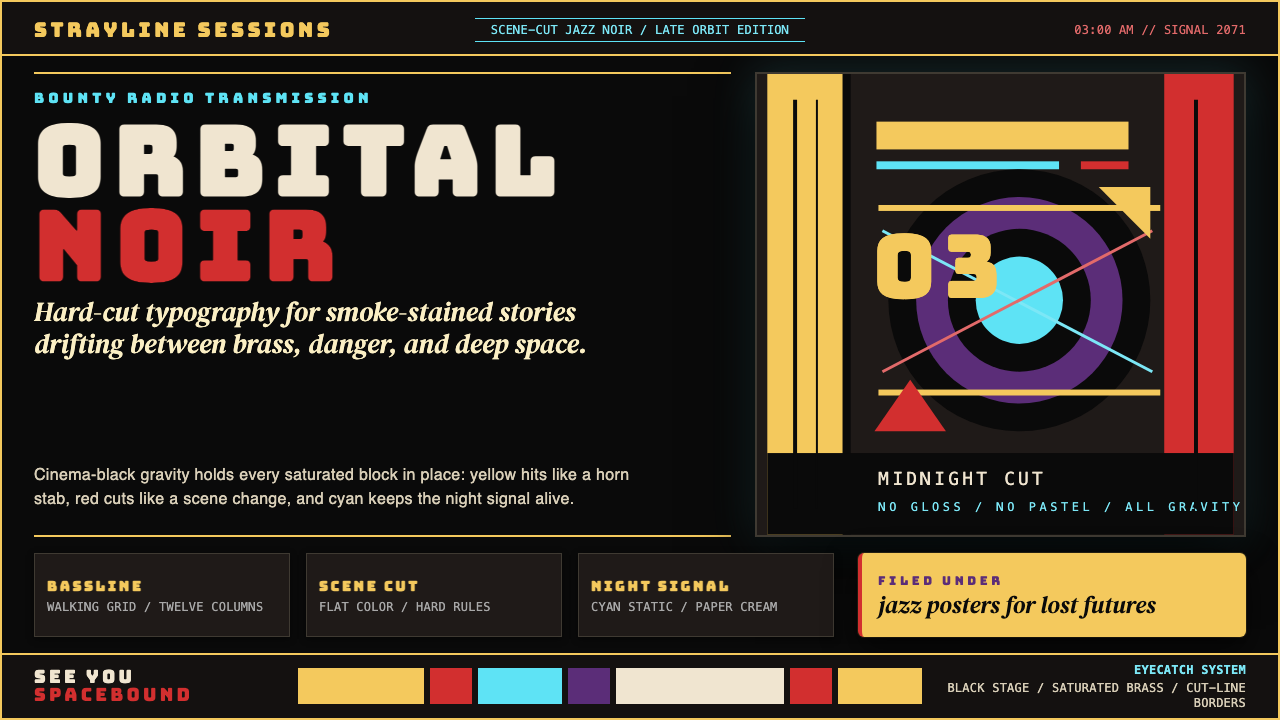 Cowboy Bebop Jazz-NoirCool at 3 AM. Bungee type, jazz yellow, red cuts, and cyan rules hit deep bla…
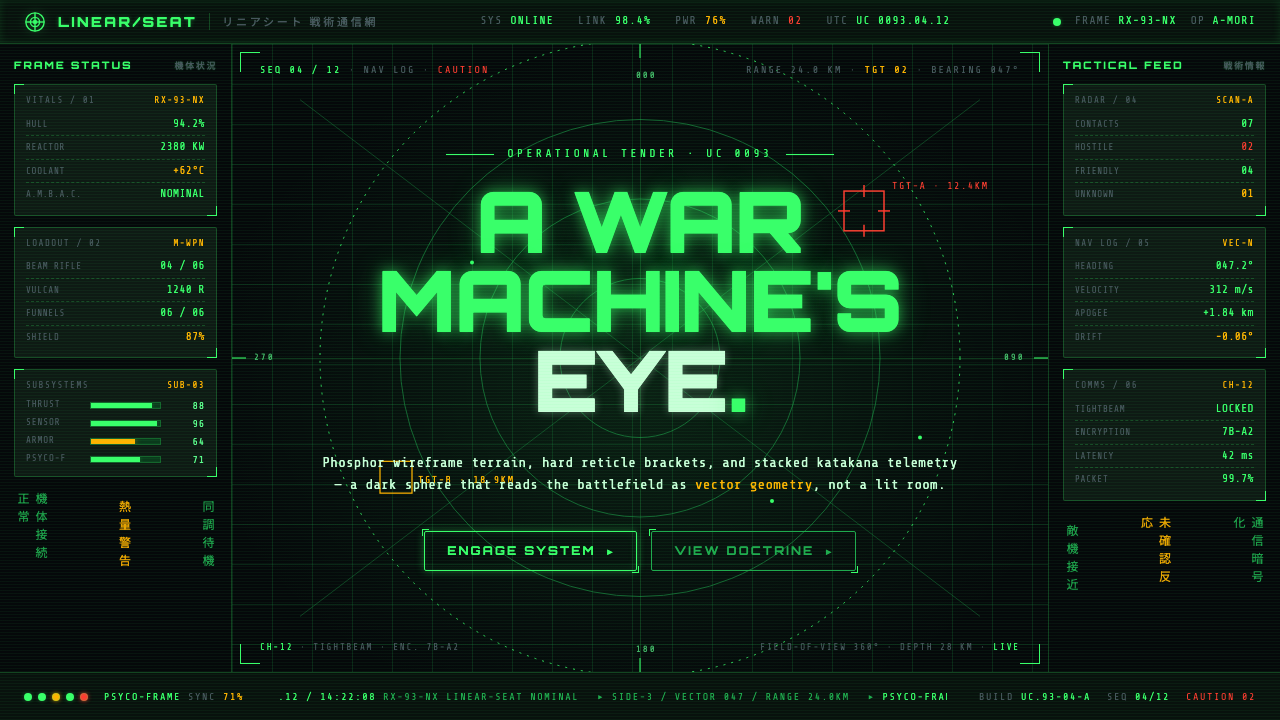 Gundam Universal Century UIA war machine's eye. Phosphor wireframe and katakana telemetry glow inside a…
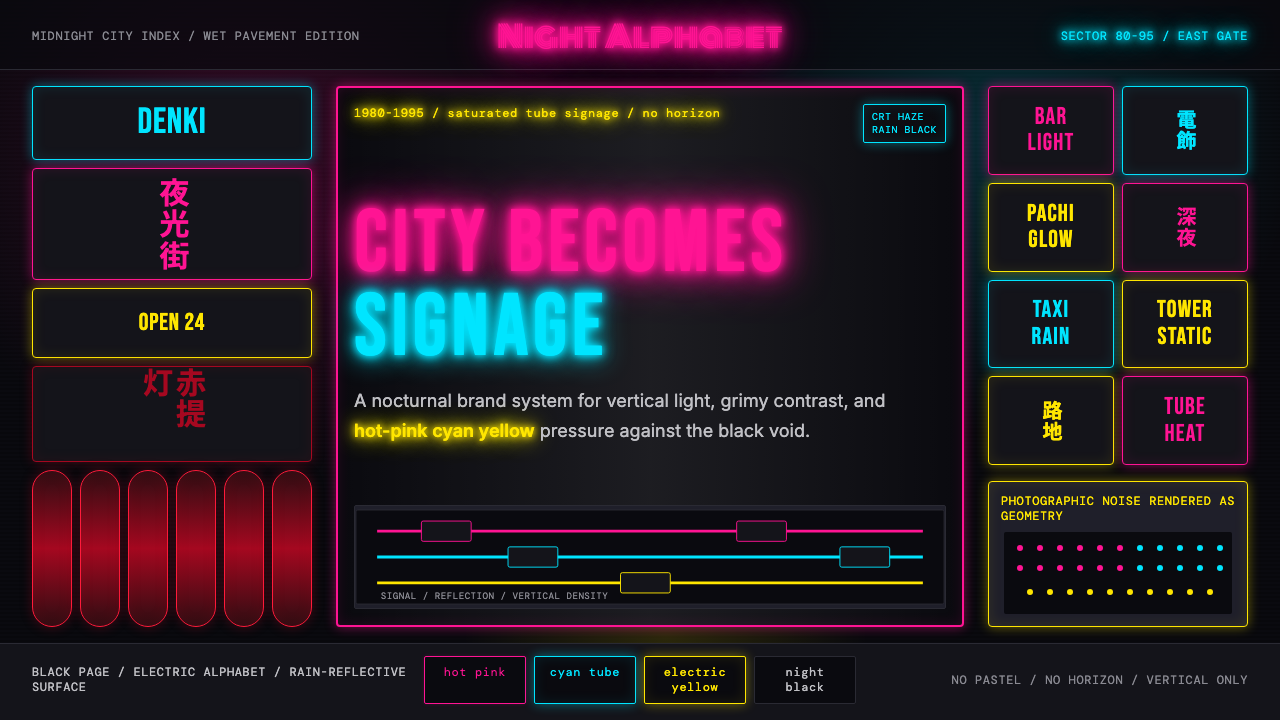 Tokyo Shinjuku Neon (1980)Night turns into alphabet. Hot pink, cyan, and yellow stack as glowing vertic…