What is The Matrix (Green-Code)?
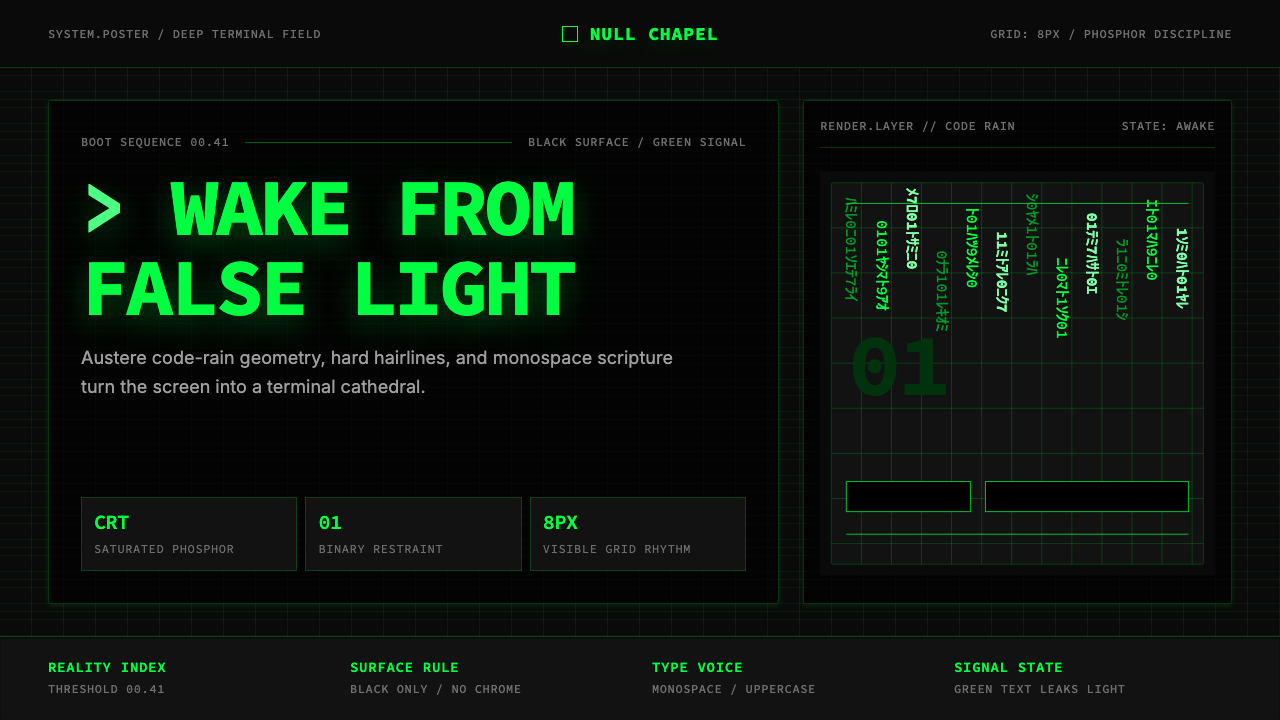
The Matrix distilled cyberpunk into two colors — saturated terminal green and absolute black — and made the command line feel like a religion.
The Matrix (Green-Code) in brief
The Matrix aesthetic is a design language born from a single, decisive visual choice: the entire world of information is rendered as glowing green characters cascading down a black field. Released in 1999, the film directed by the Wachowskis synthesized decades of cyberpunk literature, hacker culture, and Japanese digital mythology into a visual system so coherent that it became instantly and permanently iconic. The look is simultaneously austere and electric — a terminal pretending to be a cathedral.
At its core, the system operates on radical restraint. Only two tones do any meaningful work: a phosphorescent Matrix-green that pulses with the suggestion of cathode-ray tube light, and a near-absolute black that acts as the void the green is falling through. Monospace typography is not merely a stylistic choice but a philosophical statement — every character is a unit of code, equally spaced, equally weighted, as if the fabric of reality has been laid bare as data. There is no decoration that does not also function as information.
This design vocabulary has outlived its source film through four sequels and twenty-five years of cultural transmission. It now operates as a widely recognized shorthand for a specific cluster of values: technical authority, hidden knowledge, the tension between control and liberation, and the suspicion that the visible world is a layer built on top of something more fundamental. When applied to product design, it carries all of that cultural weight — which is both its power and its risk.

Where does The Matrix (Green-Code) come from?
The Matrix was released by Warner Bros. in March 1999, principal photography having taken place in Sydney, Australia. The Wachowskis drew consciously from multiple visual traditions: the green phosphorescent glow of early CRT monitors, the cascading katakana sequences invented for the film's title sequence by visual effects supervisor John Gaeta, and the anime Ghost in the Shell (1995), which the directors showed to the studio as a visual reference before a single frame was shot. Ghost in the Shell had already established the idea that digital consciousness could be expressed as visible cascading data — the Matrix team took that premise and made it the literal appearance of reality itself.
The specific choice of katakana characters for the falling code was made by production designer Owen Paterson and the VFX team as a nod to the influence of Japanese science fiction and the Pacific Rim cyberpunk literary tradition established by William Gibson's Neuromancer (1984). The characters were stylized and mirrored — deliberately unreadable as actual Japanese text — transforming language into pure visual texture. Cinematographer Bill Pope shot the film in a deliberately desaturated palette outside the Matrix simulation, reserving warmth and color saturation almost exclusively for sequences inside the simulated world, making the green-code aesthetic feel like an X-ray of the false reality rather than the false reality itself.
The cultural timing was precise. 1999 was the eve of Y2K, a moment when mainstream culture was simultaneously fascinated and terrified by the idea that civilization depended on invisible code running in machines nobody fully understood. The Matrix gave that anxiety a visual form: the world as green text on black, running whether or not any human was watching. Don Davis's score layered industrial sound design with orchestral weight, reinforcing the idea that the code-world was not cold and mechanical but mythic and alive. The film grossed over four hundred and sixty million dollars worldwide and won four Academy Awards for technical achievement.
The aesthetic endured through two sequels in 2003 — The Matrix Reloaded and The Matrix Revolutions — and returned with The Matrix Resurrections in 2021, each iteration refining and sometimes recontextualizing the visual language. Beyond the films, the green-code look saturated hacker culture, cybersecurity conference branding, technology marketing, and eventually mainstream UI design to such a degree that it now operates independently of its source. A generation of developers and designers learned to associate the aesthetic with authenticity, expertise, and the idea that beneath the user-friendly surface of things, something more powerful and more honest is running.
What defines the The Matrix (Green-Code) look?
Color — Two-Tone Discipline
The palette is a strict duopoly: a single saturated green with the quality of phosphor light emitted by a cathode-ray tube, set against a background that approaches but never quite reaches pure black — there is always a trace of the screen's self-illumination in the void. No secondary or tertiary colors are introduced. Accent states and hover effects are handled by modulating the brightness or opacity of that single green, not by adding hues. The discipline is absolute: any color outside this range reads as a deliberate breach of the system.
Typography — Monospace as Scripture
Monospace letterforms are the only acceptable voice for this system. The equal spacing of every character — whether a narrow letter or a wide one — carries the implicit message that information is data, not expression. Headlines are set in monospace at a weight that feels heavy by the standards of terminal text but is still unmistakably machine-made. Body text is compact, tightly leaded, and set at a size that recalls the density of a terminal screen. Mixed-width typefaces break the system's foundational logic irreparably.
Luminosity — Phosphor Glow
The system is not simply dark-background-with-light-text; it is a simulation of a screen that is itself emitting light. Key elements — primary headlines, active states, critical data values — carry a soft outer radiance that suggests they are generating photons rather than reflecting them. This glow is subtle and directional: it bleeds outward from the character edges into the surrounding black rather than emanating uniformly. The effect distinguishes the aesthetic from generic dark-mode design and roots it in the specific physics of cathode-ray technology.
Grid — Terminal Rigidity
Layouts are governed by an invisible but absolute grid — the character grid of a terminal, where every element aligns to the same invisible cell structure. There are no rounded compositions, no organic arrangements. Dividers are hairlines: single-pixel-weight lines that carry more visual authority than decorative rules precisely because they claim almost no space. Spacing is generous and consistent, treating the black ground as active breathing room rather than empty waste. Zero-radius corners on interactive components enforce the system's refusal of organic form.
Motion — The Cascade
When animation is present, it moves in one direction: downward, at a pace that suggests data streaming rather than decorative choreography. Characters enter from the top and dissolve at the bottom, with the brightest and most legible characters mid-fall and the faintest approaching the end of their journey. Loading states, background textures, and atmospheric effects all borrow from this vertical cascade logic. Horizontal motion, scaling animations, and bounce curves all read as foreign to the system — only linear, directional movement is native.
Texture — Scanline and Noise
Pure flat color is almost never used in isolation. The aesthetic calls for subtle texture derived from the physical properties of the CRT screen: faint horizontal banding that evokes the scanline structure of analog displays, and a very fine grain that recalls the phosphor coating's uneven surface. These textures are applied at low opacity so they never compete with the primary green-on-black composition, but their presence transforms what might otherwise read as generic dark UI into something that suggests age, physicality, and analog warmth beneath digital coldness.
Zero Decoration
Every visual element must justify its presence as either structure or information. There are no ornamental borders beyond functional hairlines, no gradient backgrounds added for visual richness, no icons that are merely decorative. If a terminal would not display it, it should not appear. This principle is more demanding than general minimalism because it demands a specific justification — not 'is this simple enough?' but 'would this appear on a command-line interface?' The question filters out a surprising range of contemporary UI conventions.

Who shaped The Matrix (Green-Code)?
The Wachowskis wrote and directed all four Matrix films, establishing and then reinterpreting the visual language across a span of more than two decades. Their synthesis of Hong Kong action cinema, Japanese anime, western philosophical tradition, and American cyberpunk literature produced a coherent aesthetic world rather than an assembled pastiche. Their decision to root the film's visual identity in the specific material quality of CRT phosphor light — rather than in abstract digital imagery — gave the green-code aesthetic its tactile, almost nostalgic quality, which proved far more durable than contemporaneous digital effects work that aimed for photorealism.
Gaeta led the visual effects team that developed both the iconic code-rain sequence and the bullet-time photography technique that became the film's other defining visual signature. His work on the code-rain established the specific visual grammar of the falling characters: the variation in brightness from top to bottom of each column, the slight variation in fall speed between columns, and the way individual characters resolve briefly into legibility before dissolving. These details gave the cascade the quality of a living system rather than a screensaver. Gaeta and his team won the Academy Award for Best Visual Effects in 2000.
Paterson designed the physical environments of the Matrix trilogy, solving the central challenge of making two visually distinct worlds — the simulated Matrix and the real world of Zion — feel coherent within a single film. His decision to render the Matrix's code in katakana characters honored the Japanese science-fiction influences that shaped the project while making the code visually distinct from any real programming language, thus preserving its mythic quality. The sets he designed for the real-world sequences — all exposed machinery, organic curves, and warm tungsten light — form the visual counterargument to the green-code world that makes the latter feel like a cage.
Pope made the crucial decision to shoot the film's exterior-to-Matrix world with a strong blue-green color cast — desaturating and cooling all scenes set in the simulated world — while warming the real-world sequences. This meant the green-code aesthetic was not just a special-effects element but was embedded in the photochemical quality of the image itself. The practical consequence for design appropriation is significant: the Matrix green does not simply sit on black; it has the quality of light that has passed through a specific atmospheric filter, which is why it reads as eerie and artificial rather than merely vivid.
Though not a direct creator of the Matrix films, Gibson's 1984 novel Neuromancer established the conceptual and aesthetic vocabulary on which the Wachowskis drew — most critically, the idea of cyberspace as a visual and navigable space, and the word 'matrix' itself as a term for the networked digital world. Gibson's prose style also modeled the aesthetic of monospace information density: his descriptions of the digital world are technical, austere, and deliberately stripped of warmth, establishing the literary template for how code-as-reality should feel on the page and, ultimately, on the screen.
How do you use The Matrix (Green-Code) today?
The Matrix aesthetic is among the most specific and demanding historical styles to apply well in product design, because it carries a powerful cultural pre-load that works for you when the context is right and against you when it is not. Before committing to it, the question to answer honestly is: does this product actually want to evoke technical authority, hidden knowledge, and a slight sense of danger? If the answer is yes — cybersecurity tools, developer platforms, data infrastructure products, technical documentation, and certain fintech or analytics contexts — the style delivers enormous signal efficiency. If the answer is no, the style will create cognitive friction between the aesthetic and the product's actual intent.
For presentation slides, the system works powerfully on cover and section-break pages. A cover benefits from maximum restraint: the product name or talk title set in monospace against deep black, a thin phosphor-green hairline as the only accent, and nothing else. Resist the temptation to add the falling-code animation unless the presentation context genuinely warrants it — used casually, it reads as costume rather than conviction. Content slides should treat text as terminal output: tight leading, generous left margin, text hierarchies differentiated by size and brightness of the green alone, no decorative elements. Data slides become dashboards: numerical values carry the most visual weight, labeled with the smallest legible monospace text, with color intensity used to signal criticality rather than decoration.
For web interfaces, the style is exceptionally well-suited to dashboards, API documentation, status pages, and developer-tool landing pages. The grid should be strict and columnar, with elements snapping to an underlying character-grid logic. Navigation should be purely typographic — no icon-only elements, no rounded pill labels. Interactive states should be distinguished through brightness changes in the green — active elements glow more intensely than inactive ones — rather than through color additions. Cards and containers use hairline borders rather than background fills, and their corners are unequivocally square. For pricing pages, the style's two-tone discipline works well for tier differentiation: the recommended or featured tier can step up to full phosphor-green brightness while others remain at reduced luminosity.
For editorial and marketing work, the style is best deployed as a contrast device rather than a full-system application. A technical white paper with a Matrix-styled cover and section headers — all other pages clean and legible — uses the aesthetic as a signal of technical seriousness without making the document exhausting to read. Marketing pages for developer tools can use a full-bleed Matrix-styled hero section, transitioning to a more neutral background for feature and pricing content. The green-on-black treatment is especially effective for code examples and terminal demonstrations, where it is literally accurate as well as stylistically appropriate.
A common mistake when applying this aesthetic is treating it as a dark mode with green accents. The error shows up as: rounded corners surviving from the base design system; multiple accent colors appearing alongside the green; soft drop shadows borrowed from the light-mode version; and body text set in a proportionally-spaced typeface rather than monospace. Each of these choices is individually small but collectively they dissolve the system's identity into generic dark UI. The other common failure is over-application of the falling-code motif as background texture — the cascade works as an ambient element at very low opacity, but used prominently it competes with content and signals that the designer found the reference more interesting than the product it is supposed to serve.

The Matrix (Green-Code) — FAQ
Is this aesthetic only appropriate for technical or developer-facing products?
Not exclusively, but the cultural associations are strong enough that a non-technical product using it needs a deliberate conceptual justification. The aesthetic works outside strictly technical contexts when the product's identity genuinely intersects with its core values: hidden-layer revelation, system-awareness, resistance to surface appearances. A financial intelligence platform, a journalism tool focused on data investigation, or an educational product about how technology works can all use the aesthetic authentically. A consumer lifestyle app or a food delivery service using it would simply read as cosplay — the style would signal values the product does not hold.
How do you maintain legibility in an all-dark, monospace system?
Legibility in this system depends on contrast and hierarchy more than it does in a standard light-mode design, because the compressed tonal range — working with brightness variations of a single green rather than multiple hues — demands much more deliberate sizing and weight decisions. The primary rule is to establish a clear luminosity ladder: the most important element on any given view should be at the highest brightness of the green, secondary elements at a noticeably lower value, and tertiary information approaching the minimum contrast threshold. Body text should be set at a size that accounts for the monospace letterform being somewhat narrower than a proportional typeface at the same point size. Generous line spacing compensates for the visual density of monospace setting.
What distinguishes an authentic application of this aesthetic from a cheap imitation?
The fastest diagnostic is to look at what happens when there is no content. Cheap imitations fill empty space with falling-code background animations, decorative scanline overlays, and gratuitous glow effects on every element. An authentic application is almost ascetically empty — the black is allowed to be just black, the hairlines are given room to breathe, and special effects like glow or texture are deployed so sparingly that they register as meaningful when they appear. The second diagnostic is typography: imitations typically use a single monospace font for one headline and then revert to a proportional typeface for everything else. Authentic application commits to monospace throughout, accepting the visual density and solving it through hierarchy rather than by switching systems.
Can the Matrix aesthetic work in a light-background context?
Technically possible but fundamentally misaligned with the system's logic. The phosphor-glow quality of the green — its defining visual property — only reads as luminous against a dark background; on a light ground, the same green becomes an ordinary saturated color with no suggestion of screen-emission. The monospace typography retains its connotations on either background, but without the dark-field context it reads as developer-tool reference rather than mythic terminal aesthetic. A light-ground version of the system is better described as a technical or utilitarian monospace design inspired by terminal conventions — a valid approach but a different system, not an extension of this one.
How does this aesthetic age, and is it at risk of feeling dated?
The green-code aesthetic has already survived one full generational cycle since 1999 and shows no signs of becoming inert — partly because it is periodically refreshed by new Matrix installments, and partly because each new generation of developers encounters it through terminal emulators, code editors, and hacker culture before encountering the film. The risk of datedness is real but specific: it arrives when the aesthetic is used by products that are not genuinely technical, chasing an association they have not earned. When a product that authentically operates in the domain of code, systems, and data uses this visual language, it reads as native rather than nostalgic. The CRT-phosphor quality may eventually read as retro in the same way vinyl album art does — a deliberate evocation of an older technology — but that retro quality is itself culturally loaded and far from neutral.
Related design styles
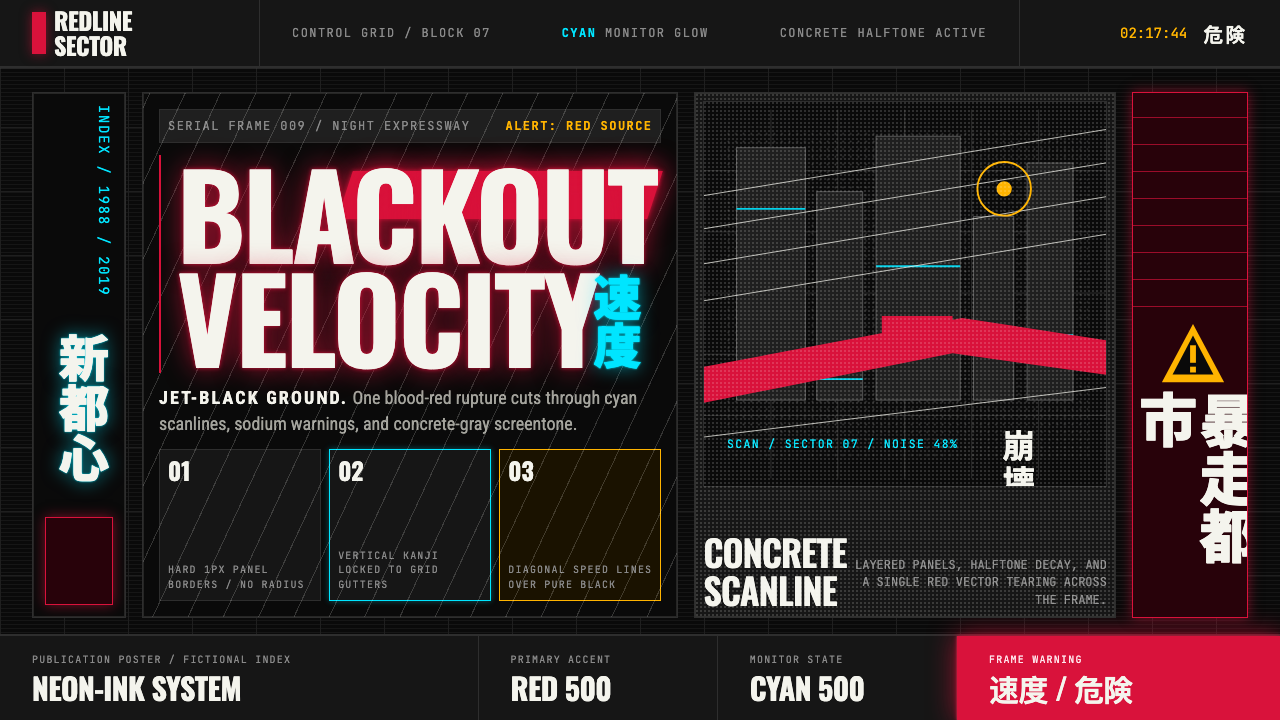 Akira (Otomo)Cyberpunk at impact. Kaneda red, cyan kanji, halftone concrete, and diagonal…
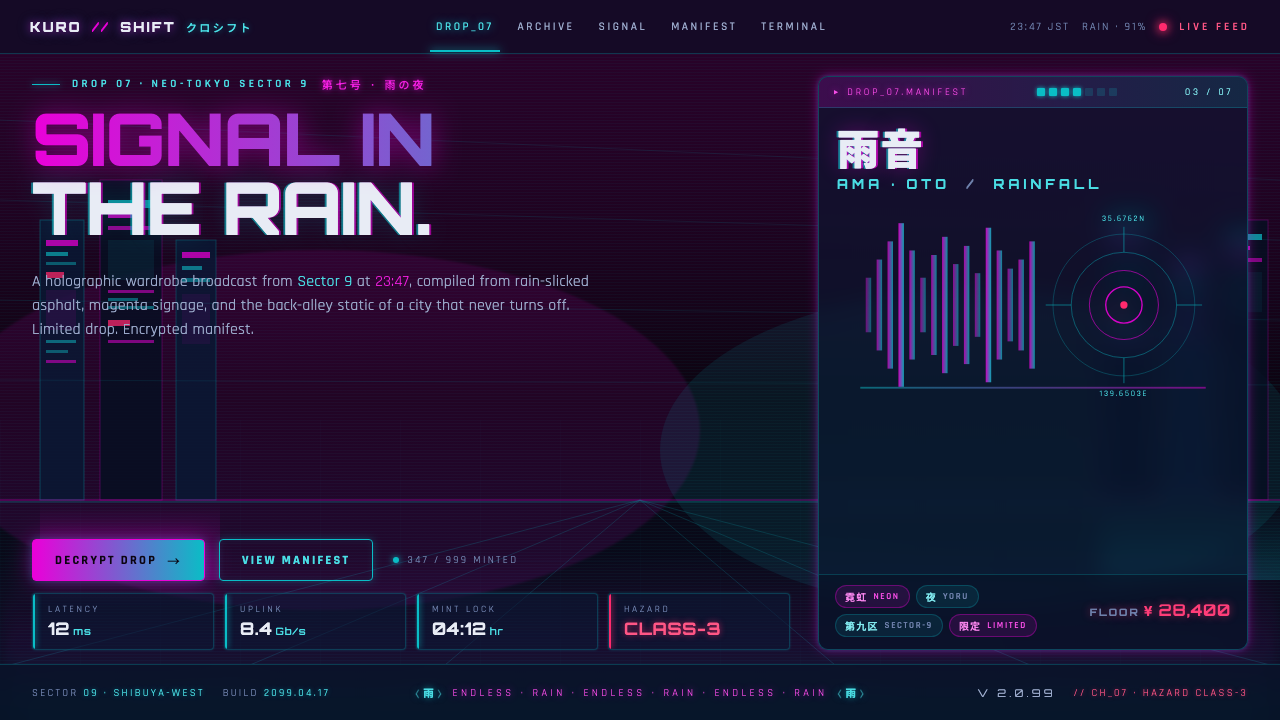 Neo-Tokyo 2099Endless rain, a thousand signs. Magenta vs cyan on near-black asphalt, kana b…
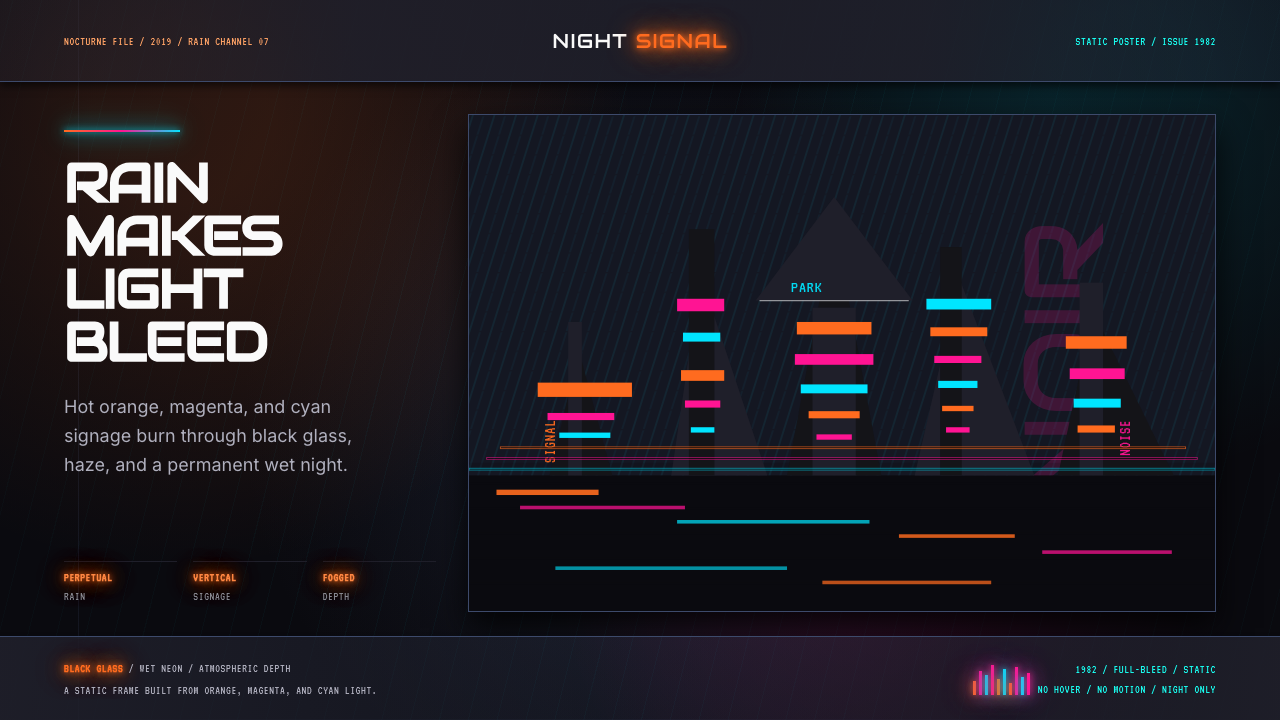 Blade Runner 1982 Neon NoirRain-soaked noir. Orange, magenta, and cyan neon cut black glass.
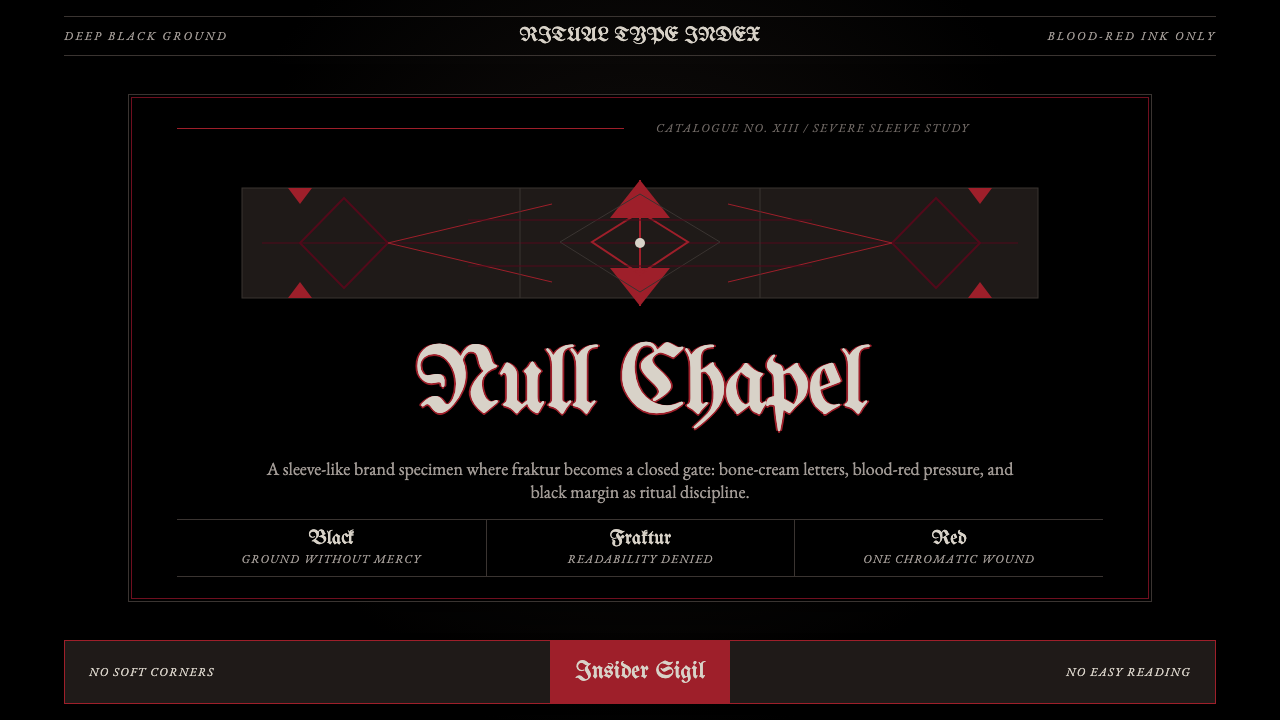 Death Metal BlackletterUnreadable by design. Bone fraktur on black, cut by one blood-red geometric s…
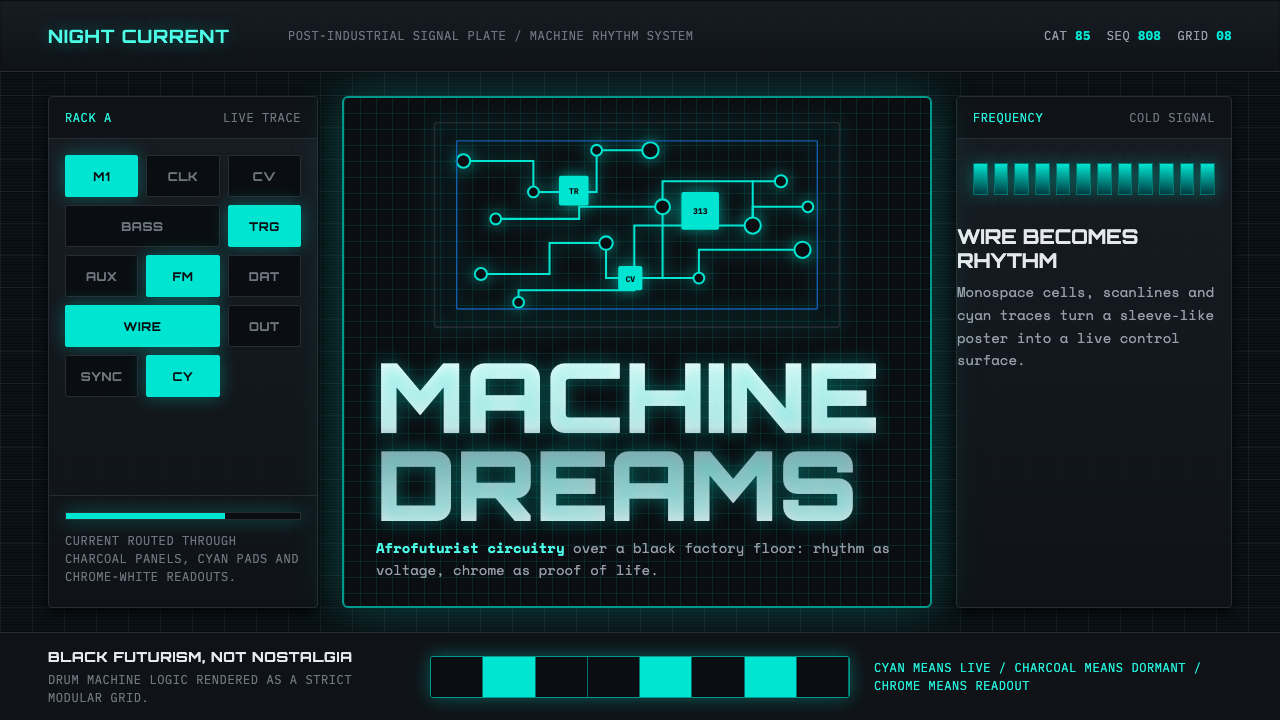 Detroit TechnoCold machines dream. Electric cyan circuits and chrome display type lock to a…
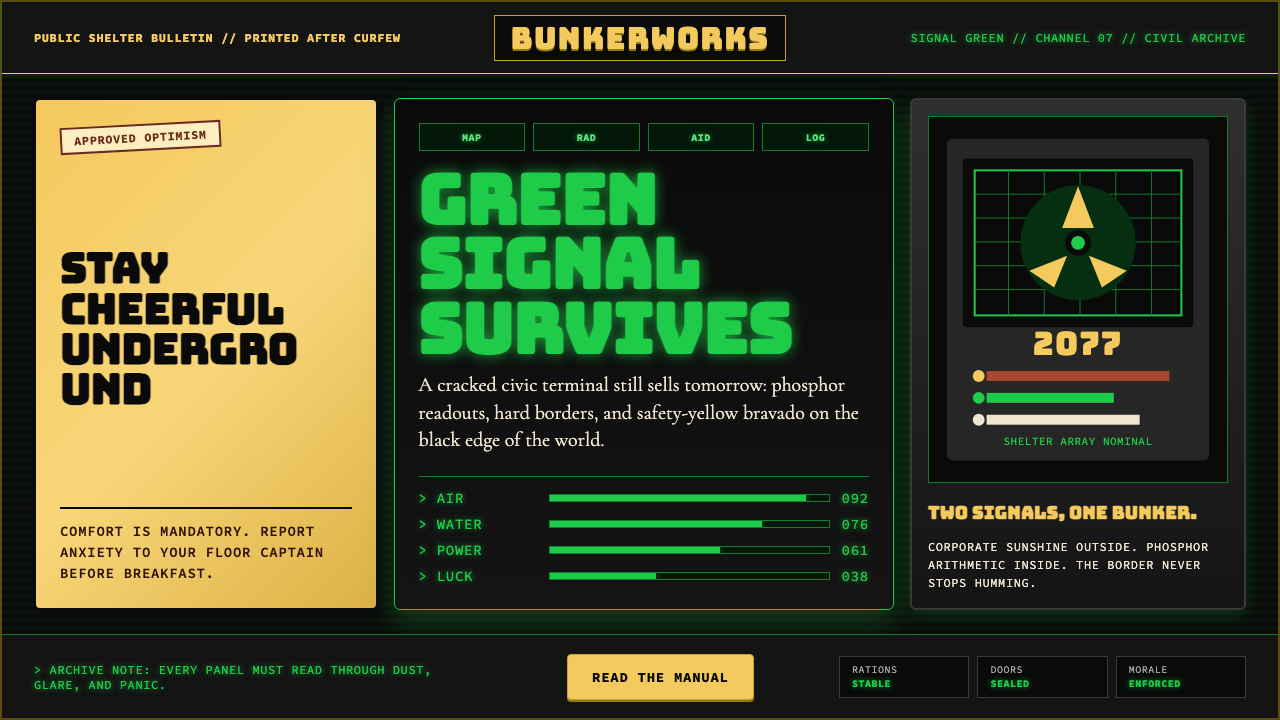 Fallout Vault-Tec Pip-BoyIrradiated optimism. Vault yellow and CRT green lock into a bordered bunker g…