What is Blade Runner 1982 Neon Noir?
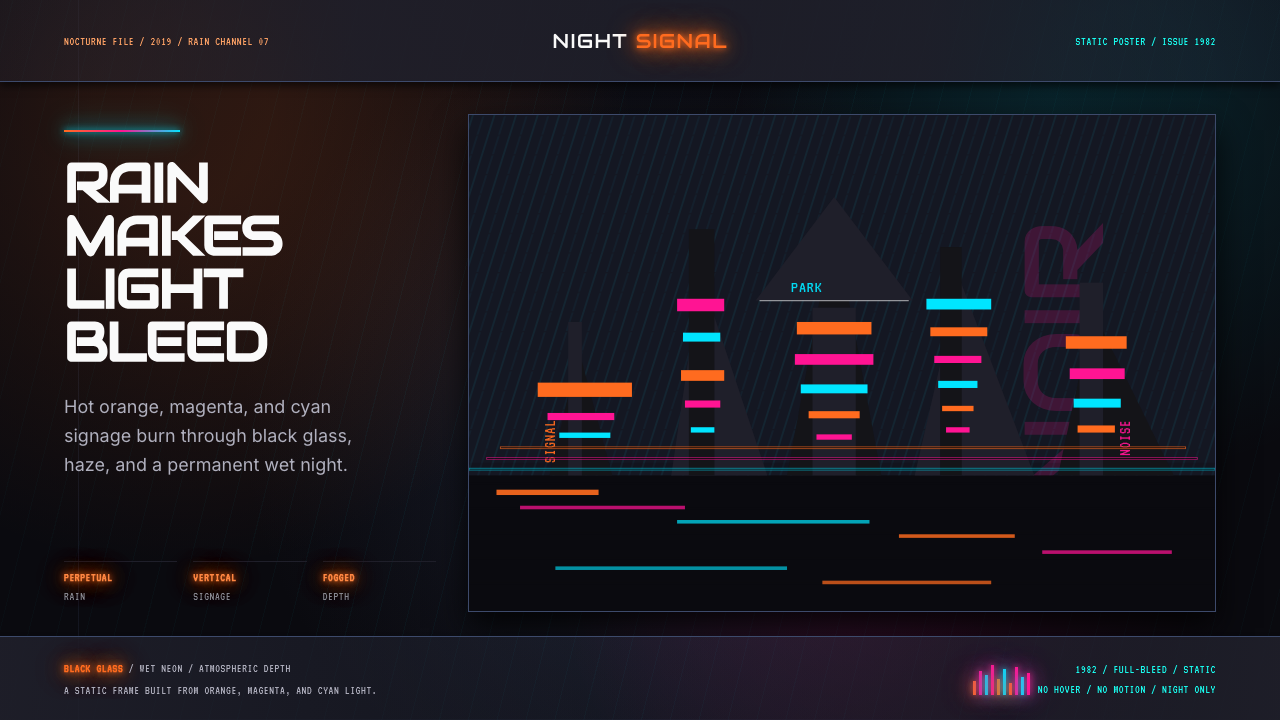
Ridley Scott's 1982 masterpiece burned a single visual grammar into culture: perpetual rain, saturated neon bleeding through black fog, and the beautiful dread of a future that never cleaned itself up.
Blade Runner 1982 Neon Noir in brief
Blade Runner Neon Noir is the visual language distilled from Ridley Scott's 1982 film — a system built on near-total darkness punctuated by hot-orange and magenta neon, washed in cyan atmospheric haze, and layered with the humid texture of perpetual rain. It is the canonical aesthetic of cyberpunk cinema: retrofitted technology colliding with decayed grandeur, vertical signage towering in languages that no longer belong to any single nation, and a chromatic palette where warmth and cold exist in violent simultaneous tension.
The style is simultaneously dark and luminous. Backgrounds are almost uniformly deep — ink blacks and ash grays — but every surface catches reflected light. Neon spills across wet pavement, bleeds through frosted glass, and halos the silhouettes of figures moving through fog. This light is never clean or directional in the way daylight is; it is ambient, diffused, competing. The result is a visual world that feels dense rather than empty despite its heavy use of darkness.
What separates Blade Runner Neon Noir from generic 'dark mode' design is its specificity of atmosphere. Generic darkness is uniform and flat. This aesthetic has weather: gradients of fog that shift depth, pools of color that define zones rather than fill them, and the sense that every lit element is fighting the surrounding darkness rather than simply existing against it. It is a style about tension — between warmth and cold, between human scale and monumental architecture, between beauty and menace.

Where does Blade Runner 1982 Neon Noir come from?
Blade Runner opened in American theaters on June 25, 1982, directed by Ridley Scott from a screenplay by Hampton Fancher and David Peoples, adapted from Philip K. Dick's 1968 novel Do Androids Dream of Electric Sheep? The film was troubled in production and received a mixed critical reception on release, yet its visual design was immediately recognized as unprecedented. Set in Los Angeles in November 2019, the film imagined a city that had grown without coherence — a dense vertical accretion of architectural eras, cultures, and technologies that had never been reconciled or cleaned up.
The visual world of Blade Runner was the creation of a small team working with unusual creative latitude. Production designer Lawrence G. Paull and his team built the 'Enhancements' — the retrofitted street-level environment — on the backlot Warner Bros. set known as the New York Street, layering it with neon signage drawing from Japanese, Chinese, and Arabic scripts, steam vents, and practical rain rigs that operated continuously during filming. Conceptual artist and futurist Syd Mead, who had worked for Ford and U.S. Steel before entering film, developed the visual concept of 'retro-fitting': the idea that future technology would not replace old infrastructure but would be bolted onto it, creating a world of accumulated temporal layers. His vehicle and environmental designs gave the film its distinctive look of high technology weathered into urban grime.
Director of photography Jordan Cronenweth made choices that broke with the conventions of science fiction cinematography. Rather than the clean, high-key lighting typical of optimistic futurism, Cronenweth used deep shadows, motivated practical lights — neon signs, street lamps, desk lamps — and smoke and rain as diffusion media. The palette emerged from the practical light sources on set: sodium vapor street lamps casting orange warmth, blue-tinted industrial illumination, and the competing colored neon of signage. The film was shot almost entirely at night or in controlled interior environments, giving it a consistency of atmosphere that would have been impossible in daylight.
The film's cultural afterlife was enormous and slow-building. Blade Runner performed modestly at the box office in 1982 — it was competing against E.T. the Extra-Terrestrial — but entered heavy cable television rotation and became a formative visual reference for a generation of artists, designers, and filmmakers in the mid-1980s. The release of the Director's Cut in 1992 and the definitive Final Cut in 2007 introduced the film to successive new audiences. By the time cyberpunk had crystallized as a literary and visual genre — through William Gibson's Neuromancer in 1984, and through the work of Japanese artists and animators who found Blade Runner's dense urban layering directly applicable to their own aesthetic traditions — the film's visual vocabulary had become a shared cultural inheritance. Its influence on video game art, graphic design, fashion, architecture, and eventually the aesthetics of dark-mode digital interfaces has been continuous and direct.
What defines the Blade Runner 1982 Neon Noir look?
Color and Light
The palette is built on the opposition of deep cold backgrounds and intensely warm neon foregrounds. Blacks and dark charcoals form the base; over this, hot orange, vivid magenta, and electric cyan cut through as luminous accents. The cyan typically reads as atmospheric — the color of fog, rain, and distance — while orange and magenta operate as close-range neon heat sources. No single color dominates cleanly; they bleed into each other through fog, reflection, and wet surfaces. This chromatic conflict is the emotional engine of the aesthetic.
Darkness and Atmosphere
The background is never neutral. Darkness in this aesthetic is textured and layered: it contains gradients of fog, suggestions of depth, and zones of deeper and shallower shadow. Atmospheric haze is a structural device — it creates soft separation between foreground and background, softens hard edges at a distance, and gives the impression that the world extends beyond what is visible. Rain is implied even when not shown directly, through the sheen of wet surfaces and the scattered reflection of light across any horizontal plane.
Vertical Layering and Signage
The compositional logic favors strong vertical elements. In the film, towering signage in multiple scripts — Japanese katakana, Chinese characters, Arabic numerals — stacked and overlapping, communicates a future of cultural accumulation rather than cultural replacement. In design terms, this translates to compositions that read from top to bottom, where scale contrast between large vertical elements and small fine text creates the sense of a world in excess of any single viewer's comprehension. Text is not decorative; it is environmental information competing for attention across multiple planes simultaneously.
Retrofitted Texture
A defining quality of the aesthetic is the coexistence of advanced technology and visible age. Surfaces are not pristine. They carry the evidence of accumulated use: grime on glass, condensation on metal, imperfections in neon tubes that flicker rather than glow steadily. This is Syd Mead's 'retro-fitting' principle made visual: the future does not replace the present but grows over it. In design applications, this translates to intentional roughness — grain over gradients, irregular glow edges rather than clean halos, a preference for analog imperfection over digital precision.
Silhouette and Contrast
Human figures and objects in this aesthetic frequently appear as dark silhouettes against luminous backgrounds, or as lit surfaces against near-total shadow. High contrast between illuminated and unlit areas is the default condition rather than the exception. This extreme contrast is not mere moodiness; it is a compositional tool that creates immediate reading hierarchy — the eye moves to the lightest area first, regardless of its size — and it allows multiple layers of depth to coexist in a single composition without competing.
Glow and Bleed
Light in this aesthetic does not have clean edges. Neon signs cast halos; reflections spread and distort on uneven wet surfaces; color bleeds from one element into the surrounding space. This diffusion is characteristic of practical neon lighting photographed in humid, smoky conditions — Cronenweth's actual shooting environment — and it gives the aesthetic its quality of barely-contained luminosity. Color never stays precisely where it is placed; it radiates. In design terms, glow is structural, not decorative, and elements that glow should feel like they are genuinely emitting light rather than having a filter applied.
Scale and Alienation
Blade Runner's architecture operates at a scale that dwarfs the human figure deliberately. The Tyrell Corporation's pyramid, the Bradbury Building adapted as J. F. Sebastian's residence, the canyon-like streets formed by close-packed towers — all communicate a world built for the accumulation of capital and power rather than human habitation. In this aesthetic, small human-scale elements are in constant dialogue with monumental structures. This tension between the intimate and the overwhelming is what gives the style its specific emotional register: beauty tipped toward dread.

Who shaped Blade Runner 1982 Neon Noir?
Scott brought to Blade Runner an obsessive attention to environmental detail cultivated in his earlier career directing television commercials, where every frame had to carry maximum visual information in minimal time. His insistence on continuous rain on set — a practical and financial extravagance — was the decision that most unified the film's atmosphere. Scott's subsequent revision of the film into the 1992 Director's Cut and 2007 Final Cut, removing the studio-imposed voiceover narration and the artificially optimistic ending, clarified the aesthetic and philosophical coherence that had always been present in the images.
Mead was a visual futurist whose clients before Blade Runner included major American manufacturers. His concept of 'retro-fitting' — technology layered onto existing infrastructure rather than replacing it — gave Blade Runner its foundational spatial logic and distinguished it from the pristine, sterile futures of most science fiction cinema at the time. Mead designed the film's vehicles, the Spinner police cars and their world, and contributed to the environmental design of the street level. His philosophy that future cities would be defined by accumulated layers of technology rather than total replacement became the governing idea of the entire cyberpunk visual tradition.
Cronenweth's cinematography for Blade Runner solved the specific problem of making a world of near-total darkness legible and beautiful. His technique of 'motivated lighting' — ensuring that every light source in a scene was justified by a visible practical source within the frame — gave the film's extreme contrast a logical foundation rather than arbitrary moodiness. Cronenweth's use of smoke and rain as atmospheric diffusion materials was partly practical necessity and partly aesthetic choice, and it produced the characteristic quality of light that seems to exist in the air rather than falling on surfaces. His work on Blade Runner remains a benchmark reference for low-key, high-contrast digital cinematography.
As production designer, Paull translated Scott's and Mead's visions into physical sets that could be photographed. His key decision — to use the Warner Bros. backlot New York Street as the primary exterior environment and transform it through layered dressing into the film's Los Angeles 2019 — was both pragmatic and visionary. The 'Enhancements' he and his team added: the dense neon signage drawing from multiple real-world scripts, the steam and smoke practical effects, the vertical complexity added to existing buildings through structural additions, created the environmental grammar that every cyberpunk visual work since has referenced, consciously or not.
How do you use Blade Runner 1982 Neon Noir today?
Blade Runner Neon Noir is one of the most immediately recognizable aesthetics available for contemporary design, and precisely because of that recognizability, it demands a light and disciplined hand. The visual system is built on specific relationships — between dark and luminous, between warm and cold, between human scale and architectural excess — and those relationships must be honored for the result to feel authentic rather than like a filter applied carelessly over unrelated content.
For presentation slides, the style works exceptionally well as a cover or section-break aesthetic, less reliably as a format for sustained reading. A cover built in this language leads with a deep, fog-layered background, a large typographic element treated with a warm neon-adjacent color, and a narrow subheading in cool-toned light. The key is restraint: one or two colored elements against near-total darkness, not a field crowded with competing lights. Content slides that need this atmosphere should use the dark ground for emphasis only — isolating key statistics or callouts in pools of warm light while keeping surrounding context in dark gray rather than black, maintaining the same neon logic at a lower intensity. Data visualizations benefit greatly from selective color: a single accent color applied to one bar, one line, one wedge to direct attention, rather than a full palette applied categorically.
For web interfaces, this aesthetic is particularly well-suited to dashboards, developer tools, analytics platforms, and products that want to communicate technical seriousness and nocturnal intensity. The approach: commit to a very dark background as the base, define the primary text color as a cool near-white, and reserve the warm accent colors for interactive states, highlights, notifications, and primary calls to action. Navigation and structural chrome should live in the mid-dark range — darker than text backgrounds, lighter than the deepest shadows — creating the layered depth that is essential to the aesthetic. Borders should be subtle, defined by a slight luminosity difference rather than a bright contrasting line. Cards and panels are defined by depth rather than by hard boundaries; they are zones of slightly different darkness, not boxes.
For editorial and marketing applications, the style's cinematic quality makes it powerful for product launches, brand campaigns, and editorial features aimed at audiences comfortable with cultural references to science fiction and tech culture. A full-page feature built in this language uses a high-contrast lead image — silhouette against fog-lit background, or extreme close-up of a neon-lit surface — with typography that is large, confident, and given a warm or cold tonal cast consistent with the surrounding palette. Section markers and pull-quotes are distinguished by a shift in background depth or a narrow rule in a neon accent color rather than decorative ornament. The neon-lit color should appear rarely enough to feel like signal rather than noise.
The most common failure mode when applying this aesthetic is the addition of too many light sources in too many colors simultaneously. Authentic Blade Runner atmosphere achieves its sense of density through the relationships between a small number of specific colors — the fog is one color, the neon is one or two, the darkness is not pure black but a range of very deep values. When designers add four or five equally saturated accent colors to a dark background in an attempt to amplify the effect, the result loses all atmospheric coherence and begins to look like generic 'gaming aesthetic' rather than studied cinematic noir. The discipline is to choose one dominant warm color — orange or magenta — and one cool atmospheric color — cyan or a desaturated blue-green — and then trust the darkness to do the rest.

Blade Runner 1982 Neon Noir — FAQ
Is this aesthetic the same as generic 'cyberpunk' or 'dark mode'?
Not precisely. Generic cyberpunk and dark mode are categories; Blade Runner Neon Noir is a specific visual grammar derived from a specific film with a specific cinematographic logic. Generic dark mode uses dark backgrounds for readability and battery reasons, without atmospheric intention. Generic cyberpunk borrows neon colors but typically deploys them without the fog, the retrofitted texture, or the particular tension between warm orange-magenta and cool cyan that is central to Blade Runner's palette. The difference is in atmospheric specificity: this aesthetic has weather, depth, and a particular emotional register — the beauty of the menacing and beautiful simultaneously — that generic dark-mode or cyberpunk templates rarely achieve.
Can this aesthetic work for light-background applications?
The aesthetic is fundamentally dark-ground — the darkness is not a stylistic choice that can be reversed while keeping the same system. Light-background 'day mode' versions can borrow individual elements: the warm-to-cool chromatic tension, the typographic scale contrasts, the preference for glowing accent colors over flat ones. But the specific quality of luminous neon emerging from near-total darkness — which is the defining condition of the aesthetic — cannot be replicated on a light ground. What you get on a light background is a loosely related palette rather than the aesthetic itself. If light-background is required by the design context, consider using the Neon Noir language only for specific high-emphasis components — hero banners, data highlights, notifications — rather than as a system-wide treatment.
How do I avoid this aesthetic looking dated or clichéd?
The key is to apply the atmospheric logic rather than the surface signals. The surface signals — neon on dark backgrounds, Japanese-adjacent typography, rain textures — became clichéd in the 1990s and again in the 2010s precisely because designers applied them without understanding the underlying relational logic. The atmospheric logic — the specific relationship between a narrow range of warm and cold luminous colors against a complex dark ground, the sense that light is diffused through air rather than placed on surfaces, the scale tension between monumental and intimate — remains powerful and contemporary when applied with restraint. One practical test: if removing the neon color from your design leaves something visually coherent and well-structured, the neon is functioning as signal. If removing it leaves a visual void, the neon was structural — which means the underlying design needed more work before the atmospheric treatment was applied.
What typography works best with this aesthetic?
The film itself used a combination of large-scale sans-serif text for signage and a more condensed typeface for the film's own credits. For design applications, the aesthetic supports two typographic directions: bold, wide, high-contrast display type that references monumental signage — where the letters themselves carry weight and presence — and narrow, technical, monospaced type that references the interfaces and data readouts visible in the film. Either direction works; mixing both in a single composition creates the layering effect characteristic of the film's signage-dense environment. What does not work is light, delicate, or historically referential type — serifs, scripts, humanist letterforms — which carries associations incompatible with the aesthetic's industrial and alienated atmosphere.
Is this style appropriate for consumer-facing products, or primarily for technical and professional tools?
The aesthetic carries specific emotional associations — menace, complexity, technological overwhelm, the beauty of a world in decay — that are not universally desirable in consumer products. It works well for products where users want to feel that they are engaging with something serious, powerful, and slightly dangerous: gaming platforms, cybersecurity tools, financial trading interfaces, developer environments, entertainment products targeting audiences who appreciate the cultural references. It is poorly suited to products where warmth, accessibility, simplicity, or cheerfulness are the primary emotional goals: children's products, health and wellness applications, e-commerce contexts where trust is paramount, or any product where the user relationship depends on feeling safe and welcomed rather than impressed and slightly challenged. The style signals intensity; intensity is not always what a product should signal.
Related design styles
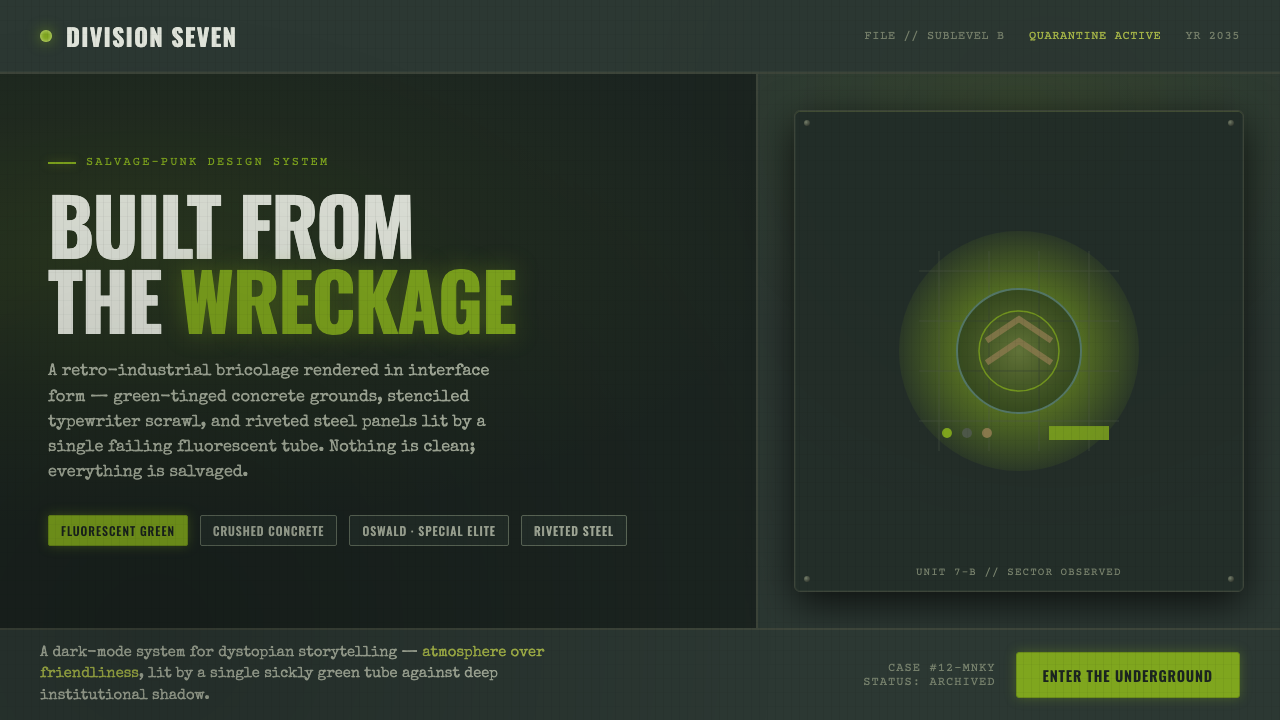 12 MonkeysBuilt from the wreckage. Sickly fluorescent green on crushed-black concrete,…
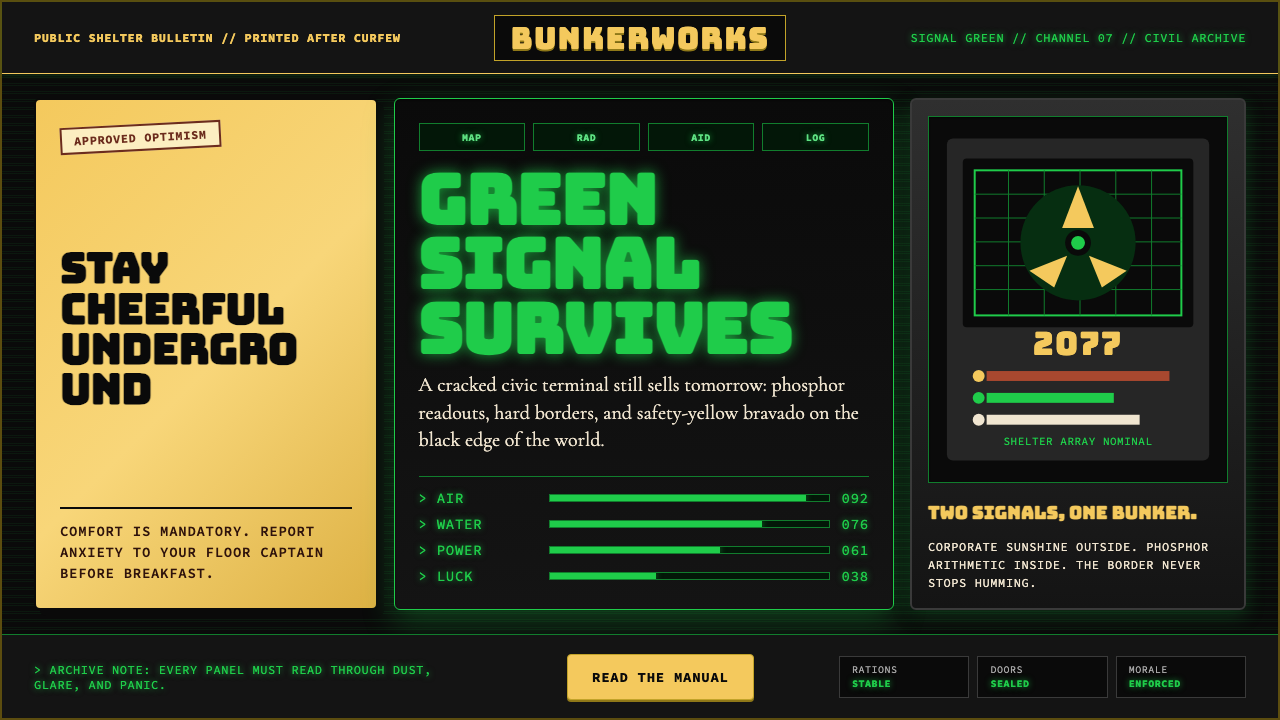 Fallout Vault-Tec Pip-BoyIrradiated optimism. Vault yellow and CRT green lock into a bordered bunker g…
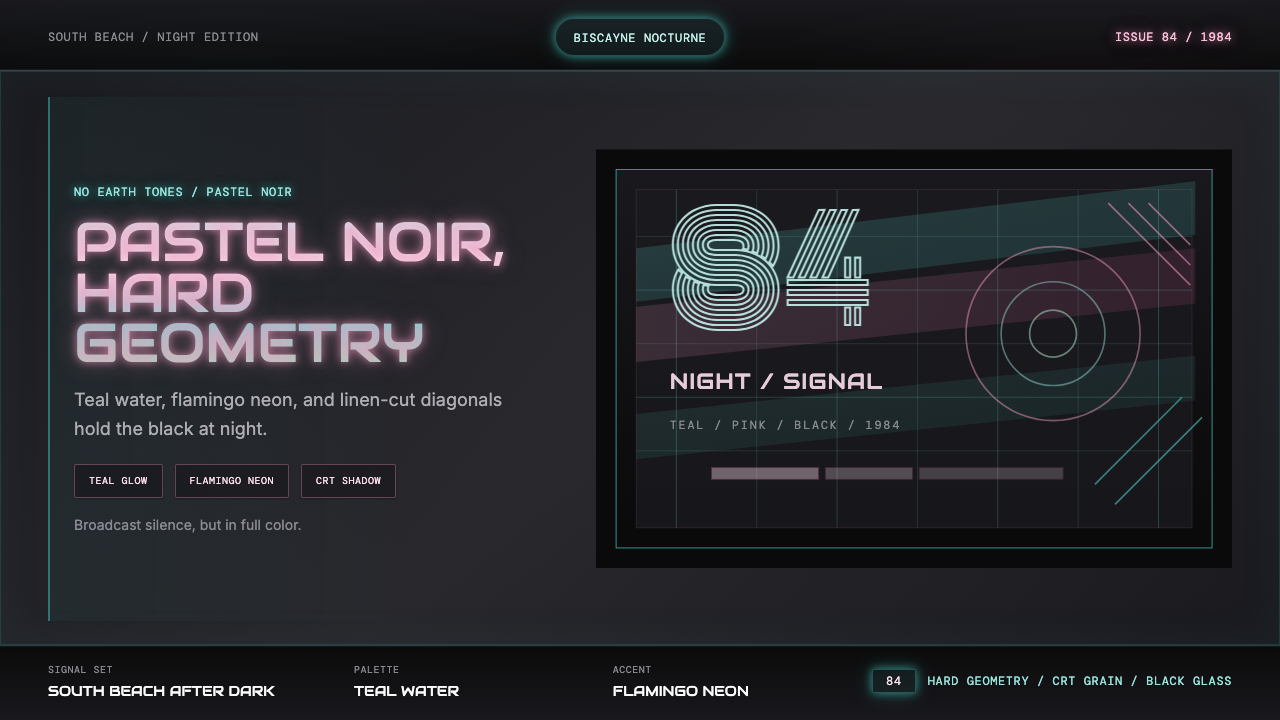 Miami Vice Pastel Teal (1984)Pastel noir, not nostalgia. Teal glow and flamingo pink slice black with geom…
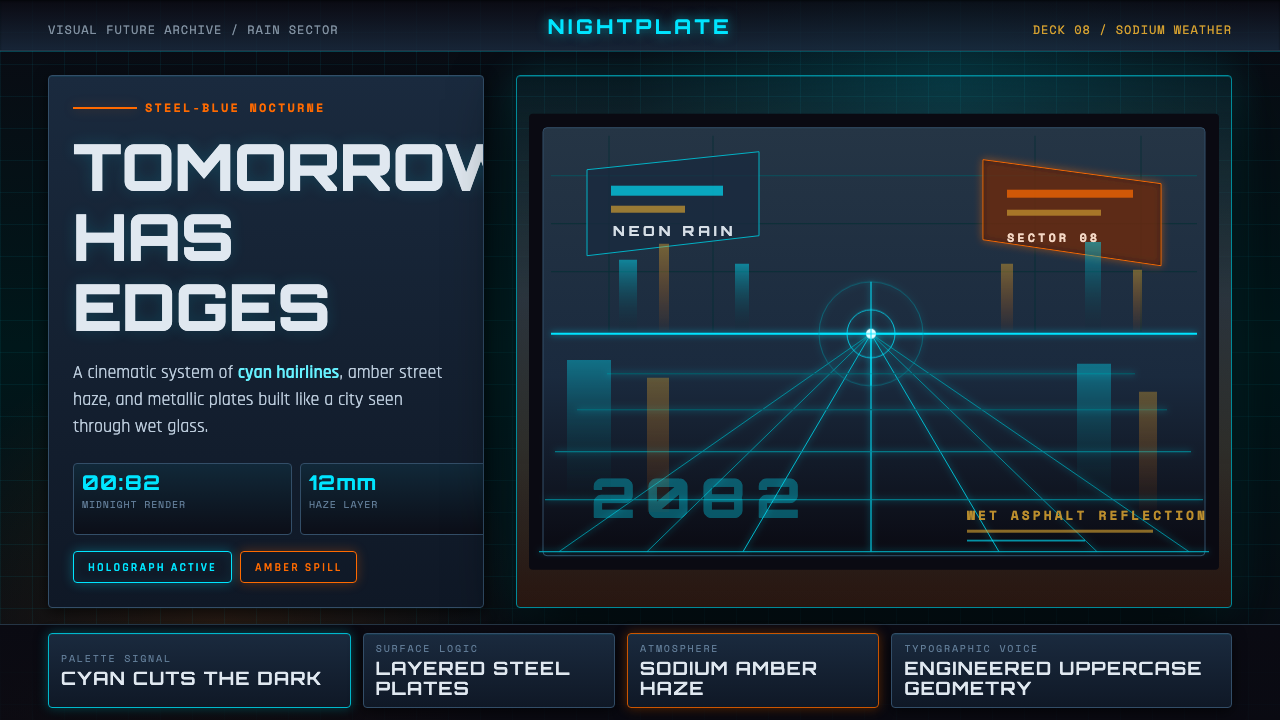 Retro-Futurism (Syd Mead)Tomorrow looks dangerous. Steel-blue night, neon cyan edges, and amber rain r…
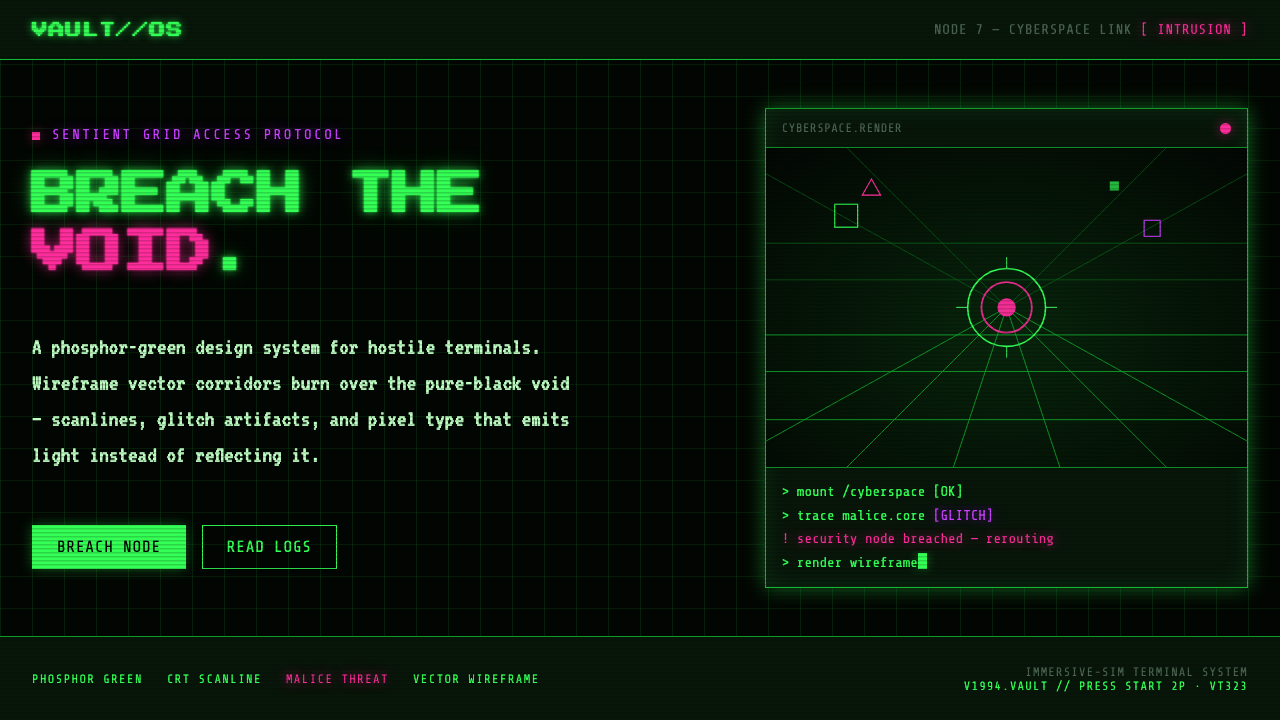 System ShockHostile retro terminal. Phosphor-green wireframes burn over black, magenta ma…
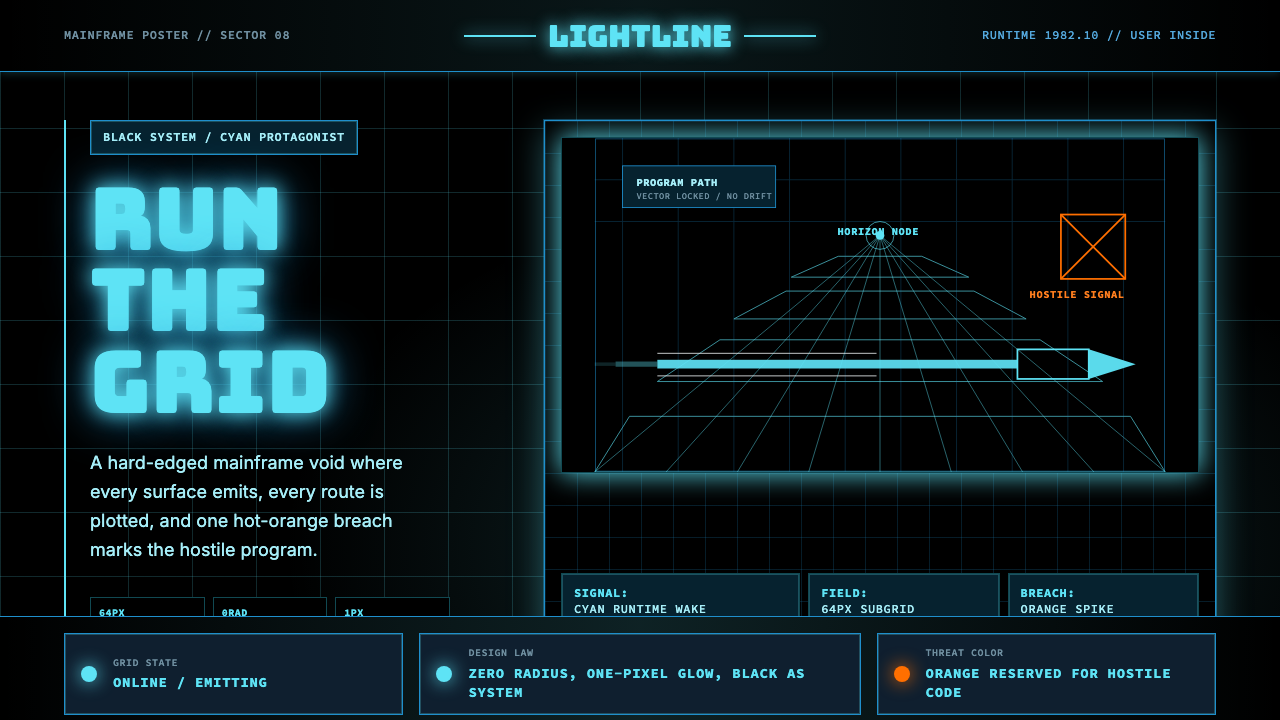 Tron Grid (1982)Cyber-precision in black. Neon cyan grids, Bungee type, and one orange breach…