What is Retro-Futurism (Syd Mead)?
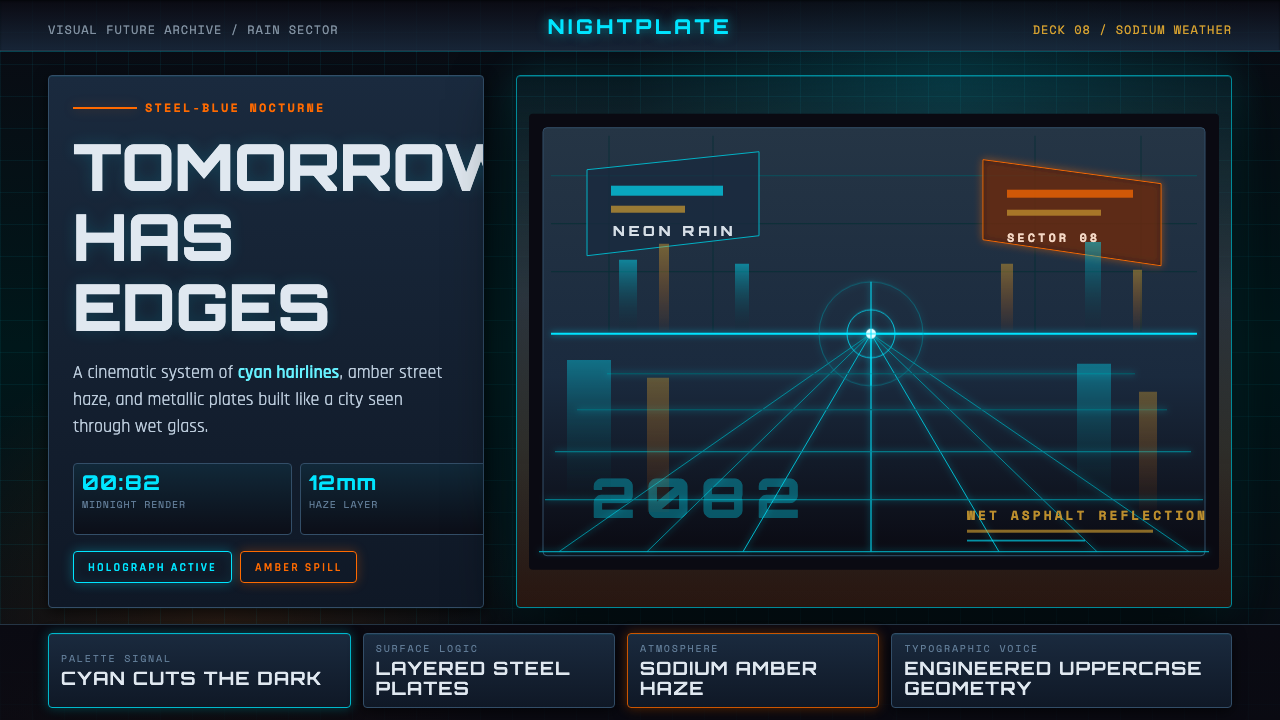
Syd Mead's Retro-Futurism is the future the 1980s dreamed and feared — neon-cut megacities, chrome vehicles, and rain-soaked streets that smell of ozone and sodium light.
Retro-Futurism (Syd Mead) in brief
Retro-Futurism, as codified by visual futurist Syd Mead, is the aesthetic language of a specific imaginative moment: the late twentieth century's vision of what tomorrow would look like. It is not nostalgia for the past, but nostalgia for a future that never arrived — a future of hovering vehicles, towering arcologies, glowing holographic displays, and perpetually rain-dark streets. The style emerged from concept art, industrial design, and science-fiction cinema, and its visual logic is inseparable from the films it helped define.
Where many historical design movements aspire to timelessness, Retro-Futurism is deliberately temporal. It belongs to a specific decade's imagination, carrying the marks of that era's anxieties — urban overcrowding, industrial decay, techno-utopianism, and corporate power — rendered in a palette that is simultaneously seductive and threatening. Deep steel blue dominates the shadows; neon cyan traces every edge and reflection; amber sodium light bleeds across wet surfaces. Together these hues construct a world that feels both hyper-real and dreamlike.
The visual system is defined by its treatment of surface and light. Nothing is matte; everything reflects. Surfaces are metallic, wet, or glass — each one a mirror that multiplies the light sources around it. Typography is engineered and precise, drawn from the tradition of technical lettering and industrial signage rather than humanist calligraphy. The overall impression is of a world built for efficiency and spectacle in equal measure, where beauty is a byproduct of function pushed to its extreme.

Where does Retro-Futurism (Syd Mead) come from?
The movement's definitive moment arrived in 1982, when Ridley Scott's Blade Runner gave Syd Mead's concept paintings their first mass audience. Mead — who had spent the previous decade designing vehicles and environments for corporate clients including U.S. Steel, Ford, and Philips — was brought on as the film's visual futurist, a title that defined both his role and his emerging reputation. His production designs for Blade Runner established the template: layered vertical cities, retrofit technology applied to decaying infrastructure, and a chromatic palette that felt simultaneously alien and familiar. The film's aesthetic became the foundational reference for everything that followed.
Mead had been active since the early 1970s, but his work found its largest audience through a series of landmark film projects across the decade. In 1982 alone, he contributed to both Blade Runner and Tron — two films that approached science-fiction visual design from very different directions but both relied on Mead's capacity to make imagined technology feel material and functional. His work on Aliens (1986) extended the vocabulary in a more militarized direction, adding industrial brutalism to the already-established neon-and-chrome lexicon. Each project refined and expanded the visual system.
The deeper origins of the style reach back into the postwar American imagination of technological progress. The 1950s and 1960s produced concept cars, world's fair pavilions, and magazine illustrations that depicted the future as clean, aerodynamic, and optimistic. Mead had absorbed this tradition during his studies at the Art Center College of Design in Los Angeles in the early 1960s, and he brought its formal confidence — the willingness to render impossible things with complete conviction — into a later, darker decade. What he added was consequence: his futures felt inhabited, weathered, and morally complicated.
The visual futurism movement that Mead effectively launched was shaped by a specific creative ecosystem. The French artist Jean Giraud — known as Moebius — brought a European ligne claire sensibility to science-fiction illustration that complemented and competed with Mead's American industrial approach. Ron Cobb contributed production design work emphasizing functional plausibility and grimy realism. Together, working across overlapping film and publishing projects, these artists created the visual grammar that defined a generation's conception of the future — and that has proven resilient enough to remain a live reference for designers working forty years later.
What defines the Retro-Futurism (Syd Mead) look?
Palette: Steel, Neon, and Sodium
The palette is organized around three dominant tones that each carry a specific atmospheric role. Deep steel blue functions as the ambient ground — the color of night sky filtered through smog, of shadow pooling between buildings. Neon cyan appears as the accent that cuts through darkness: it traces the edges of signage, reflects off puddles, and marks the technology that is still functional in a decaying world. Amber — the color of sodium vapor streetlamps — provides warmth without comfort, a light that illuminates but also isolates. These three tones work together to create depth without sunshine, a world lit entirely by artificial sources.
Reflective and Layered Surfaces
No surface in this visual system is passive. Wet asphalt mirrors overhead neon; polished metal panels catch and distort surrounding light; glass reflects multiple overlapping images simultaneously. This relentless reflectivity serves both atmospheric and compositional functions — atmospherically, it creates the sense of a world saturated with energy; compositionally, it allows a single light source to appear in multiple locations within a frame, multiplying visual complexity without adding new elements. Rain is almost always implied if not depicted, because rain maximizes the reflective surface of every horizontal plane.
Engineered Typography
Type in this system derives from industrial and technical traditions rather than humanist ones. Letterforms tend toward the geometric and the constructed — condensed forms that read well at distance on signage, characters with consistent stroke weights that communicate precision and system-level thinking. The approach is not minimalist in any contemporary sense; it is mechanical. Text often appears as if part of a larger information system — labeled, categorized, formatted for utility rather than expressiveness. Hierarchy is established through dramatic scale differences and through the quality of light applied to text: glowing text belongs to technology still active, dim or stenciled text to infrastructure that has aged.
Vertical Scale and Density
Mead's environments are almost always vertically exaggerated. Buildings stack upward past the frame's edge; infrastructure layers over infrastructure; the sky, when visible at all, is a narrow strip between towers. This vertical compression does two things simultaneously: it communicates urban density and societal overcrowding, and it creates a compositional rhythm of stacked horizontal bands — ground level, mid-rise, upper structure, sky — that gives layouts a natural layering logic. Designs in this style tend to organize information in depth as much as in width, with foreground elements distinct in tone and scale from background elements.
Glow and Light Emission
Unlike design systems that simulate shadow to create depth, this visual language uses glow to assert presence. Objects that matter emit light rather than cast shadow. A neon sign, a status indicator, a vehicle's thruster array — each is rendered not merely as a colored shape but as a source that bleeds luminescence into adjacent surfaces. This treatment of light as emission rather than reflection distinguishes the aesthetic from any approach rooted in natural lighting. The glow effect also serves a narrative function: it marks technology as live, operational, and potentially dangerous.
Functional Complexity and Mechanical Detail
Mead's signature contribution was the insistence that every designed object be fully resolved — not suggested or sketched, but specified as if it had actually been engineered. Vehicles have visible panel seams, exhaust ports, sensor arrays, and structural rivets. Buildings have maintenance access, signage in multiple languages, and the evidence of repeated repair. This commitment to functional plausibility creates objects that feel as if they belong to a coherent technological system rather than having been invented for visual effect. Applied to graphic design, this principle suggests layering information at multiple densities, including details that reward close reading even if they are not immediately legible.
Mood: Magnificent and Threatening
The defining emotional register of the style is ambivalence. The world depicted is visually spectacular — the scale is enormous, the technology is extraordinary, the lighting is cinematic — and simultaneously oppressive. The beauty is inseparable from the danger; the spectacle cannot be separated from the dystopia. Designs in this mode should resist the temptation to resolve this tension into either pure glamour or pure grimness. The most successful applications hold both qualities simultaneously: a dashboard that feels powerful and slightly ominous, a marketing image that attracts and unsettles in equal measure.

Who shaped Retro-Futurism (Syd Mead)?
Syd Mead (1933–2019) trained as an industrial designer at the Art Center College of Design in Los Angeles before beginning a corporate career designing vehicles and interiors for Ford, U.S. Steel, and Philips. His transition into entertainment began with his work on Star Trek: The Motion Picture (1979), but it was Blade Runner (1982) that made his name synonymous with science-fiction visual design. Over the following decades he contributed to Tron, Aliens, Johnny Mnemonic, and numerous other productions while continuing commercial work, and he gave dozens of lectures and interviews that articulated the philosophy behind his practice — that the future should be depicted not as fantasy but as a fully engineered, inhabitable reality.
Director Ridley Scott shaped the visual realization of Blade Runner as much as any of the film's designers. His insistence on atmospheric depth — the layers of steam, smoke, rain, and overhead light that fill every frame — transformed Mead's concept paintings from static illustrations into a believable inhabited environment. Scott's production approach, which involved constructing practical sets that extended seemingly to infinity and filling them with texture, detail, and authentic street life, established the standard against which subsequent science-fiction films have been measured. His collaboration with Mead defined what it meant to commit to a future world rather than merely suggest it.
French artist Jean Giraud, working under the pseudonym Moebius, brought a parallel visual intelligence to science-fiction design that complemented and occasionally competed with Mead's American industrial approach. His work on the Heavy Metal magazine, his concept designs for Alien and Tron, and his comics series The Incal (written by Alejandro Jodorowsky) developed a vocabulary of organic-mechanical hybridization, vast open desert landscapes, and metaphysical narrative that expanded the genre's visual possibilities beyond the purely urban and technological. Moebius and Mead together established the poles between which most subsequent science-fiction visual design has operated.
Production designer and concept artist Ron Cobb contributed to Alien, The Last Starfighter, Total Recall, and other landmark science-fiction films, developing a visual language of grease, wear, and functional grime that emphasized the lived-in quality of speculative technology. Where Mead's futures were sleek at their highest levels and layered below, Cobb specialized in the lower registers — the maintenance corridors, the cargo holds, the industrial decks that working people actually occupied. His attention to functional plausibility and to the way technology ages and degrades added a dimension of social realism to the science-fiction visual vernacular that Mead's more glamorous work sometimes elided.
Visual effects supervisor Douglas Trumbull was the technical architect of the atmospheric depth that makes Blade Runner's imagery so durably powerful. His development of practical effects — layers of miniature sets photographed through artificial smog and vapor, combined with careful lighting choices that emphasized the distinction between light sources — translated Mead's flat concept paintings into three-dimensional environments with genuine atmospheric presence. Trumbull's commitment to in-camera practical effects rather than composited illusions gave Blade Runner a material weight that later digital productions have struggled to replicate, and his approach continues to influence how designers and cinematographers think about creating depth through atmosphere rather than geometry.
How do you use Retro-Futurism (Syd Mead) today?
Applying Retro-Futurism to contemporary design work requires understanding what the visual system is actually doing before applying its surface qualities. The style is not simply dark backgrounds with neon accents — it is an atmospheric argument about the relationship between technology, humanity, and urban density. Successful applications commit to that argument; unsuccessful ones borrow the palette without the logic, producing interfaces that look like nightclub branding rather than inhabited futures.
For presentation slides, the style is most effective when structure mirrors the aesthetic's vertical density. Cover slides benefit from a composition that places the central visual element — a glowing logo, a product image, a bold statement — against a deep steel-blue ground, with neon-toned accent marks at the edges rather than centered. Section dividers work well as horizontal bands that shift between dark and slightly lighter dark, with label text glowing softly at low intensity. Data slides should treat charts as functional objects: bar graphs rendered in cyan against dark grounds, with amber highlights marking key data points, and grid lines drawn in the very faint tone that suggests structural scaffolding rather than visual noise.
For web interfaces, the style is particularly well-suited to dashboards, monitoring tools, developer consoles, and any interface that needs to communicate information density and operational seriousness. The structural approach is to anchor the layout with a very dark near-black background, reserve the neon cyan for interactive elements and alerts, and use amber selectively to signal warnings or elevated status. Navigation elements should feel like instrumentation panels — compact, labeled with high precision, visually quiet until activated. Pricing pages gain power from the style's implicit hierarchy: the top tier should feel like it belongs to a different technological order than the lower tiers, achieved through glow intensity and the depth of shadow rather than through color difference alone.
For editorial and marketing work, the style supports dramatic feature imagery and minimal supporting text. A Retro-Futurism-derived landing page works best when full-width image sections are treated as environments rather than illustrations — the viewer should feel as if they are looking into a space rather than at a picture. Marketing copy in this style is terse and confident, formatted with wide tracking and set in compressed or condensed letterforms that evoke technical documentation. Pull quotes and call-to-action text benefit from being rendered in the glowing cyan, which reads as active and forward-directed against a dark ground.
The most common mistake when applying this style is overusing glow effects until every element competes for attention. In Mead's original work, glow is selective: a few carefully chosen elements emit light while the majority of the image remains in controlled darkness. This discipline — of withholding glow from most elements to make it meaningful where it appears — is the hardest aspect of the style to maintain in production, because the impulse is always to add one more glowing edge or one more light source. A related mistake is applying neon cyan to text at body-copy scale, where it becomes difficult to read and loses the specificity that makes it powerful at headline or accent scale.

Retro-Futurism (Syd Mead) — FAQ
Is Retro-Futurism the same as Cyberpunk?
They overlap substantially but are not identical. Cyberpunk is a literary and cultural genre, first articulated in fiction by writers including William Gibson, that deals with themes of corporate power, body modification, and technological inequality in near-future settings. Retro-Futurism as a visual style is older and broader — it describes any design work that presents a vision of the future imagined from a past moment, including both the optimistic chrome-and-fins aesthetic of the 1950s and the darker neon-and-grime palette of the 1980s. Syd Mead's work became the dominant visual reference for cyberpunk aesthetics, but the style predates and exceeds the genre. Not all Retro-Futurism is cyberpunk, and not all cyberpunk visual work follows Mead's specific design language.
Can this style work in a light or bright color scheme?
A light inversion is theoretically possible but works against the style's atmospheric logic at a fundamental level. The deep darkness of the Mead-derived palette is not merely an aesthetic preference — it is what makes the glow elements meaningful. Neon cyan on a dark ground is legible, atmospheric, and emotionally charged; the same tone on a near-white ground becomes a flat accent color with none of the luminous quality that defines the style. A designer who needs to work in a light environment but wants to reference this aesthetic would be better served by borrowing the style's typography and compositional density while using a different palette, rather than attempting a direct translation that dilutes the core visual argument.
How do I avoid the look feeling like a generic dark UI or gaming interface?
The difference between an authentic Retro-Futurism application and a generic dark interface lies in three disciplines. First, atmospheric depth: dark UIs are typically flat, with elements sitting on the same implied plane; Mead-derived design creates a sense of recession and layering, as if the interface has foreground, middle ground, and background zones. Second, mechanical specificity: generic dark interfaces use rounded corners, generous spacing, and smooth gradients; this style uses tighter geometry, harder edges, and details that suggest engineering rather than consumer comfort. Third, restrained use of the signature colors: an interface that applies neon cyan to every interactive element looks like a gaming peripheral advertisement; a design that reserves it for a small number of specifically chosen moments — a key status indicator, a single call-to-action — reads as deliberate and authoritative.
Does this style suit consumer-facing products, or is it better suited to technical and professional audiences?
The style has genuine power with both audiences, but it works differently in each context. For technical and professional audiences — security platforms, developer tools, data infrastructure, financial terminals — the style's associations with operational seriousness and systematic precision are direct assets. The aesthetic communicates that the product is powerful, that it takes its users seriously, and that it was designed by people who understand how systems work. For consumer audiences, the style functions more as an emotional register than a functional one — it creates a sense of premium status, technological authority, and cultural reference. Entertainment products, performance consumer goods, and lifestyle brands that want to evoke a specific kind of aspirational future can use the style effectively. Where it struggles is with products that depend on warmth, approachability, or organic sensory richness — food, children's products, wellness, and social platforms designed around personal connection.
How faithful does the application need to be to count as this style?
The style supports a wide spectrum of application depth. A minimal invocation — dark background, one neon accent color, compressed typography — can establish the reference without full commitment to the aesthetic's denser qualities. A deeper application layers in the atmospheric complexity: multiple light sources, reflective surface treatment, mechanical typographic detailing, and the vertical compositional density of the source material. What distinguishes genuine engagement with the style from superficial borrowing is whether the light logic is consistent. If glow elements emit their color into adjacent surfaces; if dark zones are treated as environments rather than backgrounds; if the typography feels engineered rather than chosen for taste — these qualities mark an application as belonging to the tradition. The palette alone is insufficient; it is how the palette behaves with light that defines the style.
Related design styles
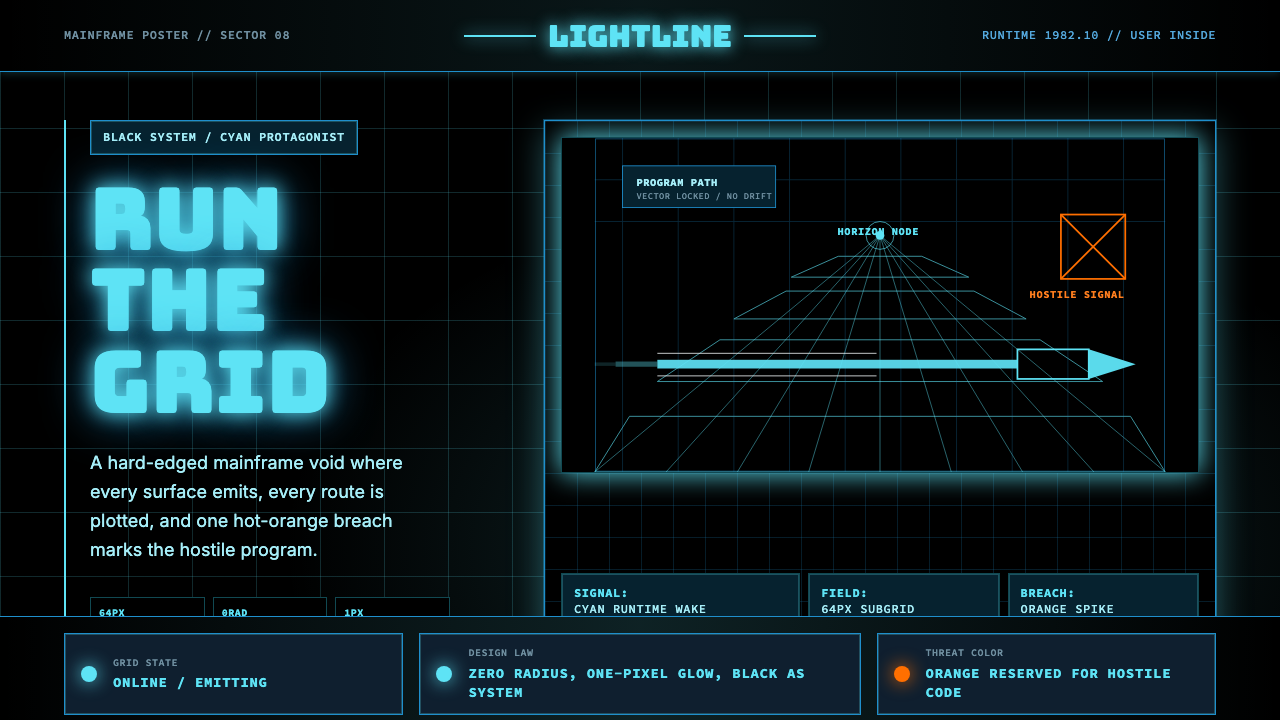 Tron Grid (1982)Cyber-precision in black. Neon cyan grids, Bungee type, and one orange breach…
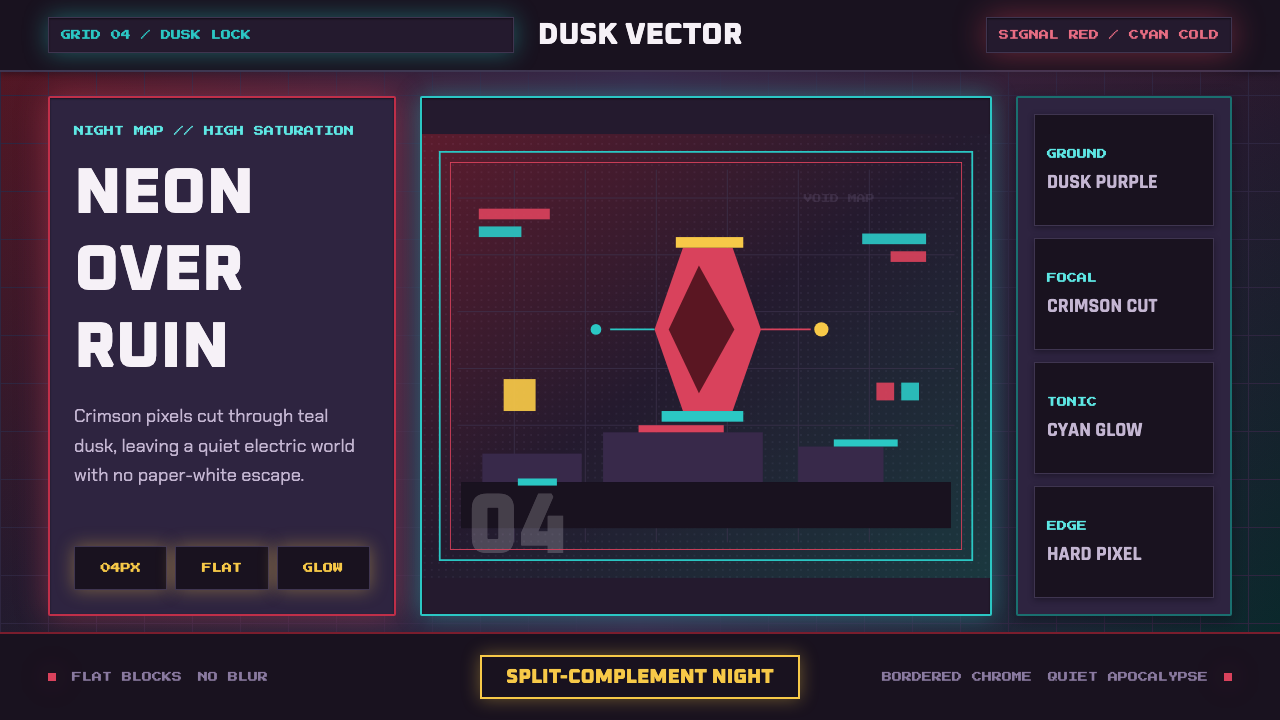 Hyper Light DrifterBeautiful ruin glows. Dusk purple holds crimson pixels and cyan grid light.
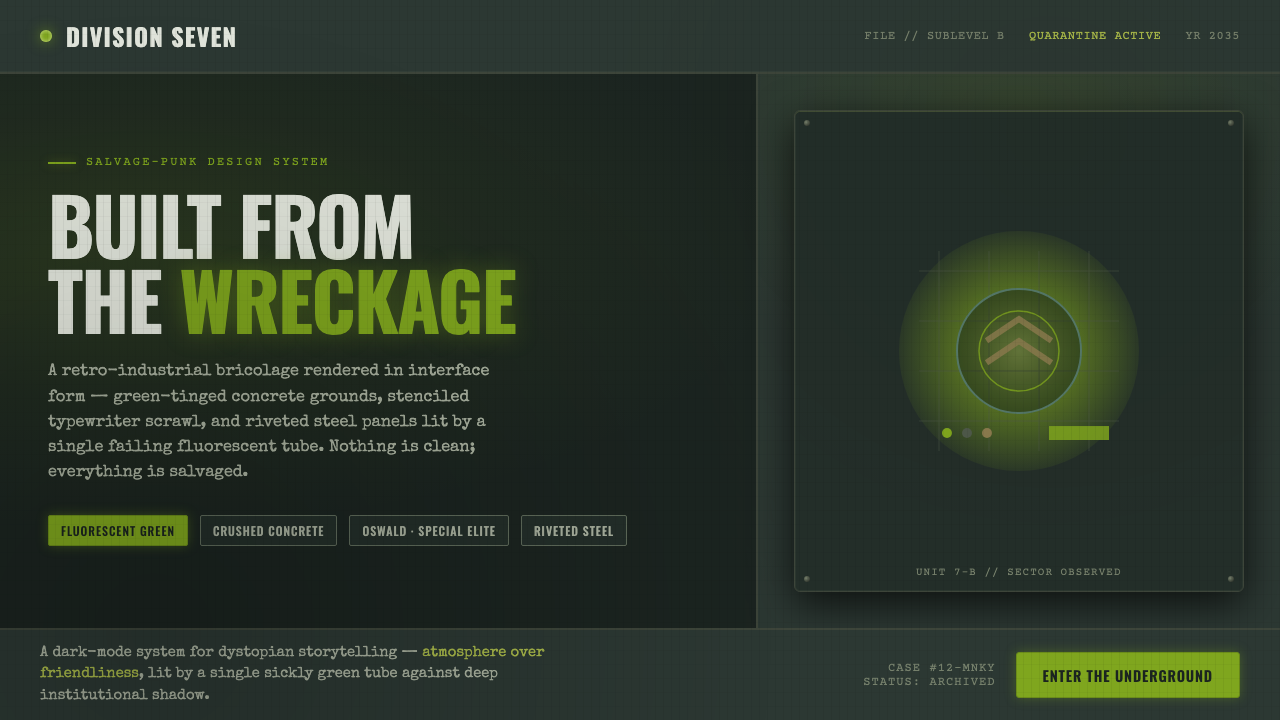 12 MonkeysBuilt from the wreckage. Sickly fluorescent green on crushed-black concrete,…
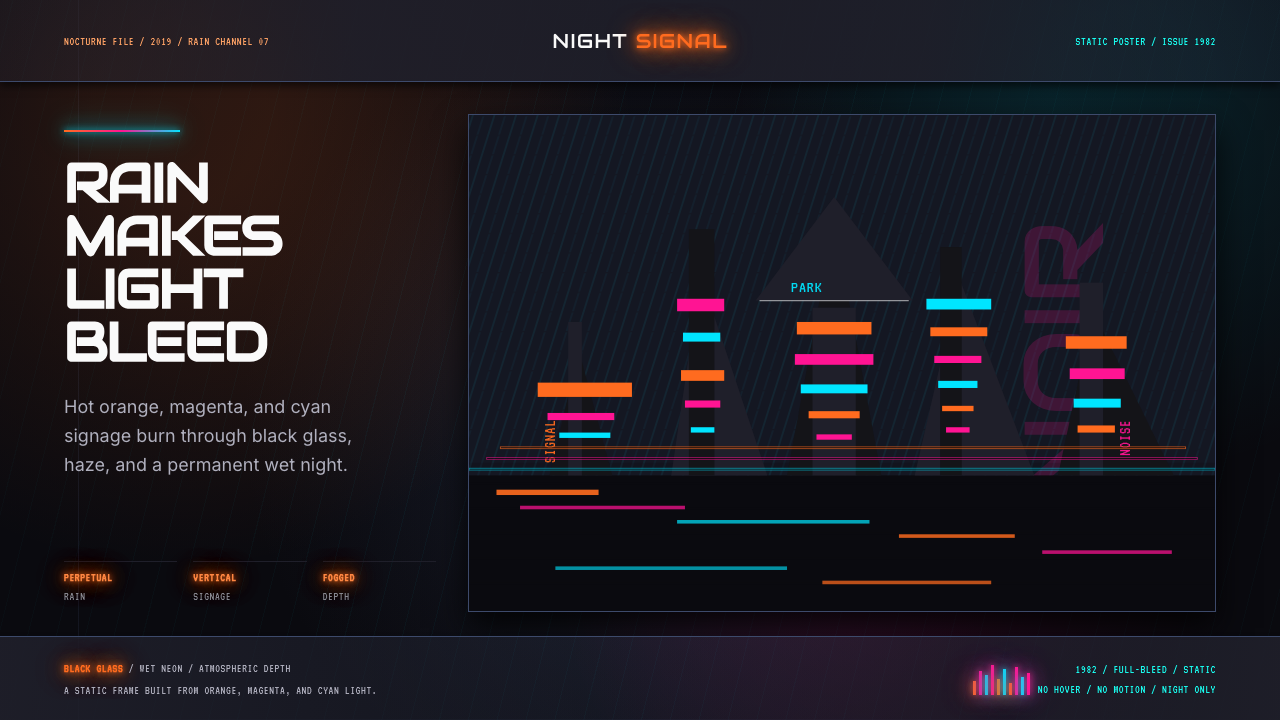 Blade Runner 1982 Neon NoirRain-soaked noir. Orange, magenta, and cyan neon cut black glass.
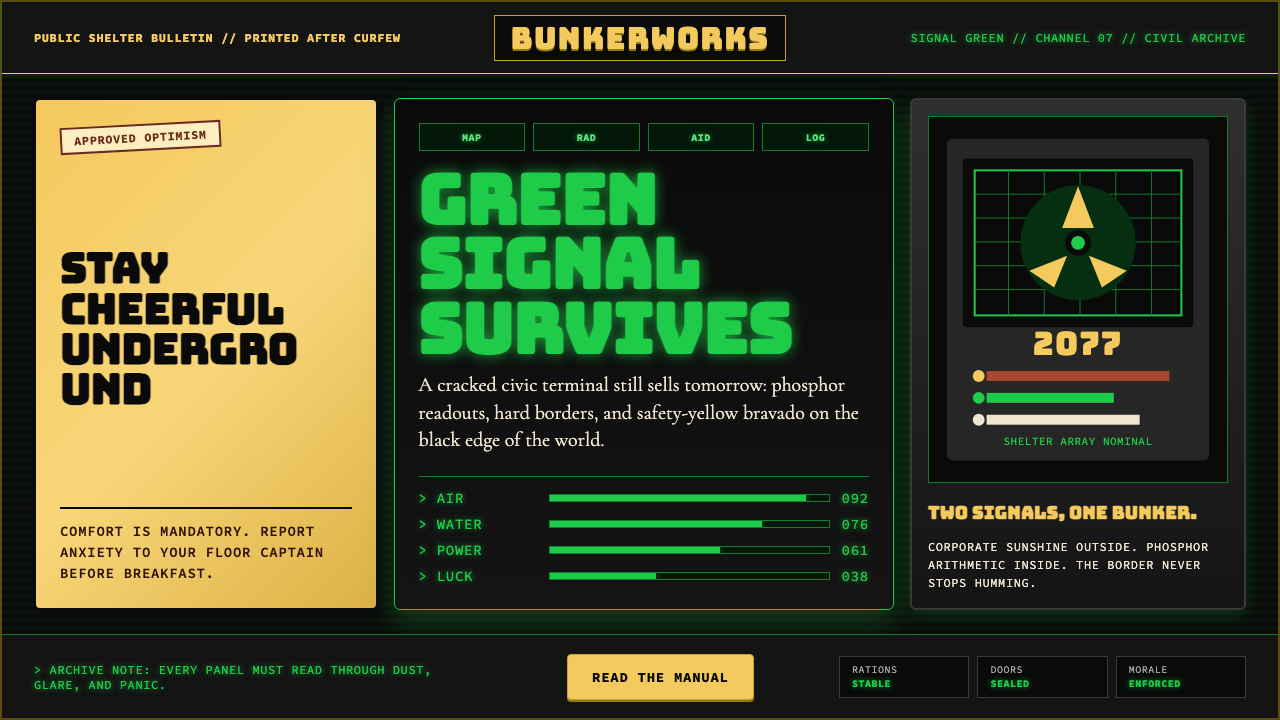 Fallout Vault-Tec Pip-BoyIrradiated optimism. Vault yellow and CRT green lock into a bordered bunker g…
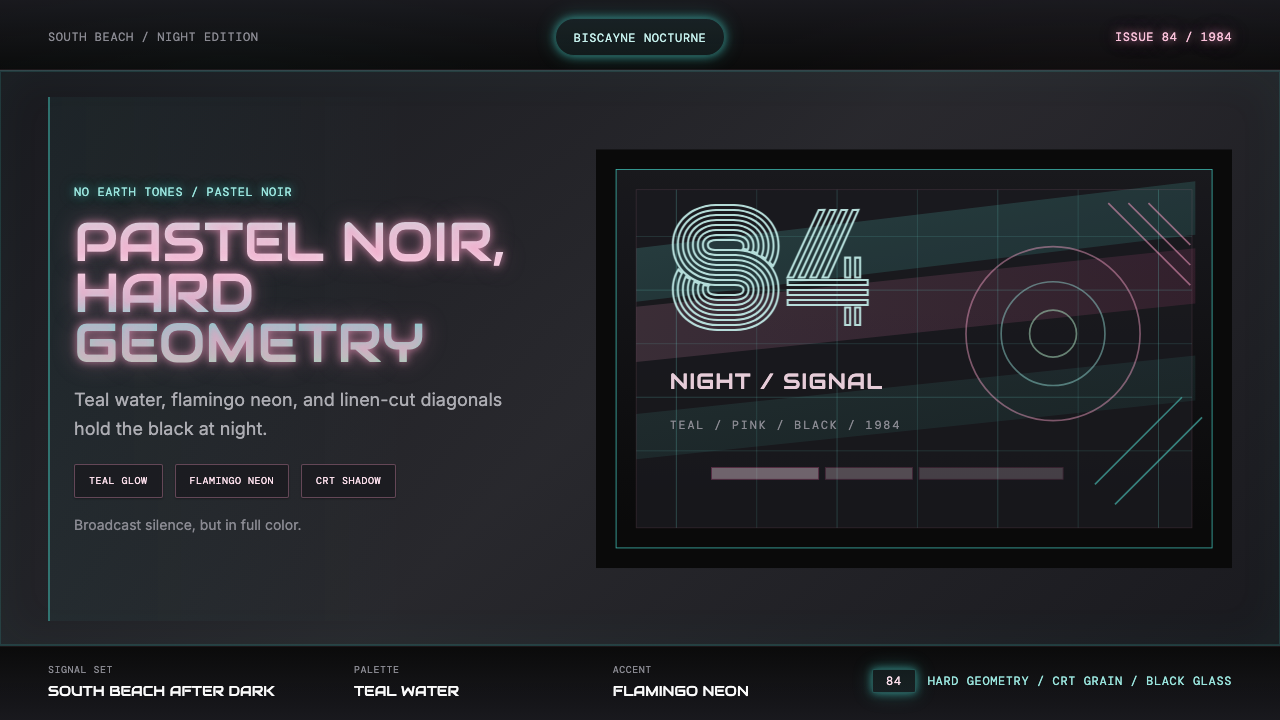 Miami Vice Pastel Teal (1984)Pastel noir, not nostalgia. Teal glow and flamingo pink slice black with geom…