What is Tron Grid (1982)?
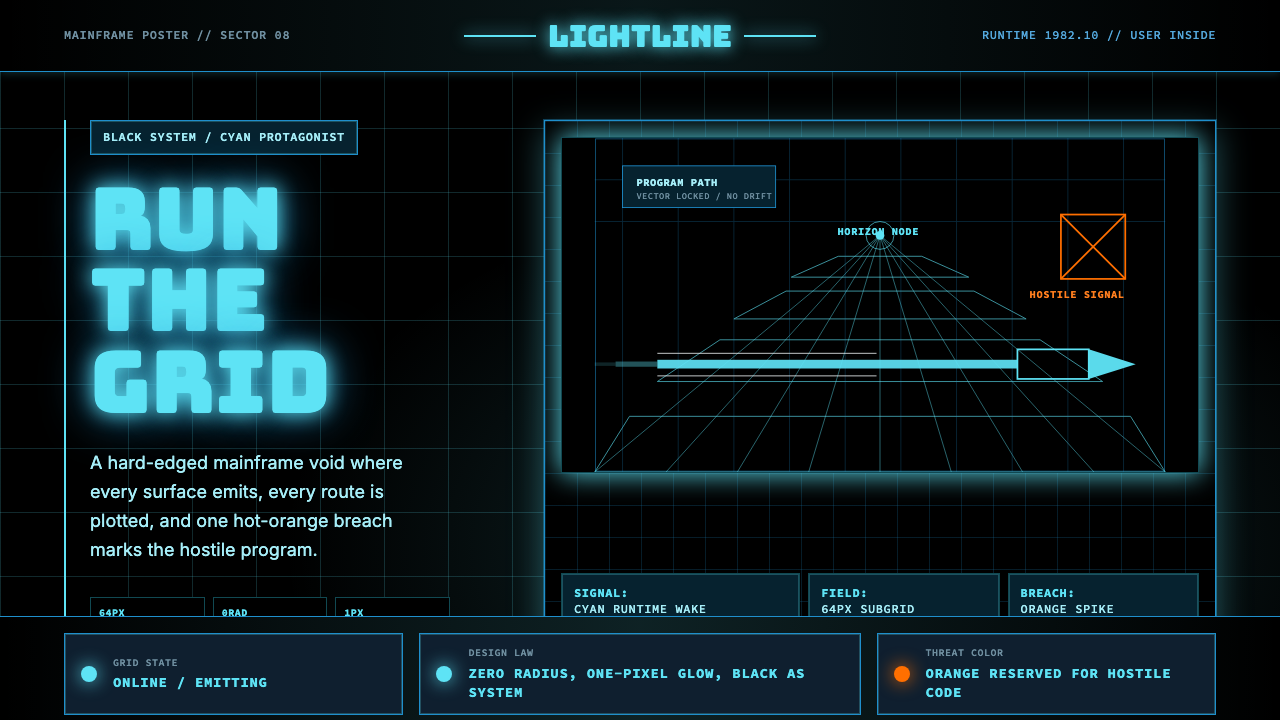
Tron Grid is the visual language of cyberspace itself — a pure-black void carved open by glowing neon-cyan lines, zero-radius geometry, and the occasional hot-orange breach of a villain's presence.
Tron Grid (1982) in brief
Tron Grid is the design language drawn directly from Disney's Tron (1982) and its sequel Tron: Legacy (2010): a deep-black void that stands in for the interior of a computer mainframe, criss-crossed by saturated neon-cyan gridlines and electric-blue runtime bands, with a single hot-orange accent reserved for the antagonist's presence. The aesthetic is immediately legible as a coded world — hard, planar, and self-luminous — rather than a naturalistic one.
The system is built on a handful of ruthless principles: every surface is flat and glowing, every corner is sharp, every line is a deliberate decision. Roundness, gradient fills, and soft shadows are categorically absent. The grid itself is not a layout tool in the conventional sense — it is the subject matter. It represents the underlying coordinate system of a digital universe, made visible as actual lines of light rather than implied as an invisible scaffold beneath content.
Visually, Tron Grid reads as cyber-precision: monospace typographic cues echo terminal readouts, gridlines vibrate at the threshold of visibility against pure black, and the hierarchy of color — cyan for structure, blue for runtime activity, orange for threat — encodes information the way a circuit diagram does. The whole system evokes that specific moment in early-CGI history when audiences first believed a computer's interior could be a place.

Where does Tron Grid (1982) come from?
The story begins in 1976 when Steven Lisberger, a Boston-based animator, saw early vector-graphics arcade games and became fascinated by the idea of a world that existed entirely inside a computer. He spent years developing what would become Tron, pitching it to every major studio before Disney agreed to produce it in 1980. The production brought together a genuinely unusual coalition: traditional Disney animators, a team of computer graphics pioneers from firms including Information International Inc. and MAGI Synthavision, and the conceptual artist Syd Mead, whose industrial design sensibility would later shape the film's sequel.
The film's visual language was partly a technical necessity and partly an inspired aesthetic decision. Because the computer-generated sequences could only render geometric primitives in the early 1980s — polygons, lines, flat planes — the production team made a virtue of the constraint. The world inside the computer would not pretend to be organic; it would be unapologetically mathematical. Black was chosen as the dominant background not because it was stylistically preferred but because it was technically free: black required no rendering at all, saving precious compute cycles for the glowing geometry placed against it. The neon-cyan color of the gridlines emerged from the glow of cathode-ray tube monitors of the era — the default color of phosphor-on-glass.
By 1982, when Tron opened in cinemas, it had consumed an unprecedented share of its production budget on computer-generated imagery — roughly fifteen to twenty minutes of fully synthetic footage, more than any film before it. Critics were divided, but the film's visual system was immediately influential in graphic design, video game art direction, and the nascent field of computer visualization. The iconography of the Light Cycle — a motorcycle that leaves a solid wall of light behind it, turning only at right angles — distilled the entire aesthetic into a single image: a line drawing itself through a void, leaving behind a permanent mark.
The sequel, Tron: Legacy, arrived in 2010 directed by Joseph Kosinski. Where the 1982 film's CGI was raw and constrained by hardware limits, the 2010 production could render anything it chose — and it chose to honor the original vocabulary while refining its resolution. Syd Mead joined the concept design team. The electronic duo Daft Punk composed the score and made a cameo appearance in the film, bringing a quality of Europeanist techno-cool that deepened the aesthetic's associations with a particular strain of machine-era discipline. The color palette tightened: the cyan became more precisely saturated, the black more absolute, and the orange accent more sparingly applied, so that its appearance carried genuine narrative weight.
What defines the Tron Grid (1982) look?
Color Hierarchy
The palette is tripartite and strictly coded. Neon cyan — the color of phosphor glowing on cathode-ray glass — serves as the primary structural tone: it defines the grid, outlines active surfaces, and marks the identity of the protagonist's faction. Electric blue appears at a lower luminosity level for secondary runtime elements and ambient world-building. Hot orange is the opposition color, used sparingly and only where narrative or compositional tension demands it. Against an absolute-black ground, these three colors do not decorate — they communicate system state. The hierarchy is non-negotiable: mixing faction colors or diluting any hue toward pastels destroys the coding logic entirely.
Grid as Subject
The defining formal gesture of Tron Grid is that the underlying coordinate system is made visible — it is not hidden beneath content but displayed as content. Lines of light extend to a vanishing point, creating a sense of infinite receding space. The grid's proportions suggest machine regularity: intervals are equal, intersections are precise, and the whole structure implies a world governed by arithmetic rather than nature. In applied design work, this means the grid is never merely structural scaffolding — it appears on the surface, functions as an active visual element, and conveys the impression of a space that has been precisely calibrated.
Zero Radius
Every corner in the Tron visual system is a hard right angle. This is not merely a stylistic preference — it is a categorical statement about the nature of the world being depicted. A digital space governed by binary logic and integer coordinates has no use for curves; curvature implies organic growth, material flexibility, or biological form. The absence of rounded corners signals that every edge is a decision rather than a convenience, and that the system prioritizes computational precision over ergonomic comfort. Even typographic elements follow this discipline: letterforms with circular counters feel anomalous in full Tron Grid compositions, and geometric display types with angular construction are strongly preferred.
Self-Luminous Depth
Objects in the Tron world do not receive light — they emit it. This inversion of conventional lighting logic produces a distinctive visual quality: forms appear to glow from within rather than being illuminated from without. In practice, this means glowing edges on otherwise dark surfaces, halos around bright lines against pure black, and a sense that brightness is a property of the object's identity rather than its position relative to a light source. The depth effect is achieved not by shadow and highlight in the classical sense but by luminosity gradients at the edges of forms — lines that are brightest at their axis and fall to black within a very narrow band.
Monospace Typography
The typographic register of Tron Grid is the terminal — not the printed page, the editorial spread, or the advertising poster. Monospaced letterforms, where every character occupies an identical horizontal increment, carry the associations of command-line interfaces, system logs, and machine-generated text. In the Tron aesthetic, this means display text that feels output rather than composed: characters aligned to an invisible grid, letter-spacing that emphasizes the modular unit rather than optical rhythm, and a general preference for uppercase settings that read as system labels or status identifiers. The effect is cool, authoritative, and impersonal in a way that humanist type cannot replicate.
Absolute Black Ground
The background in Tron Grid is not dark grey, not near-black, not a deeply saturated navy — it is the most absolute black achievable in any given medium. This is the foundational decision from which all others follow. Absolute black removes any ambient sense of atmosphere or air; the space feels like a void rather than a room. Against this ground, even a moderately luminous color reads as intensely bright, which means the palette's neon qualities are entirely dependent on the black holding its depth. Any brightening of the background — any softening toward grey — collapses the system's sense of infinite digital space and reduces the color accents to mere decoration.
Orange as Rupture
In the Tron color system, orange is not simply a third accent — it is the color of opposition, malfunction, and intrusion. Its warmth is alien to the cool cyan-and-blue dominant palette, which means its appearance always registers as a breach: something that does not belong, a force that has entered from outside the system's logic. This coded quality makes orange extraordinarily powerful when used sparingly and immediately disruptive when overused. In applied design, orange in a Tron Grid context should be reserved for the single most important call to action, the most critical alert, or the element that represents the maximum contrast point within a composition. Using it for more than one purpose in the same layout dissipates its meaning entirely.

Who shaped Tron Grid (1982)?
Lisberger wrote and directed the original Tron (1982), having nursed the concept for six years before production began. A traditional animator by training, he saw the potential of computer-generated imagery not as a replacement for hand-drawn film but as a means to depict a world that hand-drawing could not plausibly represent — the mathematical interior of a computer. His decision to embrace the geometric limitations of early CGI as an aesthetic system rather than fight them produced the visual language that persists in design culture today. Without Lisberger's conviction that constraints were assets, Tron Grid would likely have been an awkward transitional style rather than a coherent aesthetic statement.
Mead was one of the twentieth century's most influential visual futurists — his concept design work shaped the look of films including Blade Runner and Aliens before he joined the Tron: Legacy production team in the late 2000s. For Tron: Legacy, Mead refined the original film's aesthetic vocabulary, pushing the grid proportions toward greater precision and the vehicle designs toward harder geometry. His involvement gave the sequel's visual system an industrial design credibility that mere CGI craft could not supply: the world felt engineered rather than imagined. Mead's discipline of beginning every design problem with function rather than form aligned precisely with the Tron Grid's underlying logic.
The French electronic duo Thomas Bangalter and Guy-Manuel de Homem-Christo composed the score for Tron: Legacy and made a cameo appearance within the film itself — appearing as DJs in the film's world, costumed in the same luminous geometric suits worn by the film's digital characters. Their involvement was not incidental: Daft Punk had spent the previous decade developing an aesthetic of technological self-presentation — robot helmets, LED-studded stage suits, music that fused mechanical precision with emotional restraint — that was in deep alignment with the Tron Grid sensibility. Their score amplified the visual system's qualities through sound: precise, cold, structured, and lit from within.
Kosinski directed Tron: Legacy as his feature debut, having come from a background in architecture and commercial direction. His architectural training shaped how he approached the film's world-building: he treated the Grid as a designed environment with consistent spatial logic rather than as a backdrop for action sequences. Kosinski imposed systematic rules on what could and could not exist in the digital world — rules about proportion, material finish, and the behavior of light — that gave the sequel's visual system a rigor the original film's production pressures had not fully allowed. His subsequent career continued to explore technology and aesthetics in films including Oblivion (2013) and Top Gun: Maverick (2022).
How do you use Tron Grid (1982) today?
Tron Grid translates into contemporary design work with remarkable directness because its rules are few and absolute. The key is understanding that the aesthetic is not a collection of decorative elements — glowing lines, dark backgrounds, cyan accents — but a complete spatial logic: a world seen from inside a machine. Applied correctly, it produces work that feels precisely calibrated and unapologetically digital. Applied incorrectly, it becomes a set of surface decorations that evoke the aesthetic without embodying its principles.
For presentation slides, Tron Grid is particularly well-suited to cover pages and section breaks. A cover works best as a near-total void: the slide background held at the deepest black the display medium allows, a fine cyan grid extending to the edges, and the title rendered in monospaced or angular display type with enough luminosity contrast to read as a self-emitting surface rather than text on a background. Data slides benefit from the style's diagrammatic clarity: line charts rendered in cyan on black read as system telemetry rather than business reporting, which can significantly elevate the perceived precision of quantitative content. Chart axes should be treated as gridlines — fine, luminous, extending fully — rather than as conventional axis strokes. Content slides with body text require care: the absolute-black background demands high luminosity on text, and mixing multiple text colors risks fragmenting the coding logic.
For web interfaces, the style is most naturally suited to dashboards, analytics platforms, developer tools, and any product where the user's relationship to the interface is operational rather than emotional. The dark ground eliminates eye strain in extended-use contexts and provides natural focus on luminous data elements. Navigation and structural elements should be defined by fine glowing lines rather than filled containers; interactive states should shift between cyan, blue, and — for warnings or primary actions — orange. Pricing pages in this aesthetic work well when tier differentiation is handled through the color hierarchy: a standard tier in neutral blue, a recommended tier in full cyan, and an enterprise or premium tier marked with the orange accent to signal its category difference. The key discipline is maintaining the absolute-black ground throughout — any background that brightens, even to near-black, collapses the system.
For editorial and marketing work, Tron Grid carries strong genre associations — technology launches, gaming, cybersecurity, developer conferences, science fiction entertainment — that make it highly effective in those contexts and potentially incongruous in others. A product launch deck for a developer infrastructure company, a conference identity for a machine-learning symposium, or the title design for a science fiction series are natural homes for the aesthetic. In editorial layouts, full-bleed black spreads with cyan headline type and fine-rule structural dividers create a reading experience that feels like interacting with a system rather than reading a publication. Marketing materials work best when the grid is treated as a design element in itself — present on the surface of the piece, not merely implied — and when the layout leaves enough pure black space to allow the colored elements to read as luminous rather than merely tinted.
The most common mistake in applying Tron Grid is treating it as a dark theme with added glow effects rather than as a complete spatial language. Specific failure modes include: using near-black or dark grey backgrounds instead of absolute black, which destroys the self-luminous quality; applying cyan, blue, and orange simultaneously across many elements, which overwrites the coding logic and produces visual noise; softening gridlines with opacity or blur, which suggests atmosphere rather than the void; rounding corners on any element, which introduces organic warmth the system is built to exclude; and using warmly lit or naturalistic photography without applying high-contrast duotone treatment, which imports a competing visual logic. The style requires commitment: every element either belongs to the system or belongs outside it.

Tron Grid (1982) — FAQ
Is Tron Grid the same as general dark-mode or neon-cyber design?
No — Tron Grid is a specific aesthetic system with strict rules, not simply a dark background with colorful accents. General dark-mode design uses near-black surfaces, multiple accent colors, soft shadows, and conventional rounded components. General neon-cyber design (often called cyberpunk) typically features magenta, purple, or multi-color neons, photographic textures, rain or vapor visual effects, and a deliberately noisy, maximalist sensibility. Tron Grid, by contrast, is severe and minimal: absolute black only, a three-color palette with a precise coding hierarchy, zero radius on every element, visible gridlines, self-luminous rendering, and nothing that suggests organic life. The discipline is much closer to early-CGI mathematical purity than to the cultural pastiche of cyberpunk.
Can Tron Grid work for a light-background layout?
Only with significant loss of fidelity to the core logic. The self-luminous quality — the sense that elements glow from within — is entirely dependent on the absolute-black ground. On a light background, the same cyan and blue colors become flat decorative accents rather than light-emitting forms; the coding hierarchy collapses; and the spatial impression of infinite digital void disappears entirely. If a product requires a light background for functional or accessibility reasons, it is better to describe the result as 'Tron-inspired' or 'cyber-grid-influenced' rather than authentic Tron Grid. A more effective approach is to limit Tron Grid treatment to dark sections or modal overlays within an otherwise light interface.
How should photography or illustration be used in a Tron Grid layout?
Photography requires transformation before it belongs in a Tron Grid composition. Naturalistic, warmly lit photography imports a competing visual logic — organic textures, ambient light, environmental color — that conflicts with the system's machine-interior premise. The standard treatment is high-contrast duotone rendering in the palette colors: shadows to absolute black, highlights to cyan or near-white, with no intermediate warmth. Alternatively, photography can be reduced to a hard silhouette against pure black, or processed to appear as if displayed on a low-resolution vector screen. Illustrated elements work better than photography if they are constructed from geometric forms using the palette's color hierarchy; figurative or painterly illustration in a Tron Grid layout almost always reads as genre inconsistency.
What products or industries is Tron Grid poorly suited for?
The style's core associations — machine precision, digital void, oppositional color coding, absolute zero warmth — make it actively unsuitable for contexts requiring emotional warmth, human connection, or sensory richness. Consumer wellness products, children's education platforms, food and beverage brands, healthcare patient interfaces, and hospitality experiences all depend on design registers that Tron Grid categorically excludes. Even within technology contexts, the style can misfire: a consumer-facing mobile application whose value proposition is ease and approachability would find Tron Grid's severity alienating rather than reassuring. The grid's codedness also makes it genre-specific in ways that limit its application to B2C consumer products outside the gaming, entertainment, or enthusiast-technology sectors.
How does Tron Grid relate to other dark, tech-forward design aesthetics like brutalism or dark glassmorphism?
They share the dark background but diverge fundamentally at the material and spatial level. Web brutalism on a dark ground typically uses raw, unstyled typography, harsh layout decisions, and a deliberately unfinished quality that signals rejection of polish — the opposite of Tron Grid's extreme precision. Dark glassmorphism uses blur, translucency, layered depth, and soft halos to simulate the appearance of frosted glass over a dark environment — an atmospheric, material quality that Tron Grid's void explicitly rejects; there is no atmosphere in a computer mainframe, no material to be translucent. Tron Grid is distinguished from both by its mathematical flatness, its zero-tolerance for softness or ambiguity, and its insistence that every element declare its system membership through the color-coding hierarchy. It is the most rule-bound and least atmospheric of the major dark-design aesthetics.
Related design styles
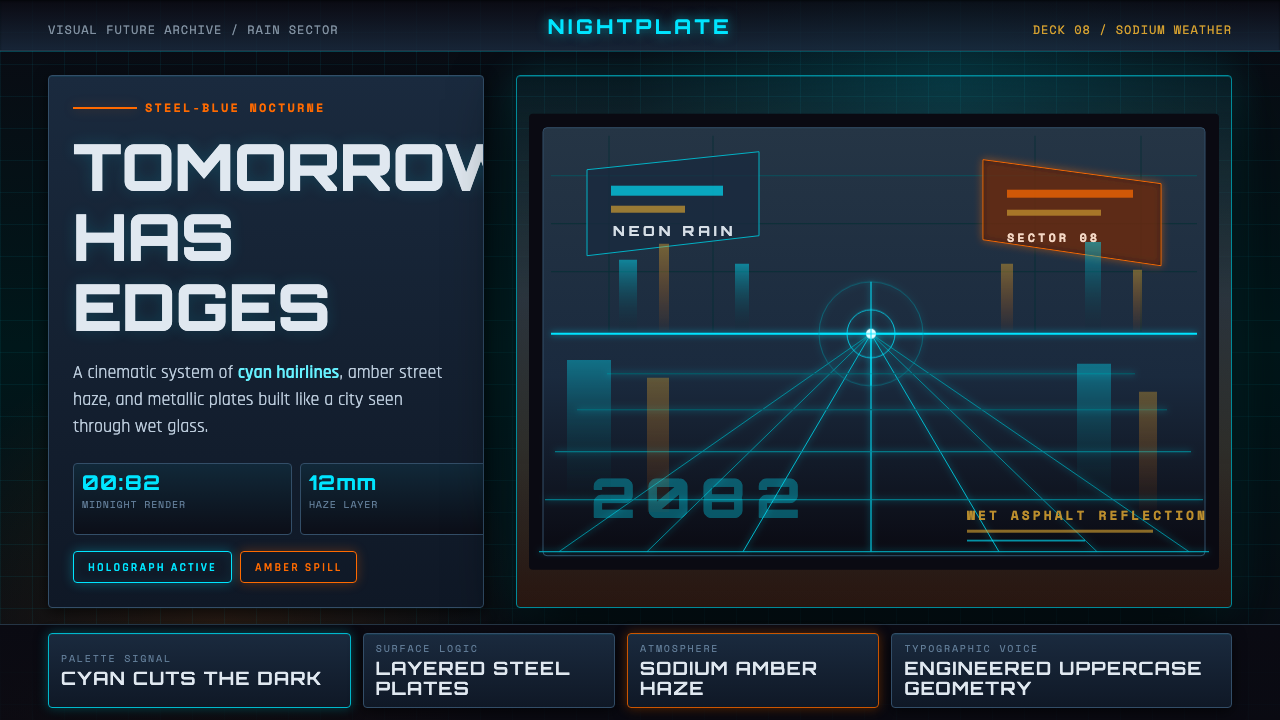 Retro-Futurism (Syd Mead)Tomorrow looks dangerous. Steel-blue night, neon cyan edges, and amber rain r…
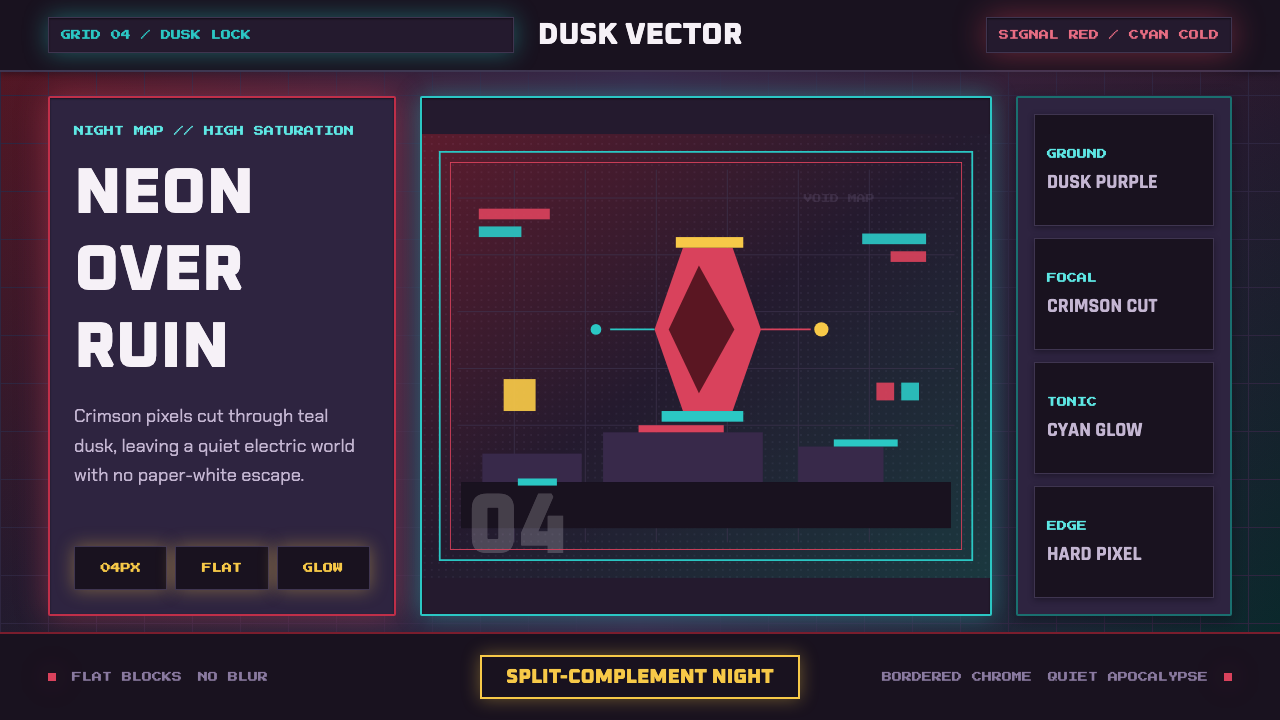 Hyper Light DrifterBeautiful ruin glows. Dusk purple holds crimson pixels and cyan grid light.
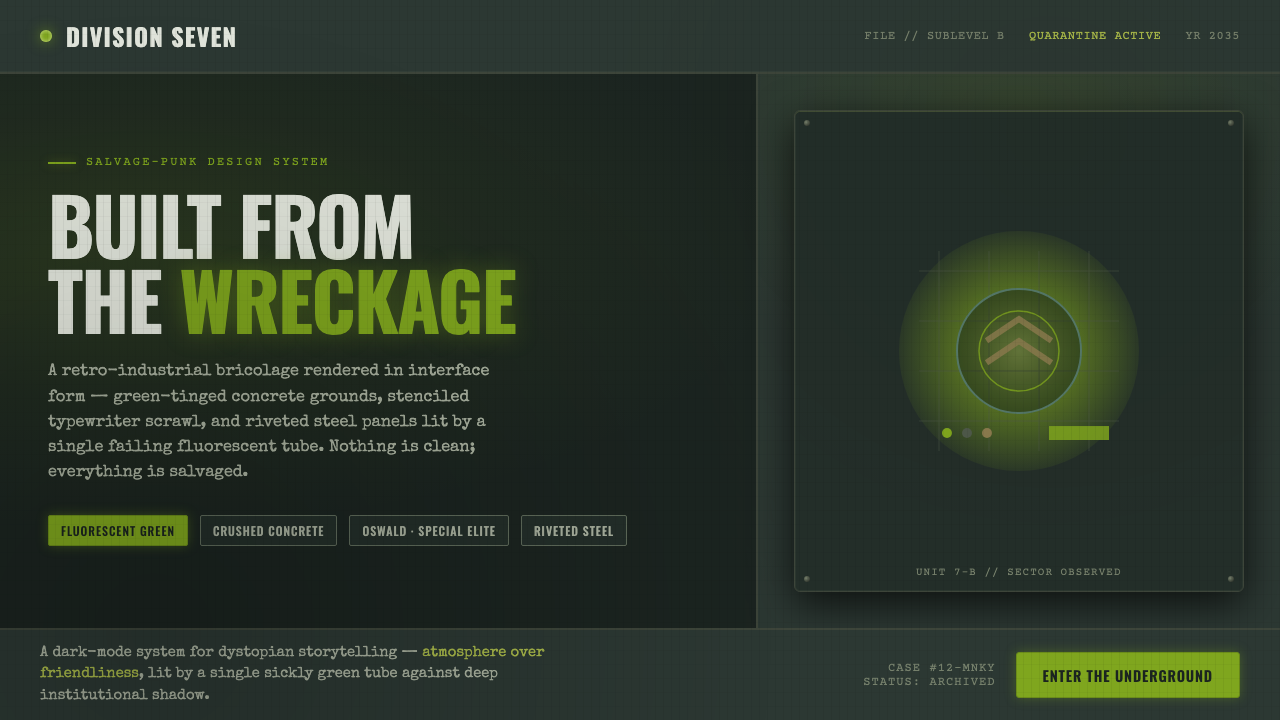 12 MonkeysBuilt from the wreckage. Sickly fluorescent green on crushed-black concrete,…
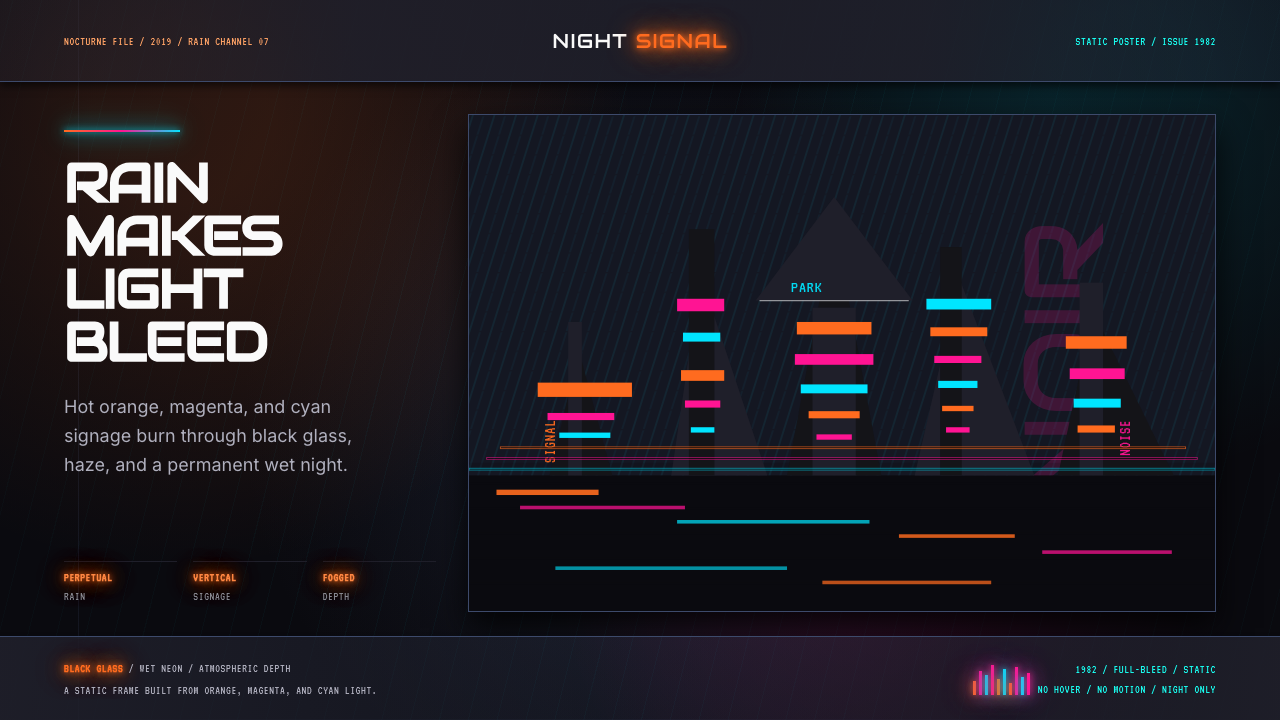 Blade Runner 1982 Neon NoirRain-soaked noir. Orange, magenta, and cyan neon cut black glass.
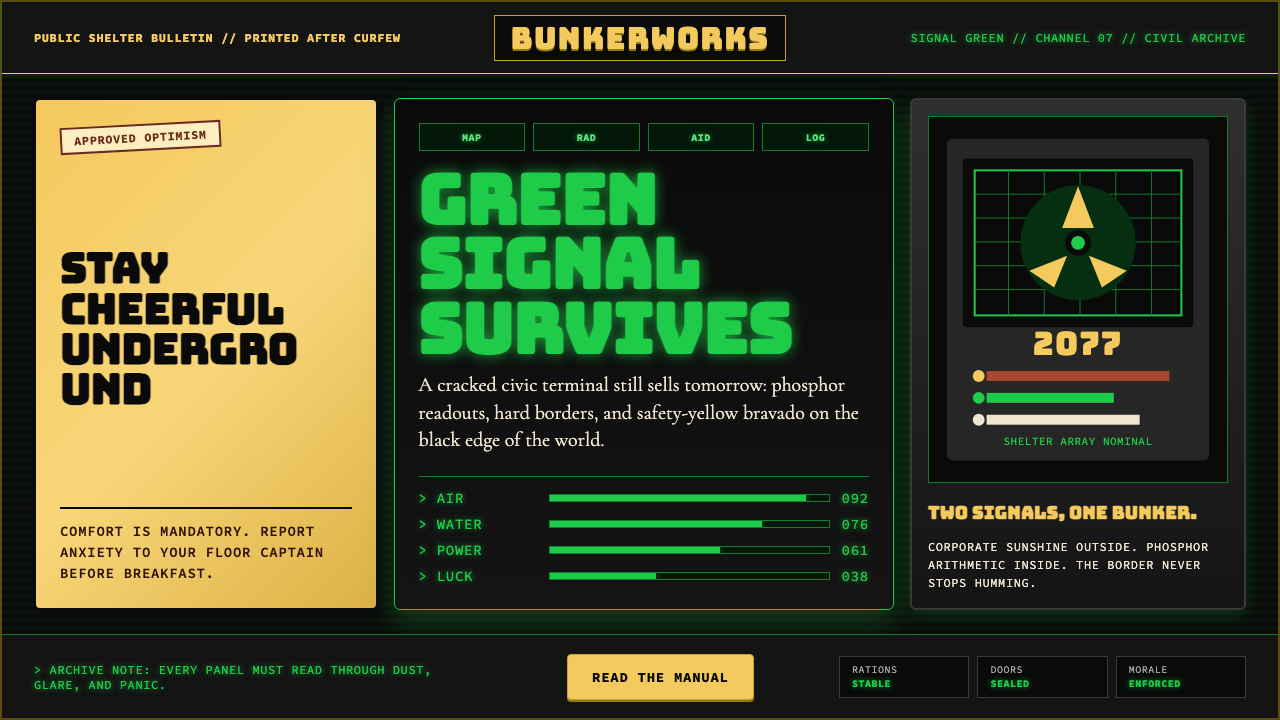 Fallout Vault-Tec Pip-BoyIrradiated optimism. Vault yellow and CRT green lock into a bordered bunker g…
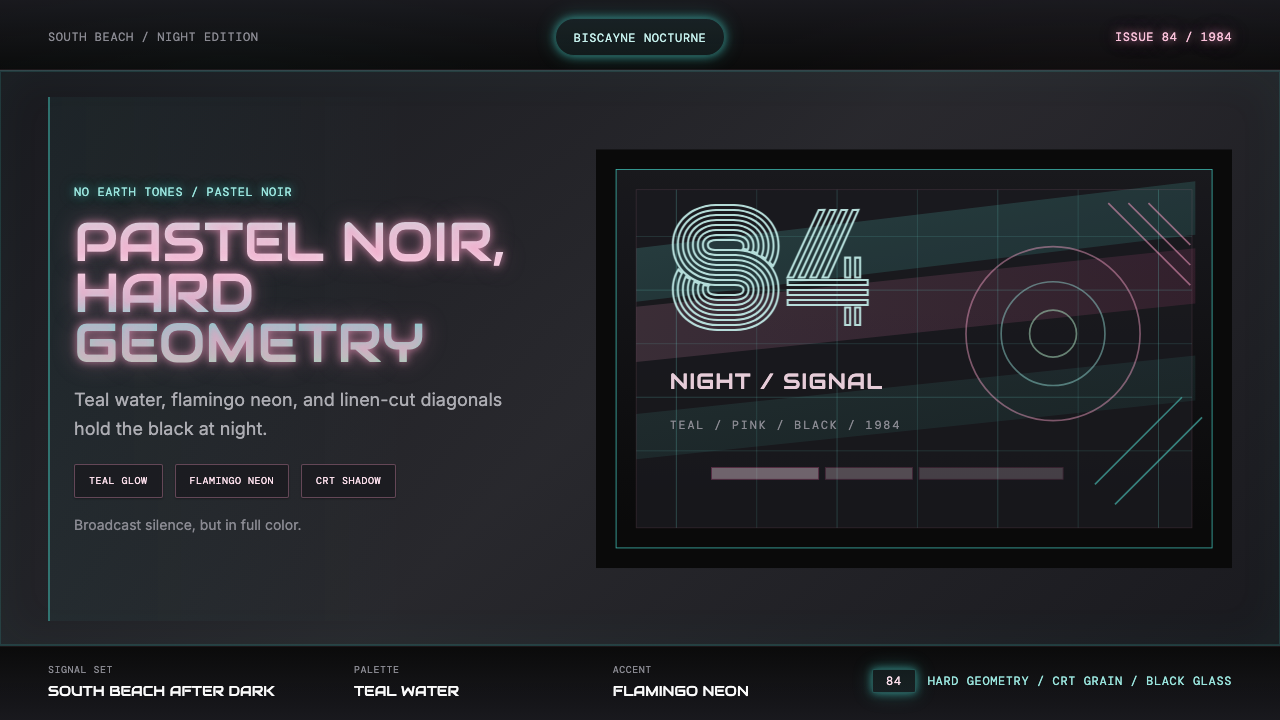 Miami Vice Pastel Teal (1984)Pastel noir, not nostalgia. Teal glow and flamingo pink slice black with geom…