What is Miami Vice Pastel Teal (1984)?
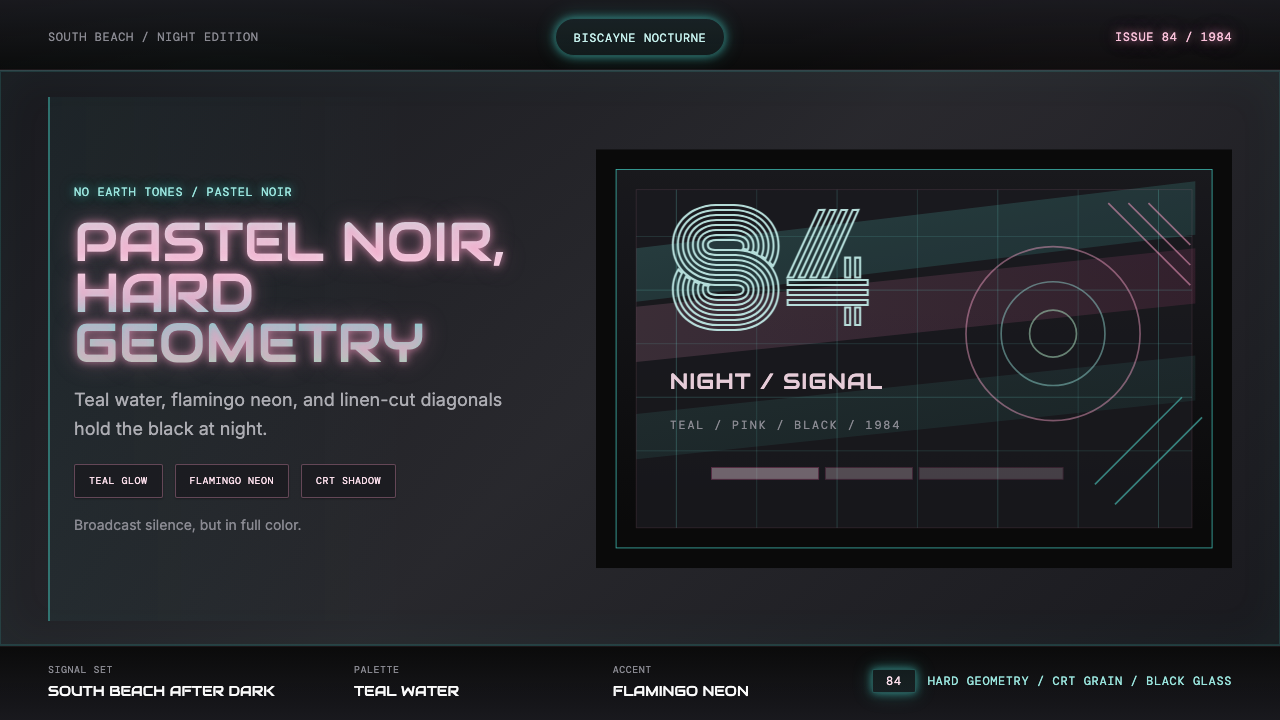
Miami Vice didn't borrow the eighties — it manufactured them, projecting a night-Miami dream of teal water, flamingo-pink neon, and knife-sharp linen geometry that the decade immediately mistook for reality.
Miami Vice Pastel Teal (1984) in brief
Miami Vice Pastel Teal is a dark-ground visual language built on the collision of opposite impulses: the softness of pastel pigment against the severity of noir black, the warmth of sun-bleached South Beach architecture against the cool glow of cathode-ray tube monitors and neon signage. The palette centers on a luminous teal — the color of Biscayne Bay under tropical late-afternoon light — paired with flamingo pink, warm white linen, and surfaces of near-absolute black. Together these hues describe a world that is simultaneously glamorous and dangerous, aspirational and melancholy.
The style emerged directly from the 1984 NBC television series Miami Vice, where producer Michael Mann issued a now-legendary production directive: no earth tones. This single prohibition dismantled the muted, naturalistic palette that had defined American television drama through the 1970s and replaced it with something closer to a painted surface — colors selected for emotional and symbolic weight rather than mimetic fidelity to the world. The result was a visual grammar instantly legible as a statement: modern, sleek, self-aware.
Visually, the system is defined by its relationship between dark fields and pastel luminosity. Teal and pink do not simply sit on a black background — they appear to glow from within it, an effect heightened by references to CRT scanlines, neon tube diffusion, and the warm haze of Miami humidity. Typography in this world is geometric display lettering derived from the synth-arcade titling conventions of the early 1980s, where display type needed to read on video monitors at broadcast resolution. Every element is grounded in its broadcast origins.

Where does Miami Vice Pastel Teal (1984) come from?
The year 1984 marks a precise cultural hinge. Ronald Reagan's America was projecting an image of confidence and consumption; MTV had been broadcasting music videos for three years and was retraining the visual vocabulary of an entire generation toward rapid cutting, high contrast, and image-as-sensation. Into this context, NBC executive Brandon Tartikoff handed producer Michael Mann a brief that has since become apocryphal: 'MTV Cops.' The directive was a compression of everything the network sensed the moment required — speed, style, and a visual register that had more in common with music video than with police procedural.
Mann, working with creator Anthony Yerkovich, chose Miami's South Beach as the series' location partly for practical reasons and partly for what the city meant aesthetically. South Beach in the early 1980s was a neighborhood in physical decay but extraordinary visual richness — its Art Deco hotels from the 1930s and 1940s still stood, faded and sun-bleached, their pastel facades a legacy of the Miami Modern movement that had absorbed and tropicalized European Deco geometry. The buildings gave the show its architectural backdrop: curved corners, porthole windows, horizontal banding, all rendered in aquamarine, coral, and cream under ferociously bright subtropical light. Mann and cinematographer Víctor Hammer then photographed this material with a luminance and color sensitivity that maximized the contrast between the pastel architecture and the deep Florida night sky.
The 'no earth tones' mandate had an immediate and specific effect on the costume and set design. Don Johnson's character Sonny Crockett established the signature look: unstructured pastel linen blazers worn over bare torsos, pleated trousers in cream or pale aqua, loafers without socks. These choices were deliberate inversions of the power-suited Wall Street aesthetic that dominated American masculine fashion elsewhere in the decade. Where suits spoke of corporate containment, Crockett's wardrobe spoke of ease, heat, and a slightly dissolute glamour — an aesthetic that fashion designers from Armani to Versace either influenced or were directly influenced by during the mid-1980s.
Jan Hammer's synthesizer-driven score provided the sonic equivalent of the visual grammar — melodic lines played on instruments that did not exist in the acoustic world, hovering between warmth and coldness in a way that exactly mirrored the palette. The show's most famous musical moment, the use of Phil Collins' 'In the Air Tonight' in the pilot episode, demonstrated this correspondence: the song's thunderous drum machine entry as a car crosses a night bridge is one of the earliest examples of image and electronic music achieving emotional synchrony in television. The visual-sonic language Miami Vice established was absorbed within months by advertising, fashion photography, and graphic design, and it had propagated globally by 1986. By the time the series ended in 1989, the aesthetic had already been named, quoted, parodied, and eventually archived as a cultural artifact — only to be revived a quarter-century later by the vaporwave movement, which found in its synthesizer tones and pastel-on-black color language an apt metaphor for digital nostalgia.
What defines the Miami Vice Pastel Teal (1984) look?
Color Field
The defining gesture of this palette is a deep, near-absolute black or dark charcoal ground against which pastel tones register as luminous rather than muted. Teal — a blue-green that sits closer to the blue end of the spectrum, evoking tropical water under overcast tropical light — is the signature accent. Flamingo pink, a warm, slightly desaturated rose, provides complementary tension. Linen white or pale cream appears as a structural neutral, suggesting the natural fabrics central to the show's costume language. These four values — deep black, luminous teal, warm pink, and structural cream — constitute the system's complete vocabulary of color.
Glow and Diffusion
Color in this system does not sit flatly on surfaces — it glows. This is achieved through soft, wide halation effects that surround pastel elements with a gentle bloom of their own hue, mimicking the behavior of neon gas tubes and CRT phosphors viewed in a dark environment. The glow is always restrained: it suggests light source rather than simulating one literally. Text and geometric shapes appear to radiate outward slightly, as if backlit or electronically generated. This luminosity is the single quality that most clearly separates the aesthetic from simple pastel-on-dark design.
CRT Texture and Scan Lines
The aesthetic is inseparable from its broadcast origins. CRT scanlines — the horizontal bands created by the electron gun sweep of cathode-ray tube televisions — function as a signature texture that simultaneously authenticates the period reference and adds visual density to large flat areas of color. Used subtly, scanline overlays give black backgrounds a sense of depth and give illuminated surfaces a slight vibrancy. Used more prominently, they evoke the direct aesthetics of early video games and computer terminal graphics, connecting Miami Vice's visual language to the broader synth-arcade cultural moment of the early 1980s.
Geometric Display Typography
Type in this system draws from the tradition of early-video geometric display letterforms — characters built on visible circular and rectangular modules, with a mechanical precision that reads as deliberately technological. Thin strokes and hairline details are avoided; the letters are built to survive low resolution and rapid legibility at broadcast scale. Headline text is typically set with wide tracking in a single weight, allowing the letterforms to breathe against the dark ground. The overall effect is of type as architecture: constructed, lit, and slightly monumental.
Art Deco Tropical Geometry
Miami's South Beach provided the series with a ready-made geometric vocabulary: the rounded corners, horizontal banding, stepped facades, and porthole motifs of 1930s and 1940s Miami Modern architecture. These forms recur throughout the aesthetic as structural and decorative elements — not as historical pastiche but as a living visual context that the show literalized by filming on location among the actual buildings. Horizontal stripes, diagonal rule lines, and rounded rectangular frames derive from this Deco-tropical inheritance and give the system a geometry that is warmer and more curved than pure Modernist grids.
Contrast Ratio and Negative Space
The system depends on extreme contrast between the dark ground and its luminous inhabitants. This is not a delicate or low-contrast aesthetic — teal and pink at full saturation against near-black demand attention and project confidence. Negative space, however, plays an equally important role: the black or deep-charcoal areas function not as voids but as atmosphere, giving the glowing elements room to breathe and preventing the composition from reading as cluttered despite its chromatic boldness. Well-composed Miami Vice layouts are simultaneously dense and spacious — a balance achieved by treating dark space as active presence rather than absence.
Linen and Natural Fabric Texture
Alongside the electronic and architectural references, the palette carries a tactile counterpoint in the form of warm cream and linen-white tones that recall unstructured natural fabrics. These surfaces have a slight warmth and visual softness that prevents the system from reading as purely cold or machine-made. In print and digital contexts, this quality can be suggested through off-white backgrounds with a barely perceptible grain, or through type set in warm white rather than pure cold white. This texture grounds the system in the human and organic, balancing the neon and electronic qualities that dominate the palette.

Who shaped Miami Vice Pastel Teal (1984)?
Mann created the visual and tonal identity of Miami Vice as executive producer and frequent director, issuing the foundational 'no earth tones' mandate that dismantled three decades of naturalistic television color convention. His background in feature film production — he had directed Thief in 1981 — meant he brought a cinematic approach to television framing, lighting, and location photography that was genuinely unprecedented for a network drama series. Mann continued to develop and refine the dark-surface, neon-accent visual grammar in his later films, most directly in the 2006 Miami Vice feature adaptation, where digital cinematography allowed the palette to be pushed to an even higher degree of luminance contrast.
Yerkovich created Miami Vice and wrote the series bible, establishing its thematic and geographic premise. His decision to set the show specifically in Miami — and within Miami, specifically in South Beach — was as consequential aesthetically as it was narratively: it gave the production access to a unique built environment whose Art Deco architecture, tropical light, and cultural ambiguity (neither fully American nor Latin) were inseparable from the visual language the show would develop. Yerkovich's series concept was lean enough to allow Mann's visual ambitions maximum room to operate, and their collaboration defined the boundary between content and form that made the show's aesthetic so coherent.
Hammer composed the series' synthesizer score, which established the sonic equivalent of the visual palette: melodic and textural, warm and cold simultaneously, built entirely from electronic instruments that in 1984 existed at the cutting edge of consumer technology. His theme for the series reached the top of the pop charts in 1985, the first television score to do so in decades — a measure of how completely the show's aesthetic had penetrated popular culture. The synthesizer's timbral palette, all sustained tones, pitch bends, and arpeggiated sequences, mirrors the neon-and-diffusion visual logic precisely: luminous, slightly unreal, and emotionally direct.
As Sonny Crockett, Johnson embodied the aesthetic in physical form, wearing the unstructured pastel linen blazers, sockless loafers, and stubble that became the decade's most widely copied masculine style. The costume design — largely driven by Johnson's own fashion sensibilities and his collaboration with costume designer Jodie Tillen — was not merely character-appropriate clothing but a visual argument about what modernity looked like in the mid-1980s. Johnson's physical presence on screen, with a color palette chosen to work specifically against South Florida backgrounds and light conditions, made him essentially a human element within the show's visual system rather than an actor within a set.
As the series' director of photography, Hammer — no relation to Jan Hammer — was responsible for translating Mann's visual directives into actual photographic decisions about exposure, lens choice, and color timing. His approach to Miami's tropical light involved significant overexposure of exterior daytime shots to maximize the bleached-out, high-key quality of the environment, then maximum underexposure in interiors and night sequences to push black areas toward true black rather than the lifted, muddy blacks typical of 1980s television. This contrast in exposure treatment between day and night is the photographic foundation of the entire aesthetic.
How do you use Miami Vice Pastel Teal (1984) today?
Miami Vice Pastel Teal is among the most atmospherically distinctive historical styles available for contemporary design work, but its effectiveness depends entirely on restraint and structural discipline. The palette is assertive by nature — teal and flamingo pink against deep black demand visual attention — and the temptation to push all elements to full saturation simultaneously must be resisted. At its best, the system creates a sense of nocturnal luxury and controlled drama; misapplied, it reads as retro costume rather than intentional design language.
For presentation slides, the style is particularly effective on both cover and full-bleed section divider pages. A cover built in this system should treat the black field as primary, introducing teal as a single dominant accent — a geometric shape, a rule line, a luminous headline — with flamingo pink held in reserve for a secondary element or a single supporting detail. Linen white works well for readable body copy. Content slides need careful restraint: against a dark background, even a small amount of teal or pink carries significant visual weight, so these colors should be reserved for the single most important element per slide. Data slides benefit from the system's built-in contrast: teal bars on a dark chart ground read more crisply than the same data on a light background, and the neon-glow quality of the palette naturally draws attention to highlighted values.
For web interfaces, the aesthetic is well-suited to dashboards, SaaS product landing pages, and pricing pages for products positioning themselves as premium, tech-forward, or distinctly nocturnal in their use context — tools for traders, creative professionals working after hours, or entertainment and nightlife platforms. The approach requires strict hierarchy: the dark background should cover the vast majority of the viewport, with teal and pink reserved for interactive elements, active states, and key calls to action. Navigation should be simple and typographic. Card components work well with a subtle inner glow on the card border or a hairline teal border that suggests luminosity without overpowering content. Ghost buttons in teal outline on dark ground are particularly effective.
For editorial and marketing contexts, the palette supports covers, feature opening spreads, and promotional materials where emotional impact is the primary objective. A Bauhaus-derived editorial layout uses structure and restraint; a Miami Vice-derived layout is permitted to be more atmospheric and sensation-driven. Full-bleed dark backgrounds with a single luminous teal graphic element and headline type in linen white create a strong poster effect. Marketing materials for events, music, entertainment, and nightlife are natural fits; the style also works for high-end fashion campaigns seeking an eighties referential quality. In long-form editorial contexts, the dark-ground palette should be used selectively — perhaps for opening spreads and chapter dividers — with lighter pages for sustained reading.
A common mistake when applying this system is treating it as equivalent to generic dark mode design, resulting in work that has neither the specificity of the Miami Vice aesthetic nor the practical legibility advantages of a well-designed dark theme. The system is not simply dark-background-with-colored-accents; it is a specific combination of luminous pastel, tropical geometry, broadcast-era typography, and glow effects that requires all its components to be present for the visual language to read as coherent. Another frequent error is using the palette across every element simultaneously — teal backgrounds, pink type, cream borders, all at once — which erases the contrast ratio that makes the system function. The dark ground is not decoration; it is structure, and it should dominate the composition.

Miami Vice Pastel Teal (1984) — FAQ
How does Miami Vice Pastel Teal differ from generic vaporwave or synthwave aesthetics?
All three aesthetics share a common ancestry — the early-1980s synthesizer culture and CRT visual environment — but they diverge significantly in emotional register and compositional logic. Vaporwave, which emerged as a music genre and visual meme around 2010–2012, is deliberately ironic and uncanny: it combines pastel tones with glitchy, corrupted imagery, classical statuary, and corporate clip art to suggest digital nostalgia tinged with anxiety. Synthwave, popularized by games and films such as Hotline Miami and Drive, leans toward a masculine, high-energy register — faster geometry, darker grounds, more aggressive neon. Miami Vice Pastel Teal is the oldest and most restrained of the three: its origins are in prestige television drama, not internet culture or gaming, and it carries a sense of warm nocturnal glamour that both vaporwave's irony and synthwave's aggression lack. The glow is softer, the geometry includes organic Art Deco curves, and the palette includes warm linen tones that the others typically omit.
Can this aesthetic work effectively in a light-background context?
The dark ground is load-bearing in this system — it is what gives teal and flamingo pink their luminous quality. On a white or cream background, the same teal becomes a simply pleasant blue-green without glow or drama; the flamingo pink becomes a conventional accent. Light-background versions are possible but require acknowledging that you are working with the palette of Miami Vice rather than its visual logic. If a light-background context is required, the most effective approach is to concentrate dark-ground areas in specific zones — hero images, section headers, call-to-action blocks — and use linen white or very pale teal-tinted fields for text-heavy areas. This hybrid approach allows the aesthetic to function in contexts where sustained dark reading environments are inappropriate.
How should photography be used within this visual system?
Photography integrates best when treated as a luminous element rather than a naturalistic window. Images should be color-graded to enhance the teal and warm tones already present in the shot, with shadows pushed toward deep black rather than lifted. Faces and architecture photograph particularly well in this system when lit with a teal-gel key light and a warmer fill — the setup that Mann's cinematographers used extensively on location in Miami. Alternatively, photography can be treated with a strong color overlay — a translucent teal or magenta wash — that integrates it into the palette rather than leaving it as a naturalistic intrusion. High-contrast black-and-white photography with a slight teal duotone tint also works well, maintaining detail in highlights while merging shadow areas with the dark background.
What kinds of brands or products is this aesthetic unsuited for?
The system carries strong cultural associations that make it unsuitable for contexts requiring neutrality, warmth, or institutional authority. Healthcare and financial services brands typically need palettes that communicate trust, calm, and accessibility — the high drama of Miami Vice neon works against those values. Children's products and family-oriented services will find the system too nocturnal and too culturally specific to the adult entertainment economy of the 1980s. Organic and natural food brands, wellness products, and sustainability-focused companies tend to work in palettes of earthy greens, warm browns, and natural whites that are the aesthetic opposite of this system. Corporate B2B products that need to communicate stability and conservatism are also poor fits. The aesthetic is most at home with products and brands that explicitly embrace modernity, tech-forward identity, nighttime or entertainment contexts, or a deliberate eighties cultural reference.
How does the Miami Vice aesthetic relate to the Art Deco movement it sampled so heavily?
The relationship is one of transformation through context rather than quotation or revival. Art Deco in its original 1920s and 1930s European form was a style of optimism, luxury, and technological excitement expressed through geometric abstraction, exotic material richness, and streamlined forms. Miami Modern, the local South Beach variant that developed through the 1930s and 1940s, took these forms and tropicalized them: the geometry became softer and more curvilinear, the materials shifted from marble and gilt to stucco and pastel paint, and the overall effect was more casual and sun-bleached than the grand European originals. Miami Vice then photographed this already-transformed architecture under artificial and nocturnal light, stripping away its daylight warmth and replacing it with the cold-warm contrast of neon against deep shadow. The result was a second transformation: Art Deco geometry, already softened by Miami's climate, was further recontextualized as a backdrop for electronic-age tension rather than interwar optimism. Contemporary designers who use this aesthetic are working with the third iteration of those forms — not Deco itself, nor even Miami Modern, but the specifically cinematic and nocturnal reading that the television series established.
Related design styles
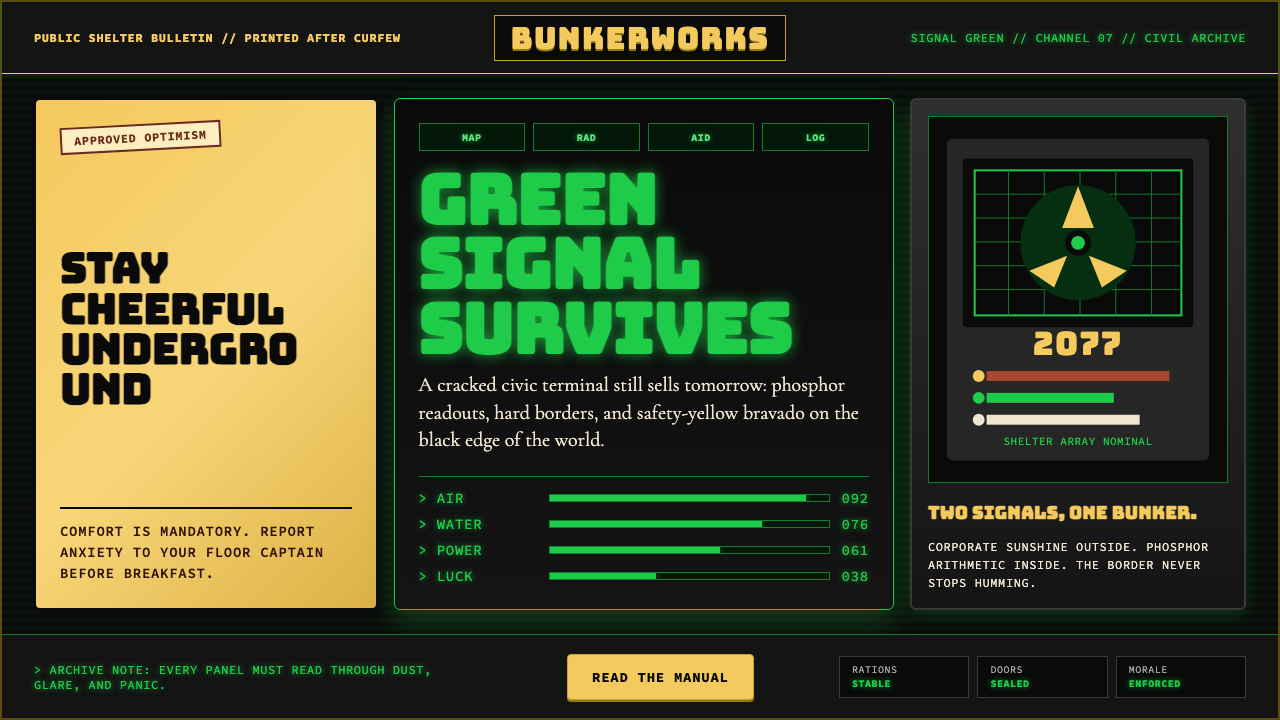 Fallout Vault-Tec Pip-BoyIrradiated optimism. Vault yellow and CRT green lock into a bordered bunker g…
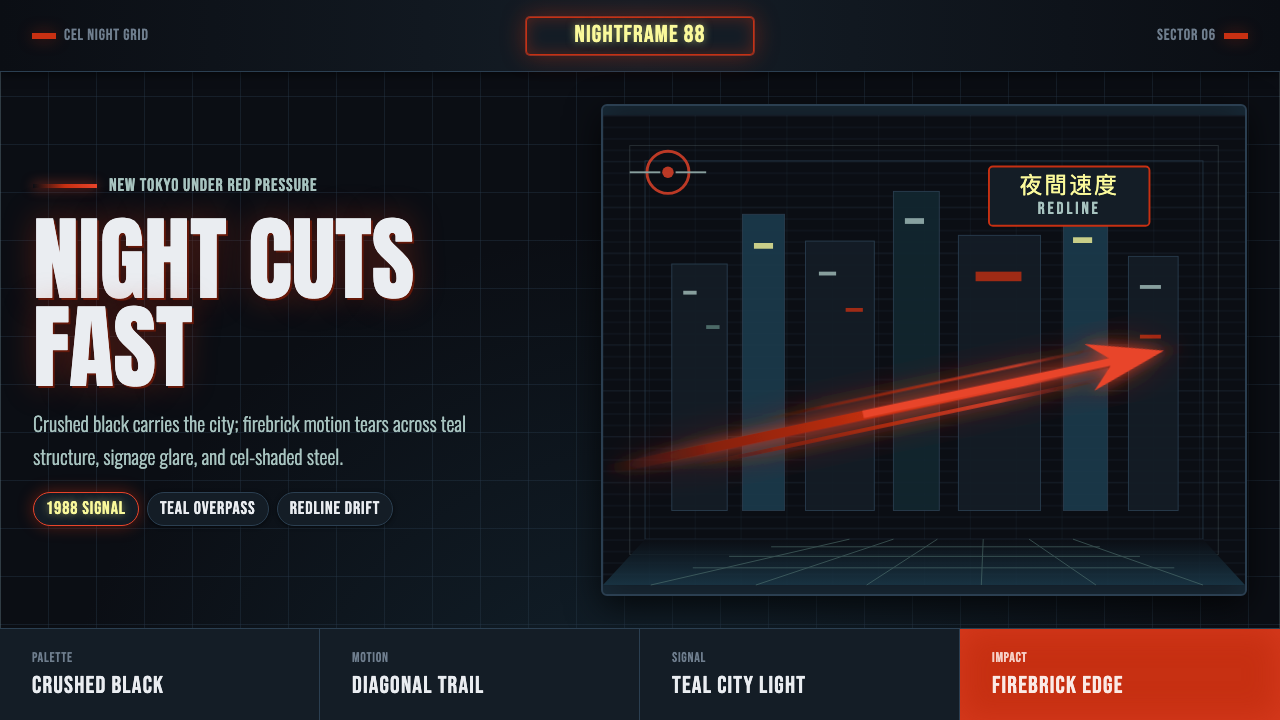 Akira Neo-TokyoNight moves fast. Firebrick trails cut crushed black, teal grids, and condens…
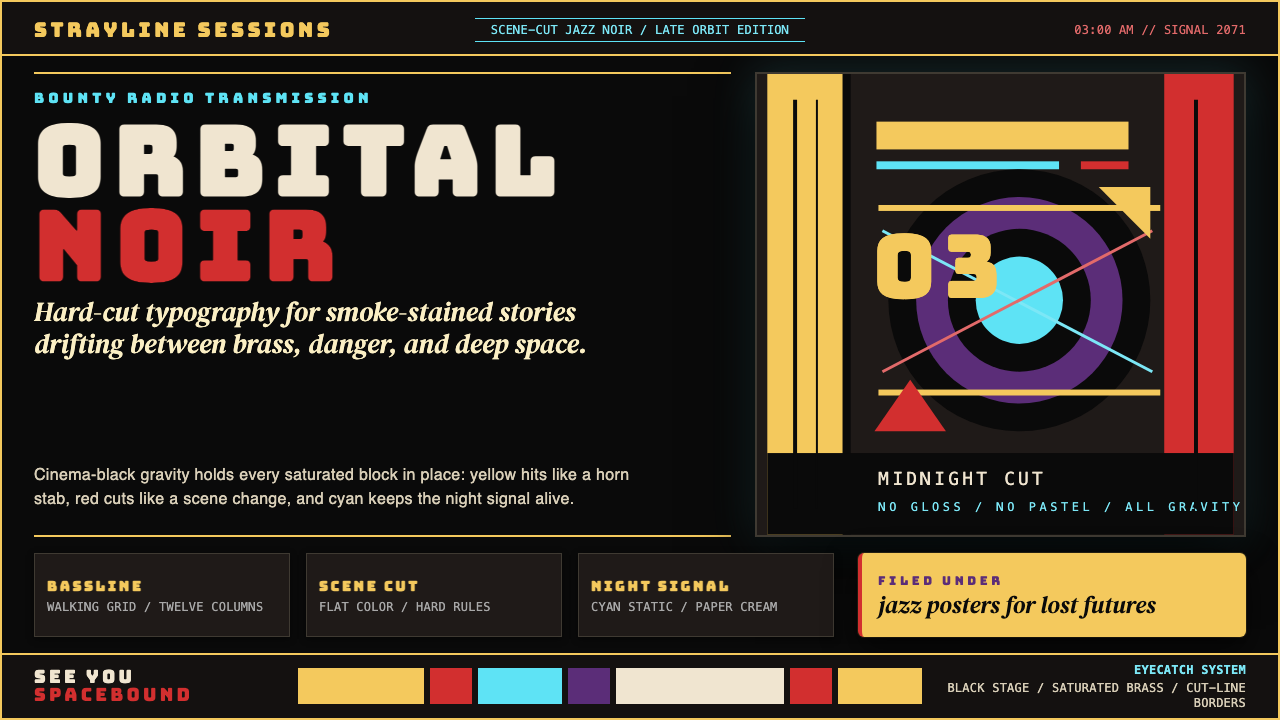 Cowboy Bebop Jazz-NoirCool at 3 AM. Bungee type, jazz yellow, red cuts, and cyan rules hit deep bla…
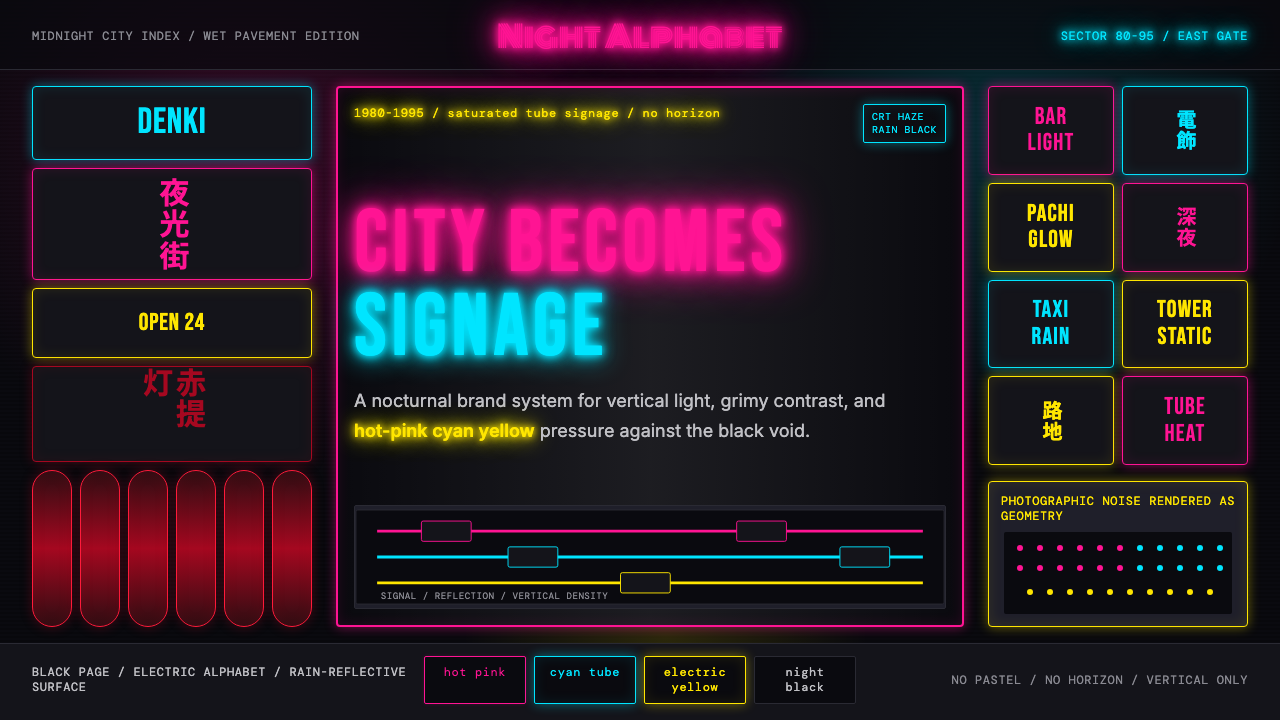 Tokyo Shinjuku Neon (1980)Night turns into alphabet. Hot pink, cyan, and yellow stack as glowing vertic…
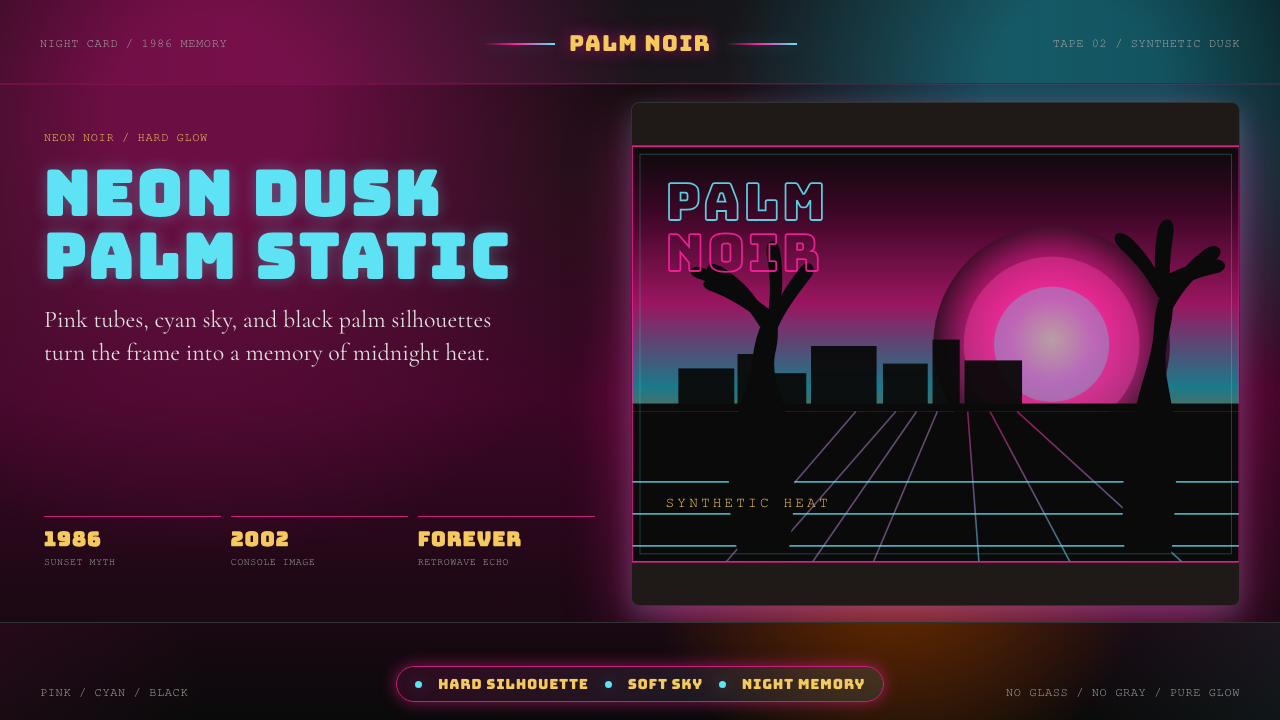 GTA Vice City (2002)Neon-noir nostalgia. Pink-cyan dusk, chunky type, and palm silhouettes.
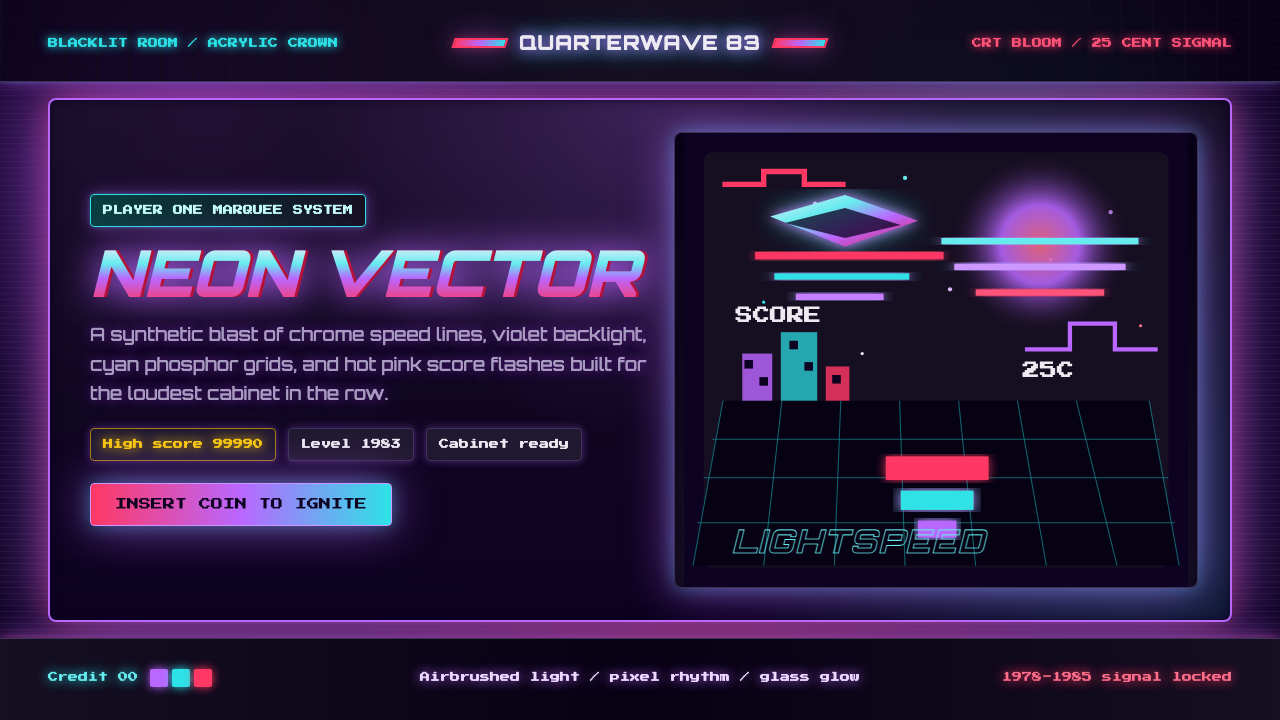 Arcade Cabinet MarqueeToo loud to ignore. Black-indigo glass, violet glow, cyan grids, hot-pink arc…