What is Cowboy Bebop Jazz-Noir?
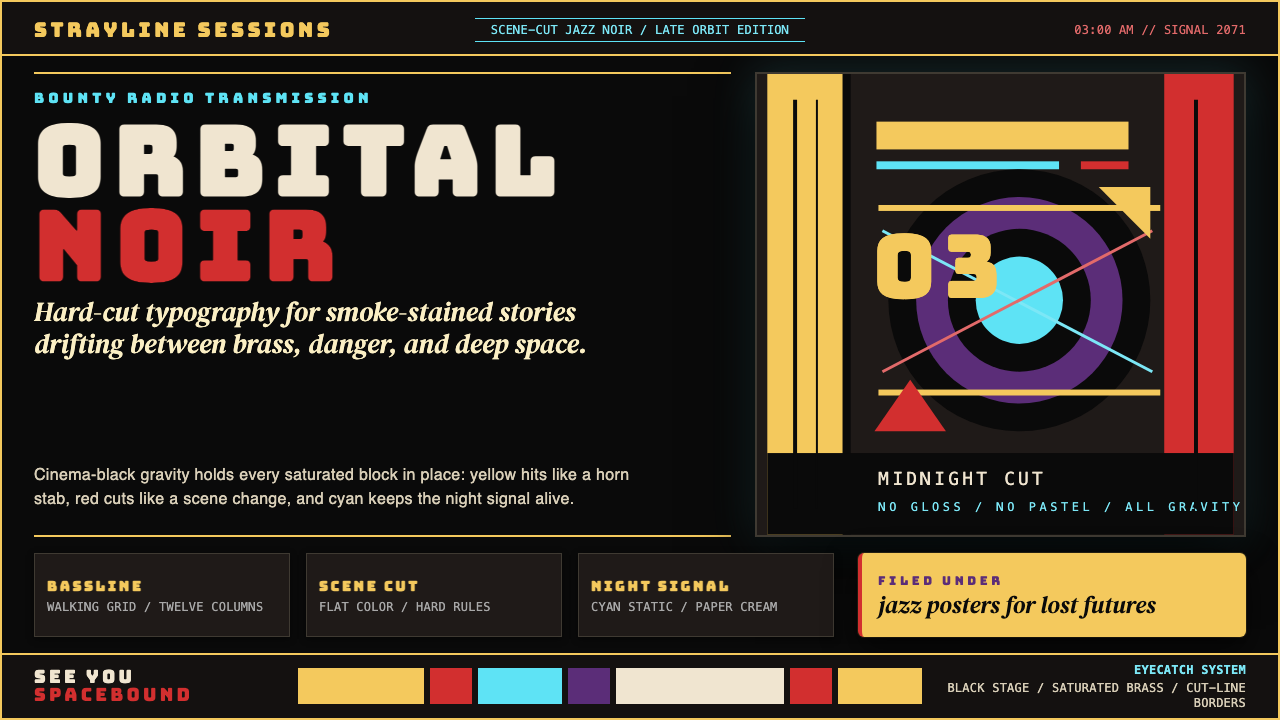
Cool at 3 AM — Cowboy Bebop's jazz-poster typography, deep-space noir blacks, and saturated bursts of yellow, red, and cyan turned a 1998 anime into a design language that still hits.
Cowboy Bebop Jazz-Noir in brief
Cowboy Bebop Jazz-Noir is the design language extracted from Shinichirō Watanabe's 1998 anime series — a visual system defined by near-total black grounds, thick display typography, and a quartet of saturated accent colors: jazz yellow, crimson red, electric cyan, and deep violet. Every episode eyecatch in the original broadcast read like a smoky bebop-club poster dropped against deep-space film grain. The aesthetic is not nostalgia for any particular decade — it synthesizes 1950s jazz poster graphics, 1940s film-noir photography, and the flat cel-animation color of 1990s anime into something that feels simultaneously vintage and timeless.
What distinguishes this style from generic dark-mode or retro design is its commitment to a specific emotional register: world-weary cool. The palette is dark not because darkness is fashionable but because darkness is the correct backdrop for a story told at 3 AM, scored to a tenor saxophone. Color breaks through that darkness with intention — a slash of yellow across a black field reads as a single streetlight, not a decorative flourish. Type is blocky and condensed because it has something urgent to say, not because it wants to fill space. Every visual decision refers back to that midnight jazz-club feeling: low light, sharp contrast, and the knowledge that nothing good lasts.
The style's durability lies in its emotional specificity. Designers applying it are not borrowing a surface treatment but adopting a mood and a set of accompanying structural choices. It works because the original source material was itself designed with genuine visual intention — Watanabe and his team at Sunrise studio treated each eyecatch as a separate poster commission, not a template to be filled in. The result is a design language that rewards close application: used loosely it reads as generic dark-with-yellow; used precisely it achieves that particular quality of beauty that feels lived-in, smoke-stained, and scored.
Where does Cowboy Bebop Jazz-Noir come from?
Cowboy Bebop premiered on TV Tokyo on April 3, 1998, produced by Sunrise studio under director Shinichirō Watanabe. The series had an unusual broadcast history: its initial run was cut short by the network after airing only a portion of the episodes, reportedly due to concerns about content. The complete twenty-six episode series aired on WOWOW satellite television later that year, and it was in that complete form that the show's visual identity — and its reputation — crystallized. A theatrical film, Cowboy Bebop: The Movie, followed in 2001, extending the aesthetic into a longer format. The series was later licensed globally and became a cornerstone of the adult-anime canon in the Western market.
The visual design emerged from the collision of Watanabe's eclectic influences. An avowed film devotee, Watanabe structured the series as a set of standalone genre episodes — noir, western, horror, kung fu, comedy — each with its own cinematographic reference points. The eyecatch cards that bookend each episode's mid-point break were designed to function as compressed poster art: they had to communicate the episode's genre, mood, and title in a single static image readable for only a few seconds. This constraint produced a typography-forward approach — bold, compressed letterforms at large scale, set against near-total black grounds with color used as an accent signal rather than a field fill.
Yoko Kanno's musical score is inseparable from the visual language. Kanno composed an eclectic soundtrack spanning bebop, blues, rock, and ambient electronic music, with the opening theme Tank! — a swinging big-band piece built on a bebop chord progression — establishing the series' tonal anchor. The visual designers responded to this musical foundation: the yellows in the typography evoke the warmth of a brass section, the deep blacks suggest a club interior at night, and the sharp red and cyan cuts read as the staccato punctuation of a drum kit. Design and music reinforce each other in a way that makes the aesthetic almost synesthetic — you can hear the color palette.
The broader cultural context includes the flourishing of adult anime in the mid-to-late 1990s alongside the resurgence of interest in jazz as a premium cultural signifier in Japan and globally. The 1990s saw jazz cafes, jazz-themed advertising, and jazz-inflected fashion branding across urban Japanese culture. Bebop — the 1940s and 1950s Charlie Parker and Dizzy Gillespie school of jazz — was specifically prestigious: intellectual, technically demanding, and associated with a certain bohemian seriousness. Watanabe's choice to name his episodes 'sessions' and his visual language to mimic bebop album covers placed the series deliberately within this cultural conversation, investing it with connotations of artistic seriousness that continue to make the aesthetic feel substantive rather than merely stylish.
What defines the Cowboy Bebop Jazz-Noir look?
Deep Black Ground
The canvas is near-total black — not a softened charcoal or dark navy but a decisive, film-grain darkness that reads as the interior of a jazz club at closing time or the void of deep space. This black is not a background choice; it is a statement about the emotional register of everything placed on it. Color only means something when it emerges from genuine darkness, and every other element in the system is calibrated against this absolute ground.
Jazz Yellow as Signal
A warm, saturated yellow — the color of a brass instrument under a single spotlight — functions as the primary accent and the style's most recognizable signature. It appears in headline type, border rules, and graphic slashes across the composition. Unlike a caution yellow or a primary-color yellow, this hue carries the warmth of stage lighting and the resonance of a saxophone bell. It is used in concentrated bursts against black, never as a fill or a wash, so that every appearance carries full weight.
Red Cuts and Cyan Rules
Crimson red and electric cyan serve as secondary and tertiary accents that work in compositional tension with the jazz yellow. Red appears as diagonal slashes, geometric cuts, or title emphasis — it reads as urgency and danger, the color of a neon sign visible through cigarette smoke. Cyan is cooler and more structural: it appears in rules, gridlines, and secondary typographic elements, evoking the blue light of a television screen in a dark room or the glow of deep-space navigation displays. The three colors rarely overlap; they stake out separate territories in the composition.
Blocky Condensed Display Type
Typography is thick, condensed, and unapologetically large. The spirit comes from both bebop album cover lettering and the compressed, ink-heavy screen-printing of mid-century jazz club posters. Characters are set tightly, often without generous letter-spacing, so that words read as graphic blocks rather than strings of individual letters. The visual weight of type is treated as a compositional element equivalent to a geometric shape — a headline sits in the layout the way a rectangle does, claiming territory and establishing structure.
Film-Grain Texture
Unlike the smooth flatness of most digital dark-mode design, the Cowboy Bebop aesthetic incorporates a suggestion of physical grain — the visual noise of 35mm film, worn vinyl, or analog broadcast signal. This texture prevents the deep black from reading as digital void and gives the entire composition a sense of material history. It implies that the design has been somewhere, has absorbed something, has a past. The grain is never so heavy that it becomes the subject; it is a subtle atmospheric condition that makes everything else feel more real.
Diagonal Dynamism
Compositions favor diagonal movement over static horizontal and vertical arrangements. This is the kinetic energy of jazz itself translated into layout: lines slash across the field at angles, type is sometimes set on a slight tilt, and color accents cut diagonally through the composition rather than sitting parallel to the frame edge. This dynamism is controlled — it never becomes chaotic — but it introduces a sense of momentum and forward motion that distinguishes the style from more static dark aesthetics.
Sparse, High-Contrast Composition
Despite the density of visual elements when they do appear, the style makes deliberate and generous use of the black ground as breathing space. A single large typographic element, a color slash, and a thin rule can constitute an entire composition. The black between elements is not emptiness to be filled but atmosphere to be inhabited. High contrast between the near-black ground and the saturated accents means that small elements read as clearly as large ones — a thin cyan line across a black field has the same presence as a paragraph of bold white type.
Who shaped Cowboy Bebop Jazz-Noir?
Watanabe directed Cowboy Bebop at Sunrise studio, bringing together an eclectic set of cinematic and musical references — noir, western, kung fu, blues, jazz — into a coherent series with an unusually distinctive visual identity. His approach to each episode as a genre exercise produced the diversity of poster styles within the eyecatch sequence, while his insistence on musical authenticity (working closely with Yoko Kanno on the score) gave the visual design a sonic foundation to respond to. Watanabe subsequently directed other influential series including Samurai Champloo (2004) and Space Dandy (2014), but Cowboy Bebop remains the definitive statement of his visual aesthetic.
Kanno composed the complete soundtrack for Cowboy Bebop, ranging across bebop, blues, ballad, rock, gospel, and ambient electronic music. Her opening theme Tank! — a swinging big-band piece built on a bebop harmonic vocabulary — established the series' tonal identity and gave the visual design its primary color reference: the warmth and brightness of brass instruments. Kanno's compositional versatility directly shaped the visual system's genre-hopping flexibility; the fact that any visual style from noir to slapstick could be supported by a corresponding musical register gave the designers permission to range widely while maintaining tonal coherence.
Hajime Yatate is the collective pen name used by Sunrise studio's creative team for original property development — the credited originator of the Cowboy Bebop story concept. As a pseudonym for institutional creative collaboration rather than a single individual, Yatate represents the studio system within which Watanabe's directorial vision was produced: the visual design of the series emerged from a team process, with the eyecatch art direction, character design, and episode-by-episode art direction involving multiple artists working within an established aesthetic framework. Yatate's credit acknowledges that the aesthetic is a studio product as much as an auteur vision.
Though not involved in the production, Charlie Parker and Dizzy Gillespie — the architects of bebop in 1940s New York — are the historical figures whose aesthetic the series most directly channels. Bebop album cover design of the 1950s, particularly the Blue Note Records house style developed by Reid Miles, established the visual vocabulary that Cowboy Bebop's eyecatch design echoes: high-contrast photography or flat graphic illustration, bold condensed typography, asymmetric composition on a dark or neutral ground, and a deliberate coolness that signals insider cultural knowledge. The series' title is a direct reference to the genre.
Reid Miles was the art director at Blue Note Records from 1956 to 1967, responsible for a body of jazz album cover design that is the single most direct visual antecedent of the Cowboy Bebop aesthetic. Miles developed a house style built on bold sans-serif typography at large scale, high-contrast black-and-white photography, a restricted palette of one or two accent colors against near-black or near-white grounds, and asymmetric composition that treated type as a graphic element equivalent in weight to the photographic image. His work for albums by John Coltrane, Thelonious Monk, Art Blakey, and dozens of others established what 'jazz looks like' for subsequent generations of visual communicators.
How do you use Cowboy Bebop Jazz-Noir today?
Cowboy Bebop Jazz-Noir is one of the most emotionally specific historical styles available to contemporary designers, and that specificity is both its greatest asset and its primary constraint. Applied correctly, it signals coolness, depth, creative confidence, and a kind of nocturnal intelligence. Applied incorrectly — as a generic dark theme with a yellow accent — it loses precisely the quality that makes it valuable. The starting point for any application is the emotional register: does this product want to feel like 3 AM jazz? If yes, the visual system follows naturally. If no, choose a different style rather than borrowing the surface without the substance.
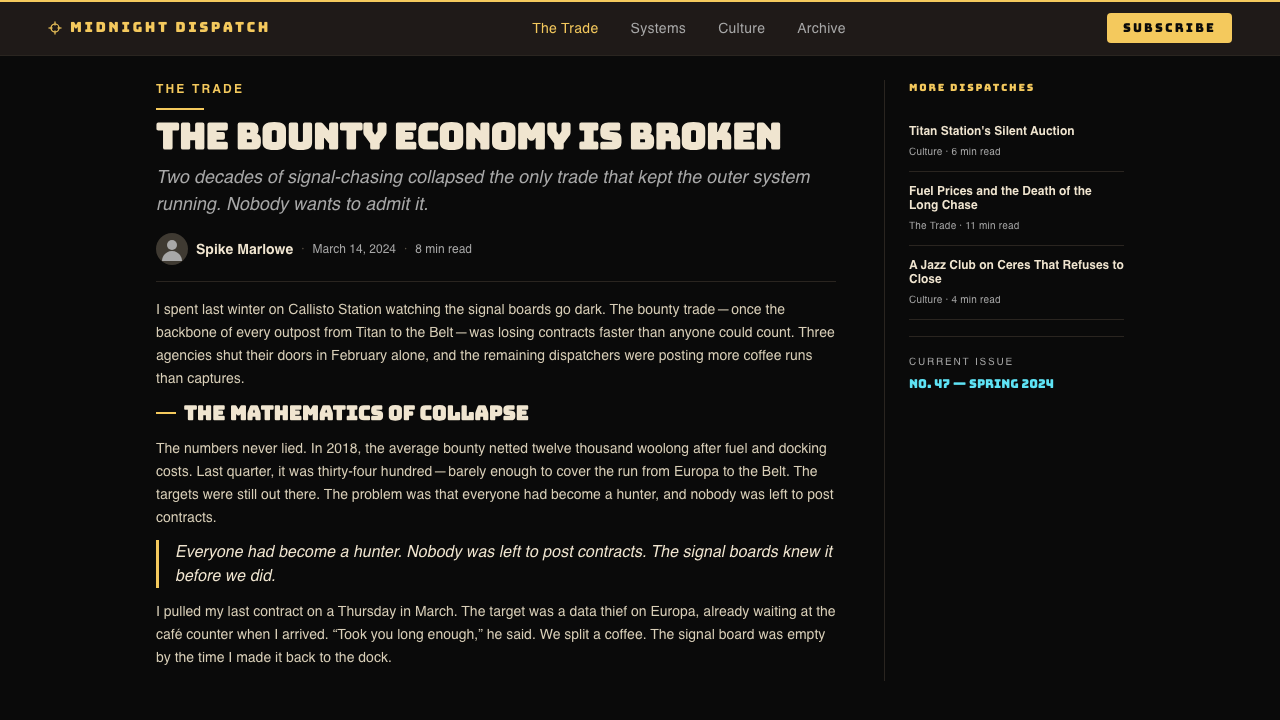
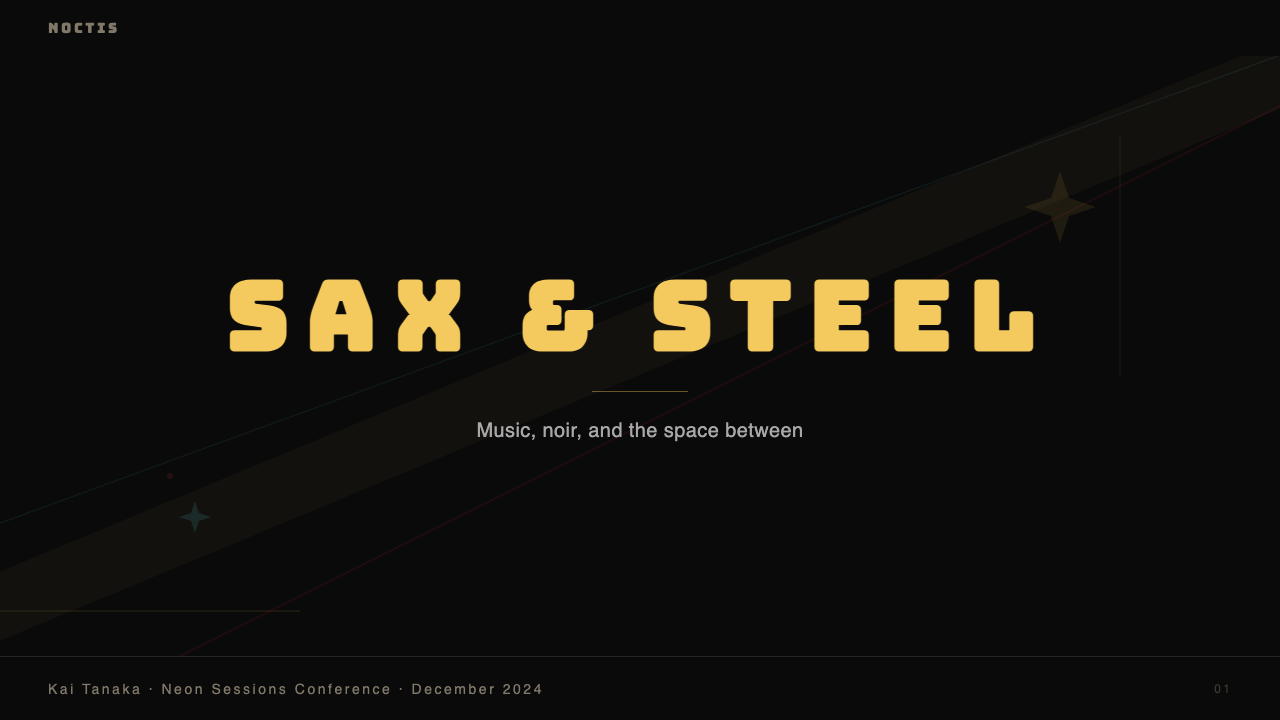
For presentation design, the style excels on covers and section openers. A cover benefits from the full compositional approach: deep black ground, a single large typographic statement in jazz yellow, a diagonal color slash in red or cyan, and generous black breathing space around all elements. Content slides should be restrained — white or light-ground slides with a single Jazz-Noir accent element (a ruled line in yellow, a section header in the display type weight) maintain the aesthetic without overwhelming the information. Data visualization slides take on particular character in this style: dark-ground charts with accent-colored data series, grid lines in faint cyan, and bold annotations in yellow create data displays that feel considered and distinctive rather than default.
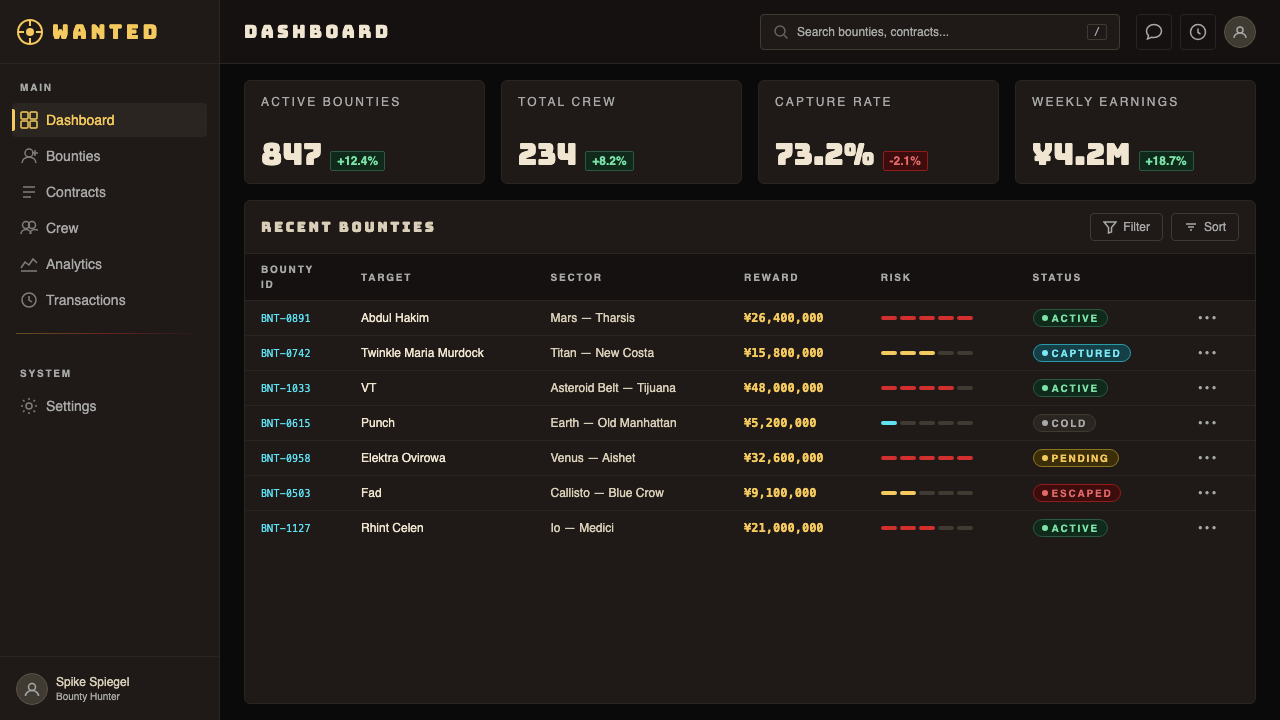
For web interfaces, the aesthetic is best suited to products that want to communicate creative depth, sophistication, or a certain after-hours cultural credibility: music platforms, creative tools, portfolio sites, premium content services, and products targeting audiences with design literacy. The approach for dashboards and data-heavy interfaces is to commit fully to the dark ground, use accent colors only for data series and interactive states, and keep typographic hierarchy legible through weight and size contrast rather than color contrast alone. Navigation and structural elements should recede into the dark ground; content and data should emerge from it through controlled use of the accent palette.
For editorial and marketing applications, the style is particularly effective for launches, announcements, and brand moments where impact and memorability are the primary goals. A Jazz-Noir poster or social card works through concentrated contrast: one dominant typographic element, one or two color accents, and the rest surrendered to deep black. Marketing sequences benefit from using the accent colors consistently but individually — yellow for the primary message, red for urgency or emphasis, cyan for informational or structural elements — so that the color system communicates hierarchical meaning rather than merely adding decoration. Print and large-format applications are where the aesthetic performs best; the high-contrast palette holds at scale and in ambient light in ways that more subtle dark palettes do not.
The most common mistake when applying this aesthetic is treating the four accent colors as a palette to be used simultaneously at full saturation. Authentic Jazz-Noir compositions lead with one accent — typically yellow — and introduce a second only for specific structural or emotional emphasis. Introducing all four colors at once produces visual noise rather than the sharp, focused composition the style depends on. A second common mistake is applying the dark ground without the grain texture, producing a flatly digital result that lacks the material warmth and historical resonance of the source. A third mistake is using the display type weight for body text, which makes extended reading fatiguing; the condensed, heavy type is reserved for headlines and eyecatch moments, while body text in a clean, legible weight at appropriate size maintains readability.
Cowboy Bebop Jazz-Noir — FAQ
How is Cowboy Bebop Jazz-Noir different from generic dark mode?
Generic dark mode is a technical inversion — light interface elements placed on a dark ground for readability in low-light environments. Cowboy Bebop Jazz-Noir is a compositional philosophy rooted in specific cultural references: bebop album cover design, film-noir photography, and the visual language of mid-century jazz club culture. The differences are substantial. Jazz-Noir uses a near-total black that is warmer and richer than the cool dark-grays of typical dark-mode interfaces; it incorporates grain texture that suggests physical materiality; it employs condensed, heavy display typography as a compositional element rather than a legibility tool; and it uses accent colors with deliberate cultural connotation — the yellow of a brass instrument, the red of a neon sign — rather than generic brand colors dropped onto a dark ground.
Can this style work for a light-background product?
The Jazz-Noir aesthetic is fundamentally dependent on its dark ground — the near-total black is not an optional element but the structural basis from which all other choices derive their meaning. A light-background variant is possible in principle, but it stops being Cowboy Bebop Jazz-Noir and becomes something more like a jazz-poster-influenced light theme, which is a different — and less distinctive — aesthetic. If a product requires a light background for legibility or brand reasons, it is better to draw specific elements from the style (the condensed display type, the diagonal dynamism, the accent color choices) and acknowledge that you are creating a jazz-influenced variant rather than claiming fidelity to the source aesthetic.
Does this style suit serious business products or only creative ones?
The style's emotional register — world-weary cool, nocturnal intelligence, creative confidence — aligns naturally with certain categories of serious business products: premium developer tools, security and infrastructure platforms, creative software, professional audio and video applications, and any product that positions itself as the choice of knowledgeable practitioners rather than casual users. It is less suited to products that need to communicate warmth, accessibility, institutional trust, or conventional authority. A jazz-noir financial trading terminal could work; a jazz-noir children's educational app would be a mismatch. The key question is whether the product's intended user would find the aesthetic's emotional register flattering or alienating.
How do you maintain readability with so much black in the interface?
Readability in a Jazz-Noir interface is achieved primarily through contrast management rather than brightness. The near-total black ground works because body text is set in a clean, legible weight in a clearly lighter tone — typically a warm off-white or light gray that is warm enough to feel part of the same system rather than a clinical white that would break the atmosphere. Display text in the accent yellow or white at large scale is fully legible against total black. The challenge comes with medium-weight elements — secondary text, captions, metadata — which need to be light enough to read but dark enough to remain secondary. Grain texture, when used with restraint, also paradoxically aids legibility by giving the eye a surface to grip rather than a seamless digital void.
Is this style appropriate for brands that have no connection to jazz or anime?
Yes — the cultural references are the origin of the aesthetic, not a requirement for its application. Brands that use Swiss International Style do not need to be Swiss; brands that use Art Deco references do not need to be from the 1920s. What matters is whether the values embedded in the aesthetic — coolness, creative depth, nocturnal intelligence, the gravity of a 3 AM conversation — align with the brand's intended positioning. A cybersecurity company, a premium music streaming service, a high-end coffee brand targeting urban professionals, or a creative agency portfolio could all deploy this aesthetic credibly without any direct jazz or anime connection. The risk is the opposite of cultural mismatch: if the aesthetic's values are adopted without genuine conviction, the result feels like costume rather than character.
Related design styles
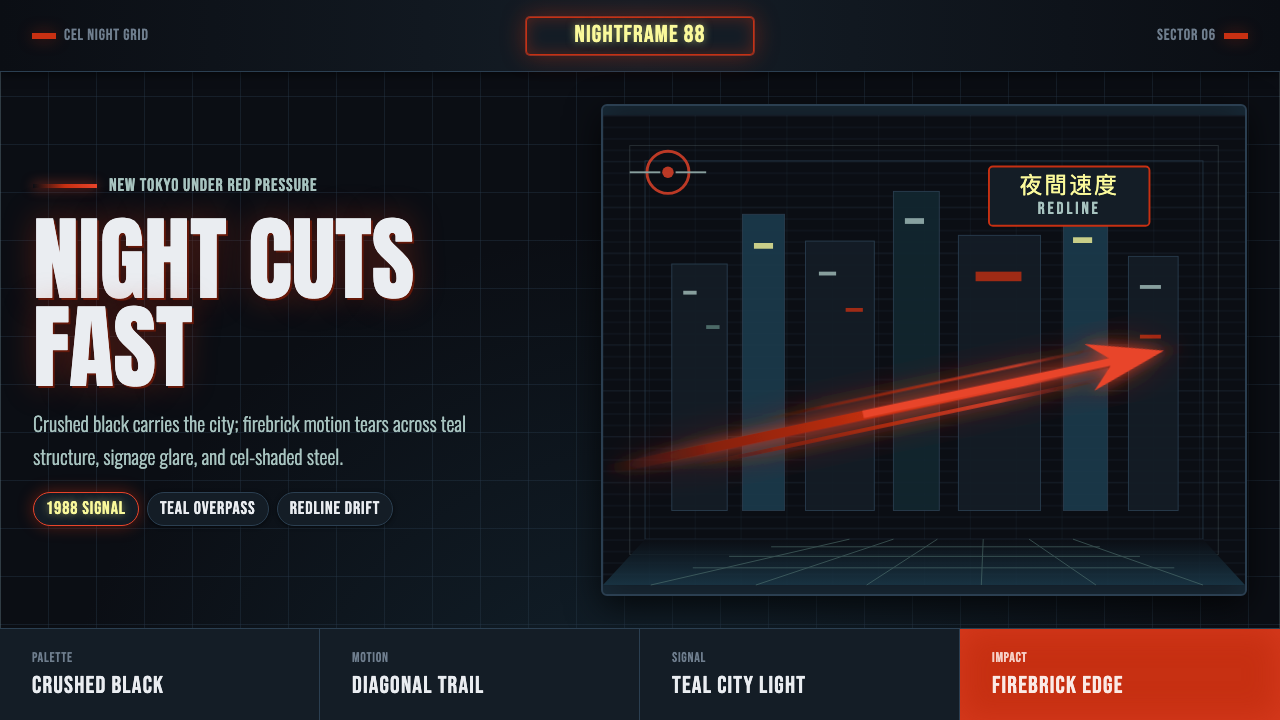 Akira Neo-TokyoNight moves fast. Firebrick trails cut crushed black, teal grids, and condens…
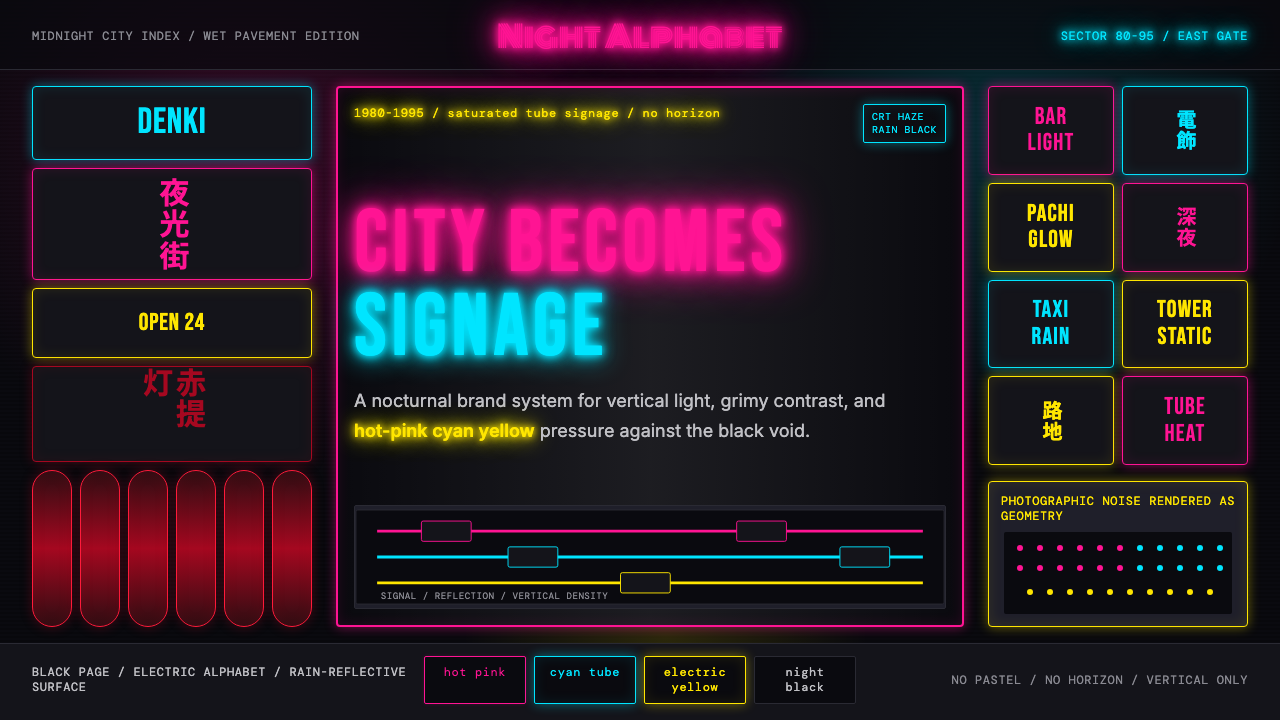 Tokyo Shinjuku Neon (1980)Night turns into alphabet. Hot pink, cyan, and yellow stack as glowing vertic…
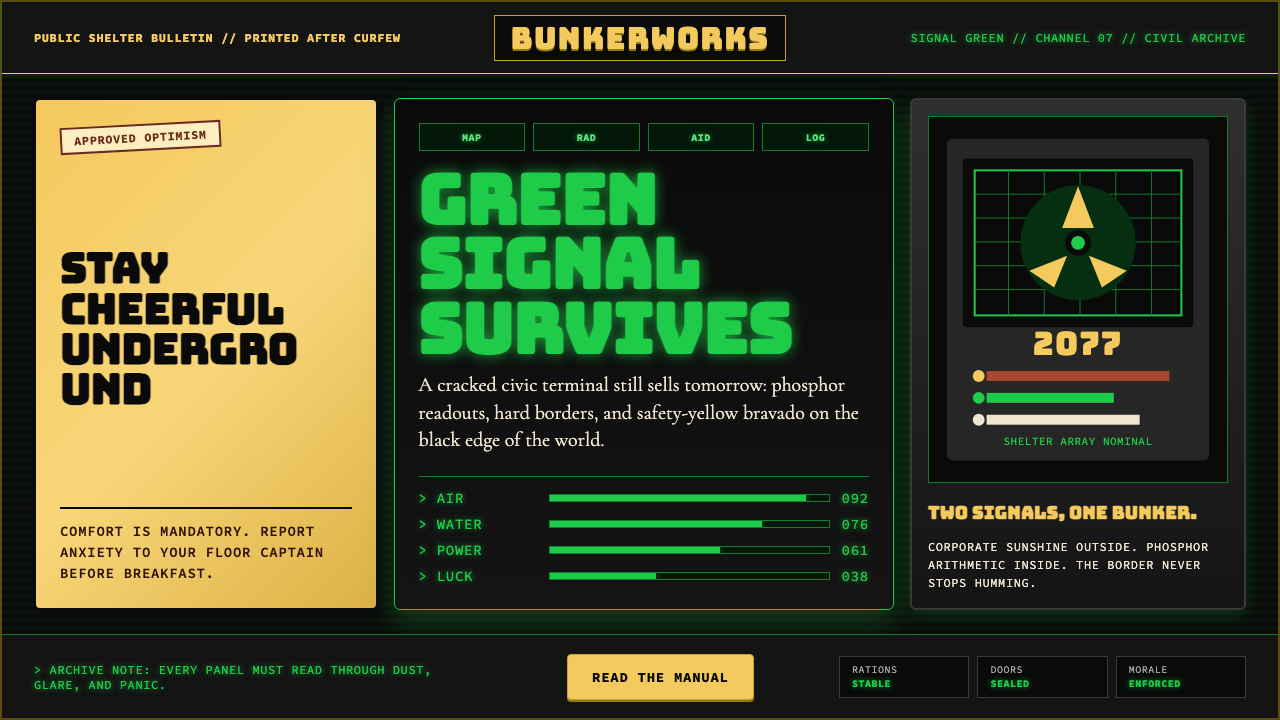 Fallout Vault-Tec Pip-BoyIrradiated optimism. Vault yellow and CRT green lock into a bordered bunker g…
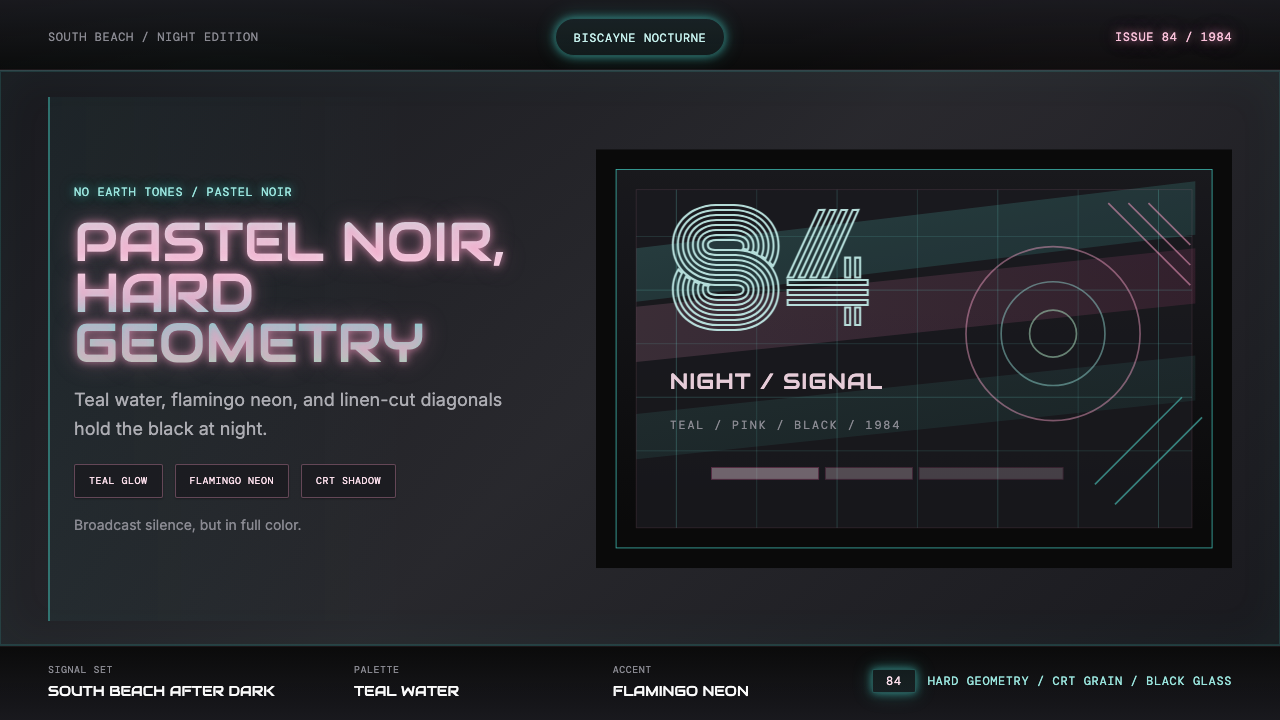 Miami Vice Pastel Teal (1984)Pastel noir, not nostalgia. Teal glow and flamingo pink slice black with geom…
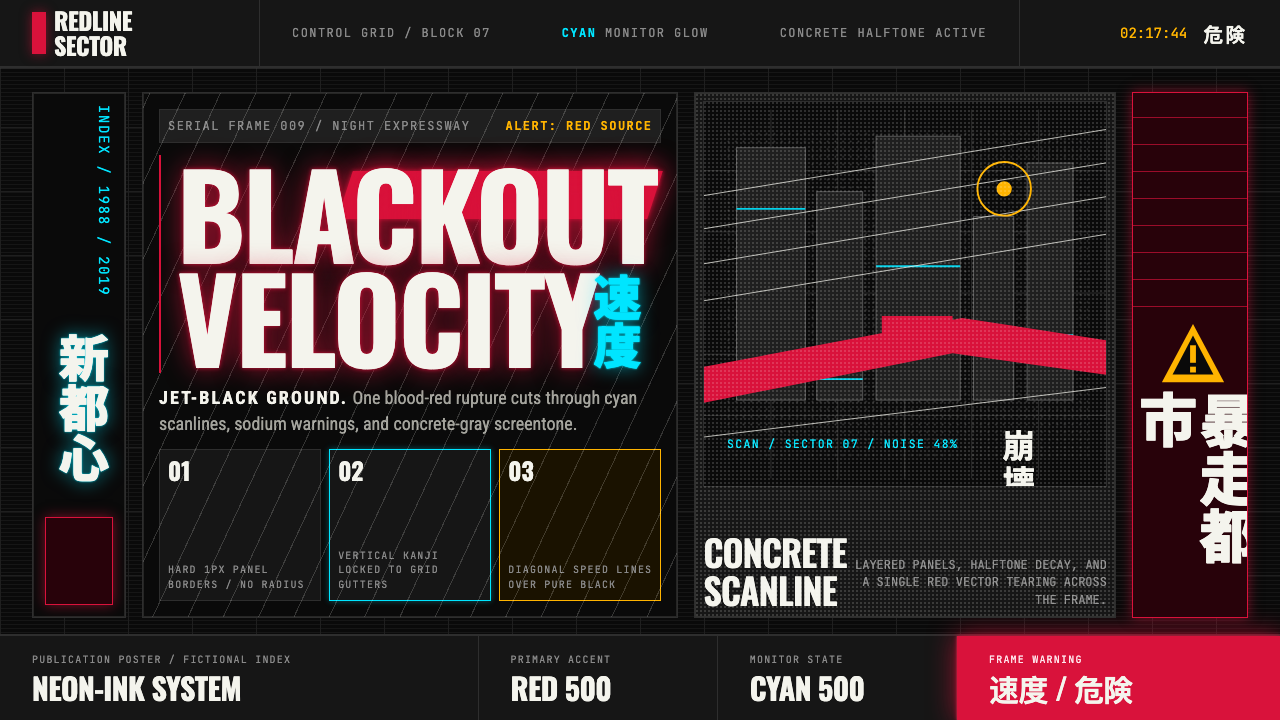 Akira (Otomo)Cyberpunk at impact. Kaneda red, cyan kanji, halftone concrete, and diagonal…
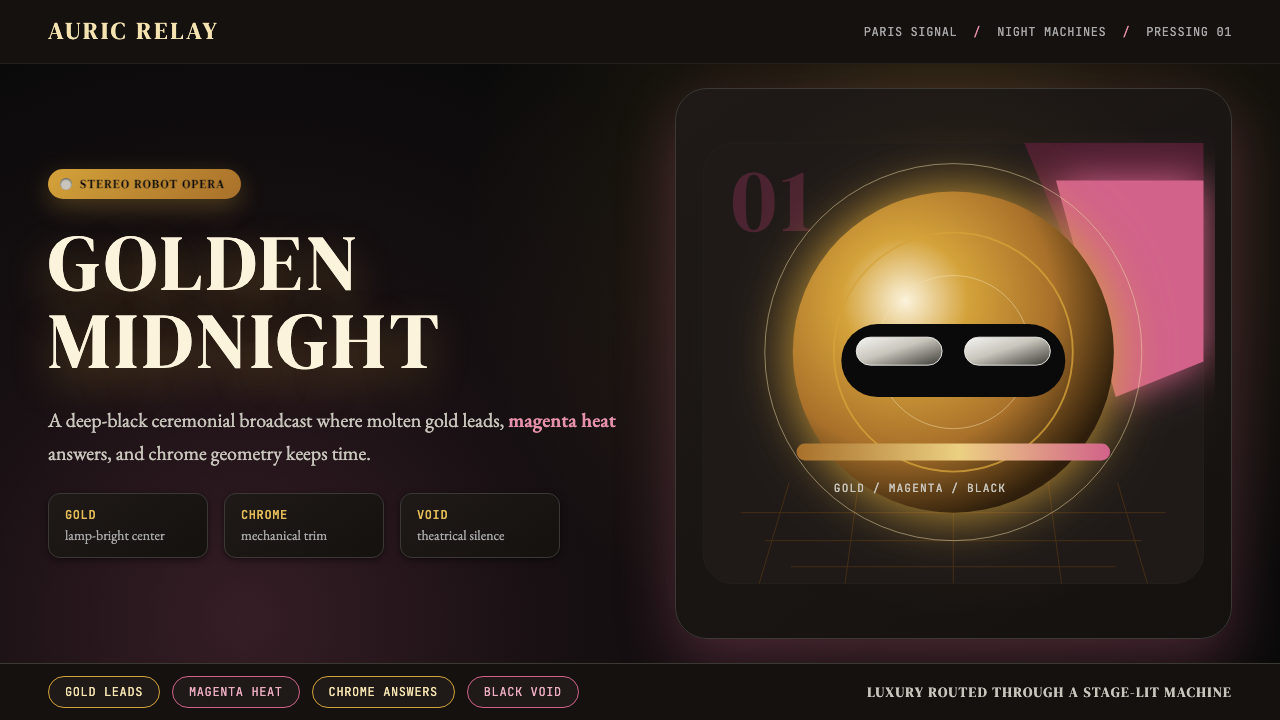 Daft Punk Discovery (Gold-Helmet)Warm sci-fi disco. Gold serif caps orbit a magenta void with chrome-disc geom…