What is Daft Punk Discovery (Gold-Helmet)?
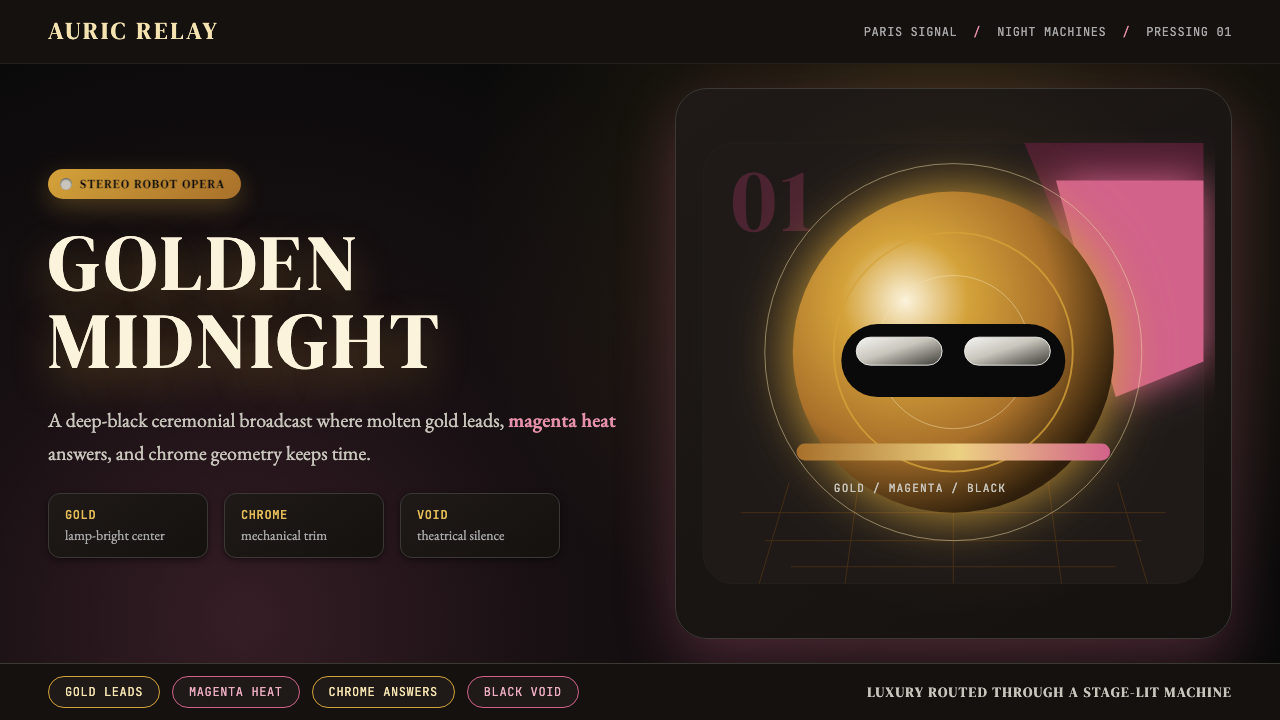
Discovery dressed electronic music in gold-gradient armor and magenta void — and made robot luxury feel inevitable.
Daft Punk Discovery (Gold-Helmet) in brief
The Daft Punk Discovery aesthetic is a visual language born from the 2001 album cover that introduced Thomas Bangalter and Guy-Manuel de Homem-Christo to the world as gold-and-silver-helmeted robots. Designed in collaboration with art director Cédric Hervet, the system layers warm saturated gold gradients over a deep void-black field, punctuated by magenta-pink accents and chrome-disc geometry. The result is something that feels simultaneously like a disco poster from the late 1970s and a PlayStation-era computer-generated render — theatrical, warm, and unmistakably mechanical.
Where most electronic music visuals of the era retreated into cool blue minimalism or industrial grey, Discovery pushed in the opposite direction: toward heat, saturation, and an almost operatic sense of occasion. Gold is not used as a neutral accent — it is the dominant atmospheric register, evoking both the warmth of analogue vinyl-era music and the prestige of science-fiction civilizations. Magenta functions as the complement that prevents the gold from becoming monotonous: it appears in glows, halos, and background fields, creating a sense of luminous depth rather than flat color.
The aesthetic draws on the visual grammar of the French Touch movement — the late-1990s Parisian electronic music scene that produced Daft Punk, Cassius, and Air — but pushes it into a more explicitly cinematic register. Geometric chrome forms (disc shapes, rings, reflective curved surfaces) read as both futuristic technology and vintage audiophile hardware, collapsing a timeline between 1978 and 2001 into a single image. The robots themselves — helmeted, faceless, anonymous — anchor the aesthetic in a philosophy of persona-as-design: identity constructed through surface rather than revealed through expression.

Where does Daft Punk Discovery (Gold-Helmet) come from?
The Daft Punk project was founded in Paris in 1993 by Bangalter and Homem-Christo, initially as a house music act operating within the nascent French Touch scene. Their 1997 debut album *Homework* established the duo's musical identity but relied on relatively conventional electronic-music visuals. The robot persona — and the fully realized visual aesthetic that came with it — was not introduced until the *Discovery* campaign in 2001, making the album cover a genuine origin point for the aesthetic rather than an iteration on earlier work.
The gold-helmet-and-magenta visual language was developed in direct response to the album's thematic content. *Discovery* was a conscious departure from the grittier, harder-edged house music of *Homework*: it was warmer, more melodic, more indebted to 1970s funk and disco and to the orchestral pop of the same era. The cover needed to encode this shift in a single image. Hervet, working with the duo, resolved the visual problem by reaching back to the palette of late-1970s disco culture — gold, warm brown, magenta — and projecting it forward through the lens of early-2000s computer graphics, complete with reflective surfaces and depth-of-field blur effects that signaled both technological sophistication and cinematic aspiration.
Tony Gardner, the Hollywood special-effects artist who actually fabricated the physical helmets worn by the duo in promotional and live contexts, brought an industrial rigor to the robot aesthetic that reinforced its visual seriousness. The helmets were not costumes in the theatrical sense — they were engineered objects, with LEDs and articulated visors, designed to be read as genuinely technological rather than merely decorative. This distinction between genuine engineering and theatrical prop matters to the aesthetic: the Discovery look is not pastiche. It is a claim about the future made with full conviction.
The historical context shaped what the aesthetic could mean. In 2001, computer graphics and digital production had become mainstream tools in music and film, but they retained a sense of novelty and prestige. The photorealistic rendering of metallic surfaces, the depth gradients of a simulated void, the warm-to-cool color transitions of a calculated glow — these were not default options but deliberate technical choices that communicated mastery and ambition. Daft Punk's visual team understood that the medium carried its own message: a machine-rendered image of machines making music closed a conceptual loop that made the aesthetic feel earned rather than adopted.
What defines the Daft Punk Discovery (Gold-Helmet) look?
Gold-Gradient Atmosphere
Gold is not a highlight or an accent in this system — it is the primary atmospheric condition. The characteristic gradient moves from a deep, saturated amber at the center of light sources outward toward cooler, darker tones, creating the impression of warmth radiating from within the image rather than falling onto it from outside. This interior luminosity is the defining temperature of the aesthetic: it reads as both the warmth of vintage analogue sound and the prestige glow of high-technology surfaces.
Void-Black Depth Field
Behind every gold form and magenta glow lies an absolute void: a black so deep and empty that it reads less as a background color and more as the absence of space itself. This void functions as the negative space through which all warm-toned elements gain their luminosity. Without the void, the gold would simply be saturated color; set against it, the gold becomes a light source. The contrast between illuminated foreground and unlit depth is what gives the aesthetic its sense of infinite theatrical scale.
Magenta-Pink Complement
Magenta occupies the chromatic role that gold cannot fill alone: it provides the cool-warm tension that keeps the palette from reading as monochromatic. In practice, magenta appears as atmospheric haze around light sources, as the dominant hue in large background zones, and as the glow that bleeds between foreground and void. It is used at full saturation but rarely at full opacity — it most often appears as a tinted luminosity rather than a solid hue, maintaining the sense of depth and atmosphere over graphic flatness.
Chrome-Disc Geometry
The signature geometric motifs — discs, rings, hemispheres, and toroidal forms — are rendered as reflective chrome or brushed metal surfaces that pick up both the gold and magenta from their environment. These forms carry a dual meaning: they read simultaneously as futuristic technology (spacecraft, machinery, industrial components) and as vintage audio hardware (record grooves, speaker cones, amplifier knobs). The reflective quality is essential — flat shapes would lose the environmental warmth that makes the geometry feel inhabited rather than diagrammatic.
Retro-Futurist Typography
Type in this aesthetic leans toward serif or display letterforms with enough weight to hold their own against the atmospheric intensity of the palette. Characters are often set in gold or cream against the dark void, sometimes with a subtle glow treatment that integrates them into the lighting logic of the composition. The typographic register is unhurried and ceremonial — more like a film title card than a product label — which reinforces the sense that the aesthetic is presenting something of consequence rather than simply labeling it.
Warm Luminous Depth
Unlike the hard-edged flatness of graphic-design movements such as Bauhaus or Swiss Style, the Discovery aesthetic relies on soft gradients, atmospheric bloom, and depth-of-field simulation to create the impression of three-dimensional space rendered under theatrical lighting. This is intentional softness — not a failure to commit to edge — and it is what separates the aesthetic from its contemporaries in electronic music visuals. The warmth is not sentimental; it is architectural, constructing a space the viewer can imaginatively inhabit.
Persona-as-Surface
The robot helmets that anchor the aesthetic are not characters in a narrative sense — they are designed surfaces. Their appeal lies precisely in their blankness: without eyes or mouths to read, the viewer projects onto the reflective visor. This principle extends throughout the aesthetic system. Every element — gold disc, magenta void, chrome ring — functions as a surface that reflects its environment rather than generating its own meaning from within. The style rewards designers who understand how to use visual weight, finish quality, and chromatic atmosphere to create presence without representation.

Who shaped Daft Punk Discovery (Gold-Helmet)?
One of the two members of Daft Punk, Bangalter served as the primary architectural force behind the duo's sonic direction, and his sensibility — rooted equally in French house music, 1970s Italian disco, and analogue synthesizer aesthetics — shaped the warm-gold-and-chrome visual direction of Discovery as much as any visual decision. His insistence on the robot persona as a permanent and total identity (interviews conducted in character, photographic appearances only in helmet) gave the aesthetic its philosophical backbone: the idea that identity could be a designed surface rather than a revealed self.
The second member of Daft Punk, Homem-Christo contributed a visual sensibility more directly drawn from cinematic and art-historical references than Bangalter's more music-theoretical approach. His interest in science-fiction film aesthetics — particularly the warm amber and chrome palettes of late-1970s genre cinema — is directly legible in the Discovery visual system. Together with Bangalter, he developed the philosophical framework in which the robots were not costumes but permanent identities, a commitment that forced the visual aesthetic to carry the full weight of public persona.
The art director principally responsible for translating the Discovery concept into a resolved visual system. Working within the constraints and direction provided by Bangalter and Homem-Christo, Hervet made the specific decisions — the precise balance between gold saturation and void depth, the choice of magenta as complement, the treatment of chrome surfaces as environmental mirrors rather than graphic shapes — that transformed an aesthetic idea into a reproducible visual language. His contribution represents the professional craft layer beneath the conceptual architecture: the system-building rather than the vision.
The Hollywood special-effects artist and costume fabricator who built the physical Discovery-era helmets. Gardner's background in practical effects for science-fiction film brought genuine engineering credibility to objects that could easily have read as theatrical props. His helmets featured functional LED matrices, precisely engineered visor mechanisms, and material finishes chosen for both photographic performance and live-stage readability. The physical solidity of these objects — their obvious weight, their engineered articulation — translated directly into the visual seriousness of the aesthetic, grounding the gold-and-chrome system in something that existed as real technology rather than only as image.
The broader Parisian electronic music scene of the late 1990s — including Cassius, Air, Bob Sinclar, and associated producers and designers — established the cultural context within which the Discovery aesthetic became legible as a statement rather than merely a style. French Touch was characterized by a warmer, more melodic, more groove-oriented approach to house music than the prevailing Northern European and American scenes, and its visual culture — typically warm-toned, reference-heavy, cinematic — provided the immediate precedent that Discovery both honored and departed from. Understanding French Touch as context is essential for understanding what Discovery was claiming when it reached for gold and void: it was positioning itself as the peak, not merely a participant.
How do you use Daft Punk Discovery (Gold-Helmet) today?
The Discovery aesthetic is one of the most immediately recognizable visual registers in popular music history, which makes it both highly evocative and unusually demanding to apply outside its original context. Used well, it signals warmth, prestige, technological sophistication, and a particular kind of theatrical confidence — the feeling that what is being presented is worth the ceremony. Used carelessly, it collapses into a generic dark-background gold-text treatment that carries none of the system's specific atmospheric logic. The key is understanding that Discovery is not a palette — it is a lighting environment, and every design decision should be made in service of that environment.
For presentation slides, the Discovery approach works powerfully on cover and section-divider pages where full atmospheric commitment is possible. A cover slide should be treated as a film title card: void black occupying most of the field, with the title in warm gold or cream letterforms that appear to be lit from within rather than printed on a surface. The gradient logic should move from the densest luminosity at a specific focal point — typically center or slightly above center — outward toward cooler, darker tones at the edges. Content slides require a different discipline: use the void-black background consistently but pull back the atmospheric effects, letting the content read against a clean dark field with warm-gold section labels and magenta used sparingly for data highlights or callout emphasis. Data visualization inherits the palette directly: charts and graphs rendered in gold against void, with magenta as the accent for peak values or selected states.
For web interfaces and dashboards, the aesthetic translates most effectively to dark-mode environments where the void-black background can function as intended. A dashboard built in this register should use the deep black as the base surface, reserve gold-gradient treatments for primary KPI values, section headers, and active navigation states, and use a muted version of the palette — desaturated warm tones rather than full gold saturation — for secondary data. The atmospheric bloom effect (a soft warm glow radiating from key values) can be achieved through careful layering without simulation of literal light. Pricing pages benefit from the theatrical confidence of the system: high-tier plans presented in full gold-gradient glory against void, lower tiers in the same field at reduced luminosity, magenta reserved for the recommended-plan highlight or primary call-to-action.
For editorial and marketing work, the Discovery aesthetic supports rich, full-page spreads where the atmospheric environment can breathe across a large canvas. A marketing hero section should commit entirely to the void: no competing backgrounds, no texture overlays, no competing color systems. Photography, if used, should be treated as a surface within the environment — lit as if by the same warm-gold light source that governs everything else, desaturated where it conflicts with the palette, and composited rather than placed. Headlines should carry the full typographic weight that the atmospheric surroundings invite: large, well-spaced, set in warm tones against the dark field. The key editorial use case is the feature announcement or product reveal — contexts where ceremonial presentation is a legitimate communication goal.
The most common mistake when working with the Discovery aesthetic is treating it as a dark-mode color theme rather than as a lighting environment. Adding gold text and magenta accents to a dark background does not produce Discovery — it produces generic dark-luxury. The distinguishing element is the sense that light is emanating from within the composition: golds that appear to glow rather than simply be colored, voids that read as space rather than as background fill, gradients that model a coherent light source rather than adding visual interest. A secondary common mistake is deploying all three tonal registers — full gold, magenta, and void — simultaneously and at equal weight, destroying the hierarchy that gives the system its depth. In authentic Discovery-derived work, void dominates, gold is the primary light source, and magenta is the atmospheric complement — never the lead.

Daft Punk Discovery (Gold-Helmet) — FAQ
Is the Discovery aesthetic the same as general dark-gold luxury design?
They share surface elements but operate on different logic. Generic dark-gold luxury design uses gold as a prestige signal against a dark field, typically with hard edges and opaque fills. The Discovery aesthetic is a lighting environment: gold values appear to emit light rather than simply occupy space, the void is a depth field rather than a background color, and magenta functions as atmospheric complement rather than decorative accent. The test is whether the composition reads as a scene with an interior light source or as a dark background with colored elements placed on it. Discovery-derived work passes the first test; generic dark-luxury passes only the second.
Can the Discovery aesthetic work for brands that are not in music or entertainment?
Yes, with the right positioning. The aesthetic carries values of technological sophistication, warmth-within-modernity, and theatrical confidence that translate well to premium technology products, luxury automotive, high-end financial services, and any brand seeking to distinguish itself from the cold minimalism dominant in tech. The key is tonal alignment: Discovery works for brands that are comfortable presenting themselves with ceremony. It is a poor fit for brands whose positioning depends on approachability, organic warmth, or understated simplicity — contexts where the theatrical scale of the aesthetic reads as disproportionate or pretentious.
How do you prevent the aesthetic from feeling dated or nostalgic rather than timeless?
The risk is real: early-2000s computer graphics carry specific period associations that can tip the aesthetic into retro territory if the rendering quality or compositional decisions feel like period reproduction rather than genuine application. The antidote is to understand what the aesthetic is actually about — a lighting philosophy and a chromatic logic — rather than reproducing specific period techniques. A Discovery-derived composition should feel like it was made now, by someone who deeply understands the original system, not like an artifact from 2001 deliberately recreated. This means avoiding the specific tells of early CG (low polygon counts, visible render artifacts, dated lens flare shapes) while preserving the atmospheric intelligence that makes the original work timeless.
What is the correct relationship between gold and magenta in a Discovery-derived layout?
Gold is the primary light source and the dominant chromatic register; magenta is the atmospheric complement that gives the void its depth and prevents the composition from reading as simply a bright-on-dark contrast study. In practice, this means gold should occupy the most visually prominent positions — headlines, focal geometry, key values — while magenta operates more diffusely, as ambient haze, background zone color, or the color of the space between elements rather than the elements themselves. When magenta appears at full saturation in a foreground element, it should be the exception, not the rule, and it should be positioned to create dialogue with the gold rather than compete with it.
Does the Discovery aesthetic require a dark background, or can it work on light grounds?
The void-black background is not optional — it is structural. The entire luminosity logic of the aesthetic depends on the contrast between emitted warm light and the unlit depth field. On a light background, gold becomes a flat yellow-beige and magenta becomes a saturated pink; neither carries the sense of interior light that defines the aesthetic. A light-background version that retains gold and magenta will inevitably read as a different aesthetic system — warm and festive, perhaps, or retro-disco — but not as Discovery. If a light-background application is genuinely required by context, it is better to draw selectively from the aesthetic's typographic and geometric logic while acknowledging that the full atmospheric system cannot be preserved.
Related design styles
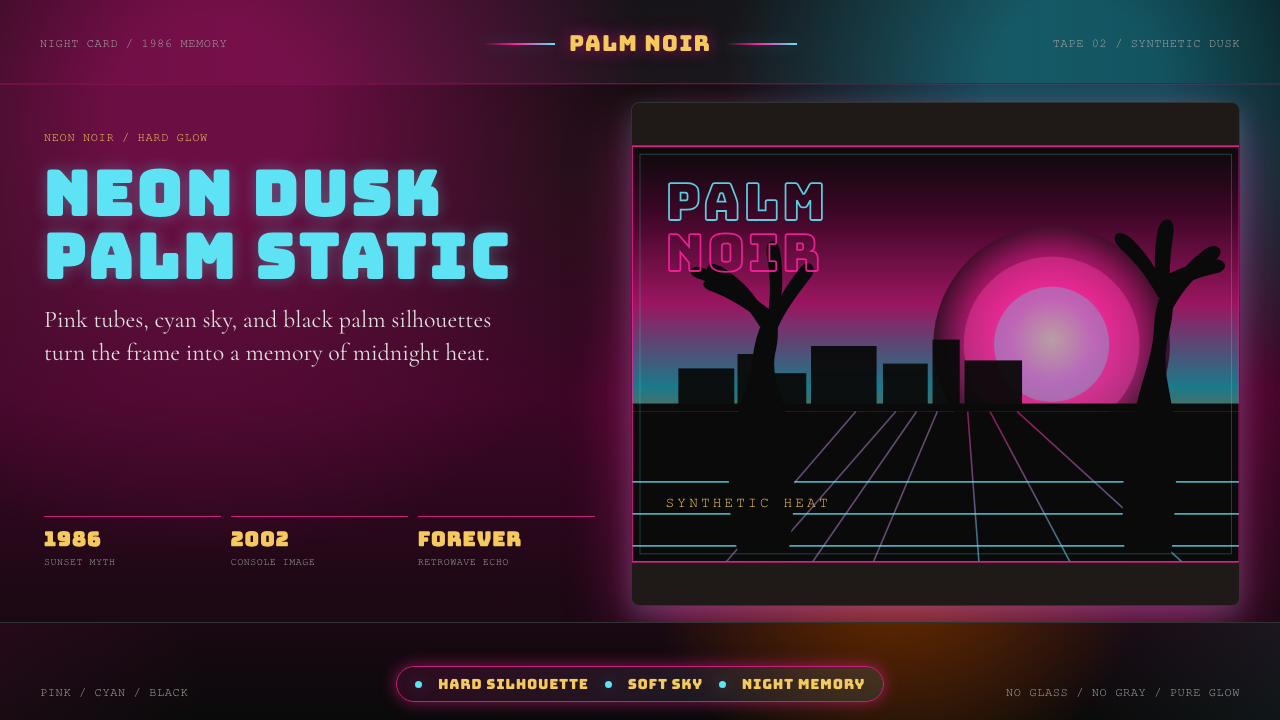 GTA Vice City (2002)Neon-noir nostalgia. Pink-cyan dusk, chunky type, and palm silhouettes.
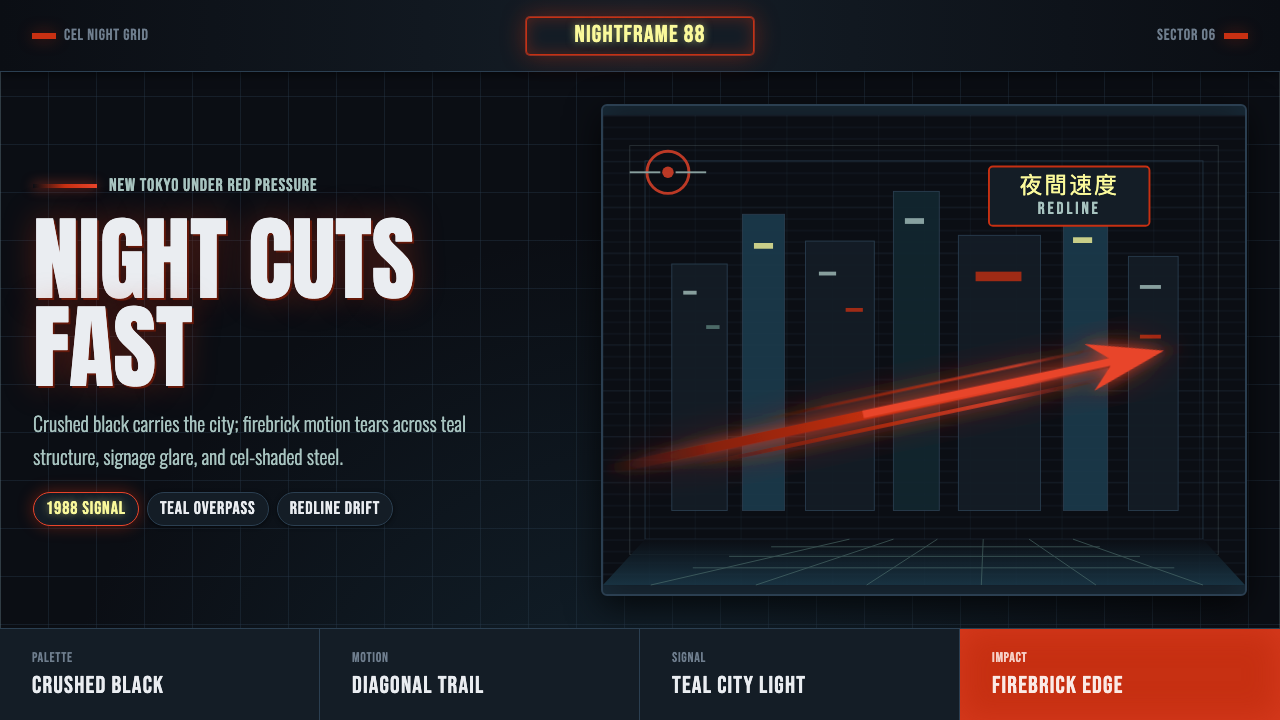 Akira Neo-TokyoNight moves fast. Firebrick trails cut crushed black, teal grids, and condens…
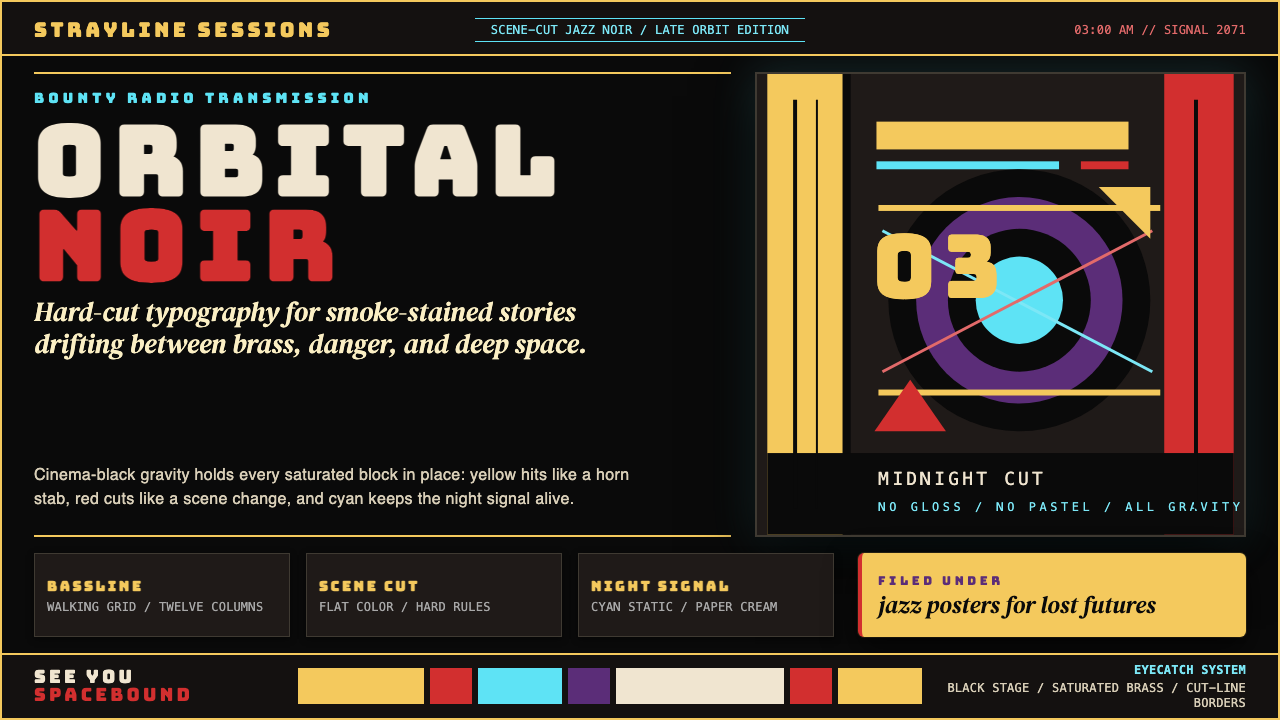 Cowboy Bebop Jazz-NoirCool at 3 AM. Bungee type, jazz yellow, red cuts, and cyan rules hit deep bla…
 Fallout Vault-Tec Pip-BoyIrradiated optimism. Vault yellow and CRT green lock into a bordered bunker g…
 Miami Vice Pastel Teal (1984)Pastel noir, not nostalgia. Teal glow and flamingo pink slice black with geom…
 No Man's SkyA paperback cosmos you can enter. Orange suns, magenta haze, and Jost type fl…