What is Death Metal Blackletter?
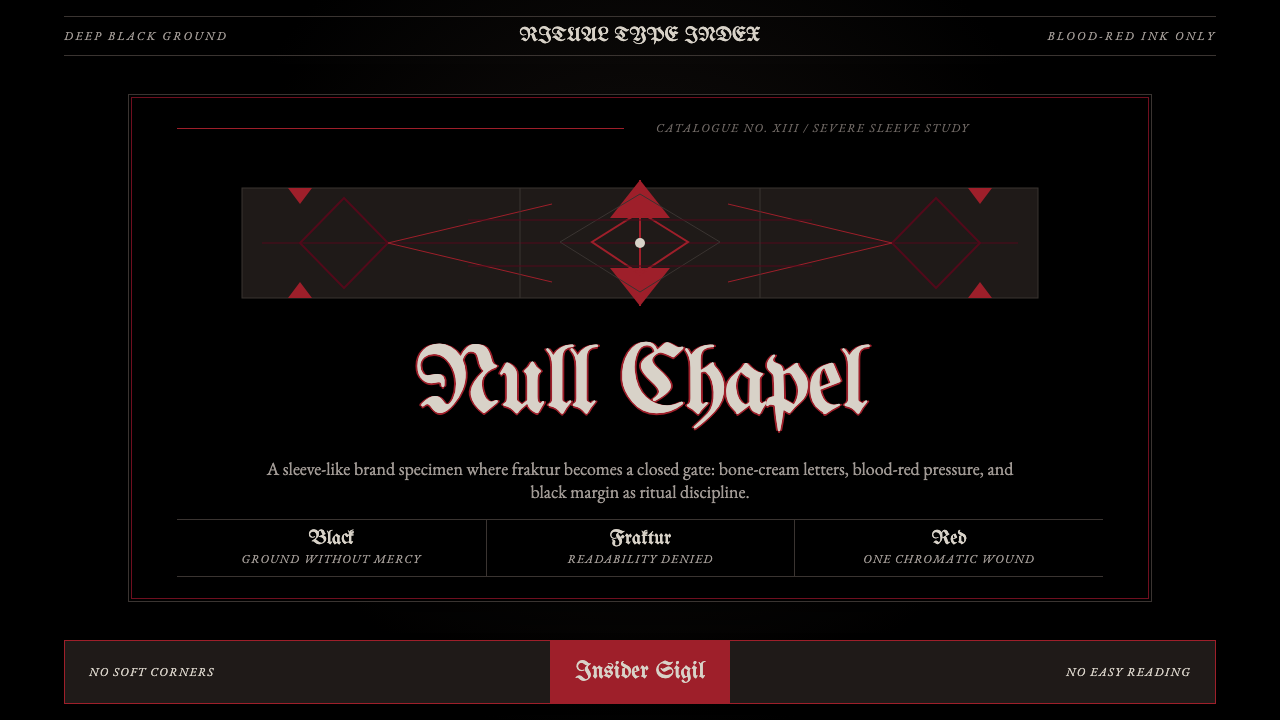
Death Metal Blackletter weaponizes medieval script into ritual — deep-black grounds, blood-red geometry, and tangled fraktur pushed so far past readability that illegibility itself becomes the message.
Death Metal Blackletter in brief
Death Metal Blackletter is the visual language forged in the extreme-metal underground: deep-black grounds, saturated blood-red accents, and Blackletter band logos descended from medieval Gothic fraktur, twisted and entangled until they hover at the edge of legibility. The palette is disciplined to the point of severity — black, blood-red, charcoal, and the occasional sliver of bone-cream are the only permitted tones. Nothing softens the contrast; nothing dilutes the darkness.
What separates this aesthetic from mere gothic pastiche is its conceptual core: illegibility is not a failure but an intention. Letters are sharpened, mirrored, interlocked, and stretched until the word dissolves into a visual sigil. Reading becomes an initiation rite. Those who can decode the logo belong; those who cannot are meant to be excluded. The typography functions as tribal mark, boundary line, and occult symbol simultaneously.
The style operates on a strict visual logic: every element exists to amplify the sense of weight and menace. Textures suggest corroded metal or dried bone. Compositional symmetry — rare in most design traditions — appears here as an almost heraldic formality, lending band logos the gravity of a coat of arms. The result is a visual system that is at once maximalist in surface complexity and minimalist in color, achieving its intensity through contrast rather than accumulation.

Where does Death Metal Blackletter come from?
The roots of Death Metal Blackletter reach back to the medieval scriptoriums of northern Europe, where monastic scribes developed Gothic fraktur — a compressed, angular letterform designed to pack maximum text onto costly parchment. Fraktur spread across German-speaking territories and remained the dominant typeface for German-language printing well into the twentieth century, carrying associations of antiquity, seriousness, and national identity. It was this historical freight — the weight of centuries, the suggestion of blood and iron — that extreme-metal musicians and designers would later consciously exploit.
The immediate origin of the aesthetic lies in the late-1980s death-metal scene centered on Tampa, Florida. Bands including Death, Obituary, and Morbid Angel needed visual identities as sonically extreme as their music. Chuck Schuldiner of Death was among the first to commission heavily distorted Blackletter logos that treated the band name as something to be felt rather than read. The approach spread rapidly across the underground tape-trading network, where photocopied flyers and hand-assembled fanzines circulated a visual vocabulary of entangled letterforms, skeletal illustration, and near-total darkness.
In the early 1990s, the Norwegian black-metal scene centered on Oslo introduced a colder, more abstract variation. Euronymous of Mayhem and Varg Vikernes of Burzum were central figures in a movement that stripped the aesthetic further, emphasizing rawness and a deliberately lo-fi, almost illegible quality. Norwegian black-metal cover art leaned into corrosion and obscurity as ideological positions. The logos became less ornate but more ritually opaque, often rendered in stark monochrome with a freezing, elemental quality absent from the Florida death-metal originals.
The figure who most systematically refined the logo tradition into a recognized art form is Belgian designer Christophe Szpajdel, who has completed over ten thousand metal logo commissions since the early 1990s. Szpajdel — known within the scene as the Lord of Logos — treats each commission as a unique heraldic problem, balancing the phonetic identity of the band name against the visual demands of the letterform composition. His work established conventions that subsequent logo designers have worked within and against: the acceptable range of letterform distortion, the rules governing negative-space management in dense entangled scripts, and the degree to which symmetry or asymmetry serves a given composition. The deathcore fusion of the 2000s onward absorbed these conventions into a broader visual language that extended from record sleeves to merchandise, stage backdrops, and digital content.
What defines the Death Metal Blackletter look?
Color Palette
The palette is governed by strict reduction. Pure black dominates as the ground, occupying the overwhelming majority of any composition. Blood-red — a saturated, slightly warm red that stops just short of orange — functions as the sole accent, used sparingly for geometric sigils, ruled lines, or typographic highlights. Charcoal appears as a midtone for textural elements. Bone-cream, if present at all, is reserved for the primary letterforms, separating them from the black ground just enough to create contrast without softening the overall darkness. No pastels, no neutrals, no colors that carry warmth or approachability.
Blackletter Typography
The typeface tradition draws directly from medieval Gothic fraktur — angular, compressed letterforms with dramatic contrast between thick strokes and hairline serifs. In Death Metal application, these historical letterforms are further distorted: ascenders and descenders are extended into sharp points or curling thorns, stroke terminals are sharpened to blades, and letters are interlocked so tightly that the word-shape dissolves into a single dense glyph. The goal is not readability but the visual impression of something inscribed rather than designed — a brand, a seal, a mark burned rather than drawn.
Geometry as Sigil
Geometric forms in this aesthetic carry occult rather than constructivist meaning. Circles appear as ritual boundaries or celestial references — the inverted pentagram inscribed in a circle being the most recognizable — while triangles suggest direction toward dark or transcendent states. These geometric elements are treated as symbols, not structure: they float over or behind the typography rather than organizing the layout grid. The blood-red geometric sigil cutting across a composition is a characteristic compositional move — a single hard-edged shape that acts as a counterpoint to the organic chaos of the entangled letterforms.
Texture and Decay
Smooth, clean surfaces are alien to this aesthetic. Authentic Death Metal Blackletter compositions incorporate textures that evoke corrosion, age, and organic decay — surfaces that look as though they have been exposed to weather, acid, or time. These textures appear in the ground, in the letterforms, and in the surrounding space. They are not decorative in the conventional sense; they are atmospheric, implying a world governed by entropy rather than design. The texture creates the impression that the composition was found rather than made.
Heraldic Symmetry
Unlike most contemporary design traditions, which favor dynamic asymmetry, Death Metal Blackletter logo composition often employs strict bilateral symmetry — the same structure used in heraldry, religious iconography, and royal seals. This symmetry lends the composition a ceremonial gravity: the logo reads as emblem rather than wordmark, as declaration rather than label. The symmetry is never casual; it is always formal to the point of rigidity, reinforcing the sense that the design encodes something permanent and immutable.
Deliberate Illegibility
The defining characteristic of this aesthetic, and the one most foreign to conventional design thinking, is that legibility is actively subverted. The most respected logos in the genre are those that push furthest from readability while remaining internally coherent — compositions where the letterforms lock together into a single visual mass that communicates identity without communicating text. This is not incompetence but a radical reversal of typographic purpose: instead of using type to transmit information efficiently, the type is used to mark territory and construct a boundary between those who understand the culture and those who do not.
Skeletal and Organic Ornament
Where ornamental elements appear — and unlike Bauhaus, ornament here is not forbidden — they are drawn from a narrow set of sources: skeletal anatomy, thorned plant forms, serpentine curves, and runic or pseudo-runic mark-making. These elements appear as frame devices, as fills within letterform counters, or as extensions of stroke terminals. They never lighten the composition; they add to its density and darkness. The ornamental vocabulary reinforces the sense that the design operates at the edge of civilization, drawing from imagery associated with death, deep forest, and pre-Christian northern European tradition.

Who shaped Death Metal Blackletter?
Schuldiner founded Death in 1983 in Orlando, Florida, and is widely regarded as the father of death metal. Beyond his musical contributions, his approach to band visual identity — commissioning logos that treated the band name as a visual object rather than readable text — established a template for extreme-metal branding that persists today. His insistence on treating every aspect of the Death project with conceptual rigor, including the visual presentation, elevated the aesthetic from underground novelty to self-conscious artistic tradition.
Øystein Aarseth, known as Euronymous, was the guitarist and ideological architect of Mayhem, the Norwegian band whose visual and sonic approach defined black metal in the early 1990s. Euronymous ran the record shop Helvete in Oslo, which became the organizing center of the Norwegian black-metal scene and a space where aesthetic and ideological positions were debated and codified. The visual language he championed — rawer, more monochromatic, and more ideologically freighted than Florida death metal — established the black-metal aesthetic as distinct from and in some ways more extreme than its American predecessor.
The Belgian-born, Norway-based designer Szpajdel has produced more than ten thousand metal logo commissions since the early 1990s, working for bands across virtually every sub-genre of extreme metal. Known within the scene as the Lord of Logos, Szpajdel approaches each commission as an exercise in Blackletter heraldry — balancing the phonetic character of the band name against the visual demands of the composition. His systematic exploration of what is possible within the genre's strict constraints has effectively established the canon: the range of acceptable distortion, the conventions of negative-space management, and the vocabulary of ornamental extension that other logo designers reference and build upon.
Vikernes, the one-man project behind Burzum, pushed the black-metal aesthetic toward its most reductive extreme. Burzum's visual presentation — rough, hand-rendered, barely legible imagery applied to deliberately lo-fi recording and packaging — articulated an aesthetic position in which technical refinement was explicitly rejected. The rawness was ideological: sophistication and legibility were associated with the commercial mainstream, and the underground's opposition to that mainstream expressed itself partly through visual inaccessibility. This position influenced an entire generation of black-metal visual culture and the raw black-metal sub-genre that followed.
The British illustrator Seagrave is the defining visual artist of the death-metal album cover tradition, producing iconic artwork for Morbid Angel, Suffocation, Entombed, and Dismember in the late 1980s and early 1990s. Where logo designers worked with letterform, Seagrave worked with imagery — cavernous architectural nightmares, writhing organic masses, and impossible geometries rendered in exacting detail against dark grounds. His work established the pictorial vocabulary that surrounds and contextualizes the Blackletter logo, defining what kind of world the typography inhabits.
How do you use Death Metal Blackletter today?
Death Metal Blackletter is a high-signal aesthetic: it communicates intensity, exclusivity, and countercultural positioning before a single word is read. This makes it exceptionally effective in contexts where those values are exactly what the work needs to project — and completely counterproductive in contexts where approachability, clarity, or mainstream appeal are goals. Knowing which context you are in is the prerequisite for applying this system correctly.
For presentation slides, this aesthetic works best on covers and divider slides rather than content pages. A cover built in this system should treat the slide as a record sleeve: deep black filling the entire frame, the title rendered in a distorted or heavily stylized letterform — not necessarily full Blackletter, but drawn from the same angular, high-contrast tradition — positioned centrally with near-heraldic symmetry. A blood-red geometric element — a circle, a ruled horizontal band, an angular sigil — provides the sole color accent. Divider slides can echo the cover; content slides should break decisively toward legibility, using the bone-cream or charcoal tones for body text against a near-black ground, with the Blackletter influence confined to section headers. Data slides in this system treat the chart as a ritual diagram: axes and grid lines in charcoal, bars or segments in blood-red, no decorative fills, no rounded corners.
For web interfaces, the aesthetic is suited to products where subcultural credibility, fierce brand differentiation, or a deliberately non-corporate tone are design goals. Music streaming platforms, gaming products, energy-drink brands, and apparel labels are natural fits. The approach: commit to a true black background, use a single high-contrast typeface with angular characteristics for all display text, and reserve blood-red for interactive states and primary calls to action only. Navigation should be sparse and text-driven. Pricing or tier pages can use the heraldic symmetry of the logo tradition for card layouts, with each tier presented as a self-contained emblem rather than a comparison table. Avoid soft-shadow card effects and rounded corners entirely — they are categorically incompatible with this system.
For editorial and marketing work, Death Metal Blackletter operates best at large scale. Print posters, event announcements, merchandise graphics, and social-media hero images are ideal formats because they accommodate the scale at which the entangled letterforms and texture become legible as atmosphere rather than straining as small text. Marketing layouts should be treated as compositions rather than documents: the text hierarchy is secondary to the visual impact of the overall arrangement. One large typographic element, one geometric accent, and a textured or pure-black ground will consistently outperform more complex arrangements. In digital editorial, pull quotes and section headers can carry the aesthetic while body text remains in a high-legibility companion face.
The most common mistake in applying this aesthetic is attempting to soften or democratize it — adding lighter background tones to improve readability, introducing warm secondary colors to reduce harshness, or using clean modern letterforms as the primary display type while retaining only surface-level distress textures as decoration. These compromises do not produce an accessible version of the style; they produce a confused hybrid that achieves neither the intensity of the original nor the clarity of a different system. If the context requires softening, the honest answer is to choose a different aesthetic entirely. Death Metal Blackletter is not a spectrum of intensity; it is a commitment.

Death Metal Blackletter — FAQ
Is Death Metal Blackletter the same as general Gothic or dark design?
No. General Gothic design is a broad category that includes Victorian ornamental lettering, contemporary dark-lifestyle branding, and horror-genre visual culture — all of which share surface characteristics like dark backgrounds and serif letterforms but differ significantly in attitude and application. Death Metal Blackletter is a specific sub-tradition with a traceable history, a defined color restriction, and a clear ideological position: illegibility as tribal marker, severity as aesthetic principle. Where general Gothic design often retains decorative flourish and a degree of romantic softness, Death Metal Blackletter actively suppresses both. The distortion of letterforms in this system goes substantially further than in most Gothic traditions, and the commitment to near-total darkness is absolute in a way that romantic Gothic aesthetics typically are not.
Can this aesthetic work for a brand that has nothing to do with music?
Yes, but the cultural associations travel with it. When Death Metal Blackletter is applied outside its native context — to a coffee brand, a streetwear label, a gaming product — it imports those associations deliberately: intensity, underground credibility, countercultural positioning. Brands that understand and want those associations can use the system effectively. The risk is that the associations may overwhelm the product's own identity, or that audiences unfamiliar with the source culture will read the aesthetic as simply aggressive or unapproachable without the subcultural context that gives it meaning. The clearest path to successful cross-context application is to use the system selectively — Blackletter for the logo mark, the signature color restriction, and the typographic attitude — rather than importing every element wholesale.
How do you make the entangled Blackletter logo legible enough to function as a brand mark?
The answer lies in shape recognition rather than letter recognition. The most successful Death Metal logos — even the most deliberately illegible — have a distinctive overall silhouette that functions as a consistent identifier across contexts even when the individual letterforms cannot be read. Szpajdel's approach, developed over thousands of commissions, is to ensure that the exterior contour of the word-shape is clear and distinctive enough to be recognized at a distance or at small sizes, while the interior detail remains deliberately complex. In practice: the overall bounding shape should be unique and consistent; the balance between filled mass and negative space within the logo should be maintained across different sizes; and the composition should be tested at both poster scale and at the small size it will appear on merchandise or a mobile screen.
Is it appropriate to use this aesthetic for projects that have no authentic connection to metal culture?
Appropriateness depends on intent and execution. Using an aesthetic as pure style, detached from its cultural origin, is a common design practice and not inherently disrespectful — design traditions have always been adopted across contexts. The relevant questions are whether the appropriation is knowingly done (understanding what you are borrowing and from where), whether it serves the project rather than simply being provocative, and whether the execution respects the internal logic of the system rather than cherry-picking surface elements. What undermines credibility is not adoption but dilution: using death-metal typography softened with pastels and rounded corners, or applying the vocabulary to contexts that directly contradict its values. The culture that produced this aesthetic is intensely aware of authenticity; designs that appropriate the surface while discarding the logic will read as inauthentic to audiences familiar with the source.
What distinguishes death-metal visual style from black-metal visual style?
Both draw from the same Blackletter tradition and share the core color restriction, but they diverge in texture, temperature, and ornamental approach. Death-metal aesthetics — rooted in the Florida scene — tend toward higher ornamental complexity: intricately detailed logos with elaborate entanglement, and cover art featuring detailed biomechanical or anatomical imagery. The tone is visceral and physical. Black-metal aesthetics — rooted in the Norwegian scene — tend toward rawness and abstraction: logos that are cruder and less refined, cover art that favors desolate landscape photography, winter light, and deliberate lo-fi degradation. Where death metal is dense and elaborate, black metal is sparse and severe. Both are dark; death metal is warm-dark (blood, flesh, decay), while black metal is cold-dark (ice, void, night). In contemporary practice, deathcore and adjacent sub-genres often synthesize elements from both traditions.
Related design styles
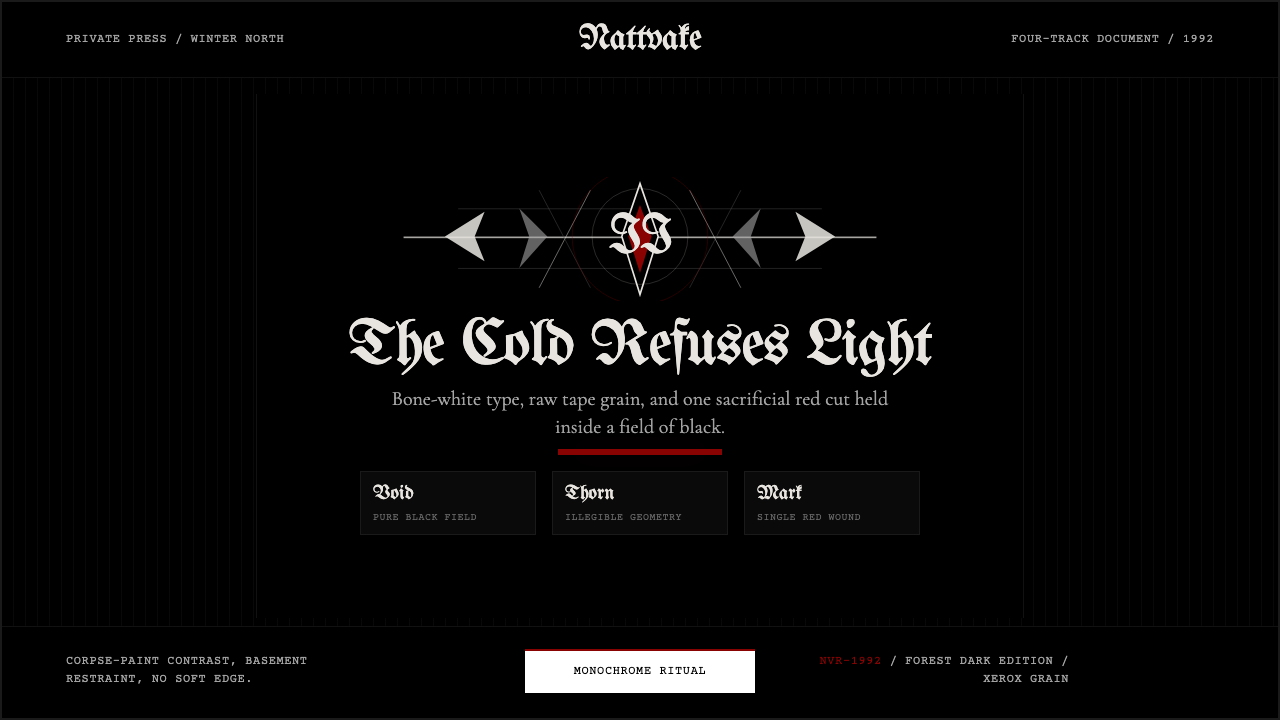 Norwegian Black Metal (1992)Ritual severity. Bone-white blackletter cuts through black grain with one blo…
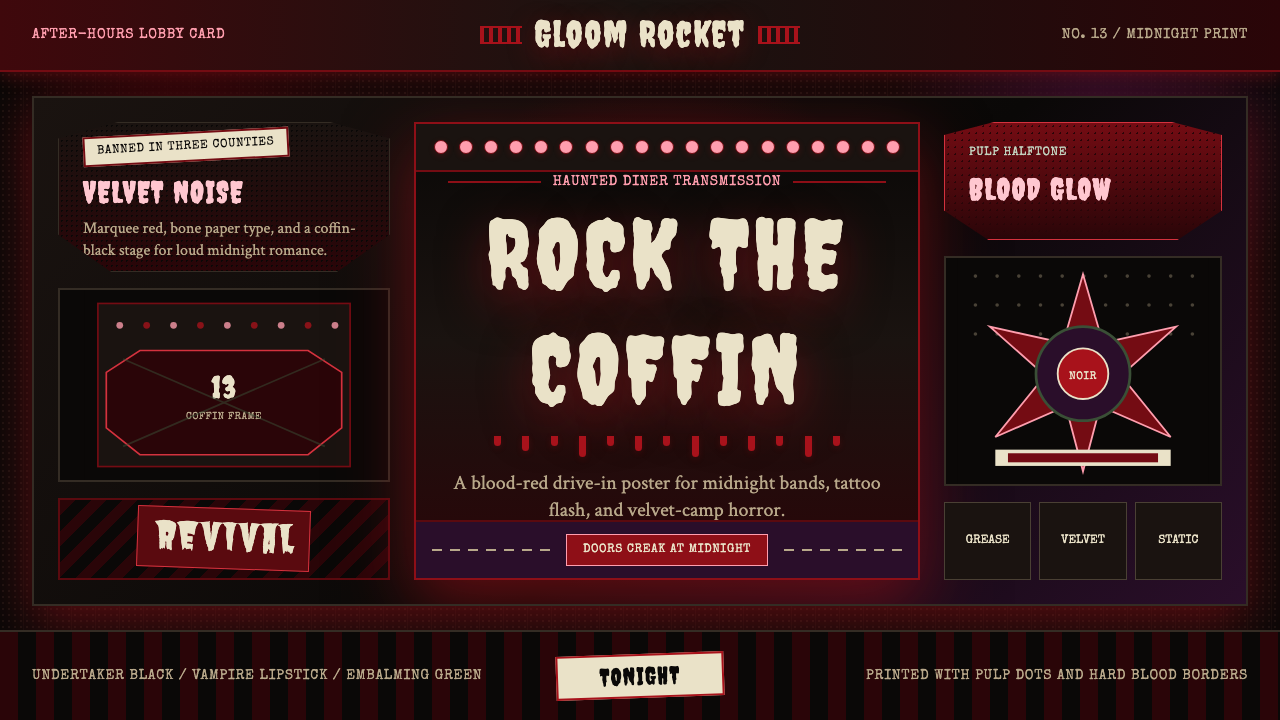 Gothabilly Horror RevivalHaunted swagger. Blood-red marquee type, coffin frames, and pulp halftone on…
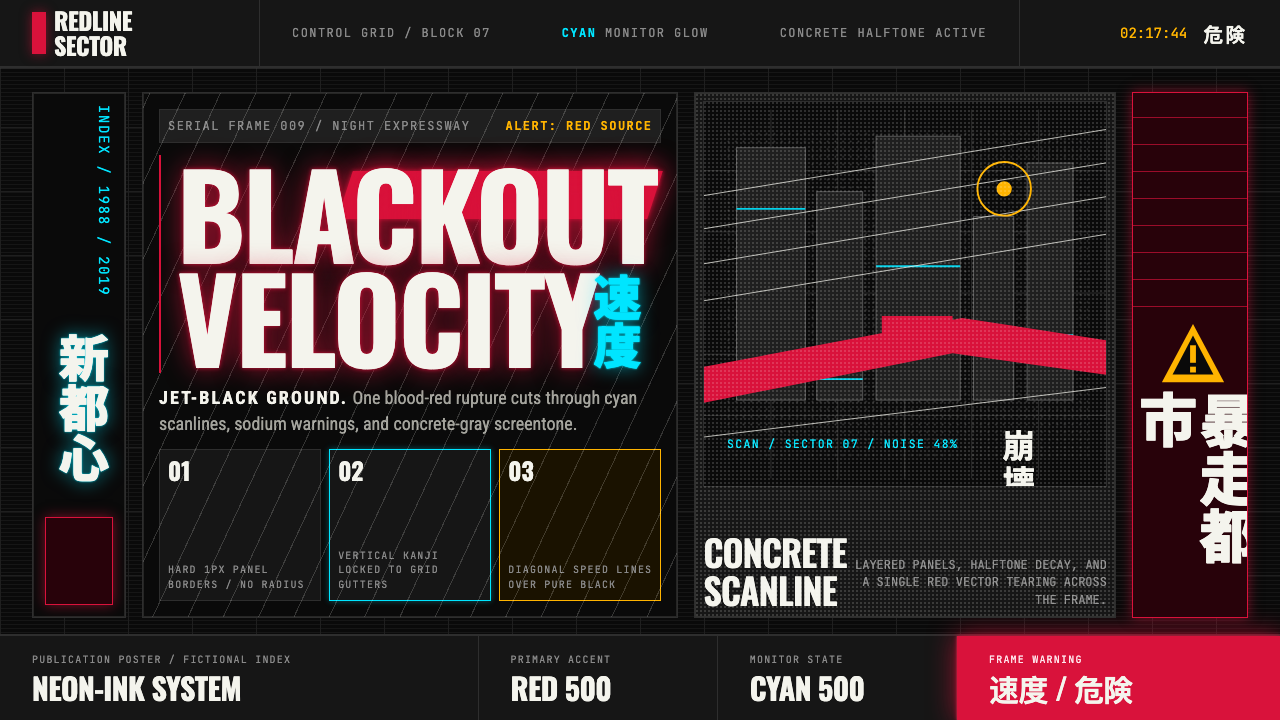 Akira (Otomo)Cyberpunk at impact. Kaneda red, cyan kanji, halftone concrete, and diagonal…
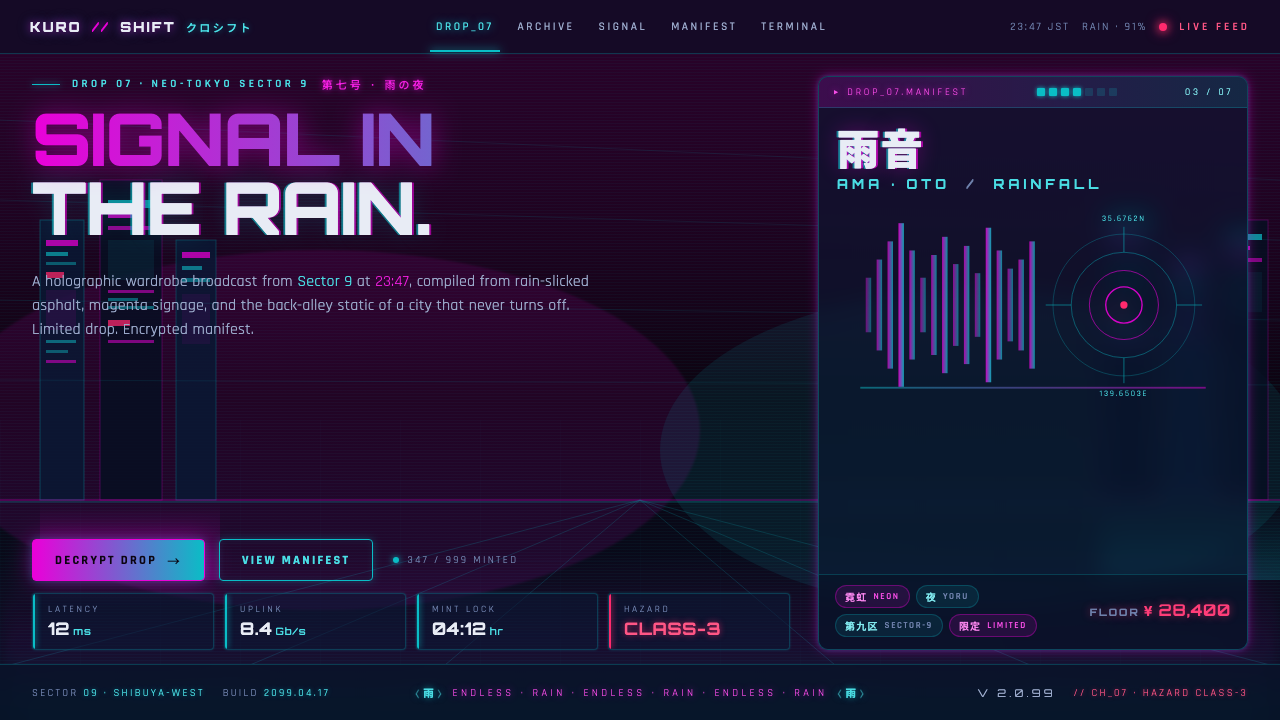 Neo-Tokyo 2099Endless rain, a thousand signs. Magenta vs cyan on near-black asphalt, kana b…
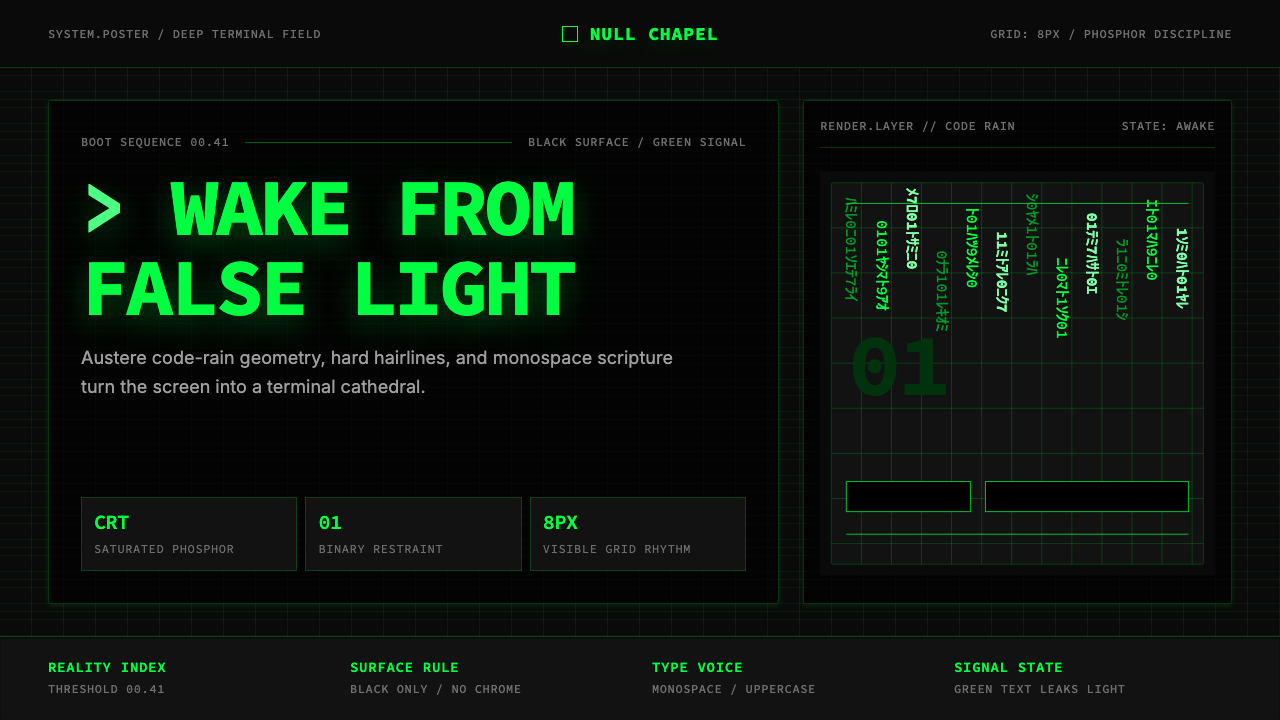 The Matrix (Green-Code)Terminal myth, disciplined. CRT green code rain, black grid, monospace script…
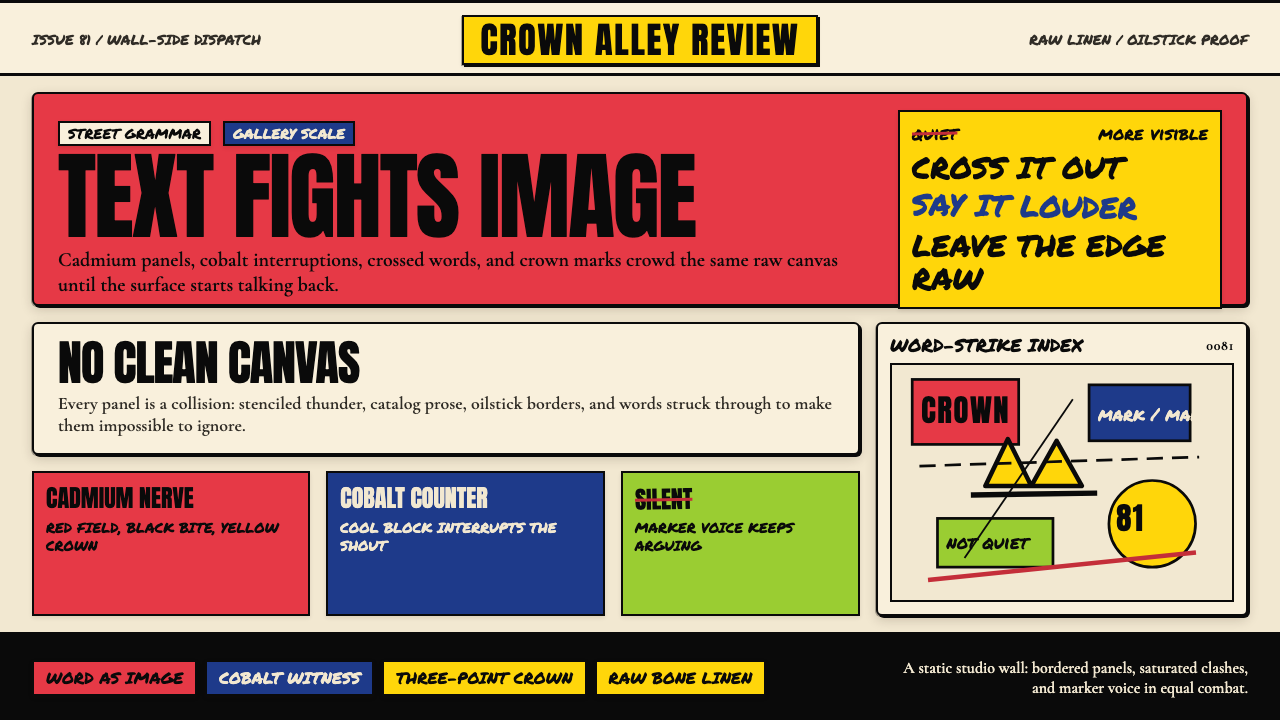 Basquiat Neo-ExpressionismExplodes off raw linen. Cadmium red, cobalt blue, Anton blocks, and struck ma…