What is Norwegian Black Metal (1992)?
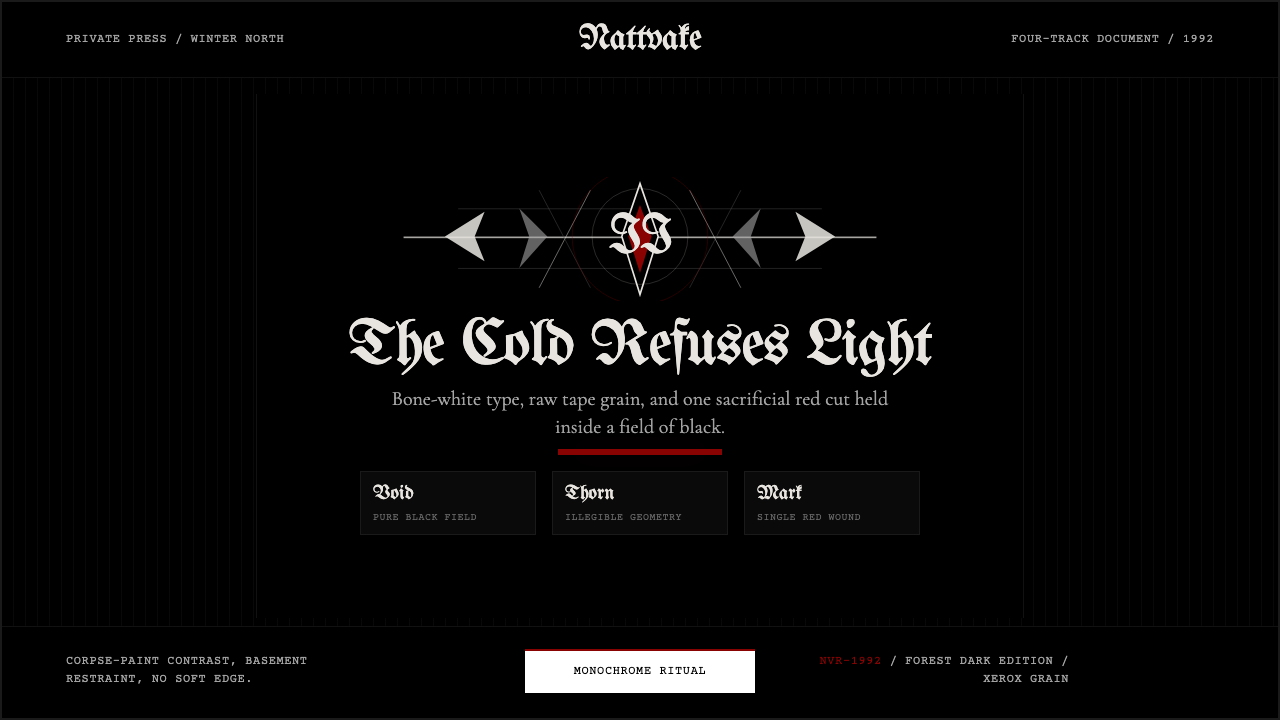
Norwegian Black Metal forged the most visually severe aesthetic in music history from corpse-paint, hand-drawn thorn logos, and an absolute commitment to black, bone-white, and a single drop of blood-red.
Norwegian Black Metal (1992) in brief
Norwegian Black Metal (1992) is a design system distilled from the visual culture that erupted out of Oslo and Bergen in the early 1990s. A small circle of teenagers — armed with cassette recorders, photocopiers, and an almost ritualistic hatred of commercial gloss — produced album sleeves, fanzines, and merchandise that collectively defined a new grammar of severity: pure black backgrounds, bone-white typography, zero color except for a single sacrificial accent of deep red.
The aesthetic is not minimalism in the contemporary sense. It does not pursue elegance or restraint for its own sake. It is instead an expression of negation — of everything soft, polished, or commercially palatable. Grain is embraced, not corrected. Edges are inked rather than smoothed. Typography pushes into deliberate illegibility, treating readability as a concession to the uninitiated. The result is a visual language that communicates exclusion and ritual intensity before a single word is deciphered.
What makes this system usable beyond its original subcultural context is its underlying structural clarity. Beneath the grain and the blackletter extremity lies a remarkably disciplined palette: three values (near-black, bone-white, blood-red) and two typographic registers (ornate display and restrained body). When those constraints are applied with precision, the system generates compositions of extraordinary visual force — confrontational, memorable, and deeply resistant to the generic.
Where does Norwegian Black Metal (1992) come from?
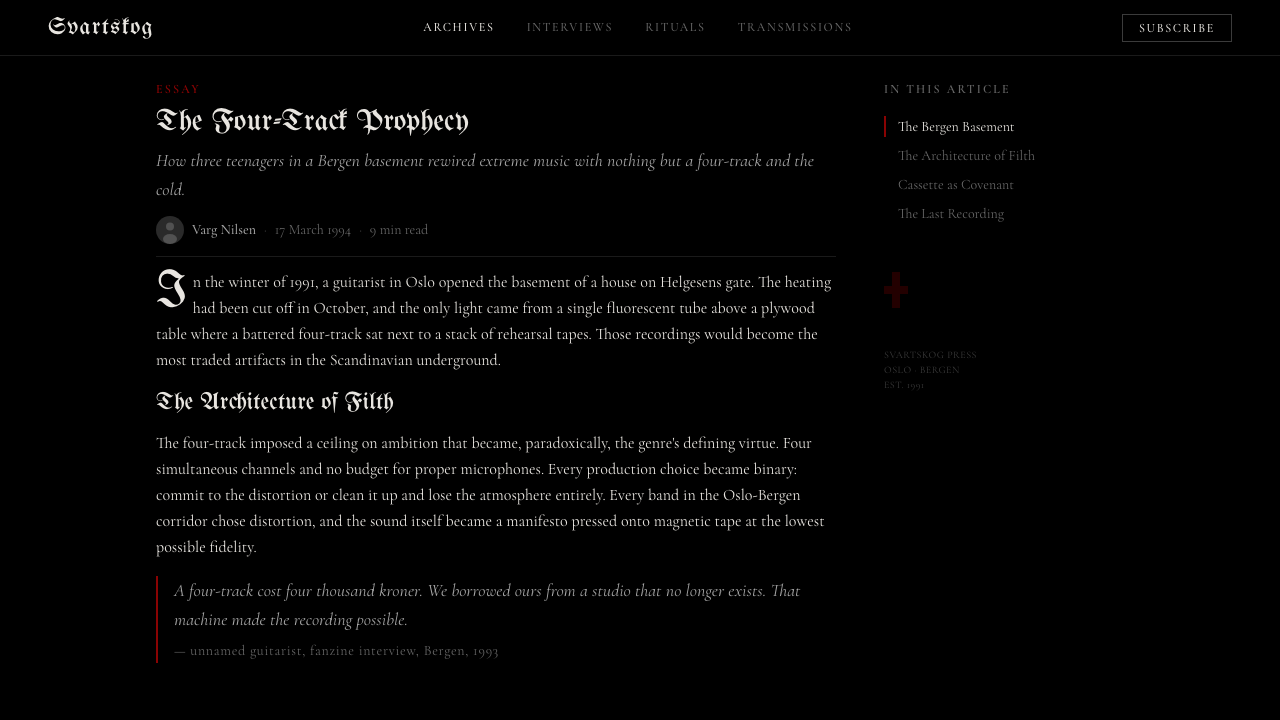
The visual culture of Norwegian Black Metal crystallized between 1991 and 1994, when a loose network of musicians centered on Oslo's Helvete record shop — owned by Euronymous (Øystein Aarseth) of Mayhem — began producing self-released cassettes and albums whose artwork was as ideologically charged as the music. The scene was self-consciously anti-commercial: professional design tools were rejected in favor of hand-drawn layouts, photocopied zines, and typesetting techniques borrowed from hardcore punk but pushed to new extremes. The black-and-white forest photography that became synonymous with the genre was shot in Norwegian winters, often by the musicians themselves, using consumer cameras and harsh available light.
The blackletter typography that defines the style has roots stretching back centuries, but its specific form in Norwegian Black Metal was largely shaped by hand-drawn logo design. Christophe Szpajdel, known as the Lord of Logos, became the scene's most prolific lettering artist — producing hundreds of spike-and-thorn wordmarks for bands across Europe. His designs deliberately subverted readability, interweaving letterforms with thorns, branches, and inverted crosses until the text became close to pure visual texture. This anti-legibility was a statement: these records were not made for everyone, and the artwork made that rejection visible.
The genre's stark monochromatism was partly practical — self-released recordings with no label budget had to be produced cheaply, and two-color or single-color printing was the economic reality — and partly ideological. Color, particularly the warm and saturated palette of commercial heavy metal artwork, was associated with entertainment, with accessibility, with selling out. Black and white were the colors of negation, of winter, of the ancient and the raw. The single red accent, when it appeared, carried maximum symbolic weight precisely because it was the only chromatic note in an otherwise achromatic system.
Key albums from the period — Darkthrone's Transilvanian Hunger (1994), Burzum's Filosofem (1996), Emperor's In the Nightside Eclipse (1994) — established visual templates that the scene would return to for decades. Darkthrone's work in particular, photographed by the band themselves in stark Norwegian landscapes, exemplified the deliberate rejection of production value. The grain, the bleached-out contrast, the absence of any studio-polished element — these were not limitations but choices, and they gave the work an authenticity that more technically accomplished imagery could not replicate.
What defines the Norwegian Black Metal (1992) look?
Palette
The color system operates on absolute restriction: a field of near-black (not quite pure black, but black that carries the texture of darkness), bone-white for primary text and key graphic elements, and a single deep blood-red deployed as the sole chromatic accent. Secondary colors do not exist within the system. The red appears rarely and precisely — a band name, a border fragment, a single symbol — and its power derives entirely from that scarcity. Any expansion of the palette toward additional hues dilutes the system's ritual severity.
Typography
The typographic system operates in two opposing registers. Display type is drawn from ornate blackletter traditions — dense, spike-laden, sometimes approaching pure abstraction — and is used for titles, band names, and major headings where visual impact matters more than immediate legibility. Body text retreats to a restrained, classically proportioned serif, creating a sharp contrast between the decorative excess of the headline register and the deliberate plainness of the reading register. The tension between these two poles is essential to the system's character.
Grain and Texture
Surface texture is not an accident but a structural element. High-contrast photographic grain, the artifacts of cassette-to-cassette dubbing, and the bleed of photocopied ink are not corrected but amplified. Black areas are not flat — they carry the depth of over-exposed film or inked paper. White areas glow with the particular quality of bleached-out photography pushed to its tonal limit. This deliberate roughness is what separates authentic applications of the style from sanitized recreations, which tend to use smooth digital approximations of grain that carry none of the material weight.
Composition and Negative Space
Layouts favor stark, confrontational arrangements over balanced harmony. Central placement of primary elements — a figure against an empty black field, a logo centered with wide margins of darkness on all sides — is common, and gives compositions a monumental, almost heraldic quality. The negative space is not empty but active: the black field is atmospheric, pressing against elements rather than simply surrounding them. Asymmetric compositions, when they appear, use extreme weight imbalance — a single dense typographic block against a largely empty ground — rather than conventional design tension.
Iconography and Symbol
The visual vocabulary draws from a narrow and consistent set of references: inverted crosses, runes of Scandinavian origin, thorn and branch motifs, animal skulls, winter forest silhouettes, and the ornamental conventions of medieval manuscript marginalia. These symbols are not deployed decoratively — they carry specific subcultural meanings, and their inclusion signals allegiance to a tradition that predates contemporary design. When adapting the style, the iconographic choices should be treated as structural commitments, not arbitrary ornament.
Photography and Image Treatment
When photography is used, it is treated to reinforce the system's tonal extremity. Images are converted to near-monochrome, with shadows crushed toward pure black and highlights blown toward pure white. Mid-tones are compressed or eliminated. The effect is less a photograph and more a field of black with white forms emerging from darkness — trees in winter, a figure against a pale sky, a landscape bleached by overcast light. Color photography has no place in the system; even desaturated images should carry the particular quality of developed black-and-white film rather than digital grayscale conversion.
Anti-polish as Principle
The most important characteristic of the system is what it deliberately refuses. Smooth gradients, soft shadows, rounded corners, any element that suggests digital refinement or corporate professionalism — these are treated not as neutral choices but as ideological betrayals of the aesthetic's core. The system communicates authenticity through material rawness. This does not mean technical incompetence; it means that every roughness is intentional, that every imperfection has been kept rather than corrected. The discipline required to achieve convincing rawness is as demanding as the discipline required to achieve conventional polish.
Who shaped Norwegian Black Metal (1992)?
Guitarist of Mayhem and founder of Helvete, Oslo's black metal record shop that served as the scene's ideological and social center from 1991 to 1993. Euronymous self-released key recordings, distributed underground tapes across Europe, and helped establish the visual codes — hand-drawn logos, stark black-and-white photography, the deliberate rejection of commercial presentation — that defined the genre's aesthetic. His murder by Varg Vikernes in 1993 ended his direct influence but crystallized the scene's mythology at the precise moment its visual language was fully formed.
Drummer and visual creative director of Darkthrone, responsible for much of the band's artwork across their pivotal early albums including Transilvanian Hunger. Fenriz embraced deliberate technical primitivism — photographs shot in winter forests, layouts assembled with minimal equipment, a rejection of anything that suggested professional production. His approach formalized the aesthetic of intentional rawness that distinguishes Norwegian Black Metal from the more elaborate visual culture of earlier extreme metal scenes. He also operated as a tastemaker and archivist whose record collection and written commentary helped define the canon.
The sole member of Burzum, whose album artwork — particularly the hand-drawn cover of the self-titled debut and the bleak landscape photography of subsequent releases — contributed the most sustained exploration of the style's austere end. Vikernes's visual choices were deeply personal and anti-collaborative, treating the album cover as a private statement rather than a commercial artifact. The extreme spareness of Burzum's artwork, stripped of even the ornate logowork common elsewhere in the scene, represented the system's most reductive expression.
Belgian-born lettering artist known as the Lord of Logos, who became the primary craftsman of the scene's blackletter and spike-thorn logo tradition. Beginning in the early 1990s, Szpajdel produced hand-drawn wordmarks for hundreds of black metal and related extreme metal bands across Europe, developing a personal vocabulary of intertwined letterforms, natural motifs, and deliberate illegibility. His work is the single most studied and imitated aspect of the Norwegian Black Metal visual style, and his influence extends into contemporary logotype design, tattoo art, and brand identity work that engages with the style.
Primary creative force behind Emperor, whose albums — In the Nightside Eclipse in particular — developed the most compositionally elaborate visual language within the scene. Emperor's artwork incorporated classical landscape painting references, mythological illustration traditions, and a more overtly theatrical black-and-white aesthetic than the raw primitivism of Darkthrone or the isolationist sparseness of Burzum. Ihsahn's approach demonstrated that the Norwegian Black Metal visual system was capacious enough to accommodate range — from the near-abstract to the representational — while retaining its core identity.
How do you use Norwegian Black Metal (1992) today?
Applying Norwegian Black Metal (1992) to contemporary design work requires understanding that its power comes from constraint and commitment, not from surface decoration. The system produces its most effective results when every element — palette, typography, texture, imagery — is held to the same principles simultaneously. Partial application, where some elements follow the system and others do not, tends to produce incoherence rather than useful contrast.
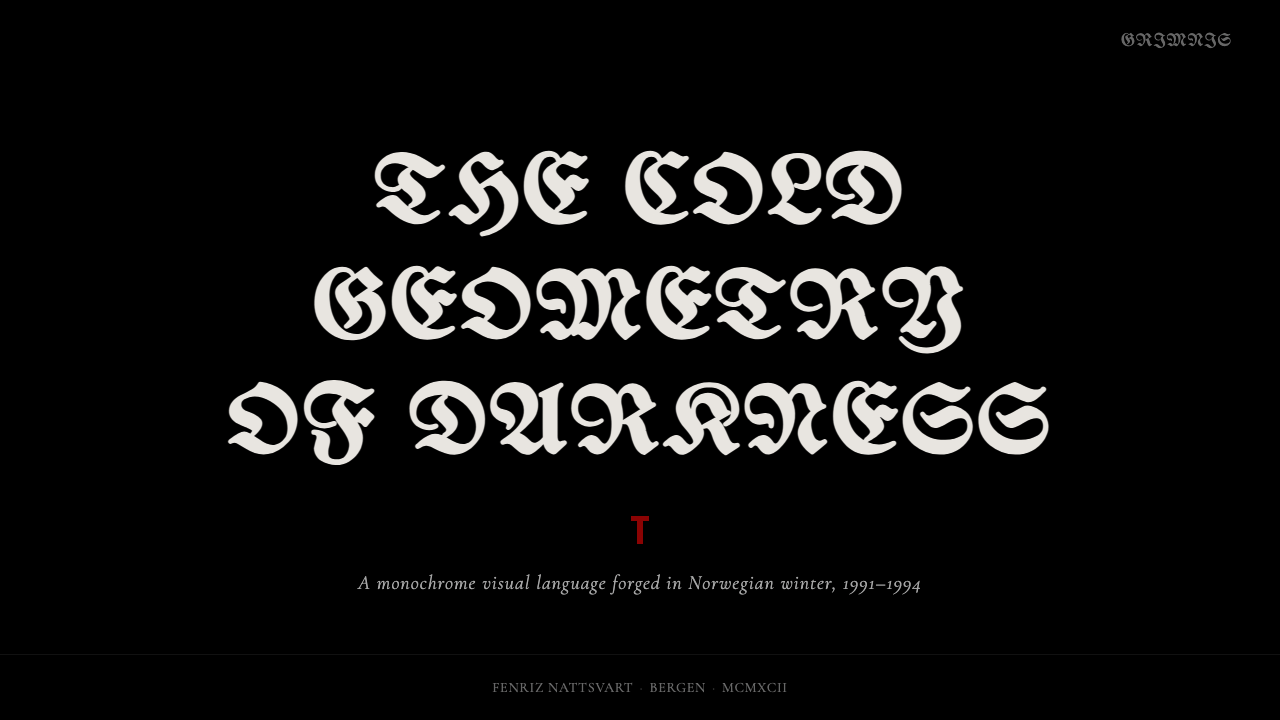
For presentation slides, the style is most effective on cover pages and section dividers where impact takes precedence over information density. A cover built in this system uses the full black field as its primary surface, places a bone-white headline in a blackletter or heavy display typeface at center or slightly above center, and reserves the blood-red accent for a single subordinate element — a date, a tagline, a speaker name. Content slides should shift to a restrained mode: bone-white or near-white ground, black body text in a classical serif, and the blackletter display reserved only for section headers. Data visualizations within this system should treat chart elements as graphic forms — bars and lines rendered in bone-white against a dark ground, with the red accent marking the single most important data point rather than applied categorically.
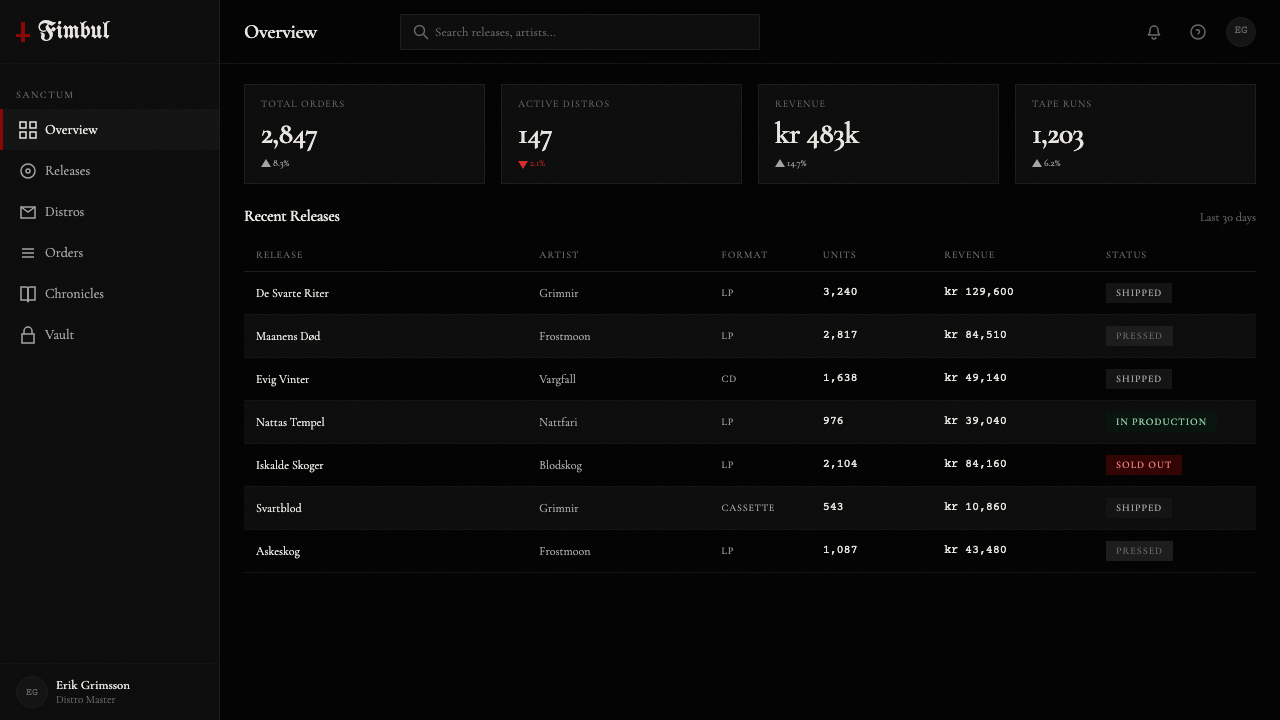
For web interfaces and product design, the style lends itself most naturally to contexts where authority, exclusivity, or cultural specificity are core brand values — independent music platforms, limited-edition product releases, event identities, or editorial platforms positioned as curated and selective rather than broadly accessible. Dashboard applications can use the dark-ground variant effectively when the product's content warrants a monumental visual register. Pricing pages benefit from the style's inherent hierarchy: the high-value tier receives the blood-red accent, while lower tiers remain in the bone-white and black system. Navigation should be typographic and minimal — the system has no room for decorative iconography beyond the genre's established symbolic vocabulary.
For editorial and marketing applications, the style performs well in contexts that require high visual memorability with limited color budget. A single-color or two-color print context is where the system operates at its most authentic: one ink color on a black or near-black stock, or black and white photography printed with maximum contrast. Digital marketing applications should respect the same economy — social assets work best when they commit to a full black field with one significant typographic element and one red accent, rather than attempting to pack multiple hierarchies into a single frame.
The most common mistake when applying this style is treating the grain and the blackletter typography as costumes rather than structural commitments. Designers who apply the surface textures without the underlying palette discipline — who introduce mid-tones, who use the red accent on multiple elements, who mix the blackletter display with rounded sans-serif body text, or who add a fourth color on the grounds that it is also dark — produce work that reads as pastiche rather than as a coherent system. The discipline is not in the aesthetics alone but in the refusals: no softness, no warmth, no additional chromatic notes, no smoothing of rough edges. Every concession made to palatability costs the system a measure of its force.
Norwegian Black Metal (1992) — FAQ
How is this style different from general gothic or dark design?
General gothic design and broadly dark aesthetics typically allow themselves a wider color range — deep purples, forest greens, warm ambers — and often incorporate soft shadows, atmospheric gradients, and decorative flourishes drawn from Victorian or Romantic sources. Norwegian Black Metal is more radical in its restraint: near-black, bone-white, one red, no gradients, no softness, no decorative warmth. It is not darkness for atmosphere; it is darkness as ideological position. The grain is material rather than stylistic. The illegibility of the typography is a statement rather than an aesthetic preference. These distinctions matter practically: a design that introduces soft shadows or a deep purple accent is no longer operating within this system, even if it retains the black background.
Can this style work for mainstream commercial clients?
It can, but the use cases are specific. The style works where the client's brand values include exclusivity, subcultural credibility, or deliberate difficulty — limited-edition product releases, collector-market communications, festival and event identities, independent publishing, and any brand that positions itself as not for everyone. It fails in contexts that require warmth, accessibility, or broad appeal. A financial services firm, a healthcare brand, a food company, or any brand built on trust and approachability will find that the system's severity reads as alienating. The style's power is inseparable from its unwillingness to accommodate — applied to a context that needs accommodation, it produces antagonism rather than authority.
Is the deliberate illegibility of the typography a problem for digital applications?
For display use — large headers, cover text, titles — the illegibility is a feature rather than a bug, and digital applications handle it no differently than print. The tension between ornate display and legible body is the same whether the medium is a screen or a page. The practical challenge arises at smaller scales and on low-resolution outputs, where intricate blackletter forms can become genuinely unreadable. The solution is not to simplify the blackletter — that defeats the purpose — but to apply it only at scales where its details are visible, and to ensure that any essential information it carries is reinforced by secondary legible text. The ornate headline communicates atmosphere; the legible subhead communicates content.
How should imagery be sourced or created for this style?
The most authentic imagery for this system is high-contrast black-and-white photography of natural subjects — bare trees, winter landscapes, overcast skies, rock formations — processed to eliminate mid-tones and push shadows toward absolute black. Stock photography can be used if it is treated aggressively: desaturated, contrast-boosted, and grain-added until the digital origin is no longer evident. Illustration, if used, should draw from the genre's existing visual vocabulary — the spike-and-thorn ornamental tradition, the skeletal and runic iconography — rather than from unrelated decorative styles. Photorealistic color illustration, soft digital painting, and vector-clean imagery have no place in the system. The rougher and more material the image source, the more convincingly it integrates.
What is the difference between using one red accent versus two or three?
The difference is fundamental, not gradual. The entire logic of the blood-red accent rests on its singularity: it is the only chromatic element in an achromatic system, and its visual force comes from that uniqueness. When a second red element is introduced — a second headline, a second border, a second icon — the accent becomes a color rather than an event. The composition loses its focal point; the eye has nowhere to land with finality. A third red element completes the transition from ritual severity to simply a dark color scheme with red in it. The practical rule is one red element per composition, and ideally one red element per entire visual identity — the same mark, the same use, repeated consistently — rather than red applied to any element that needs emphasis.
Related design styles
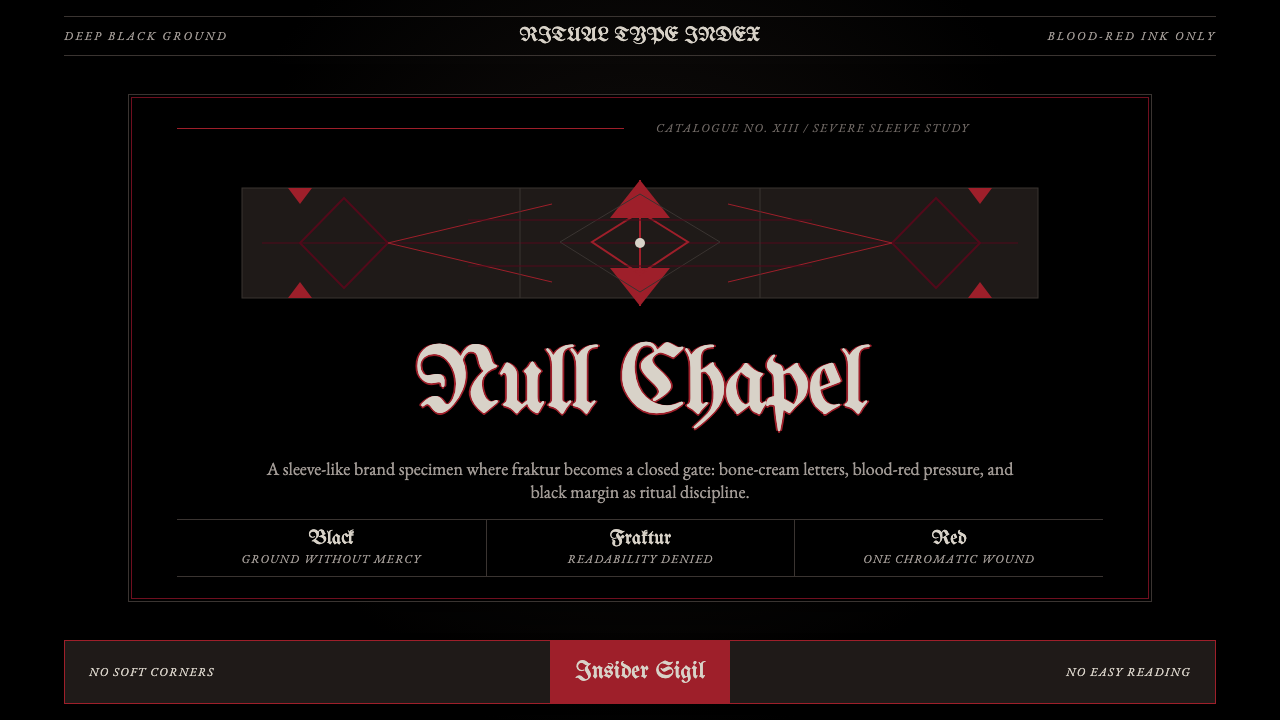 Death Metal BlackletterUnreadable by design. Bone fraktur on black, cut by one blood-red geometric s…
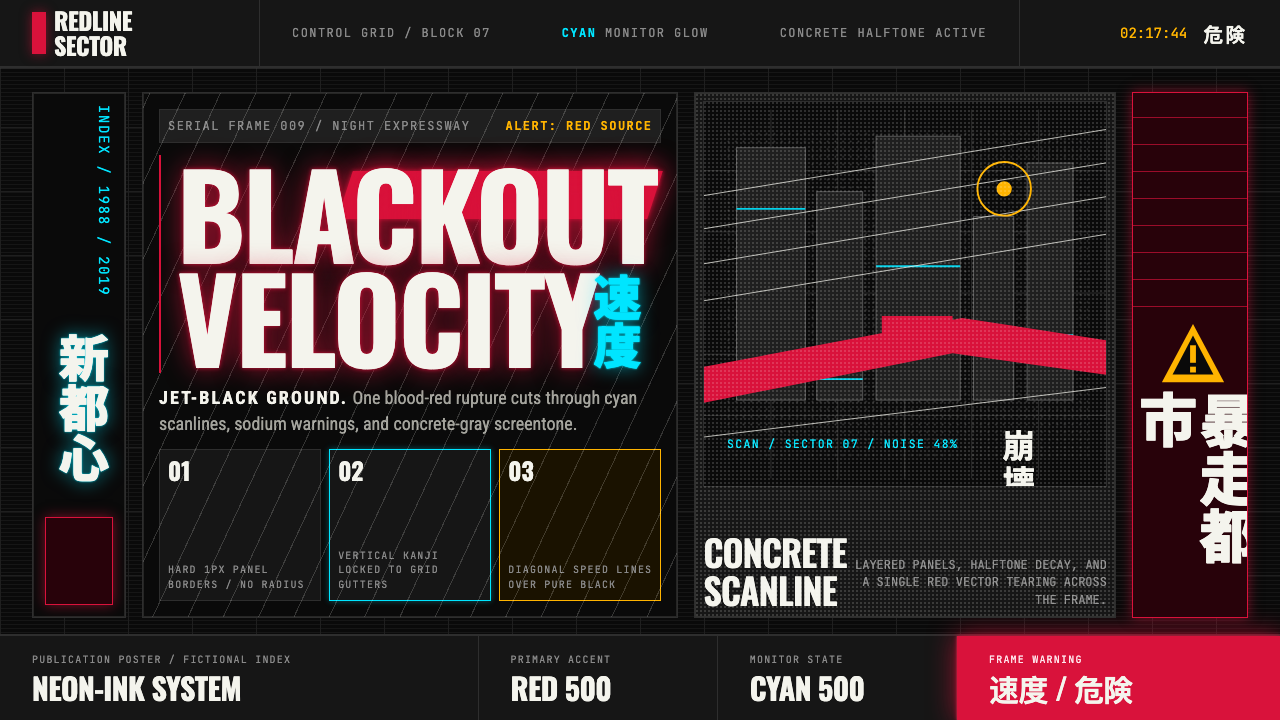 Akira (Otomo)Cyberpunk at impact. Kaneda red, cyan kanji, halftone concrete, and diagonal…
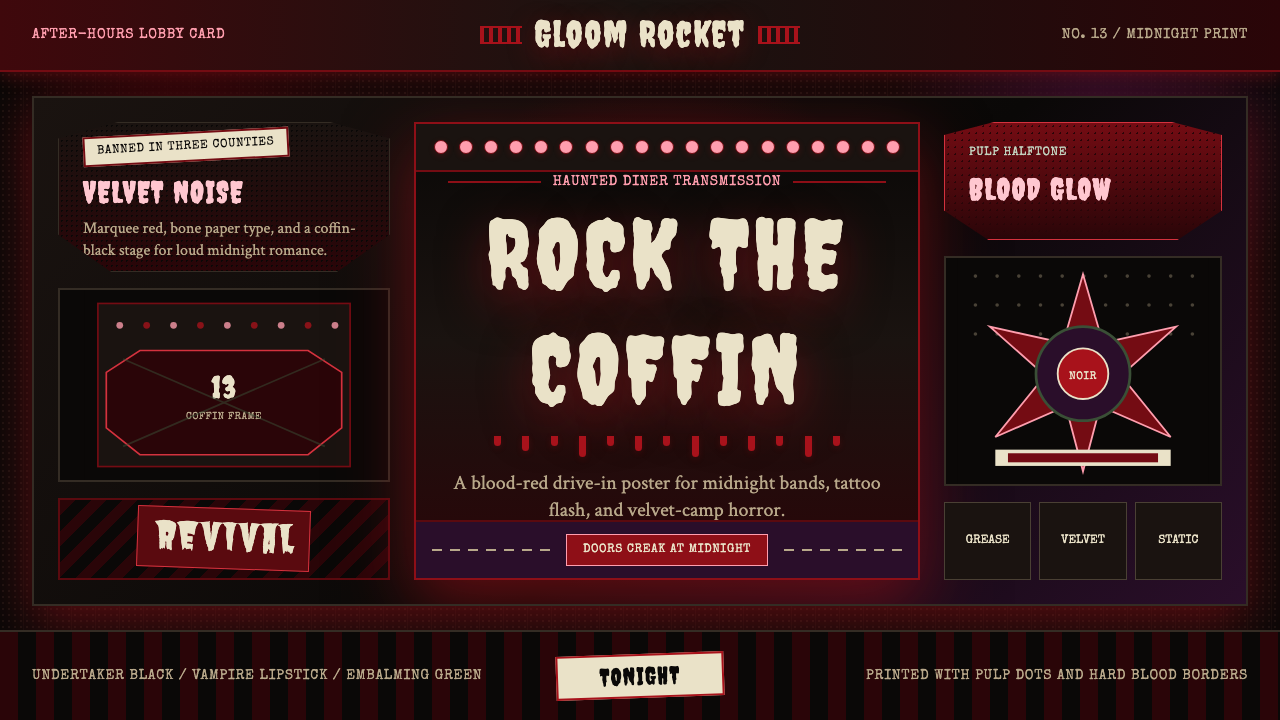 Gothabilly Horror RevivalHaunted swagger. Blood-red marquee type, coffin frames, and pulp halftone on…
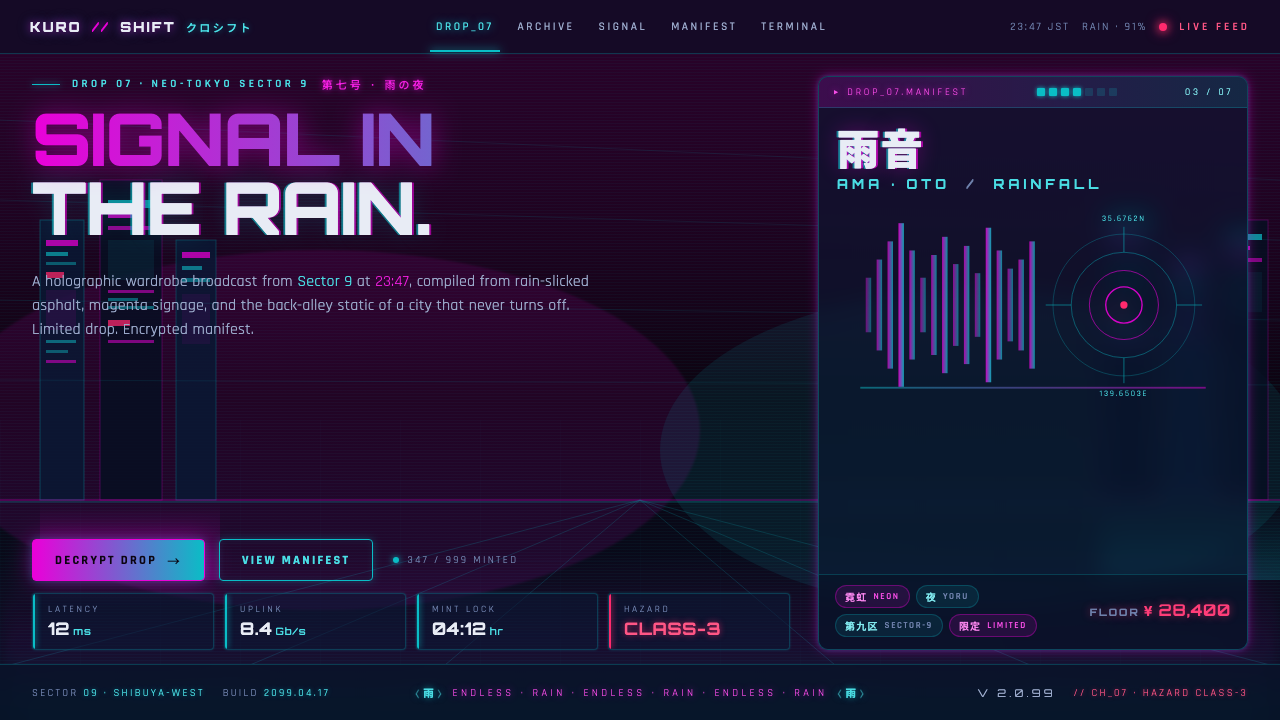 Neo-Tokyo 2099Endless rain, a thousand signs. Magenta vs cyan on near-black asphalt, kana b…
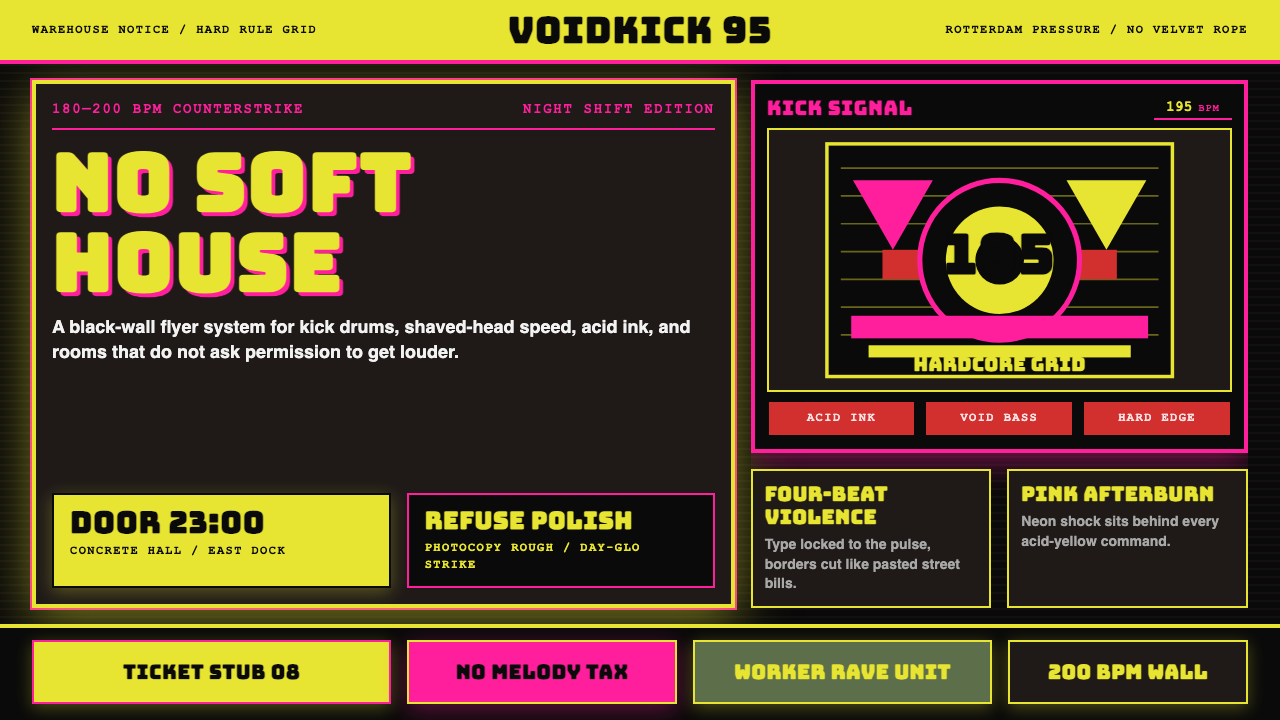 Rotterdam Gabber HardcoreHardcore refuses polish. Acid yellow, neon pink, black grid, and brutal Bunge…
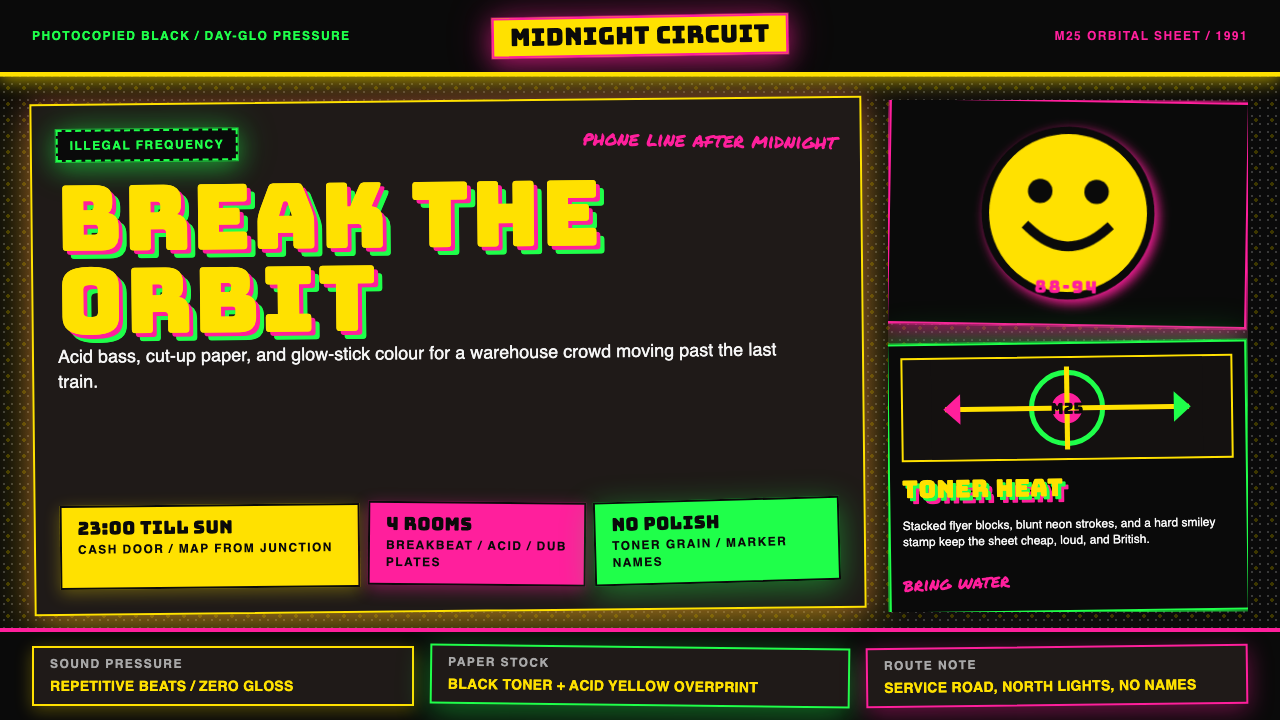 UK Rave Glow-Stick FlyerIllicit euphoria. Acid yellow, rave pink, and laser green slam into photocopi…