What is Bowie — Ziggy Stardust?
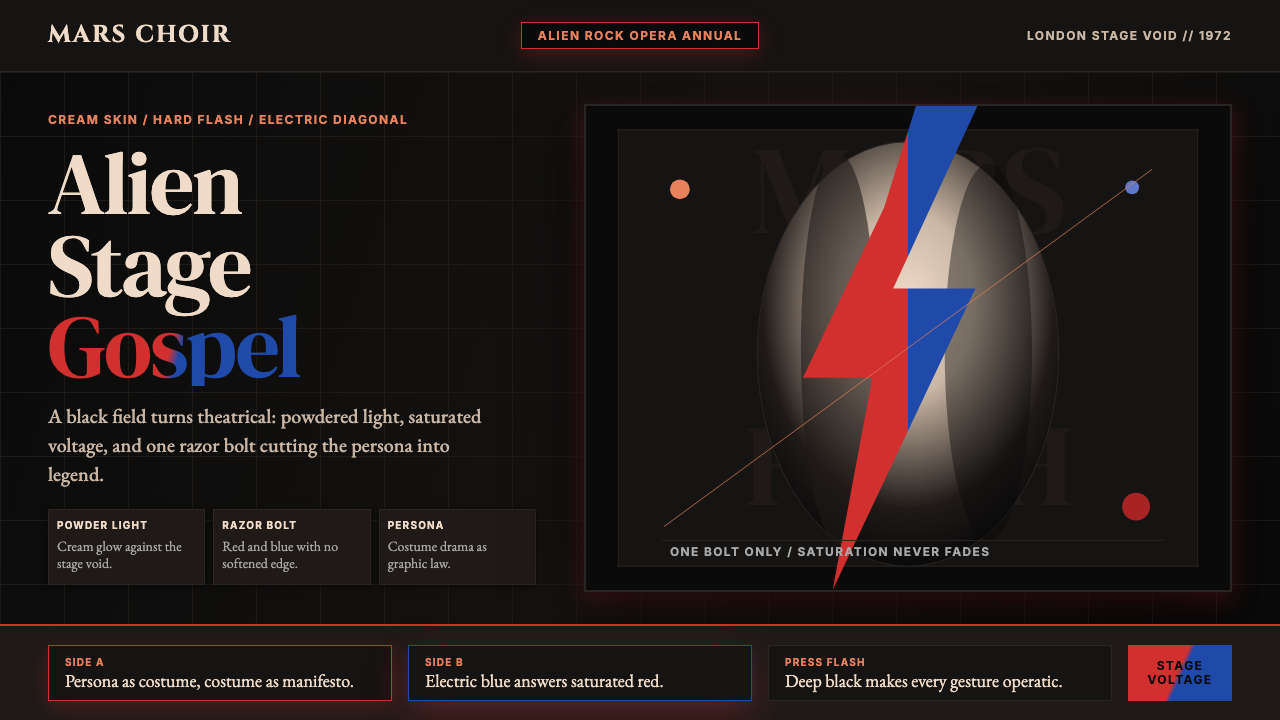
David Bowie invented Ziggy Stardust in 1972 and with him a visual language of glam-rock theater — deep black, cream-pale skin, and a hard lightning bolt that turned pop music into costume drama.
Bowie — Ziggy Stardust in brief
Bowie — Ziggy Stardust is the visual aesthetic that emerged from David Bowie's 1972–1973 glam-rock period, crystallized in the iconic Aladdin Sane album sleeve: a cream-pale face against a deep black backdrop, bisected by a hard-edged lightning bolt in red and electric blue. It is a style that treats pop music as theater, design as stagecraft, and the human face as a canvas for transformation.
The aesthetic is saturated, androgynous, and theatrical. Color is pushed to maximum voltage — the contrast between the near-black void of the background and the almost luminous pallor of the skin is as stark as a spotlight on a darkened stage. The lightning bolt functions simultaneously as ornament, signature, and symbol: neither decorative frill nor legible type, but a graphic gesture that collapses the distance between costume and identity.
Unlike design movements that emerge from institutions or manifestos, this aesthetic is inseparable from a specific artistic persona. Ziggy Stardust was not simply a costume but a fully realized alien alter-ego, and every visual decision — the makeup, the hair, the photography, the album art — served that persona. The result is a design language defined by committed artifice: nothing here pretends to be natural, and that refusal of naturalism is its defining strength.

Where does Bowie — Ziggy Stardust come from?
David Bowie created the Ziggy Stardust persona in London in 1972, launching it with the album The Rise and Fall of Ziggy Stardust and the Spiders from Mars. Ziggy was conceived as an alien rock messiah, a being from another world who had descended to bring humanity its final message before apocalypse. This was not casual theatricality — it was a total artwork, merging narrative, performance, costume, and image into a single sustained fiction that Bowie inhabited onstage and off.
The visual grammar of Ziggy was assembled from multiple influences. Bowie drew on Japanese kabuki theater for its tradition of extreme facial transformation and the coded meaning of stage makeup. He was influenced by the British glam-rock scene already in motion — Marc Bolan and T. Rex had introduced glitter and androgyny to rock — but Bowie pushed the artifice further, hiring theatrical costumers and making the alien-outsider image philosophically as well as aesthetically deliberate. Guitarist Mick Ronson contributed a raw, electric energy to the stage presence that the photographs of Mick Rock captured with stage-flash intensity.
The canonical image came in 1973 with the Aladdin Sane album, shot by photographer Brian Duffy with makeup by Pierre La Roche. Duffy photographed Bowie against a stark black ground, bleached to near-white pallor, with the red-and-blue lightning bolt applied across the face. The Aladdin Sane sleeve was designed by Celia Philo, and its compositional severity — face centered, background absolute black, bolt as the sole graphic element — distilled the entire Ziggy visual project into a single unforgettable image. It became one of the most reproduced photographs of the twentieth century.
The glam-rock movement that Bowie helped define was partly a reaction against the earnest, earthy naturalism of late 1960s rock culture. Where the counterculture had celebrated authenticity, denim, and the communal, glam elevated artifice, costume, and the individual star image to high principle. Bowie's genius was to take this instinct to its logical extreme by insisting that the persona was not a mask worn over a real self but a fully valid artistic identity in its own right — a distinction that made the Ziggy project philosophically richer than mere spectacle and gave its visual language a coherence that outlasted the persona itself.
What defines the Bowie — Ziggy Stardust look?
Color Voltage
The palette operates at maximum contrast. A near-black or absolute-black ground is set against skin bleached to a luminous pallor that reads almost as white, then cut by the red-and-electric-blue lightning bolt — two colors chosen for their clash, not their harmony. The effect is not warm or welcoming but electric and confrontational. Saturation is pushed as far as it will go; the palette refuses any middle ground of warmth or grey.
The Lightning Bolt as Graphic Gesture
The Aladdin Sane lightning bolt is the defining graphic form: hard-edged, asymmetric, slashing diagonally across the face. It is neither purely geometric nor representational — it reads as both a natural symbol and an abstract shape. Critically, it is applied directly to the face, collapsing the boundary between design element and human subject. The bolt is not a logo placed beside the subject; it is part of the subject. This fusion of graphic form and human body is the aesthetic's most radical move.
Theatrical Lighting as Design Logic
The photography that defines this aesthetic — primarily Mick Rock's stage and portrait work — uses hard, directed flash that flattens the face into a graphic plane while creating pools of absolute shadow. This is not flattering portraiture but stage-lighting logic applied to still photography: the face becomes a mask, the shadows become shapes, and the resulting image reads as much as a designed artifact as a document of a person. The photographic approach is inseparable from the visual system.
Androgyny as Visual Statement
The aesthetic deliberately refuses conventional gender signals. The bleached, made-up face is neither masculine nor feminine by the codes of its era — it is coded as alien, as other, as performed. This androgyny is not ambiguity but a decisive visual position: clothing, makeup, and posture are chosen for their theatrical impact and their refusal of norms rather than for naturalistic gender expression. The visual system thus communicates that identity itself is a costume — one that can be changed.
Black Ground as Stage
The background in Ziggy-era imagery is almost invariably absolute black — not dark grey, not textured, but void. This is the logic of the theater curtain and the photographer's dark-room: it strips away environment and context so that only the figure and its graphic elements remain. The black ground is not a neutral backdrop but an active design decision that elevates the subject into the realm of symbol rather than documentation.
Persona as Total Design System
The coherence of the Ziggy visual language comes from the fact that every element — makeup, costume, hair, album art, stage lighting, promotional photography — was designed in service of a single fictional persona. This is an unusual design principle: consistency enforced not by a brand guidelines document but by the internal logic of a character. The aesthetic only works at full strength when all elements are aligned. Fragmentary application — a lightning bolt without the theatrical context, the palette without the persona — reads as costume rather than system.
Maximum Artifice, Zero Apology
The Ziggy aesthetic makes no pretense of naturalness or restraint. Makeup is heavy and obvious, color is pushed to its limits, the lighting is theatrical, and the persona is explicitly fictional. Where many design systems aim for invisibility — the work that conceals its craft — Ziggy Stardust announces its own construction at every moment. The craftsmanship is visible and intended to be visible: you are meant to see that this is a performance, and that awareness is part of the experience.

Who shaped Bowie — Ziggy Stardust?
The originator of the Ziggy Stardust persona and the creative director of its entire visual project. Bowie conceived Ziggy not merely as a stage costume but as a fully realized alien identity, and he controlled every aspect of its visual expression — the makeup, the hair, the album art direction, the stage design. His instinct for total artwork, drawing on kabuki, mime, and European art cinema as much as rock music, gave the aesthetic its philosophical depth and its coherence across media. When he retired the Ziggy persona in July 1973, the abruptness of that decision itself became part of the persona's mythology.
The photographer who shot the Aladdin Sane sleeve in 1973, producing the canonical Bowie image. Duffy was one of the 'Black Trinity' of 1960s British fashion photographers alongside David Bailey and Terence Donovan, but by the early 1970s he had moved toward more conceptual, high-contrast portrait work. His decision to shoot Bowie against an absolute black ground, bleached to near-white in post-production, and to let the lightning bolt function as the sole compositional element gave the image its graphic severity. Duffy later destroyed much of his archive in a period of disillusionment with the photography world, which has made the surviving Aladdin Sane prints especially significant.
The photographer who documented Bowie and Ziggy Stardust throughout the 1972–1973 era, producing the defining stage and promotional images. Rock's work is characterized by his use of hard stage flash — a technique that flattens the face into a graphic plane, obliterates background detail, and creates the high-contrast, almost poster-like quality of the Ziggy images. He also photographed Iggy Pop, Lou Reed, and Queen during the same period, but his Bowie work remains the visual record of glam-rock at its peak. His photographs established the visual vocabulary that subsequent glam and glitter movements drew upon.
Lead guitarist of the Spiders from Mars, Bowie's backing band throughout the Ziggy era, and a crucial contributor to the visual identity of the live performances. Ronson's own stage presence — his platinum-blond hair, his aggressive playing style, his costumes — extended the Ziggy aesthetic beyond Bowie alone and established the glam-rock visual language as a collective rather than solo enterprise. He also served as arranger and producer on several Bowie records of the period, making him a full creative collaborator in the sonic and visual construction of the Ziggy project.
The makeup artist who executed the Aladdin Sane lightning bolt for the Brian Duffy shoot, as well as Bowie's stage makeup throughout much of the Ziggy and Aladdin Sane tours. La Roche worked within the theatrical makeup tradition — thinking in terms of mask, symbol, and visual impact from the back of the room rather than naturalistic enhancement — and his work on Bowie is the closest the Ziggy aesthetic comes to having a graphic designer: someone who translated the conceptual idea of the lightning bolt into a precise, reproducible, visually perfect mark applied to a face.
How do you use Bowie — Ziggy Stardust today?
The Bowie — Ziggy Stardust aesthetic is one of the most distinctive and demanding historical references in contemporary design. It works when a project genuinely calls for maximum theatrical impact, a dark and electric palette, and willingness to push past conventional restraint. It does not work as a casual overlay: the style demands commitment, because half-measures produce costume rather than conviction. Before applying it, confirm that the audience, context, and brand values all support a visual register that is explicitly dramatic and refuses to apologize for that drama.
For presentation slides, the style is most effective on cover and section-break pages rather than content-heavy slides. A cover built on this aesthetic uses a dark — ideally near-black — background, a single high-impact image or typographic element treated with extreme contrast, and one or two saturated accent colors used sparingly and deliberately. The lightning bolt motif, while visually powerful, should be deployed with restraint: it works as a structural diagonal or a single accent element, not as a repeating pattern. Section breaks can use full-bleed dark backgrounds with bold, minimal type to maintain theatricality. Content slides should be simpler — dark background, clean type hierarchy, restrained color — to avoid visual fatigue across a long deck.
For web interfaces, the aesthetic is well-suited to landing pages, artist or performer portfolios, music or entertainment platforms, and brand identity sites where differentiation and bold first impressions are the primary goal. The approach: commit to a dark-ground palette with near-black backgrounds, use a single saturated accent color for calls to action and interactive states, and treat photography or illustration with high-contrast cropping that isolates the subject from any naturalistic background. Dashboards and data-heavy interfaces are a poor fit — the theatrical palette works against the scannability that functional tools require.
For editorial and marketing work, the style supports striking covers, poster campaigns, music promotional materials, and any context where a single powerful image needs to command attention. The compositional principle is isolation: one dominant subject, one graphic element, maximum contrast, empty space used as darkness rather than as white breathing room. For multi-page editorial, the full-bleed theatricality of the cover should give way to a more restrained inner-page system — a dark accent color, bold section headings — to avoid exhausting the reader. Marketing materials that reference the style often work well in experiential and entertainment contexts: event posters, tour merchandise, brand activations in live music or fashion spaces.
A common mistake when applying this aesthetic is treating it as a general dark-mode style. The Ziggy palette is not simply dark — it is specifically high-voltage: saturated color against deep black, with no soft gradients, no desaturated tones, no warm shadows to soften the contrast. Applying the dark background without the electric color saturation produces a result that feels merely dim rather than dramatic. A second common error is applying the lightning bolt or face-bisecting graphic device too literally — reproducing it as a decorative element without the underlying logic of persona and transformation produces pastiche. The style works when the design stakes feel as high as a Bowie album cover; it reads as imitation when they do not.

Bowie — Ziggy Stardust — FAQ
Is this style appropriate for corporate or professional contexts?
Rarely, and only for specific niches. The Ziggy aesthetic is explicitly theatrical, androgynous, and rock-inflected — qualities that work well in entertainment, fashion, music, creative agencies, and experiential brand contexts, but that create friction in financial services, enterprise software, healthcare, and most B2B environments. The exception is when a corporate brand deliberately wants to signal disruption, creativity, or cultural edge — a technology company positioning itself as a category-breaker, for instance. Even then, the application typically requires significant adaptation: the theatrical color voltage is dialed back, the black ground is softened, and the lightning bolt reference is abstracted rather than applied literally.
How do I use the lightning bolt motif without it feeling like a costume?
The lightning bolt works in the original context because it is integral to a persona — it is applied to a face, at scale, as the organizing principle of an entire visual identity. When extracted and used as a decorative element, it quickly reads as quotation rather than design. The productive approach is to engage with the underlying principle — a hard diagonal that bisects a composition, creates tension, and implies sudden energy — rather than the literal form. A bold diagonal line, a sharp angular crop, an asymmetric layout with a strong diagonal axis: these channel the bolt's visual logic without literalism. Use the actual lightning bolt shape only when the project has sufficient theatrical context to support it.
Can this aesthetic work in a light or white-ground layout?
It is possible but significantly weakened. The deep black ground is not incidental to the Ziggy aesthetic — it is structural. The black creates the stage, the void from which the face and the bolt emerge with theatrical force. On a white or light ground, the same elements read as graphic design referencing the Ziggy aesthetic rather than embodying it. If a light-ground application is required by context (a print piece that will not reproduce well on dark stock, for instance), the most effective approach is to invert the logic: use the dark palette as a contained element — a black panel, a dark header band — within an otherwise light layout, preserving some of the theatrical contrast rather than abandoning it entirely.
What makes this different from other dark, high-contrast aesthetics like film noir or goth?
Film noir is cinematic and narrative — its darkness implies threat, mystery, and moral ambiguity, and it typically uses atmospheric shadow and diagonal composition to create unease. Goth aesthetics are rooted in romantic decay, Victorian funerary symbolism, and a darkness that is mournful rather than electric. The Ziggy aesthetic shares the dark palette but its emotional register is entirely different: it is not threatening or mournful but triumphant and performative. The blackness is a stage, not a shadow. The color, when it appears, is saturated and electric rather than jewel-toned or atmospheric. The defining quality is theatricality in the sense of deliberate, exuberant performance — which is why it aligns naturally with pop music, fashion, and entertainment contexts rather than horror, crime, or melancholy ones.
How should photography be treated when applying this style?
Photography in the Ziggy aesthetic is treated with maximum graphic intervention — it is never naturalistic or ambient. The Mick Rock approach is the reference: hard flash that flattens the face into a graphic plane, absolute black backgrounds that strip away environment, extreme contrast that pushes highlights toward white and shadows toward pure black. In contemporary application, this translates to: high-contrast processing that reduces tonal range, dark or black backgrounds achieved either in-camera or in post-production, and aggressive cropping that isolates the subject. Color photography should be pushed toward saturation rather than pulled toward neutrality. The goal is for the photograph to read as a designed object — a mask, a symbol, an artifact — rather than as documentation of a person or place.
Related design styles
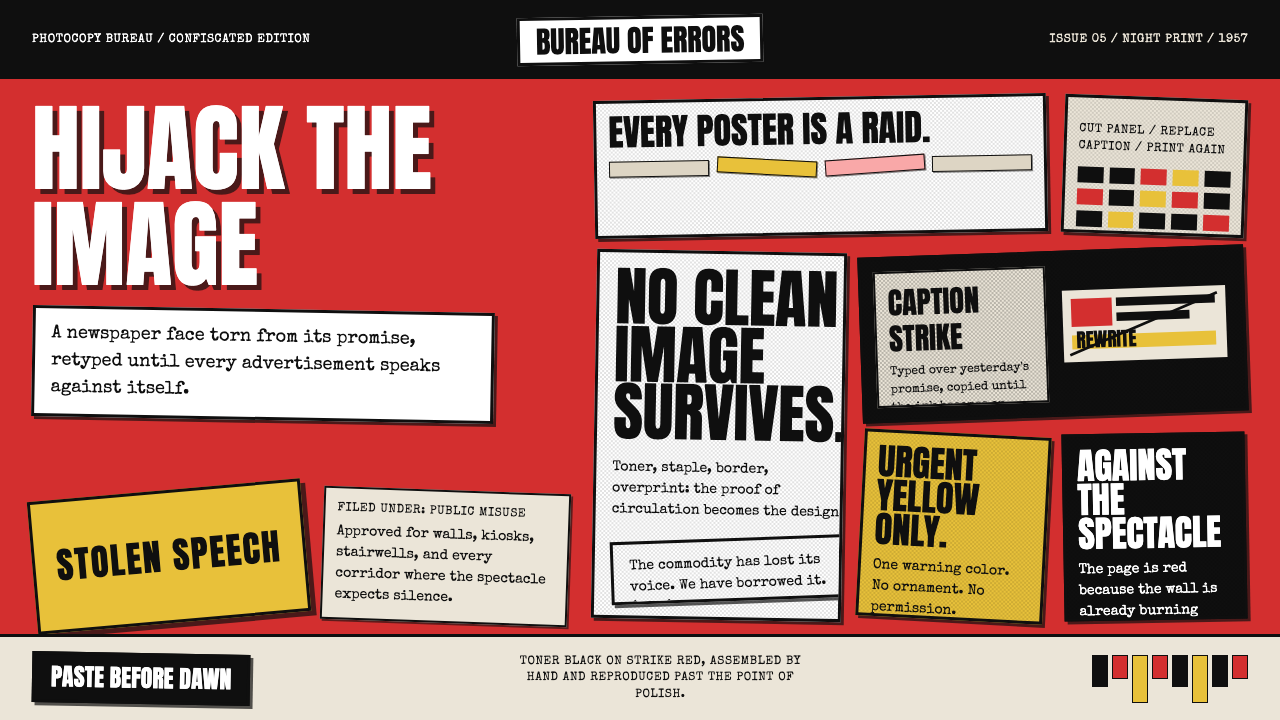 Situationist Détournement (1957)Contraband urgency. Strike red, toner black, and jagged comic panels make the…
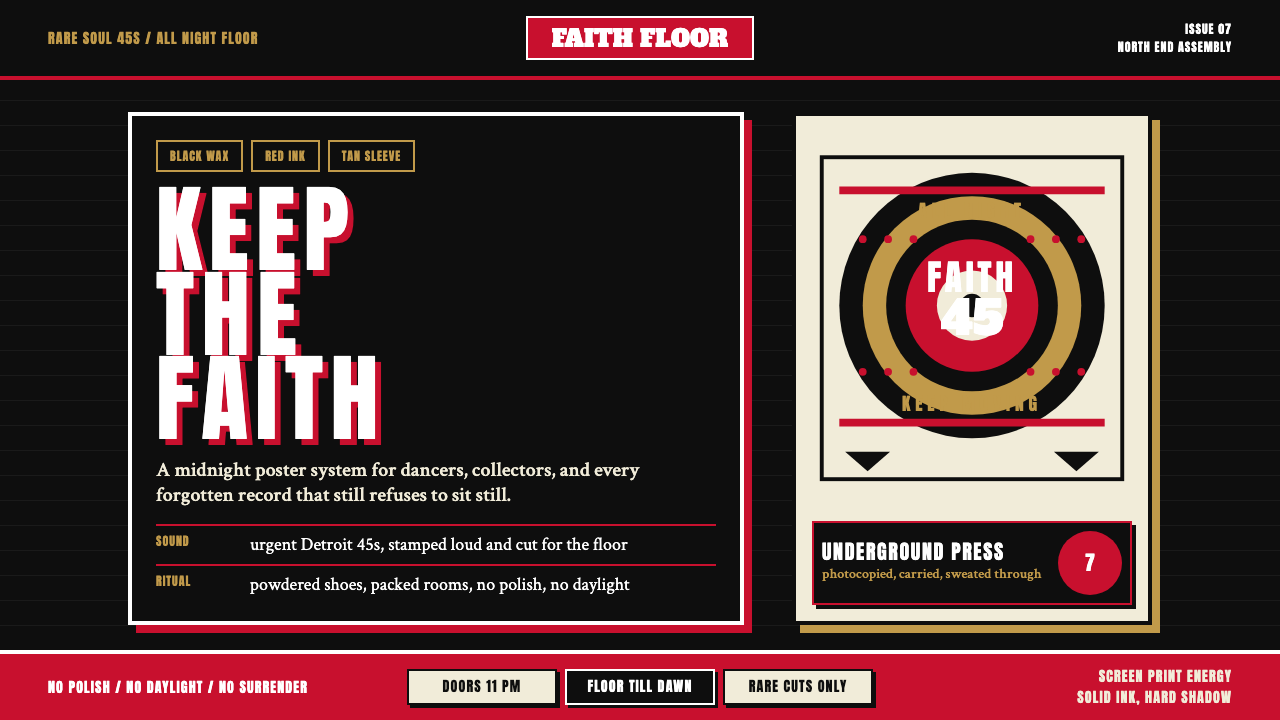 Northern Soul Wigan (1970)Underground urgency. Black ground, fist-red type, and tan vinyl rings hit lik…
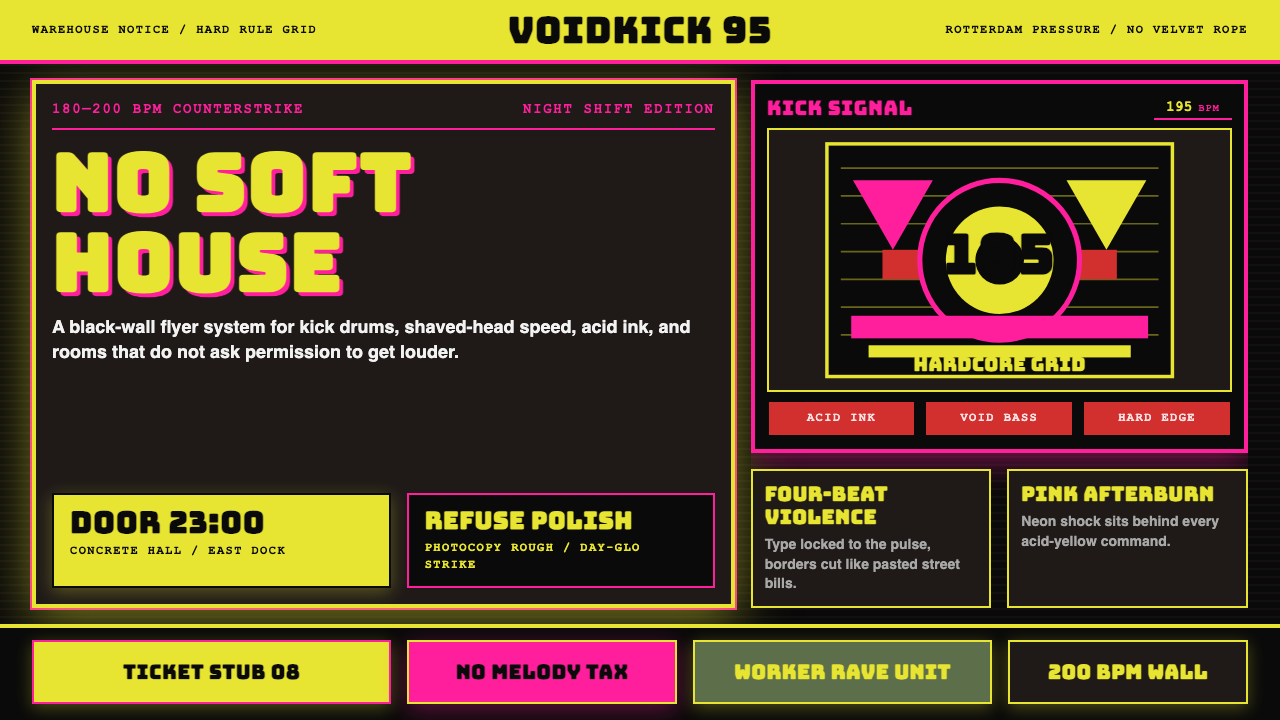 Rotterdam Gabber HardcoreHardcore refuses polish. Acid yellow, neon pink, black grid, and brutal Bunge…
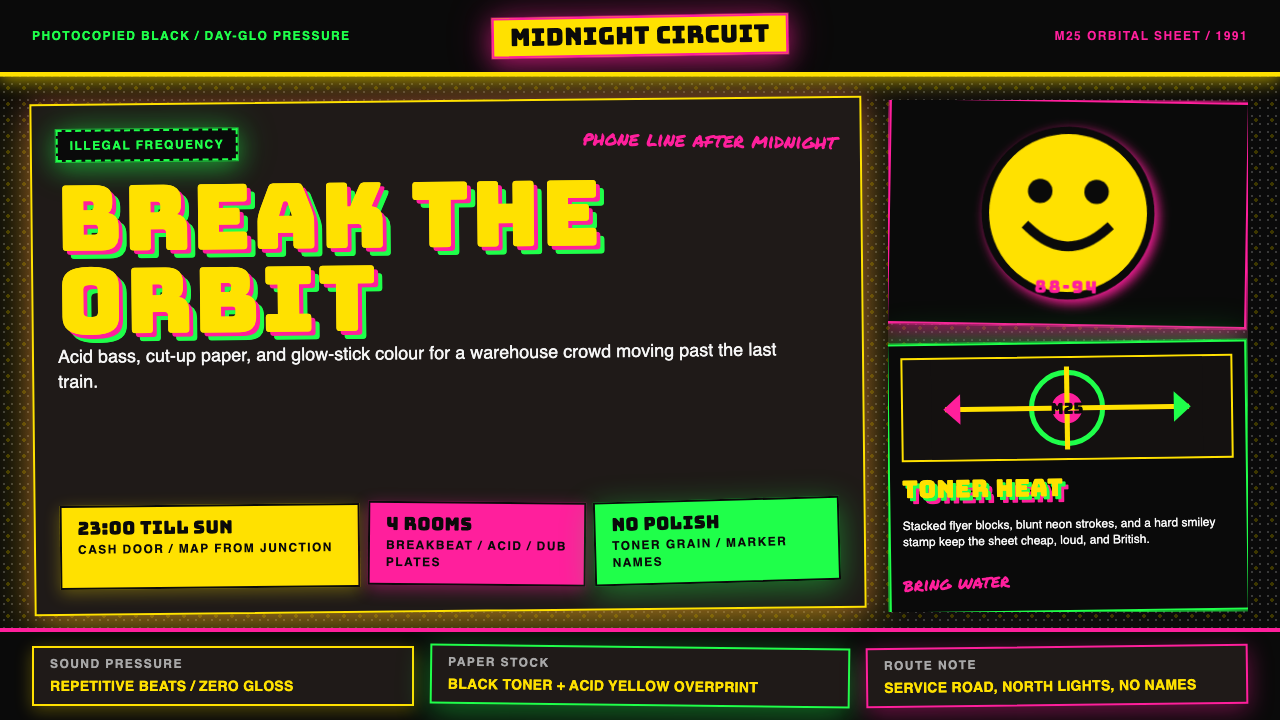 UK Rave Glow-Stick FlyerIllicit euphoria. Acid yellow, rave pink, and laser green slam into photocopi…
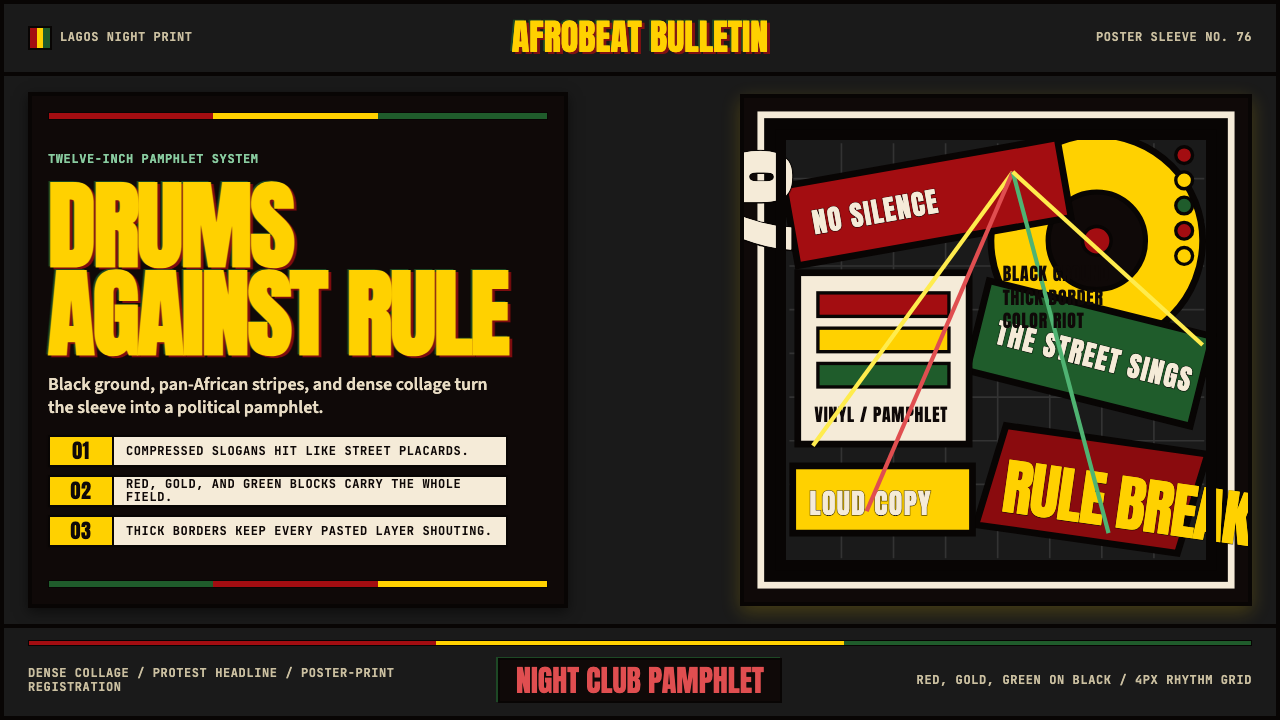 Fela Kuti Afrobeat Album (1976)Protest rhythm made visual. Red-yellow-green blocks and compressed Anton shou…
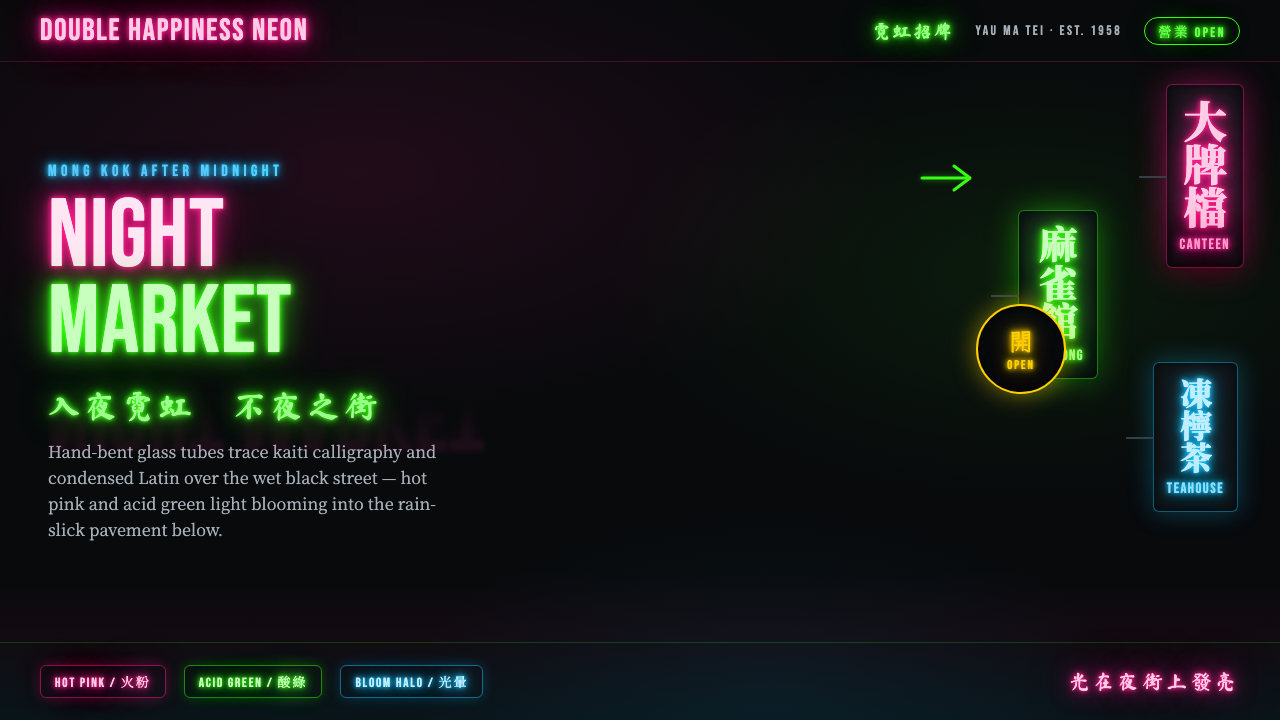 Hong Kong Neon SignboardsLight only reads against the wet black night. Hand-bent pink and green tubes…