What is UK Rave Glow-Stick Flyer?
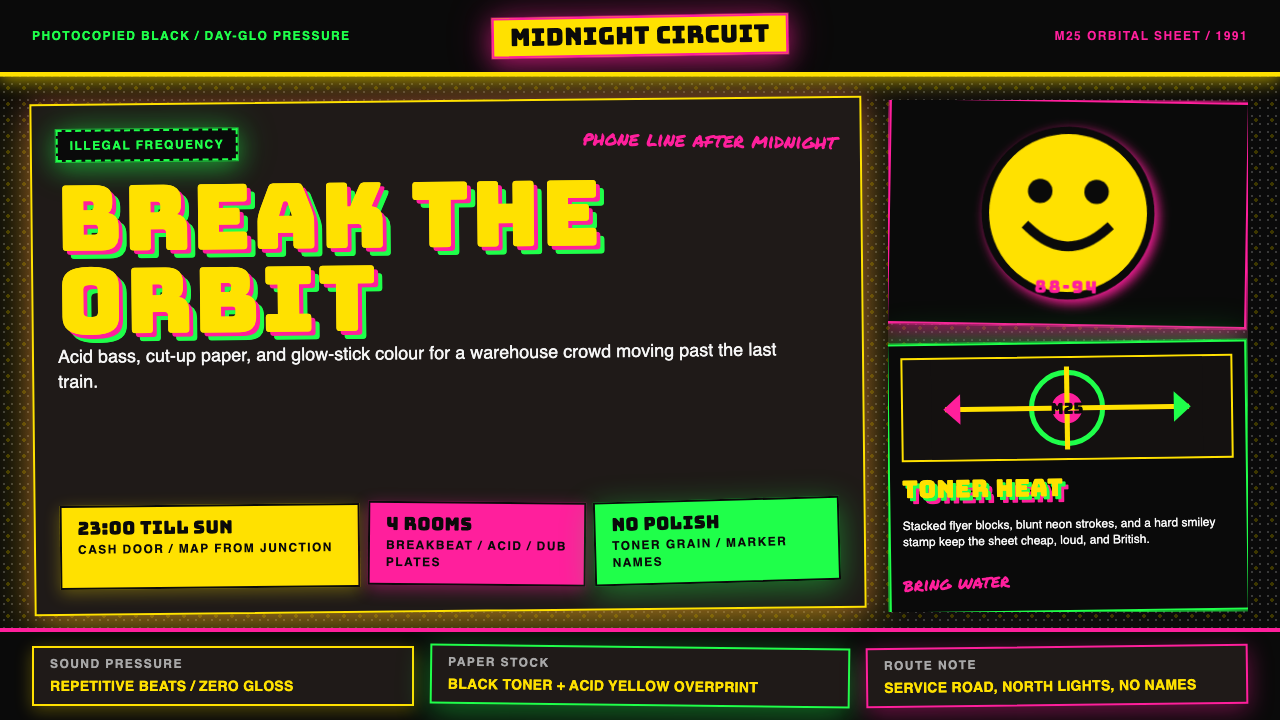
Acid house turned a photocopier, a marker pen, and three neon inks into the most euphoric graphic language of late-twentieth-century Britain.
UK Rave Glow-Stick Flyer in brief
UK Rave Glow-Stick Flyer is the visual vernacular of British acid-house and free-party culture between 1988 and 1994 — a raw, saturated aesthetic born entirely outside commercial design studios. Neon yellow, neon pink, and neon green are slammed against a deep photocopied black, anchored by the smiley-face icon that had become the movement's universal emblem, and assembled through cut-and-paste collage rather than professional typesetting. The result is deliberately rough, loud, and cheap — a design language that wears its origins on its sleeve.
What distinguishes this aesthetic from generic electronic-music pastiche is its extreme specificity. These were not posters produced by advertising agencies or design graduates; they were flyers photocopied by the thousand in corner shops and handed out at petrol stations, taped to lamp posts along the M25 orbital, or slipped into the hands of revellers leaving one party with directions to the next. The medium shaped the message: photocopier toner is monochrome, so color had to be added through Day-Glo paper stocks or fluorescent ink layers. The machine's grain, its blown-out blacks and chalky highlights, became a feature rather than a flaw.
The aesthetic carries a specific emotional charge that distinguishes it from all other forms of countercultural print. It is simultaneously illicit and euphoric — the visual equivalent of a warehouse where ten thousand people are dancing under laser grids and glow-stick arcs. Every element, from the smiley face to the chunky distorted lettering to the neon palette, is calibrated to communicate transgressive joy at a glance, in poor light, to someone who may have been dancing for six hours.

Where does UK Rave Glow-Stick Flyer come from?
The story begins in Chicago and Ibiza and arrives in Britain in the summer of 1987. Acid house — a stripped, repetitive mutation of Chicago house built around the Roland TB-303 bass synthesizer — crossed the Atlantic in the luggage of British DJs who had spent summers in Ibiza. Back in London, nights at the Haçienda in Manchester, Shoom at the Fitness Centre in Southwark, and Spectrum at Heaven in Charing Cross became the crucibles of what the tabloids would call the Second Summer of Love. The music was the catalyst; the visual culture followed almost immediately.
The smiley-face emblem — drawn, according to most accounts, by Danny Rampling for Shoom's flyers in early 1988 — crystallized the aesthetic. Rampling's designer used a hand-drawn yellow circle with black dot eyes and a simple arc mouth, photocopied onto fluorescent card stock. The image was contagious. Within months, smileys appeared on flyers across London, then across the country, then on t-shirts, in tabloid cartoons, and eventually on the facade of every souvenir shop in Britain. But the original flyer smiley was specific: hand-made, slightly irregular, embedded in a context of neon type and rough collage that signaled underground rather than commercial.
As the scene moved outdoors — from licensed clubs to unlicensed warehouses to open fields — the flyer culture scaled with it. Promoters like Sunrise, Energy, and Raindance organized events for tens of thousands of people along the M25 corridor. The Castlemorton Common Festival in 1992, organized by the Spiral Tribe sound system, drew an estimated twenty thousand people over a week and triggered the political crisis that culminated in the Criminal Justice and Public Order Act of 1994. The flyers for these events had to work without addresses — they directed ravers to phone lines or meeting points, with final locations revealed by radio. This constraint pushed the visual language toward pure affect: if you cannot say where, you say how it will feel.
The designers who defined the peak years of the aesthetic — most prominently Junior Tomlin and Pez — worked in conditions of deliberate urgency. Flyers were produced overnight, printed on whatever fluorescent stock was available, and distributed before authorities could act. The tools were intentionally limited: photocopier, marker, Letraset dry-transfer lettering, scissors, and spray adhesive. Genesis P-Orridge of Throbbing Gristle and Psychic TV had earlier explored industrial cut-up aesthetics that fed into the visual grammar; Andrew Weatherall, known primarily as a DJ and producer, brought a knowing art-school sensibility to the genre's iconography. By 1994, when the Criminal Justice Act made large unlicensed gatherings illegal, the aesthetic had already seeded itself across British popular culture — in album artwork, magazine design, and eventually the mainstream advertising that it had originally defined itself against.
What defines the UK Rave Glow-Stick Flyer look?
Neon-on-Black Palette
The defining color logic is inversion: the background is dense, near-absolute black — the darkness of a photocopied page pushed to its limits — and the foreground colors are the most saturated fluorescents available. Acid yellow, rave pink, and laser green are not simply bright; they are specifically Day-Glo, calibrated to read under ultraviolet light and to glow against darkness. The three colors rarely appear in equal measure: typically one color dominates — yellow is most common — while the other two appear as secondary emphasis or decorative edge.
Smiley-Face Icon
The smiley is not decoration — it is the movement's primary symbol, as legible and culturally loaded as a political emblem. In flyer usage, it is almost always hand-drawn or photocopied from a hand-drawn original, which gives each instance a slightly irregular, humanly imperfect quality that distinguishes it from the clean commercial smileys that came later. The face is simplified to its minimum readable form: two dot eyes and an upward arc, usually in yellow on black or black on yellow, sometimes distorted by photocopy degradation into something that reads as both ecstatic and slightly sinister.
DIY Collage Typography
There is no single typeface that defines the aesthetic — rather a method: cutting letterforms from other printed materials, combining Letraset dry-transfer alphabets, hand-lettering with fat marker pens, and photocopying the result at various sizes to create scale contrast. The output is intentionally inconsistent. Headlines might be enormous, condensed, and distorted by photocopier zoom; sub-information might be a hand-written note added after the fact. This typographic roughness communicates authenticity: a flyer that looks professionally set would signal the wrong kind of organization.
Photocopier Grain and Degradation
The photocopier is not merely the production tool — it is the aesthetic engine. Successive generations of copying introduce grain, lose mid-tones, blow out whites, and crush blacks into a solid dense field. This process, which any commercial printer would treat as a defect, is embraced and sometimes deliberately amplified: running a flyer through the machine multiple times to increase contrast and grit, or copying a copy of a copy to introduce the specific texture of information decay. The resulting surface resembles no other print medium — it is specific to the electrostatic process and to a particular moment in office-machine history.
Asymmetric Information Stacking
Rave flyers must communicate quickly and clandestinely: event name, date, sometimes a phone number, and whatever location can be safely disclosed. The layout strategy is not a grid in the formal sense but a stacking of information blocks at different scales and angles, creating a composition that reads as urgent and layered simultaneously. Text blocks are placed without regard to alignment; elements overlap freely; the hierarchy is established by scale rather than position. This apparent disorder is functional: it draws the eye across the whole surface, ensuring that even a glance in poor light will capture at least the core information.
Laser and UV Light References
The visual language consistently references the physical experience of the rave itself: the sweep of laser grids, the pulse of strobe lights, the glow of fluorescent clothing under black-light. These references are not illustrative but atmospheric — a bold streak of neon across a black field evokes a laser trail without depicting one. The use of fluorescent inks that read differently under ultraviolet light than under daylight is the most literal translation of the rave environment into print: holding a flyer under a UV lamp, as ravers did in clubs, transformed its appearance entirely.
Coded and Incomplete Information
Perhaps the most culturally specific characteristic: rave flyers frequently omit the venue address, replacing it with a phone number, a map reference, or a grid coordinate that would only make sense to those already within the network. This was a practical response to police pressure — a flyer with a full address could be used as evidence and the venue raided before the event began. The visual language absorbed this constraint productively: the implied secrecy became part of the aesthetic, giving even printed information a sense of privileged access. The incomplete flyer is an invitation into an insider community, not just an event announcement.

Who shaped UK Rave Glow-Stick Flyer?
Junior Tomlin is regarded as one of the most accomplished practitioners of the rave-flyer form. Working in London through the late 1980s and early 1990s, he developed a compositional approach that brought a degree of intentional sophistication to what was ostensibly a vernacular medium. His flyers for major events used the neon-on-black palette with a command over scale contrast and visual rhythm that distinguished them from simpler cut-and-paste work, while retaining the essential roughness and urgency of the form.
Pez — working primarily out of the Bristol and London scenes — brought a more graphic, almost poster-art sensibility to rave flyer design. Where many practitioners treated the flyer as purely functional, Pez treated it as a compositional problem worth solving for its own sake. His use of neon color was more architectural — using it to divide space and create visual structure rather than simply flood the surface — and his lettering work showed an awareness of the expressive potential of distorted display type that anticipated later developments in underground graphic design.
Spiral Tribe was a free-party sound system and art collective that became the most prominent exponents of the outdoor rave movement. Their visual identity — spiral motif, dense black backgrounds, hand-stencilled lettering — was inseparable from their organizational and philosophical commitments to free culture and non-commercial access to music. The Castlemorton Common Festival of 1992, with which they are most associated, became the defining event of the era: the scale of the gathering, and the government's response to it, crystallized the political stakes of the movement and its visual culture.
Andrew Weatherall was primarily known as a DJ and record producer — his remix of Primal Scream's 'Loaded' in 1990 helped define the sound of the era — but his contribution to the visual culture of British rave extended to record sleeves, flyers, and the broader iconographic environment of the clubs and events he was associated with. Weatherall brought an art-school literacy to contexts that often lacked it: his design sensibility was informed by dub music aesthetics, punk cut-and-paste, and continental surrealism, which he filtered through the Day-Glo urgency of the rave scene.
Genesis P-Orridge's influence on rave visual culture was upstream and philosophical rather than directly commercial. Through Throbbing Gristle in the late 1970s and Psychic TV in the 1980s, P-Orridge developed an industrial cut-up aesthetic — collaged imagery, deliberately degraded reproduction, occult symbolism, psychedelic color — that established a visual grammar for transgressive British subculture. When acid house designers reached for techniques to communicate illicit joy, they were often reaching for tools that P-Orridge had already tested and theorized: the photocopier as revolutionary instrument, degradation as authenticity signal.
How do you use UK Rave Glow-Stick Flyer today?
Applying the UK Rave Glow-Stick Flyer aesthetic requires understanding that its power comes from controlled tension: neon against deep black, rough against deliberate, chaotic arrangement against urgent legibility. The style is not simply about bright colors on dark backgrounds — it is about the specific emotional register of transgressive joy, and every design decision should serve that register. Used without that intention, it risks reading as generic nightlife branding rather than the specific countercultural artifact it references.
For presentation slides, the style works best for cover and section-break pages rather than dense information slides. A cover built in this mode should commit fully to the black ground, choose one dominant neon color for the main title in oversized, visually distorted type, and use a second neon only for a subordinate line or accent. The smiley or a simplified circular motif can anchor the composition. Content slides within the same deck should be pulled back significantly — dark backgrounds become fatiguing for reading-heavy slides — so consider a desaturated or near-black background for text slides with neon used only for emphasis and data visualization highlights. Data slides can lean into the aesthetic's poster energy: bold bar charts in neon against black, with the grain and roughness deliberately softened so numbers remain legible.
For web interfaces, the aesthetic translates well into hero sections, loading screens, countdown pages, and event landing pages where mood-setting takes precedence over information density. Dashboard and pricing applications should use it selectively: reserve neon against black for primary calls to action, tier differentiation, or alert states, and use a lighter near-black or dark-charcoal ground for the main reading surface. Navigation elements should prioritize legibility over mood — the roughness of the rave flyer is compelling in a poster context but becomes tiring in a component that users interact with repeatedly.
For editorial and marketing work, the style's most effective application is in contexts that explicitly reference energy, music, nightlife, or creative community — festival branding, music publication headers, youth-culture campaign materials, and fashion editorial. The DIY quality is the style's authenticity signal: attempting to polish it into a fully refined, professional finish undermines the very qualities that make it distinctive. In marketing contexts, the style works well when the brand can credibly claim some form of outsider or underground positioning — forced adoption by an obviously corporate product creates an uncanny valley effect, where the rough aesthetic highlights rather than conceals the commercial intent.
A common mistake is applying the neon palette without committing to the black ground, resulting in fluorescent colors on white or mid-grey — which reads as generic festival branding rather than rave authenticity. Equally problematic is cleaning up the typography: replacing rough, irregular lettering with professionally set type in display weights removes the specific rough charge of the style and produces something that resembles a theme-park approximation. The photocopier grain is structural, not optional — if the surface looks too clean, it no longer reads as rave. Finally, resist the impulse to use all three neon colors simultaneously at full saturation; authentic flyers almost always lead with one dominant neon, using the others as peripheral accents.

UK Rave Glow-Stick Flyer — FAQ
Is this aesthetic appropriate for brands that have no connection to rave culture?
It can work, but with significant caveats. The aesthetic's power comes from its specific cultural authenticity — it signals something that was genuinely illicit and genuinely euphoric. Brands that borrow it without any credible connection risk reading as exploitative or simply confused. The most successful cross-context applications tend to share some values with the original: access, energy, community, anti-establishment positioning. A brand with none of those values should use the visual vocabulary sparingly and with full awareness that the cultural context is being cited rather than claimed.
How do you make the style legible — isn't neon on black hard to read?
Legibility in this aesthetic is governed by scale and contrast rather than by the conventional rules of typographic hierarchy. Large text in neon yellow against black is highly legible — more so than the same text in a mid-value color — because the luminance contrast is extreme. The readability problem arises at small sizes, particularly for extended body text, where the halation effect of bright color on dark ground causes letters to bleed into each other. The practical rule: reserve neon for display sizes and any text that needs to be read quickly from a distance; use a lighter, less saturated near-white for body reading where sustained attention is required.
Can the rave flyer aesthetic work in a light-background version?
Technically yes, but it loses most of its specific charge. The black ground is not incidental — it is constitutive. Day-Glo colors on white read as generic 1990s nostalgia or retro sportswear rather than rave-flyer culture specifically, because the luminance relationship inverts: fluorescents lose their apparent glow when surrounded by a ground that is itself bright. If a light background is a hard requirement, the approach that preserves the most of the original energy is to use a very dark warm grey rather than white, and to treat the neon colors as aggressive foreground elements with strong dark outlines or drop-shadows that maintain the sense of contrast.
How does this style differ from other 1990s nostalgia aesthetics like Memphis or Grunge typography?
Memphis (associated with the 1980s Italian design group) is geometric and playful but fundamentally optimistic and commercial — it was designed for mainstream consumption. Grunge typography (associated with David Carson and Ray Gun magazine from the early 1990s) is also dark and distorted but intellectual in its deconstruction, designed for a literate design-school audience. The rave flyer aesthetic differs from both in its class origin and its function. It was made by non-designers for non-designers, for purely practical distribution purposes, in conditions of legal risk. Its roughness is not a critique of professionalism; it is the direct result of urgency and material constraint. This distinction matters when applying it: Memphis can be polished, grunge typography can be intellectualized, but rave-flyer aesthetic loses its essential character the moment it becomes too self-conscious.
What happened to this aesthetic after 1994, and why does it feel current again now?
After the Criminal Justice Act of 1994 drove much of the free-party movement underground or into licensed venues, the flyer aesthetic was absorbed into mainstream graphic design — appearing in record packaging, magazine layouts, and advertising — and gradually diluted. A second wave of interest came with the early 2000s post-rave nostalgia in music and fashion. The current revival is driven by several converging forces: the fortieth anniversary of the Second Summer of Love, the prominence of 1990s reference in contemporary fashion, the TikTok-era rediscovery of rave culture by younger audiences, and a broader cultural interest in lo-fi and DIY aesthetics as a reaction against the over-polished visual language of algorithmic social media. The style feels contemporary because its values — roughness, urgency, community, anti-corporate affect — are in genuine demand again.
Related design styles
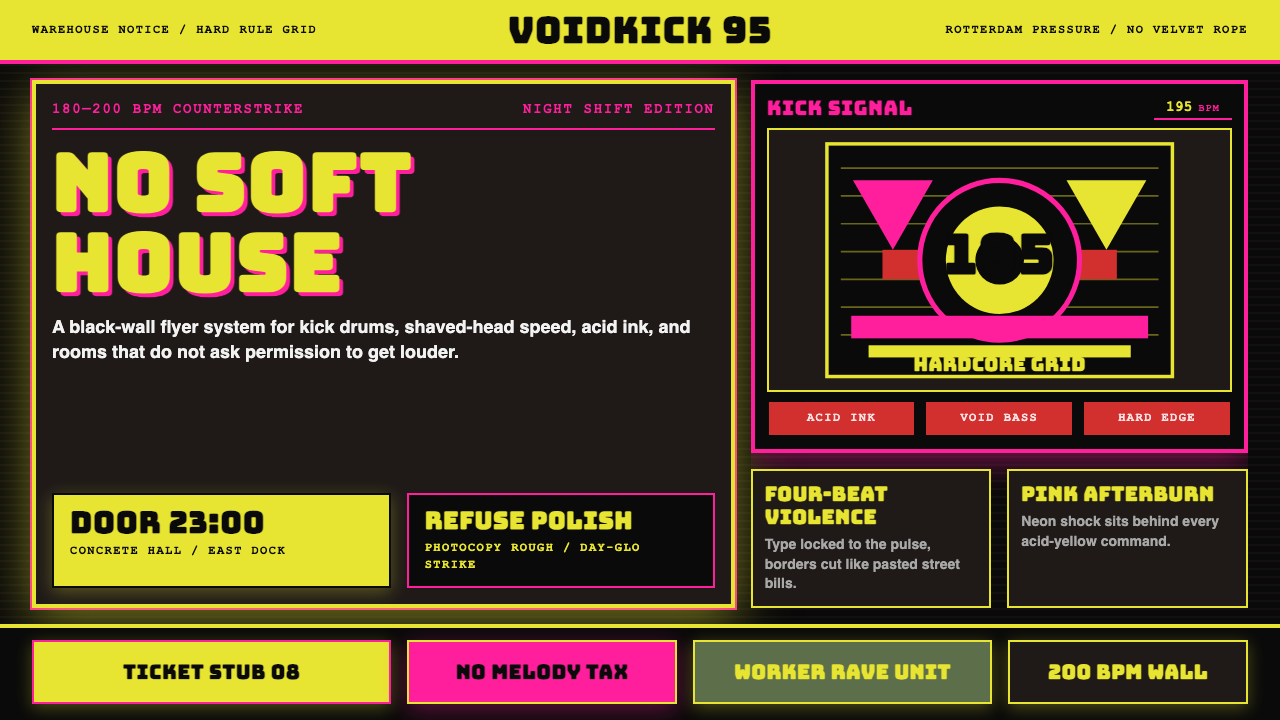 Rotterdam Gabber HardcoreHardcore refuses polish. Acid yellow, neon pink, black grid, and brutal Bunge…
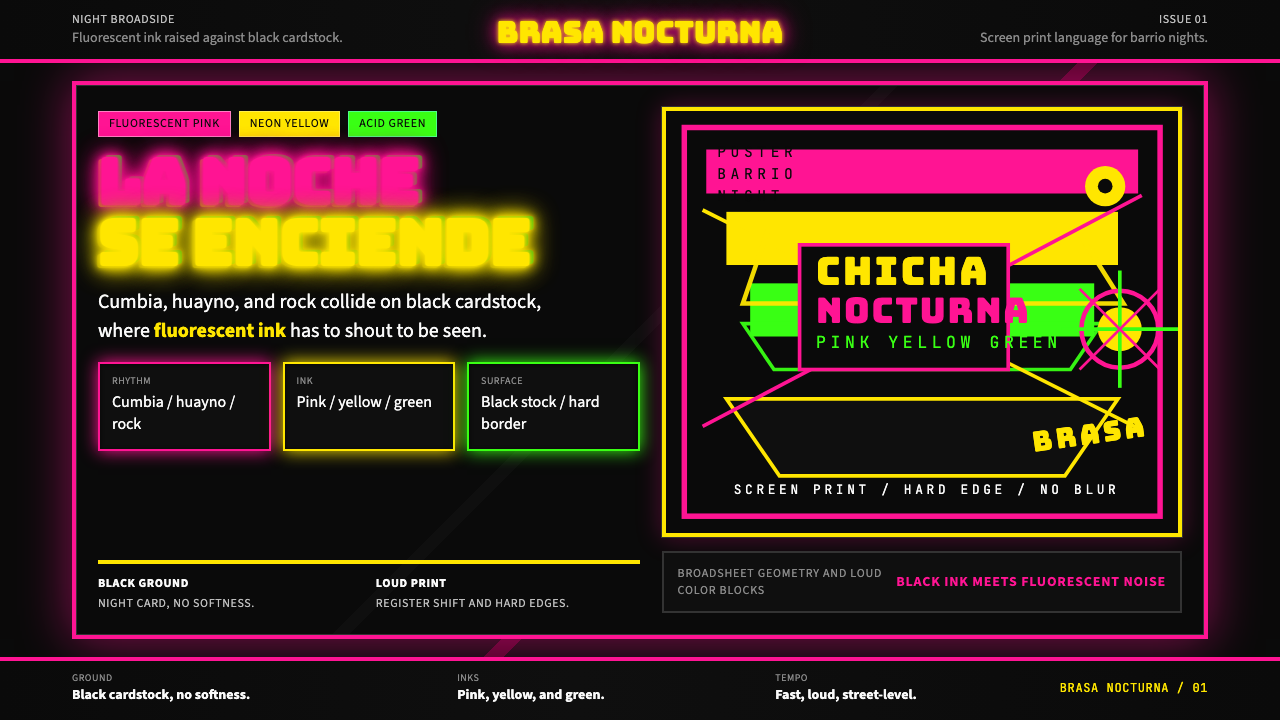 Peruvian Chicha Fluorescent PosterStreet-night fury. Pink, yellow, and green stack on black cardstock in hard b…
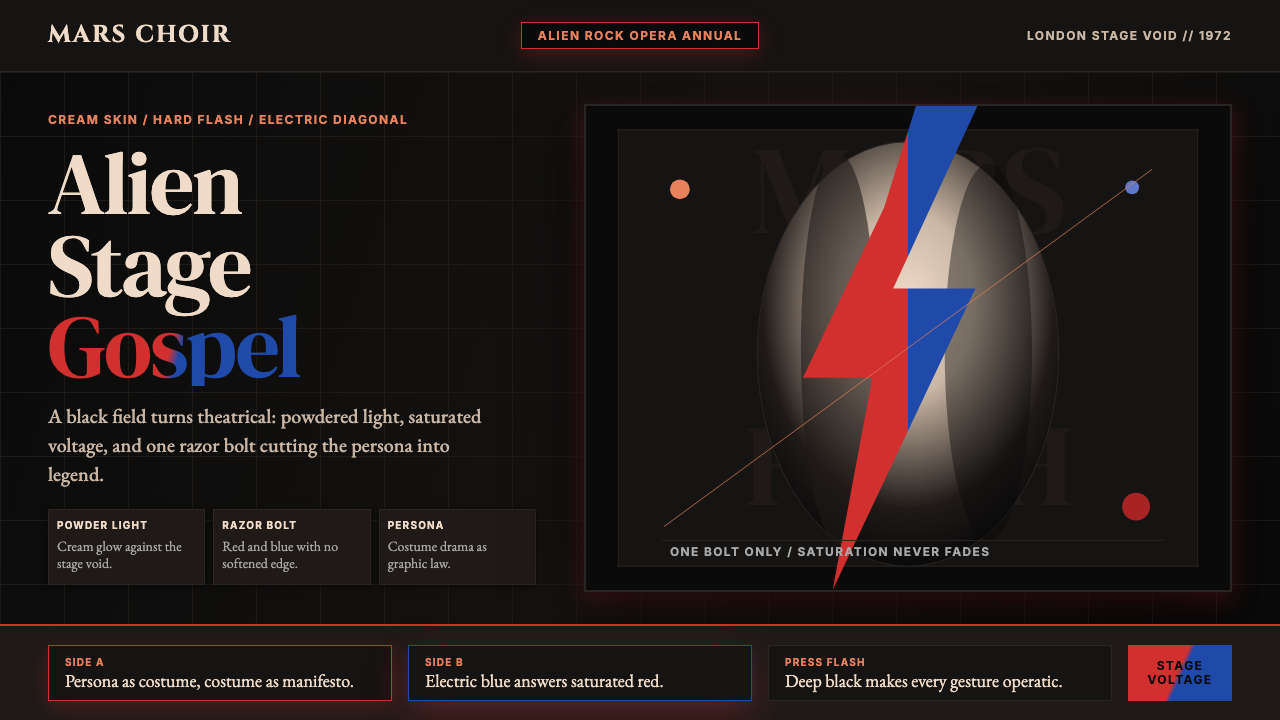 Bowie — Ziggy StardustTheater at full voltage. Cream-on-black portrait cut by one red and electric-…
 Nirvana — NevermindAnti-pop in pool blue. Cream cards, dollar-gold accents, and marker type roug…
 90s Aggressive Inline SkateX-Games attitude in plastic and paint. Fluoro lime and magenta slash across m…
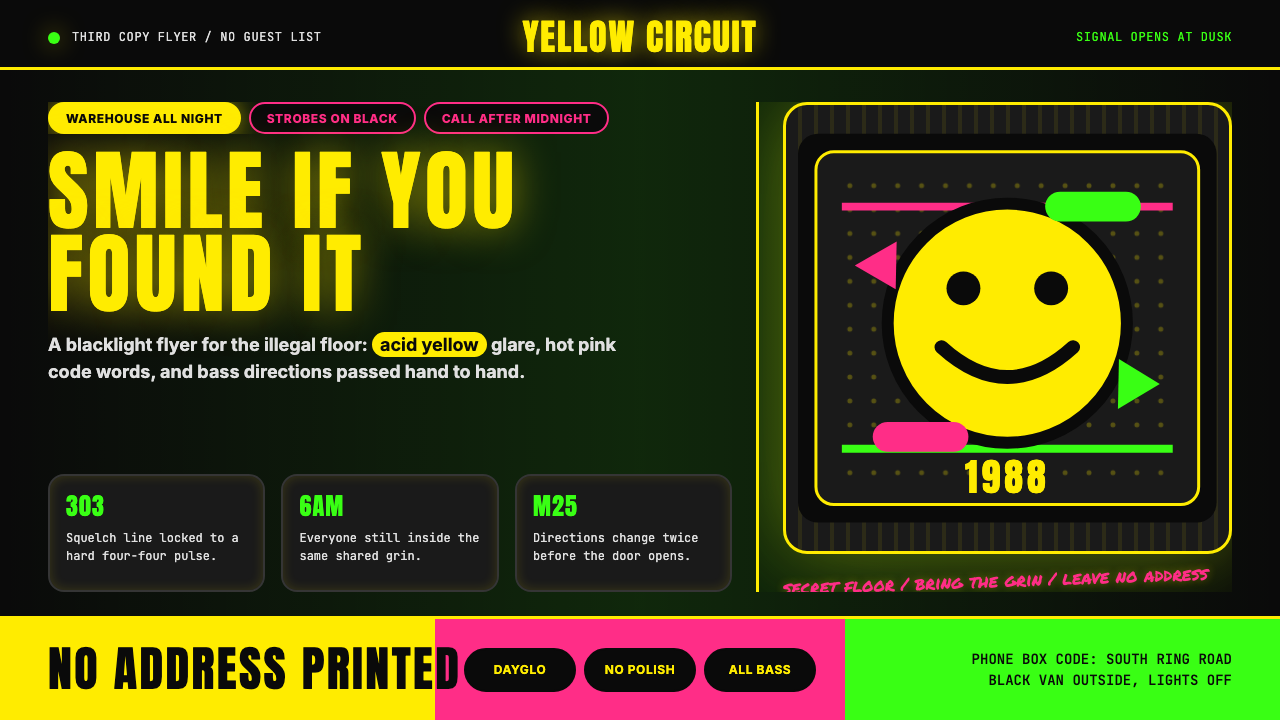 Acid House Smiley (1988)Rave energy hits first. Acid yellow on black, Anton caps, smiley glow.