What is Peruvian Chicha Fluorescent Poster?
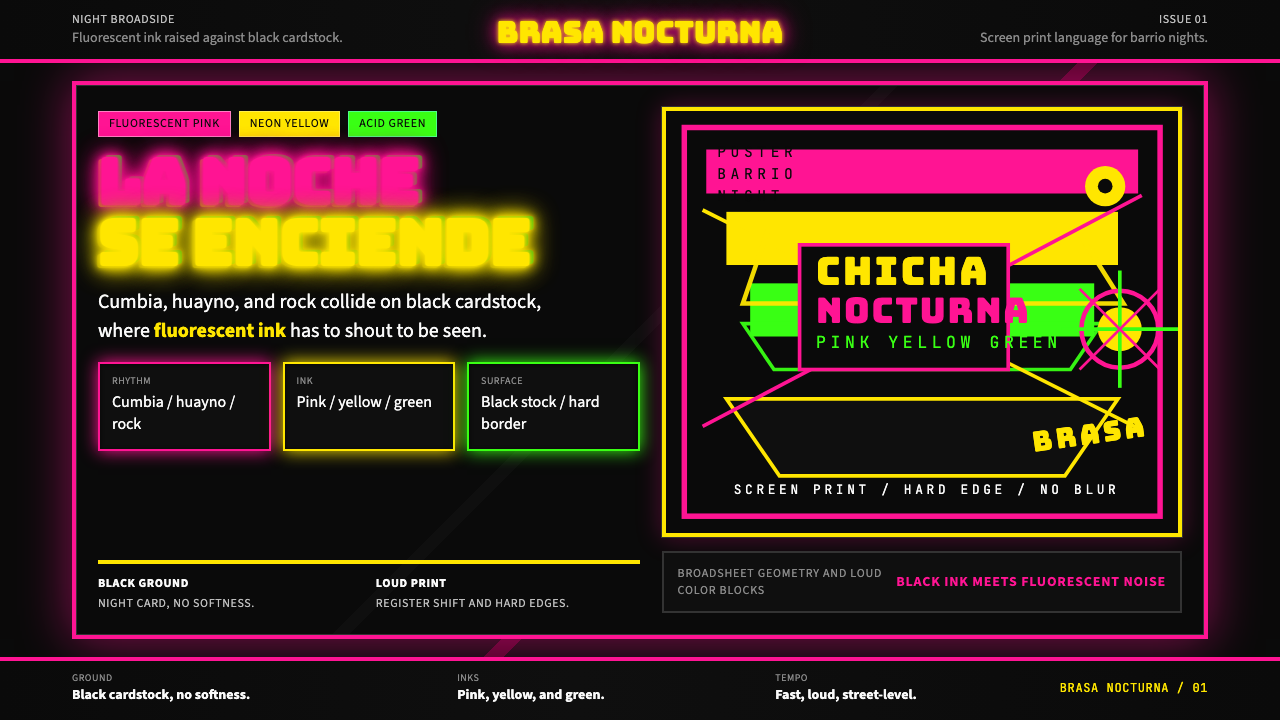
Lima's chicha poster tradition turns night-black cardstock into a fluorescent battlefield — screaming pink, acid green, and neon yellow fighting for every eye on the city street.
Peruvian Chicha Fluorescent Poster in brief
The Peruvian chicha fluorescent poster is a vernacular graphic tradition born in the working-class barrios of Lima, Peru. It is defined by maximum-saturation fluorescent inks — electric pink, acid green, neon yellow — layered directly onto night-black cardstock, with hand-painted dimensional lettering, deliberate overprint registration shifts, and a compositional logic that treats every centimeter of surface as a declaration of presence. The style takes its name from chicha, the Andean fermented drink, but more directly from chicha music — a fusion of Andean huayno melody, cumbia rhythm, and electric guitar energy that became the soundtrack of Peru's internal urban migration in the 1970s and 1980s.
Where most graphic traditions work by organizing space, the chicha poster works by saturating it. There is no negative space in the conventional sense, no breath between elements, no hierarchy built on restraint. Instead, every layer competes with every other: a title in raised three-dimensional lettering fights a starburst background fights a bordered announcement panel fights a fluorescent color field. The effect is not chaos but a kind of maximum-volume visual music — the poster equivalent of a cumbia band playing at full power in an open courtyard.
The tradition operates within a specific material and social context. Posters were printed quickly and cheaply for immediate public posting — announcing weekend concerts, dances, and festivals in districts like El Agustino, Comas, and Villa El Salvador on the outskirts of Lima. The fluorescent inks were chosen not for aesthetic sophistication but for raw visibility: these posters had to be legible at night, at distance, in competition with every other surface on a dense urban block. The design choices that now read as style were originally solutions to the problem of being seen.

Where does Peruvian Chicha Fluorescent Poster come from?
The chicha poster tradition emerged in the 1970s alongside the music it announced. Peru was undergoing one of the most dramatic urban migrations in Latin American history: millions of rural Andeans, primarily from the Sierra and the Amazon basin, moved to Lima seeking economic opportunity. By 1980, Lima's population had more than doubled within a generation. The migrants brought their music with them — huayno, the Andean modal folk tradition — and found it colliding and fusing with the Colombian cumbia rhythms circulating through Lima's coastal districts. The result was chicha music: a genuinely hybrid urban-Andean sound that belonged to neither the traditional highland nor the established coastal elite, but to the new working-class barrio.
The posters that announced chicha concerts were made by anonymous screen-printers working in small operations scattered across Lima's peripheral districts. These printers worked from hand-cut stencils and mixed their own inks, often combining standard printing colors with fluorescent pigments imported from industrial supply chains. The dimensional lettering — letters that appear raised, beveled, or extruded — was developed as a technique to make type readable from greater distances and at night, when flat lettering would be lost against a dark background. Registration shifts, where two or more ink passes are intentionally misaligned to create a shadow or halo effect, were partly a production artifact and partly a deliberate compositional choice that added visible energy to the surface.
The tradition remained largely anonymous until the 2000s, when graphic design scholarship began documenting chicha culture as a significant vernacular tradition. The decisive figure in the transition from anonymous craft to recognized art form was Elliot Tupac, a Lima-born designer who began working in the chicha poster tradition around 2006. Tupac's contribution was not to modernize or sanitize the style but to understand and amplify its internal logic — scaling the posters to monumental sizes, refining the dimensional lettering technique, and engaging international art and design institutions without abandoning the tradition's working-class roots. His collaborations with international brands and cultural institutions from the mid-2000s onward brought global attention to a tradition that had been visible on Lima's walls for three decades but largely invisible to the design establishment.
The geographic spread of the style reflects the geography of Andean migration. While Lima — and particularly its northeastern cone districts — is the tradition's center, significant poster-making cultures developed in Iquitos (the Amazonian capital, accessible only by river or air), Pucallpa (a river port city in the Ucayali region), and Trujillo (the northern coastal city with its own cumbia traditions). Each regional variant has subtle inflections: Amazonian posters tend toward even denser layering and a stronger presence of organic and zoomorphic imagery; northern coastal variants show more influence from international cumbia graphics. But the shared DNA — black ground, fluorescent primaries, dimensional type, maximum saturation — is consistent across the tradition.
What defines the Peruvian Chicha Fluorescent Poster look?
Fluorescent Color on Black
The defining chromatic move is fluorescent ink applied directly to night-black cardstock. The colors — electric pink, acid green, neon yellow, occasionally blazing orange — are not chosen to harmonize with one another but to maximize individual luminosity against the darkest possible ground. On a black surface, fluorescent pigments appear to emit their own light. The result is a color system that operates by contrast intensity rather than by hue relationships: each color is fighting the darkness, not relating to its neighbors.
Dimensional Hand-Painted Lettering
Typography in the chicha tradition is not set from a typeface but built by hand — each letterform constructed with beveled edges, cast shadows, inner highlights, and a sense of physical mass. Letters appear extruded from the surface rather than printed onto it. This three-dimensional quality was developed originally for legibility at distance and in low light, but it became the style's most distinctive graphic signature. The letterforms are thick, condensed, and tightly packed, with internal color fills that shift from one fluorescent to another within a single word.
Registration-Shift Overprinting
Multiple ink passes are printed with deliberate or semi-deliberate misalignment, creating halos, echoes, and shadow outlines around letterforms and graphic elements. Where two fluorescent colors overlap in a shift, they produce a third color — green and pink produce a warm yellow-orange; yellow and pink create an almost white flare. These overprint zones are not errors to be corrected but active compositional elements that add visual vibration and depth to what is otherwise a flat surface.
Maximum Surface Density
The chicha poster rejects negative space as a compositional tool. Every zone of the surface carries information or color or both. Backgrounds are not passive fields but active starburst patterns, radiating lines, geometric fills, or repeated motifs. Announcement panels are stacked vertically in bands. The resulting density is not the result of poor design judgment but of a specific visual philosophy: visibility requires occupation. A surface that is empty is a surface that loses.
Starburst and Radial Geometry
Among the most recognizable recurring motifs in the chicha vocabulary is the starburst or sunburst — radiating rays emanating from a central point, covering the background behind a title or filling the corners of a composition. These radial forms serve multiple functions: they direct attention toward the center, they create contrast zones that make overlaid text legible, and they carry a festive energy inherited from carnival and street-fair visual traditions. Stars, sunbursts, and geometric ray patterns appear in almost every classic chicha poster.
Festive Illustrative Borders
Rather than the clean ruled lines of European modernism, the chicha poster uses elaborate borders built from repeated geometric units, wave patterns, stepped Andean textile motifs, and star clusters. These borders delineate announcement zones and separate bands of information. They are functional as dividers but simultaneously ornamental as surface decoration, drawing on both pre-Columbian Andean textile geometry and twentieth-century commercial print convention. The border is never an afterthought — it is a designed element as intentional as the headline.
Cultural Hybridity
The visual language of the chicha poster is itself a reflection of its cultural origins — a fusion of Andean indigenous geometry, Spanish colonial baroque ornament, twentieth-century commercial print techniques, and the kinetic energy of Latin American popular festivity. No single source dominates. Pre-Columbian stepped patterns and zoomorphic motifs coexist with Catholic saint iconography and generic commercial starburst patterns. This layered hybridity is not eclectic confusion but a genuine visual record of Andean-mestizo urban identity in formation.

Who shaped Peruvian Chicha Fluorescent Poster?
Elliot Tupac is the designer most responsible for transforming the chicha poster from an anonymous street-print tradition into a recognized art form with international presence. Born and raised in Lima's peripheral districts where chicha culture was embedded in daily life, Tupac began working with the poster format around 2006. His method was amplification rather than modernization: he scaled the posters to monumental dimensions, refined the dimensional lettering into a more controlled but still fundamentally hand-crafted technique, and engaged international brands, museums, and art institutions without abandoning the tradition's working-class DNA. His collaborations have included commissions from global cultural institutions and appearances at design festivals across Europe and the Americas, introducing chicha aesthetics to audiences who had never encountered a Lima barrio.
Lorenzo Palacios Quispe, known as Chacalon, was the defining musical voice of chicha in the 1980s and the figure whose concerts generated some of the tradition's most celebrated posters. His enormous popularity in Lima's migrant communities meant that his concert announcements were posted across entire districts, creating a visual saturation that gave chicha posters their public presence. Chacalon's image — his face, his name in dimensional lettering — became one of the most reproduced elements in the tradition. His death in 1994 elevated him to near-legendary status, and his name continued to appear on memorial posters and tribute concerts for decades afterward.
Los Shapis, formed in the early 1980s, were the group that brought chicha music to its broadest urban audience and helped establish the concert poster as the tradition's primary visual medium. Their prolific touring schedule throughout Lima's districts and provincial cities meant a continuous demand for poster production, which in turn drove the development of faster, bolder printing techniques. The group's visual identity — often featuring the band members in their characteristic stage costumes against fluorescent backgrounds — helped codify the conventions that subsequent chicha poster makers would work within and against.
Pedro Tolomeo represents the generation of anonymous craftsmen whose screen-printing expertise created the visual vocabulary that Elliot Tupac and others later recognized and built upon. Working in Lima's northern cone districts from the 1970s onward, Tolomeo and practitioners like him developed the techniques of fluorescent ink mixing, dimensional lettering construction, and starburst background filling that define the tradition. Their work was functional — made fast, made cheap, made to last a weekend on a street wall — but it accumulated into a visual language of remarkable consistency and power. Tolomeo's practice illustrates how the tradition was built not by trained graphic designers but by skilled artisans solving immediate commercial problems.
How do you use Peruvian Chicha Fluorescent Poster today?
The chicha fluorescent poster style is among the most kinetic and high-energy historical traditions available to contemporary designers, but applying it successfully requires understanding why it works — not just copying what it looks like. The style is built on a set of coherent decisions: dark ground for maximum luminosity, fluorescent color for night visibility, dimensional type for distance legibility, maximum surface density for competitive visibility. When these decisions are replaced by surface mimicry, the result is decoration rather than design.
For presentation slides, the chicha system is most effective when used with genuine commitment to its energy. A cover slide benefits from treating the entire background as an active field: a starburst or radial pattern in one fluorescent color against black, with the title set in dimensional or thick-outlined lettering that sits on top. Content slides should use horizontal color bands to separate sections — a narrow fluorescent band above a text zone creates clear hierarchy without requiring complex layout. Data slides take on their most powerful form when chart elements themselves are rendered in fluorescent tones against a dark ground, with labels set in the same bold, slightly condensed letterform style as the poster tradition. The key is committing to the dark background throughout the deck rather than reverting to light slides for content.
For web interfaces, the style is best suited to event-focused pages, landing pages for music or festival brands, and any context where high-energy visual impact is a primary goal. Dashboard and data applications can use the chicha vocabulary selectively: fluorescent accent colors applied to key metrics or status indicators against a near-black background can borrow the tradition's legibility logic without overwhelming the interface. Pricing pages work well with the band-stacking logic — each tier rendered as a distinct horizontal zone with a different fluorescent accent, creating immediate visual differentiation. Navigation and controls should be set in bold, clean lettering that echoes the poster's typographic density without attempting a full dimensional treatment.
For editorial and marketing work, the style supports an entirely different register than European modernist traditions: where Bauhaus or Swiss design signal rationality and authority, chicha signals energy, popular festivity, and cultural specificity. An editorial spread using chicha vocabulary might use a full-bleed black background with a fluorescent headline in dimensional or outlined lettering, pull-quotes rendered in a contrasting fluorescent, and body text set in a clean bold weight to maintain legibility against the dark field. Marketing campaigns benefit from the tradition's poster logic: a single strong announcement with maximum visual weight, stripped of supporting information, commanding attention rather than explaining itself.
A common mistake when applying the chicha style is treating fluorescent color as merely a palette choice while retaining the compositional logic of conventional layout — light background, generous negative space, restrained type scale. The result reads as a hesitant pastiche rather than a genuine application. The tradition's power comes from the combination of dark ground, fluorescent ink, dimensional type, and maximum surface density working together. Pulling one element out of context while retaining conventional surroundings creates visual dissonance. Another frequent error is using multiple fluorescent colors at equal weight simultaneously: in the source tradition, one color tends to dominate a poster's zone or band, with others used as accent or overprint. Giving every element equal fluorescent intensity produces visual noise rather than the structured intensity of the original.

Peruvian Chicha Fluorescent Poster — FAQ
Is chicha poster style the same as lo-fi or retro aesthetics?
No, and confusing them produces work that misses the point of both. Lo-fi and retro aesthetics celebrate the degraded, the worn, and the nostalgically imperfect — they are about the passage of time and the charm of imperfection. The chicha poster is not nostalgic; it is immediate. Its fluorescent colors are chosen for maximum present-tense visibility, not for period atmosphere. Its dimensional lettering is a legibility solution, not a vintage affectation. Applying lo-fi filters, film grain, or faded tones to a chicha composition fundamentally contradicts the tradition's values: the original posters were trying to be as vivid and visible as possible, not charmingly worn.
Can the style work in a light-background context, or does it require a dark ground?
The tradition is built on the dark ground — black cardstock is not incidental but structural to how fluorescent colors function. Fluorescent pigments reach their maximum apparent luminosity against the darkest possible background; on white or cream, they become merely bright colors without the glow effect that defines the style. A light-ground version can borrow elements — dimensional lettering, band structures, starburst motifs, dense surface composition — but it loses the tradition's core visual effect. If a dark background is genuinely impossible in a given context, treat the adaptation as a structural borrowing rather than a full application of the style, and acknowledge that the result will have less of the fluorescent intensity that distinguishes chicha from other vibrant traditions.
How does chicha relate to other Latin American graphic traditions like lucha libre or Mexican lotería?
They share a family resemblance as popular commercial print traditions that developed outside the academy, in direct response to specific community needs, and were later recognized by design institutions after their vernacular functions were already established. But they are distinct in specific ways. Lucha libre graphics — Mexican wrestling promotion material — share the bold lettering and high energy but work primarily in a daylight context with different chromatic logic. Mexican lotería imagery is illustrative and symbolic rather than typographic and color-saturated. The chicha tradition is unique in its combination of Andean cultural specificity, fluorescent ink on black cardstock, dimensional type as primary element, and the direct connection to a hybrid musical form. Understanding each tradition on its own terms produces better design than treating them as interchangeable sources of 'Latin energy'.
Is there a risk of cultural appropriation when using this style outside its original Peruvian context?
The question deserves genuine engagement rather than dismissal or false reassurance. The chicha poster tradition was created by and for Peru's internal migrants — a community with a specific history of social marginalization and cultural invisibility. Using the style's surface aesthetics as mere decoration, stripped of any acknowledgment of that history, risks reducing a living cultural practice to a visual novelty. The more considered approach is to engage with the tradition's actual origins — understanding who made it, why, and for whom — and to let that understanding inform how and where you deploy it. Crediting the tradition and its key figures, using it in contexts where its energy is genuinely relevant rather than ironic or exotic, and avoiding applications that mock or trivialize its working-class roots are practical expressions of that engagement. The tradition is not closed to outside reference, but it deserves to be treated as a specific cultural practice rather than a generic visual resource.
How do I keep text legible when everything in a chicha layout is competing for attention?
Legibility in the chicha tradition is achieved through contrast management rather than through restraint. The tradition solves the legibility problem in several specific ways that contemporary applications can adopt. First, dimensional or outlined lettering creates a visible separation between the text and its background regardless of color — the shadow or outline acts as a built-in separator. Second, color zone discipline: while the poster is dense overall, individual text elements typically sit within a color field that contrasts with the surrounding zone rather than competing with it at the same saturation level. Third, the tradition uses ruled borders and decorative frames to delineate text zones, giving the eye a clear boundary to follow. Applying these techniques — outline or drop-shadow on key text, local color field contrast, and framed zones for critical information — allows a dense chicha-style composition to maintain readable hierarchy without reducing its overall intensity.
Related design styles
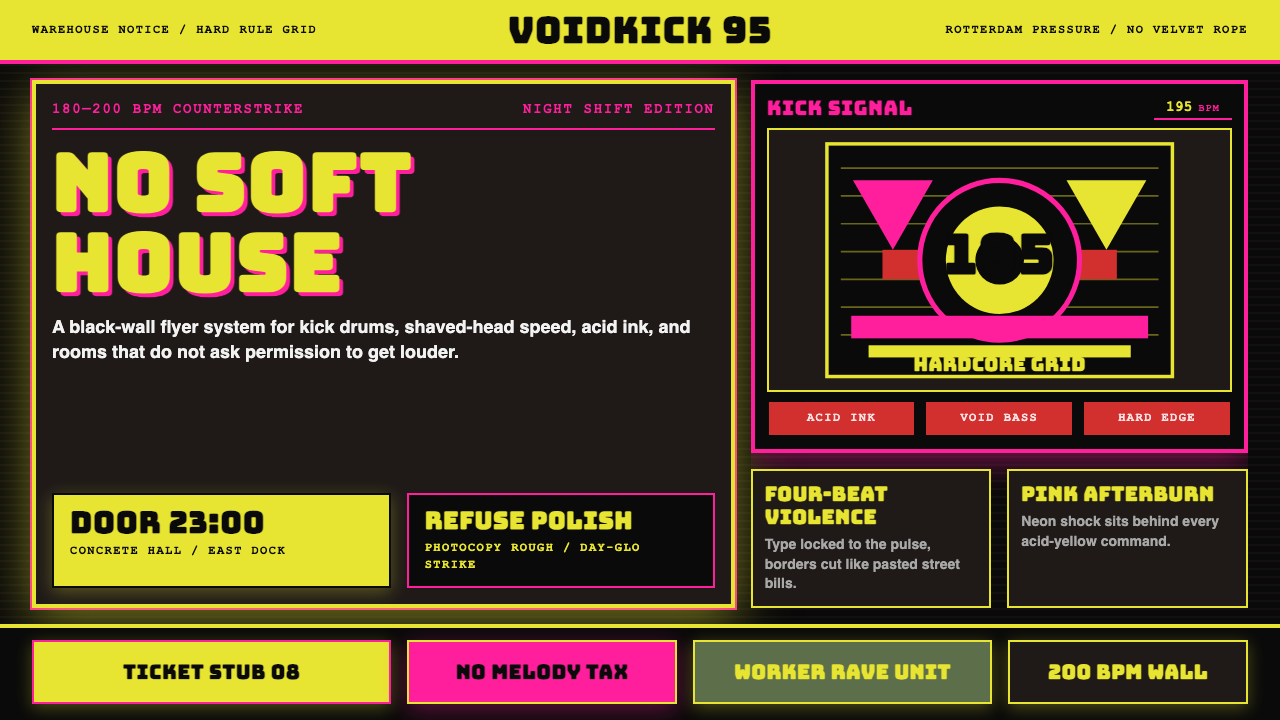 Rotterdam Gabber HardcoreHardcore refuses polish. Acid yellow, neon pink, black grid, and brutal Bunge…
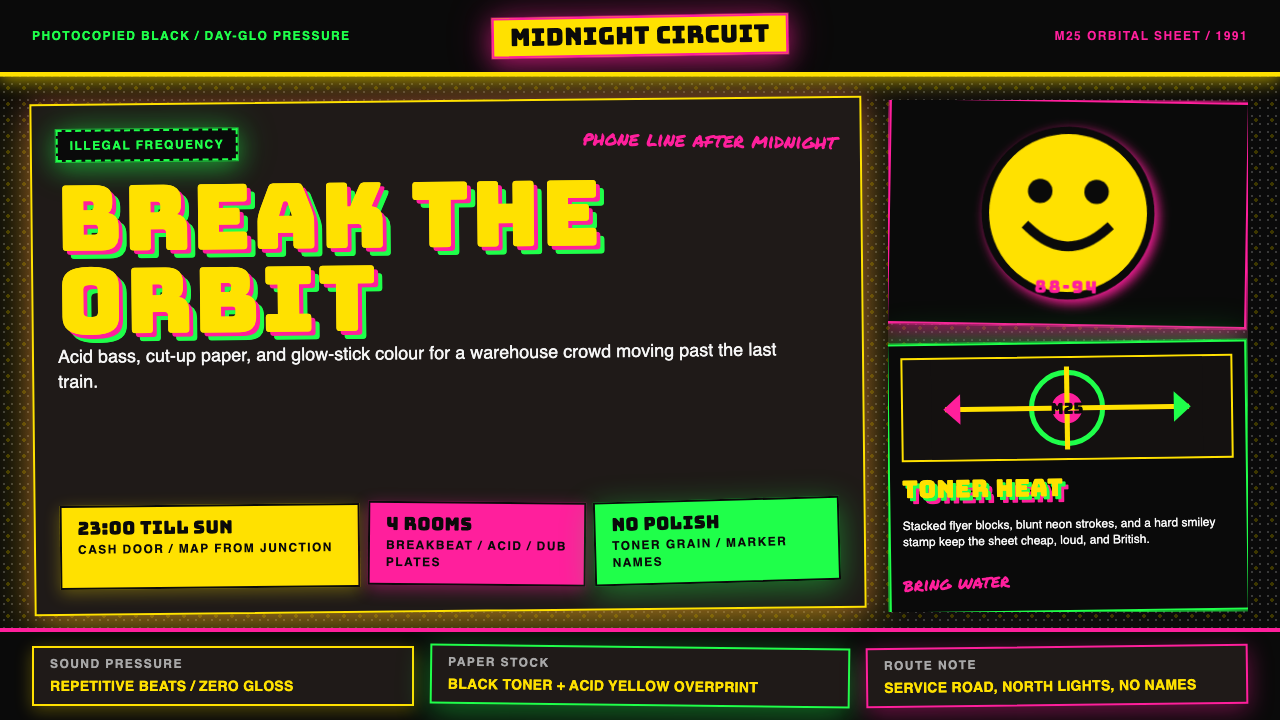 UK Rave Glow-Stick FlyerIllicit euphoria. Acid yellow, rave pink, and laser green slam into photocopi…
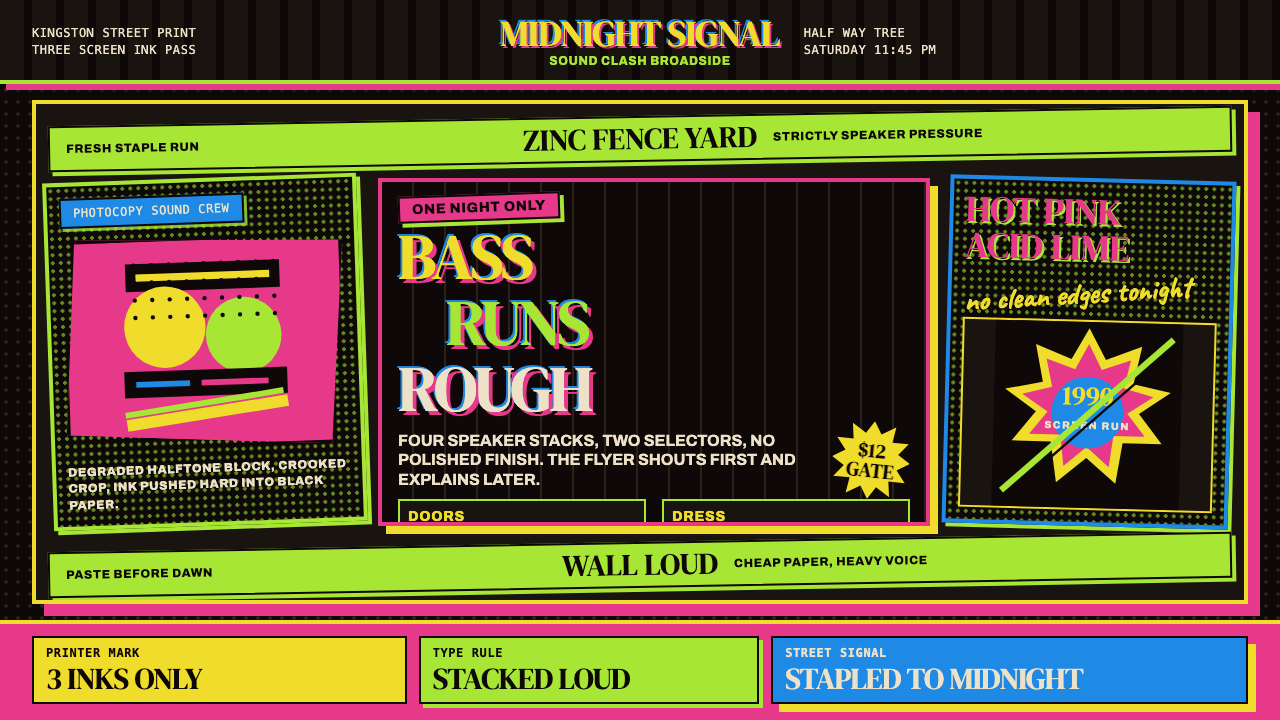 Jamaican Dancehall 1990 PosterMidnight volume. Acid lime and hot pink type stack like screenprint ink on bl…
 Nirvana — NevermindAnti-pop in pool blue. Cream cards, dollar-gold accents, and marker type roug…
 90s Aggressive Inline SkateX-Games attitude in plastic and paint. Fluoro lime and magenta slash across m…
 Bowie — Ziggy StardustTheater at full voltage. Cream-on-black portrait cut by one red and electric-…