What is Nirvana — Nevermind?
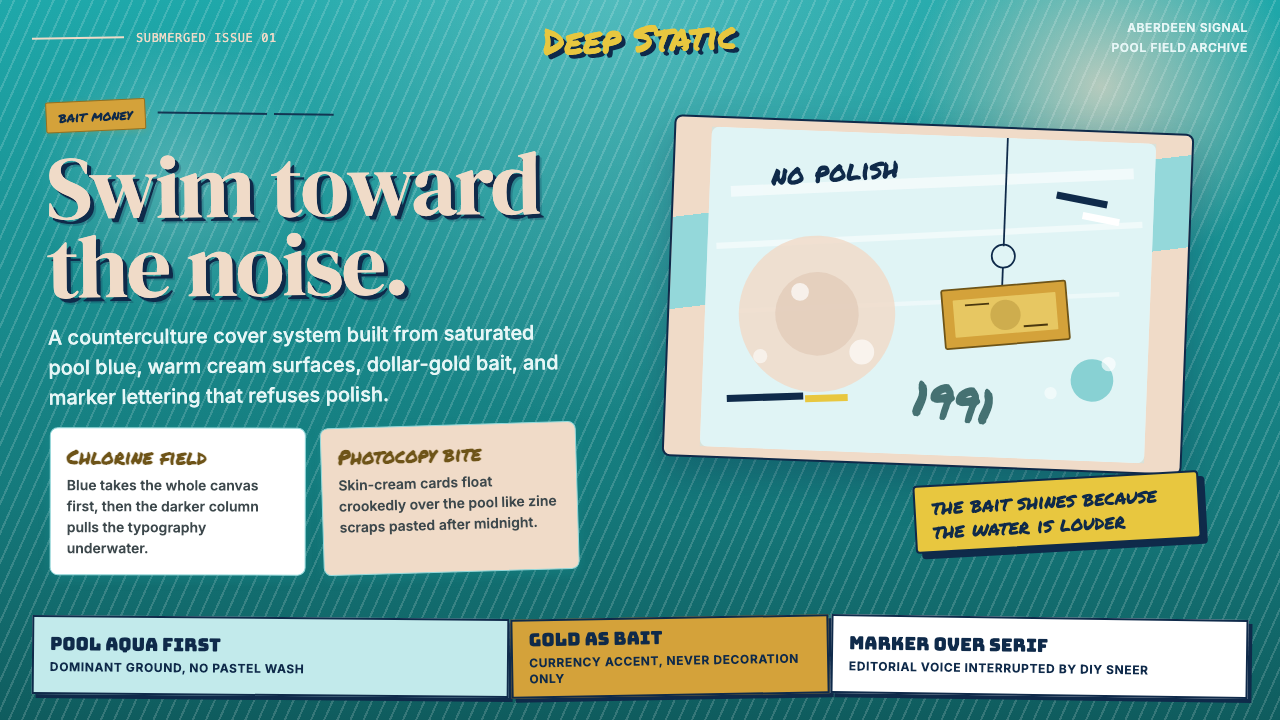
A chlorinated pool, a dollar on a fishhook, and a baby that made grunge the sound — and the look — of a generation.
Nirvana — Nevermind in brief
Nirvana — Nevermind is a design system derived from one of the most recognized album covers in recorded music history: the 1991 art-directed photograph of an underwater infant reaching toward a dollar bill suspended on a fishhook. The visual system extracts the exact contrast that made that image iconic — saturated aqua water, warm cream skin, gold-dollar accent, and renegade hand-lettered type — and translates it into a coherent set of design decisions for contemporary use.
The palette carries the emotional weight of the original: pool-aqua blue as the dominant ground, cream as warmth and counterbalance, dollar-gold as a charged accent that implies both desire and irony, and rough marker-style letterforms that push back against the polished conventions of mainstream commercial design. This is not a nostalgia project. The tension encoded in that original image — innocence reaching for money, purity in an artificial pool — still reads with full force as a visual statement about ambition, co-optation, and counterculture.
As a design system, Nirvana — Nevermind works best where a brand needs to signal independence, rawness, or a deliberately unpolished authenticity. It is grunge in the original sense: texturally honest, anti-decorative, and visually loud in the way that a guitar amp at full distortion is loud — not chaotic, but intentionally saturated.

Where does Nirvana — Nevermind come from?
Nirvana formed in Aberdeen, Washington, in 1987, when Kurt Cobain and Krist Novoselic began playing together in the Pacific Northwest's interconnected network of basement shows and independent venues. Their debut album, Bleach, was released in 1989 on Sub Pop Records for a recording budget of approximately six hundred dollars. The aesthetic of that era — photocopied flyers, hand-lettered show posters, grainy black-and-white photography — was born of necessity, but it codified an entire visual language for the underground music scene that would persist long after necessity ceased to be a constraint.
When DGC Records signed Nirvana and released Nevermind in September 1991, the album's cover image was conceived by Cobain, who wanted a water-birth photograph and then refined the concept to include the dollar-bill lure. Photographer Kirk Weddle shot the underwater sequence at a public pool in Pasadena, California, using a four-month-old infant named Spencer Elden. Art director Robert Fisher at DGC assembled the final composition: the near-fluorescent aqua of the chlorinated water, the warmth of Spencer's skin against the cool blue, and the gold dollar bill as the sole focused object in the frame's foreground. The baby reaches; the hook is hidden. The metaphor was impossible to miss.
The album sold over thirty million copies worldwide, making it one of the best-selling records ever released. More relevantly for design history, it forced the visual language of the Pacific Northwest underground into global mass circulation. The photocopied grunge aesthetic that had lived on show posters and zine covers was suddenly on billboards and MTV. The collision of counterculture rawness with massive commercial scale created a productive friction: the style was legible at both intimate and monumental scales, and it retained its anti-establishment charge even when deployed by a major label.
The cultural context of the early 1990s was central to the system's staying power. The preceding decade had been dominated by the slick, high-production aesthetics of arena rock and top-forty pop — chrome gradients, neon glows, airbrushed surfaces. Grunge was the deliberate refusal of all of that. The aqua, cream, and gold of the Nevermind cover were not aspirationally luxurious — they were the accidental colors of a public swimming pool and a piece of printed currency, recombined into something that managed to be both deadpan and visually arresting. That quality — accidental richness — remains the system's defining characteristic.
What defines the Nirvana — Nevermind look?
Color: Aqua, Cream, and Gold
The palette is derived directly from the Nevermind photograph: the saturated blue-green of chlorinated pool water as the dominant field, a warm cream standing in for human skin tone and providing visual warmth against the cool aqua, and a muted dollar-gold used sparingly as accent. The three colors exist in a precise hierarchy — aqua grounds everything, cream provides breathing room and warmth, gold punctuates and implies value. No fourth color is needed. The combination reads as simultaneously clinical and vital, artificial and organic, which mirrors the original image's own ambiguity.
Typography: Grunge Hand-Lettering
The typographic voice of this system is the rough marker letterform — irregular stroke weight, uneven baseline, the deliberate imprecision of something scrawled rather than set. This does not mean illegibility; grunge type is always readable, but it refuses the smoothness of mechanical typesetting. Headlines carry this texture loudly, while body text can step back to a cleaner, more neutral sans-serif to manage reading comfort at length. The contrast between the rough display type and a clean secondary face creates the same productive friction that the album cover itself embodies.
Composition: The Unpolished Grid
Layout in this system acknowledges the grid but does not obey it rigidly. Elements are allowed to break margins, captions can sit at angles, and white space is distributed unevenly to create tension rather than balance. This is not chaos — the underlying structure is always present — but the grid is treated as a substrate to push against rather than a cage to inhabit. The visual effect echoes the DIY show poster: organized enough to communicate clearly, raw enough to signal that the designer chose rawness deliberately.
Texture and Grain
Smooth vector cleanliness is refused in favor of deliberate texture. Backgrounds carry a subtle grain, as though printed on newsprint or photocopied one generation too many. Image treatments lean toward high-contrast and slightly washed-out rather than crisp and saturated. This textural quality is what separates authentic grunge-derived design from aqua-and-cream layouts that are merely retro in color but smooth in execution. The grain is the signal: it says the thing was made, not generated.
Irony as Visual Principle
The original image is built on irony: a baby in a pristine pool, money on a hook, innocence as bait. The design system inherits this structure. Gold is used not to signal luxury but to signal the lure of luxury — a knowing wink rather than an aspiration. Scale juxtapositions can be deliberately uncomfortable. The system rewards designers who understand that the style's power comes from what it refuses to smooth over, not from how pretty it looks when cleaned up.
Photography: Underwater and Against the Grain
When photography is used in this system, it carries the visual DNA of Kirk Weddle's original: high-contrast, slightly dreamlike, shot from an unusual angle or with an unusual subject relationship. Underwater or submerged aesthetics translate naturally. Above water, the preferred treatment is high-contrast black-and-white or a strongly color-graded single hue, avoiding the neutral editorial look. Photography should feel like evidence of something real rather than a styled production shot.
Scale Contrast and Visual Loudness
Nirvana — Nevermind is not a quiet system. Type is set at dramatic scale contrasts — a headline might be several times larger than supporting text not to signal hierarchy alone but to create a visual shout. Negative space is used selectively, concentrated in some areas and nearly absent in others, creating pressure and release. This visual loudness is disciplined, not undisciplined: it comes from deliberate decisions about where to push and where to hold back, mirroring the dynamic range of the music itself.

Who shaped Nirvana — Nevermind?
Cobain was the creative director of his own band's visual identity as much as its songwriter and frontman. He conceived the Nevermind cover concept, insisting on the dollar-bill lure over label resistance, and oversaw the visual tone of the band's promotional materials throughout their career. His aesthetic instincts — authentic material over polished presentation, confrontational imagery over aspirational flattery — define the entire design philosophy the system inherits. His 1991 Vanity Fair interview quote, 'We're so mainstream now it's sickening,' captures the productive tension between counterculture authenticity and commercial reach that underpins the visual system.
Fisher was the art director at DGC Records who assembled the final Nevermind cover composition. Working with Cobain's concept and Weddle's photographs, Fisher made the key decisions about framing, the relationship between the baby and the dollar bill, and the typographic treatment of the band and album names. His choices — particularly the decision to let the aqua field dominate overwhelmingly with the figure relatively small and centered — created the cover's sense of scale and environmental immersion that distinguishes it from a simple portrait. Fisher's work on Nevermind stands as one of the most influential single design decisions in recorded music history.
Weddle was the underwater photographer who shot the infant sequences for the Nevermind cover. His technical achievement — capturing a four-month-old infant underwater in conditions that required precise lighting and rapid shooting — was as much an act of documentary instinct as commercial photography. The particular quality of his image, the way the chlorinated water creates a color field that is simultaneously beautiful and slightly uncanny, is the direct source of the system's dominant hue. Weddle's work belongs to a tradition of underwater photography that treats the submerged state as a metaphor for altered consciousness, vulnerability, and the boundary between breath and drowning.
Grohl joined Nirvana in 1990 as drummer, completing the trio that recorded Nevermind. Beyond his musical contribution, Grohl represents the collaborative and relatively democratic creative culture within the band — the sense that the visual and sonic identity of Nirvana was a collective output rather than a solo auteur project. After Cobain's death in 1994, Grohl went on to found Foo Fighters, carrying grunge's visual DNA into subsequent decades and demonstrating how the raw-but-structured aesthetic could adapt across changing mainstream contexts while retaining its essential character.
Sub Pop, the Seattle independent label that released Nirvana's debut, was as responsible for the visual language of Pacific Northwest grunge as the bands it signed. The label's house aesthetic — deliberately lo-fi photography, photocopied promotional materials, hand-lettered or rough-set type, a consistent brown-and-cream-and-black palette in early releases — established the vocabulary that Nevermind then translated into mainstream visibility. Sub Pop co-founders Bruce Pavitt and Jonathan Poneman understood that the visual aesthetic was inseparable from the musical and subcultural identity they were building, and their art direction choices became the foundation of an entire regional design vernacular.
How do you use Nirvana — Nevermind today?
Nirvana — Nevermind works best in contexts where a brand needs to signal counterculture credibility, independent spirit, or a deliberately anti-corporate identity. Music platforms, independent record labels, documentary streaming services, arts and culture publications, streetwear and alternative fashion, and any product targeting audiences who value authenticity over polish are natural homes for this system. The key is that the rawness must be intentional and controlled — grunge deployed carelessly reads as neglect rather than attitude.
For presentation slides, the system's cover page should lead with the dominant aqua field, with the title set in rough display type at a scale that commands attention. The cover benefits from a single strong image — preferably photographic, high-contrast, shot from an unusual angle — positioned so that it creates tension with the type rather than sitting politely beside it. Content slides should use the cream field as the primary background, reserving the aqua for section dividers or key callout blocks. Data slides work well in this system when charts are treated as graphic objects: bars and areas rendered in the primary palette without gradients or rounded corners, with annotation set in a contrasting weight that reads as handwritten rather than mechanically placed.
For web interfaces, the system is well-suited to artist portfolios, music and culture dashboards, editorial platforms, and pricing pages where an alternative or indie brand positioning is the goal. A dashboard built in this system uses the aqua as the primary brand color in the navigation and key metric displays, cream as the card and panel background, and the rough typographic treatment for section headers. Interactive states and calls to action use the gold accent. The overall effect should feel like a fanzine designed by someone who also knows grid systems — not accidental roughness, but roughness as intention.
For editorial and marketing work, the system supports long-form layouts where the texture adds reading interest rather than friction. A Nirvana — Nevermind editorial page uses wide margins for marginalia and pull quotes set at angles, with section breaks marked by a thick horizontal rule or a raw ink-texture element rather than a clean line. Marketing materials — event posters, social cards, campaign headers — should lean into the poster heritage of the style: full-bleed aqua or cream backgrounds, type at confrontational scale, gold used as a single flash of accent rather than distributed decoration. The style's poster-DNA means it scales from phone screen to billboard without losing coherence.
The most common mistake when applying this system is confusing distressed aesthetics with lack of craft. Authentic grunge-derived design is always controlled: the roughness is a decision, the grain is applied at a specific density, the type choice is deliberate even when it looks impulsive. A second common error is using the aqua-cream-gold palette on a layout that is otherwise pristine and smooth — the color alone does not make the system. If the grid is tight, the type is clean, and the surfaces are smooth, the palette will read as an aqua-tinted corporate deck rather than as Nevermind. The texture, the type treatment, and the composition must all carry the same DNA for the system to cohere.

Nirvana — Nevermind — FAQ
Is this style appropriate for corporate or enterprise clients?
It depends entirely on what the enterprise client wants to signal. A conventional financial services firm or healthcare provider will find the raw, anti-polish quality of this system at odds with their need to project stability and trustworthiness — the grain and grunge type will undermine rather than support their brand values. However, a tech company positioning itself as a challenger brand, a streaming service targeting independent creators, or an enterprise client in the music or entertainment industry can use the system effectively. The question to ask is not 'is the client big or small?' but 'does the client want to be perceived as part of the establishment or as pushing against it?'
How do you use the gold accent without it reading as luxury or premium branding?
The key is context and quantity. In the Nevermind cover, the dollar bill's gold is not aspirationally luxurious — it is the bait on a hook, and the image makes that function clear. In a design system, you maintain that ironic distance by using gold sparingly, pairing it with rough type and textured surfaces rather than with smooth gradients and clean geometry, and ensuring it appears in contexts that reference value ironically rather than earnestly. A gold highlight on a price point in a rough-textured card reads very differently from the same gold on a glossy, precision-set pricing table. The roughness of the surrounding system contains the gold's associations.
Can this system work in a light mode / dark mode toggle?
Yes, with care. The light mode is the canonical form: aqua ground, cream panels, dark type. A dark inversion replaces the aqua with a very deep teal or near-black with a blue-green cast, uses cream type against it, and keeps the gold accent. What must be preserved in both modes is the textural quality — the grain, the rough type treatment, the uneven composition. A dark mode that is smooth and glossy will abandon the system's identity entirely. The safest approach is to design the light mode first, then derive the dark mode by shifting the ground to dark and the type to cream, rather than adding dark mode as an afterthought.
How does this system relate to other 1990s aesthetic revivals like Y2K or vaporwave?
They share a decade of origin but very different cultural DNA. Y2K aesthetics celebrate the optimistic techno-utopianism of late-1990s digital culture — chrome surfaces, lens flares, the sheen of a future that was supposed to arrive at midnight on January 1, 2000. Vaporwave is an ironic hypercommodification of early-internet and mall-culture aesthetics, bathed in pastel purples and pinks. Nirvana — Nevermind belongs to neither of these. It is pre-digital in feeling, rooted in analog print culture, and hostile to the optimism that both Y2K and vaporwave — even ironically — celebrate. The shared 1990s time frame is misleading; the visual values are nearly opposite.
What kinds of brands or products should avoid this system?
Any context requiring warmth, accessibility, and organic softness should avoid this system: children's products, wellness and mental health applications, food and beverage brands emphasizing naturalness, financial products targeting risk-averse consumers, and healthcare services. The system's deliberate loudness and confrontational quality, combined with the ironic edge of its color relationships, can read as aggressive or alienating in these contexts. Similarly, brands that require the perception of precision and premium craft — luxury goods, high-end real estate, precision engineering — will find that the grain and rough typography undermine the quality signals they need. The test is simple: if the brand's core promise is comfort, safety, or luxury, this is not the right system.
Related design styles
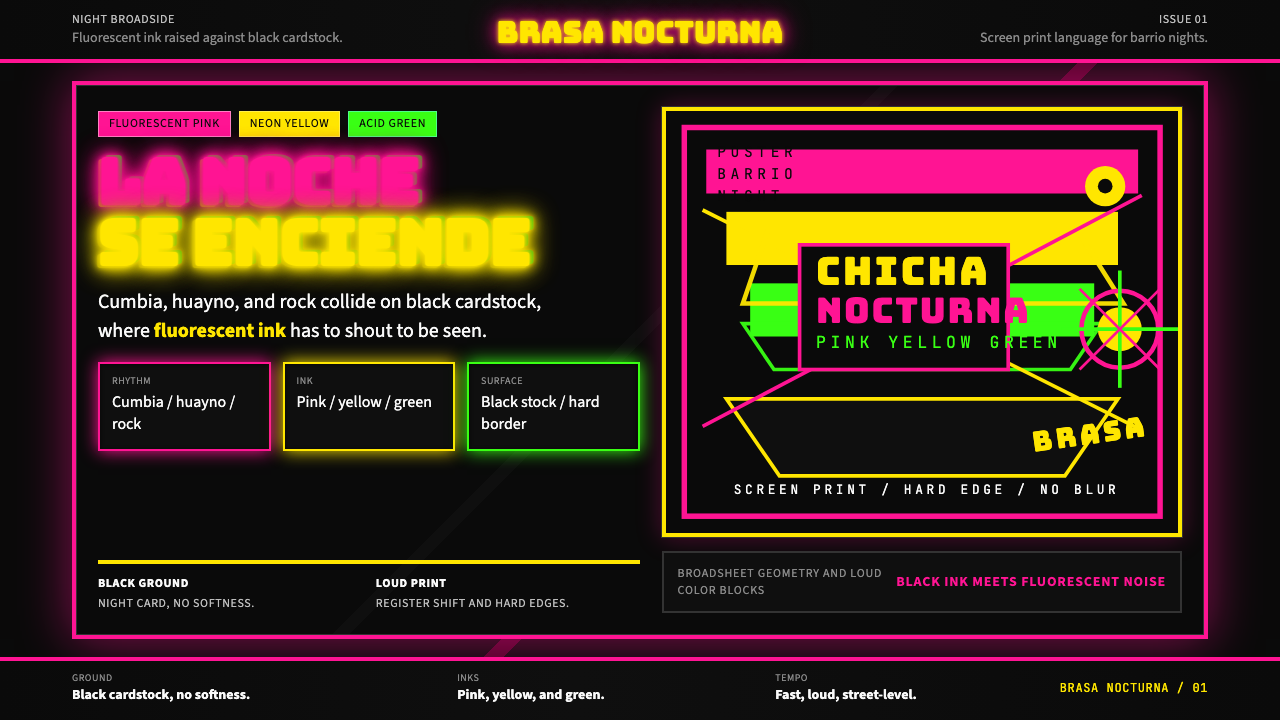 Peruvian Chicha Fluorescent PosterStreet-night fury. Pink, yellow, and green stack on black cardstock in hard b…
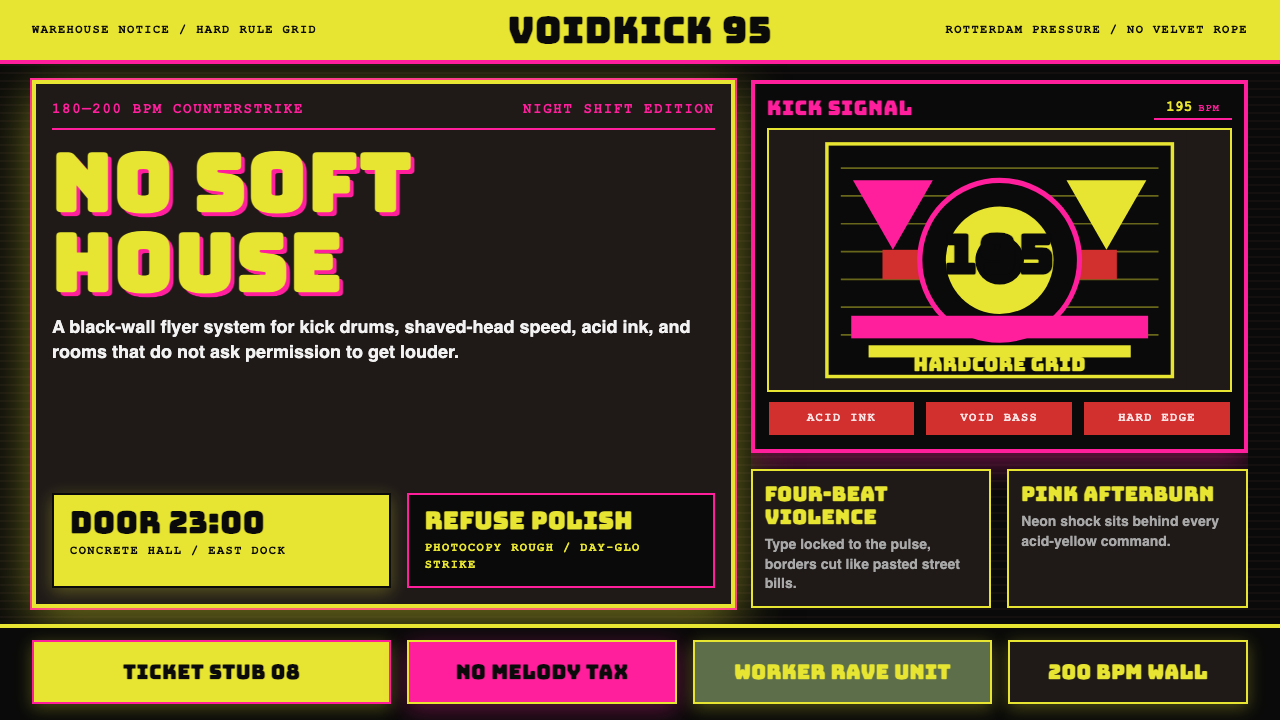 Rotterdam Gabber HardcoreHardcore refuses polish. Acid yellow, neon pink, black grid, and brutal Bunge…
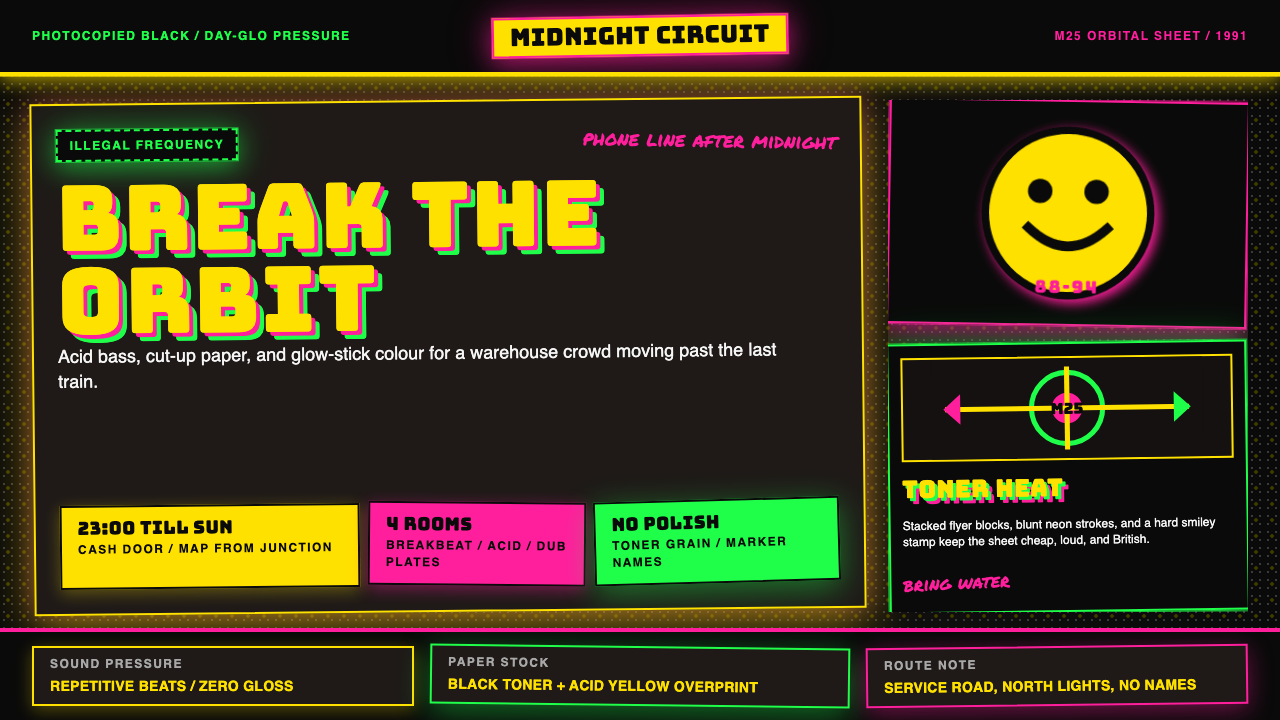 UK Rave Glow-Stick FlyerIllicit euphoria. Acid yellow, rave pink, and laser green slam into photocopi…
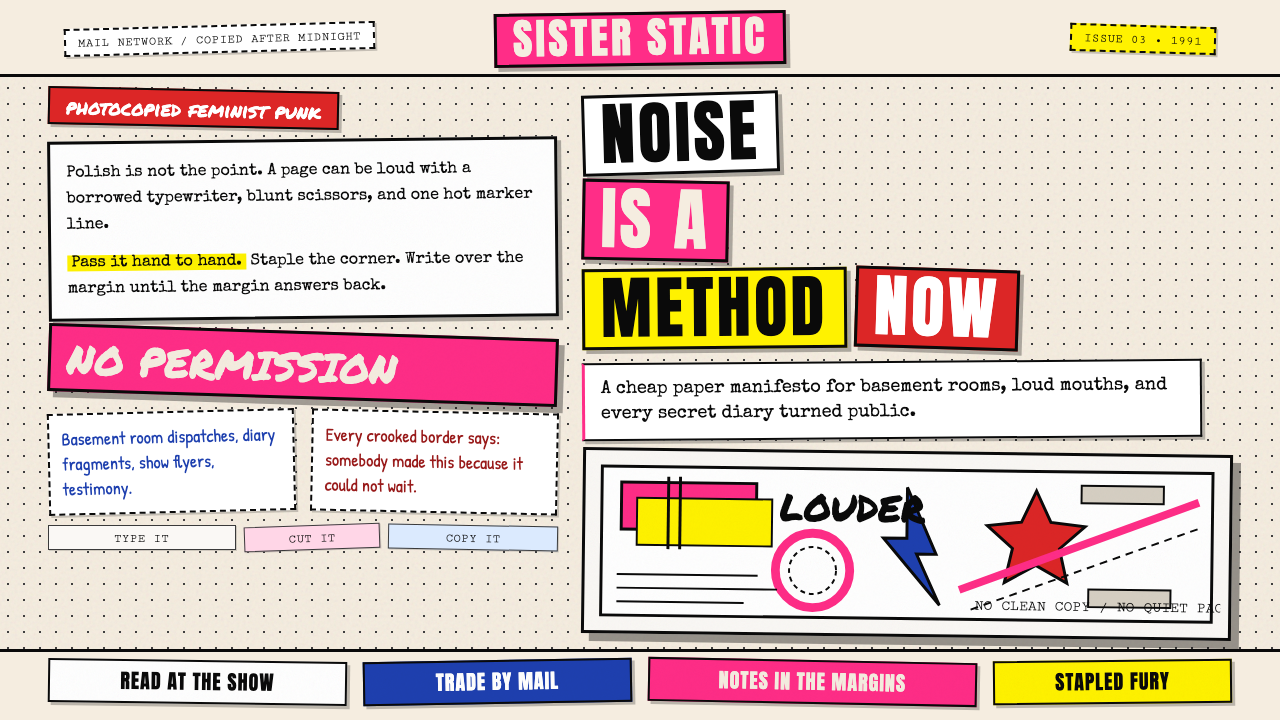 Riot Grrrl Zine (1991)DIY fury, unpolished. Cream Xerox grain, black toner type, hot-pink marker co…
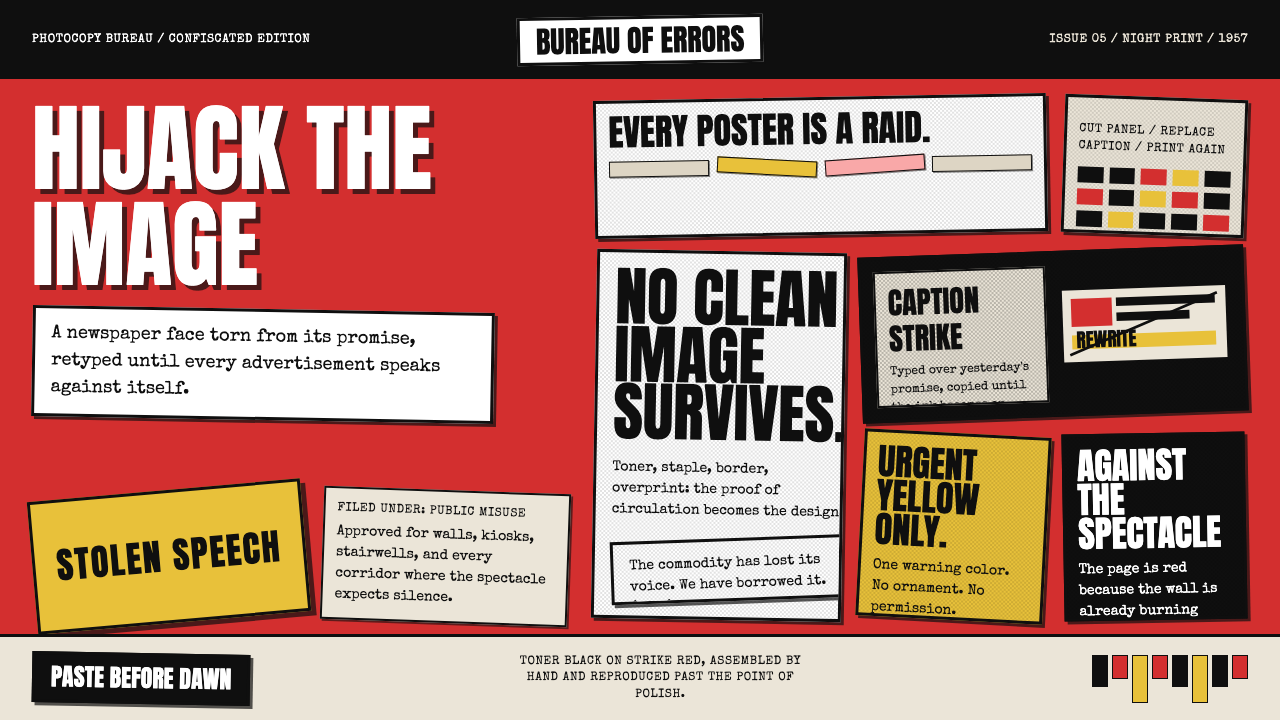 Situationist Détournement (1957)Contraband urgency. Strike red, toner black, and jagged comic panels make the…
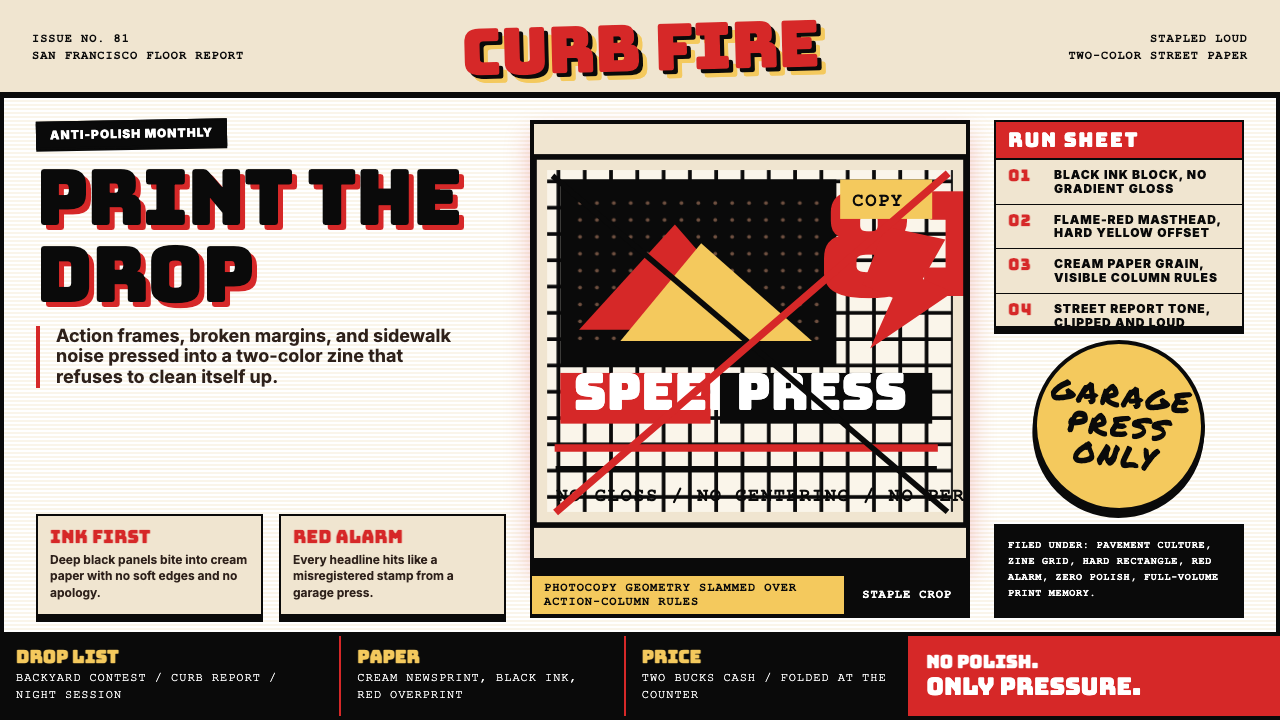 Thrasher Skate Zine (1981)Loud without polish. Flame red type, black ink blocks, and cream zine grids h…