What is Thrasher Skate Zine (1981)?
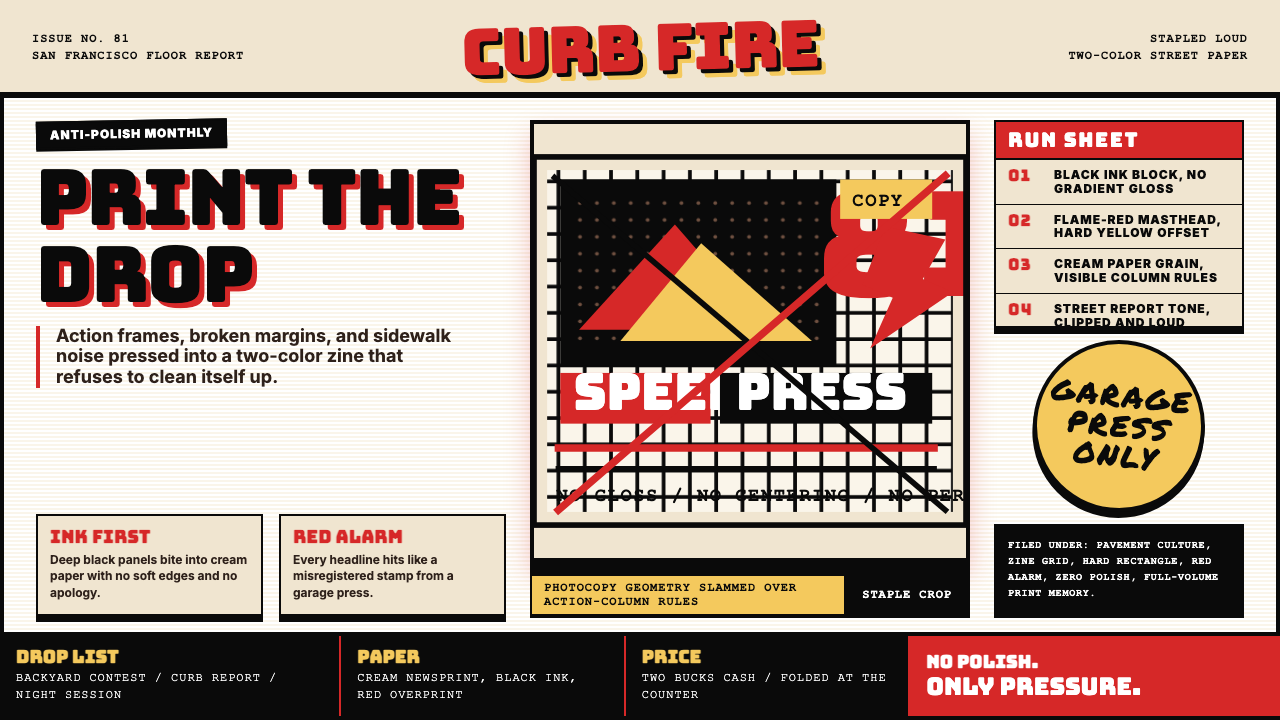
Thrasher took skateboarding's raw energy and printed it — flame-red type on newsprint, black ink slammed hard, zero apology.
Thrasher Skate Zine (1981) in brief
Thrasher Skate Zine is the visual language that emerged from the 1981 San Francisco skateboarding magazine of the same name: a combustible mix of DIY zine production values, street-photography brutalism, and the populist anti-establishment energy of the skateboarding counterculture. Its defining marks are a flame-red wordmark, dense black ink, cream newsprint grounds, chunky display type, and hard-edged rectangular layouts that look assembled rather than designed.
The style is emphatically non-precious. Images bleed to the edge or get cropped without ceremony. White space is not cultivated as breathing room but surrendered under the pressure of content — more photos, more headlines, more coverage. Where Bauhaus used restraint as a philosophical commitment, Thrasher uses density as a badge of authenticity: if it looks overloaded, it looks real.
Over four decades the aesthetic has migrated far beyond its origins. The Thrasher flame logo, unchanged in its essential aggression, has appeared on high-fashion runways and luxury collaborations — but the underlying visual code retains its street credibility precisely because it refuses polish. Designers now apply the Thrasher-zine grammar to streetwear lookbooks, brand campaigns, event posters, and digital interfaces wherever anti-corporate rawness is the intended signal.

Where does Thrasher Skate Zine (1981) come from?
Thrasher Magazine was founded in January 1981 by Eric Swenson and Kevin Thatcher in San Francisco, initially as a free publication distributed through skate shops in Northern California. The city and the moment were formative: San Francisco's Mission District and the wider Bay Area had a thriving skate scene whose participants were largely working-class teenagers with no mainstream cultural representation and no budget for glossy production. The magazine's visual rough edges were not a stylistic choice so much as an economic fact — newsprint was cheap, offset lithography was available, and the fire-engine red that became the publication's signature was one of the most economical ways to add a second ink color to a black-and-white print run.
The 1980s skateboard counterculture that shaped Thrasher's aesthetic was deliberately antagonistic toward mainstream design and media. Where surfing had found its way into corporate advertising and mainstream sportswear by the late 1970s, skateboarding in the early 1980s was legally marginalized — municipalities banned skating from public spaces, schools expelled skaters — and the culture responded by building its own parallel infrastructure: DIY ramps, self-organized contests, and self-published media. Thrasher was the most prominent node in that network, and its visual defiance — loud, unrefined, unashamed — was a direct expression of the subculture's relationship to institutions that had excluded it.
Jake Phelps, who joined the magazine in the mid-1980s and served as editor-in-chief for nearly three decades until his death in 2019, became the most important steward of the aesthetic's integrity. Phelps was famously resistant to mainstream co-optation, famously abrasive in his editorial voice, and deeply committed to the idea that Thrasher's visual language should remain inseparable from actual skateboarding — not fashion, not art, not lifestyle marketing. Under his tenure the design stayed confrontational: heavy photo crops, aggressive type sizing, and a consistent refusal to adopt the cleaner production values that were becoming standard in music or sports publishing.
The 2010s brought what critics described as the canonization of skater-streetwear: Supreme, Palace, and similar brands began citing Thrasher's visual grammar explicitly, and the magazine itself entered collaborations with luxury houses. This crossover is now a familiar cultural pattern — subcultural aesthetics absorbed and commodified by the mainstream — but Thrasher's case is notable because the source material itself remained in print and on newsstands throughout, never softening its presentation to accommodate new audiences. The tension between the style's underground origins and its current cultural ubiquity is now part of its meaning, and designers who invoke it are borrowing that tension along with the flame-red palette.
What defines the Thrasher Skate Zine (1981) look?
Color
The palette is anchored by a single aggressive primary: a flame red that functions more as a shout than an accent. Against cream newsprint or stark white, the red claims maximum attention — wordmarks, masthead elements, pull quotes, and section tags all reach for it. Black takes the structural load: ink blocks, photo backgrounds, and display type in the heaviest available weight. The cream of the newsprint ground is not a chosen color but an inherited one, and its warmth keeps the red-and-black combination from reading as purely alarming. Secondary colors and tints are rare and, when present, are photographic rather than decorative — the colors of a skater's gear or a California sunset bleeding through a photograph.
Typography
Type in the Thrasher system is blunt and hierarchical. Display headlines are set at the maximum size the page can absorb — thick strokes, compressed or condensed proportions, no letterspacing that might soften the impact. Body text is set small and tight, a foil to the headline's aggression that also communicates volume: a lot of coverage packed into limited space. Italics appear frequently in captions and pull quotes, adding a raw momentum to the text. The overall impression is that type has been applied with force rather than placed with care — which is the intention.
Photography and Image Treatment
Photography is the soul of the Thrasher aesthetic. Skate photography demands extreme angles — fisheye lenses inches from the ground, overhead shots of aerial tricks, long-lens compressions of urban terrain — and the magazine embraced these perspectives as compositional assets rather than technical footnotes. Images are cropped aggressively: limbs cut off, backgrounds obliterated, the moment of peak action isolated without margin. Halftone dot patterns and high-contrast reproduction are valued over smooth gradation; an overexposed sky or crushed shadow is a mark of authenticity, not a production error.
Layout and Grid
Thrasher layouts operate on an implied grid that is systematically overridden. The underlying structure is a standard magazine column system, but images are allowed to bleed across columns, captions are dropped into unexpected corners, and headlines break across the gutter without apology. The result reads as organized chaos: there is enough underlying structure to prevent true illegibility, but enough willful disruption to communicate that the designer — and the skateboarding culture it represents — answers to no external authority about what a magazine page should look like.
Texture and Print Grain
The newsprint substrate is not a neutral background — it is an active textural element. Ink spreads slightly on newsprint, softening hard edges in a way that coated paper would not permit, and the visible paper grain gives even solid black areas a depth that digital reproduction must deliberately approximate. Reproduction artifacts — slight misregistrations, visible halftone rosettes, occasional ink bleed — are not cleaned up in the Thrasher aesthetic; they are preserved as evidence of the physical production process and by extension of the culture's handmade, non-corporate character.
Anti-Polish as Principle
The Thrasher aesthetic contains a self-regulating mechanism against refinement. Any element that begins to look too considered, too finished, or too aligned with mainstream graphic design standards reads as inauthentic within the system. This is not accidental roughness but a deliberate cultural position: polish is associated with corporate production, corporate production is associated with the institutional world that skateboarding defined itself against, and therefore polish undermines the message. Contemporary designers must understand this principle to apply the style without neutralizing it.
Wordmark and Brand Mark
The Thrasher wordmark — heavy, all-caps, set in red with a baseline that often carries a flame motif — functions as a territorial declaration rather than a corporate identifier. It is large when it appears, frequently bled to an edge or corner, and treated as a compositional anchor rather than a mere label. The flame element, whether rendered as literal fire illustration or implied through the red color and aggressive letterform weight, has become one of the most recognized subcultural symbols of the late twentieth and early twenty-first centuries — legible at a distance, legible at small scale, legible across cultures.

Who shaped Thrasher Skate Zine (1981)?
Swenson co-founded Thrasher in 1981 alongside Kevin Thatcher, providing the organizational and publishing infrastructure that allowed the magazine to survive its early years as a free distribution zine and grow into an internationally recognized title. His decision to anchor the publication to genuine skate-community values — rather than adapting to mainstream advertising demands — established the editorial and visual independence that remains the magazine's defining characteristic.
Thatcher was the editorial co-founder and early editor whose sensibility shaped the magazine's voice in its foundational years. His background in and commitment to the skating community gave the publication its insider authority — the sense that it was written and designed by people who actually skated, for people who actually skated — a quality that distinguished it from later, more polished skateboarding media that entered the market as the sport gained mainstream visibility.
Phelps joined Thrasher in the mid-1980s and served as editor-in-chief from 1993 until his death in 2019. More than any other individual, he is responsible for the aesthetic's integrity across the decades of pressure from mainstream co-optation. Phelps rejected sponsorship arrangements and collaborations he deemed inauthentic, maintained the magazine's confrontational editorial voice, and kept the visual language raw even as production technology advanced and competitors adopted cleaner digital design standards. His presence ensured that the Thrasher aesthetic remained a live cultural position rather than a nostalgic pose.
Friedman was among the most influential photographers to shoot for Thrasher in its early years, working in the late 1970s and 1980s. His images established many of the compositional conventions that define the aesthetic: low-angle perspectives that foreground the board and the terrain, high-contrast printing that strips away middle tones, and a documentary honesty that refused to glamorize the subject. Friedman later applied similar visual principles to his landmark documentation of early hip-hop and punk, demonstrating the aesthetic's cross-subcultural legibility.
Gonzales, a professional skateboarder who rose to prominence through Thrasher's coverage in the mid-1980s, contributed to the magazine's visual language not as a designer but as a subject whose street skating style embodied the aesthetic's values. His skating — improvisational, urban, resistant to the choreography of the contest format — translated directly into the kind of photography the magazine prized. Gonzales later pursued painting and illustration, and the rawness of his visual art extended Thrasher's visual values into fine-art and fashion contexts.
How do you use Thrasher Skate Zine (1981) today?
The Thrasher Skate Zine aesthetic is most effective when the brief explicitly calls for anti-establishment credibility, subcultural authenticity, or aggressive visual energy. It is a style with a strong point of view — applying it correctly means committing to its roughness rather than refining it toward comfort. The first question to ask is whether the product or brand genuinely earns the posture: the style reads as authentic when the context is genuinely connected to street culture, independent production, or counterculture values, and as appropriation when it is purely cosmetic.
For presentation slides — covers and content pages alike — the Thrasher grammar translates into bold asymmetric compositions anchored by the flame-red accent. A cover works well with a full-bleed photograph cropped to isolate action, overprinted with a heavy wordmark or headline in maximum-weight type. Content slides should resist the urge toward alignment: allow text blocks to sit at tension with image crops, use a single saturated accent color for section tags or call-outs, and let the page feel slightly overloaded rather than spaciously composed. Data visualizations in this style are treated as raw readouts — bar charts and tables gain credibility from tight spacing and maximum-contrast rendering, with no decorative chart elements.
For web interfaces, the style suits editorial platforms, event pages, streetwear commerce, and community hubs where visual authority and counter-culture positioning matter more than approachability. The approach: set the background to an off-white or cream close to newsprint, use deep black for all body type, and designate the flame red exclusively for interactive highlights, hover states, and primary calls to action. Card components should use hard borders or flat solid backgrounds rather than soft shadows. Navigation should be typographic, all-caps where possible, using scale contrast to establish hierarchy. Avoid rounded corners and gentle transitions — hard edges signal authenticity in this system.
For editorial and marketing work, the style is well-suited to event posters, zine-format lookbooks, music and sports brand campaigns, and any collateral where a hand-assembled feel is a virtue rather than a liability. A poster in this aesthetic uses a large photographic anchor — heavily cropped, high-contrast, possibly duotoned in red and black — with headline type set at the scale of the image rather than beside it. Marketing pages work at their most powerful when they alternate between near-black and cream fields in full-width blocks, treating the red accent as a device used once per screen unit to prevent habituation.
A frequent mistake when applying the Thrasher aesthetic is softening it toward legibility at the cost of its character. Designers trained in contemporary digital interface standards often add padding, reduce headline weight, increase line-height, and introduce hover animations — each a reasonable move in isolation, but collectively they transform the style into a polished imitation that carries none of its cultural weight. The other common error is treating the flame red as a general accent color rather than a declaration: it should appear rarely enough to retain its urgency, not everywhere it would add visual interest. If the layout starts to look clean, it has been over-designed.

Thrasher Skate Zine (1981) — FAQ
Is the Thrasher aesthetic only appropriate for skateboarding or action-sports brands?
Not exclusively, but the brand or project should have a genuine connection to the values the aesthetic encodes: independence, anti-establishment posture, subcultural authenticity, and street-level credibility. The style has been successfully applied to music brands, independent publishers, streetwear beyond skateboarding, youth-culture events, and arts organizations whose programming has a genuinely countercultural dimension. Where it fails is in contexts that are fundamentally corporate, institutional, or positioned around comfort and approachability — applying the style to a bank, a hospital brand, or a luxury hospitality concept would produce cognitive dissonance regardless of how well the visual system was executed.
How does the Thrasher look differ from generic punk or grunge aesthetics?
All three share DIY roughness and anti-establishment energy, but they differ in their specific visual vocabularies. Punk aesthetics typically involve ransom-note typography, deliberate misregistration as a graphic device, safety pins and torn materials as motifs, and black-and-white or limited-color schemes. Grunge aesthetics lean toward texture-heavy backgrounds, distressed type, and a more organic, less geometric visual chaos. Thrasher is distinguished by its specific color code — that particular flame red against black and cream — its commitment to action photography as the primary image type, and its underlying grid structure, which gives the chaos a degree of legibility that true punk layouts often sacrifice.
Can the style work in a digital-first environment where newsprint texture is absent?
Yes, but it requires understanding which elements are essential and which are substrate-dependent. The essential elements are the color logic, the typographic aggression, the cropping conventions, the asymmetric grid, and the anti-polish principle. The newsprint texture is a useful signal but not a requirement — a warm off-white background approximates the feeling without literal grain. What does not translate well is artificially layering scanned newsprint textures over digital layouts: this tends to read as retro pastiche rather than authentic energy. A cleaner digital implementation that commits to the color, type, and composition principles will feel more genuinely in the tradition than one that simulates the substrate while softening everything else.
How should photography be sourced or treated when applying this aesthetic to a non-skateboarding project?
The key photographic qualities in the Thrasher tradition are action, proximity, and authenticity — not skateboarding specifically. For a music brand, this might mean live photography shot at close range with a wide-angle lens; for a streetwear brand, candid street documentation rather than studio product shots; for an event, real attendee photography rather than stock lifestyle imagery. Treatment-wise, the processing should move toward high contrast and reduced midtone range rather than the flat, color-corrected look of contemporary commercial photography. Silhouetting subjects against plain backgrounds, printing in duotone with the red and black, or reproducing images at a scale where halftone grain is visible — any of these handling decisions will read as consistent with the tradition.
Does this aesthetic suit dark-background layouts, or is the cream-newsprint ground essential?
The historical ground is warm light — newsprint cream — and this is the most authentic base. A dark inversion is possible and is used by some brands working in the tradition, typically substituting a near-black for the cream and relying more heavily on the white of type and the red of accents for structural contrast. The risk is that on a dark ground the flame red loses some of its specificity: it begins to read as a generic warm accent rather than the particular aggressive red of the Thrasher masthead. If a dark variant is used, the commitment to maximum type weight and hard-edge image treatment must increase to compensate — any softening will immediately read as conventional dark-mode UI design rather than skate-zine culture.
Related design styles
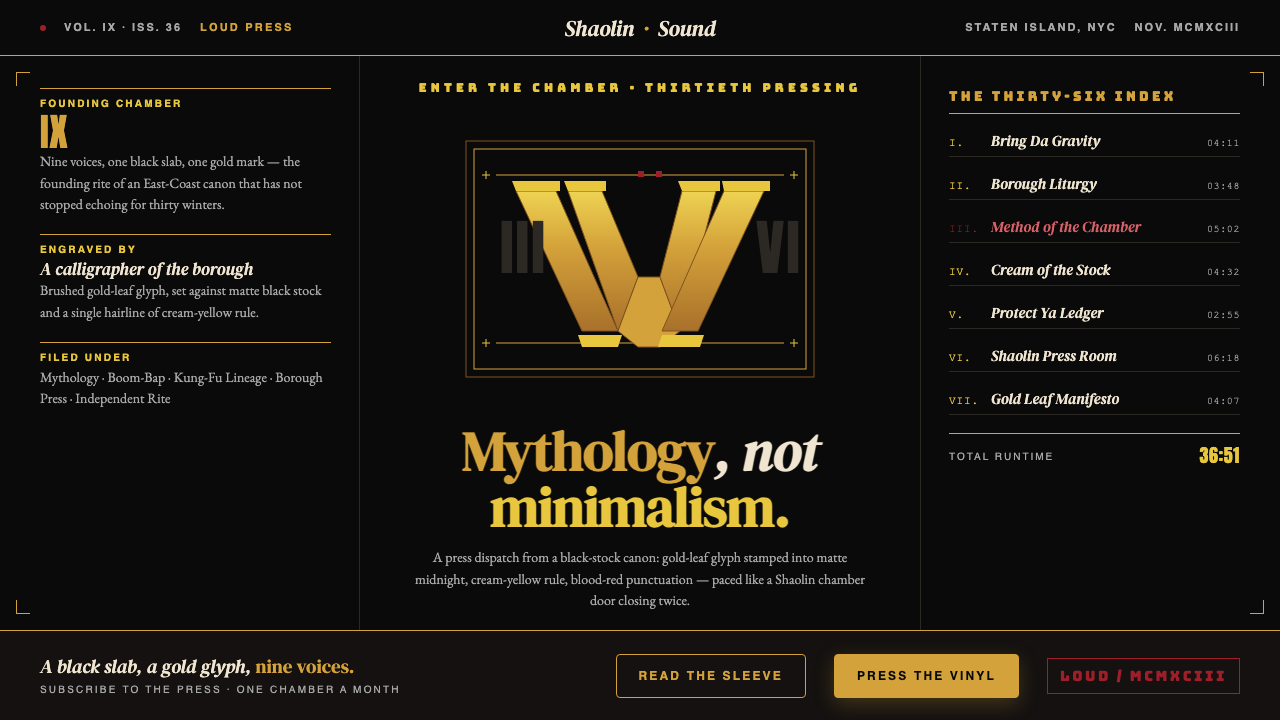 Wu-Tang Clan — 36 ChambersMythology, not minimalism. Gold-leaf glyph on matte black, cream-yellow rule,…
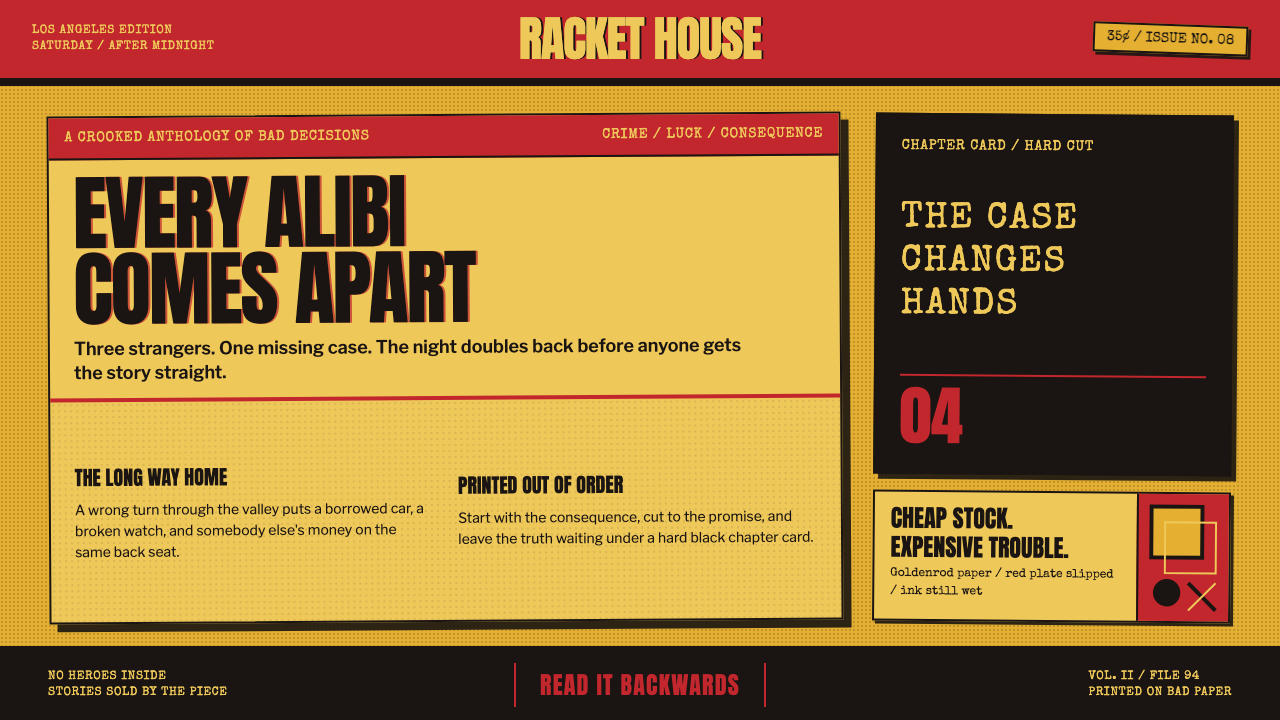 Pulp Fiction (1994)Cheap print, dangerous rhythm. Goldenrod stock, pulp red, and black chapter c…
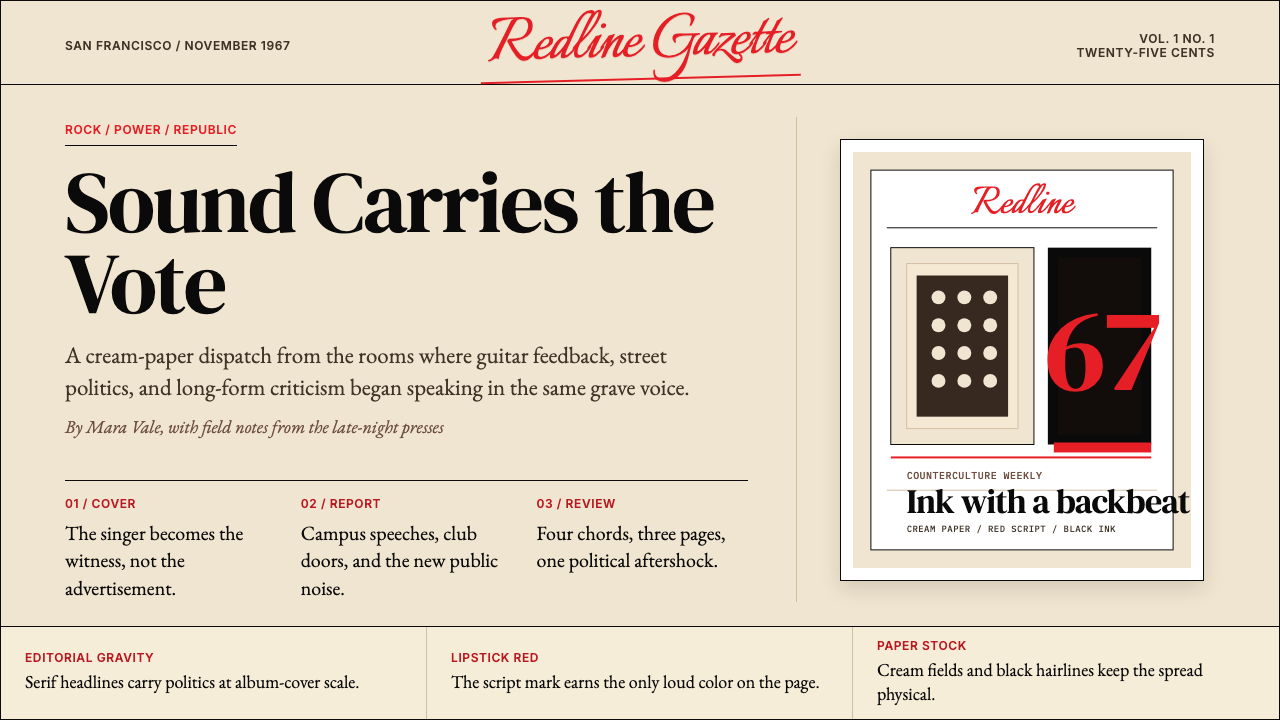 Rolling Stone MagazineCounterculture gets editorial weight. Cream paper, lipstick red script, serif…
 Nicaraguan Sandinista FSLN 1979Urgency in two inks. Blood red, jet black, halftone dots, and cut-stencil typ…
 Nirvana — NevermindAnti-pop in pool blue. Cream cards, dollar-gold accents, and marker type roug…
 Parisian Zazou (1942)Defiance swings in the dark. Ink black, record-sleeve red, and battered typew…