What is Parisian Zazou (1942)?
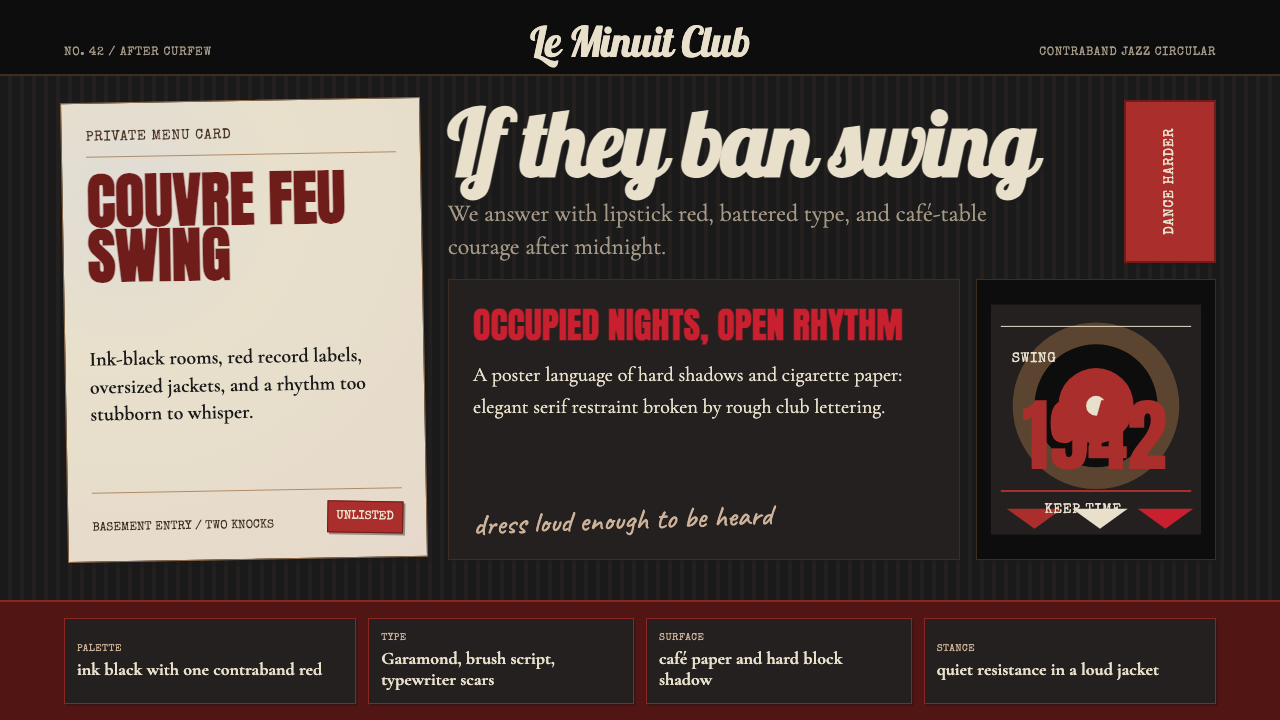
The Zazous answered Nazi occupation with swing jazz and zoot suits — turning banned American music and flamboyant dress into an act of daily defiance that looks, six decades later, like the most stylish resistance movement ever photographed.
Parisian Zazou (1942) in brief
The Parisian Zazou style is a design language rooted in the visual world of occupied Paris, 1942 — specifically in the clandestine cafés, contraband jazz concerts, and hand-lettered underground culture of a youth movement that defied the Vichy regime through aesthetic excess. The system distills that world into its essential visual grammar: ink-black interiors, record-sleeve reds, cigarette-stained paper tones, hand-painted lettering, and a typographic rhythm that feels like a typewriter left out in the rain.
Where most historical design styles draw from institutional sources — schools, studios, government commissions — the Zazou aesthetic emerges from the street. It is deliberately rough, deliberately loud, deliberately wrong by the standards of Vichy propriety. Oversized proportions, clashing weights, text that presses against its margins: everything about the visual language communicates refusal. It does not persuade; it announces.
The style is dark-ground by conviction. Black is not a dramatic choice here — it is the literal color of a curfew city, of jazz bars lit only enough to see the band, of mimeographed sheets passed hand to hand. Against that near-total darkness, saturated red and tobacco-stained cream carry the full communicative load. The result is a palette that feels simultaneously vintage and confrontational, as comfortable on a film noir poster as on a contemporary brand that wants to signal genuine irreverence.
Where does Parisian Zazou (1942) come from?
The Zazous emerged in Paris between 1940 and 1944, with their most visible and politically charged moment arriving in the summer of 1942, when the Vichy government — under German pressure — escalated its crackdown on what it called moral degeneracy. The name itself is disputed in origin: some trace it to the lyrics of a Cab Calloway song heard on contraband recordings; others link it to the French slang for someone nonsensical or absurd. Either etymology suits a movement that wore its ridiculousness as armor.
The cultural context was the Hot Club de France, founded in 1932 by jazz enthusiasts including guitarist Django Reinhardt and violinist Stéphane Grappelli. Their Quintet du Hot Club de France had, before the occupation, made Paris a world capital of jazz — the city where American swing met Romani guitar and emerged as something entirely its own. When the Nazis banned jazz as degenerate art (Entartete Musik) and American culture more broadly, the Hot Club went underground. Its visual culture — the record sleeve graphics, the hand-lettered concert bills, the cabaret typography — became the design vernacular of the resistance.
The Zazous dressed in deliberate violation of wartime austerity codes: long jackets with heavily padded shoulders (the French equivalent of the American zoot suit), tight pegged trousers or pleated skirts, enormous quantities of hair grease forming elaborate quiffs, thick-soled shoes, and — for women — exaggerated lipstick and nail varnish in deep reds. Vichy newspapers ran cartoons depicting Zazous as parasites and traitors. The collaborationist youth group Jeunes Populaires Français organized Zazou hunts, forcibly cropping the distinctive quiffs. The Zazous responded by wearing yellow stars — not legally required of them — in solidarity with Jewish Parisians being deported.
After the Liberation in 1944, the Zazous dissolved into the broader existentialist scene of Saint-Germain-des-Prés. Many became the first generation of French bebop enthusiasts and later the audience for Boris Vian's writing and jazz performance at the Club Saint-Germain. The visual culture they left behind — black café walls, red on black typography, hand-lettered excess — fed directly into the graphic language of French New Wave cinema posters, the album art of the 1950s Paris jazz scene, and the aesthetic of contemporary brands that want to evoke authentic Parisian cool without its tourist-facing prettiness.
What defines the Parisian Zazou (1942) look?
Color
The palette is built on three anchors: near-total black as the dominant ground, a deep saturated red — the red of Hot Club record sleeves and hand-stamped concert bills — as the primary accent, and a tobacco-stained cream that reads as warmth against the darkness. White, when it appears, is always aged rather than pristine. Olive and charcoal appear as secondary neutrals. The overall effect is of a photograph developed in low light: rich, slightly compressed, with no color that reads as cheerful.
Typography
Type in this system feels hand-made even when it is not. The primary reference is the lettering of wartime jazz concert posters: uneven baselines, letterforms that press together as if the typesetter ran out of leading, capitals mixed with minuscules mid-word for visual drama. Condensed display faces carry the expressive weight; body text, where it appears, uses the tight mechanical rhythm of a manual typewriter — monospaced, slightly worn, with characters that almost touch. Contrast between display and body is extreme rather than graduated.
Texture and Surface
Unlike design systems that celebrate pristine surfaces, the Zazou aesthetic requires visible aging. Paper shows grain; ink bleeds slightly at its edges; halftone dots are coarse enough to be seen individually. These are not decorative affectations — they are the honest marks of mimeograph machines, rubber stamps, and underfunded printing presses. Any digital reproduction of this style must simulate imperfection deliberately, because the texture is inseparable from the meaning.
Composition
Layouts are dense and clamorous rather than airy. Elements crowd toward the center or toward a dominant axis; margins are treated as wasted space. Concert poster logic prevails: performer name largest, venue and date compressed below, decorative rule lines used to separate tiers of information rather than to create breathing room. The eye is given no single resting point — everything competes, which is the point. Quietude would be a political concession.
Ornament
Ornament here is not Bauhaus-style absence — it is specifically the ornament of café culture: cigarette burns rendered as graphic motifs, watch chain patterns, the curl of a clarinet bell converted into a decorative border element. Where Bauhaus rejects ornament on principle, Zazou deploys it as cultural signal. The decoration announces membership: only someone who knew the scene would recognize what the motifs meant.
Darkness and Contrast
The system's contrast ratios are extreme. Text that reads as cream on black, or red on black, operates at the maximum distance the palette allows. There are no midtone transitions: elements are either fully present or absorbed into the dark ground. This is not a dark mode in the contemporary sense — it is the visual logic of a room lit by a single overhead bulb, where anything not directly illuminated disappears entirely.
Attitude
More than any other quality, the Zazou aesthetic communicates defiance. This is not the cool disdain of mid-century modernism or the ironic detachment of postmodernism — it is the specific heat of people who were being arrested for dancing. Every design choice in this system should feel like it could get someone in trouble: too loud, too dark, too much. Restraint is the one thing this style explicitly refuses.
Who shaped Parisian Zazou (1942)?
The Belgian-born Romani guitarist is the central figure of French swing jazz and, by extension, of the Zazou visual world. His Quintet du Hot Club de France — formed with Stéphane Grappelli — created the sound that defined underground Parisian café culture during the occupation. Reinhardt continued to perform in Paris throughout the German occupation, navigating the contradiction of being both a celebrated musician and a member of a group the Nazis were actively deporting. His record sleeves and concert bills — printed in the distinctive black-and-red typography of the Hot Club — are the direct visual ancestors of the Zazou design system.
Grappelli's role in the Hot Club's visual and musical identity is inseparable from Reinhardt's. As co-founder of the Quintet, his name appeared on every concert bill and record sleeve that shaped the Zazou visual language. Grappelli was in London when the occupation began and remained there for its duration — a detail that gave the Hot Club's Paris operation its particular underground quality, with Reinhardt leading the Paris sessions while Grappelli continued recording in Britain. The physical artifacts of this split operation — letters, printed programs, album covers — are among the richest documentary sources for the Zazou graphic sensibility.
The French novelist, jazz trumpeter, and polymath Boris Vian became the literary and visual conscience of the post-Zazou generation, bridging the occupation's underground culture with the existentialist scene of Saint-Germain-des-Prés. His writing and performances at the Club Saint-Germain in the late 1940s gave the Zazou aesthetic its intellectual framework, arguing that jazz and the visual culture surrounding it were forms of moral and political seriousness, not mere escapism. Vian's album cover collaborations and poster work established the graphic conventions — dark grounds, condensed lettering, red accents — that carried Zazou visual DNA into the French jazz poster tradition of the 1950s.
The French singer-songwriter Trenet occupied a fascinating ambiguous position in the Zazou cultural landscape: a mainstream popular artist whose visual presentation — the tilted hat, the animated performance style, the collusion between formal dress and improvised energy — shared the Zazou spirit even while his commercial success kept him above the underground. His concert posters and record packaging from the occupation period represent the Zazou aesthetic at its most widely distributed, blending the hand-lettered graphic tradition with the production values of the French music industry. Trenet is the evidence that the Zazou visual language was not confined to samizdat; it was the dominant aesthetic of wartime Parisian popular culture.
No single name can be attached to the majority of Zazou visual production, because most of it was made in haste, without credit, and under conditions that made self-identification dangerous. The hand-lettered concert bills, the mimeographed pamphlets, the chalked notices on café blackboards — these were collaborative, anonymous, and produced by necessity rather than ambition. Acknowledging this namelessness is essential to understanding the style: the Zazou aesthetic is not the vision of a master designer but the accumulated improvisation of hundreds of people who needed to communicate quickly under surveillance. Its roughness is not a failure of execution; it is the direct trace of those conditions.
How do you use Parisian Zazou (1942) today?
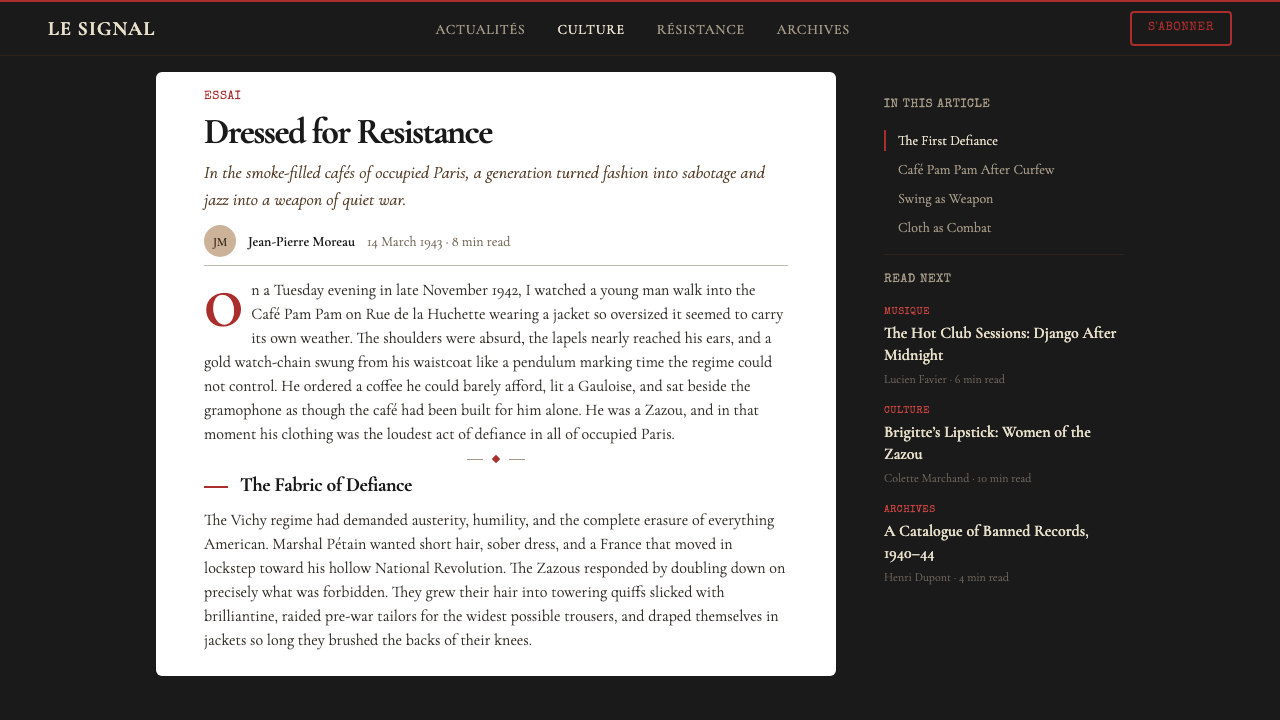
Parisian Zazou is a high-commitment style best applied to contexts where defiance, authenticity, and cultural specificity are genuine brand values rather than decorative claims. It performs exceptionally well in music and entertainment contexts — concert posters, album covers, event branding, festival identities — where the dark-ground, hand-lettered aesthetic is both historically resonant and viscerally effective. It also suits editorial contexts that want to position themselves as serious and counter-cultural rather than mass-market: independent magazines, literary publications, arts journalism that wants its visual identity to argue for something.
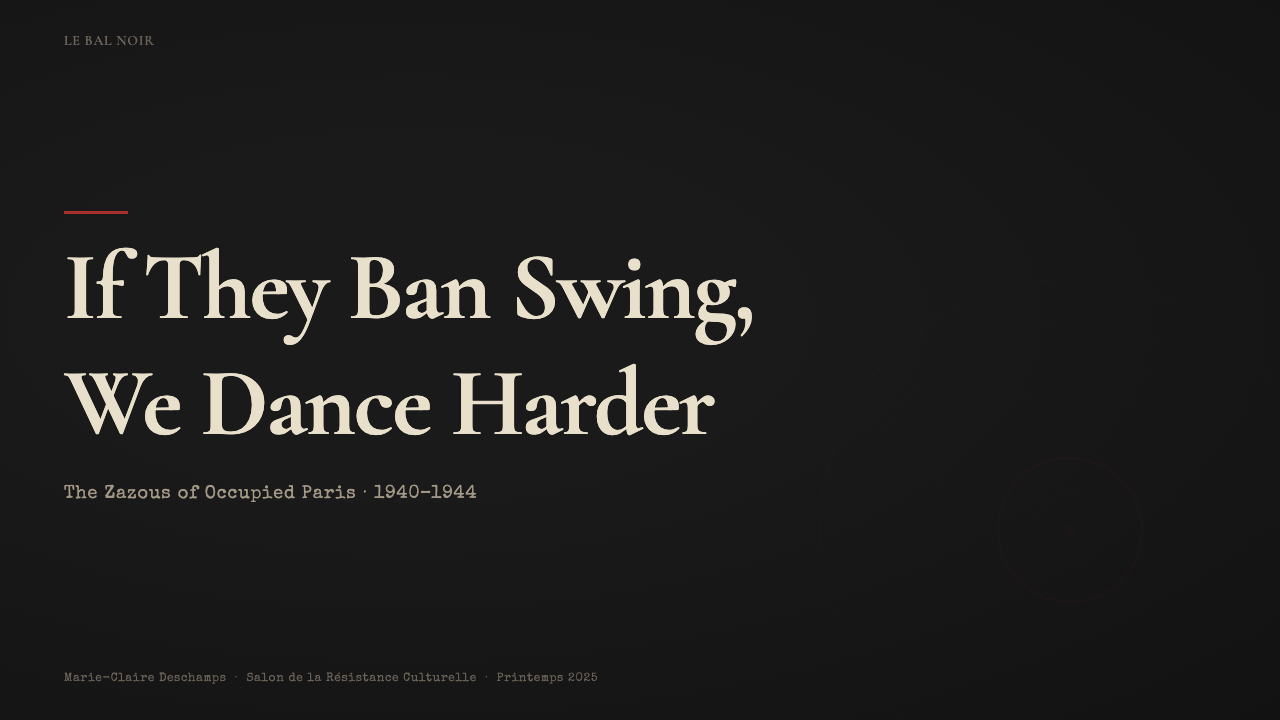
For presentation slides, the style requires a different approach than most historical design systems. Cover slides work as concert bills: a single dominant event or proposition in condensed display type, date and context in a compressed secondary tier, everything against a near-black ground with a single red accent. Content slides should resist the temptation to lighten the background for legibility — instead, use cream or aged-white type on the dark ground, and reserve the black-white reversal for data or comparison moments where contrast hierarchy needs to shift. Data visualizations take on the quality of printed newspaper infographics from the period: bar charts rendered as solid blocks of red or cream against the dark field, with axis labels in tight condensed type.
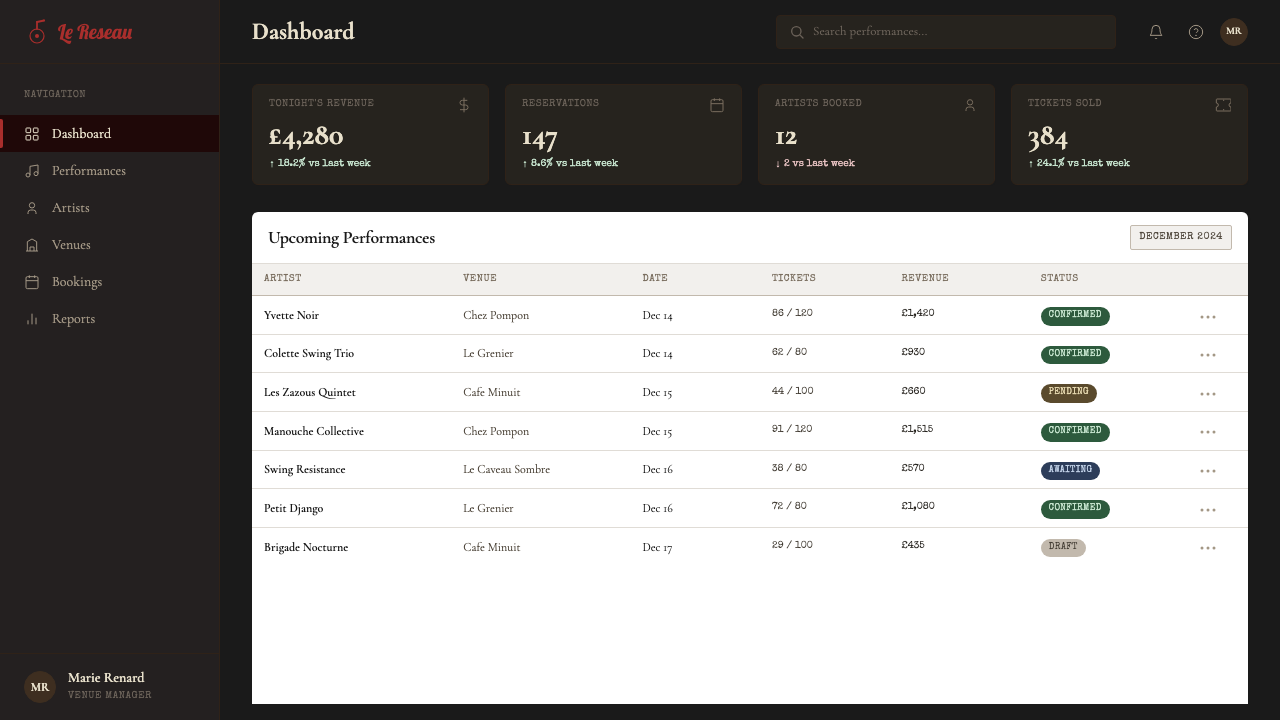
For web interfaces, Zazou is well-suited to dark-mode dashboards, music platforms, and editorial sites where the reading experience is meant to feel immersive rather than efficient. The approach: a near-black background across the full viewport, cream or light-warm type for body text, red restricted to interactive elements and critical alerts only. Navigation should be typographic and dense — no icons, no generous spacing. Card components should carry visible texture in their background treatment rather than relying on soft shadows against a white ground. The common mistake is applying the dark ground and assuming the rest of the system follows; without the specific warmth of the cream tones and the deliberate roughness of the typographic treatment, a dark-background site simply looks like a generic dark mode rather than something with cultural specificity.
For editorial and marketing work, the style excels at announcing rather than persuading. A Zazou-derived marketing page operates on the logic of a concert announcement: hierarchy is extreme, the primary message is stated once at maximum scale, and supporting information is compressed into secondary tiers with visible separators. Full-bleed dark sections alternate with moments of inverted contrast — cream ground, black type, red accent — to create rhythm without reducing the overall darkness of the visual experience. Photography, when used, should be treated as if it were a period photograph: high-contrast, slightly underexposed, cropped to isolate faces or hands rather than showing full scenes.
A common mistake when applying this style is mistaking darkness for grimness. The Zazou aesthetic is dark but not austere — it is the darkness of a room full of people doing something that feels urgent and alive, not the darkness of emptiness. The red accent must earn its place: one strong red element per composition is transformative; two or three reds competing reduce the system to generic noir. Similarly, the hand-made quality should feel like authenticity rather than sloppiness. If the texture and imperfection read as production error rather than intentional register, the cultural specificity collapses and you are left with something that merely looks old.
Parisian Zazou (1942) — FAQ
Is this style appropriate for brands that have no connection to jazz or French culture?
Appropriateness depends less on literal connection than on whether the underlying values match. The Zazou aesthetic communicates defiance, underground credibility, and the refusal to conform to dominant aesthetic norms. A technology company that genuinely operates against the grain of its industry, a publication that exists to challenge mainstream narratives, or a music platform built on independent artists — these contexts make the visual language feel earned rather than borrowed. A brand that simply wants to look cool without the underlying substance will find that the style exposes rather than hides the absence of conviction. The roughness and darkness read as authenticity claims, and audiences test those claims.
How do you maintain legibility with such extreme contrast and dark grounds?
Legibility in the Zazou system comes from restricting the palette rigorously. Cream and aged-white on deep black — or the reverse — are the system's two primary text combinations, both of which are highly legible when type is set at appropriate sizes. Red should never be used for body text: at small sizes against a dark ground, saturated red loses contrast and fails accessibility standards. The typographic roughness should be applied at the display level only; body text benefits from a clean, readable face even within the overall aesthetic. Where the style demands density, use tighter leading rather than smaller type — compressed vertical space maintains the crowded energy without sacrificing readability.
How does Zazou differ from generic noir or dark-mode design?
Generic noir and contemporary dark-mode design share the dark ground but differ in almost every other respect. Noir's darkness is cinematic and atmospheric — it uses soft vignetting, gradient light sources, and high-gloss surfaces. Contemporary dark mode is utilitarian — neutral dark backgrounds, system fonts, soft glow effects for depth. Zazou's darkness is neither cinematic nor utilitarian: it is the darkness of cheap reproduction, of paper gone black with overprinting, of a room lit only by necessity. The distinguishing features are the warm cream accents (not cool white), the visible texture (not smooth digital surfaces), the hand-lettered typographic register (not system fonts), and the specific hot red (not the cool gray or blue accents of standard dark-mode design). Remove any one of these and the style collapses into something more generic.
Can this style work for digital products, or is it too tied to print?
The Zazou aesthetic translates to digital contexts more naturally than many print-derived styles because its defining qualities — extreme contrast, typographic density, texture — are achievable on screen without the compromises that, say, embossing or letterpress require. Music streaming platforms, ticketing applications, editorial websites, and portfolio sites in music or arts have applied the visual register successfully. The translation requires discipline: texture should be applied at the surface level (background grain, subtle paper overlay) without compromising tap targets or interactive affordances. The typographic density that works on a static poster becomes a usability problem if applied indiscriminately to navigation and interface copy. The solution is to use the full Zazou register for hero and editorial sections, and to moderate it — more space, cleaner type — for functional interface areas.
What is the risk of this style reading as costume rather than conviction?
It is the central risk of applying any style with strong cultural origins. The Zazou aesthetic carries the weight of a specific historical moment — people who faced real consequences for their choices — and deploying it as purely decorative surface risks a kind of trivialization. The safeguard is not avoiding the style but using it with awareness of what it claims. Every design choice should be defensible as a necessary one rather than a borrowed one: the darkness is earned by the content's seriousness, the roughness by the urgency of what is being communicated, the red by what it marks as important. Brands and designers that use the visual language well tend to have something they genuinely believe in; the style amplifies conviction rather than simulating it.
Related design styles
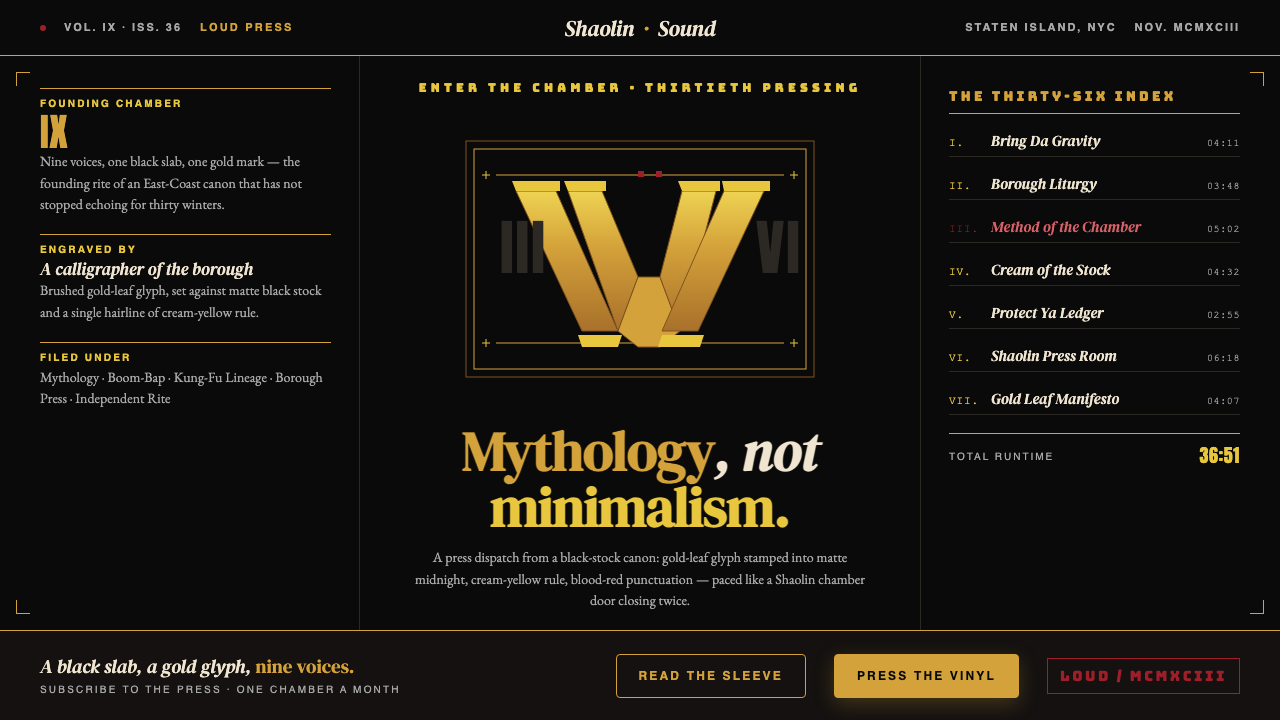 Wu-Tang Clan — 36 ChambersMythology, not minimalism. Gold-leaf glyph on matte black, cream-yellow rule,…
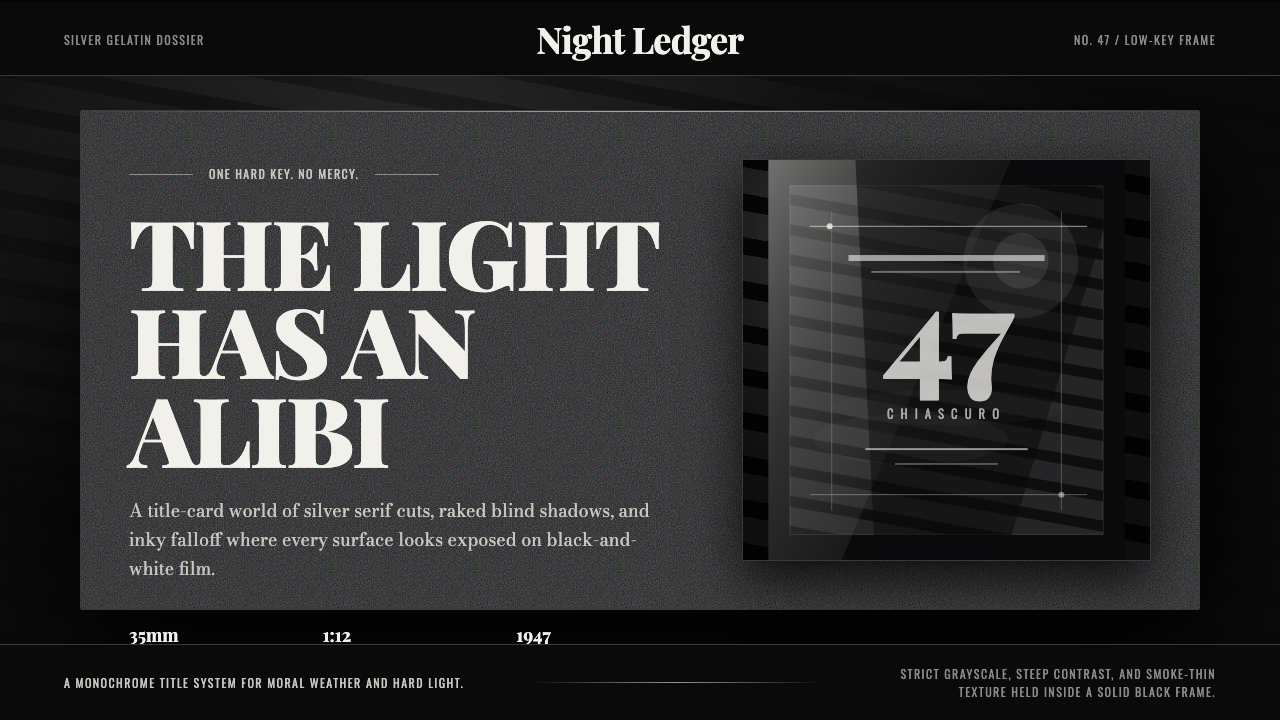 Film Noir ChiaroscuroLight is the crime. Silver serif cards, blind stripes, and grain carve drama…
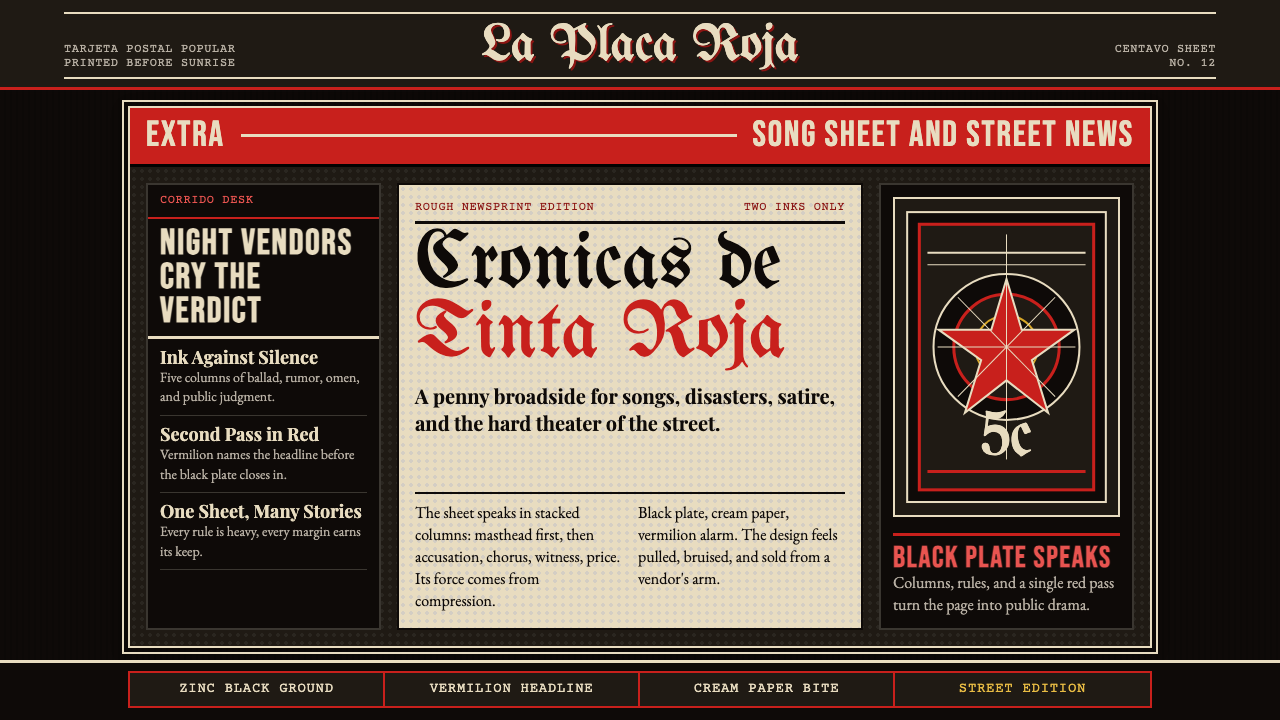 Mexican Tarjeta Postal (Posada Engraving 1900)Tabloid drama in two inks. Fraktur mastheads, vermilion rules, and cream news…
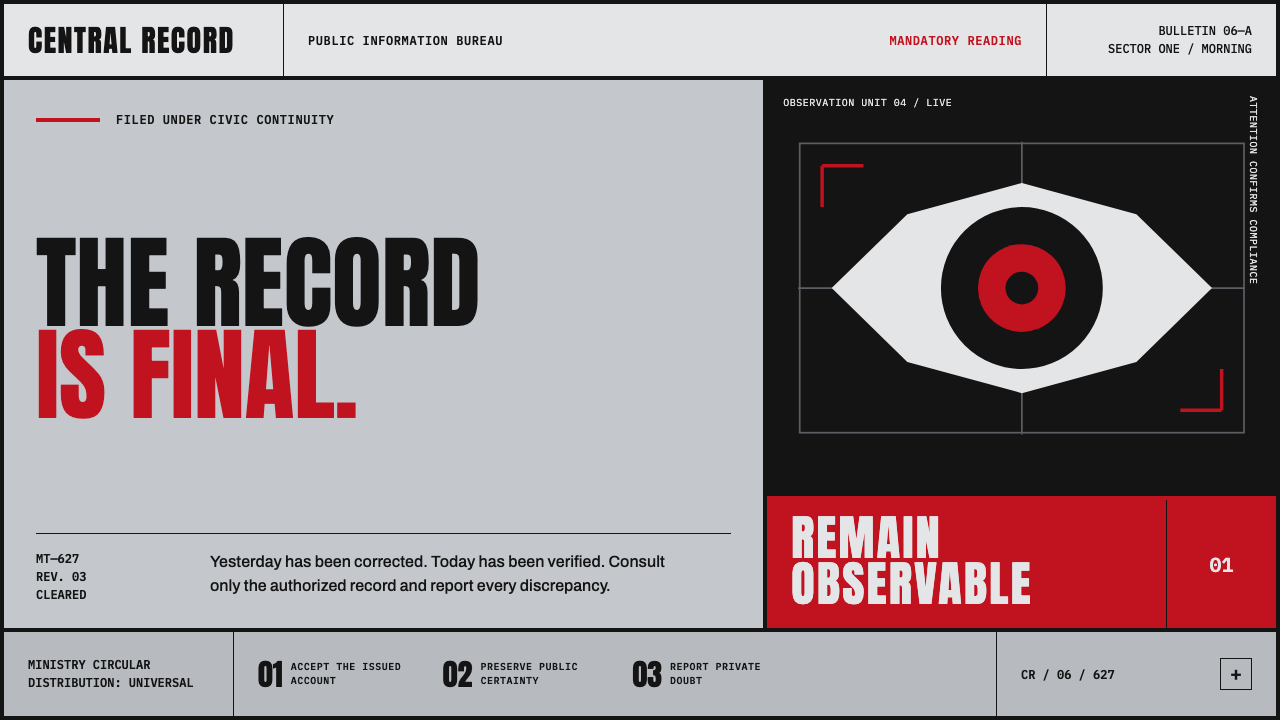 Orwell 1984 (Ministry Propaganda)Authority never blinks. Monumental black type and rationed red ink command a…
 Peaky Blinders (1919)Industrial menace, struck alive. Cold slate grids meet one rare furnace-orang…
 Rolling Stone MagazineCounterculture gets editorial weight. Cream paper, lipstick red script, serif…