What is LIFE Magazine (Red-Banner)?
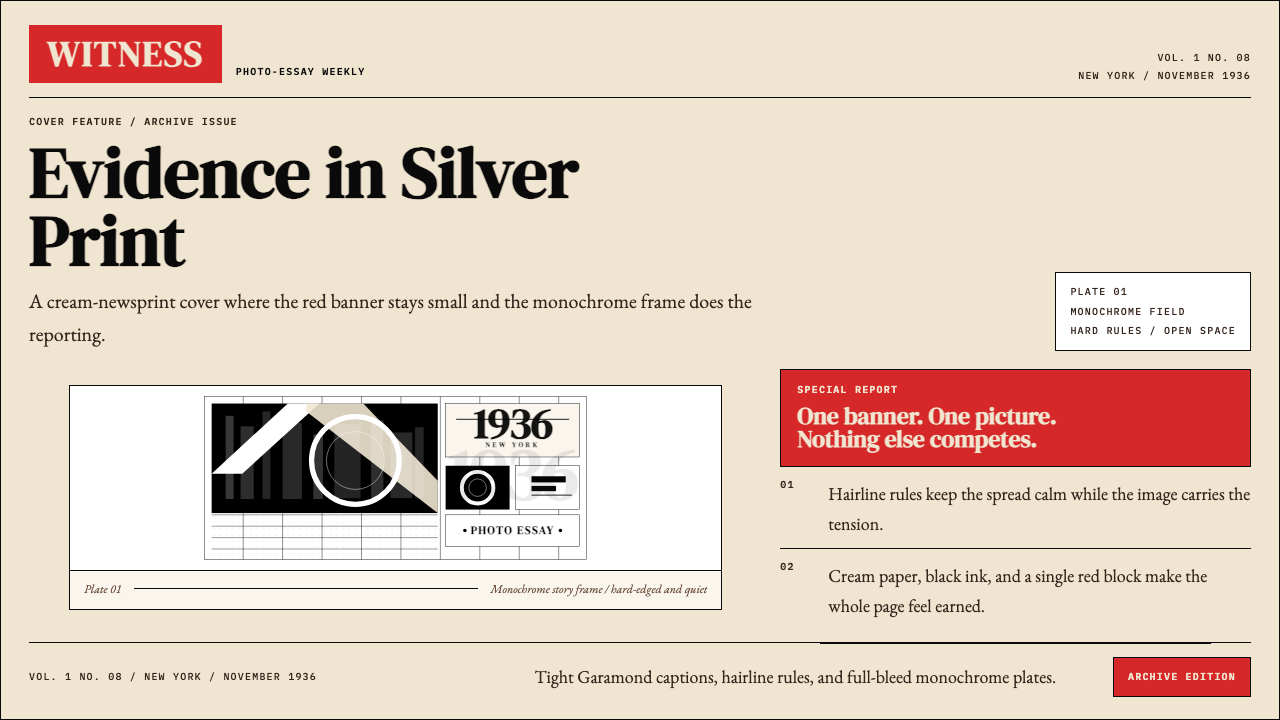
One saturated red wordmark on cream newsprint, one dramatic black-and-white photograph, and the twentieth century learned to read pictures as stories.
LIFE Magazine (Red-Banner) in brief
LIFE Magazine (Red-Banner) is the visual system pioneered by Time Inc.'s LIFE from its founding in 1936 through its golden decades as America's dominant weekly. Its core logic is radical restraint in service of photographic impact: a single emergency-red masthead anchors the top of every cover and section head, while cream or off-white newsprint, hairline black rules, and tightly set caption text step back to let full-bleed black-and-white photography speak unimpeded. The palette is, by deliberate choice, almost binary — red for identity, black for image and type, off-white for ground.
Where most magazine design systems of the era competed for visual attention with illustrated borders, decorative headlines, and color fills, LIFE inverted the hierarchy. The photograph was the article. Headlines existed only to explain the image, not to attract the eye independently. Captions were set in a compact, slightly condensed serif, snug beneath or beside each frame. White space was not emptiness but breathing room — every margin was generous enough that the photographs seemed to float. The result was a page that felt simultaneously journalistic and monumental.
The style's authority comes from its refusal. By committing to a single accent color at maximum saturation, setting all titling in wide-spaced capital letters, and running photographs at sizes that would have seemed extravagant to a newspaper art director, LIFE created a visual language that said: this matters. That rhetoric of importance — red declares urgency, monochrome photographs claim documentary truth, generous white space signals that nothing here is filler — remains the style's core communicative argument.

Where does LIFE Magazine (Red-Banner) come from?
The story of LIFE's visual identity begins not with a designer but with a publisher's ambition. Henry Luce, co-founder of Time Inc., acquired the rights to the LIFE name in 1936 from a defunct humor magazine. His vision was transformational: a weekly magazine that would make photojournalism the primary medium for understanding American and world events. When the first issue appeared on November 23, 1936, the cover photograph — Margaret Bourke-White's image of Fort Peck Dam in Montana — established immediately that this would be a different kind of publication. The photograph ran nearly full-bleed, framed only by the red masthead above it and a caption below.
The typographic architecture that framed those photographs emerged from the editorial traditions of the era's most serious newspapers and news magazines. The masthead wordmark was drawn in a style descended from the heavy Bodoni-influenced display serifs that American newspapers used for front-page banners — thick verticals, razor-thin horizontals, high contrast between stroke weights, tight bracketing on the serifs. Its color, a saturated primary red, was chosen for maximum visibility on newsstand racks and maximum contrast against the cream stock. The decision to use red and only red as the accent — no secondary palette, no seasonal variations — was an unusual commitment to visual consistency for the 1930s.
From the start, LIFE's art direction operated on a principle that distinguished it from illustrated magazines: the photograph was not decoration for the text, but the text was annotation for the photograph. Art directors at LIFE — including the influential Howard Chapnick and later Bernard Quint — developed page layout conventions that treated the photographic spread as a cinematic sequence. Photographs were sequenced across pages to create narrative rhythm, with a large "lede" image establishing a scene, supporting photographs developing context, and a final image providing resolution or emotional closure. This sequencing logic, sometimes called the photo-essay grammar, became the template that countless editorial designers have borrowed since.
The magazine's visual authority was inseparable from its photographers. Margaret Bourke-White, Alfred Eisenstaedt, W. Eugene Smith, Gordon Parks, and Robert Capa — working through the 1940s, 1950s, and 1960s — produced images of a consistent tonal and compositional quality that the layout system was designed to honor rather than override. Eisenstaedt's images of ordinary American life, shot in available light with deep shadow and bright highlight, became the tonal model for what a LIFE photograph should look like. Smith's longer photo-essays — on a rural doctor, on Minamata — pushed the form toward something approaching visual literature. The design system's restraint was what gave these images room to be what they were.
What defines the LIFE Magazine (Red-Banner) look?
The Red Masthead
The defining element is a single saturated red band across the top of the page carrying the LIFE wordmark in heavy, high-contrast serif capitals. The red is unmodulated — no gradient, no shadow, no texture — and appears nowhere else in the layout. Its function is dual: brand identification at distance on the newsstand, and a chromatic anchor that makes the cream-and-black composition below feel complete. The masthead never competes with the photograph; it declares ownership of the page and then yields entirely to the image.
Full-Bleed Monochrome Photography
Photographs run edge-to-edge or close to it, with gutters kept minimal and frames eliminated entirely. Black-and-white reproduction was partly a production constraint of the era, but LIFE's editors and photographers embraced it as an expressive choice: the removal of color forces the eye toward form, light, shadow, and gesture. The tonal range of LIFE photographs tends toward deep shadow and brilliant highlight — a high-contrast print style that reproduced well on newsprint and gave images a dramatic, almost graphic quality.
Wide-Spaced Capital Headlines
Headlines and section labels are set in capital letters with generous letter-spacing, typically in a weight heavier than the body text but considerably lighter than the masthead. The wide spacing slows the reading pace, giving each word weight and deliberateness. This is typographic restraint in service of gravitas — the headline does not shout, it pronounces. Subheadings, where used, are set smaller but follow the same capitalized, spaced convention, creating a clear and consistent hierarchy.
Hairline Rules and Structural Lines
Thin, single-weight horizontal rules — barely visible but structurally present — separate sections, frame captions, and articulate the grid. These hairlines are not decorative; they are organizational. Their fineness prevents them from competing with the photographs, but their presence keeps the layout from dissolving into undifferentiated white space. The rules reinforce the sense that every element on the page has been placed with intention, not dropped into position.
Compact Caption Typography
Captions are the secondary reading layer in the LIFE system, and they are typeset to behave subordinately: a slightly condensed serif face, set at a smaller size than body text, with tight leading that keeps the caption block visually compact. The caption is anchored close to its photograph — never floating ambiguously between images. This proximity creates an unambiguous image-text pair. Captions were written with journalistic precision and often ran to several sentences, forming a secondary narrative beneath the visual one.
Cream Ground and Generous Margins
The base is off-white newsprint — not pure white, but the warm, slightly yellowish cream of uncoated stock. This ground gives the photographs a slightly warmer tonal context than a bright white page would, and it makes the red masthead appear richer and more saturated by contrast. Margins are kept wide by the standards of print journalism, providing visual breathing room that signals editorial confidence: the editors did not fill every column inch because they did not need to.
Narrative Photo Sequencing
The photo-essay layout is not a collection of images but a scripted sequence. LIFE art directors typically opened with one large establishing photograph, followed by a series of supporting images at varied sizes and crops that developed the story, and closed with an image that provided resolution or emotional weight. Scale relationships between photographs on a spread signal importance: the largest image is the thesis, smaller ones are evidence. This cinematic grammar elevated magazine layout to a storytelling discipline.

Who shaped LIFE Magazine (Red-Banner)?
Luce co-founded Time magazine in 1923 and launched LIFE in November 1936, transforming photojournalism from a supplementary illustration practice into the primary vehicle for American news storytelling. His editorial conviction — that photographs could convey the complexity of world events with an immediacy that text alone could not match — shaped every aspect of LIFE's visual and editorial identity. Luce ran Time Inc. until 1964, presiding over LIFE's peak circulation years and its influence on how generations of Americans understood news through pictures.
Bourke-White shot the photograph that appeared on LIFE's first cover — the Fort Peck Dam construction site in Montana — and became one of the magazine's defining staff photographers. Her visual approach combined formal architectural composition with documentary social concern: industrial subjects rendered with the precision of a technical drawing, human subjects placed within those structures to convey scale and social meaning. Her photographs from the Dust Bowl, from World War II battlefields, from the partition of India, and from the aftermath of the Nazi concentration camps set a standard of moral seriousness that shaped what LIFE photography aspired to be.
Eisenstaedt was one of LIFE's earliest staff photographers and remained associated with the magazine for decades, contributing more than ninety cover photographs during his tenure. His approach to portraiture and candid photography — catching subjects in unposed moments with available light — established the visual baseline for what a LIFE image looked and felt like. His photograph of a sailor kissing a nurse in Times Square on V-J Day, 1945, became one of the most reproduced images of the twentieth century and crystallized the magazine's ability to capture a historical moment as a single, iconic frame.
Smith worked for LIFE at intervals from the 1940s through the early 1970s and pushed the photo-essay form toward its most ambitious and contentious expressions. His extended essays — on a rural Spanish village, on a country doctor in Colorado, on jazz musician Albert Schweitzer, and most powerfully on the mercury poisoning tragedy in Minamata, Japan — ran to dozens of photographs and were designed to be read as complete visual arguments rather than illustrated articles. Smith's conflicts with LIFE editors over control of his photo-essays made the underlying question of who governs the layout of a photographic story a lasting professional and ethical debate.
Parks joined LIFE as a staff photographer in 1948, becoming the first African American staff photographer at any major American news magazine. His work for LIFE documented segregation, poverty, and the civil rights movement with a visual authority that forced these subjects into the mainstream of American editorial culture. Parks also brought a formal compositional sensibility rooted in his background as a self-taught photographer — his images frequently deploy symmetry, depth of field, and strong geometric framing in ways that gave his documentary subjects the visual weight of fine-art portraiture.
How do you use LIFE Magazine (Red-Banner) today?
The LIFE Red-Banner style translates most naturally to contexts where a single dominant image needs to carry authority, and where the designer's job is to frame rather than to decorate. The core discipline is the same whether the medium is a slide deck, a web dashboard, or a printed editorial layout: choose the strongest visual, give it maximum real estate, and let the typographic system announce rather than compete.
For presentation slides, the cover page is where this style pays its highest dividend. A full-bleed photograph or a high-contrast graphic occupies nearly the entire slide area; a red band at the very top carries the title or event name in wide-spaced capitals; a short subtitle or date runs below in a smaller, tracked serif. Content slides should resist the temptation to fill — a single strong graphic or photograph per slide, with a headline above and a caption-length annotation below, follows the photo-essay grammar and keeps each slide readable at a distance. Data slides can adopt the tonal language of LIFE's charts from its editorial spreads: black-and-white bar graphs with a single red bar used to highlight the most important value.
For web interfaces, the style suits editorial landing pages, long-form article templates, and publisher home pages rather than transactional or application interfaces. The approach: set the hero module as a full-width, high-contrast photograph with a red band above carrying the publication name or section identity. Body copy should be set in a traditional, slightly condensed serif at a moderate measure, with generous line spacing and wide left and right margins. Navigation is typographic — categories in tracked capitals — with no icon ornamentation. Red appears only in the masthead and in active or hover link states, never as a background fill.
For editorial and marketing work, the style has natural affinity with print-referencing contexts: book covers, magazine-style annual reports, brand journalism, and event programs. A well-executed LIFE-derived book cover uses a strong photograph or high-contrast illustration at full bleed, a red strip at top or bottom for the publisher or series identity, and titling in wide-spaced capitals against a light or dark ground. Marketing materials that need to convey authority — capability statements, prospectuses, institutional presentations — benefit from the style's association with editorial seriousness. The red accent, used only as a masthead or a single rule, communicates the visual rhetoric of a news organization: reliable, direct, significant.
The most common mistake when applying this style is treating the red as a general accent color rather than as the sole identity element. In authentic LIFE-derived work, red appears in one place: the masthead. When designers use red for call-to-action buttons, pull quotes, section dividers, and data highlights simultaneously, the chromatic discipline collapses and the style loses its authority. A second frequent error is filling white space with content — adding additional photographs, sub-articles, or feature previews to layouts that the style demands be kept sparse. The LIFE aesthetic is not a dense information system; it is a stage for a single performance.

LIFE Magazine (Red-Banner) — FAQ
Can this style work without black-and-white photography?
Yes, but it requires care. The LIFE system was built around the tonal properties of monochrome photography — deep shadow, brilliant highlight, the absence of color distraction. Color photography can work within the system if it is treated with similar tonal discipline: high contrast, strong blacks, limited mid-range murkiness. Flat or low-contrast color photography will undermine the style's authority, because the layout architecture is designed to honor a bold image. Color illustration, if kept to high-contrast black line work or bold flat fills, can also function effectively. The red masthead and cream ground remain constant regardless of whether the primary visual is in color or monochrome.
How does this style differ from other editorial magazine aesthetics, like Esquire or Harper's Bazaar?
Esquire in its golden era under art director Henry Wolf deployed illustration, conceptual photography, and strong typographic wit — the cover was as much a designed object as a photograph. Harper's Bazaar under Alexey Brodovitch was typographically adventurous, using large type as a graphic element and treating the page as a canvas for visual tension between image and letter. LIFE's system is more austere than either: it subordinates typography entirely to photography, uses a single accent color rather than a developed typographic palette, and values documentary weight over formal elegance. Where Brodovitch's Bazaar was fashion and fine art, LIFE was journalism and history — and its visual language made that claim unmistakably.
Is this style appropriate for digital-first contexts, or does it feel too print-native?
The core elements — full-bleed imagery, strong typographic hierarchy, a single saturated accent color, generous white space — translate effectively to digital screens. What requires translation rather than direct transfer is the newsprint ground: on screen, a warm cream background reads differently than it does on uncoated paper, and the choice between a true cream, a warm off-white, or a pure white ground affects the mood significantly. The hairline rules that work beautifully in print can disappear or look anemic at screen resolution; they may need to be slightly heavier than their print equivalents. The style works best on screens in long-form reading contexts — article templates, editorial landing pages, institutional reports — where the slow, considered pacing of the photo-essay format is an asset rather than a friction.
How much of the style depends on having access to strong photography?
Substantially. The LIFE layout system is designed to serve exceptional photography, and a weak or generic photograph will expose the system's limitations rather than its strengths. The architecture of the style — wide margins, minimal typography, the single red accent — exists to honor a dominant image; if the image does not command attention, the layout will simply feel empty. This is the style's most significant practical constraint. Designers working without access to strong photography can adapt by working with high-contrast graphic elements — bold illustration, typographic composition, strong geometric shapes rendered in the red-black-cream palette — but this shifts the style toward a graphic idiom that owes more to constructivism than to LIFE itself.
What is the single rule most worth remembering when using this style?
One image, one red element, nothing else competing. The entire authority of the LIFE visual system comes from its willingness to let a single photograph carry the page, with the red masthead as the only other element with any chromatic weight. Every design decision in the system — the cream ground, the hairline rules, the tracked capitals, the tight caption setting — is a form of subtraction: removing visual noise so that the photograph can do its work. If a layout built in this style is not working, the solution is almost never to add an element; it is to remove one, or to find a stronger photograph.
Related design styles
 Film Noir ChiaroscuroLight is the crime. Silver serif cards, blind stripes, and grain carve drama…
 Mexican Tarjeta Postal (Posada Engraving 1900)Tabloid drama in two inks. Fraktur mastheads, vermilion rules, and cream news…
 Paris MatchThe cover shouts in one red slab. Cream paper, serif headlines, and black rul…
 TIME MagazineAuthority in a red rectangle. Didone masthead, black-white columns, and a 4px…
 Broadsheet LetterpressAuthority in ink. Lampblack serif decks lock into tan paper with strict ruled…
 Cuban Malecón 1960 PosterPublic voice in flat ink. Turquoise wall, cream stock, brick red and cobalt b…