What is TIME Magazine?
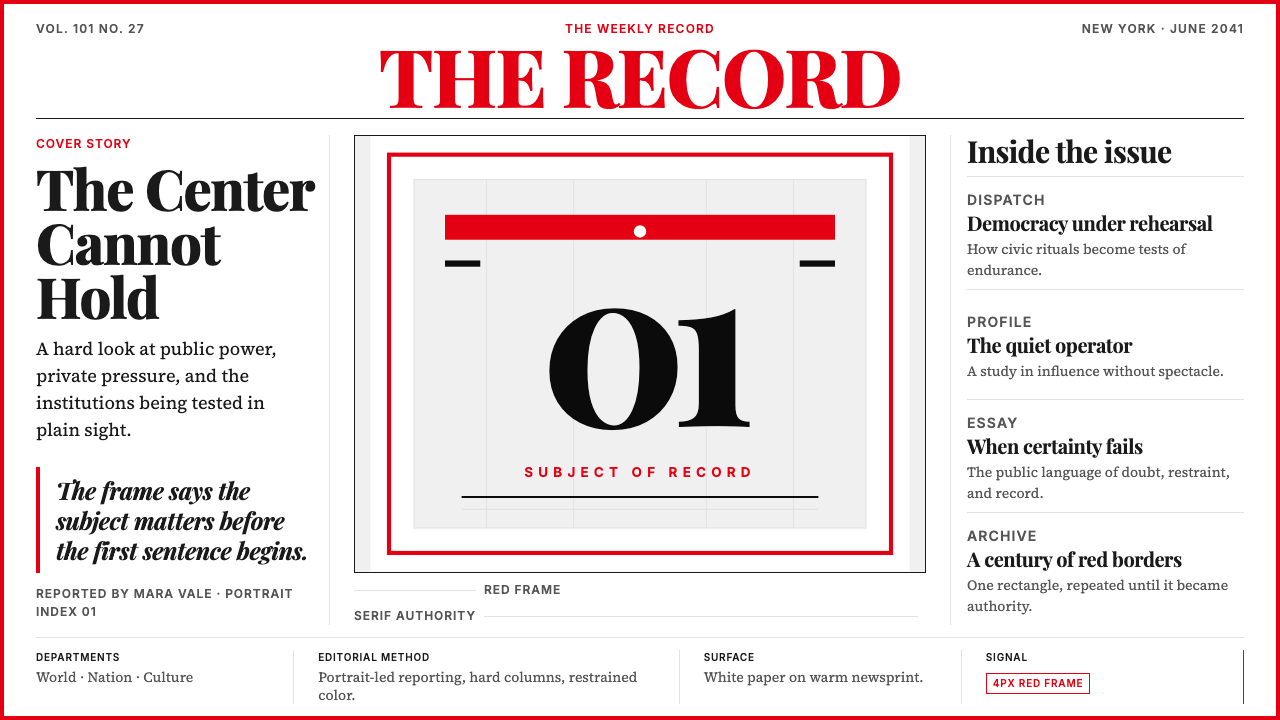
A red rectangle drawn around a single portrait told the world, for a century, that this person and this moment mattered.
TIME Magazine in brief
TIME Magazine is an American weekly news publication whose visual identity — a scarlet border, a bold Didone masthead, a single portrait dominating the cover, and a strict red-black-white palette — has remained essentially unchanged since the late 1920s and has become one of the most recognized editorial design systems in the world.
The design language is rooted in newspaper clarity and editorial authority. Serif headlines carry weight and permanence; column grids give the interior pages a disciplined, legible rhythm. Red is used sparingly and deliberately: the border frame, the masthead lettering, and selective accent treatments are its almost exclusive domain. Black carries body text and secondary hierarchy. White — or the clean ground of the page — provides the breathing room that keeps the system from feeling heavy despite its visual seriousness.
What distinguishes the TIME aesthetic from other editorial systems is its economy. The cover composition almost never changes: one image, one name or subject line, one border. This restraint is a statement of confidence — the belief that the subject is enough, that the design's job is to frame rather than to decorate. The result is a visual vocabulary that reads instantly as authoritative, serious, and built for the long record.

Where does TIME Magazine come from?
TIME was founded on March 3, 1923, by Henry Luce and Briton Hadden, two Yale graduates who had worked together on the Yale Daily News. Both were in their mid-twenties. Their founding concept was deliberately populist: not a newspaper, not an academic journal, but a weekly digest that would allow a busy reader to follow world affairs in one sitting. Hadden shaped the prose voice — brisk, opinionated, written with a compression that became known as 'Timestyle.' Luce shaped the business. When Hadden died unexpectedly in 1929, Luce took sole control and turned the single title into a publishing empire that would eventually include Fortune, Life, and Sports Illustrated.
The cover format was established early and refined slowly. The first issue featured a portrait of Speaker of the House Joseph Cannon — a convention that would rarely be broken for decades. Initially the border was simple and dark; it became the now-famous red in 1927, a change whose precise origin is debated but which transformed the magazine's newsstand presence immediately. The Didone-style serif masthead — with its high contrast between thick strokes and hairline thins — projected the permanence and gravity of an institution, not the casualness of a consumer magazine.
The cover portrait tradition became a cultural institution in its own right. Being named TIME's 'Person of the Year' (originally 'Man of the Year,' introduced in 1927) became a global marker of significance. The selection process — covering statesmen, scientists, activists, and occasional abstract concepts such as 'The Computer' in 1982 or 'You' in 2006 — extended the magazine's editorial authority far beyond its pages. The red-bordered cover was reproduced on newsstands in every country, making the frame itself synonymous with the idea that a subject had achieved world-historical importance.
Boris Artzybasheff, who worked as a cover illustrator for TIME for over three decades beginning in the 1940s, helped define the magazine's illustrative register: technically precise, slightly dramatic, always portrait-focused. His work, and that of subsequent illustrators, established that a painted or illustrated cover was a signal of particular weight — not a substitute for photography, but a deliberate elevation of the subject. D.W. Pine, who served as TIME's art director in the 2000s, led refinements that brought the masthead into the digital era while preserving its essential character, ensuring that the system read as legibly on a screen thumbnail as on a printed cover.
What defines the TIME Magazine look?
The Red Border
The defining element of the TIME visual system is the narrow scarlet rectangle that surrounds every cover. It functions simultaneously as a brand mark, a compositional frame, and an editorial signal. The border is not decorative — it is declarative. It announces that whatever appears inside it has been judged, by the editorial process, to deserve that frame. Crucially, the border is sometimes partially obscured by the subject of the cover photograph, a deliberate convention that signals the subject is larger than the frame — an iconographic statement of magnitude.
Didone Masthead
The TIME masthead is set in a Didone-category serif — a style characterized by extreme contrast between thick vertical strokes and almost invisible hairline horizontals. This contrast gives the letters a sharp, almost engraved quality that connotes precision, permanence, and institutional authority. The masthead sits at the top of the cover in large, confident lettering, often printed in red against white or white against red, reinforcing the brand's two-color signal. The letterforms have been refined over decades but never abandoned for a sans-serif or a softer serif, because the Didone contrast is fundamental to the magazine's tone.
Portrait-Dominant Cover Composition
The TIME cover format is almost invariably built around a single portrait — a face, usually front-facing or three-quarters, that fills or nearly fills the cover field. This compositional convention, established in the first issue and maintained for a century, communicates a specific editorial philosophy: history is made by individuals, and the face is the most immediate and emotionally legible subject available. Typography on the cover is reduced to its minimum: the masthead, a brief headline, and often a cover line. The image carries the argument.
Three-Color Palette
The TIME palette is among the most austere in mainstream magazine publishing: red, black, and white, with no sanctioned departure. Red is reserved for structural and brand elements — the border, the masthead, and occasional typographic emphasis. Black handles editorial typography: headlines, standfirsts, body text, captions. White or the near-white of the page ground provides the field. The absence of additional colors is not a limitation but a discipline. Over a century, the palette has become self-reinforcing: the red-black-white combination, in the proportions TIME uses them, is instantly legible as TIME before the masthead is even read.
Serif Typography with Strong Hierarchy
Interior pages establish hierarchy through a disciplined typographic system in which a high-contrast Didone or transitional serif governs headlines, a more readable text-weight serif handles body copy, and scale and weight do the organizational work that other systems assign to color. Captions, pull-quotes, and section labels step down through clearly differentiated sizes. The reading experience is column-structured, with generous leading that makes sustained reading comfortable — a newspaper inheritance adapted for the longer-form narrative that TIME pioneered.
Photography as Primary Visual Language
From its earliest decades, TIME has treated photography — and painted portraiture in its place when a living photograph was unavailable — as the primary carrier of editorial meaning. The cover image is selected not for aesthetic novelty but for journalistic weight: it should make the argument visible. Interior photography follows editorial conventions of documentary and news photography: direct, factual, contextually grounded. When illustration is used, it maintains the portrait format and the gravity of the photographic tradition, rather than departing into decorative or abstract directions.
Institutional Restraint
Perhaps the most distinctive quality of the TIME aesthetic is what it refuses to do. No decorative borders inside the magazine, no ornamental dividers between sections, no gradient backgrounds, no playful typographic experiments, no seasonal redesigns. The system is conservative in the precise sense: it conserves a visual identity that has accrued credibility over generations. Every design decision is subordinated to the editorial mission of record-keeping and authority. The restraint is itself the message — it says that the magazine does not need to court attention through visual novelty because its subject matter already demands it.

Who shaped TIME Magazine?
Luce co-founded TIME in 1923 and, after Briton Hadden's death in 1929, became the sole architect of the Time Inc. publishing empire. His conviction that photojournalism and editorial design were as important as prose — manifest most fully in the founding of Life magazine in 1936 — shaped the visual ambition of all Time Inc. publications. Luce believed that the designed page was an argument, not a container, and the TIME cover, with its deliberate portrait-plus-border formula, reflects that conviction directly.
Hadden, Luce's co-founder and equal partner until his death at thirty-one, was responsible for TIME's distinctive prose voice — a compressed, active, often irreverent style that broke sharply from the formal conventions of newspaper journalism. Though his contributions were editorial rather than visual, Hadden's insistence on compression and directness established the editorial philosophy that the design system would need to serve: more impact per square inch, a layout that respected the reader's time. His influence on the magazine's tone persists in its design DNA.
Artzybasheff created more than two hundred TIME covers between 1941 and 1965, making him the magazine's most prolific cover artist and one of the defining visual voices of mid-century American editorial illustration. His portraits combined technical precision with psychological intensity — subjects were rendered with the detail of a scientific illustration and the drama of a theatrical close-up. His work demonstrated that the painted cover was not a compromise when photography was unavailable but a distinct editorial mode capable of conveying interiority and significance that photography could not.
Pine served as TIME's art director through the 2000s, a period in which the magazine faced the foundational challenge of translating a print-born visual identity to digital screens, web thumbnails, and social media contexts. His stewardship of the masthead refinement — maintaining the Didone contrast and the red-black-white palette while ensuring legibility at reduced scale — is a case study in responsible heritage design. Under Pine, the system that Luce and Hadden's original vision had produced proved durable enough to survive the transition from newsstand dominance to digital competition without losing its essential character.
Though primarily associated with Life magazine, Bourke-White's influence on Time Inc.'s editorial photography standards shaped how TIME itself understood the relationship between photographic image and editorial argument. Her approach — treating the photograph as a document of moral as well as factual significance — matched the register that TIME's cover format demanded. Her career established the precedent that the journalists and photographers who fed the TIME cover were not image-makers in the commercial sense but witnesses whose work warranted the authority of the red border.
How do you use TIME Magazine today?
The TIME Magazine aesthetic is one of the most legible editorial design systems available to contemporary designers because its principles are structural and repeatable: a dominant image, a constrained palette, a strong typographic hierarchy, and a framing device that confers authority. Applying it well requires understanding that the system's power comes from restraint, not decoration — every element earns its place or is removed.
For presentation slides, the TIME approach works powerfully on cover and section-divider pages. A cover slide should foreground a single strong image — a portrait, a product photograph, or a documentary-style scene — cropped to fill the slide field, with the title overlaid in high-contrast serif type and a narrow red border applied to the slide edge as a frame. Section-divider slides benefit from the TIME convention of large, bold type against a clean white or near-black field, with red used only for a single accent element. Data and content slides should maintain the column-grid logic: two or three content zones separated by clear typographic hierarchy rather than decorative dividers. Charts and graphs take on an editorial quality when axis labels and annotations are set in a consistent serif, with red reserved for the single most important data series.
For web UI, dashboards, and pricing pages, the TIME visual system translates into a clean, authority-signaling interface language. Use a near-white background as the primary field; structure navigation and headers with a high-contrast serif typeface at meaningful scale; deploy red exclusively for primary calls to action, status alerts, or selected states. A thin red border or underline applied to active navigation items echoes the cover-frame convention and gives the interface a distinctive editorial identity. Avoid gradient backgrounds and soft drop shadows — the system reads best when surfaces are flat and edges are crisp.
For editorial layouts, marketing materials, and branded reports, the TIME aesthetic supports strong information hierarchy with minimal visual noise. Long-form article layouts work well with a narrow central column for body text and a wide outer margin for pull-quotes or supporting data — a structure that echoes the magazine's own interior grid. Marketing pages can deploy the full-bleed image with typographic overlay convention from the cover: a strong photograph, a headline set in a bold serif, and a red border or accent that frames the key message. Branded reports gain credibility from the system's restraint — a consistent serif for all editorial text, black and red for hierarchy, and white space that gives data room to breathe.
A common mistake when applying the TIME aesthetic is treating the red as a general accent color to be used freely throughout a layout. In the original system, red is extremely scarce — it appears in the border, in the masthead, and almost nowhere else in any given spread. Overusing red dilutes the framing power that makes the system work. A second frequent error is selecting a decorative or display serif that suggests fashion or culture rather than permanence and authority. The Didone contrast is essential: a serif with low stroke contrast will look soft where the system demands gravity. Finally, resist the temptation to add secondary colors, gradients, or photographic treatments that soften the image — the three-color discipline is not a retro aesthetic choice but the load-bearing structure of the entire visual argument.

TIME Magazine — FAQ
Does the TIME aesthetic only work for news or journalism contexts?
No — the TIME system transfers well to any context where authority, credibility, and hierarchical clarity are desired values. Annual reports, institutional publications, policy documents, academic presentations, and technology platforms positioned as serious and trustworthy all benefit from the visual grammar. The association with journalism is an asset in those cases: it says the content is researched, factual, and intended to inform rather than persuade through emotion. The system struggles in contexts that call for warmth, playfulness, or cultural specificity — consumer brands, lifestyle products, and entertainment platforms will find the palette too austere and the typographic gravity too heavy.
How should the red border be adapted for digital interfaces?
In print, the TIME border is a physical frame around the entire cover. In digital contexts, a literal full-screen red border is rarely appropriate and can feel gimmicky. The better approach is to use the border convention selectively: a thin red left-border on featured content cards, a red underline on active navigation, or a narrow red horizontal rule to separate major content sections. The key is to deploy it as a framing device rather than a decoration — it should mark what is most important, not appear uniformly throughout. Used this way, the border convention carries the editorial signal into digital space without overwhelming the interface.
Can the TIME style work in dark mode or with an inverted palette?
A dark-mode inversion is possible but requires deliberate handling. The canonical TIME palette is light-ground: white or near-white serves as the field, with black for type and red for structure. On a dark ground, the relationships shift: red becomes more aggressive, and white type against a dark field can lose the gravitas that black type on white delivers. The most effective dark inversion keeps the red border but treats it as a light element against the dark field, uses a warm off-white for body text to avoid the harshness of pure white on pure black, and reduces red usage even further than in the light version. An inverted TIME design that feels authentic will look like the covers TIME has run for special editions — moody, deliberate, and reserved for specific occasions.
What is the difference between the TIME style and other authoritative editorial systems like The Economist or The New Yorker?
All three are editorial systems built on restraint and typographic authority, but they diverge significantly in tone and application. The Economist is more sparingly designed — its covers often feature a single bold illustration against a white or single-color ground with minimal typography, and its palette is even more constrained than TIME's. The New Yorker favors a warmer, more literary register: its cover art is painterly and playful, its interior typography is classical rather than high-contrast, and the overall tone is cultural rather than declarative. TIME is the most photo-centric and the most explicitly framing in its authority claim — the border convention is unique to it. Designers should choose based on the tonal register their content requires: TIME for institutional weight and journalistic authority, The Economist for analytical clarity and stripped-back seriousness, The New Yorker for cultural prestige and editorial wit.
Is it appropriate to use the TIME aesthetic for a brand that is not in media or publishing?
Yes, and it can be highly effective precisely because it borrows credibility from a context — news journalism — that the target audience already trusts. Financial services, legal technology, healthcare information platforms, and professional education providers have all successfully adopted the core conventions of the TIME visual system: authoritative serif typography, a constrained red-black-white palette, portrait-forward imagery, and a framing border device. The risk is mismatch: if the brand's actual content or product does not justify the seriousness the system claims, the aesthetic will read as overclaiming or parody. Used authentically, the TIME-derived system signals that the organization takes its subject matter seriously, respects the reader's intelligence, and has the institutional confidence to resist the pressure to seem approachable through visual casualness.
Related design styles
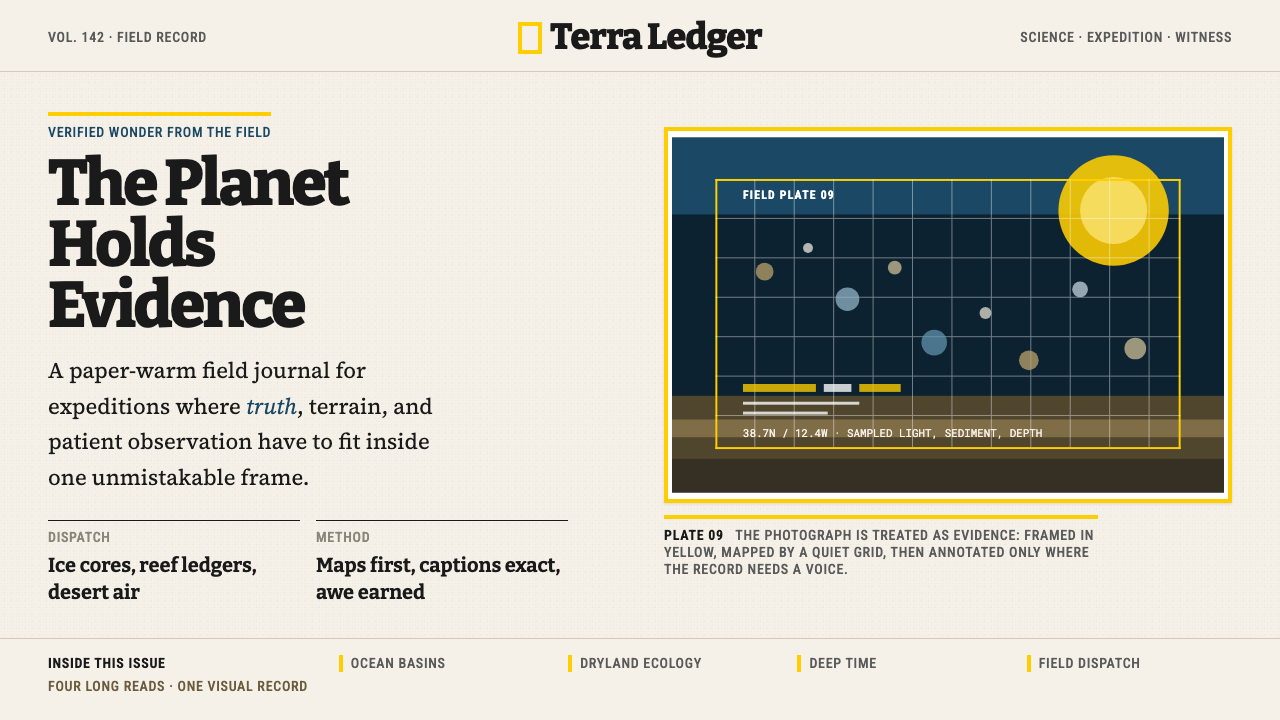 National GeographicAuthority frames wonder. Yellow border, Bitter slab type, and warm paper make…
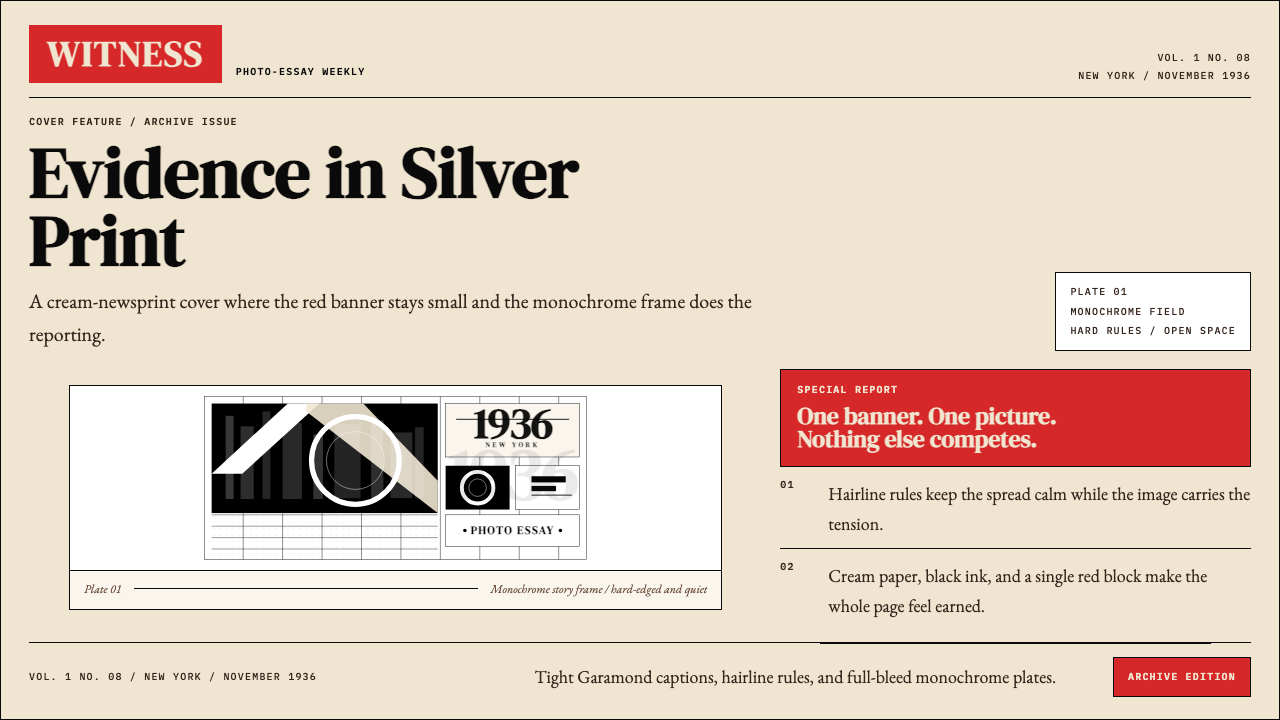 LIFE Magazine (Red-Banner)Photojournalism stripped bare. One red banner, cream newsprint, stark black p…
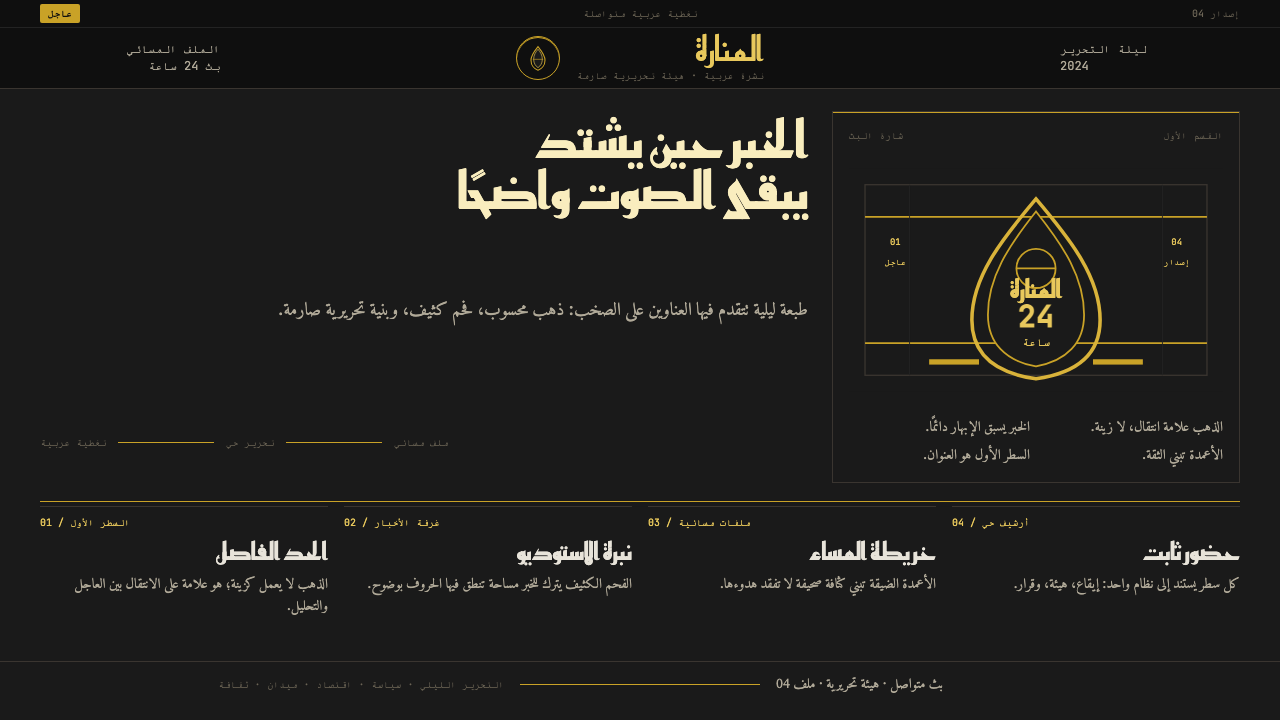 Al Jazeera Arabic NewsAuthority, stripped bare. Gold seal, dense Arabic type, matte charcoal.
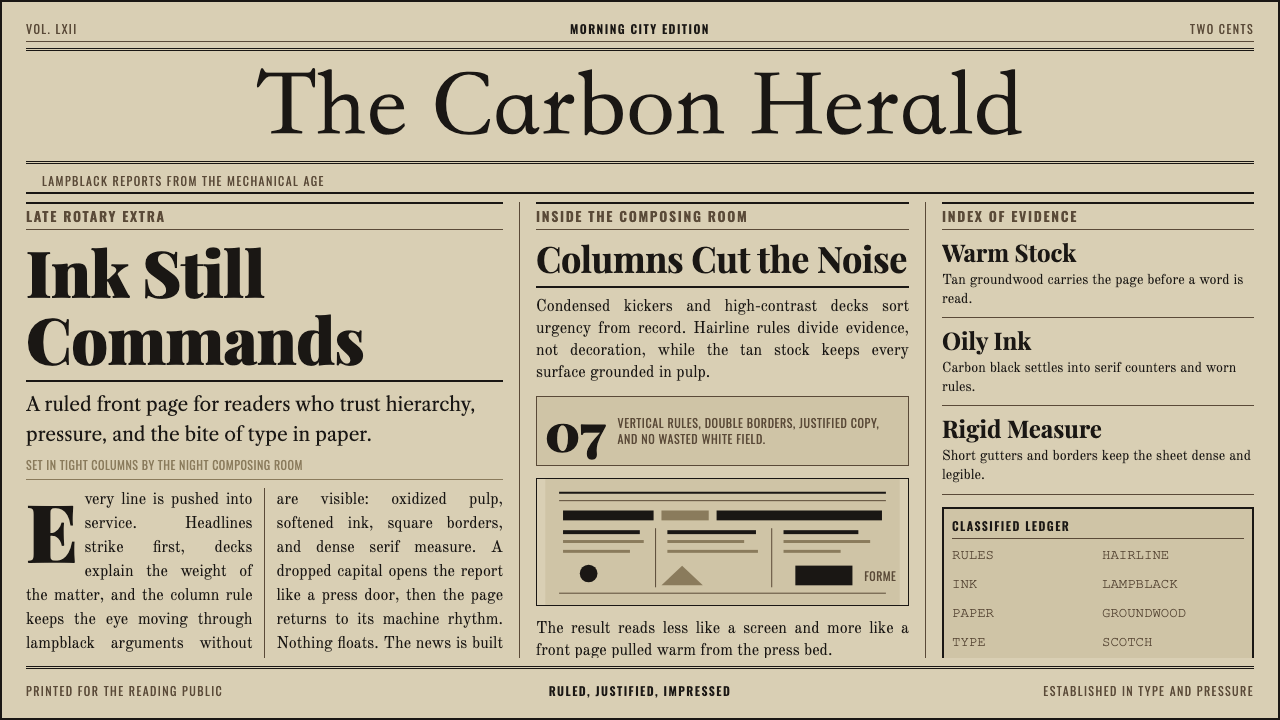 Broadsheet LetterpressAuthority in ink. Lampblack serif decks lock into tan paper with strict ruled…
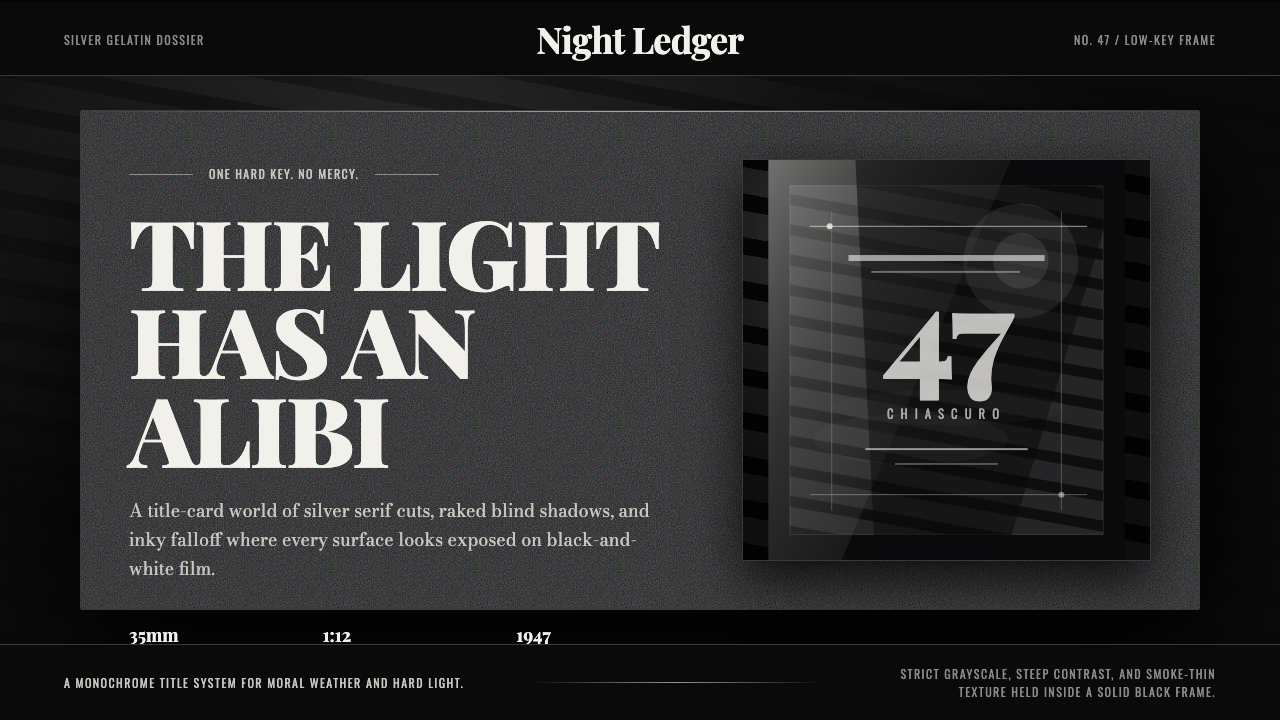 Film Noir ChiaroscuroLight is the crime. Silver serif cards, blind stripes, and grain carve drama…
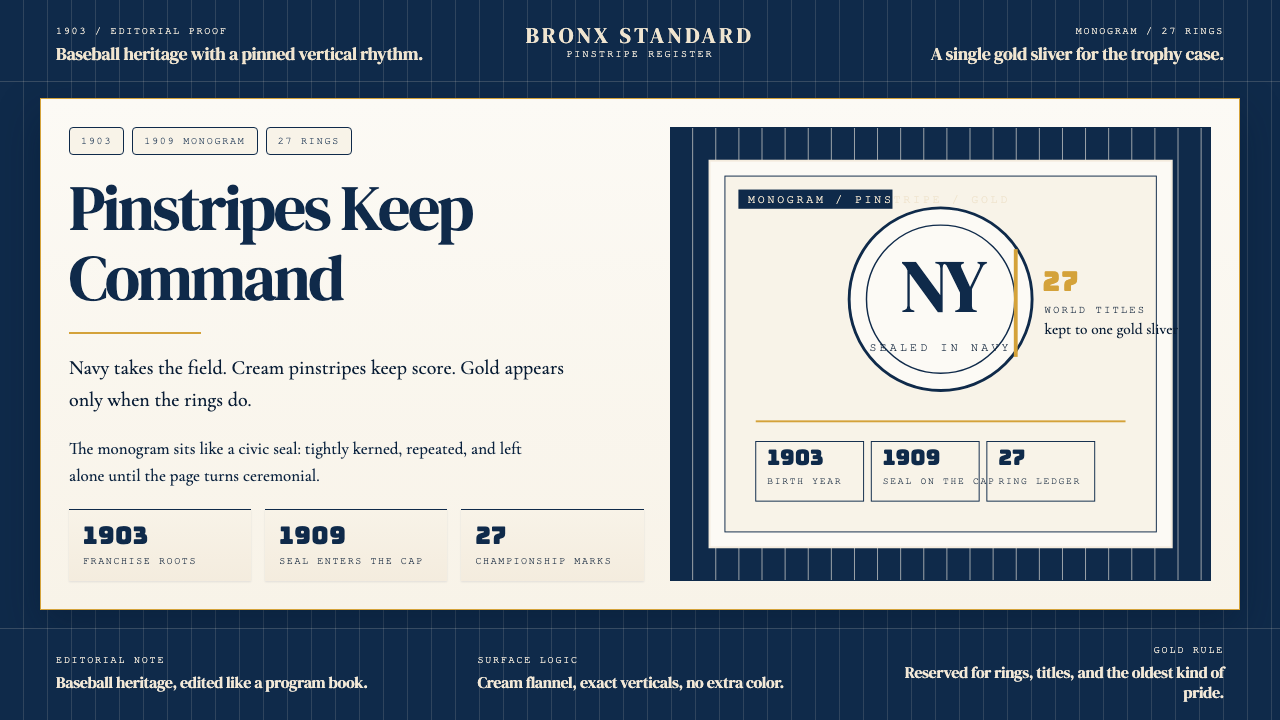 New York Yankees (Navy-Pinstripe)Navy restraint, not noise. Cream pinstripes and a gold monogram seal do the w…