What is National Geographic?
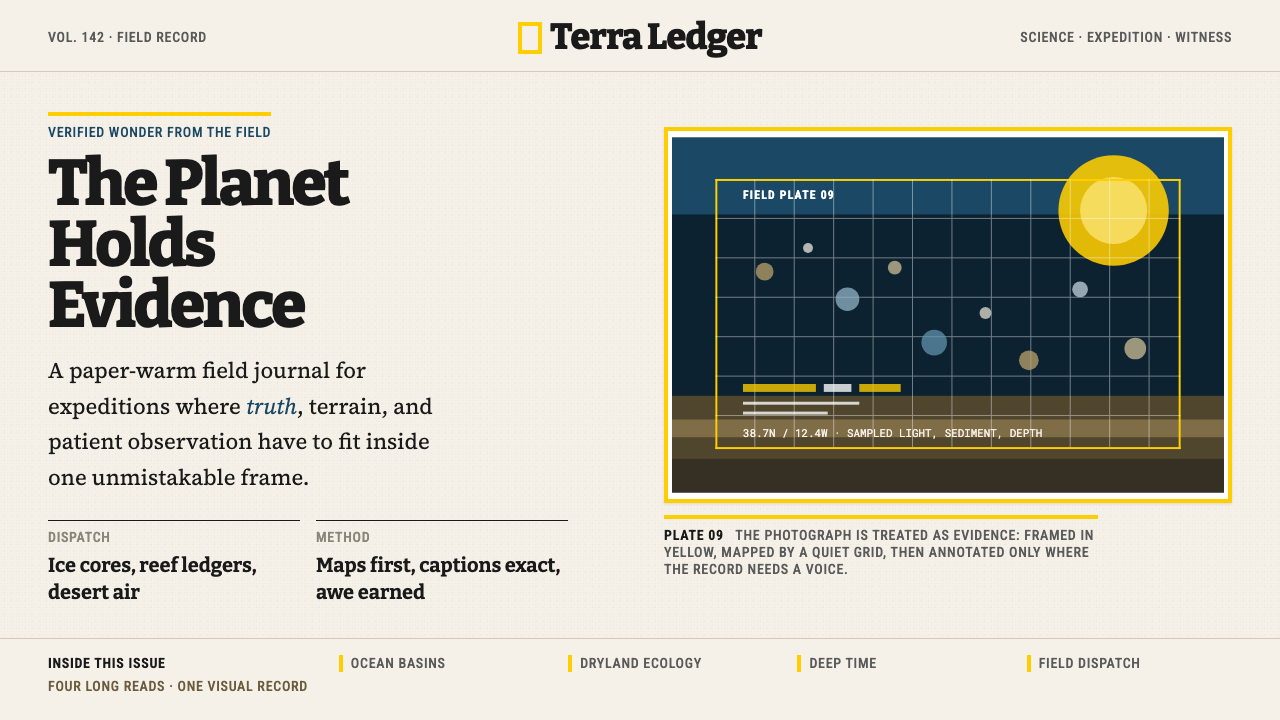
The yellow border is not decoration — it is the oldest, most trusted frame in publishing history, and everything inside it must earn its place.
National Geographic in brief
National Geographic is one of the most recognizable visual systems ever built around a single graphic element. The famous yellow border — a rectangular frame introduced in 1910 on the magazine's cover — has become so closely identified with authority, scientific rigor, and the beauty of the natural world that it functions less like a logo and more like a credential. When the border appears, it signals that what is inside has been verified, that it matters, and that it has been presented with care.
The design language that grew around that border is built on a deliberate tension: maximum photographic drama contained within maximum editorial restraint. Full-bleed imagery of extraordinary quality shares space with dense, authoritative body text set in slab-serif faces that feel both serious and warm. Color in the interface itself is minimal — the yellow is structural, used as a frame or a narrow accent rather than a field, and the grounds are warm off-white rather than clinical white. Chrome is stripped away so that the photograph — always the primary argument — is never competed with.
What distinguishes National Geographic's visual identity from other authoritative editorial brands is that restraint here does not mean coldness. The warm paper tones, the generous leading in body text, and the pairing of a rugged slab-serif headline voice with a highly readable text face all produce a register that feels both expert and inviting — the sensation of being guided through difficult or remote subject matter by someone who genuinely loves it.

Where does National Geographic come from?
The National Geographic Society was founded in Washington, D.C., in January 1888 by a group of thirty-three explorers, scientists, and academics who wanted a formal institution for the promotion of geographical knowledge. The magazine launched the same year, initially as a dry academic journal with no illustrations. For the first two decades, it looked and read like a scholarly proceedings document — dense with text, sparing with images, and concerned primarily with scientific credibility rather than public appeal.
The pivotal transformation came under Gilbert Hovey Grosvenor, who became editor in 1899 and would shape the magazine's voice and visual direction for the next half century. Grosvenor believed that geographic knowledge was not the exclusive property of scientists — it belonged to the curious public — and that photographs were the most powerful instrument for conveying it. He faced institutional resistance: the Society's board initially objected to the extravagant use of imagery as insufficiently serious. Grosvenor persisted, and by the early 1900s National Geographic was publishing large, high-quality photographs of places and peoples that most readers would never visit in person. The readership grew rapidly, and with it the conviction that photography and scientific authority were not in conflict but mutually reinforcing.
The yellow border appeared on the cover in 1910, framing a photograph for the first time and establishing the template that would define the magazine for the rest of the century. The choice of a warm, saturated yellow was not accidental — it has high visibility on newsstands, reads at distance, and conveys warmth and energy without sacrificing the seriousness of the editorial content it contains. Over subsequent decades, the border became such a defining symbol that it was recognized by readers who had never seen the masthead text. The magazine's visual system evolved around protecting and reinforcing what the border signaled: trustworthiness, adventure, and the authority of direct observation.
The modern photographic era of National Geographic is inseparable from the careers of photographers like Steve McCurry, whose 1984 portrait of Sharbat Gula — the Afghan girl with the green eyes — became one of the most widely recognized magazine covers in publishing history, and David Guttenfelder, whose work from North Korea in the 2010s demonstrated that the brand's authority extended into some of the most restricted visual territories on the planet. These photographers and their peers did not simply document; they composed with an editorial rigor that made every frame feel both immediate and permanent. The design system's job was to receive that work and present it without diminishing it — a challenge the yellow border, the slab-serif typography, and the warm editorial grounds have met consistently across more than a century.
What defines the National Geographic look?
The Yellow Border
The defining element of the entire visual system is the rectangular yellow frame used at the cover's perimeter and as a recurring structural accent throughout the brand. The yellow is warm and highly saturated — closer to a golden amber than a primary process yellow — and it is used exclusively as a line, a border, or a narrow band rather than a surface fill. Its structural role is to contain and to credential: whatever it surrounds is implicitly marked as verified and significant. When used as an accent inside layouts, it draws the eye to the element of highest editorial priority without competing with the photography.
Photography as Primary Argument
Unlike design systems that treat photography as decoration or supporting evidence, National Geographic is built on the premise that the photograph is the primary argument and everything else — type, borders, white space, captions — exists to serve it. Imagery is used full-bleed when the composition warrants it, filling the entire available surface without margins. When cropped, photographs are cropped with editorial precision: framing tightens around the subject of maximum significance. The design never competes with the image by layering text or graphic elements over the most important areas of the frame.
Slab-Serif Authority
The typographic register is anchored in slab-serif display faces for headlines and prominent labels — a category of letterform with thick, bracketed serifs that project authority, legibility at size, and a faint historical resonance with newspaper and scientific publication traditions. Body text is set in a highly readable serif with generous leading, creating density without fatigue. The overall typographic voice sits between the formal seriousness of academic publishing and the directness of longform journalism: knowledgeable but not forbidding, precise but not clinical.
Warm Paper Ground
Where the background is not photographic, it is warm: an off-white that reads as aged paper or natural parchment rather than digital white. This ground temperature is one of the most important and most frequently overlooked aspects of the system. It gives the typography and the yellow accent a tactile, material quality that pure white would destroy. It also provides continuity with the magazine's print heritage — the sense that you are reading something that could exist as a physical object of weight and permanence, not a screen artifact. Applied to UI or presentation contexts, this ground immediately distinguishes the look from sterile digital minimalism.
Controlled Color Economy
Outside the yellow of the border and the warmth of the ground, color in the National Geographic system comes primarily from photography rather than from the graphic layer. Interface and typographic elements are restricted to the yellow, near-black for text, and warm neutrals for backgrounds and dividers. This discipline prevents the graphic system from competing with the photographs, which carry their own complex and unpredictable color worlds. The restraint also has a concentrating effect: when yellow appears as a rule or a label accent against a warm-white field, it carries disproportionate visual weight relative to its surface area, making it an efficient signal.
Dense, Credentialed Captions
Captions in the National Geographic system are not afterthoughts — they are editorial units in their own right. They run long by the standards of most publications, providing geographic context, scientific framing, and occasionally biographical or historical background that the image alone cannot supply. Typographically, captions sit in a size and weight that is clearly subordinate to body text but not dismissibly small; they are meant to be read, not scanned. This approach to captioning signals that the visual system respects the reader's curiosity and treats the photograph as the beginning of a story rather than its entirety.
Grid Discipline with Breathing Room
National Geographic layouts are organized on a consistent editorial grid, but the grid is used generously rather than with maximum density. Text columns are set at comfortable measures with adequate margins, and the space around photographs is treated as active — necessary room for the eye to rest before engaging with the next element. This contrasts with the maximally compressed layouts common in tabloid or commercial publishing. The sense of spaciousness is part of what communicates quality and seriousness: content that has been selected and curated does not need to compete for attention by crowding.

Who shaped National Geographic?
Grosvenor served as editor of National Geographic Magazine from 1899 to 1954 — a tenure of fifty-five years that makes him the longest-serving editor in the magazine's history and one of the most influential editors in the history of American journalism. He transformed the publication from an academic journal with a few hundred subscribers into a mass-market institution read by millions. His central editorial conviction — that photographs could make distant places and scientific ideas legible and compelling to non-specialist readers — established the template for what the magazine would become visually and editorially. He advocated for larger, better-reproduced photographs at a time when this was considered wasteful and insufficiently serious, and he was proven correct by the subscription figures. The visual identity that still defines the brand is largely his construction.
McCurry is the photographer most closely identified with National Geographic's visual legacy in the late twentieth century. His 1984 portrait of Sharbat Gula, a young Afghan refugee whose green eyes gazed directly into the camera against a dark ground, appeared on the June 1985 cover and became arguably the most recognized magazine cover image ever published. The photograph exemplifies the magazine's visual philosophy: a single human subject, framed with intensity, lit with precision, and composed so that the yellow border around it feels like the only appropriate container for what it holds. McCurry's work across Asia, the Middle East, and conflict zones demonstrated the capacity of the National Geographic visual system to frame human experience with both documentary rigor and visual poetry.
Guttenfelder represents the National Geographic photographic tradition in the digital era, and his career demonstrates how the magazine's visual authority has extended into new kinds of access and new distributional contexts. His sustained documentary work in North Korea — one of the most visually restricted countries in the world — produced images that carried the brand's credential of direct observation into territory where very few outside photographers had worked. Guttenfelder also became one of the earliest photojournalists to use mobile and social platforms as primary distribution channels, bringing the National Geographic visual ethic — environmental scale, human presence, color discipline — into the feed alongside very different visual registers.
Marden worked for National Geographic from 1934 to 1976 and was among the first photographers at the magazine to use 35mm color film extensively — a technical shift that fundamentally changed what the publication could do visually. Before small-format color film, the magazine's photographs were largely formal and static, constrained by the logistics of large-format equipment. Marden's advocacy for and mastery of the new format enabled the immersive, dynamic, intimate photography that came to define the magazine's midcentury golden age. He was also a gifted writer and underwater photographer, and his discovery of the wreck of HMS Bounty in 1957 exemplifies the combination of scientific curiosity and adventurous access that the National Geographic brand has always sought to represent.
How do you use National Geographic today?
The National Geographic visual system translates well into contemporary design contexts precisely because its logic is content-first rather than style-first. Applying it correctly means beginning with a question about the material: what is the most powerful image or piece of evidence available, and how do we build the surrounding layout to serve it rather than compete with it? In contexts where you have strong photographic or documentary assets, this system will dramatically amplify them. In contexts where imagery is generic or absent, the system will feel hollow — the yellow border without a powerful photograph inside it is a credential without a claim.
For presentation slides, the National Geographic approach works most powerfully on cover and section divider pages. A cover slide benefits from a full-bleed photograph that fills the entire surface, with the title in a slab-serif face positioned over a portion of the image where contrast is naturally high, and a yellow rule or border element providing structural separation between the title and any subtitle. Content slides should be treated with similar restraint: one or two strong data visualizations or quotations per slide, generous white or off-white margins, and captions or source attributions that are typographically visible rather than hidden in a footnote scale. Data slides take on a journalistic quality — present one clear finding per slide with enough context in the caption that the slide makes sense without the presenter speaking.
For web dashboards and product interfaces, the system is particularly effective on pages where credibility and information density must coexist. A dashboard in this register uses a warm off-white ground rather than pure white or dark grey, reserves yellow exclusively for the highest-priority status indicators or calls to action, and sets all metrics and labels in a slab-serif or authoritative serif that gives numbers a sense of weight and reliability. Navigation should be editorial in feel — text-first, with minimal iconography, organized around content categories rather than feature labels. Pricing pages benefit from the system's natural ability to signal tiers through typographic hierarchy and controlled use of the yellow accent without needing gradient backgrounds or decorative badges.
For editorial layouts, marketing materials, and printed reports, the National Geographic system offers a powerful template for long-form content that needs to hold attention across many pages. Body text should be set at a comfortable reading size with generous line height, in a serif face that has been optimized for extended reading rather than display impact. Pull quotes and callout statistics should be set large and in the slab-serif headline face, using scale and weight rather than color to signal their importance. Section breaks are most effectively marked by a thick horizontal rule in yellow or a full-bleed photographic opener rather than decorative ornament. The warm off-white paper ground, if applied consistently to printed materials, gives the document a tactile authority that pure white cannot match.
The most common mistake when applying this system is using the yellow as a fill color rather than a line or border element. A yellow background panel, a yellow button with full fill, or a yellow card background all immediately violate the logic of the system and produce something that looks promotional rather than authoritative. A related error is using photography decoratively — as texture or background fill — rather than as the primary subject of its frame. A blurred or overlaid photograph serves no editorial purpose in this system; if a photograph cannot be used at sufficient size and clarity to stand on its own, a typographic or abstract treatment will serve the system's values better than a decorative photographic treatment.

National Geographic — FAQ
Can the National Geographic style work without strong photography?
It can work, but it requires a deliberate substitution. The system is designed around photography as the primary argument, so when photography is absent or weak, something else must carry that load. The most successful substitutions are large-scale data visualization treated with the same compositional seriousness as a photograph — a well-crafted map, a precisely rendered diagram, or an infographic built to the same quality bar as the editorial imagery. Generic stock photography, illustration used decoratively, or no imagery at all will leave the yellow border feeling like an empty credential. If you have no strong visual asset, lean into the typographic authority of the system: large slab-serif type, generous spacing, and disciplined hierarchy can produce a credible result even without photography.
How does National Geographic style differ from other authoritative editorial brands like The Economist or Time?
All three are editorial authority systems, but they achieve authority through different means. The Economist is typographic authority — its power comes from density, from the refusal of photographs on the cover for most of its history, and from the confidence of words alone. Time is cover-photograph authority combined with bold red masthead — the cover functions as a verdict, and the visual system supports that declarative quality. National Geographic is photographic-scientific authority — the yellow border frames the evidence, and the system's visual warmth signals that the subject matter has been inhabited rather than merely observed from a distance. In application, The Economist style suits contexts where data and argument are paramount; Time style suits contexts of cultural currency and moment; National Geographic style suits contexts of deep subject expertise and sensory richness.
Is it appropriate to use the National Geographic style for dark-mode interfaces?
A dark inversion is possible but requires significant care. The system's warmth — one of its most important qualities — is much harder to maintain on a dark ground. A cold dark grey background immediately loses the paper-temperature quality that distinguishes this style from generic digital minimalism. If a dark version is needed, the background should be a very dark warm brown or near-black with a warm undertone rather than a neutral or cool grey. The yellow accent remains functional in a dark environment, but its behavior changes: on a light ground it reads as a structural mark, on a dark ground it tends to dominate and can easily become the focal point of the layout rather than a frame. Use yellow even more sparingly in dark contexts, and allow photography to provide most of the warmth and color that the ground cannot supply.
How should data visualizations be styled within this system?
Data visualization in the National Geographic system should be treated with the same seriousness as photography: a chart or map is a form of evidence, and it should be composed and labeled to stand on its own without the body text explaining it. Maps are the most natural visualization type for this system — they have an inherent editorial authority and a visual scale that pairs naturally with full-bleed photography. Charts should use the warm ground as their canvas, restrict color to the yellow accent for highlights and near-black for the primary data series, and reserve additional color only for a second clearly distinct category. All data labels and axis text should be set in the same typographic register as the editorial text — readable, authoritative, with no decorative chart furniture. A common error is using bright multicolor palettes on charts within this system; the restraint of the editorial color discipline must extend to the data layer.
What types of brands or products are a poor fit for this style?
National Geographic style struggles in contexts that require lightness, playfulness, or sensory comfort rather than authority and wonder. Consumer brands in categories like food delivery, social networking, casual gaming, or children's products will feel mismatched — the system's gravitas and density will read as heavy or even intimidating rather than inviting. Fashion and beauty brands that depend on sleekness, neutrality, or sensual softness will find the slab-serif warmth and journalistic structure too editorial in tone. Fintech and software-as-a-service products aimed at a broad consumer audience often prefer interfaces that feel lighter and more immediate; the National Geographic register can feel too serious or too print-influenced for contexts where users expect digital-native visual idioms. The style is best reserved for brands or products where deep subject matter expertise, trustworthy evidence, and a sense of earned wonder are central to the value proposition.
Related design styles
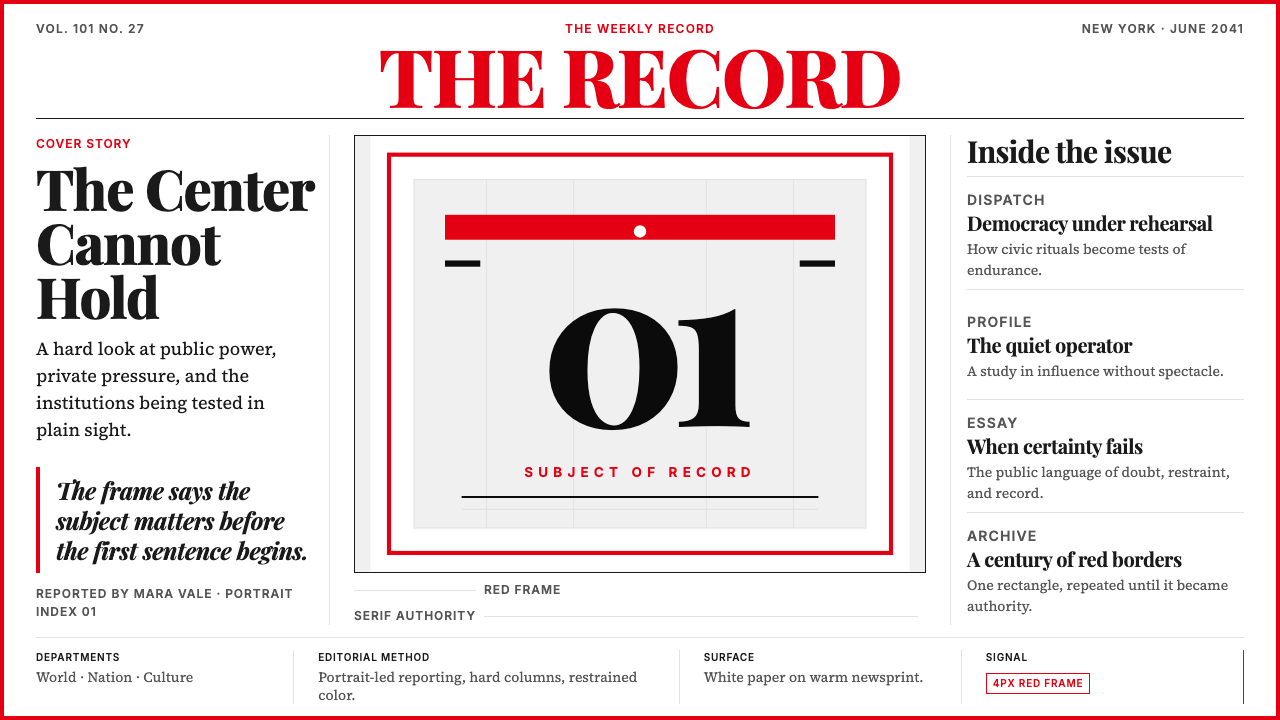 TIME MagazineAuthority in a red rectangle. Didone masthead, black-white columns, and a 4px…
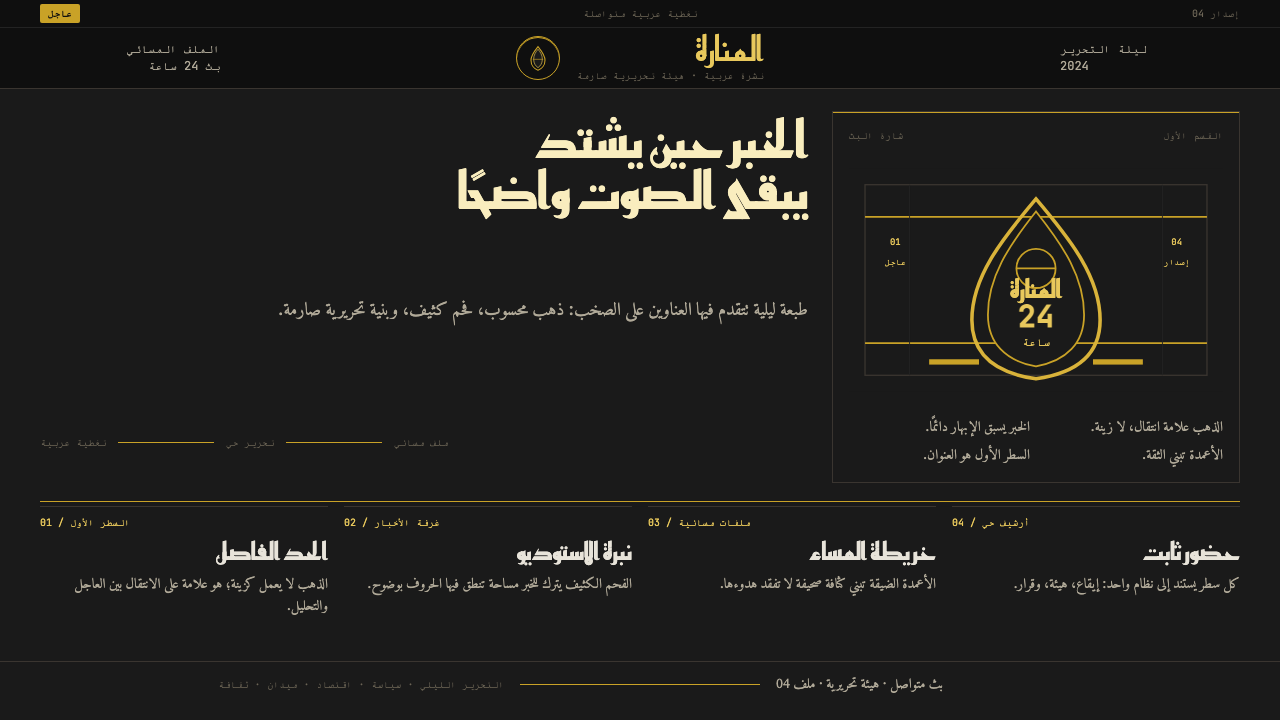 Al Jazeera Arabic NewsAuthority, stripped bare. Gold seal, dense Arabic type, matte charcoal.
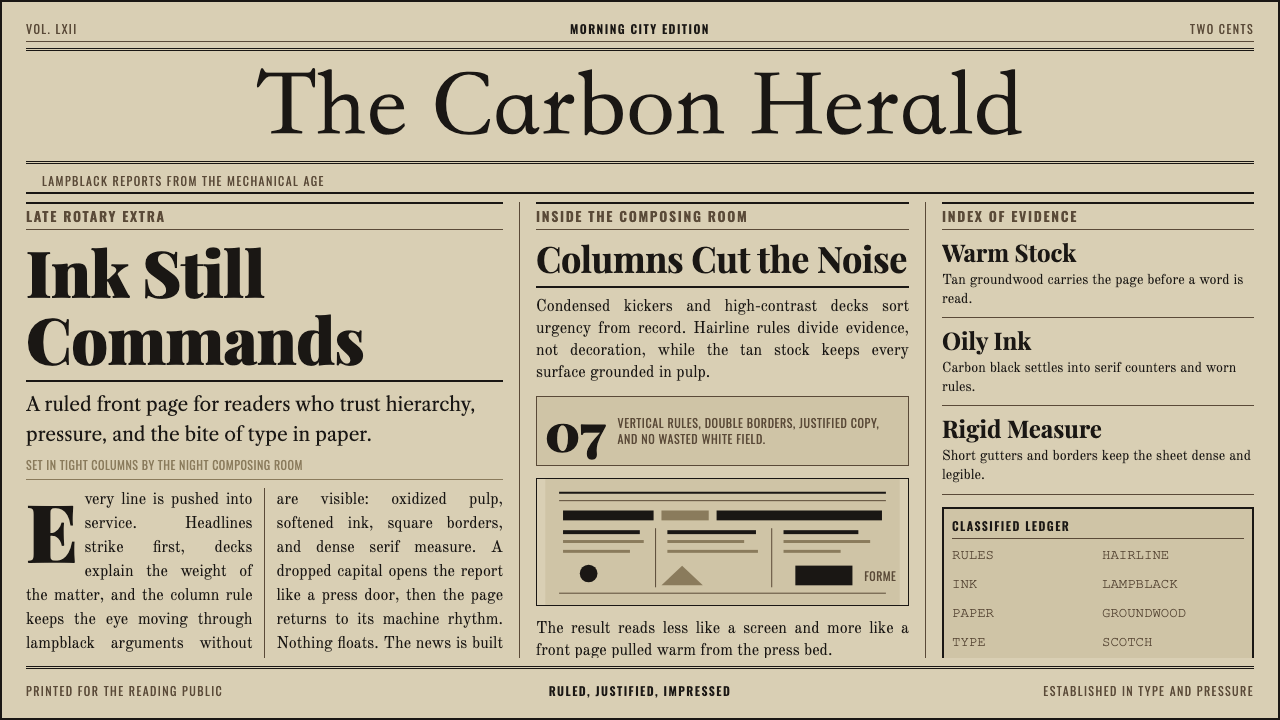 Broadsheet LetterpressAuthority in ink. Lampblack serif decks lock into tan paper with strict ruled…
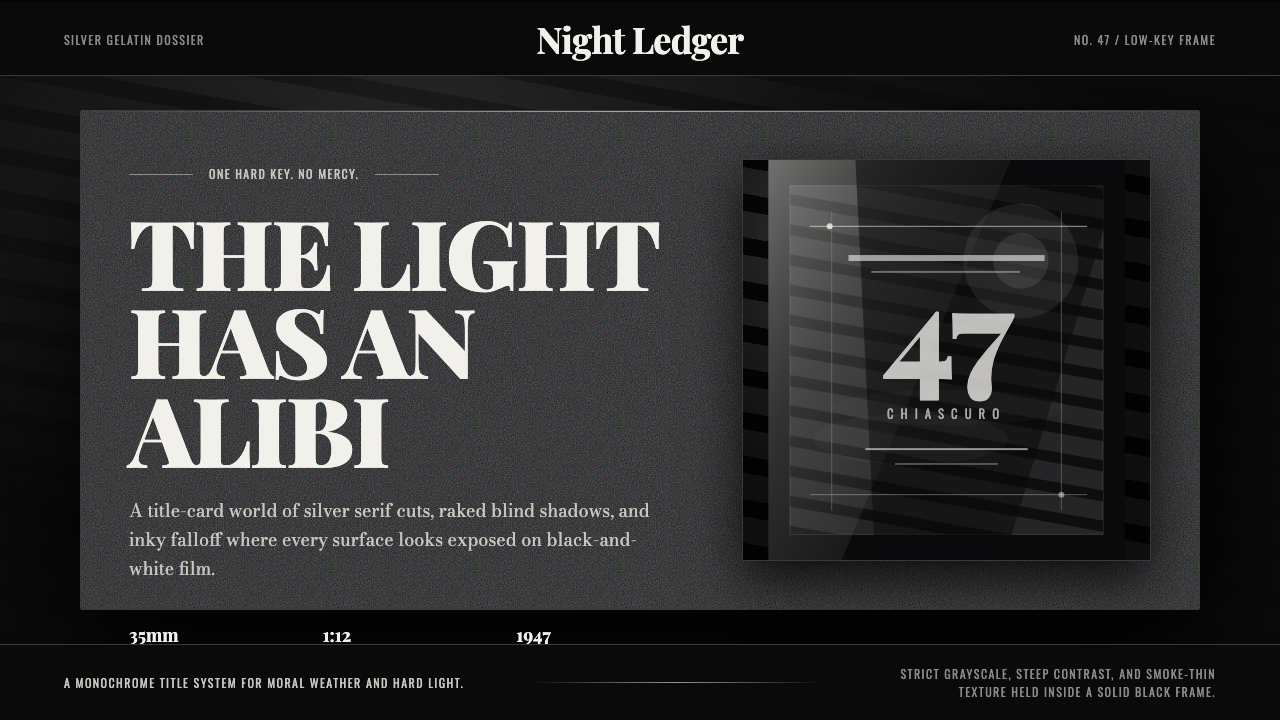 Film Noir ChiaroscuroLight is the crime. Silver serif cards, blind stripes, and grain carve drama…
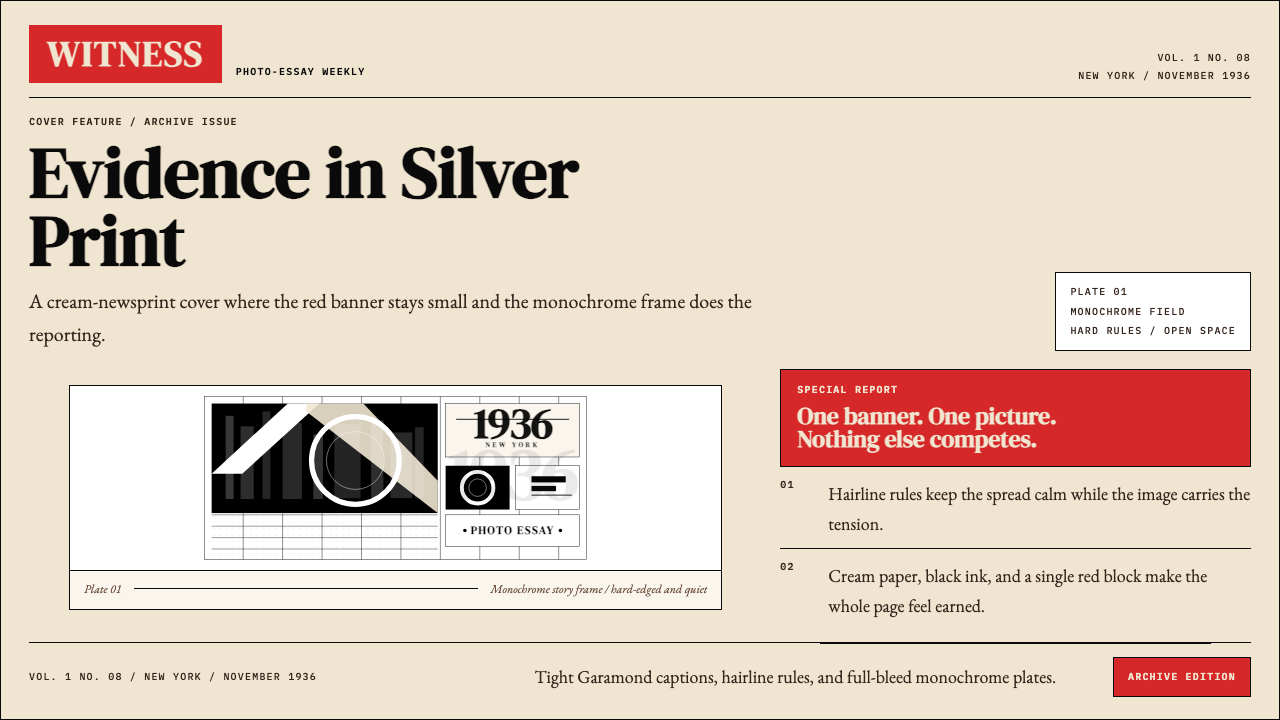 LIFE Magazine (Red-Banner)Photojournalism stripped bare. One red banner, cream newsprint, stark black p…
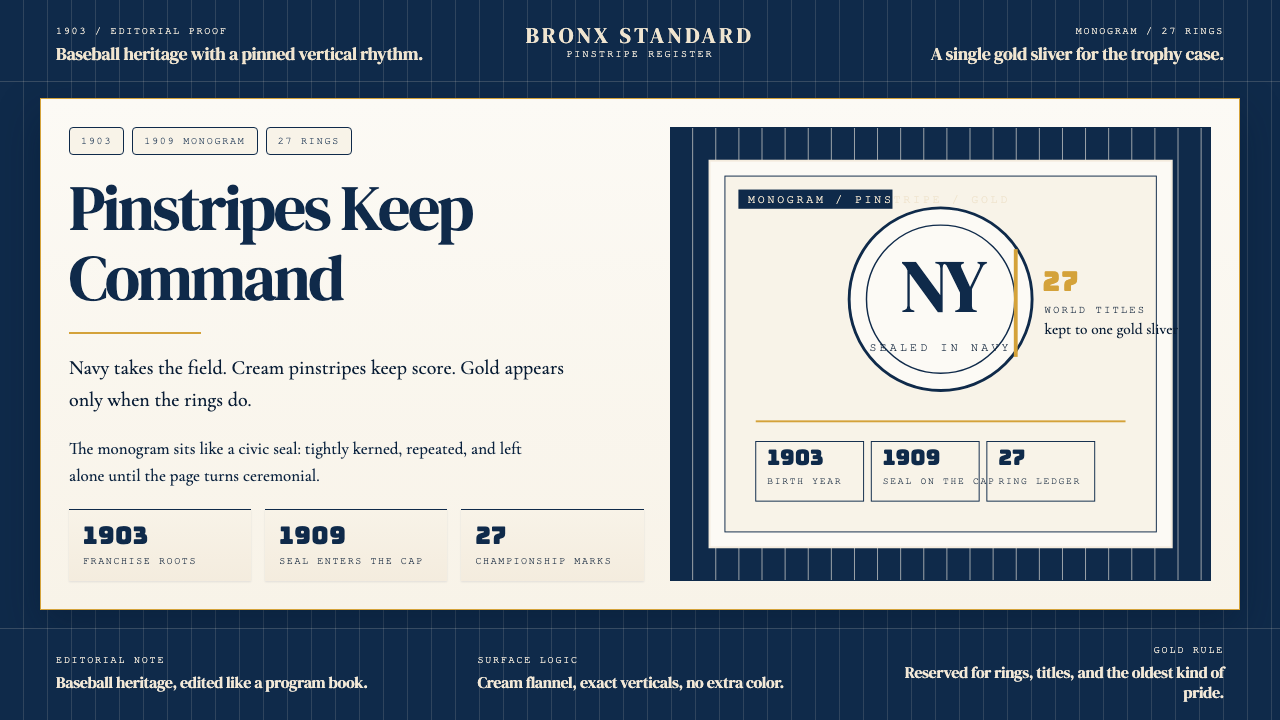 New York Yankees (Navy-Pinstripe)Navy restraint, not noise. Cream pinstripes and a gold monogram seal do the w…