What is Al Jazeera Arabic News?
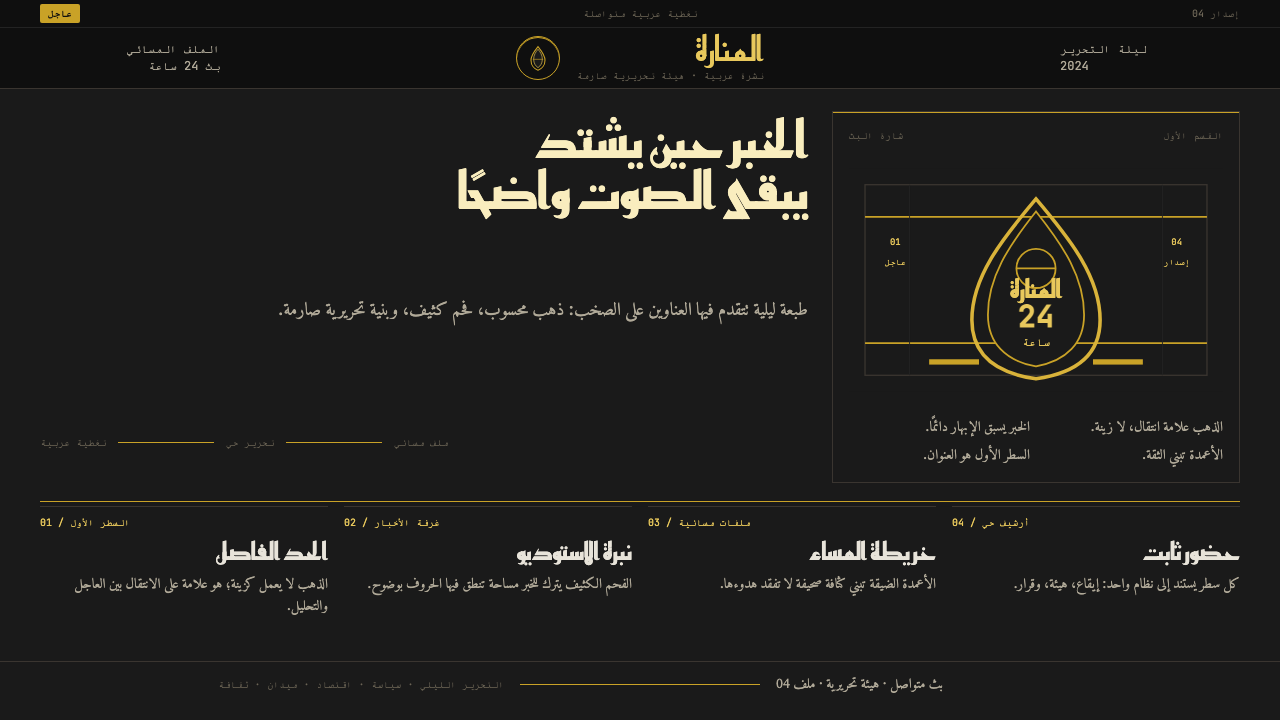
A burnished-gold seal on matte charcoal — Al Jazeera's visual language turned Arab broadcast journalism into a global grammar of authority and restraint.
Al Jazeera Arabic News in brief
Al Jazeera Arabic News is a broadcast and digital visual identity built on the principles of editorial authority, typographic density, and chromatic restraint. Its defining image is a dark, near-matte ground — charcoal rather than pure black — set against which a single burnished-gold accent carries all symbolic weight. The palette refuses the saturated reds and whites common to Western news brands and instead builds tension through the contrast between the depth of the ground tone and the warmth of gold.
The typography is the system's structural backbone. Arabic calligraphic traditions are honored not through decorative letterforms but through dense, broadsheet-scale setting: tight line spacing, authoritative weight, and columns that feel like the printed page of a serious newspaper. Every headline is an event. Body text is treated as continuous, uninterrupted information flow — no pull-quotes for decoration, no callout boxes breaking the cadence.
What distinguishes the Al Jazeera aesthetic from other dark-ground broadcast identities is its economy of signal. The iconic teardrop logo mark and the gold section rule do not compete with the content — they orient the viewer and then step aside. This discipline reflects a newsroom philosophy: the story is the authority, and the design exists only to deliver it with maximum legibility and minimum distraction.

Where does Al Jazeera Arabic News come from?
Al Jazeera launched in November 1996 from Doha, Qatar, funded by Sheikh Hamad bin Khalifa Al Thani, who had recently become Emir of Qatar following a bloodless palace coup. The channel's founding coincided with a moment of acute tension in Arab media: state broadcasters across the region operated as direct organs of government censorship, and the appetite for independent pan-Arab journalism was enormous. Al Jazeera stepped into that vacuum with a mandate for editorial independence that was, at the time, genuinely unprecedented in the Arab world.
The early visual identity was shaped by the imperatives of the satellite broadcast context of the late 1990s. Broadcast graphics of that era were constrained by the technical limits of standard-definition transmission: fine detail bled, subtle color distinctions collapsed, and legibility at small sizes was paramount. Al Jazeera's solution — a high-contrast ground, a boldly weighted typeface for Arabic text, and a restrained gold accent — was as much an engineering response as an aesthetic one. The charcoal-and-gold scheme proved exceptionally stable across different transmission qualities and screen technologies.
The figure of Wadah Khanfar, who served as director-general from 2003 to 2011, was central to the channel's editorial maturation during the years when its visual identity became globally recognized. Under his tenure, Al Jazeera's coverage of the Iraq War, the Palestinian conflict, and the early phase of the Arab Spring established the channel's authority as a primary source — not merely a regional broadcaster. The visual system had to carry that authority, and the refinement of the identity during this period emphasized gravity over novelty: darker grounds, tighter typographic control, and a more disciplined restriction of the gold accent to structurally necessary roles.
The 2020–2024 visual refinement cycle modernized the system for high-definition and streaming contexts while preserving its essential DNA. The teardrop logo mark — derived from a stylized Arabic letter, a form simultaneously calligraphic and abstract — was refined for vector sharpness at all scales. The gold was recalibrated to read consistently across the expanded range of display technologies from OLED studio monitors to mobile screens viewed in daylight. The broader Gulf-funded media renaissance of this period, in which Qatar positioned itself as a hub of regional soft power, gave Al Jazeera's visual identity renewed strategic significance beyond mere broadcast branding.
What defines the Al Jazeera Arabic News look?
Ground Tone
The dominant background is a deep charcoal — not the absolute black of cinema or luxury goods branding, but a tone that retains warmth and surface without becoming brown or grey. This choice is deliberate: pure black tends to flatten elements against it, while the charcoal ground creates a subtle spatial depth that allows foreground elements — type, rules, the logo — to appear to sit above the surface rather than on it. In motion graphics, this depth is reinforced by the slight luminosity of the gold as it moves across the ground.
Gold as Structural Signal
Gold is the system's single accent color, and it is used with strict economy. It marks the teardrop logo, horizontal section rules, and the occasional headline emphasis — nothing more. This restraint is what gives the gold its authority: when it appears, the viewer's eye goes there immediately, because it is the only warm element in an otherwise cool, dark field. Decorative use of gold — as a background wash, as a gradient, as a frame ornament — is entirely absent. The metal earns its presence through structural necessity alone.
Arabic Typographic Density
The typography draws on the tradition of the Arabic broadsheet: dense, tightly set, with headlines that command the full width of the column. Arabic script's connected letterforms and the right-to-left reading direction create a natural visual texture that is richer than Latin equivalents at comparable settings. Al Jazeera's typographic system leans into this density rather than loosening it for legibility. The result is a visual weight that signals seriousness — this is the typography of an institution, not a publication optimized for casual reading.
Calligraphic Logo Mark
The teardrop logo is the system's most compressed formal statement. It reads simultaneously as an abstract geometric form and as a stylized Arabic letterform, bridging the calligraphic tradition and a modernist vocabulary of simple, scalable shapes. At small sizes it holds its legibility because it has been refined to its simplest possible execution; at large sizes it reveals the calligraphic gesture at its origin. This dual legibility across scales is a mark of identity design of the first order.
Motion as Revelation
In broadcast, the identity's most distinctive character emerges in motion: the gold mark glides or resolves onto the charcoal field, rules slide into position, and type fades up with deliberate weight. The motion language is not kinetic for its own sake — every transition serves to introduce or conclude information. Speed is measured. There are no bounce effects, no particle systems, no lens flares. The broadcast aesthetic carries the same principle as the static design: authority is quiet, and what moves should move because it must.
Information Hierarchy Without Decoration
The screen layout establishes hierarchy through type scale, rule weight, and spatial position alone. A banner headline sits at a different scale from a ticker; the gold horizontal rule marks the boundary between the broadcast logo zone and the content field; chyron text sits in a designated lower-third area with no gradient overlay or drop shadow to lift it. Each element knows its place, and that place is defined by structure rather than by visual elaboration. The discipline is closest in spirit to the editorial design of a serious broadsheet newspaper: everything earns its position.
Cross-Media Stability
One of the system's most underappreciated qualities is its stability across radically different output contexts. The charcoal-and-gold language reads with equal authority on a studio broadcast monitor, a mobile news feed, a billboard-scale out-of-home display, and a printed magazine supplement. This stability is a direct consequence of the system's economy: because the visual identity depends on contrast between two tones rather than on fine gradients, photography, or complex illustration, it degrades gracefully at lower resolutions and reproduces reliably in partial-color environments.

Who shaped Al Jazeera Arabic News?
As the founding patron of Al Jazeera, Sheikh Hamad provided the political will and financial backing that made an independent pan-Arab news channel possible at a moment when no such thing existed. His decision to fund the channel without demanding editorial control was the single most consequential structural choice in Al Jazeera's history — it created the conditions under which a genuine editorial identity, and by extension a genuine visual identity, could develop. The channel's authority is inseparable from the credibility that independence conferred.
Khanfar served as director-general from 2003 to 2011, the decade during which Al Jazeera's global identity was most intensely forged. His tenure encompassed the Iraq War coverage that brought the channel to the attention of Western media critics and policymakers, and the early Arab Spring broadcasts that demonstrated its position as the region's primary source for breaking news. The visual gravity of the identity as it is recognized today — the insistence on restraint, the authority of the dark ground — was consolidated during his leadership.
Al-Dosari's contributions to the channel's editorial and production infrastructure helped translate the foundational editorial principles into consistent on-air execution. In broadcast identity, the distance between a design specification and a reliably consistent on-air product depends entirely on production discipline and institutional culture — the kind of sustained attention to detail that keeps a visual system coherent across thousands of hours of live programming. His role represents the operational dimension without which any visual identity remains theoretical.
Al Jazeera did not emerge in isolation — it was the defining institution of a broader movement of pan-Arab broadcast journalism that sought to serve Arabic-speaking audiences across national boundaries with shared news, shared analysis, and a shared visual grammar. The 24-hour news cycle format, imported from CNN and BBC World Service models, was adapted to Arabic-language contexts with editorial priorities — geopolitics, the Palestinian question, intra-Arab affairs — that Western channels had long underserved. The visual identity is inseparable from this editorial mission: it looks the way it does because it is designed to carry news that its audience takes seriously.
How do you use Al Jazeera Arabic News today?
The Al Jazeera Arabic News aesthetic is among the most purposeful dark-ground visual systems available to contemporary designers. Applying it correctly means understanding its underlying logic: authority comes from restraint, not from accumulation. Every element added to a composition that is not structurally necessary dilutes the gravity of every other element. The system works because it refuses to compete with itself.
For presentation slides, the style is most powerful on cover and chapter-break pages. A cover built in this aesthetic should feature the charcoal ground at full field, a single large headline set in a weighty Arabic-inspired or broadly architectural typeface, and a single gold horizontal rule as the only decorative element. Supporting content slides benefit from the same discipline: type hierarchy defined entirely by scale and weight, no background patterns, no gradient fills, data visualizations treated as geometric objects against the dark ground. The gold should appear in a chart bar, a highlighted row, or an annotated data point — never as a background wash.
For web interfaces, this visual language translates most naturally to editorial dashboards, news aggregators, and any platform where the content itself is the primary visual element and the interface must recede. The approach: a near-charcoal surface for the main content container, near-white or very light warm-toned text for body copy, a single gold accent for interactive states and primary action buttons, and typographic hierarchy established through scale alone. Navigation bars should feel institutional — wordmarks, category labels, no rounded corners or playful icon sets. Card components use the gold rule as a top border to signal category or priority, never as decoration.
For editorial and marketing applications, the system supports strong poster-level communication. A full-width hero section with charcoal ground and a large headline set in a bold, architecturally weighted typeface will communicate authority across virtually any subject matter. Section breaks on long-form article pages should use the gold horizontal rule — not a decorative flourish but a structural caesura, the way a broadsheet newspaper uses a printed rule to separate sections. Marketing materials for platforms, conferences, or institutional publications benefit from the deliberate pacing of this aesthetic: one message per visual field, delivered with maximum weight.
A common error when working in this aesthetic is treating the gold accent as generously available — using it to highlight three or four different types of elements simultaneously. When gold appears everywhere, it marks nothing. The discipline of the Al Jazeera system is that gold appears in at most two roles in any given composition: the logo mark and one structural signal. A second frequent mistake is softening the dark ground with gradients or texture overlays in the belief that it will add visual richness. It removes gravity instead. The authority of the charcoal field depends entirely on its being read as a single, resolved, unwavering tone.

Al Jazeera Arabic News — FAQ
Can this aesthetic work for light-background digital products?
A direct inversion — placing charcoal type and gold accents on a near-white ground — is structurally possible and retains much of the typographic authority. However, the specific sense of gravitas created by the dark ground is lost, because the charcoal-on-white reading carries associations with general editorial design rather than the specific weight of broadcast journalism. If a light-background application is necessary, the most effective approach is to preserve the economy of the gold accent (still appearing in at most two roles), maintain the typographic density, and use the gold horizontal rule to carry the identifying signature. The result will be authoritative but warmer than the canonical dark-ground version.
How does this style differ from other dark-ground news aesthetics, such as those used by BBC or CNN?
Western broadcast news identities built on dark grounds typically use saturated primaries — BBC red, CNN red — as their dominant accent, creating an urgency and immediacy that reads across cultures. Al Jazeera's gold accent is warmer, more restrained, and culturally specific: gold carries weight in the Gulf context as a marker of authority and value. Western news aesthetics also tend toward higher contrast, faster motion transitions, and more aggressive use of animated lower-thirds. Al Jazeera's system is measurably more deliberate: slower reveals, wider margins around type, and a single accent rather than two or three. The result is an aesthetic that prioritizes gravity over urgency — a different editorial posture entirely.
Is this a style that works only for journalism and news, or can it transfer to other domains?
The core values of the aesthetic — authority, restraint, typographic density, and the economy of a single warm accent against a dark field — transfer well to any domain where the content is serious and the institution behind it wants to communicate credibility rather than approachability. Financial services, legal technology platforms, government-facing digital tools, academic publishing, and high-stakes conference identity design all have requirements that align with these values. The aesthetic would struggle in domains that need to communicate warmth, playfulness, or sensory pleasure: consumer food and beverage, children's education, wellness and health applications, or any context where the user relationship depends on emotional invitation rather than institutional trust.
How should photography and imagery be handled within this visual system?
Photography in the Al Jazeera aesthetic is treated as a factual element rather than an atmospheric one: images are cropped tightly to their subject, run at full bleed or against the charcoal field without decorative framing, and are not filtered or color-graded to harmonize with the palette. The design system does not try to absorb photography into itself. Instead, the image and the typographic system coexist with clear visual separation — the gold rule or the charcoal surround marks the boundary. Composite illustration, decorative stock photography, or heavily processed images with stylized color grading are incompatible with the system's editorial integrity.
What is the most important single discipline to internalize when applying this style?
Economy of signal: every element in the composition should be doing only one job, and no job should be done by more than one element. When two elements compete for the same role — two gold accents marking two different types of priority, two type sizes claiming the same hierarchical level — the system loses coherence and the authority dissolves. The Al Jazeera aesthetic depends on the viewer trusting that every visual decision is deliberate and that its meaning is unambiguous. That trust is earned by never being redundant. The gold means what it means because it means only that. When you add a second meaning, you destroy both.
Related design styles
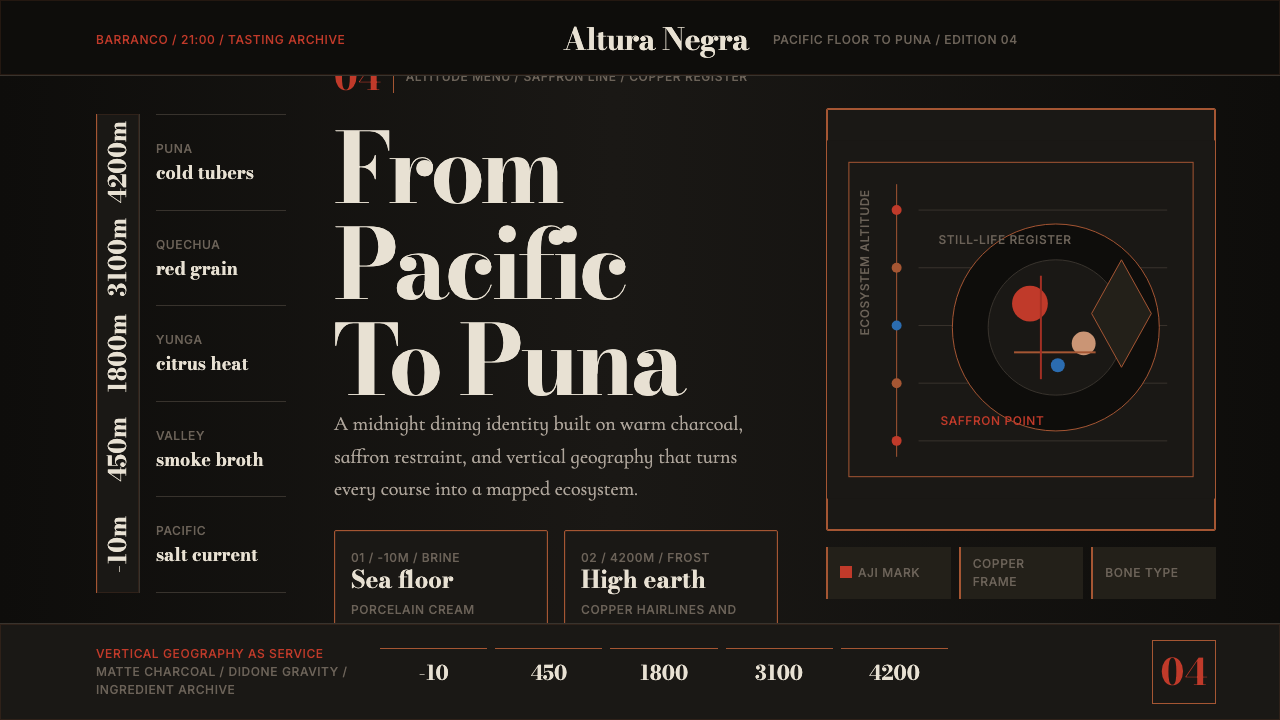 Lima Nuevo Andino CuisineAltitude turns luxurious. Charcoal fields, copper hairlines, and saffron-red…
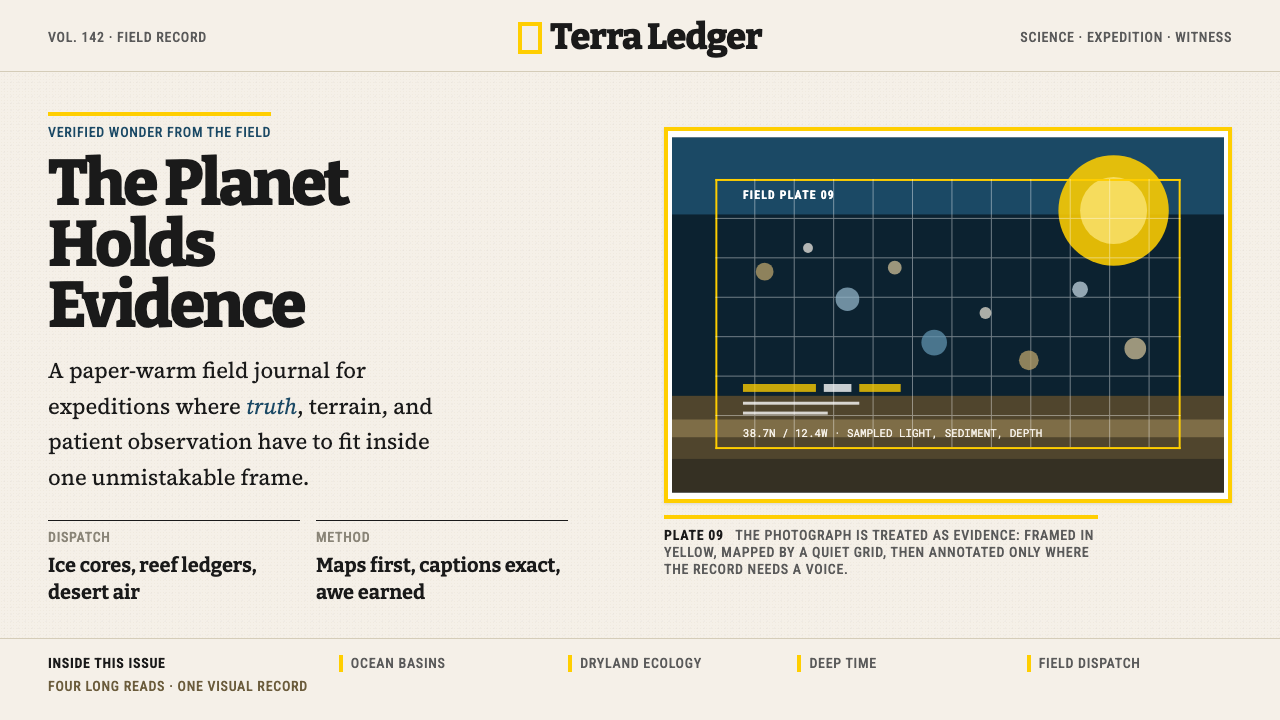 National GeographicAuthority frames wonder. Yellow border, Bitter slab type, and warm paper make…
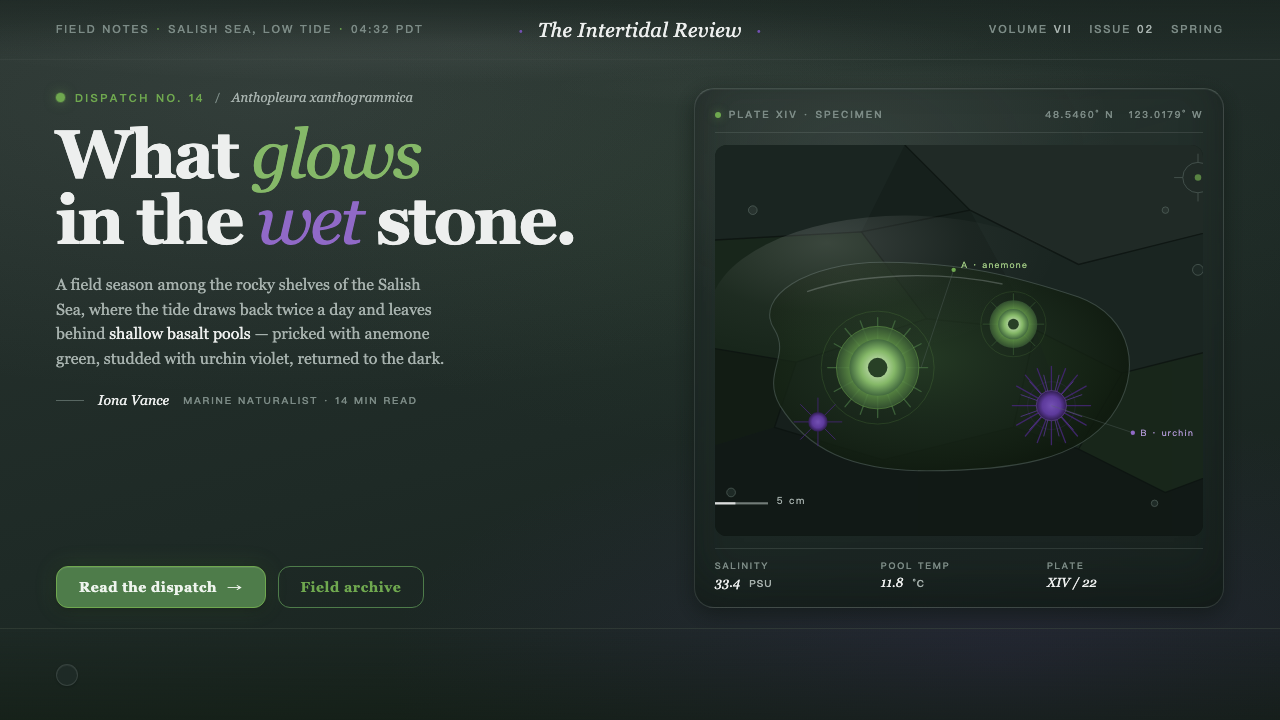 Tide PoolFeels like field notes after rain. Literary serif in basalt black, algal gree…
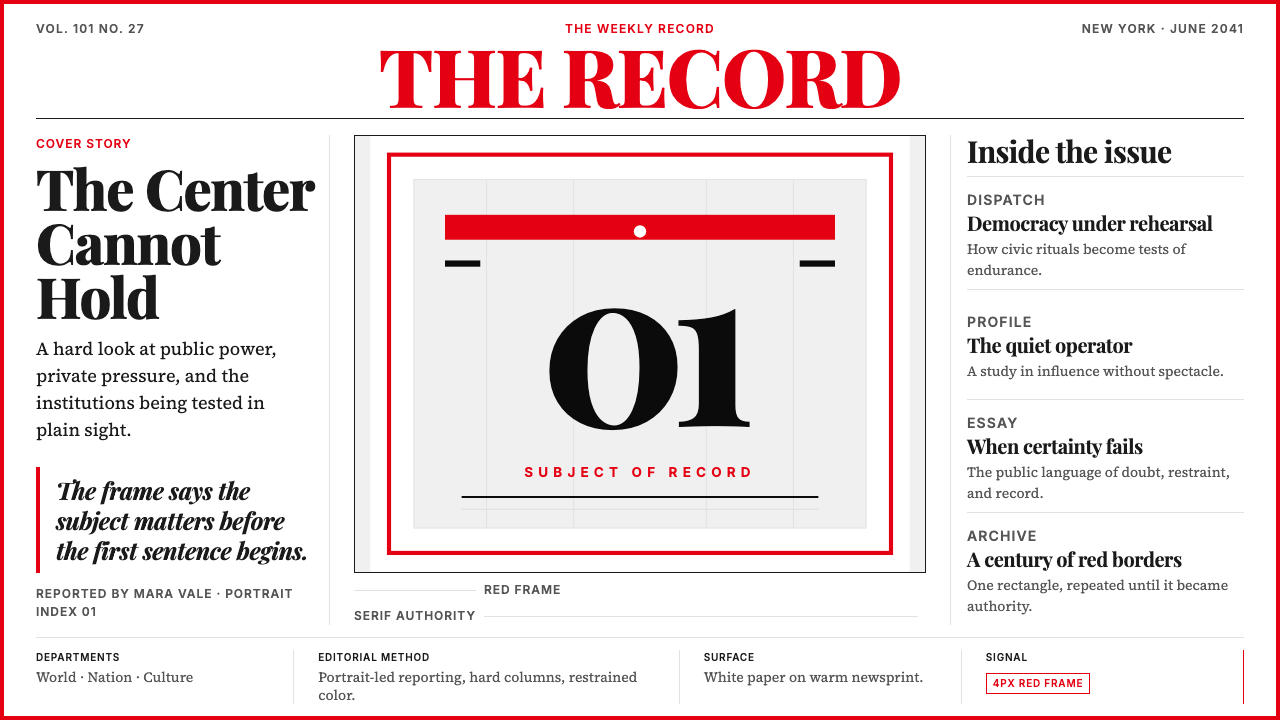 TIME MagazineAuthority in a red rectangle. Didone masthead, black-white columns, and a 4px…
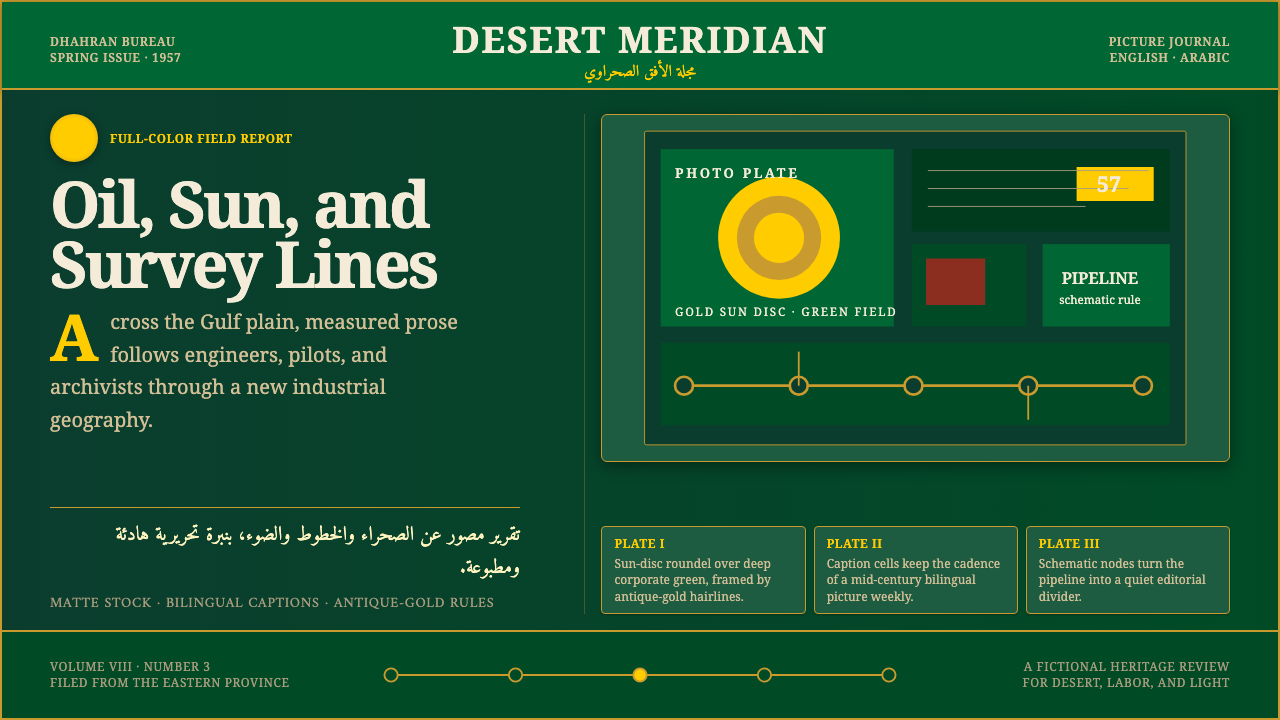 Aramco World MagazineMatte Gulf modernism. Desert green, gold sun-discs, classic serif, and naskh…
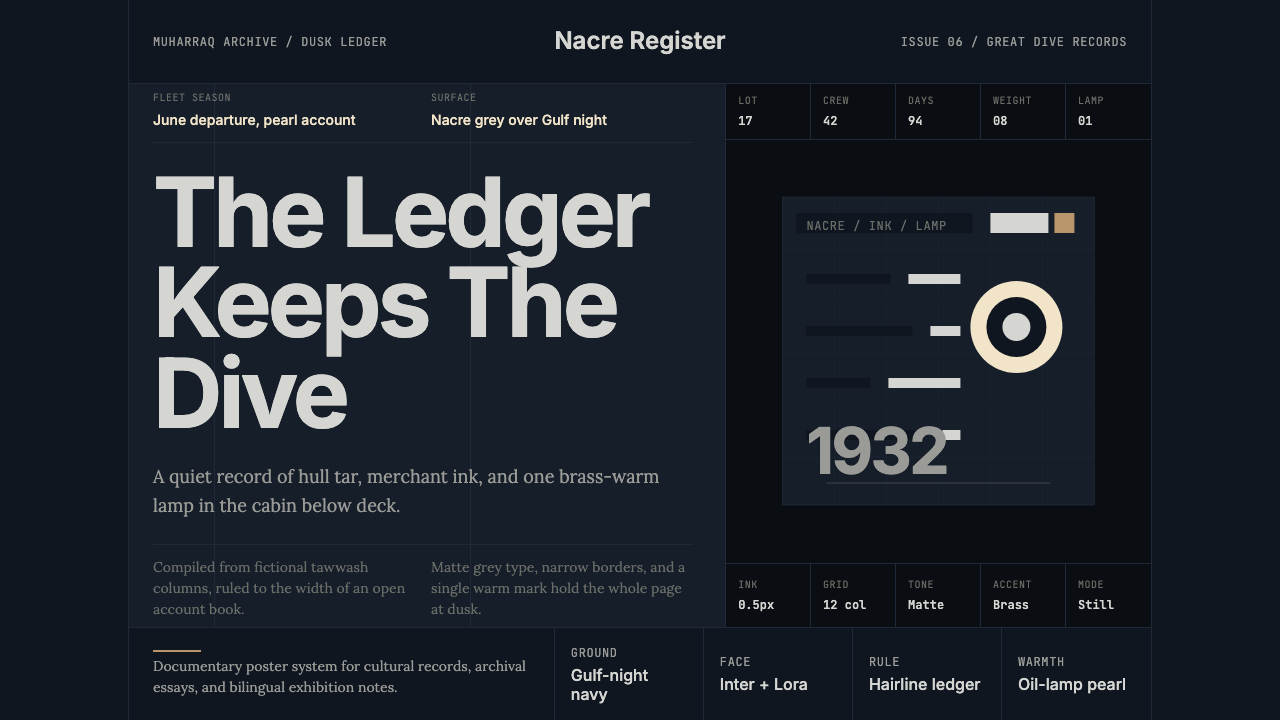 Bahraini Pearl Diving GreyQuiet authority at dusk. Nacre grey type and hairline grids hold one brass-wa…