What is Bahraini Pearl Diving Grey?
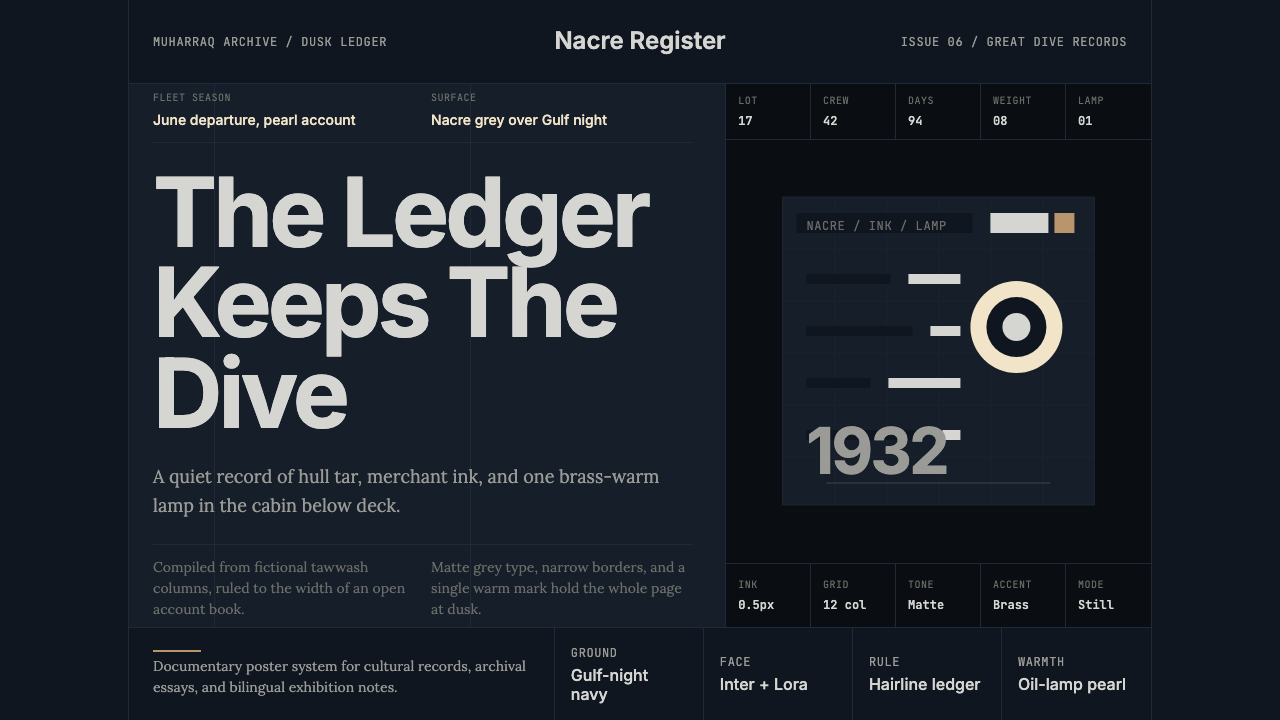
Before oil reshaped the Gulf, Bahrain's wealth rose from the sea floor in the form of natural pearls — and the visual culture that surrounded that trade left behind a haunting aesthetic of nacre grey, deep-night navy, and the singular warmth of an oil lamp burning below deck.
Bahraini Pearl Diving Grey in brief
Bahraini Pearl Diving Grey is a design language drawn directly from the material culture of the Arabian Gulf's pearling era — a period spanning roughly the 1830s through the collapse of the natural pearl market in 1932. Its visual identity is built around the tones and surfaces that defined life aboard a pearl diving vessel: the matte silvered grey of a nacre shell held against Gulf-night sky, the almost-black of deep seawater seen from above, and the single amber warmth of an oil lamp that served as the sole light source across long nights anchored offshore.
The aesthetic is documentary in spirit rather than decorative. It does not idealize or romanticize the hardship of the dive season — it observes it. The ledger pages of the tawwash merchants, the ink-black text of the chettab debt contracts, the ruled grids of the accounts recording the season's harvest: these are the design objects at the heart of the system. Restraint is not a stylistic choice but an economic and environmental reality carried forward into visual form.
What distinguishes this system from other dark, moody palettes is its specific cultural grounding. The grey is not the grey of fog or concrete or corporate neutrality — it is the grey of nacre, the iridescent inner surface of the pearl oyster shell, caught in the moment before dawn when the diving fleet prepares to lower anchor. The warmth that punctuates the darkness is not generic amber but the particular quality of an oil lamp flame in high humidity, slightly softened at its edge, never fully sharp.
Where does Bahraini Pearl Diving Grey come from?
Bahrain's pearling industry was one of the oldest and most economically consequential in the world. The island's coastal waters sat above some of the richest oyster beds in the Arabian Gulf, and the trade they supported predated Islam, predated the Portuguese arrival in the Gulf in the sixteenth century, and predated British influence in the nineteenth. At the industry's peak in the early twentieth century, more than four hundred vessels sailed from Muharraq each summer, crewed by upward of thirty thousand men — roughly half the island's population. The visual culture produced by this industry was not fine art but operational documentation: manifests, contracts, debt registers, navigational charts, the tar-caulked geometry of hull construction.
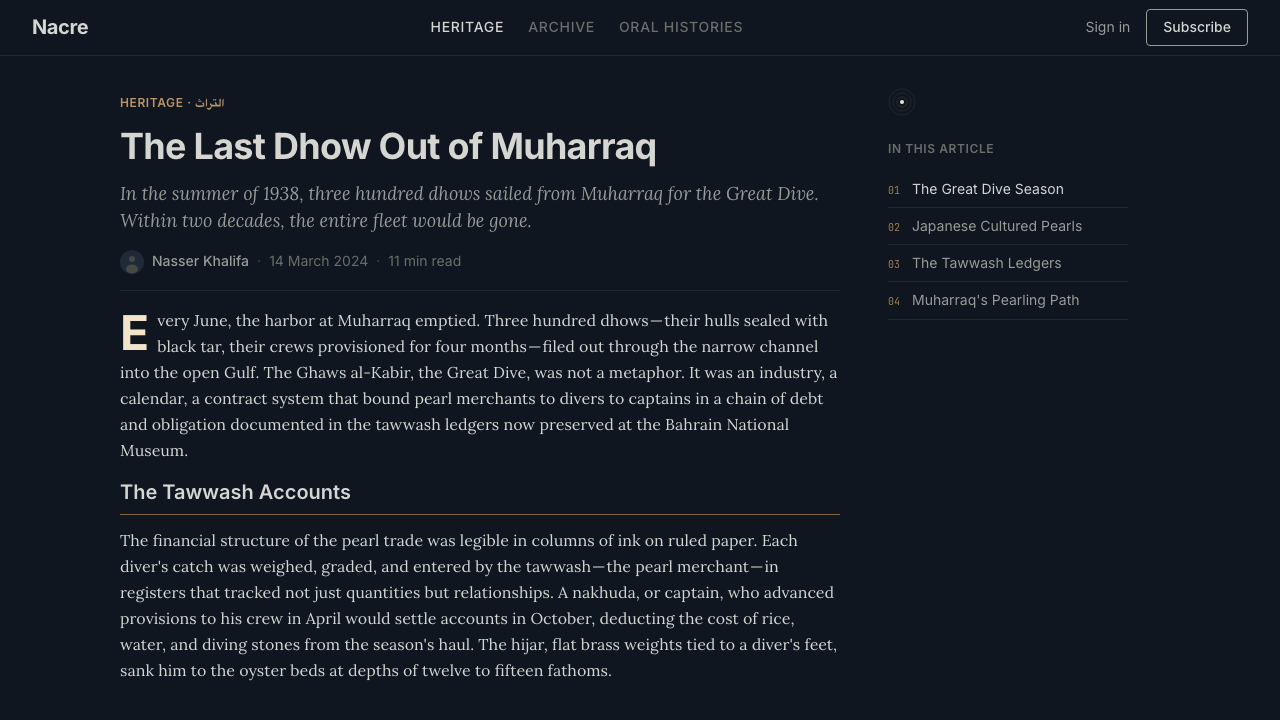
The tawwash — the licensed pearl merchant who sailed with the fleet and graded pearls at sea — kept ledgers whose visual language was austere by necessity. Ink was conserved. Every entry was written in compressed script against hairline ruled grids. The quality of the page surface — matte, slightly textured, the colour of unbleached cloth — became the ground against which all commerce was conducted. These ledger pages are among the few surviving visual records of the pre-oil Gulf economy, and their aesthetic is the direct ancestor of Bahraini Pearl Diving Grey.
The collapse of the industry came quickly and from an unexpected direction. Beginning in the late 1920s, Japanese cultured pearls — grown deliberately by inserting an irritant into a live oyster and farming the result — flooded the international market at a fraction of the price of natural Gulf pearls. By 1932, the Gulf pearl trade had effectively ended. The Great Depression accelerated the collapse. Bahrain's subsequent oil discovery in 1932 redirected the island's economy entirely, but the cultural memory of the pearling era remained alive in the architecture of Muharraq, in oral tradition, and in the documentary photography of the period.
The modern revival of interest in the pearling aesthetic is associated with the Bahrain Pearling Path, a UNESCO World Heritage designation granted in 2012. The Pearling Path encompasses seventeen merchant houses, four mosques, the seafront, and the remaining oyster beds — a preserved circuit through which the full social and economic logic of the pearling era can be traced. Alongside this heritage effort, designers and institutions led by figures including Sheikha Mai bint Mohammed Al Khalifa and textile designer Khaled Al Hashimi have worked to articulate a contemporary Khaleeji visual language rooted in authentic Gulf material culture rather than generalized Arabian ornament.
What defines the Bahraini Pearl Diving Grey look?
Surface Tone
The dominant ground is a deep Gulf-night navy — not the blue of daytime sea, but the near-black of open water after sunset, still holding a trace of blue within its depth. Against this, the secondary surface is the matte silvered grey of nacre: the inner lining of the pearl oyster shell, luminous but never glossy, occupying the range between pale ash and the lightest reflection of moonlight on water. Together, these two tones define the night-aboard-a-vessel quality that makes the system immediately distinctive.
Accent Warmth
A single brass-warm accent cuts through the coolness of the primary palette. This is not decorative gold — it carries the specific quality of an oil lamp burning in a maritime context: slightly orange at its core, cooling toward amber at its edge, never yellow enough to read as cheerful. It is used with extreme restraint, appearing as a highlight on a key data point, a navigational indicator, or the edge of an interactive element. Its rarity is its strength; repeated, it loses the sense of a lamp in darkness and becomes mere decoration.
Grid Discipline
The structural logic of the tawwash ledger — hairline ruled grids, carefully preserved white space, every entry occupying its allotted column — translates directly into the system's compositional approach. Lines are fine and precise, never bold or decorative. The grid is visible only as constraint, not as graphic texture. Columns align strictly, and the space between entries carries as much weight as the entries themselves. This is accounting logic applied to layout, and it produces a quiet authority that bolder systems cannot replicate.
Typographic Register
Type in this system occupies a narrow tonal range: ink black against the nacre grey surface, or nacre grey against the deep-night navy ground. Scale, not color, establishes hierarchy — a lead figure or heading is set large, body text small, with the proportion between them drawn from the economy of the ledger page rather than from contemporary typographic convention. Decorative variation in letterform is absent; the emphasis is always on the quality of the text block as a whole, its weight and density against the field around it.
Material Restraint
The system avoids simulated texture, decorative pattern, and any reference to ornamental Khaleeji motifs — geometric tile, arabesque, muqarnas shadow — that might be expected in a Gulf-heritage context. The restraint is deliberate and documentarily accurate: the pearl trade's working visual culture was not decorative. Ornament belonged to the mosque, the merchant house, the formal occasion. The ledger, the hull, the diving contract were stripped of it entirely. Applying this system correctly means resisting the impulse to add cultural decoration to signal authenticity.
Light Logic
The single-lamp model governs how illumination is handled in the system. There is one light source, and it is warm, directional, and limited in its reach. Elements close to the metaphorical lamp are rendered with the full brass-warm accent; elements at distance fall toward the cool grey of the ambient surface. Gradients used to express this falloff, if used at all, are subtle and move only between adjacent tones — they do not span the full value range and they do not use the accent color as a gradient endpoint. The effect is of objects seen by lamplight, not under studio illumination.
Silence as Content
Negative space in this system carries narrative weight. The wide margins and generous spacing between elements do not read as emptiness — they read as the open sea, as the silence of deep water, as the hours of waiting between dives. This is not arbitrary white space; it is the compositional equivalent of the diver's breath held in suspension. Overcrowding a layout removes the system's defining quality immediately. The restraint must be structural, not incidental, or the entire sensibility collapses into a generic dark interface.
Who shaped Bahraini Pearl Diving Grey?
Among the most documented of the Gulf pearl merchants, Al Mosawi represents the tawwash class whose professional practice directly produced the documentary aesthetic at the heart of this design system. The tawwash sailed with the diving fleet, graded pearls at sea using trained eye and touch alone, and maintained the meticulous ledger records that are now among the few surviving primary visual documents of the pearling era. His class of merchants operated at the intersection of maritime life and commercial precision — an intersection that defines the system's character.
The nawkhada — the captain of a pearl diving vessel — occupied the commanding position in the social and economic structure of the dive season. Captain Matar represents this figure: responsible for the vessel's navigation, the welfare of the crew, the management of debt relationships with the nakhuda financiers, and the daily decisions of where to anchor and how long to dive. The nawkhada's authority was both practical and symbolic — the one point of warmth and decision in the system's visual metaphor of a lamp amid deep water.
As President of the Bahrain Authority for Culture and Antiquities, Sheikha Mai was the central figure behind the successful UNESCO World Heritage nomination of the Bahrain Pearling Path in 2012. Her institutional leadership brought together the preservation of physical sites, the documentation of oral histories, and the broader project of establishing a contemporary Khaleeji cultural identity grounded in documented material history rather than generalized heritage aesthetics. The UNESCO designation created the conditions under which the pearling era's visual culture could be studied, archived, and applied by contemporary designers.
Al Hashimi is a Bahraini textile and material designer whose work has focused on recovering and recontextualizing the material aesthetic of the Gulf pearl trade — particularly its relationship to undyed and minimally processed natural materials, the geometry of the dhow hull and sail, and the documentary restraint of the trade's written records. His practice represents the design-facing dimension of the Khaleeji heritage revival: taking authenticated material culture as a starting point and developing from it a contemporary design vocabulary that belongs to the Gulf rather than importing generic international minimalism.
The photographers — many working for British Petroleum companies, commercial agencies, or the Bahraini government — who documented the final decades of the pearl diving industry produced the primary visual archive on which contemporary understanding of the era's aesthetic is based. Their photographs share consistent qualities: high contrast between the dark sea surface and the pale hull timbers, the reduced color range of natural materials, and the quiet compositional dignity of men at physical labor. These images, now held in archives in Bahrain, London, and Washington, constitute the most direct visual precedent for the Bahraini Pearl Diving Grey palette.
How do you use Bahraini Pearl Diving Grey today?
Bahraini Pearl Diving Grey is most effective in digital contexts where depth, restraint, and quiet authority are the intended experience — as opposed to energy, accessibility, or brightness. The system rewards patience: applied carefully across a product, it builds a coherent atmospheric world that feels researched and culturally specific rather than generically dark. Applied carelessly, it risks producing an interface that is simply dim, with insufficient contrast and no clear hierarchy.
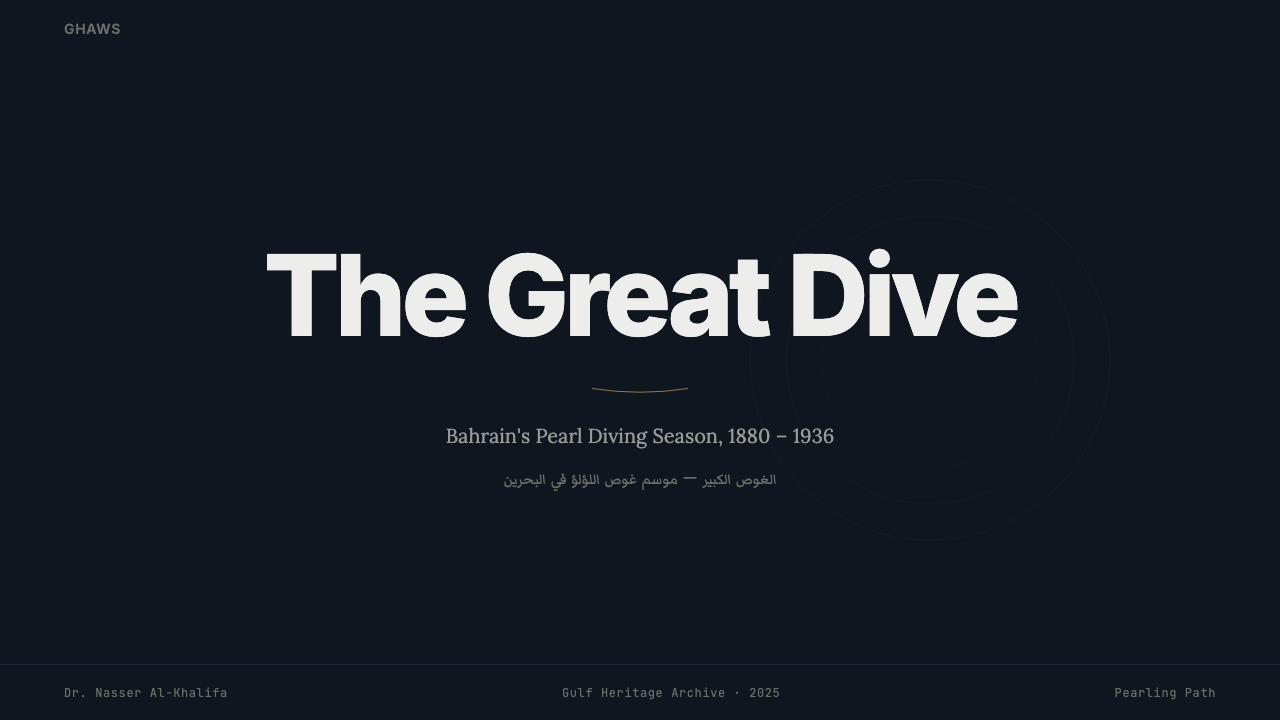
For presentation slides, the system works best on cover and transition slides where the full atmospheric weight can be felt. A cover built on deep Gulf-night navy with nacre grey type and a single brass-warm accent on the title or a key figure has an immediate, almost cinematic presence. Content slides should shift to a lighter nacre grey ground with ink-black type to maintain legibility across varied projection environments — the pure deep navy ground is too dark for body text at small sizes in most projection settings. Data visualizations should use the nacre grey and navy as the chart background and grid lines, with the brass-warm accent reserved for the single most important data series or call-out figure.
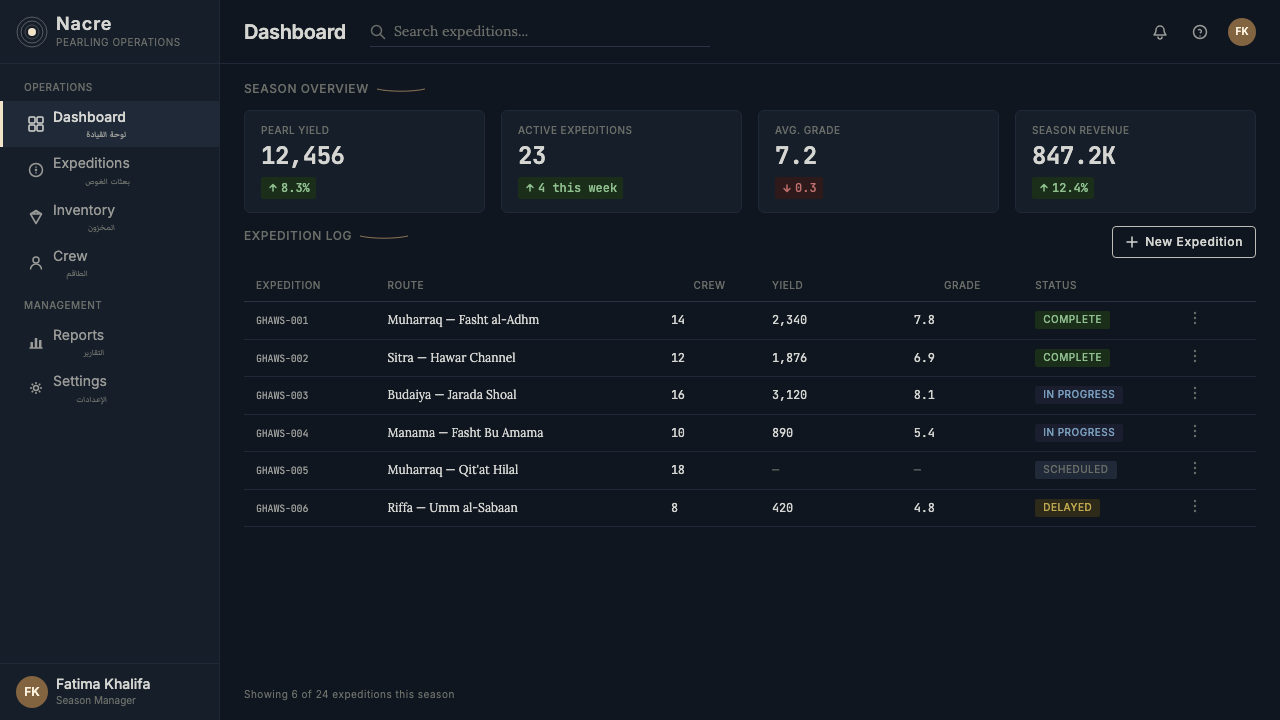
For web and dashboard interfaces, the system is well-suited to analytical tools, portfolio sites, and premium product pages where the user is expected to spend time reading and exploring rather than converting quickly. The key discipline: use the deep navy as the page background only for hero sections and full-width feature blocks; shift to the lighter nacre grey for content areas, cards, and sidebars. This prevents visual fatigue. The hairline grid approach translates directly to table and data grid components — thin dividers, generous cell padding, no bordered cards, no soft shadows.
For editorial and marketing contexts, the system handles long-form content well when the layout commits to a generous measure and open spacing. Chapter headers set large in nacre grey against navy create the ledger-page reading rhythm; body text in ink black on a nacre grey ground reads cleanly without the strain that pure white grounds can produce under extended reading. The brass-warm accent should appear no more than once per spread or page view — as a pull-quote marker, a section indicator, or an emphasis on a single critical figure.
The most common error when applying this system is reaching for pattern or decoration to signal 'Gulf heritage' — geometric tile, arabesque line, muqarnas-derived forms. These elements break the documentary logic of the system immediately. The historical visual culture this palette references was explicitly non-decorative. A second error is over-use of the brass-warm accent, which drains the system's sense of a single lamp in darkness and makes the palette read as generically warm-dark. The accent's power is entirely dependent on its scarcity.
Bahraini Pearl Diving Grey — FAQ
Is this system appropriate for light-background interfaces, or is the dark palette essential?
The dark palette is the system's primary mode, and inverting it loses most of what makes it distinctive. The deep Gulf-night navy and nacre grey combination on a light ground reads simply as a generic cool-grey palette — the atmospheric weight that comes from darkness, the sense of lamplight in shadow, disappears entirely. A partial adaptation is possible: use the nacre grey as a page ground, ink black for type, and the brass-warm accent for call-outs. This reads as a quieter, more documentary aesthetic than full inversion but retains the system's restraint. Reserve the full dark mode for hero sections, modal overlays, and contexts where the immersive quality is appropriate.
How is this system different from other dark Gulf or Middle Eastern design aesthetics?
Most contemporary Gulf-heritage design draws on architectural ornament — Islamic geometric tiling, arabesque, calligraphic flourish, muqarnas-derived shadow patterns. These elements are visually rich and culturally legible, but they reference the mosque, the palace, and formal civic culture. Bahraini Pearl Diving Grey references instead the working economy of the sea: ledgers, hulls, diving contracts, and the functional objects of maritime labor. It is documentary rather than ceremonial. The result is a system that does not look like standard 'Middle Eastern design' — it looks like evidence, like a record, like something that happened.
Can the system accommodate color photography or illustration, or does imagery break the palette?
Full-color photography is difficult to integrate cleanly because most contemporary images introduce saturation levels that sit outside the system's tonal range. The most successful approach is to treat any imagery as the Gulf documentary photographers treated their subjects: high-contrast, with desaturated midtones that allow the nacre grey and navy palette to remain dominant. Duotone processing — rendering images in the system's two primary tones — integrates photography completely. For illustration, the same logic applies: geometric, reduced to the system's tonal range, and stripped of any decorative line or pattern that would conflict with the documentary restraint.
What makes the brass-warm accent work, and what makes it fail?
The accent works because of context: against the cool, dark ground, a single warm element carries enormous visual weight. The metaphor of an oil lamp in darkness is not just evocative — it is functionally accurate. A lamp works because the surrounding darkness makes its light significant. Multiply the lamps and the darkness disappears, taking the significance with it. Practically, this means the brass-warm accent should never appear on more than one element per visual unit, should never be used for body text or supporting information, and should never be used as a background color. It is a spotlight, not a flood. When it fails, it is almost always because it has been used too many times or at too large a scale.
Is Bahraini Pearl Diving Grey suited to consumer-facing products, or is it better for professional and institutional contexts?
The system's restraint and documentary quality make it a stronger fit for professional, institutional, and high-consideration consumer contexts than for mass-market or impulse-purchase products. It performs well for premium financial services, archival platforms, heritage institutions, high-end portfolio sites, and analytical tools where the user relationship is characterized by trust and deliberation. In contexts that call for warmth, playfulness, or broad accessibility — mass-market retail, social media, entertainment, children's products — the system's deliberate coolness and quietness work against the product's goals. It is not a versatile baseline palette; it is a specific cultural and atmospheric register that must match the product's intended relationship with its users.
Related design styles
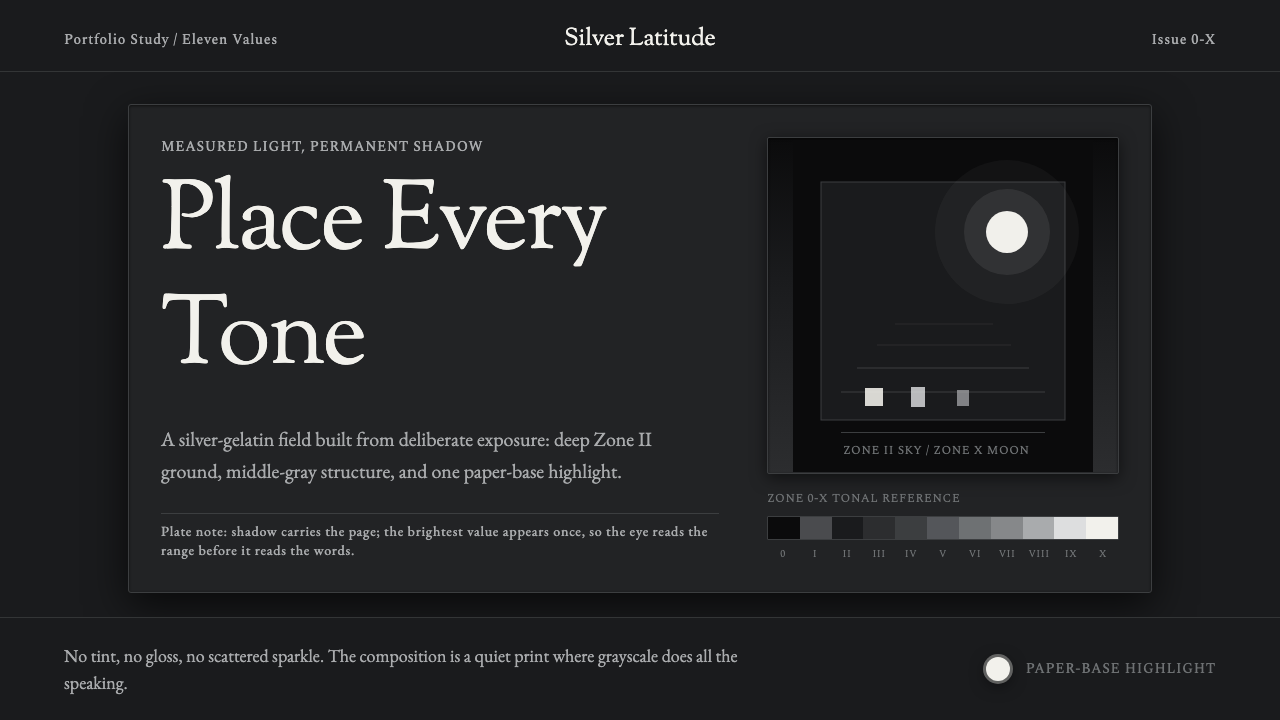 Ansel Adams Zone SystemOnly light remains. Deep shadow, serif captions, and one white moon mark the…
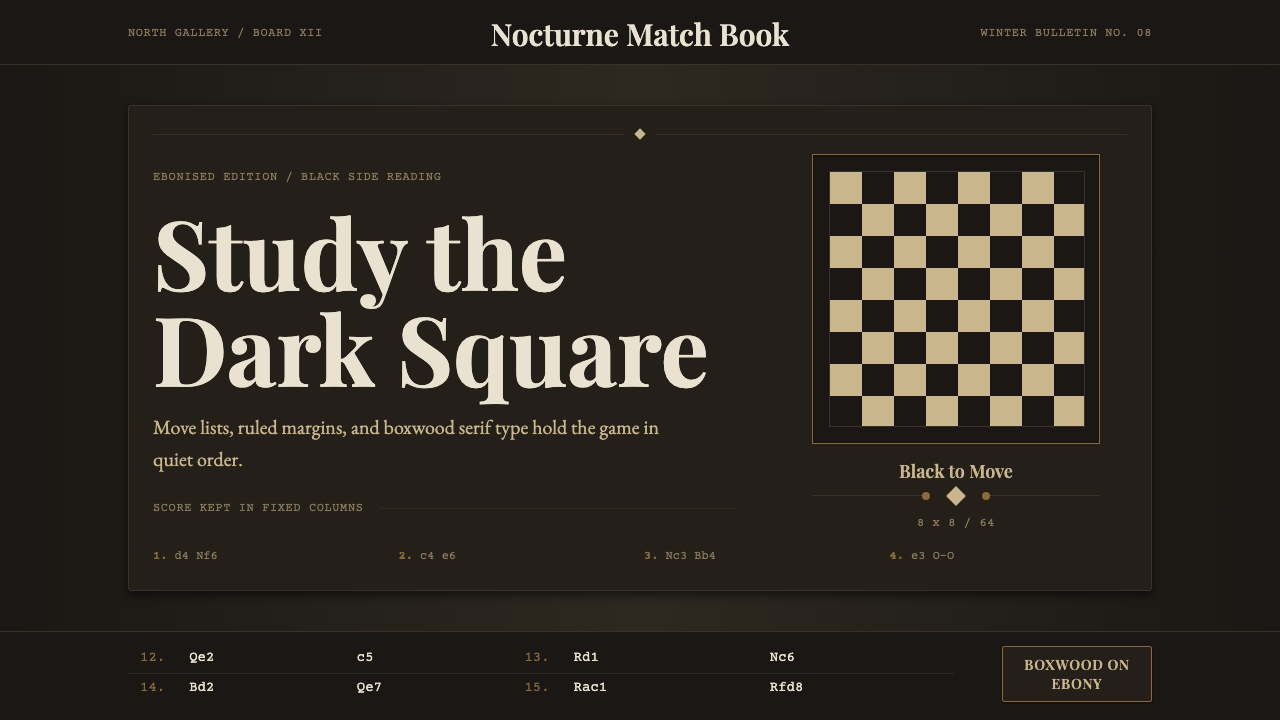 Chess TournamentQuiet intellect. Cream Playfair type, walnut rules, and notation glow on ebon…
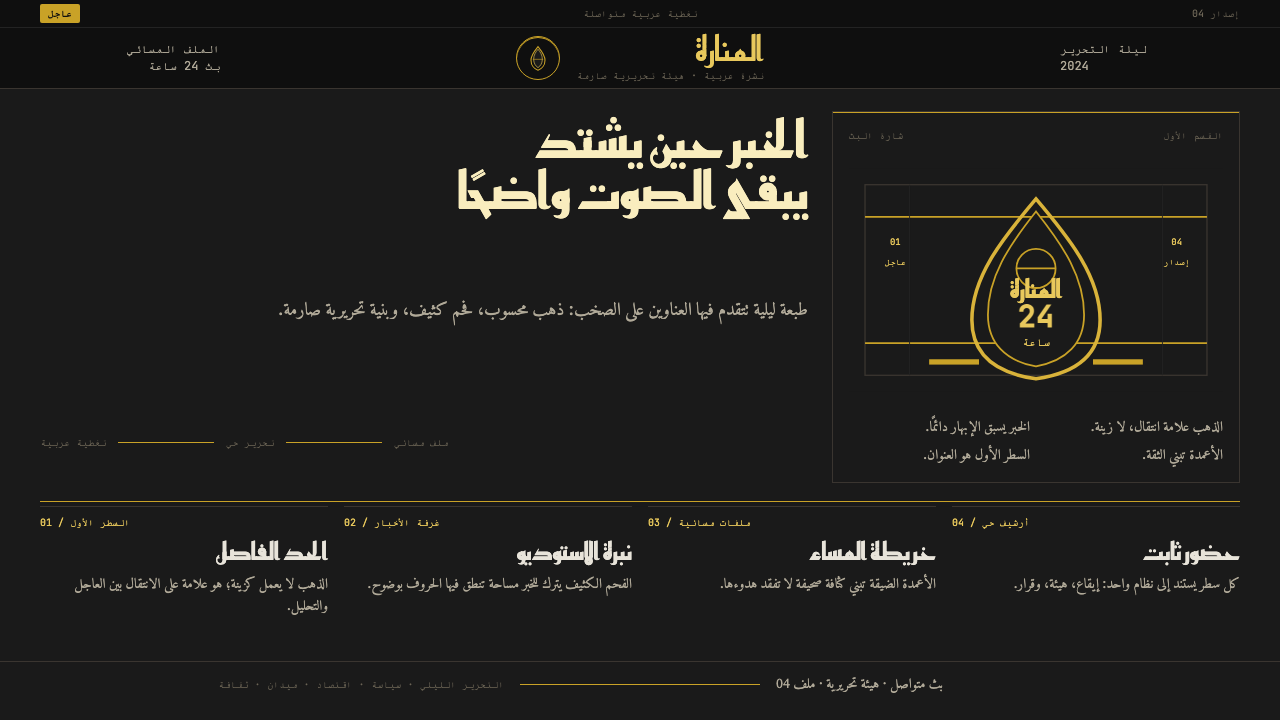 Al Jazeera Arabic NewsAuthority, stripped bare. Gold seal, dense Arabic type, matte charcoal.
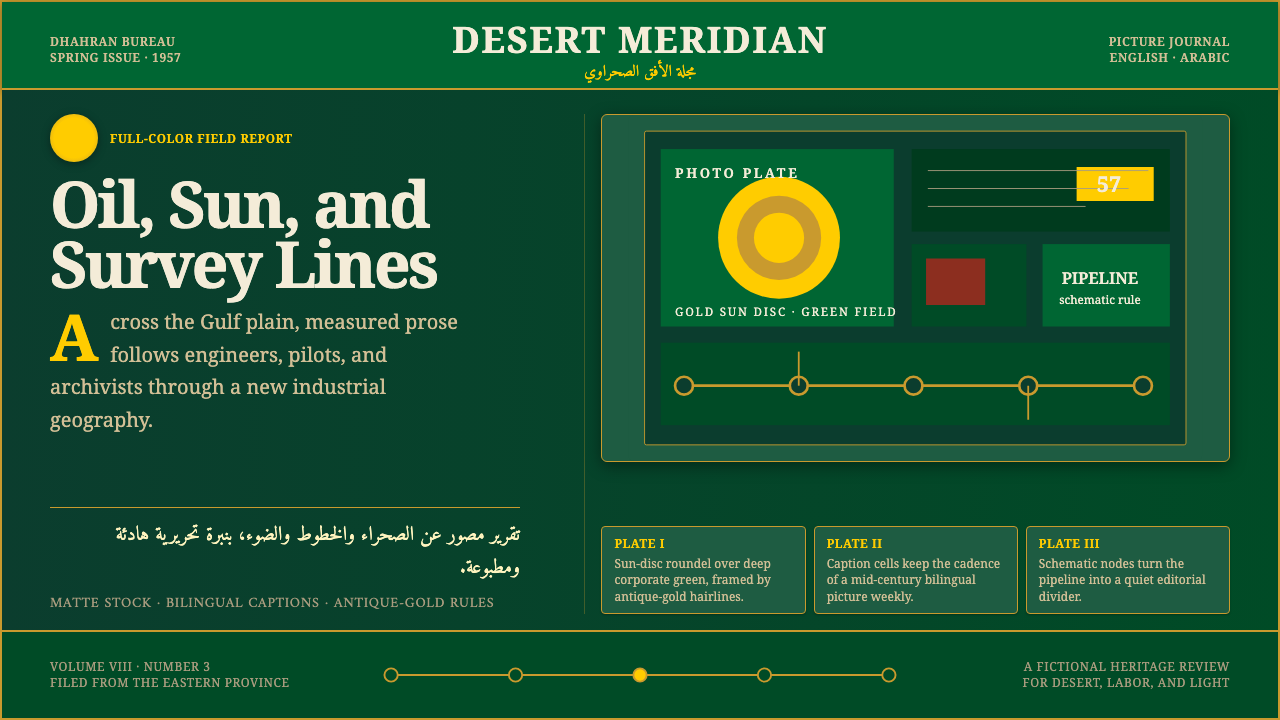 Aramco World MagazineMatte Gulf modernism. Desert green, gold sun-discs, classic serif, and naskh…
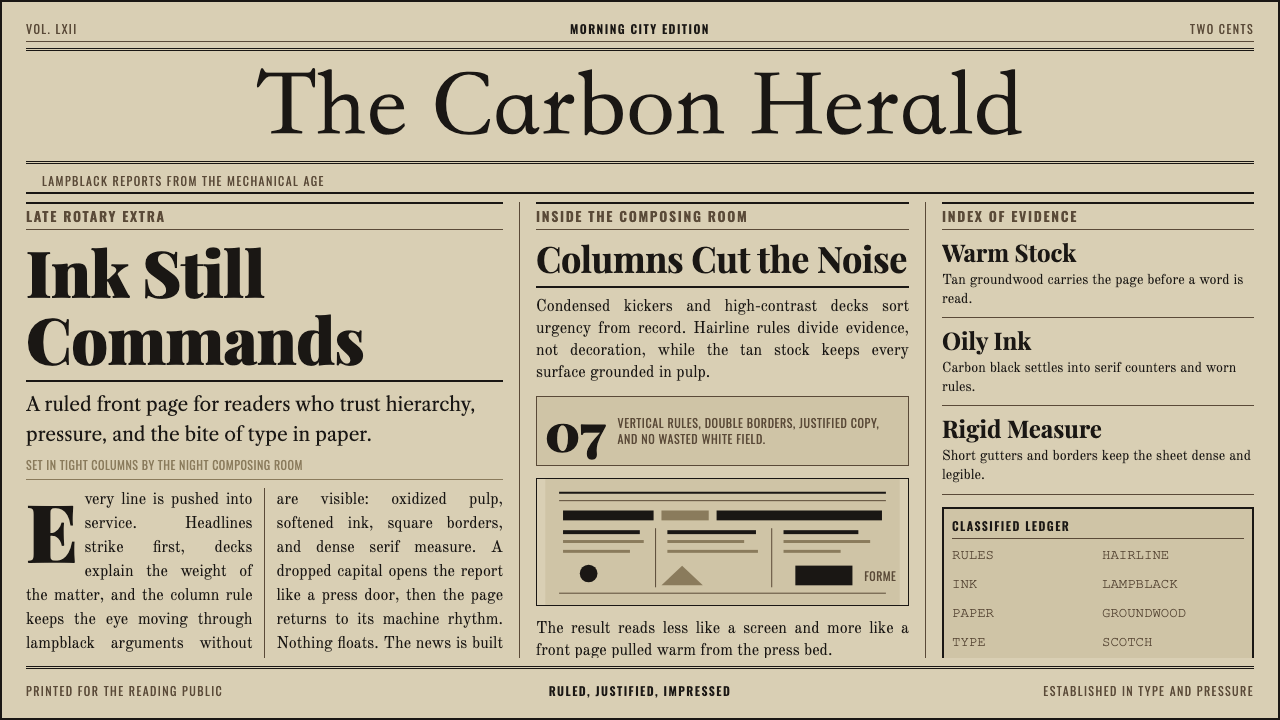 Broadsheet LetterpressAuthority in ink. Lampblack serif decks lock into tan paper with strict ruled…
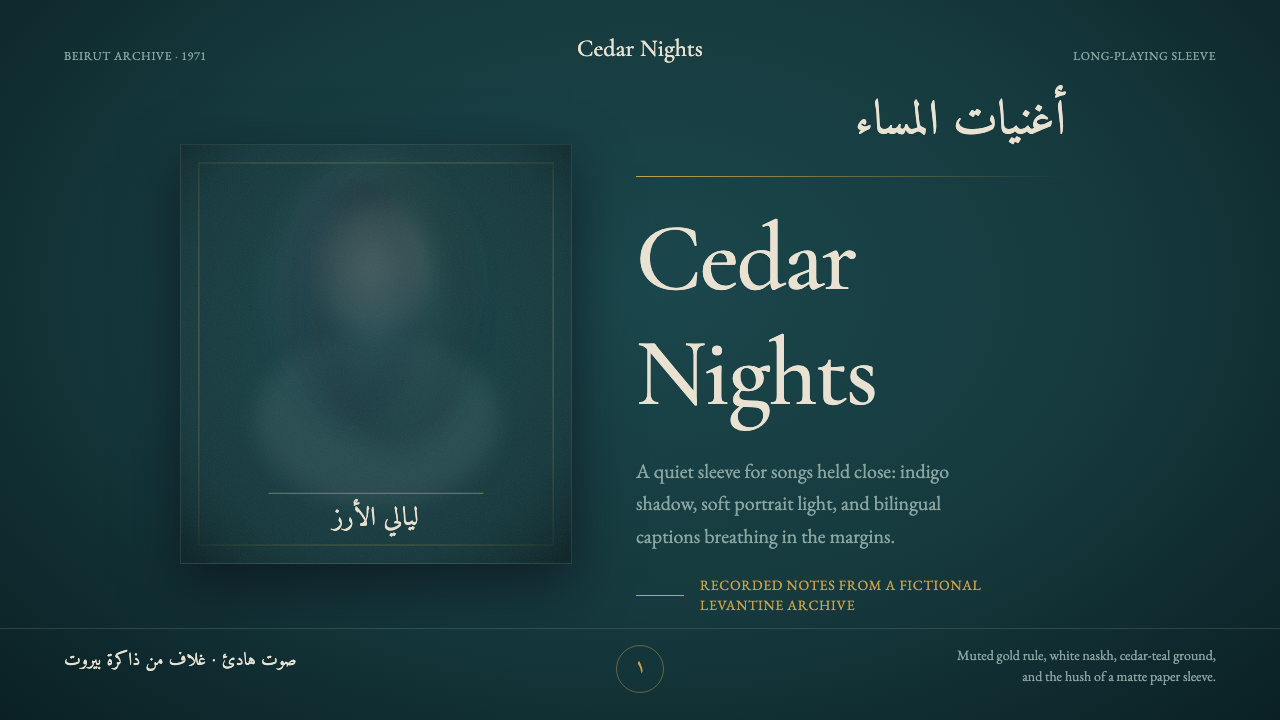 Fairuz Record SleeveQuiet luxury holds the sleeve. Cedar teal, white naskh, and one muted gold ru…