What is Gill Sans (BBC, 1928)?
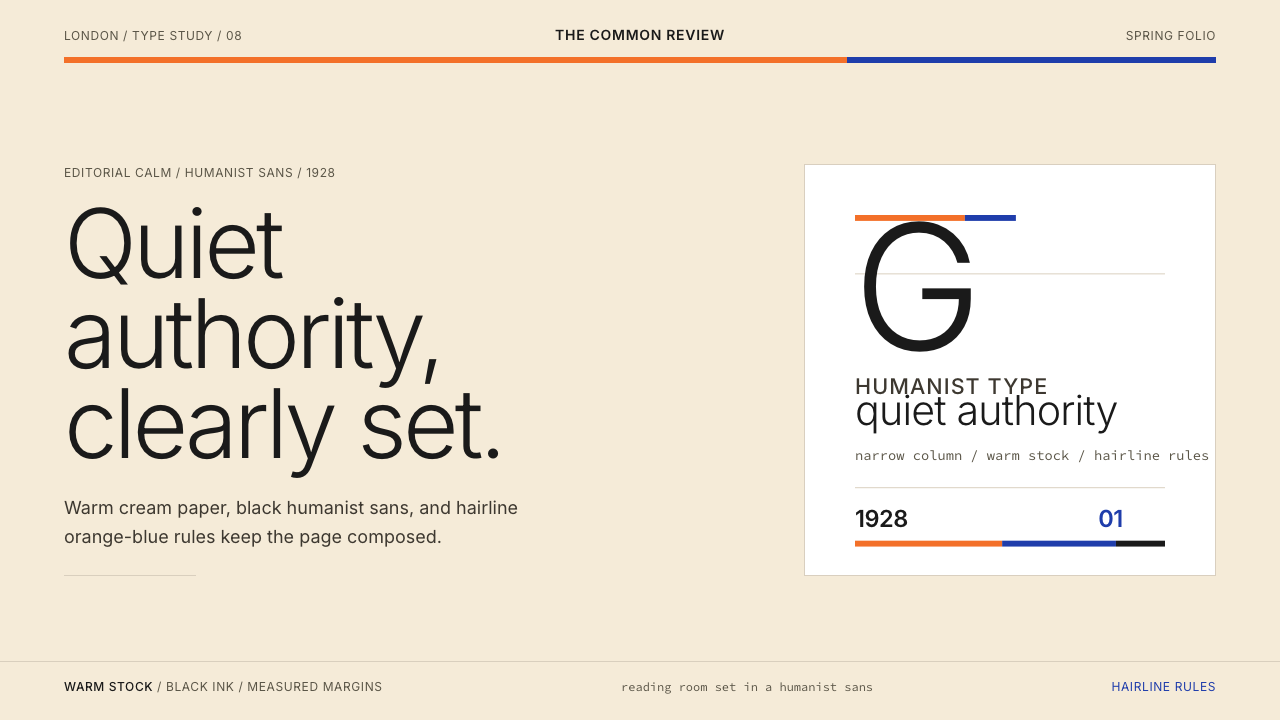
Gill Sans is the voice of British institutions — classical, unhurried, and unmistakably authoritative.
Gill Sans (BBC, 1928) in brief
Gill Sans is a humanist sans-serif typeface designed by sculptor and letter-cutter Eric Gill for the Monotype Corporation, released commercially in 1928. Unlike the geometric sans-serifs emerging from continental Europe at the same moment, Gill Sans draws its proportions and stroke modulation from Roman inscriptional capitals and the calligraphic tradition, producing letterforms that feel warm and hand-considered rather than mechanically derived. Its lowercase letters in particular carry a subtle variation in stroke weight — thicker at the curves, tapering toward the joins — that the purely geometric typefaces of the same era deliberately eliminated.
The typeface occupies a singular position in British visual culture. The BBC adopted it as a cornerstone of its corporate identity; Penguin Books used it on the iconic three-color series covers from the 1930s onward; the Church of England employed it on liturgical publications; and the London and North Eastern Railway had already featured a close precursor on station signage before Gill's commercial release. This accumulation of institutional use gave Gill Sans an authority that no amount of deliberate branding could manufacture — it carries the cultural weight of a tradition.
Visually, the style built around Gill Sans is one of editorial restraint. The ground is warm cream rather than stark white, softening the reading experience without sacrificing legibility. Type is set in pure black, allowing the humanist letterforms to register fully. Structural dividers — when they appear — are hairline thin, functioning as pauses in the composition rather than declarations. The accent colors associated with this system are a citrus orange and a deep, composed blue, borrowed from the Penguin series covers: vivid enough to orient the reader, restrained enough not to overwhelm the typography.

Where does Gill Sans (BBC, 1928) come from?
Eric Gill was commissioned to design a typeface for Monotype following a direct lineage from Edward Johnston's typeface created for London Underground in 1916. Johnston's Underground type had demonstrated that a sans-serif could carry the clarity demanded by public signage while remaining legible, dignified, and free of the mechanical coldness that characterized many nineteenth-century grotesques. Gill had worked as a student under Johnston and absorbed the older craftsman's conviction that letterforms should descend from the Roman tradition, however radically simplified. Gill Sans inherits Johnston's underlying logic and pushes it into a form suitable for book setting and general typography.
Stanley Morison, Monotype's typographic advisor, recognized that British publishing lacked a credible modern sans-serif rooted in the humanist tradition. German publishers and advertisers were embracing Futura, released the previous year; American work was gravitating toward the updated gothic grotesques. Britain risked being typographically caught between an exhausted Victorian grotesque tradition and foreign imports that felt culturally alien. Gill Sans arrived at precisely the right moment: modern enough to signal the new century, classical enough to satisfy the conservative institutions that represented the bulk of British publishing.
The LNER — London and North Eastern Railway — was among the first major clients, beginning to use Gill Sans for its timetables, posters, and station name boards from around 1929, providing the typeface with one of the most prominent early deployments in British public life. This railway association established an enduring link between the typeface and reliable public service: by the time the BBC began formalizing its own corporate identity in subsequent decades, Gill Sans carried an already deep institutional endorsement.
The BBC's corporate adoption, solidified during the 1980s and continuing through various identity revisions into the present, gave Gill Sans its most visible modern platform. The corporation's reach — broadcasting into tens of millions of British homes, with a visual identity appearing on screen, in print, and on signage across the country — transformed the typeface from a distinguished publishing choice into a daily presence in British life. The effect is one that designers call 'cultural saturation': the typeface became inseparable from the idea of authoritative, public-service communication in the British context.
What defines the Gill Sans (BBC, 1928) look?
Humanist Stroke Modulation
Unlike geometric sans-serifs that maintain uniform stroke width throughout, Gill Sans exhibits subtle variation derived from the broad-nib pen tradition. Curves swell slightly at their midpoints and thin toward the joins, a quality inherited from Roman inscriptional practice. This modulation is restrained enough to read as clean and modern at a glance, yet distinctive enough to give the typeface its characteristic warmth — preventing the coldness that afflicts strictly mechanical letterforms.
Warm Cream Ground
The canonical ground for this style is not pure white but a warm, slightly yellowed cream — the color of aged laid paper. This choice is not decorative but functional: it reduces the stark contrast between background and black type, making sustained reading less fatiguing. The cream ground also anchors the palette's accent colors — a citrus orange and a composed deep blue — making them feel vivid without appearing aggressive. The warmth of the background communicates age and reliability, appropriate to the institutional character the style conveys.
Editorial Restraint in Accent Color
The accent palette — citrus orange and deep blue — is used with the discipline of a skilled editor: sparingly, purposefully, and never simultaneously at high saturation. Orange anchors structural elements such as category labels, rules, or active states; blue serves for secondary hierarchy, links, or informational tags. The two colors are not used as decoration but as orientating signals. This restraint is borrowed directly from Penguin Books' series color-coding system, where a single accent stripe was sufficient to classify an entire volume at a glance.
Generous Margins and Hairline Dividers
Layouts in this style breathe through generous surrounding margins. White space is not treated as unused area but as an active structural element that gives letterforms room to register and prevents the composition from becoming crowded. Where separation between sections is needed, the divider is a hairline — the thinnest visible rule — rather than a heavy bar or a colored band. This hairline functions as a pause, not a wall: it indicates a transition without interrupting the visual flow.
Typographic Hierarchy Through Scale and Weight Alone
Information hierarchy in this system is established almost entirely through contrasts of type size and weight rather than through color, decoration, or structural framing. A principal heading is set large and moderately weighted; a subheading is set smaller, sometimes in a lighter cut of the same face; body text drops to a comfortable reading size and weight. The lack of decorative differentiation forces the typographic system to carry all the organizational work — and it succeeds precisely because the humanist letterforms remain legible and tonally consistent across the full range of sizes.
Institutional Quietness
The overriding aesthetic quality of this style is quietness: it does not shout, seek to impress, or attempt novelty. It communicates as British public institutions historically communicated — by assuming authority rather than performing it. This quality comes partly from the typeface itself, which sits comfortably at any size without demanding attention, and partly from the palette, which is warm and composed rather than bright and urgent. The intended effect is that the reader trusts the content without first being startled by the presentation.
Classical Proportion Without Ornamentation
Gill Sans letterforms observe the proportions of classical Roman capitals: the O is nearly circular, the M is wide-set, the I is narrowly upright. These proportions create an underlying order that feels neither cramped nor extravagant — they have the natural authority of forms refined over centuries. Yet the typeface carries none of the serif additions or swash alternatives that historicist revival faces typically accumulate. It is, in this sense, a distillation: classical proportion without historical costume.

Who shaped Gill Sans (BBC, 1928)?
Eric Gill was a sculptor, printmaker, and type designer whose understanding of letterforms came from stone carving rather than from typesetting or commercial art. He had studied under Edward Johnston and developed a conviction that type design should be rooted in the physical act of incising letters into material. Gill Sans emerged from this background: its forms are those of a letter-cutter who has internalized Roman proportion and then worked toward simplicity, not a geometric constructor who has worked backward from a circle and a straight line. Gill's simultaneous work on the sculptures for the BBC's Broadcasting House in London in the early 1930s created a biographical link between the designer and the institution that would later become his typeface's most prominent patron.
Johnston was the calligrapher and lettering artist who taught Eric Gill and whose 1916 commission for a new London Underground typeface established the foundational principles that Gill Sans later inherited and extended. Johnston's typeface — known as Johnston Sans or Underground — demonstrated that a sans-serif could be both rigorously clean and deeply humane, by anchoring its proportions in classical Roman letterform study rather than in geometric construction. His influence on British typography extends far beyond the Underground: the tradition of humanist sans-serif type design that Johnston inaugurated, and that Gill continued, remains the dominant strand of British letterform thinking across the twentieth century.
Morison served as typographic advisor to the Monotype Corporation and was the strategic intelligence behind many of the type revivals and new commissions that defined British typography in the early twentieth century, including the commissioning of Times New Roman for The Times of London in 1931. His role in championing Gill Sans was partly editorial — recognizing the cultural gap the typeface could fill — and partly commercial, understanding that a British humanist sans-serif would find institutional clients that the German geometric imports could not reach. Morison's broader influence on typographic taste in Britain gave Gill Sans the institutional endorsement it needed to become a standard.
When Allen Lane founded Penguin Books in 1935, the decision to use Gill Sans across the now-famous three-color series covers — orange for general fiction, green for crime, blue for biography — created the most publicly visible sustained deployment of the typeface outside of signage and broadcasting. The Penguin system demonstrated that Gill Sans could anchor a highly systematic visual identity across thousands of titles while remaining legible, dignified, and recognizably consistent. This long association between the typeface and the world's most respected mass-market publishing imprint did more to cement Gill Sans's cultural authority in Britain than any single institutional adoption.
The BBC's sustained adoption of Gill Sans — formalized in its corporate identity work from the 1980s onward and revised but not abandoned through subsequent rebrands — represents the typeface's longest and most culturally significant institutional use. Because the BBC's visual identity appears on broadcasts viewed by millions daily, on the BBC website, on physical signage, and in print publications, Gill Sans gained a frequency of exposure that no other British institution could match. The effect has been to make the typeface a kind of ambient cultural reference: viewers who could not name the typeface nonetheless associate its visual quality with reliability, public service, and a particular kind of British institutional seriousness.
How do you use Gill Sans (BBC, 1928) today?
The Gill Sans style is among the most transferable institutional aesthetics in contemporary design work, because its authority is earned rather than performed. Applying it well requires internalizing what the system is actually doing: using a humanist typeface with classical proportions to communicate reliability, using a warm ground to soften without weakening, and using accent color with the restraint of an editorial system rather than the exuberance of a brand campaign. The result should feel like something that has existed for a long time and does not need to announce itself.
For presentation slides, this system works with particular clarity on cover pages and structured content layouts. A cover page benefits from the straightforward approach: title in the largest type size the layout permits, set flush left or centered against a cream field, with a hairline rule and a small orange or blue element providing the only structural accent. The composition should feel unforced — no dramatic geometric overlaps, no heavy frames. Content slides are best treated as simple hierarchies: one clear heading, body text at a comfortable size, and any structural divisions indicated by hairline rules alone. Data slides take on a diagrammatic character when charts and figures are presented in the accent palette against cream grounds, with generous surrounding space.
For web interfaces, this style is well suited to dashboards, documentation pages, and pricing layouts where clarity and authority are the primary communication goals. The recommended approach is a clean grid with generous column gutters, a near-cream background for content areas, black for all body copy, and the accent colors reserved exclusively for interactive states, status indicators, or tier differentiation. Navigation should be typographic, relying on clear labeling and size contrast rather than iconographic decoration. Card components, where used, should have clean borders without soft drop shadows — the style's vocabulary is precise edges, not diffuse lighting effects.
For editorial and marketing work, the style supports strong, uncluttered information hierarchy. An article or report layout works well with a moderately narrow text measure for body copy, a wider margin for pull quotes or annotation, and section breaks indicated by horizontal hairline rules rather than colored bands or ornamental dividers. Marketing pages can use the style's natural poster-like quality: alternating full-width content blocks between cream-on-black and black-on-cream, with orange or blue used consistently as a single call-to-action accent. The palette and typeface combination is particularly effective for content that needs to establish trust quickly — financial communications, institutional reports, public-service announcements — because the aesthetic carries its own credibility.
The most common mistake when applying this style is reaching for the accent colors too eagerly. Authentic institutional typography of this kind uses orange and blue sparingly — as signals, not decoration. When both accent colors appear simultaneously in significant quantities, the composition loses its composed character and begins to look like a branded consumer product rather than an institutional publication. A second common error is replacing the cream ground with stark white in the belief that this looks more modern; in practice, it eliminates the warmth that distinguishes this system from generic sans-serif minimalism and makes the typography appear colder and less inviting than the style intends.

Gill Sans (BBC, 1928) — FAQ
How is Gill Sans different from other humanist sans-serifs like Johnston or Optima?
Johnston Sans and Gill Sans share a common parent: Eric Gill learned letterform construction from Edward Johnston, and the two typefaces share underlying proportional logic derived from Roman inscriptions. Johnston is slightly wider and more openly spaced, and carries a stronger sense of calligraphic origin. Optima, designed by Hermann Zapf in the late 1950s, is a different tradition entirely — it has flared stroke terminals that give it a semi-serif quality, and its stroke modulation is more pronounced. Gill Sans sits between these poles: more refined than Johnston, less flared than Optima, and deliberately stripped of overt calligraphic detail while retaining the humanist proportion that makes it readable and warm.
Can this style work in a dark-background layout, or is cream ground essential?
The cream ground is not absolutely mandatory, but it is load-bearing: it is what distinguishes this style from cold, generic sans-serif minimalism and gives the palette its editorial warmth. A dark inversion is possible — black ground with cream or off-white type and single accent color — but it changes the character of the style significantly, shifting it from quietly authoritative to more dramatically emphatic. If a dark variant is needed, the approach that preserves the most of the original system's character is to use the deep blue as the ground rather than pure black, which retains a sense of depth without the severity of maximum contrast. Both accent colors active simultaneously on a dark ground is strongly inadvisable.
How do I avoid the style looking stiff or old-fashioned?
The risk of stiffness comes from over-applying the institutional seriousness without the corresponding elegance. Two practical correctives: first, ensure the layout breathes — generous margins and spacing are not optional details but core structural elements of the style, and cramped Gill Sans layouts read as merely old-fashioned rather than classically restrained. Second, keep accent color use genuinely sparse. When orange or blue appears too frequently, it signals effort rather than confidence, which undermines the effortless authority the style depends on. The style looks contemporary when it is used with real restraint and proportion; it looks dated when those proportions are pushed into fussiness.
Is this style appropriate for consumer-facing products, or is it better suited to institutional contexts?
The style is genuinely institutional in character and communicates best in contexts where trust, authority, and a sense of established reliability are the primary values. It is well suited for financial services, publishing, public-sector communications, educational platforms, and professional tools — any context where the user should feel they are in the hands of a capable, experienced institution rather than a brand seeking their enthusiasm. For consumer products that require warmth, playfulness, or cultural specificity — food, entertainment, lifestyle, youth-oriented applications — the style will typically feel too composed and will struggle to generate the approachability or emotional excitement those categories require. The litmus test is whether the product's values align with the typeface's established cultural associations: authority, seriousness, and quiet confidence.
How should images and photography be handled within this style?
Photography in this system should be treated editorially rather than decoratively. The approach is close to that of classic British magazine and book publishing: images cropped tightly to their essential content, presented with clear borders or generous surrounding space, and never bleeding decoratively into the typography. Warm-toned or sepia-inflected photography sits most naturally within the cream-and-black palette; high-saturation or heavily color-graded imagery tends to disrupt the tonal consistency the style depends on. Where illustration is used, it should be linear and considered rather than filled and exuberant — fine-line diagrams, simple maps, or editorial spot illustrations in the accent palette sit well within the system. Decorative stock photography or complex image compositing is not native to this aesthetic.
Related design styles
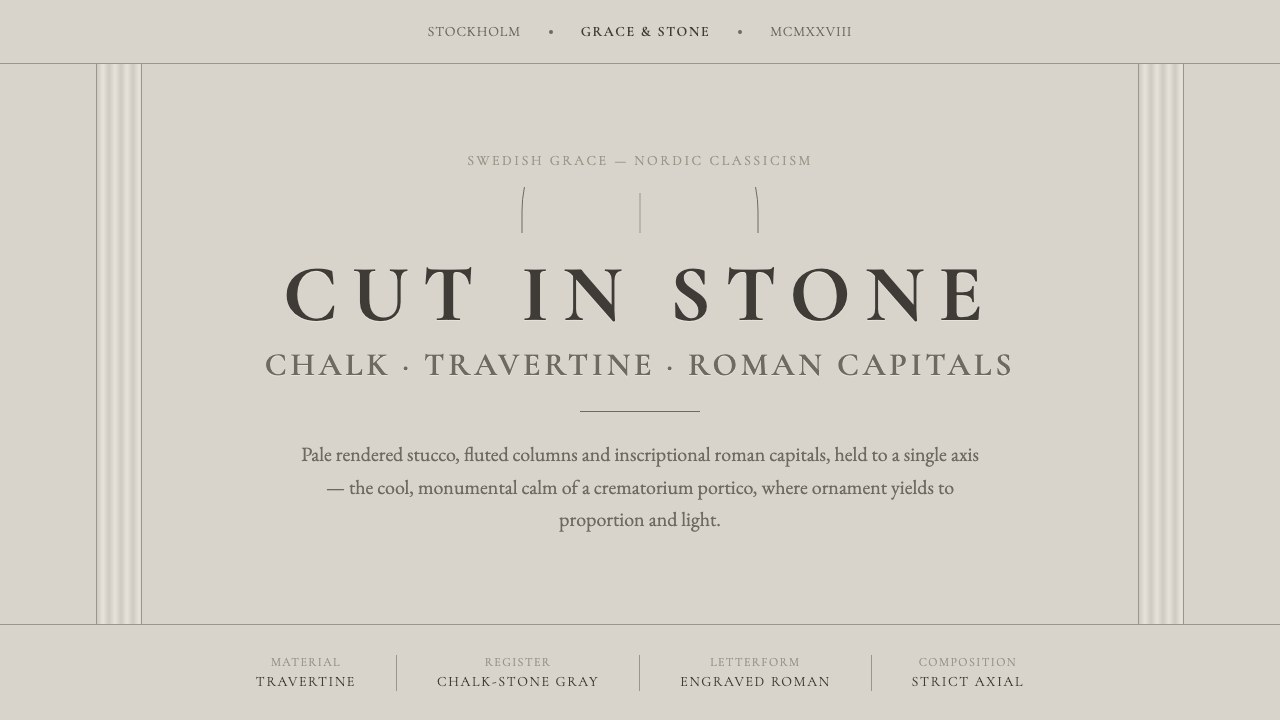 Nordic Classicism AsplundStone, not cream. Engraved Trajan capitals on cool chalk stucco, fluted colum…
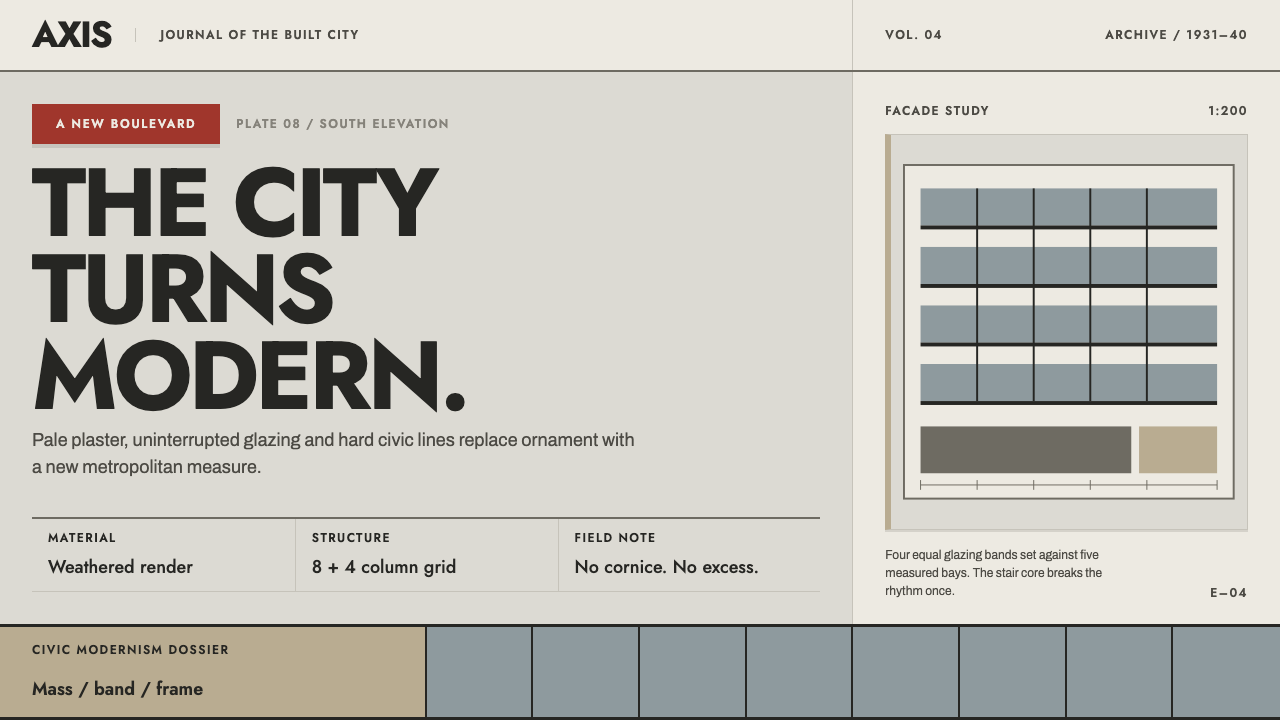 Bucharest Interwar ModernismModernism gathers civic weight. Sooted plaster, strict glazing bands and one…
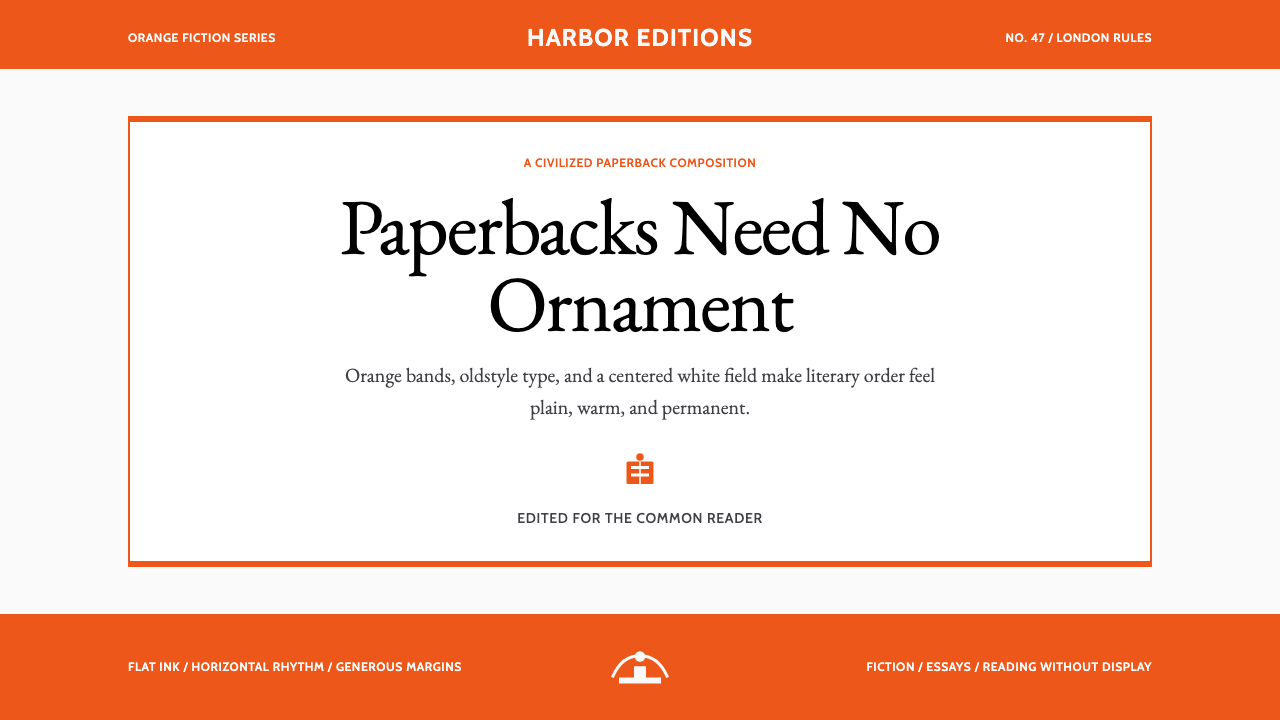 Penguin Classics OrangePaperback authority. Orange tri-bands, serif title panel, and flat ink enforc…
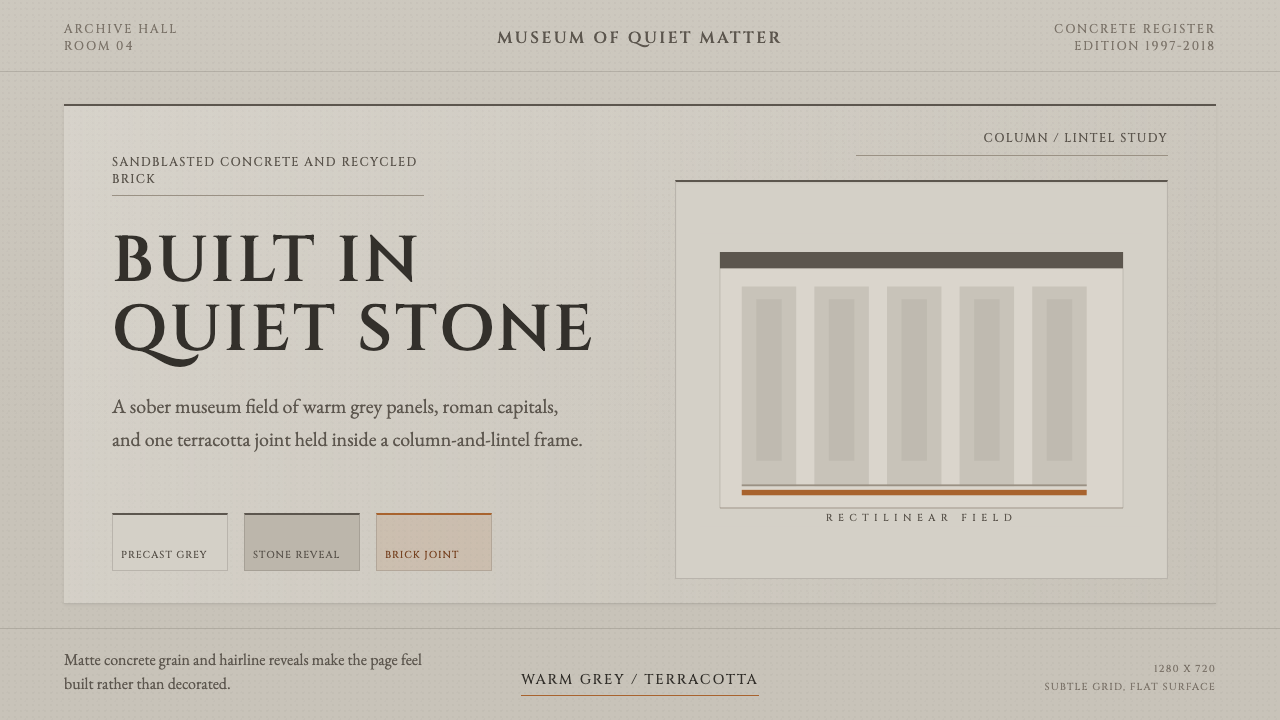 Chipperfield Museum GrayMuseum gravity, rendered quietly. Warm concrete grey, roman capitals, one ter…
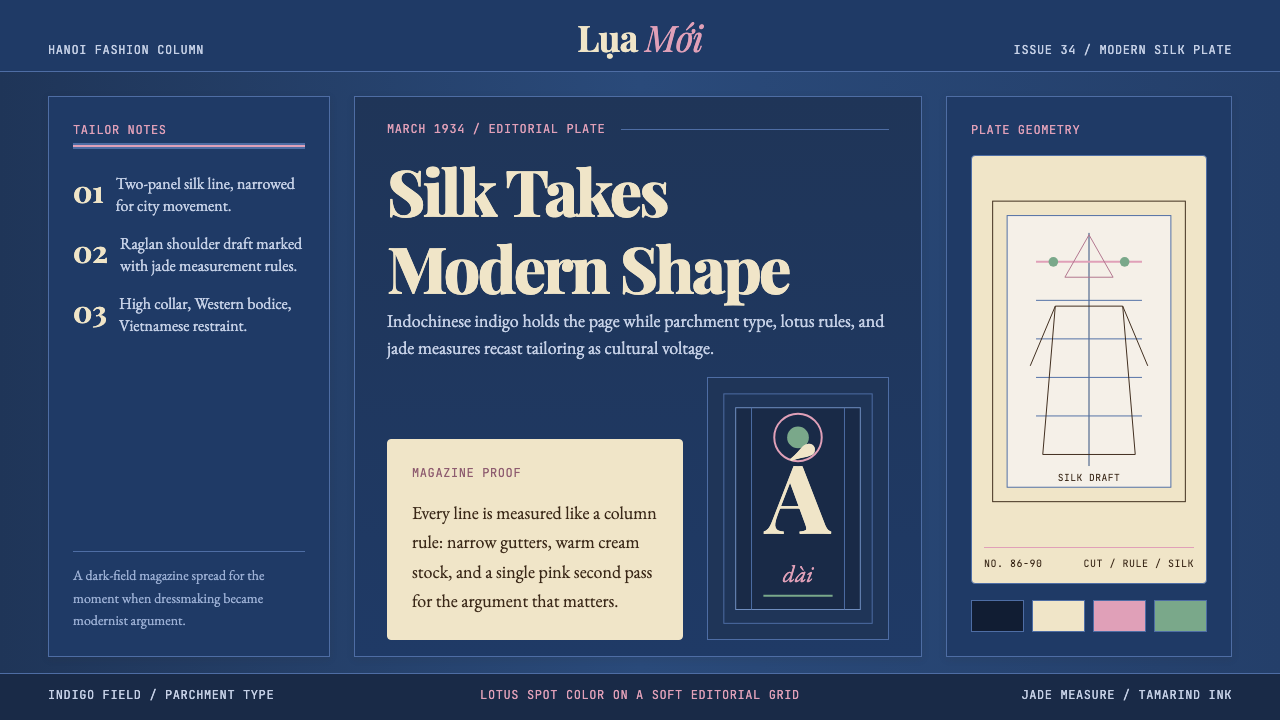 Vietnamese Áo Dài 1934 (Cát Tường)Indigo editorial poise. Parchment serif columns and lotus-pink rules frame th…
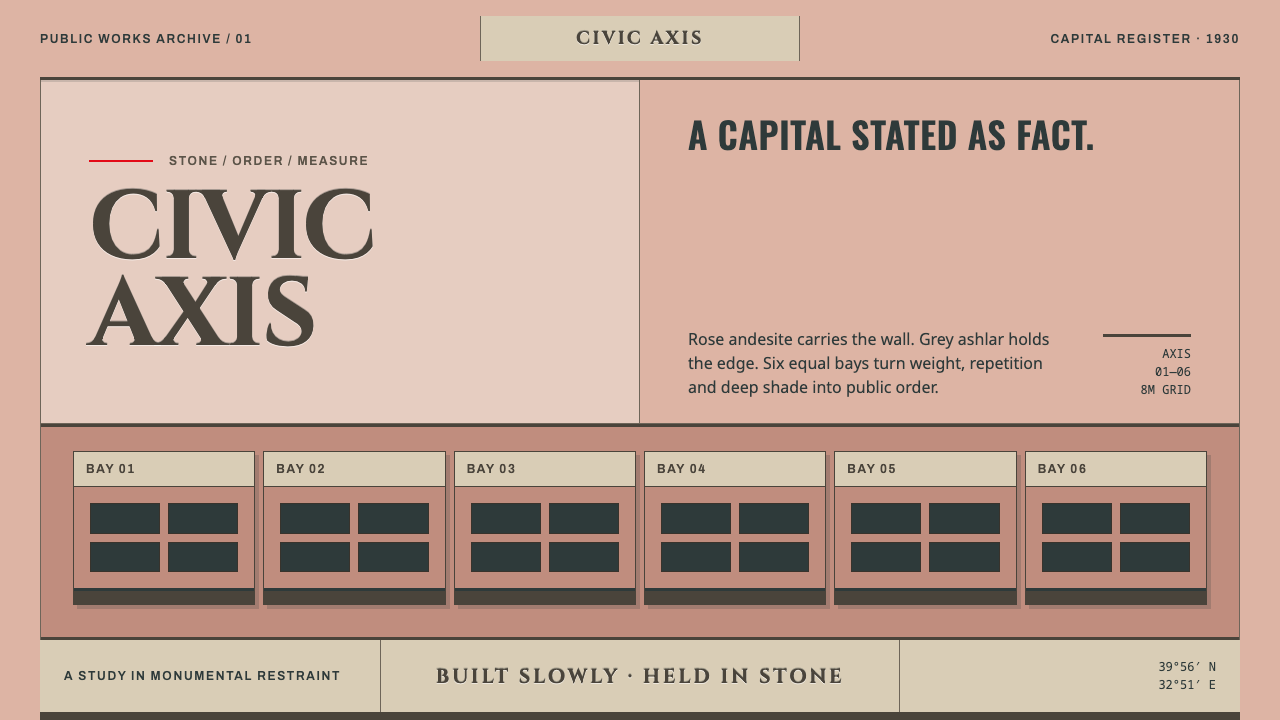 Ankara Republican ArchitectureAuthority moves slowly. Rose andesite, grey ashlar and six equal bays enforce…