What is Financial Times (Pink Paper)?
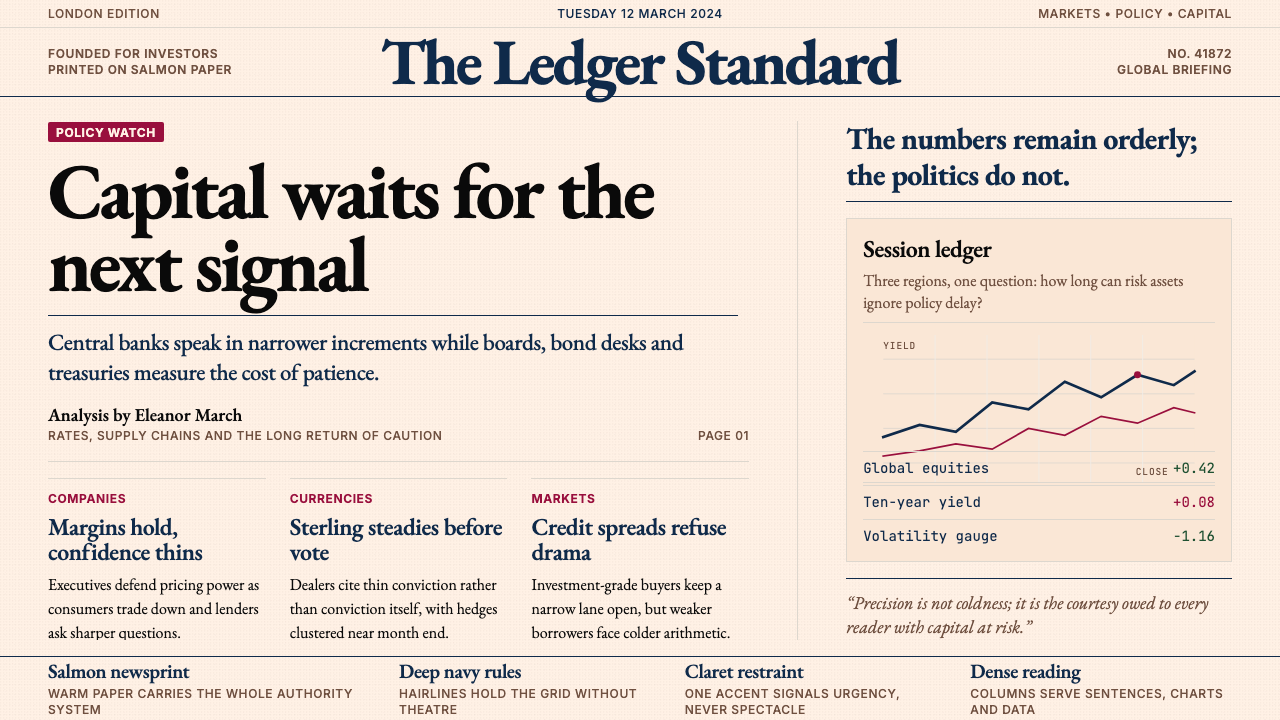
For over a century, a warm salmon-pink ground and hairline-ruled columns have made the Financial Times the most visually distinctive publication in global business journalism.
Financial Times (Pink Paper) in brief
The Financial Times visual identity is a typographic and chromatic system built entirely in service of dense, data-rich reading. At its centre sits a warm salmon-pink ground — neither orange nor peach, but a hue unique to the paper — paired with a bespoke serif typeface commissioned from a New Zealand type foundry, deep navy structural elements, and a restrained claret used as a secondary accent. The result is an immediately recognizable visual voice that requires no logo to identify itself.
This is not a decorative style. Every decision in the FT system is governed by editorial utility: hairline horizontal rules divide columns to guide the eye without consuming space; the custom serif typeface separates into a display variant for headlines and a text variant for body copy, each tuned to its precise reading distance; navy headers orient the reader within section and hierarchy; claret accents punctuate only those elements demanding immediate attention. Nothing competes with the sentence.
The FT aesthetic belongs to a broader British broadsheet tradition — long-form text culture, restrained palette, authority through density rather than showmanship — but it is distinguished from its peers by the pink ground and by the discipline of its typographic system. Where other financial publications lean on photography and infographic spectacle, the FT trusts the column and the serif to carry weight.

Where does Financial Times (Pink Paper) come from?
The Financial Times was founded in London in 1888 by a group of financial journalists who wanted a daily record of Stock Exchange transactions and commercial news. The paper launched in the heady atmosphere of Victorian capitalism, when London was still the world's financial centre and the City's appetite for reliable market information was insatiable. In its earliest years, the FT was a conventional broadsheet printed on white stock, competing directly with the older Financial News. The two papers would eventually merge in 1945.
The salmon-pink paper stock was adopted in 1893, and while the exact reasoning behind the decision has never been fully documented, contemporaneous accounts suggest it was a combination of commercial differentiation and practical advantage. The distinctive color immediately separated the FT from the sea of white-paper competitors on the newsstand. Printers of the period also noted that the unbleached or lightly dyed salmon stock was marginally cheaper than fully bleached white newsprint — a not-inconsiderable factor for a publication operating on thin margins. Whatever the original logic, the color's unintended consequence was identity permanence: within a generation, pink became synonymous with financial authority in the British press.
For most of the twentieth century, the FT's typography evolved incrementally through successive hot-metal and cold-type technologies but retained a fundamentally conservative broadsheet character — dense serif columns, minimal white space, news-wire efficiency. The paper's international expansion accelerated after it was acquired by Pearson in 1957, and by the 1990s the FT had grown into a global publication with simultaneous printing sites across Europe, the United States, and Asia. This scale demanded a more rigorously unified visual identity than the incrementally evolved system could provide.
The decisive typographic modernisation came in 2014, when the FT commissioned Kris Sowersby of the Klim Type Foundry in Wellington, New Zealand, to design a bespoke typeface family called Financier. Sowersby's brief was to create a serif rooted in the classical tradition of British and Dutch punchcutters — legible at the small sizes demanded by dense column text — while carrying enough typographic personality to anchor the paper's identity at display sizes. The resulting family, with its open apertures, restrained contrast, and slightly bracketed serifs, achieved precisely that balance. Financier gave the FT's visual system a typographic anchor that the salmon ground alone could not provide, and the combination has remained the foundation of the identity through subsequent redesigns and the paper's continued digital transformation.
What defines the Financial Times (Pink Paper) look?
The Salmon Ground
The FT's warm salmon-pink ground is the most recognizable single element in financial journalism. It is not a vivid or saturated color — it reads as warm, slightly dusty, and authoritative rather than bright or energetic. On screen, the digital equivalent preserves this quality: warm but muted, never competing with the ink above it. The ground functions simultaneously as brand identifier, reading comfort layer, and perceptual anchor that separates editorial content from advertising.
Bespoke Serif Typography
The FT's typographic system is built around a custom serif typeface with two distinct optical variants — one tuned for the large scale of headlines and section titles, another engineered for the demanding conditions of small-body column text. The display variant carries more personality and optical tension; the text variant prioritises even colour on the page and low fatigue at sustained reading distances. This dual-variant approach is a mark of serious typographic investment, distinguishing the FT's system from publications that rely on off-the-shelf type families.
Deep Navy Headers and Rules
Where other broadsheets might use pure black or a neutral dark for structural elements, the FT employs a deep navy that reads as slightly warmer and more deliberate against the salmon ground. Section headers, masthead elements, and the rules that divide columns all live in this navy register. The color carries connotations of institutional gravity — naval uniform, corporate suiting, official documentation — that reinforce the paper's positioning as a publication of record.
Column Grid and Hairline Rules
The FT's layout discipline is rooted in a tight, multi-column grid inherited from broadsheet tradition but executed with unusual precision. Columns are separated by hairline rules — lines so thin they register as texture rather than boundary, guiding the eye without asserting themselves. This restraint in rule weight is characteristic: every structural element does its job at the minimum necessary weight, preserving the page's overall tonal evenness and preventing any grid artifact from competing with editorial content.
Claret as Accent
The FT-claret — a deep, wine-adjacent red — functions as the system's third chromatic voice after salmon and navy. It appears sparingly: in bylines, in certain data visualisation elements, in selected navigation markers. Its rarity is part of its function; a color that appears everywhere loses the ability to signal importance. Claret is the FT's typographic italics — used to denote, not to decorate.
Informational Data Graphics
FT data visualisation is governed by the same editorial values as its prose: clarity over spectacle, precision over decoration. Charts use a limited palette drawn from the core system, with gridlines kept light and axis labels set small. The FT's charting conventions — flat fills, clean axes, minimal annotation — have become influential enough that the newspaper's data team has published its own visual vocabulary guide, which is widely referenced in the data journalism and business intelligence communities.
Restraint Over Decoration
Perhaps the most defining characteristic of the FT system is what it refuses to do. There are no decorative borders framing content, no drop shadows adding false depth, no gradient treatments on headers, no illustrative ornament filling white space. Where a lesser-confident publication might fear the blank column inch, the FT treats white space — or salmon space — as a breathing room earned by editorial economy. The aesthetic confidence required to leave space empty is inseparable from the publication's editorial confidence.

Who shaped Financial Times (Pink Paper)?
Sowersby is the Wellington-based type designer who, through his Klim Type Foundry, designed the Financier typeface family commissioned by the Financial Times in 2014. His brief was to create a serif rooted in classical British and Dutch punchcutting traditions while meeting the demanding requirements of a modern, multi-platform publication. The resulting family — with separate optical variants for display and text use — is considered one of the most accomplished bespoke newspaper typeface commissions of the twenty-first century. Sowersby's other notable designs include Tiempos, Domaine, and National, all of which show his characteristic attention to historical derivation and contemporary utility.
Bottomley was among the entrepreneurial figures associated with the early Financial Times, which emerged from the volatile world of Victorian financial journalism where newspapers served as much as promotional vehicles for stock promotions as they did as editorial records. His involvement reflects the paper's origins in a period when the boundary between financial reporting and financial promotion was considerably more porous than it later became. The FT's subsequent evolution into a publication of record — and the visual seriousness that identity entails — represents in part a deliberate distancing from that early promotional character.
Khalaf became editor of the Financial Times in 2020, the first woman to hold the position in the paper's history. Her editorship has overseen the continued evolution of the FT's visual and editorial identity during a period of significant digital transformation. Under her leadership, the paper has deepened its investment in data journalism and visual storytelling while preserving the core typographic and chromatic discipline that defines the FT's identity. Her presence at the head of the masthead is itself part of the visual identity — the editor's authority is encoded in the paper's restrained confidence.
Klim Type Foundry, established by Kris Sowersby in Wellington, New Zealand, has become one of the most respected independent type foundries in the world. Its practice is notable for combining deep historical research — particularly into Dutch and British type history — with rigorous contemporary design standards. The Financier commission brought Klim to wide international attention and positioned it alongside other storied institutional type commissions. The foundry's public retail catalogue, which includes Tiempos, Calibre, and Domaine, is widely used in editorial design and has influenced the broader direction of contemporary serif typography.
The Financial Times data journalism and visualisation team — contributors include John Burn-Murdoch among others — has become internationally recognised for its data graphics standards. Working within the paper's established chromatic and typographic system, the team has developed charting conventions notable for their editorial clarity: minimal chartjunk, consistent axes, plain annotation, and a limited color vocabulary derived from the core FT palette. Their work during the COVID-19 pandemic in particular drew global attention and established the FT's data visualisation style as a benchmark in journalism.
How do you use Financial Times (Pink Paper) today?
The FT visual language is one of the most directly applicable historical editorial styles for contemporary professional design work, because its principles are practical rather than symbolic. Applying it correctly requires internalising what the system values: authority through restraint, hierarchy through typographic weight rather than color saturation, and the willingness to leave space empty when content does not fill it.
For presentation slides — both cover and content — the FT approach transforms decks from fragmented slide-by-slide experiences into something resembling a designed publication. A cover page works well with a warm light ground, a bold editorial headline set in a strong serif, and a subtle horizontal rule beneath the title — no photography, no illustration, no decorative border. Content slides should treat each page as a newspaper layout: body text in a readable serif at a measured weight, data labels set small and consistently, charts that use the warm ground rather than a white box inset. Section-break slides can simply carry a large display-weight title and a deep navy rule, with nothing else. Data slides deserve particular attention: choose one or two colors drawn from the navy-claret-salmon family to distinguish data series, keep axis labels minimal, and let the grid lines be nearly invisible.
For web interfaces — dashboards, pricing pages, and analytics tools — the FT system offers a powerful alternative to the default light-grey-and-blue corporate web aesthetic. The approach: set the page background to a very warm near-white that references but does not copy the salmon tone, use deep navy for primary navigation, reserve claret for calls to action or alert states, and keep typography in a confident serif for titles and a well-spaced system-level sans for data labels and UI text. Table components should use alternating warm tints on rows rather than grey stripes. Card components work without soft drop shadows — a thin navy border and a slightly deeper warm ground read as more considered than shadow.
For editorial and marketing materials — reports, white papers, newsletters, social cards — the FT register communicates financial seriousness and institutional weight. An annual report or research publication in this style would use the warm ground throughout, place charts on the same ground rather than reversing them to white, and trust the typography to carry chapter breaks rather than relying on large imagery. Marketing materials can use the system's poster-like quality: a high-contrast serif headline against the warm ground, a single claret accent on a key phrase or data point, and generous white — or salmon — space around the text block.
The most common mistake when working in this style is misreading the salmon ground as a dominant brand color and extending it aggressively — pushing it toward orange, oversaturating it, or using it as a design element rather than a ground. The FT's pink is effective because it recedes: it is a field on which ink sits, not a color that competes with the typography above it. A second frequent error is treating the navy and claret as interchangeable; they have distinct roles — navy for structure, claret for emphasis — and using claret for structural elements destroys the hierarchy the system depends on. Finally, the style fails quickly when a decorative illustrative layer is added, however tasteful: the system's authority comes precisely from its refusal to illustrate.

Financial Times (Pink Paper) — FAQ
Is the FT style actually usable for digital products, or is it too print-rooted?
The FT style is highly effective for digital products, and the FT itself has demonstrated this through its own digital transformation over the past decade. The salmon ground translates well to screen: it reduces eye strain in extended reading sessions in ways that pure white cannot, which is why several digital reading apps have adopted warm-tinted reading modes. The typographic hierarchy — display serif for titles, text serif for body, restrained palette for data — maps cleanly onto web and app patterns. The main adjustment required is scaling the hairline rules up slightly for screen resolution, since a print hairline at web pixel density can become invisible.
How does the FT style differ from other broadsheet editorial styles, like The Economist or The New York Times?
The most obvious distinction is the salmon ground, which exists nowhere else in broadsheet journalism at scale. Beyond color, The Economist uses a more aggressively typographic approach with very tight leading and smaller type, while the FT allows more air in its column text. The New York Times digital visual identity is considerably more photography-driven and uses a much wider color vocabulary, including a bold use of black and significant white space, giving it a different tonal register — more magazine-like, less data-dense. The FT's particular combination of warm ground, restrained palette, and typographic seriousness positions it closest to a data-publication aesthetic — something between a newspaper and a financial terminal.
Can this style work for a startup or small company, or does it only suit established institutions?
The FT style can work for smaller organisations, but it requires confidence to carry. The risk for a startup is that the style's institutional gravity can read as pretension if the product behind it does not yet match the implied authority. The style works best for B2B products in financial services, professional analytics, legal technology, or any domain where the user's primary expectation is reliability and precision rather than warmth or creativity. Used in the right context — a fintech dashboard, a data subscription product, an investor relations site — the FT register immediately communicates seriousness in a way that takes years of conventional design to achieve.
Does the style support dark mode?
A dark-mode inversion of the FT system is possible but requires careful thought. The challenge is that the salmon ground — the system's defining element — does not simply invert to a usable dark equivalent. A true dark mode in this register would not be a salmon-on-dark composition; it would shift the ground to a very deep navy and bring the salmon in as a warm accent, allowing claret to disappear and reintroducing it only for very specific states. The typographic system carries over cleanly to dark — strong serif on deep ground is a traditional book-printing technique — but the color relationships need complete reconsideration rather than mechanical inversion. The FT's own dark mode on its digital platforms reflects exactly this complexity.
How should data visualisation be handled within this style?
Data visualisation within the FT register should treat the chart as an editorial element rather than a decorative one. This means: charts sit directly on the warm ground rather than in a white container; color in charts is drawn from the system palette — navy for primary series, claret for a secondary series, and warmer or cooler tints of these for additional series if required; gridlines are set to barely-visible rather than prominent; and titles and annotations are typeset consistently with the surrounding body text rather than in a different face or size. The FT's own chart style avoids the over-annotated, legend-heavy approach common in business intelligence tools; instead, important values are labeled directly on the chart elements themselves, and the surrounding prose carries contextual explanation.
Related design styles
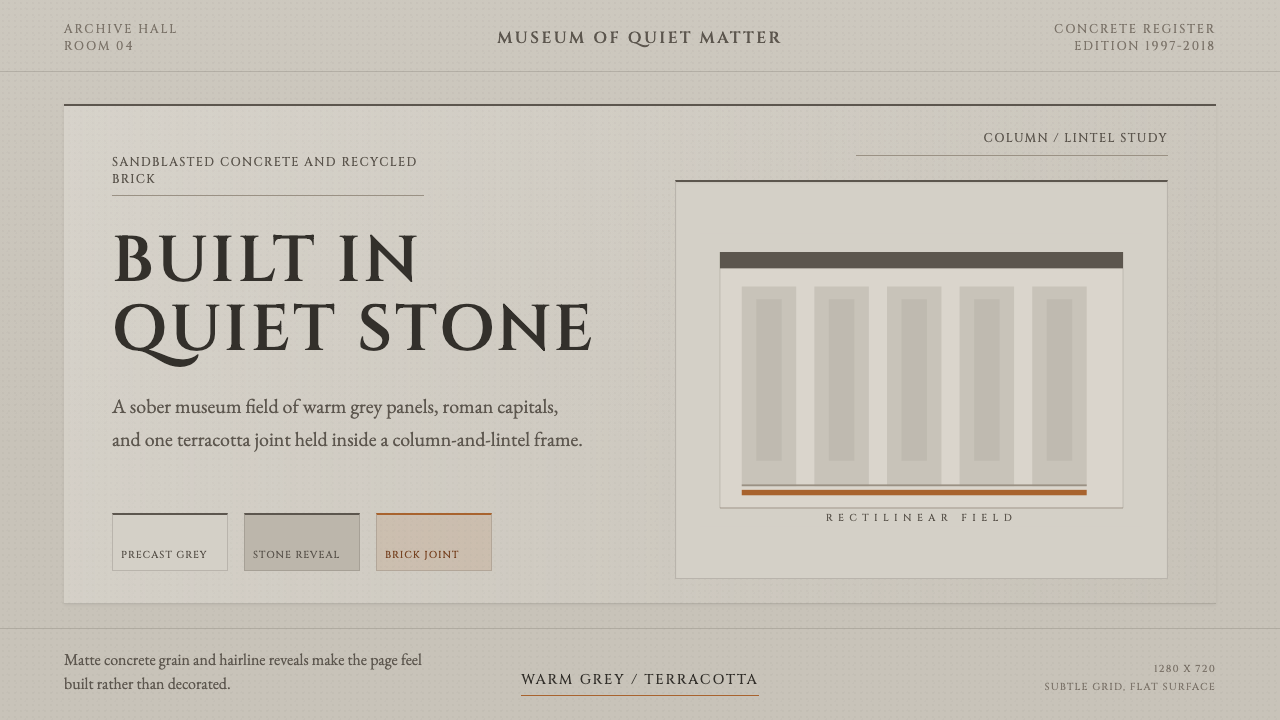 Chipperfield Museum GrayMuseum gravity, rendered quietly. Warm concrete grey, roman capitals, one ter…
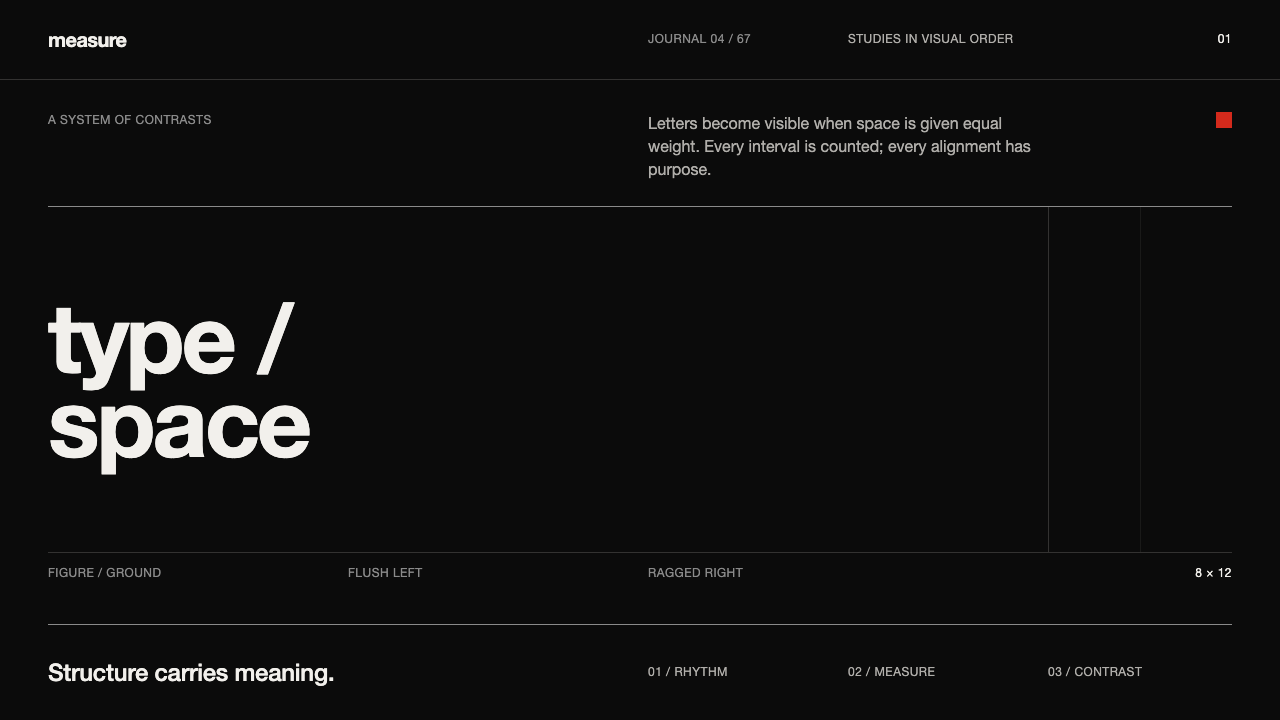 Emil Ruder TypografieDiscipline makes type visible. Near-white grotesque and measured space cut th…
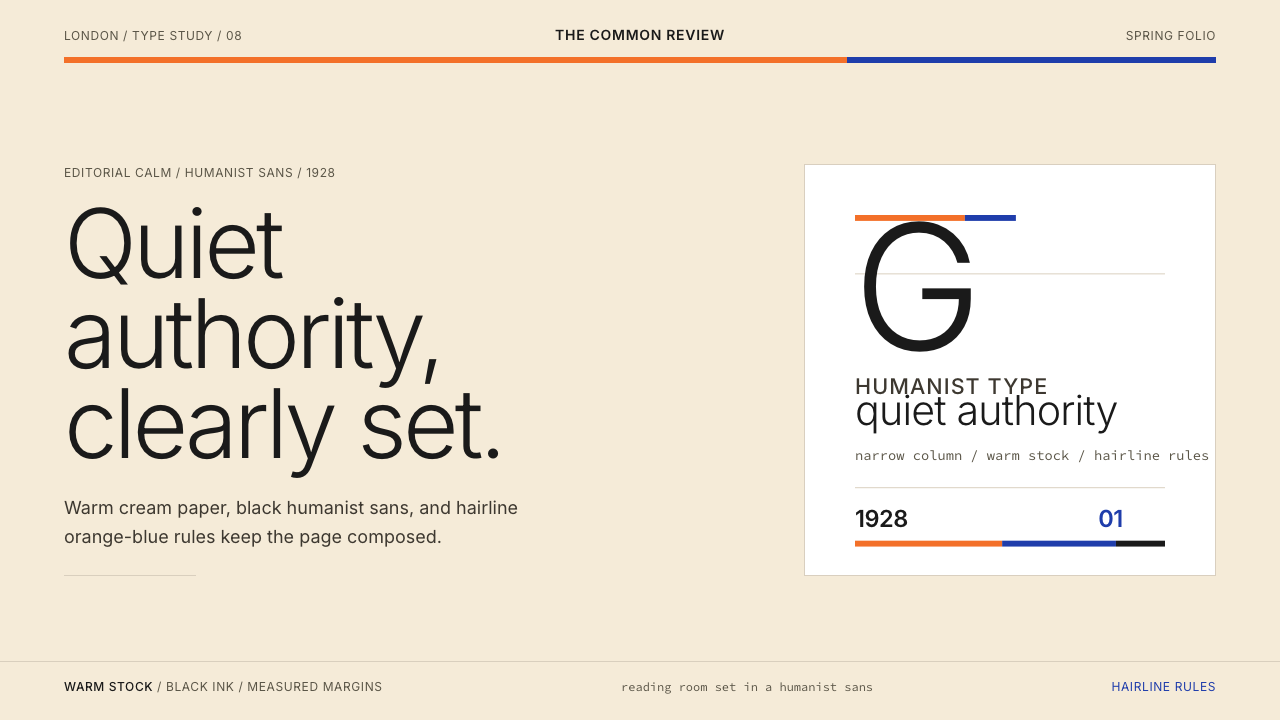 Gill Sans (BBC, 1928)Quiet authority, clearly set. Warm cream, black humanist sans, and hairline o…
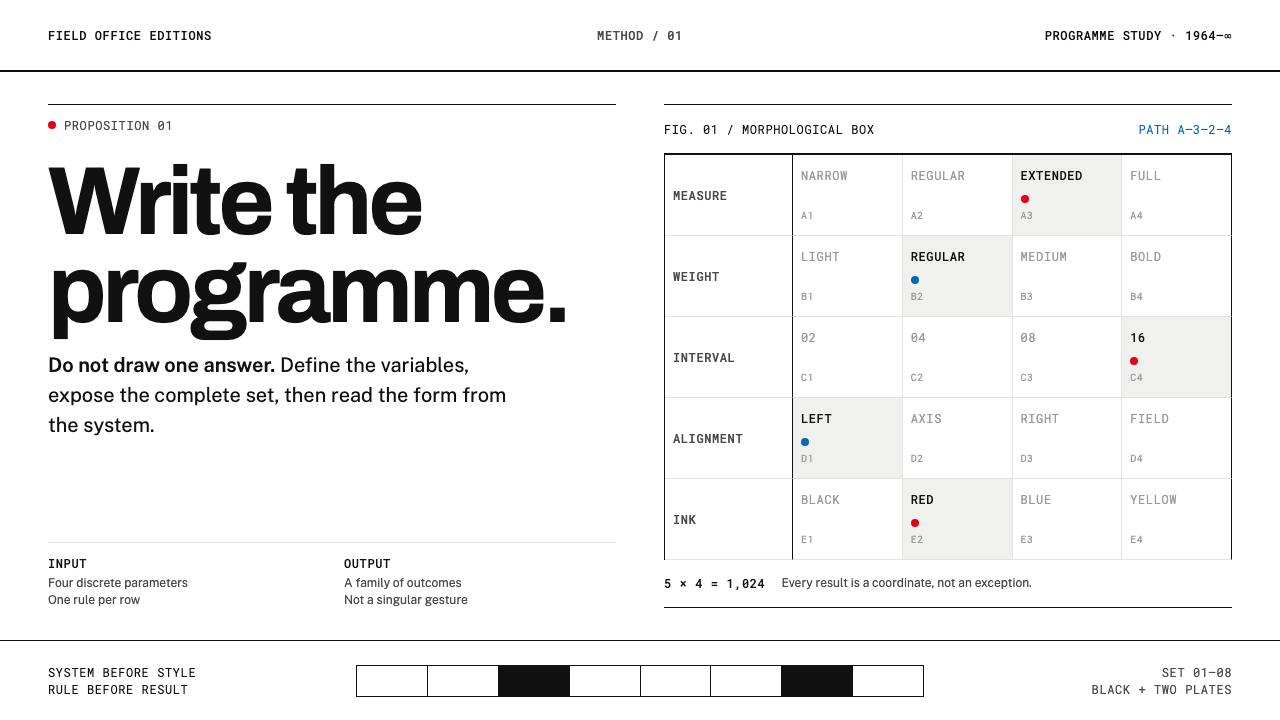 Karl Gerstner ProgrammesDesign becomes a programme. Black hairlines and a strict matrix turn paramete…
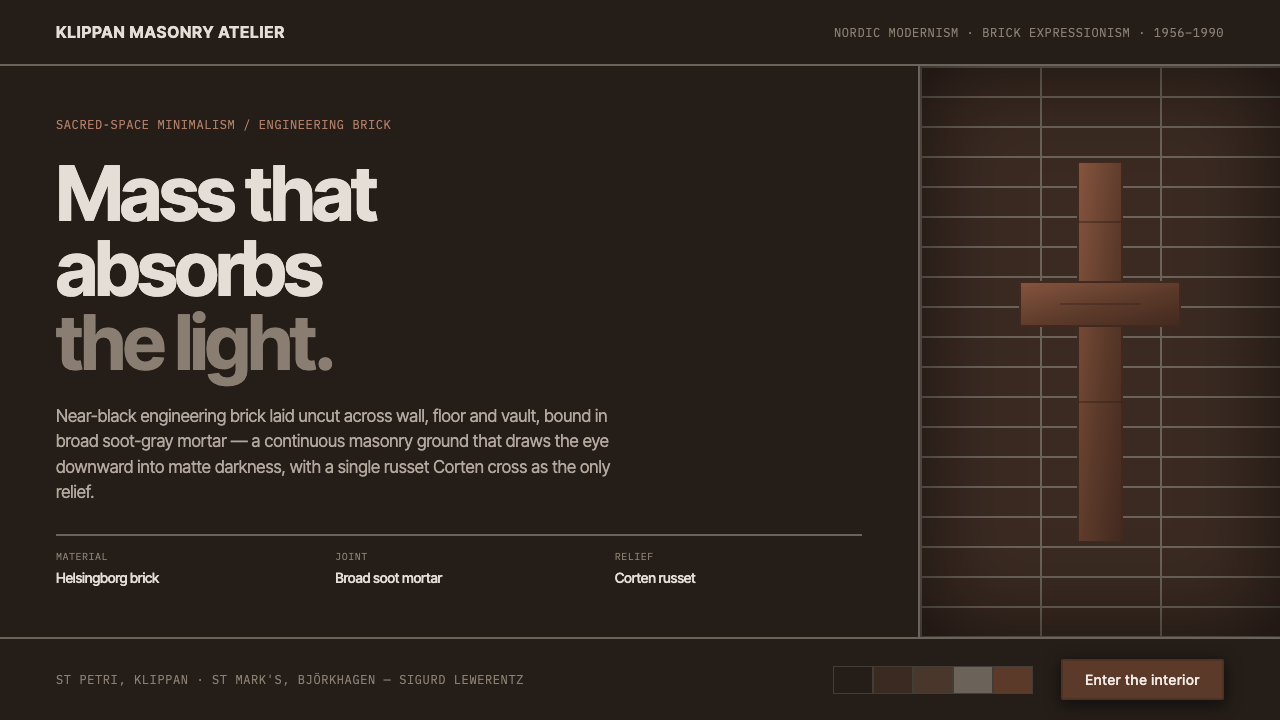 Lewerentz Dark BrickMass that absorbs light. Near-black engineering brick, broad soot mortar, one…
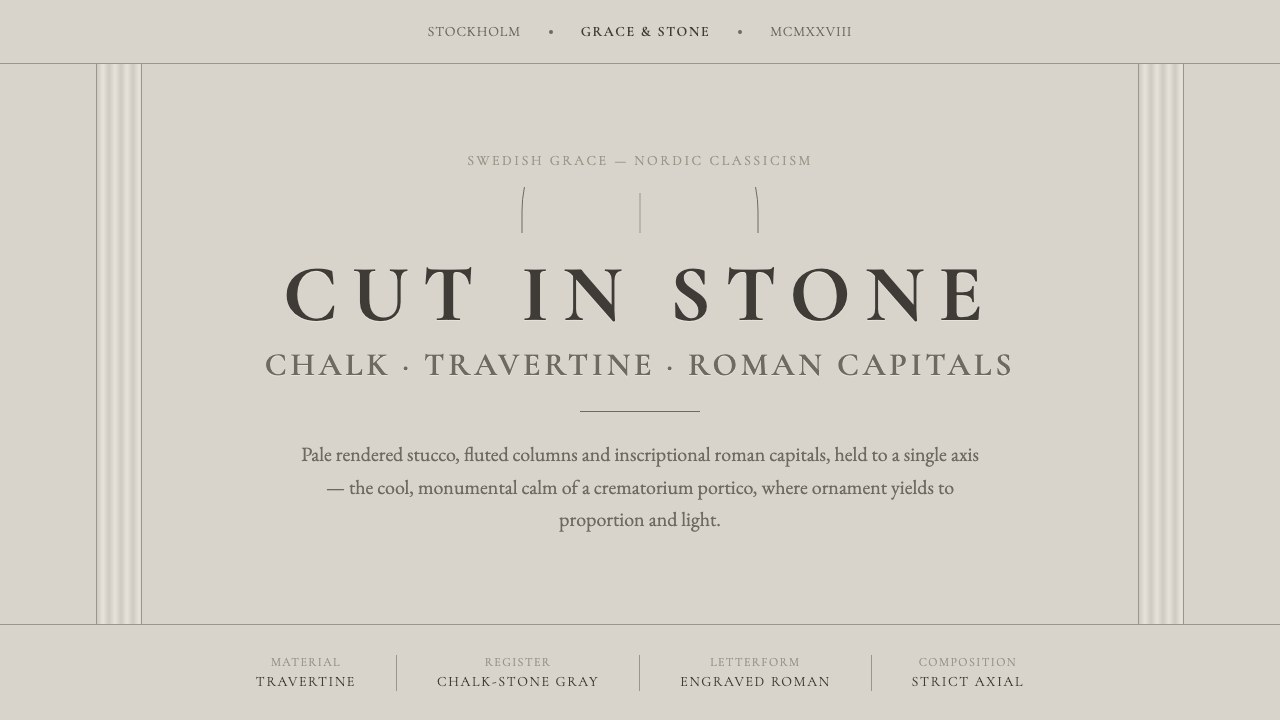 Nordic Classicism AsplundStone, not cream. Engraved Trajan capitals on cool chalk stucco, fluted colum…