What is Acne Studios Pink-Paper?
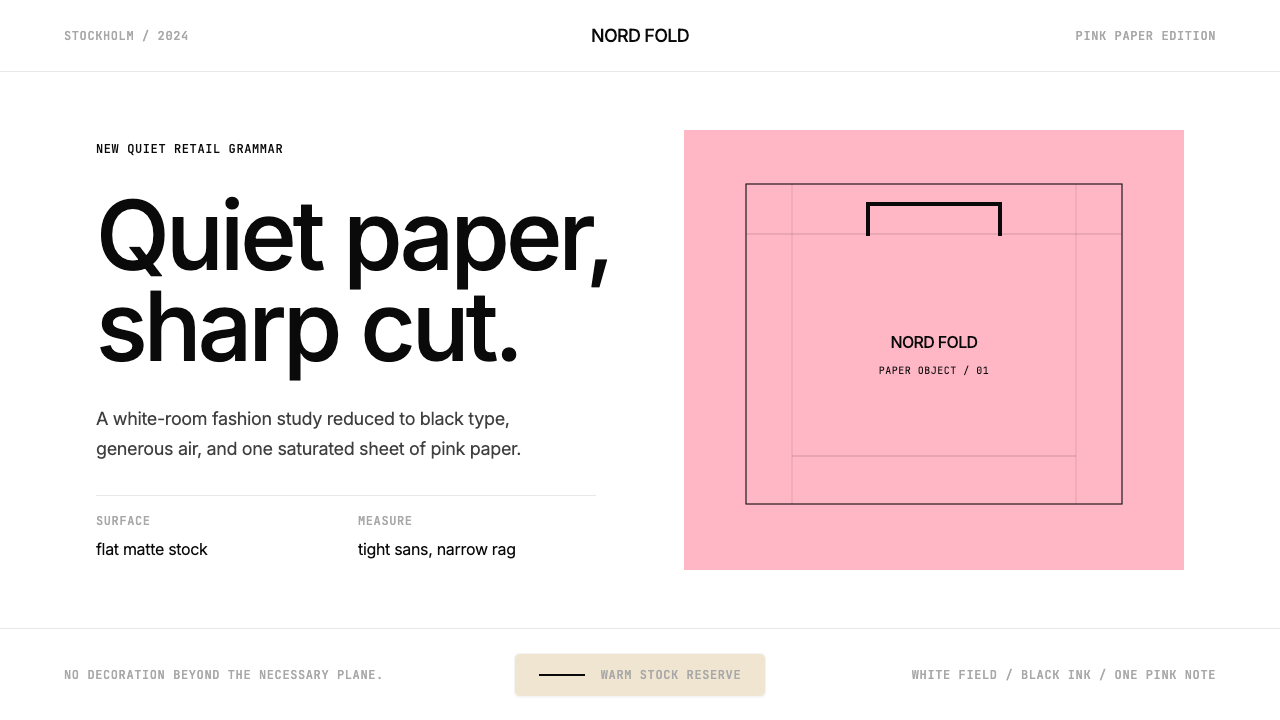
Acne Studios built a global luxury identity from a single iconic object — a saturated bubblegum-pink paper shopping bag that turned restraint into desire.
Acne Studios Pink-Paper in brief
Acne Studios Pink-Paper is the visual design system distilled from Acne Studios' brand identity — a Swedish luxury fashion house whose entire aesthetic language orbits a single tactile artifact: the saturated pink paper shopping bag. The system pairs that iconic pink with generous white space, deep-black modernist sans-serif type, and a quiet boutique atmosphere that feels simultaneously minimal and sensuous.
Where many luxury brands signal prestige through gilded ornament or maximalist imagery, Acne Studios signals it through conspicuous restraint. The palette is reduced to three anchors — the signature bubblegum pink, pure white or near-white, and a deep near-black — deployed with an almost surgical economy. Every element on the page earns its placement; whatever cannot justify its presence has already been removed.
The system belongs to the contemporary 'quiet luxury' movement — a sensibility that rejects logomania and visual noise in favor of understatement, material quality, and the confidence of a brand that does not need to announce itself. Applied to digital and print contexts, it reads as a minimalist Stockholm boutique translated into pixels and paper: clean walls, a single pink accent, black type, and the kind of silence that only expensive things can afford.

Where does Acne Studios Pink-Paper come from?
Acne Studios was founded in Stockholm in 1996 by Jonny Johansson and three collaborators. The name is an acronym: Ambition to Create Novel Expressions. The brand began not as a fashion house in the conventional sense but as a creative collective producing films, furniture, and magazines alongside clothing. This multidisciplinary origin is visible in the design system's intelligence — it carries the sensibility of a studio that thinks across media rather than a marketing department executing brand guidelines.
The pink shopping bag emerged as the brand's most powerful visual asset over the course of the 2000s and 2010s. Its specific hue — a warm, high-saturation pink that sits between bubblegum and rose, with a softness that prevents it from reading as aggressive — became instantly recognizable on the streets of Stockholm, Paris, New York, and Tokyo. In an era when luxury brands competed through heritage and monogram, Acne Studios competed through a single chromatic gesture so distinctive it needed no logo to identify it.
The visual identity as a coherent digital and print system solidified primarily through the 2010s, running through 2024 and beyond. In 2014, the LVMH group acquired a stake in Acne Studios, bringing the brand into the orbit of the world's largest luxury conglomerate while leaving its creative direction largely intact. The Scandinavian modernist roots — spare geometry, confident whitespace, distrust of ornament — remained the structural foundation even as the brand scaled internationally.
The Musubi knotted-bag silhouette, introduced as a product and later absorbed as a graphic motif, added a second visual signature alongside the pink bag. Both forms — the pink rectangle of the shopping bag and the looped knot of the Musubi — function as icons in the design system: simple, geometric, and legible at any scale. Together they illustrate how the Acne Studios visual language converts physical product forms into graphic vocabulary, collapsing the boundary between fashion object and brand mark.
What defines the Acne Studios Pink-Paper look?
The Signature Pink
The bubblegum pink is the system's defining anchor — a warm, fully saturated pink that is bold enough to command attention from across a room yet soft enough to avoid aggression. It reads as neither candy nor blush, occupying a precise chromatic territory that feels simultaneously playful and considered. In the system, this pink functions as a primary accent: it colors the bag-form motif, appears as a background wash on select surfaces, and signals the brand without additional language.
Whitespace as Material
Whitespace in the Pink-Paper system is not passive emptiness — it is the primary material through which luxury is communicated. Margins are wide, line spacing generous, and text blocks deliberately small relative to the available field. This spatial generosity mimics the experience of a high-end retail environment where objects are given room to breathe, where crowding would signal discount rather than desire. The white ground is never filled for the sake of filling.
Deep-Black Modernist Typography
Type in the system is set in a clean, contemporary geometric sans-serif — tightly tracked, deeply black, and given significant size contrast between hierarchy levels. Headlines sit at a commanding scale; body text is small and precise. There are no decorative letterforms, no script accents, no serifs. The typographic voice is confident and Nordic — spare rather than warm, exact rather than expressive. Uppercase settings appear for brand-level communication; mixed case governs editorial body text.
The Bag-Form Motif
The pink shopping bag silhouette — a simple, upright rectangle with a pair of handles — recurs as a graphic element throughout the system. Rendered flat, it functions as both a brand icon and a compositional anchor. When deployed as a full-bleed background or a cropped foreground element, it transforms from a commercial object into an abstract geometric form: a pink rectangle, vertically oriented, floating on white. The Musubi knot-form offers a complementary organic counterpoint to this geometric purity.
Restrained Color Economy
Beyond the signature pink, near-white, and near-black, the system admits almost no additional color. When a secondary tone appears — perhaps a muted warm gray or a soft neutral — it plays a purely structural role, demarcating zones or softening transitions. No gradients introduce new hues; no photographic color palettes expand the range. This monastic color discipline is what separates the system from ordinary pink-and-white schemes: the pink operates as a singular chromatic event in an otherwise achromatic field.
Minimal Surface, Maximum Tension
Compositions in the Pink-Paper system achieve their visual energy not through density but through precise tension between elements. A single pink block against a white field, a lone line of text in a sea of margin, a bag form cropped at the edge — each creates a charged relationship between positive and negative space. The eye is guided by implied geometry rather than explicit rules, by weight and placement rather than arrows or decorative pointers.
Tactile Quietude
The system's emotional register is quiet, not cold. Where Scandinavian modernism can sometimes feel clinical, the bubblegum pink introduces warmth and a subtle playfulness that prevents the system from becoming severe. This balance — between the rational clarity of Nordic design and the soft femininity of the pink accent — is the system's most distinctive tonal achievement. It feels premium without feeling intimidating, minimal without feeling bare.

Who shaped Acne Studios Pink-Paper?
Johansson co-founded Acne Studios in Stockholm in 1996 and has served as creative director throughout the brand's history. His vision fused Scandinavian modernist restraint with an irreverence that prevented the brand from calcifying into mere minimalism. The decision to anchor the brand's identity in a physical object — the pink shopping bag — rather than a conventional logo or wordmark reflects his understanding that in contemporary luxury, the most powerful brand signals are experiential and chromatic rather than symbolic. Johansson's multidisciplinary background, spanning film, furniture, and publishing, gave the brand's visual language a studiousness rare in fashion.
Unlike many luxury brands that outsource visual identity to external agencies, Acne Studios has maintained an in-house creative studio responsible for developing and stewarding its visual language. This arrangement has produced a consistency rare in contemporary fashion: the same tonal and compositional sensibility runs through campaign photography, retail environments, editorial content, packaging, and digital platforms. The studio's work demonstrates that a coherent visual system, maintained over time by a dedicated internal team, can itself become a form of brand equity — something that accumulates value precisely because it does not change.
While not a single person, the broader tradition of Scandinavian modernism — encompassing mid-century Swedish, Danish, and Finnish design — provides the ideological skeleton on which the Pink-Paper system is built. Scandinavian modernism championed the belief that good design should be democratic, functional, and free of ornament that serves no purpose. Applied to fashion and brand identity, this tradition produces work that is confident without being aggressive, sophisticated without being exclusive in its visual language. Acne Studios channels this legacy through its spatial generosity, typographic precision, and the refusal to compete through decorative complexity.
LVMH acquired a stake in Acne Studios in 2014, providing the brand with resources to scale internationally while leaving its creative apparatus largely independent. The acquisition is significant in the context of the visual system because it marks the moment Acne Studios' design language was validated as a global luxury proposition — one that could compete in the same tier as Maison Margiela, Celine, and other houses with deeply considered visual identities. The LVMH relationship also accelerated the brand's retail expansion, which in turn multiplied the exposure of its distinctive pink bag and quiet boutique aesthetic across global markets.
How do you use Acne Studios Pink-Paper today?
Acne Studios Pink-Paper translates remarkably well to presentation design when its underlying logic is understood: this is a system built on the supremacy of negative space and a single chromatic event, not on the busyness of decoration. A slide deck built in this style should feel like walking through a quiet gallery — each slide a composed moment, not a packed information delivery system. Cover slides work best with a near-full-bleed pink background or a large pink rectangle against white, the presentation title set in a tightly tracked, bold, deep-black sans-serif at a generous scale. The composition should have one clear visual focal point, surrounded by space.
Content slides in the Pink-Paper system carry text at restraint. Body copy is kept small and tight; a single statement or headline occupies the dominant size. Section dividers use a spare horizontal rule or a shift in background — pink section, white section — rather than decorative graphic elements. Data slides present charts and graphs with the same discipline: bars and lines in the signature pink against white, labels in deep black, no gridlines unless structurally necessary. The data becomes part of the visual system rather than an interruption of it.
For web interfaces — particularly dashboards, pricing pages, and editorial platforms — the Pink-Paper approach demands a strong typographic grid and serious restraint in color use. The background should read as white or very near-white; the pink appears sparingly as an interactive highlight, a selected-state indicator, a badge, or a call-to-action surface. Navigation is typographic rather than icon-heavy. Cards and containers use fine borders or the faintest drop shadows rather than soft-glow effects; borders in near-black feel consistent with the system's precision. The entire interface should feel like it costs something to look at — not through ornamentation, but through the confidence of its emptiness.
In editorial and marketing contexts, the system supports strong headline-led layouts where the visual hierarchy is established by type scale alone. A feature article opening in this style might pair a near-full-bleed pink-tinted image or a white page with a single large headline in black, body text beginning in a narrow column far below it. Marketing pages benefit from alternating sections — white on pink, pink on white — with copy kept brief and headlines doing the persuasive work. Campaign imagery should be treated with a clean, high-contrast edit rather than richly saturated or mood-lit photography; the images should feel Swedish, not tropically colorful.
The most common mistake when applying Pink-Paper is treating the pink as a background color to be used generously across the entire composition. Deployed at full field, the pink ceases to be an accent and becomes wallpaper — losing its power as a chromatic event. The pink should appear where it will be noticed, which means it needs adjacent white space to activate it. A second common mistake is introducing warmth through additional colors — peach, coral, blush — which dilute the system's chromatic precision. The signature pink does all the warmth-carrying; everything else should be cold and achromatic.

Acne Studios Pink-Paper — FAQ
What makes Acne Studios Pink-Paper different from other pink design systems?
Most pink design systems use pink as a mood — feminine, playful, energetic — combined with other accent colors and rich imagery. The Pink-Paper system uses pink as a singular, almost architectural event: one specific shade, deployed sparingly, against an otherwise achromatic palette of white and near-black. The pink carries the entire chromatic identity of the system; nothing else competes with it. This restraint transforms the pink from a decorative choice into a structural one, which is why it reads as luxury rather than as sweetness.
Can this style work for brands that are not in fashion or luxury?
Yes, with appropriate calibration. The Pink-Paper system's core values — restraint, spatial confidence, tonal precision — translate well to any brand that wants to communicate quality without ostentation. It is particularly effective for creative agencies, design studios, premium software products, editorial publications, and cultural institutions. It works less well for brands that need to communicate warmth, accessibility, or emotional expressiveness as primary values — the system's quietness can read as coolness or even aloofness in those contexts. The key question is whether 'quiet confidence' aligns with the brand's core communication objective.
How should the pink be proportioned in a layout?
The pink should be a minority element by area — typically covering far less of the total composition than white or near-black. Think of it as a single stroke of color in a composition that is otherwise mostly empty. When the pink does cover a large area — a full-bleed cover, for instance — the typographic and compositional elements that sit on top of it should be minimal, letting the pink itself carry the page. The moment the pink competes with other colors or dense content, its function as a singular chromatic event breaks down.
Does the system work on dark backgrounds?
The Pink-Paper system is fundamentally a light-ground system — white and near-white backgrounds are canonical. A dark-mode inversion is technically possible but requires significant recalibration. On a dark background, the bubblegum pink typically becomes too luminous and risks losing its measured, considered quality — it can shift from elegant accent to glowing neon. If a dark variant is required, the pink is best used at a reduced surface area with careful attention to how it interacts with the dark ground. The near-black type characteristic of the light system becomes near-white in the dark variant, which can work, but the tonal discipline must be maintained.
How do you prevent the style from feeling cold or clinical?
The pink itself is the primary warmth provider — used intentionally, it introduces enough sensory temperature to prevent the system from feeling sterile. The risk of coldness increases when the pink is used too sparingly or when the white space is so vast that the composition feels unfinished rather than composed. Warmth can also be managed through the tone of the photography or imagery: images with human presence, skin tones, and soft natural light work with the system rather than against it. What should be avoided is trying to add warmth through additional warm colors — that disrupts the system's chromatic logic and typically reads as inconsistency rather than humanization.
Related design styles
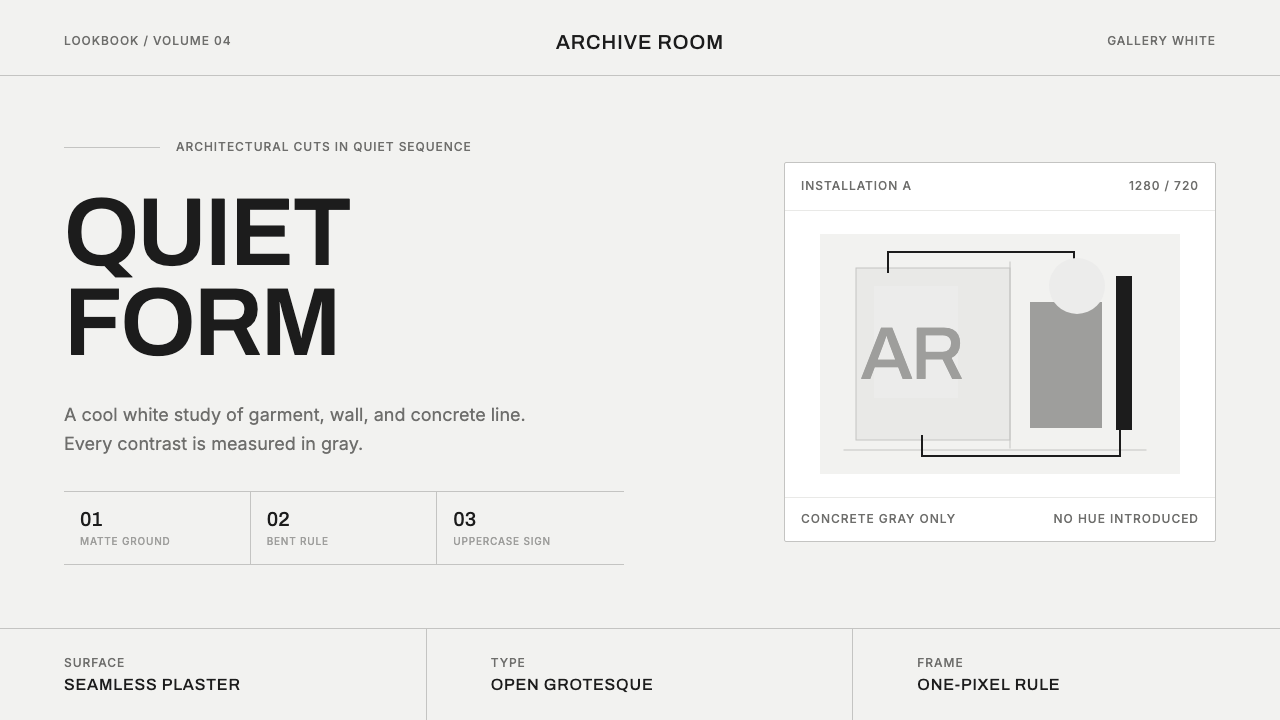 COS Gallery MinimalSilence has structure. Cool gallery white, Archivo uppercase, and concrete-gr…
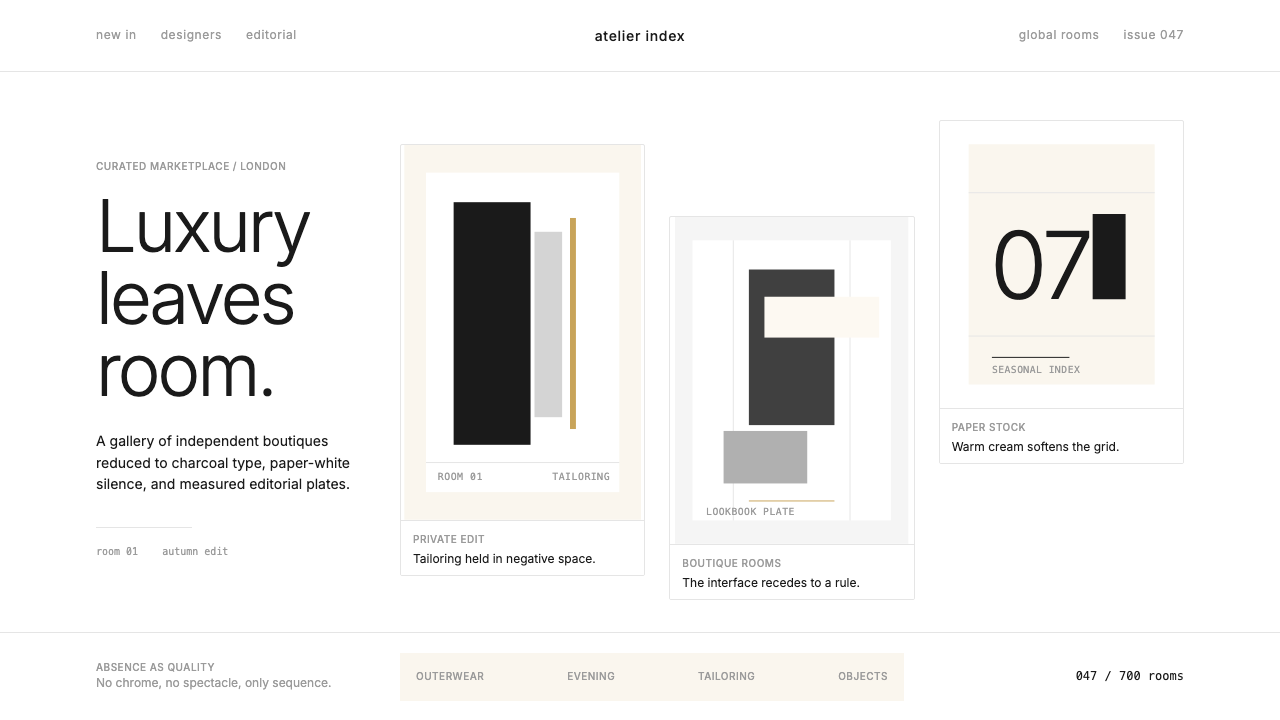 FarfetchLuxury as absence. Charcoal type, white canvas, and hairline editorial plates.
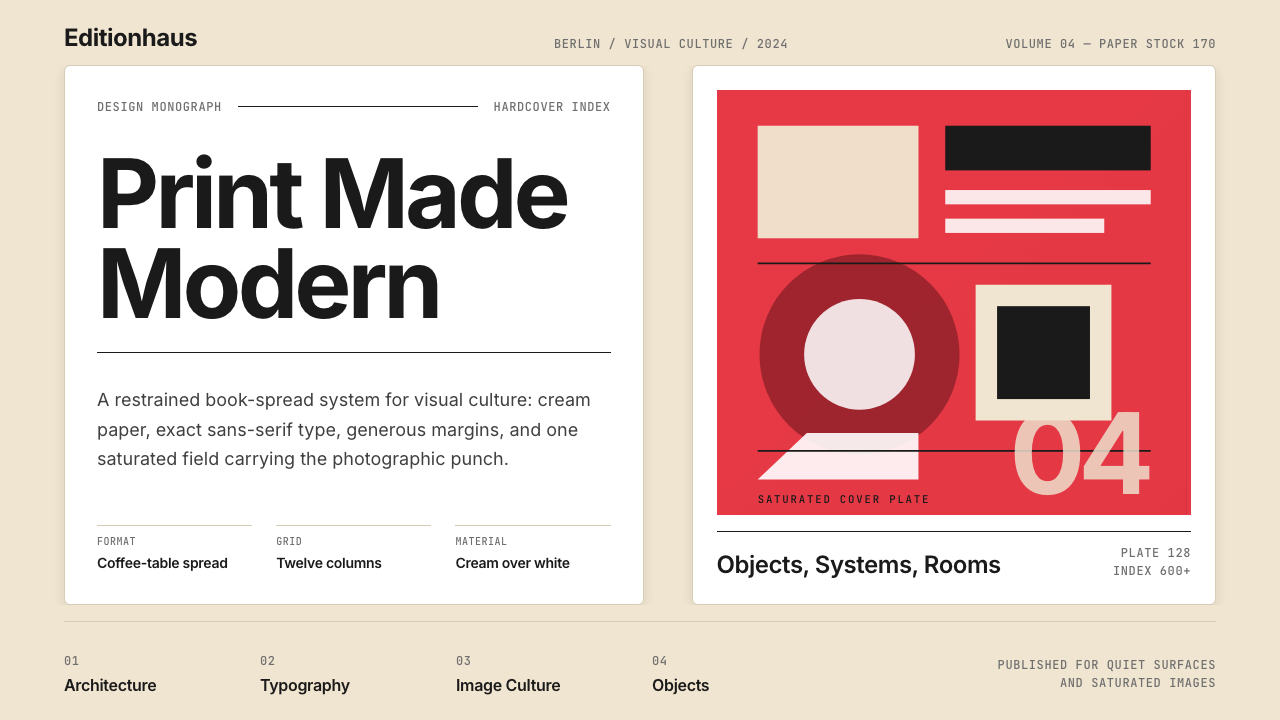 Gestalten Design BookCoffee-table calm. Cream paper, tight sans, one saturated block, and a strict…
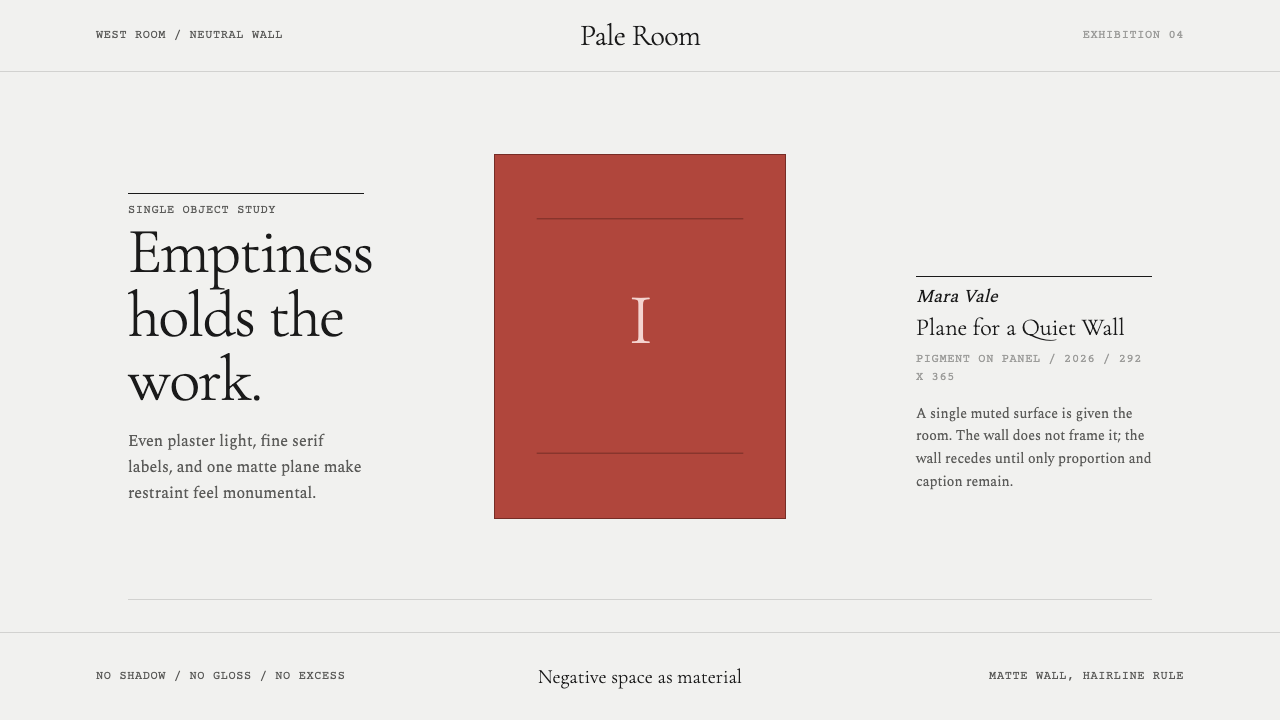 White Cube GalleryEmptiness is the medium. Cormorant labels and one terracotta plane hold the w…
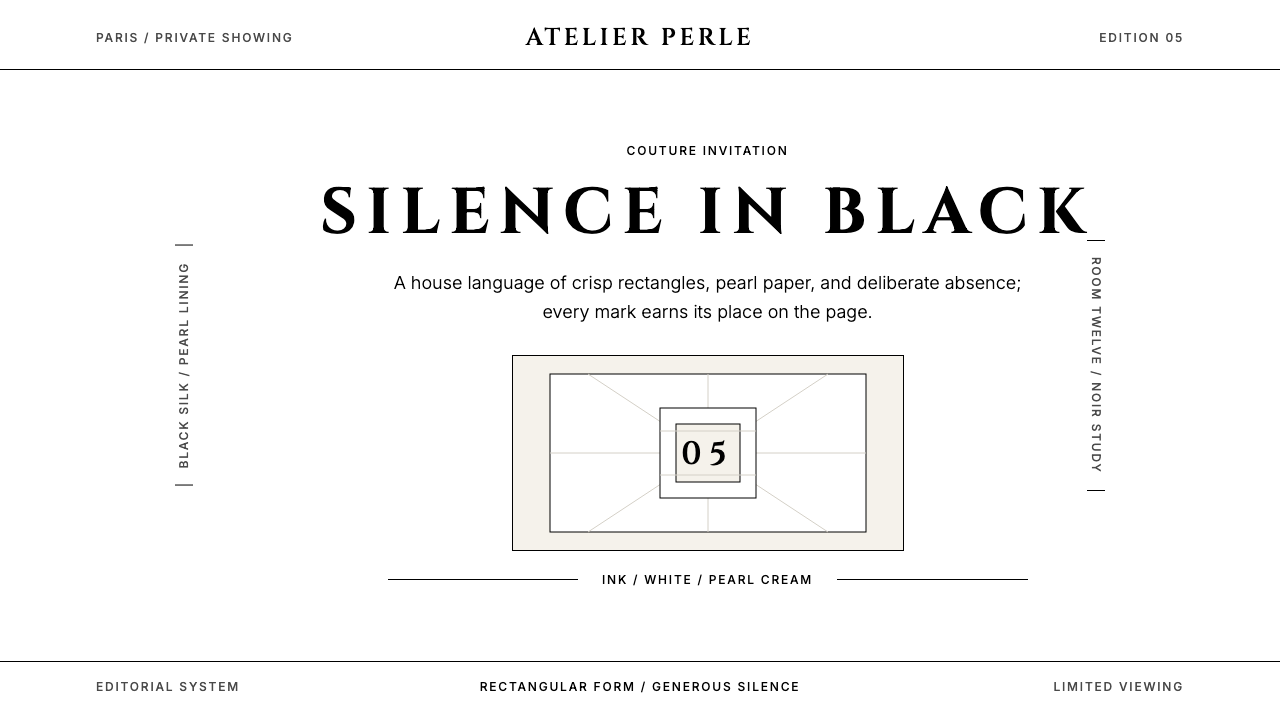 ChanelLuxury needs no color. Black on white, pearl-cream warmth, geometric capitals…
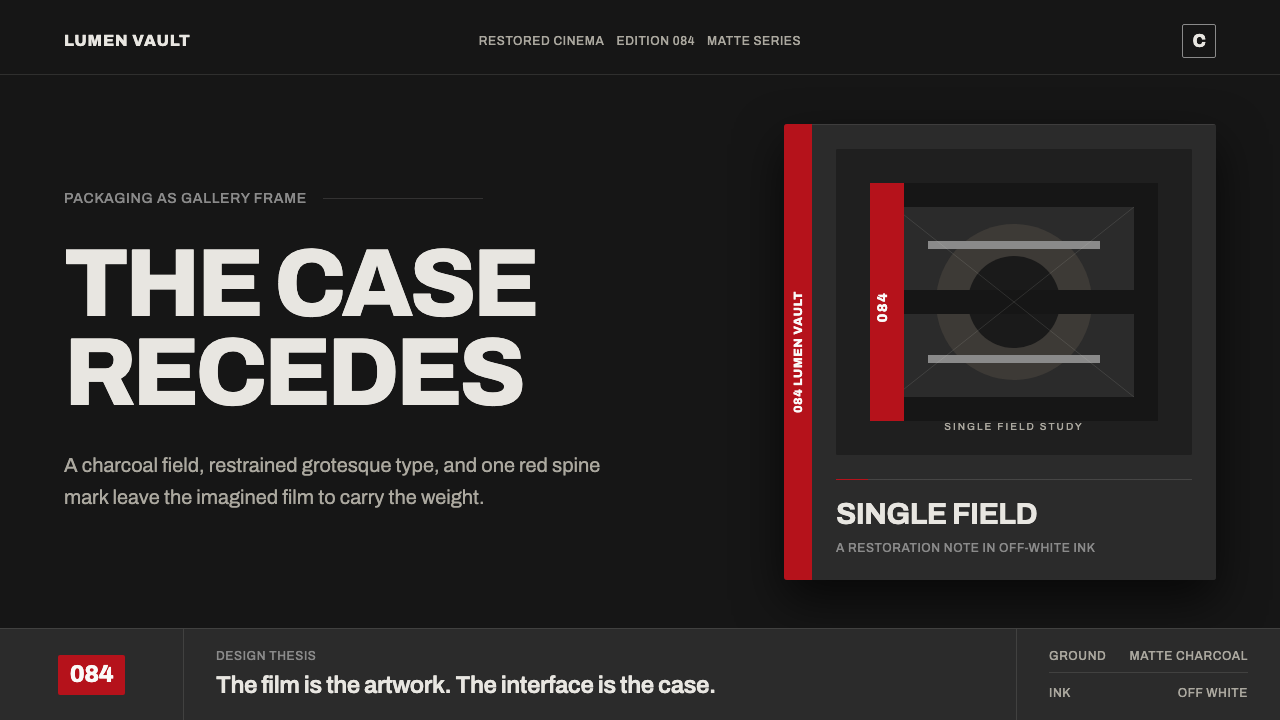 Criterion ArthouseThe case disappears. Charcoal field, off-white Archivo, hairline rules, one r…