What is Farfetch?
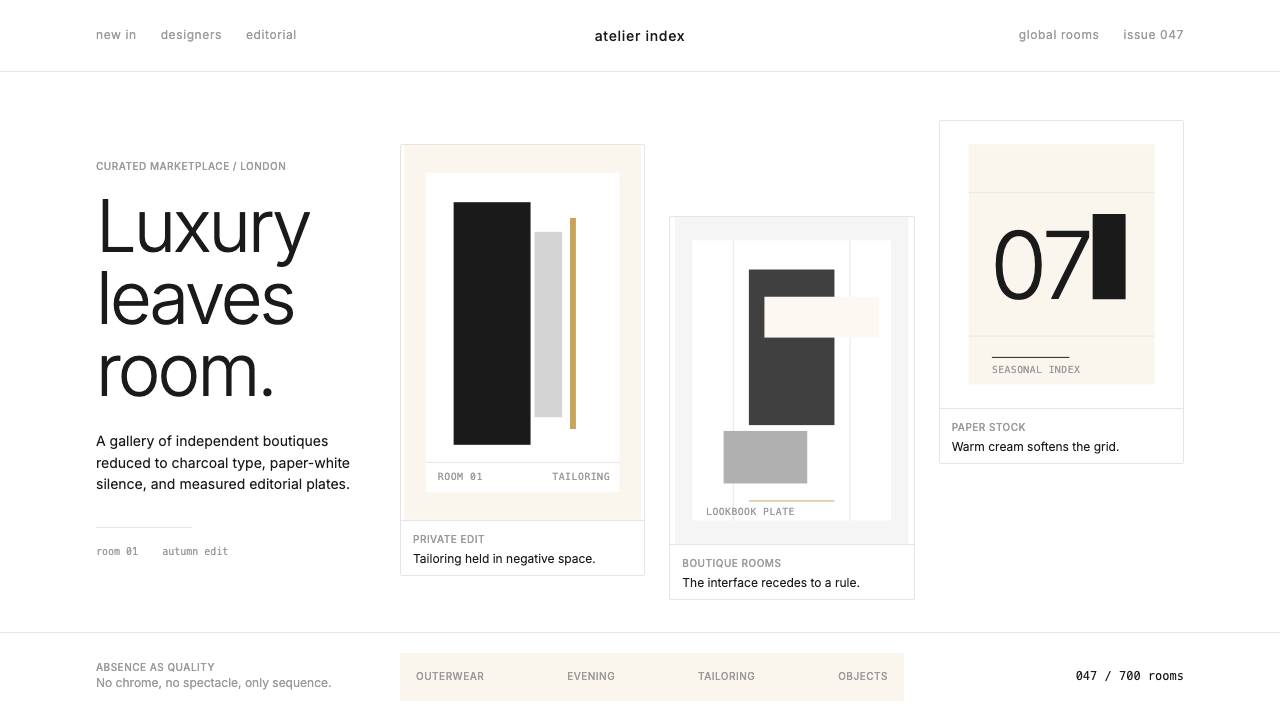
Farfetch turned luxury e-commerce into a whisper — pure-white canvas, charcoal letterforms, and full-bleed lookbook photography that makes every boutique feel like a private gallery.
Farfetch in brief
Farfetch is a global luxury-fashion marketplace whose visual identity is built on deliberate restraint: a canvas of pure white or near-white, charcoal sans-serif type scaled with editorial precision, full-bleed lookbook photography that fills the frame entirely, and hairline rules that divide sections without intruding on them. The platform treats over seven hundred independent boutiques as gallery rooms, giving each collection generous breathing space rather than stacking merchandise in dense grids.
The aesthetic is best described as editorial luxury at digital scale. It borrows the visual grammar of high-fashion print magazines — tiny lowercase navigation, slim rule lines, occasional warm-cream sections that evoke the feel of uncoated editorial paper — and applies that grammar consistently across every screen state, from product listing to checkout. Nothing shouts; everything is implied. Color is near-absent by design, allowing the fashion photography itself to carry all emotional and chromatic weight.
What separates Farfetch's visual system from conventional e-commerce is its understanding of luxury as the experience of removal. The interface withholds the typical signals of retail urgency — no countdown timers, no starburst sale badges, no crowded product carousels — and replaces them with space, quietude, and a typographic hierarchy so measured that navigating the site feels closer to reading a well-edited magazine than to shopping online.

Where does Farfetch come from?
Farfetch was founded in London in 2007 by José Neves, a Portuguese entrepreneur and fashion technologist who had previously built software for the footwear industry. Neves observed that the world's finest independent fashion boutiques — in Milan, Paris, Tokyo, São Paulo — each held irreplaceable inventory and cultural authority, but lacked the digital infrastructure to reach a global audience. His solution was a marketplace that would preserve each boutique's editorial identity while connecting it to buyers anywhere on earth. The founding insight was curatorial rather than commercial: the platform's value would come from selection and trust, not from price competition.
The visual language that defines Farfetch today took shape progressively through the platform's evolution, with the most coherent iteration of its current identity emerging between roughly 2018 and 2024. During this period, the design team moved decisively away from the busy, feature-heavy interfaces common to mainstream e-commerce and toward something that consciously referenced high-fashion print. The shift was both aesthetic and strategic: as the platform grew to represent hundreds of luxury brands, the interface itself needed to recede, becoming a neutral gallery wall rather than a competing visual presence.
The editorial references are legible in specific formal choices. The use of full-bleed imagery — photographs that run edge to edge with no margin or border — comes directly from the tradition of fashion magazine spreads, where the page disappears and only the image remains. The preference for lowercase in navigation and supporting text has roots in avant-garde print typography of the twentieth century, where lowercase was associated with modernism and the rejection of hierarchical formality. The hairline rule — a line so thin it reads as a whisper rather than a barrier — appears throughout luxury print publishing as a device for organizing without imposing.
Key figures in shaping Farfetch's commercial and cultural identity include Holli Rogers, the former President of Browns Fashion whose curatorial sensibility influenced how the platform positioned itself relative to the traditional luxury establishment; Stephanie Phair, a former Chief Customer Officer who emphasized editorial storytelling as a driver of brand differentiation; and Bom Suk Kim, whose work on the platform's technology infrastructure helped enable the seamless visual experience the design language depends on. Together, they represented the convergence of fashion editorial culture, luxury retail authority, and technology platform thinking that made Farfetch's particular aesthetic possible.
What defines the Farfetch look?
White Canvas
The foundation of the Farfetch visual system is near-absolute whiteness. Backgrounds are pure white or within a hair's breadth of it; no off-white warm tones intrude except in deliberate editorial accent sections. This whiteness is not emptiness — it is the primary expressive device, conferring on every product image the same neutral reverence that a gallery wall confers on a painting. The absence of background color is itself a statement about the primacy of the fashion objects being presented.
Charcoal Editorial Type
Type throughout the Farfetch interface is set in a restrained sans-serif at a color closer to deep charcoal than to pure black, softening the typographic presence without reducing legibility. Navigation uses a notably small scale, often in lowercase, which signals editorial restraint rather than conventional retail communication. Hierarchy is achieved almost entirely through scale and weight contrast — headlines are significantly larger than body text, but neither color nor ornament is used to reinforce the distinction. The typographic voice is quiet and authoritative simultaneously.
Full-Bleed Photography
Lookbook and campaign photography occupies the full visual frame with no bordering, no caption overlays at the image edge, and no container shape constraining the image. This full-bleed treatment is borrowed directly from high-fashion print editorial practice, where the photograph is treated as the primary content — not an illustration of a product description, but the thing itself. The photography is typically high-production, with attention to lighting that reads as natural or studio-precise rather than commercial-bright. Product photography against white backgrounds is equally rigorous: no cast shadows, no environmental props that distract from the object.
Hairline Rules and Minimal Structure
Section dividers throughout the interface are rendered as lines so thin they register as texture rather than boundary. These hairline rules — inherited from luxury print publishing — perform a structural function without acquiring visual weight of their own. They separate without asserting. Similarly, the overall layout structure is felt rather than seen: columns align, spacing is consistent, and the eye is guided through the page by proportional logic rather than explicit visual signposting. Navigation and filtering elements are reduced to the minimum marks necessary to communicate their function.
Cream Accent Sections
Against the prevailing white, Farfetch deploys occasional warm-cream background sections — typically used for editorial content, brand storytelling, or curatorial features. These sections evoke the feel of uncoated paper stock, immediately shifting the register from digital interface to print publication. The cream is not a brand color in the conventional sense; it is a contextual signal, indicating that the content within is editorial rather than transactional. It appears sparingly and always purposefully, never as decorative filler.
Generous Negative Space
The spacing between elements on the Farfetch platform is deliberately expanded beyond what standard e-commerce conventions would allow. Product grids are open rather than dense, with significant space between cards. Product pages give images room to dominate without competing with adjacent information. This commitment to negative space communicates a specific luxury signal: scarcity and attention. In conventional retail, density implies abundance and value; in luxury, spaciousness implies that each object deserves individual consideration.
Suppressed E-commerce Chrome
Farfetch's design actively removes or visually demotes the standard signals of online retail: promotional banners, urgency indicators, badge overlays on product images, and heavy call-to-action buttons. Where other platforms amplify conversion-focused elements, Farfetch suppresses them to the point of near-invisibility. Purchase actions are available but understated — buttons are outlined or text-only rather than filled and dominant. The effect is that the commercial act of buying is subordinated to the aesthetic experience of looking, consistent with how luxury is sold in physical boutiques where sales staff are present but never aggressive.

Who shaped Farfetch?
The founder and long-time CEO of Farfetch, Neves brought both technical and fashion credentials to the company's creation. His background in building software for the footwear industry gave him an understanding of the operational complexity boutiques faced, while his genuine engagement with fashion culture gave him credibility with the independent retailers who formed the platform's early supply base. The founding vision — that the world's best boutiques should function as a single interconnected marketplace without losing their individual identities — reflects a curatorial sensibility that directly shaped the platform's editorial visual language.
Rogers joined Farfetch as CEO of Browns Fashion, the storied London boutique that Farfetch acquired in 2015. Browns had been a cornerstone of London fashion culture for decades, credited with introducing numerous designers to the British market. Rogers brought with her a deeply editorial understanding of how luxury fashion should be presented — not as product inventory, but as a curated cultural proposition. Her influence on how Farfetch positioned its content and editorial programming helped establish the platform's tone as something closer to a fashion publication than a retailer.
As Chief Customer Officer and later Chair, Phair was instrumental in articulating Farfetch's identity as a luxury destination rather than a transactional marketplace. Her emphasis on editorial storytelling, brand narrative, and the elevation of the customer relationship beyond the purchase moment shaped how the platform's design was asked to behave — as an environment for sustained engagement with fashion culture, not simply as a point of sale. This orientation toward experience over transaction is visible throughout the Farfetch visual system.
As a key technology leader within the Farfetch organization, Kim's work on the platform's underlying infrastructure helped ensure that the seamless, performance-optimized experience the visual design required could actually be delivered at scale. Luxury e-commerce makes particular demands of technology: high-resolution imagery must load quickly, transitions must be smooth, and the interface must never feel labored or commercial in its loading behavior. The design language's dependence on generous imagery and open space is only viable when the technology beneath it performs without friction.
How do you use Farfetch today?
The Farfetch visual language translates most naturally to contexts where the goal is to present objects — products, projects, artworks, or ideas — with authority and cultural seriousness. Applying it correctly requires resisting the instinct to fill space. The style's expressive power comes from what is absent: no promotional urgency, no color noise, no typographic decoration. Before placing any element, the right question is whether it serves the content or merely occupies the canvas.
For presentation slides, the Farfetch approach works best when photography or imagery is the primary content. Cover slides should use a single full-bleed image — occupying the entire slide area — with a title in small, restrained type positioned in a lower corner or along a narrow lower band. Content slides should be treated as editorial spreads: one or two images at generous scale, minimal text set in a single typeface at two or three sizes, no decorative borders or background fills. Data slides benefit from the same restraint — charts and graphs should be simple, isolated against white, with labels set in the same typeface family as body text. Avoid infographic embellishments; let the numbers occupy the same quiet visual field as the surrounding text.
For web interfaces and digital dashboards, the style is well suited to product showcases, portfolio sites, editorial platforms, and any context where the object being displayed should dominate the visual field. The implementation principle is aggressive whitespace: margins wider than standard, padding between elements expanded beyond convention, and a content column narrow enough that the surrounding white reads as intentional rather than wasted. Navigation should be typographic and recessive — small scale, lightweight, positioned to be found rather than to announce itself. For interactive states, avoid color fills on buttons; instead, use border transitions or subtle scale changes that signal response without introducing chromatic noise.
For editorial and marketing applications, the Farfetch visual language supports longform content as well as advertising. An editorial article layout should use a narrow body text column with an expansive outer margin — the margin can hold pull quotes, image captions, or simply remain empty as a breathing zone. Section breaks are marked by horizontal hairline rules rather than headline-sized dividers. Marketing pages and campaign materials work well with alternating background sections: white followed by cream, with full-bleed imagery anchoring each section. Campaign type should be set large, in a single weight, against a clean field, with no layering of text over complex photography — or, if text must overlay an image, position it against the image's most neutral region.
A common mistake when applying the Farfetch visual language is confusing editorial restraint with visual emptiness. The style requires that every element placed on the canvas earn its position through content relevance, not spatial necessity. Layouts that are simply sparse — few elements, no clear grid, inconsistent spacing — do not achieve the Farfetch aesthetic; they achieve vacancy. The correct interpretation is proportional discipline: spacing that is generous but consistent, type that is small but deliberately scaled, imagery that is large but purposefully selected. The second common error is breaking the chromatic silence with conventional e-commerce color conventions — colored call-to-action buttons, colored category labels, colored notification badges. When any of these appear in a Farfetch-influenced design, they immediately signal retail anxiety, which is precisely the register the style works to suppress.

Farfetch — FAQ
Is the Farfetch style just minimalism with luxury photography?
Minimalism is a useful shorthand but it misses the specificity of what Farfetch does. Contemporary minimalism in digital design often produces clean but affectless interfaces — functional, but without a point of view. The Farfetch visual system is shaped by a very particular cultural reference: high-fashion print editorial. The choices it makes — hairline rules, lowercase navigation, cream sections, full-bleed photography — are all borrowed from a specific publishing tradition with its own history and connotations. The result reads differently from generic minimalism: it carries the authority and cultural weight of fashion publishing, not just the aesthetic of reduction.
Can this style work for non-fashion brands?
Yes, but the fit depends on whether the brand's core value proposition involves quality, curation, or cultural authority — not price efficiency or convenience. The Farfetch visual system works well for independent jewelry and watch brands, high-end hospitality and residential real estate, premium beauty and fragrance, and any direct-to-consumer brand positioning itself as an alternative to mass-market equivalents. It struggles for brands whose primary messaging is about accessibility, abundance, or affordability. The visual language communicates that what is being offered is rare, carefully chosen, and worth sustained attention — if the product does not support that claim, the style creates dissonance rather than authority.
How should color be introduced into a Farfetch-influenced design without breaking the system?
Color, when introduced, should enter through the photography and imagery rather than through the interface itself. The interface palette — backgrounds, type, rules, buttons — should remain in the white-charcoal-cream range, allowing whatever chromatic richness the fashion imagery contains to provide all the color the design needs. If interface color is required — for example, to signal an error state, a sale event, or a category distinction — it should appear once, in a single restrained tone, and be removed from every other context where it is not strictly necessary. The moment color begins to accumulate in the interface layer, the editorial register dissolves into conventional retail.
What is the difference between the Farfetch aesthetic and the Net-a-Porter aesthetic?
Both platforms operate in luxury fashion e-commerce and both use restrained palettes, but their visual languages have distinct personalities. Net-a-Porter is more structured and graphic: its black-and-white editorial identity is harder-edged, with stronger typographic contrast and a more magazine-grid sensibility. It is luxury as editorial authority — precise, formatted, controlled. Farfetch, by contrast, is softer and more gallery-like in its spatial treatment: the warmth of the cream sections, the open spacing, and the full-bleed photography approach create something closer to an immersive browsing experience than a structured editorial page. Net-a-Porter tells you what to pay attention to; Farfetch invites you to wander.
Does the Farfetch visual language translate well to mobile?
The core principles — whitespace, typographic restraint, image primacy — translate to mobile naturally, but the implementation requires adjustments. On a narrow screen, the generous margins that define the desktop experience must be reconsidered: what reads as luxuriously spacious at large scale can read as wasted real estate at small scale. The solution is to preserve the proportional logic rather than the literal spacing values — margins should still feel intentional and wide relative to the content column, even if the absolute measure is smaller. Full-bleed photography works even more powerfully on mobile, where the narrow viewport forces images to fill the entire visual field. Typography must be set with particular care: at small sizes, the restrained lowercase aesthetic can cross from editorial elegance into illegibility if not tuned for the medium.
Related design styles
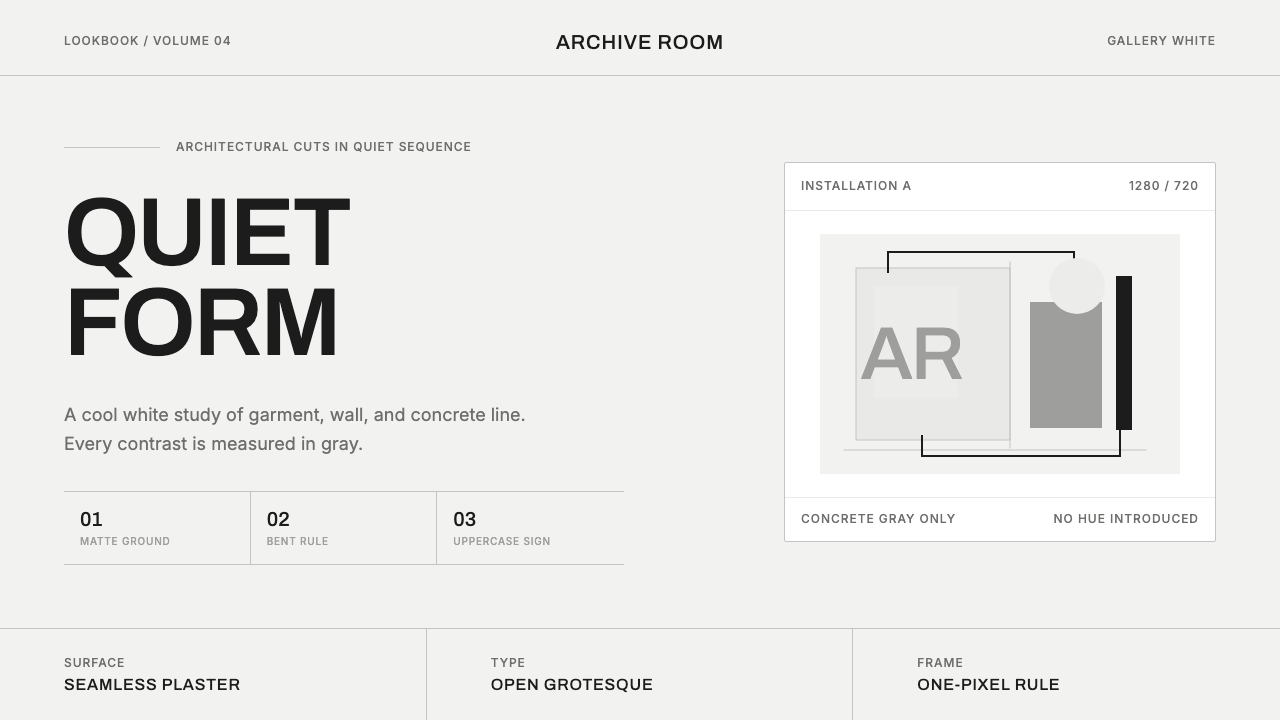 COS Gallery MinimalSilence has structure. Cool gallery white, Archivo uppercase, and concrete-gr…
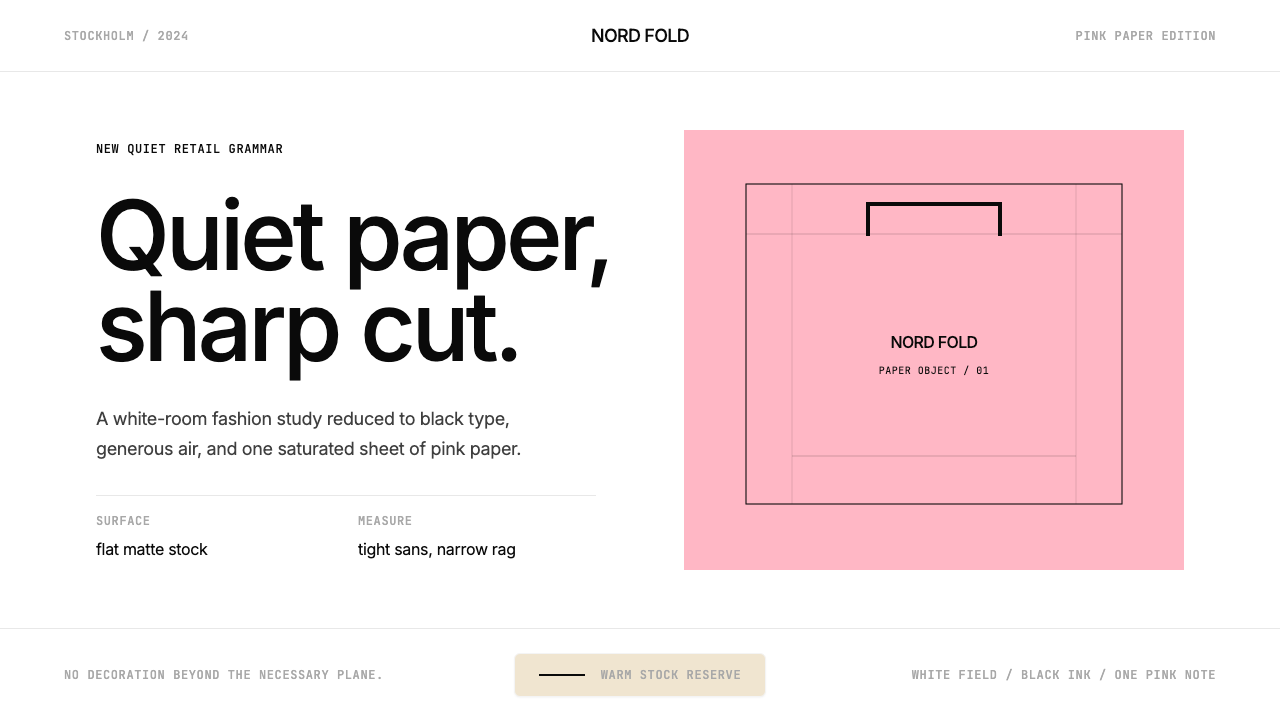 Acne Studios Pink-PaperQuiet luxury in one pink plane. Inter type floats on white with a bag-like re…
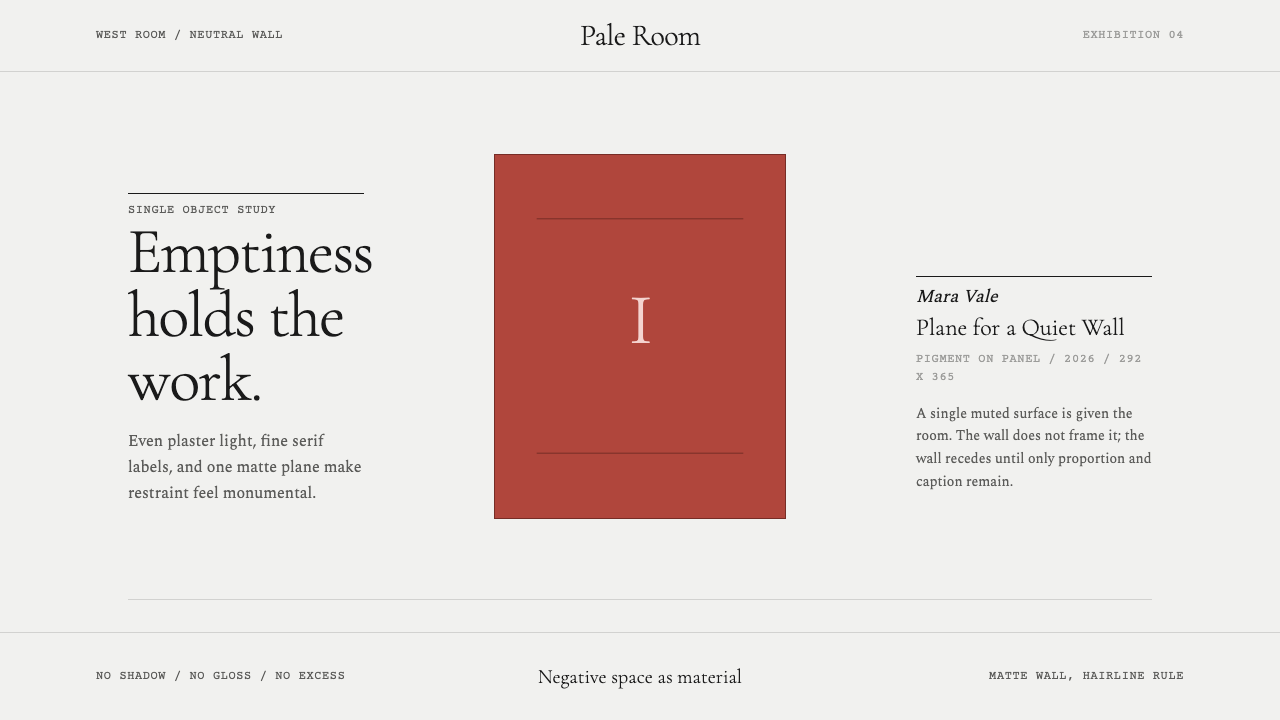 White Cube GalleryEmptiness is the medium. Cormorant labels and one terracotta plane hold the w…
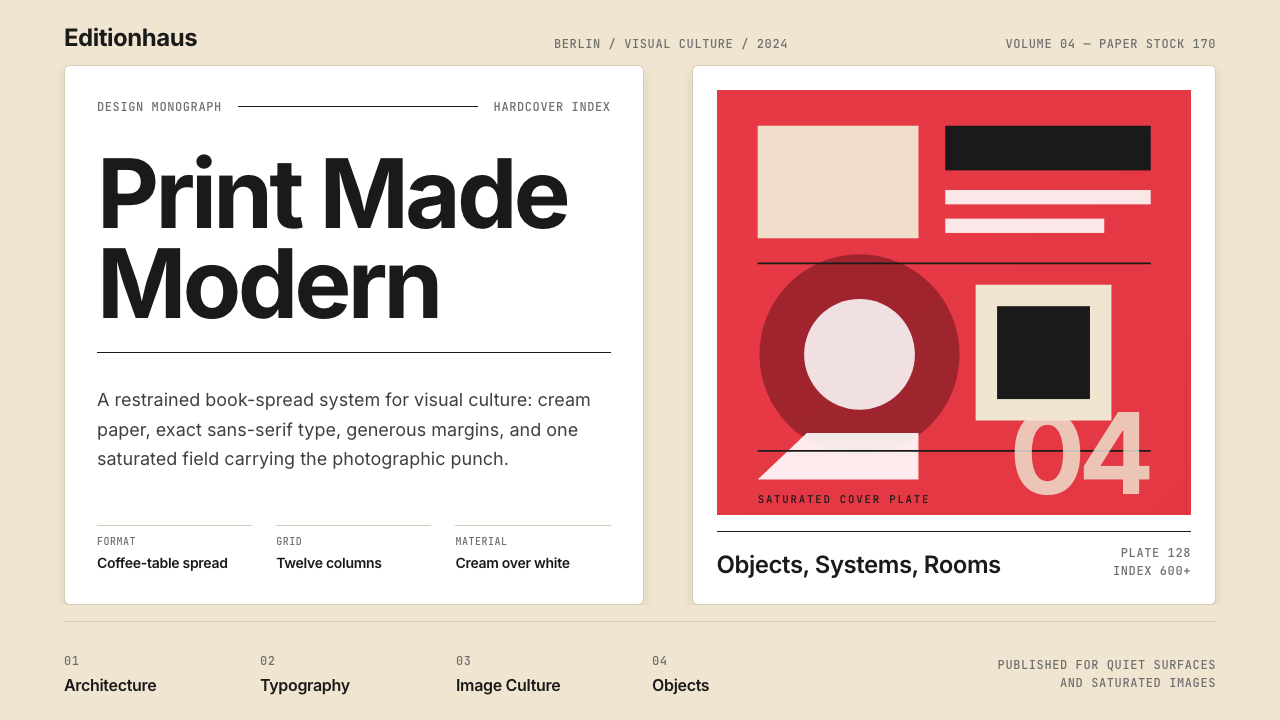 Gestalten Design BookCoffee-table calm. Cream paper, tight sans, one saturated block, and a strict…
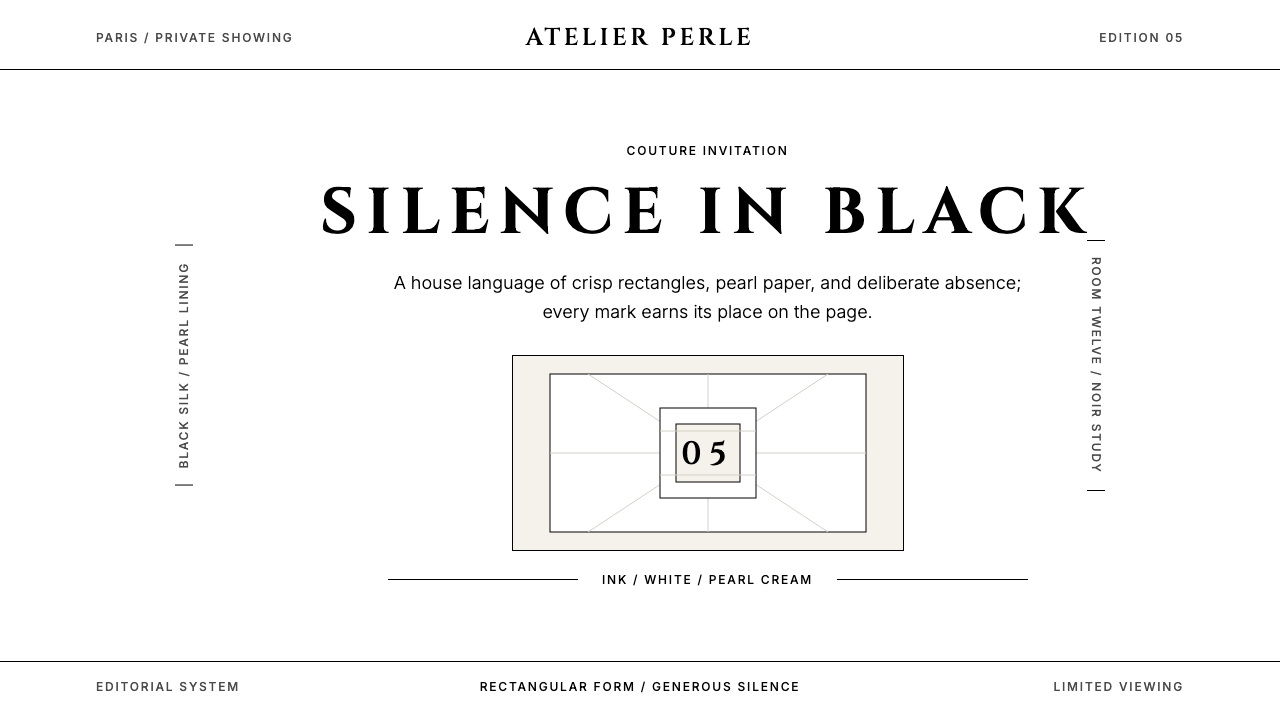 ChanelLuxury needs no color. Black on white, pearl-cream warmth, geometric capitals…
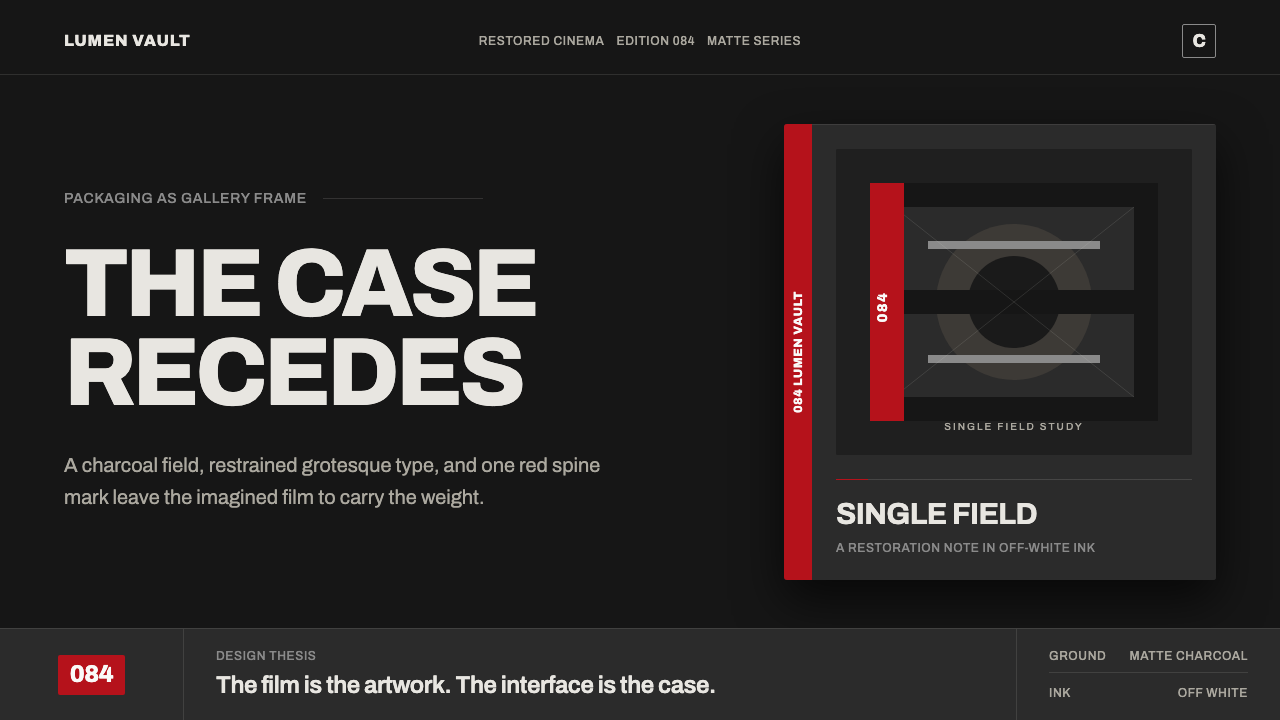 Criterion ArthouseThe case disappears. Charcoal field, off-white Archivo, hairline rules, one r…