What is Swiss Alps Graubünden?
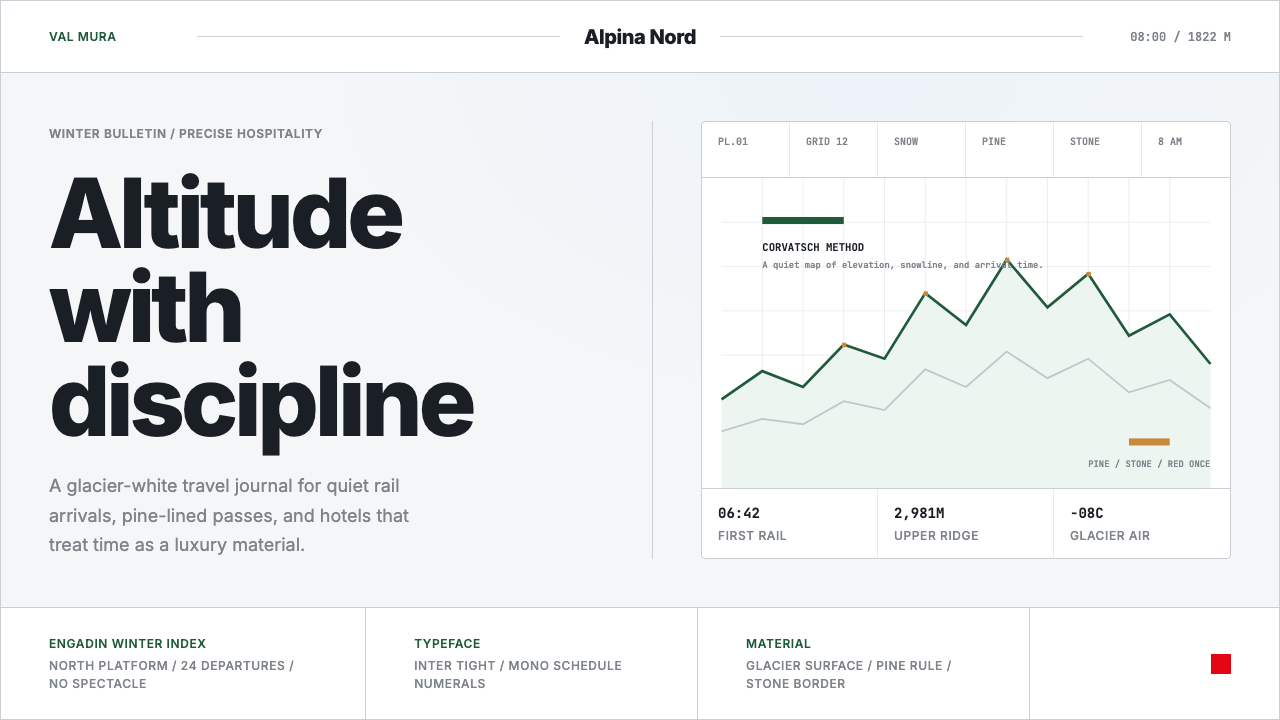
Swiss Alps Graubünden distills a century of Swiss typographic discipline into a tourism aesthetic as precise as an alpine timetable — every element earning its place through clarity, never decoration.
Swiss Alps Graubünden in brief
The Swiss Alps Graubünden design system is a tourism visual identity rooted in a century of Swiss graphic discipline, applied with the restraint and precision that the alpine landscape itself seems to demand. It draws on the formal logic of Swiss International Style — the strict grid, the preference for generous whitespace, and the conviction that visual communication should function first and impress second — while grounding that logic in the specific geography and cultural identity of Switzerland's largest canton.
The system is built around a palette drawn directly from the landscape: glacier whites that feel luminous rather than sterile, a pine-green derived from the larch forests of the Engadin valley, and a red that echoes the Swiss national flag — used with the restraint of a brand that knows when to reach for its most powerful signal and when to hold back. The overall effect is one of legibility at altitude: information that reads clearly against snow glare, against mountain light, and against the visual complexity of a dramatic natural setting.
What separates this system from a generic 'clean Swiss' aesthetic is its insistence on earned restraint. The whitespace is not emptiness — it is the compositional equivalent of a mountain plateau, a deliberate opening that gives every remaining element room to breathe and weight to carry. The system does not compete with the landscape it represents; it frames it.
Where does Swiss Alps Graubünden come from?
Graubünden — known in German, Italian, and Romansh respectively as Graubünden, Grigioni, and Grischun — is Switzerland's largest canton by area and its most linguistically complex, home to three official cantonal languages. This multilingual character shaped its communication culture: from early Alpine signage to modern tourism materials, clarity and legibility across language groups has always been a structural requirement, not merely an aesthetic preference. The design tradition that emerged from this necessity aligns naturally with the Swiss International Style that Josef Müller-Brockmann and his contemporaries formalized in Zurich and Basel during the 1950s and 1960s.
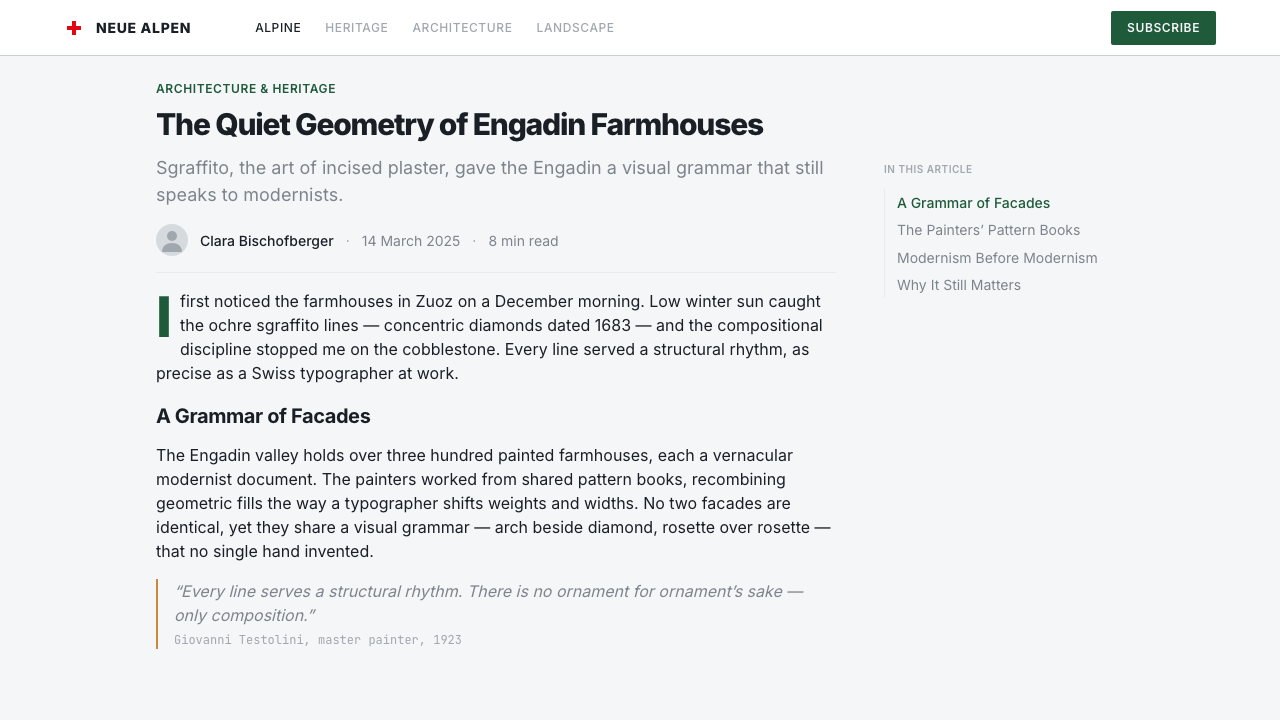
The visual heritage of the region runs deeper than the twentieth century. The Engadin villages — Sils Maria, St. Moritz, Pontresina — developed a distinctive architectural and decorative tradition called sgraffito, in which patterns are scratched through colored plaster to reveal a contrasting layer beneath. This technique, which flourished from the sixteenth to nineteenth centuries, produced geometric and floral motifs of considerable refinement on the facades of Engadin farmhouses and merchant homes. Sgraffito is not a direct ancestor of the modern Graubünden visual identity, but it speaks to a regional aesthetic sensibility that has long found beauty in the relationship between surface and structure, between restraint and precision.
The modern Swiss tourism brand and its associated visual standards emerged through the twentieth century alongside the professionalization of Swiss graphic design. Figures central to that professionalization — Adrian Frutiger, who designed typefaces for maximum legibility at varying scales; Max Bill, the Zurich-based artist and designer who argued that concrete visual form could be derived from objective principles; and Josef Müller-Brockmann, whose grid systems became the backbone of rational Swiss typography — all contributed to an aesthetic climate in which the Graubünden tourism identity could take root. The canton's visual identity absorbed this tradition without copying it wholesale, adapting the grid logic and typographic discipline of Swiss Style to the specific registers of hospitality and place-making.
The Belle Époque played an important role in establishing the international reputation of the Graubünden Alps as a destination. Caspar Badrutt, the St. Moritz hotelier who in 1864 famously wagered his British summer guests that they would enjoy a winter stay and won, effectively invented the European winter resort culture. The visual communication of this era — printed on posters, in railway timetables, across hotel stationery — set an early tone of precision and elegance that later Swiss typographers would inherit and systematize. The SBB timetable, itself one of the great achievements of information design, provided a functional model for how complexity could be organized through typographic clarity alone.
What defines the Swiss Alps Graubünden look?
Palette Restraint
The color system uses three anchors — glacier white as the dominant ground, pine green as a single organic accent, and Swiss-flag red held in reserve for moments of genuine communicative necessity. The white is not blank; it carries the luminous quality of alpine light at altitude. The green is cool and specific, evoking resin and altitude rather than vegetation in general. The red is never decorative — it appears only where brand authority or urgency must be signaled. This disciplined three-color logic prevents the palette from drifting into postcard sentimentality or tourist-brochure brightness.
Grid Discipline
Every layout is governed by a consistent underlying grid that organizes content into clear vertical columns with defined horizontal intervals. Headlines align to the grid's left edge as a rule; centered composition is avoided except where ceremonial formality demands it. The grid is never visible — it operates as infrastructure, not decoration — but its presence is legible in the consistent spatial relationships between every element on the page. This approach is directly inherited from the Müller-Brockmann tradition, where the grid was understood as a rational solution to the problem of organizing multiple pieces of information without arbitrary visual noise.
Typographic Precision
The typographic system is set tight — letterforms at close intervals, tracking compressed enough to evoke the condensed information on a mountain-station signboard or an SBB departure board. This tightness is not claustrophobic; it is counterbalanced by the generous whitespace that surrounds type blocks and by a clear size hierarchy that distinguishes headlines, subheadings, body text, and captions as functionally distinct levels rather than stylistic variations. Left alignment is maintained as a structural default; justified text, which creates irregular word spacing, is avoided.
Whitespace as Material
Whitespace in this system is not absence — it is the primary compositional material. Margins are wide enough to function as breathing zones, not merely as frame boundaries. The space between a photograph and its caption, between a section heading and the paragraph below it, is calibrated rather than defaulted. This approach treats the empty surface the same way the Engadin landscape treats open snow fields: as something that has presence and communicative weight, not as background waiting to be filled.
Photographic Integration
Landscape photography is used as a structural element rather than wallpaper. Images are cropped to foreground compositional geometry — the diagonal of a ridgeline, the horizontal band of a treeline, the vertical plane of a granite face — rather than to center a postcard-perfect panorama. Where photography and type coexist on the same surface, the typographic grid determines the crop, not the other way around. Full-bleed images appear only where the spatial scale of the landscape justifies the format; otherwise, images are bounded by the grid's column structure.
Multilingual Clarity
Because Graubünden operates across German, Italian, and Romansh, the visual system must support multilingual communication without privileging one language visually over another. This requirement reinforces the typographic discipline: when the same information must be set in three scripts of varying length, arbitrary decorative variation becomes impossible. The grid is the only fair arbiter. This constraint, far from being a limitation, is a structural generator — it is one reason the system defaults to left-aligned, size-differentiated, grid-anchored typography rather than the centered, ornamented alternatives that monolingual systems can more easily afford.
Environmental Legibility
The system is calibrated for contexts where ambient conditions challenge ordinary visual communication: mountain light that is both brilliant and directionally harsh, snow fields that flatten contrast, altitudes where signage must be readable at speed from a moving vehicle or cable car. This environmental grounding produces design choices that translate well to screen: high contrast between text and ground, clear size differentiation between information levels, and a color logic that works even when viewed through glare. The constraints of the alpine environment have made the system more robust, not more specialized.
Who shaped Swiss Alps Graubünden?
Müller-Brockmann was the Swiss graphic designer whose grid systems, typographic rigour, and advocacy for objective visual communication became the intellectual backbone of the Swiss International Style that directly influenced Graubünden's design identity. His poster work for the Zurich Tonhalle, his books on grid systems, and his theoretical writing about the moral dimension of clear communication — the idea that honesty in visual language is an ethical commitment, not merely an aesthetic preference — established a standard against which all Swiss institutional communication, including alpine tourism, continues to be measured.
Frutiger was the Swiss typeface designer whose work on legibility at varying scales, in varying light conditions, and at varying distances was directly applied in wayfinding systems, airport signage, and public information environments across Europe. His approach — that a typeface should efface itself in service of its content, performing reliably without drawing attention to its own form — shaped the typographic sensibility that Graubünden's communication standards inherited. His thinking about how letterforms must function in environmental contexts influenced the system's preference for clean, open type that reads under difficult lighting.
Max Bill was a Zurich-based artist, architect, and designer who argued that visual form could be derived from objective, mathematical principles — a position he called 'concrete art.' Trained at the Bauhaus in Dessau, he transplanted that school's structural discipline into Swiss design culture, where it merged with the local tradition of precision craftsmanship. His influence on Swiss graphic and product design established a cultural expectation that design should be demonstrably rational — that choices should be justifiable, not merely pleasing — which underlies the Graubünden system's commitment to functional legibility over atmospheric effect.
Badrutt was the St. Moritz hotelier who established the Engadin as an international winter destination in the 1860s, in doing so creating the context within which a distinctive alpine visual communication culture had to develop. His bet with British guests that they would enjoy winter in the Alps — and his subsequent success in making good on it — transformed the local economy and made high-end alpine tourism a category requiring sophisticated visual representation. The posters, publications, and way-finding materials produced for the Belle Époque winter season in Graubünden established the earliest formal standards for the region's visual identity.
Segantini was the Italian-Swiss painter who spent his final years in Maloja in the Engadin, producing monumental canvases of the alpine landscape that fundamentally shaped how the region was visually understood and internationally communicated. His paintings — their extraordinary luminosity, their attention to the quality of alpine light at different hours and seasons, their treatment of the mountain environment as both physically real and symbolically charged — gave Graubünden its first sustained visual identity as a landscape with particular spiritual and aesthetic qualities. Tourism posters and publications of the early twentieth century drew directly on the visual register he established.
How do you use Swiss Alps Graubünden today?
Swiss Alps Graubünden is a system that rewards application in contexts where authority, trustworthiness, and environmental clarity are the dominant values — places where the user is navigating decisions, planning journeys, or evaluating options, and where visual noise would undermine confidence rather than add interest. Its discipline is architectural rather than decorative; applying it correctly means understanding what each element is structurally doing before deciding how it looks.
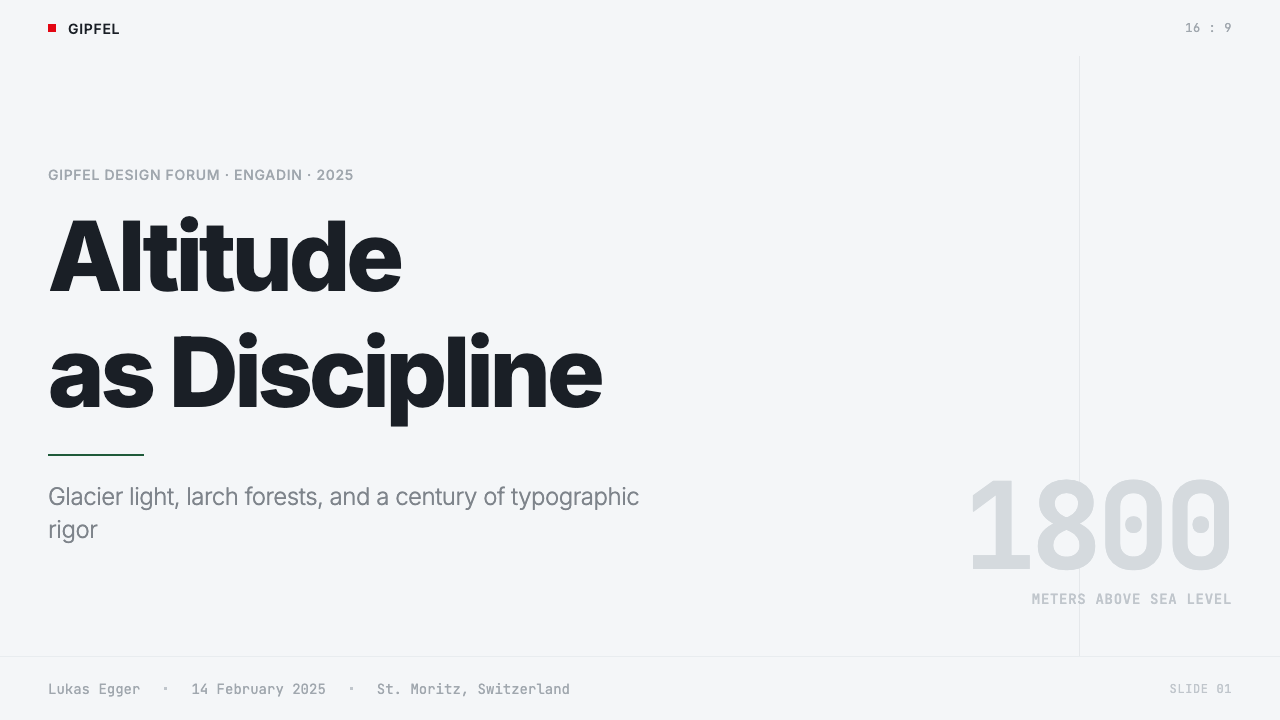
For presentation slides, the system excels at both cover compositions and information-dense content pages. A cover should be built on the three-color anchor logic: a near-white field as ground, a headline in a weight that reads at distance, and a single accent color used for a geometric element or underline rather than for background fills. Content slides should be treated as grids: content organized in clear columns, type differentiated only by size and weight, data visualizations rendered as clean geometric objects with bars and areas colored according to the primary palette. The system does not support ornamental slide transitions or gradient backgrounds — if those feel necessary, the system is being misapplied.
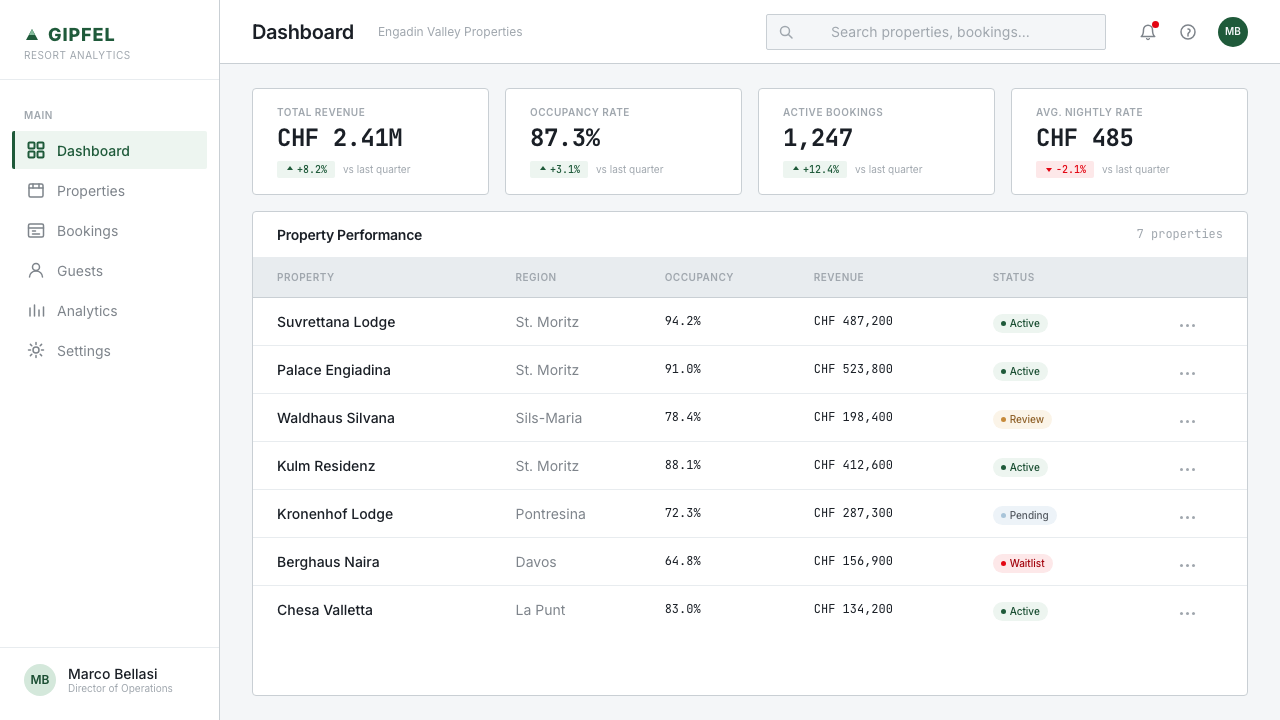
For web interfaces — dashboards, booking flows, pricing pages, information-dense navigation — the system performs exceptionally well. The approach: establish a strict column grid, maintain a near-white or glacier-white ground throughout, use the pine green for interactive states and positive confirmations, reserve the red for alerts and critical notifications. Card components should carry enough visual separation to read clearly without relying on colored borders; the system favors subtle elevation over line-based separation. Navigation should prioritize typographic clarity — labels that are unambiguous and sized for legibility — over icon-heavy shorthand that requires visual decoding.
For editorial and marketing applications — printed materials, travel guides, campaign pages — the system supports strong compositional hierarchy and benefits from the full integration of landscape photography. Images should be selected and cropped for geometric quality rather than panoramic completeness: the geometry of a ridgeline, the texture of snow shadow across a slope, the compression of a long telephoto shot across a valley. Type should sit on photographs only where contrast is sufficient and where the grid can be maintained; overlaying type on complex photographic backgrounds without a clear structure produces exactly the visual noise the system is designed to eliminate.
A common mistake when applying this system is reading its restraint as a license for generic minimalism — swapping out the specific three-color logic for a neutral gray scale, or using excessive whitespace without maintaining the underlying grid structure. The system's whitespace is precise, not merely generous; the grid is what makes the whitespace legible as intentional. Similarly, the system's photographic integration is structural, not atmospheric: photographs selected purely for mood rather than for compositional contribution will produce results that look pleasant but feel disconnected from the system's underlying logic.
Swiss Alps Graubünden — FAQ
How does Swiss Alps Graubünden differ from Swiss International Style?
Swiss International Style (developed in Zurich and Basel from the 1950s onward) is a broader, more abstract formal system concerned with universal communicability — it was applied to corporate identity, cultural institutions, and global brands as much as to regional tourism. Graubünden inherits the same typographic discipline and grid logic but grounds them in a specific landscape and regional identity. Where Swiss Style uses photography as a formal element treated with graphic abstraction, Graubünden uses landscape photography with more direct environmental presence. The color logic is also more specific: rather than the full-spectrum neutrality of canonical Swiss Style, Graubünden commits to three landscape-derived anchors. Think of it as Swiss Style applied with geographical affection rather than universal ambition.
Can this system work for a dark-mode interface?
The system's canonical form is light-ground — glacier white surfaces are central to its identity. A dark inversion is possible, but it requires careful recalibration. On a dark ground, the pine green needs to shift toward a brighter, more luminous register to maintain its legibility and to avoid reading as muddy. The red remains usable for alerts but should be used even more sparingly than in the light variant, since it draws disproportionate visual weight in low-light contexts. The most successful dark adaptations tend to replace the glacier white with a deep cool near-black — not a warm charcoal — maintaining the color temperature relationship of the original palette rather than simply inverting it.
Is this system appropriate for non-tourism applications?
The system transfers well to any application where environmental clarity, precision, and trustworthiness are primary values — financial services, healthcare navigation, transport information, educational platforms, and any product where the user is making decisions in complex or high-stakes contexts. It performs less well for products that depend on warmth, cultural specificity beyond Switzerland, sensory richness, or playfulness. A children's platform, a food brand, a creative portfolio tool, or an entertainment product would find the system's severity working against rather than for its communication goals. The question to ask is whether the product's values align with the system's core register: clear, trustworthy, precise, and environmentally grounded.
How should the sgraffito tradition inform contemporary applications?
Sgraffito is a historical regional decorative tradition, not a formal model for the contemporary system. The relevance is tonal rather than visual: the tradition demonstrates that the Engadin region has a long history of finding beauty in the relationship between surface and structure, between geometric pattern and material constraint. That sensibility — design as the revelation of underlying structure rather than as applied ornament — aligns with the modern system's own logic. The practical takeaway is not to use sgraffito motifs in contemporary applications; it is to understand that the restraint and precision the system values are culturally rooted, not merely fashionable.
How does the system handle multilingual content in practice?
The grid is the solution. When the same information must appear in German, Italian, and Romansh — which vary significantly in character count for equivalent meanings — the only design decision that holds across all three is the one governed by structure rather than by line count. This means: establish the grid first, let content fill its designated columns, and trust that clear size hierarchy and generous line spacing will maintain legibility regardless of which language is running long. The system avoids justified alignment specifically because it breaks down under variable-length multilingual content. Left alignment, with consistent left-margin anchoring, is the single most important structural decision for a multilingual implementation of this system.
Related design styles
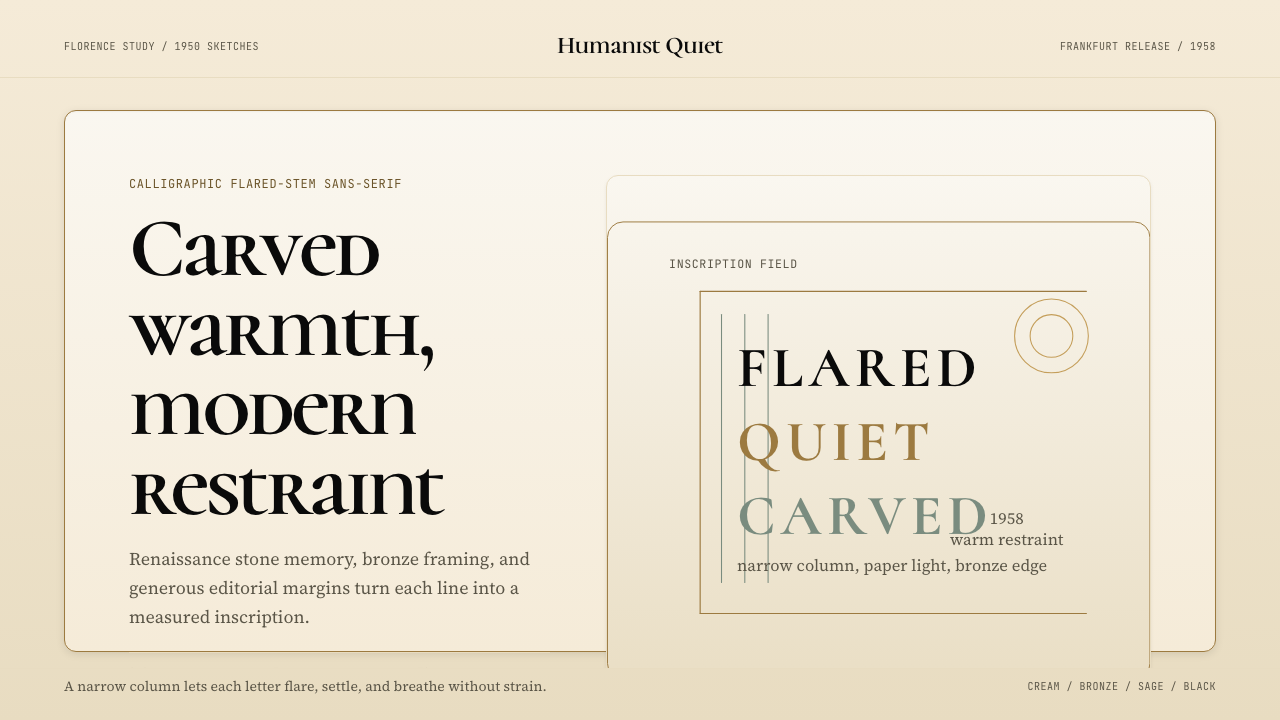 Optima (Hermann Zapf, 1958)Calligraphic calm, cut in cream and bronze. Narrow margins let the letters br…
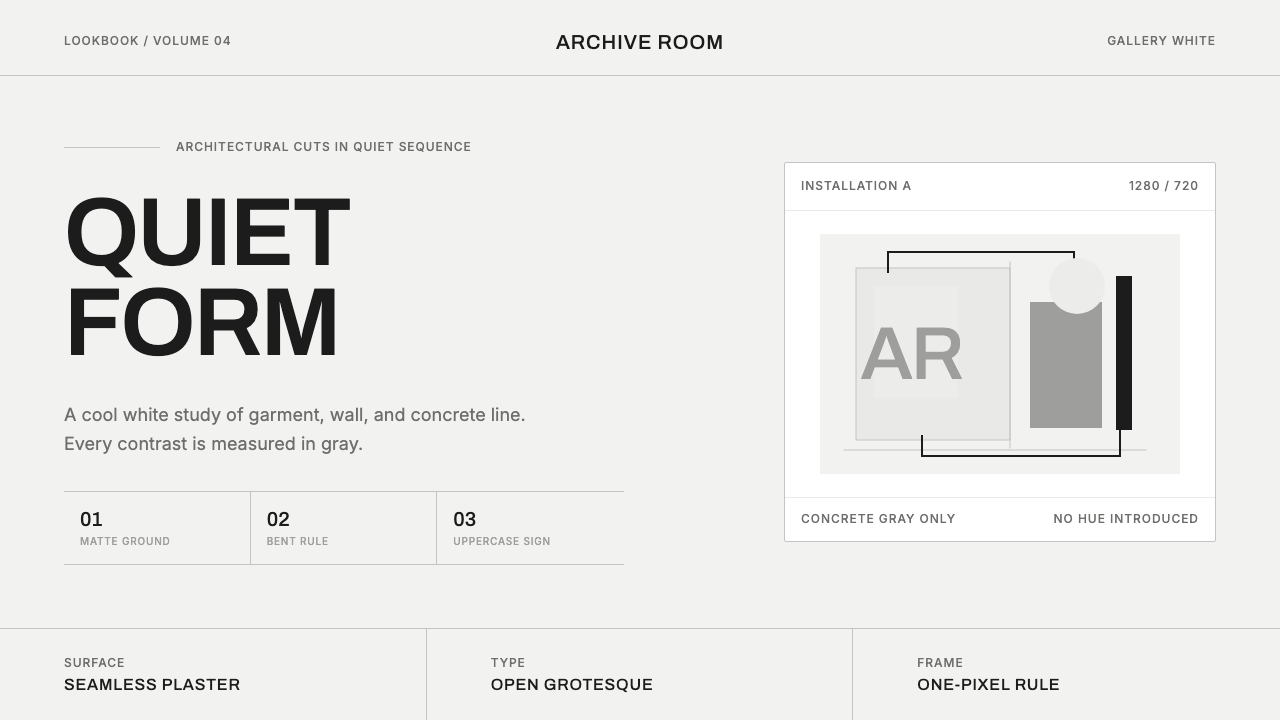 COS Gallery MinimalSilence has structure. Cool gallery white, Archivo uppercase, and concrete-gr…
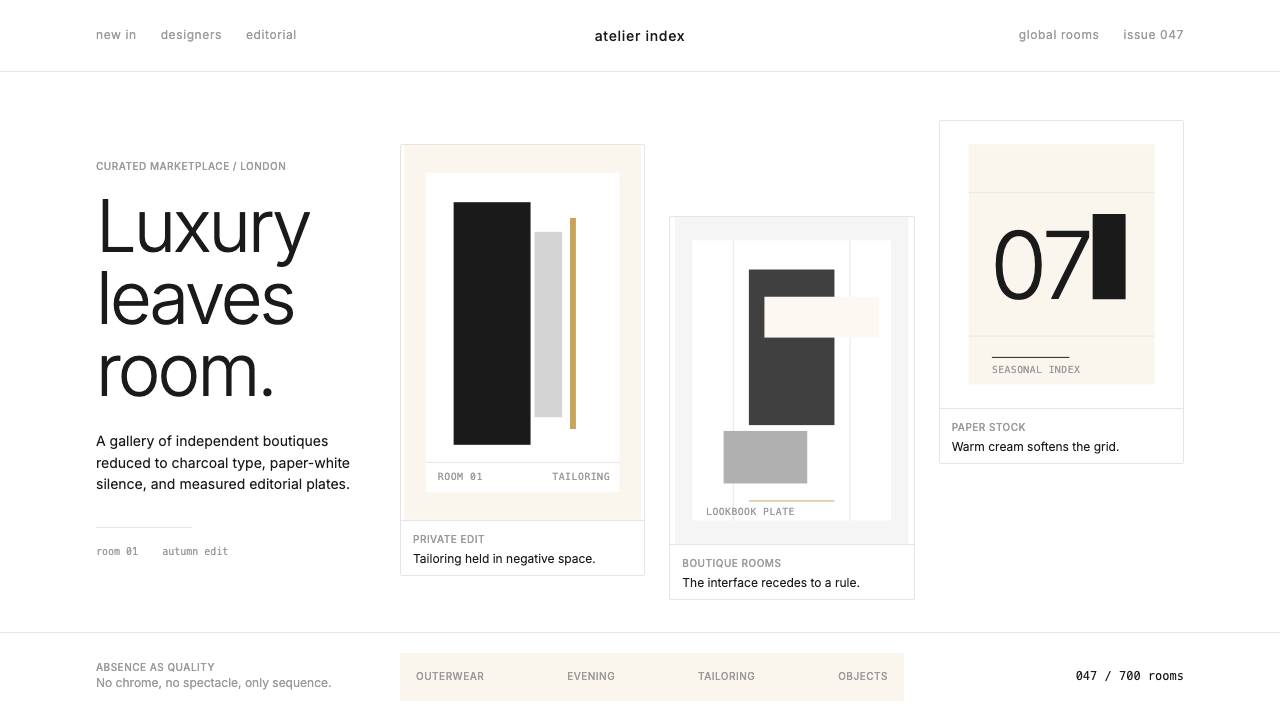 FarfetchLuxury as absence. Charcoal type, white canvas, and hairline editorial plates.
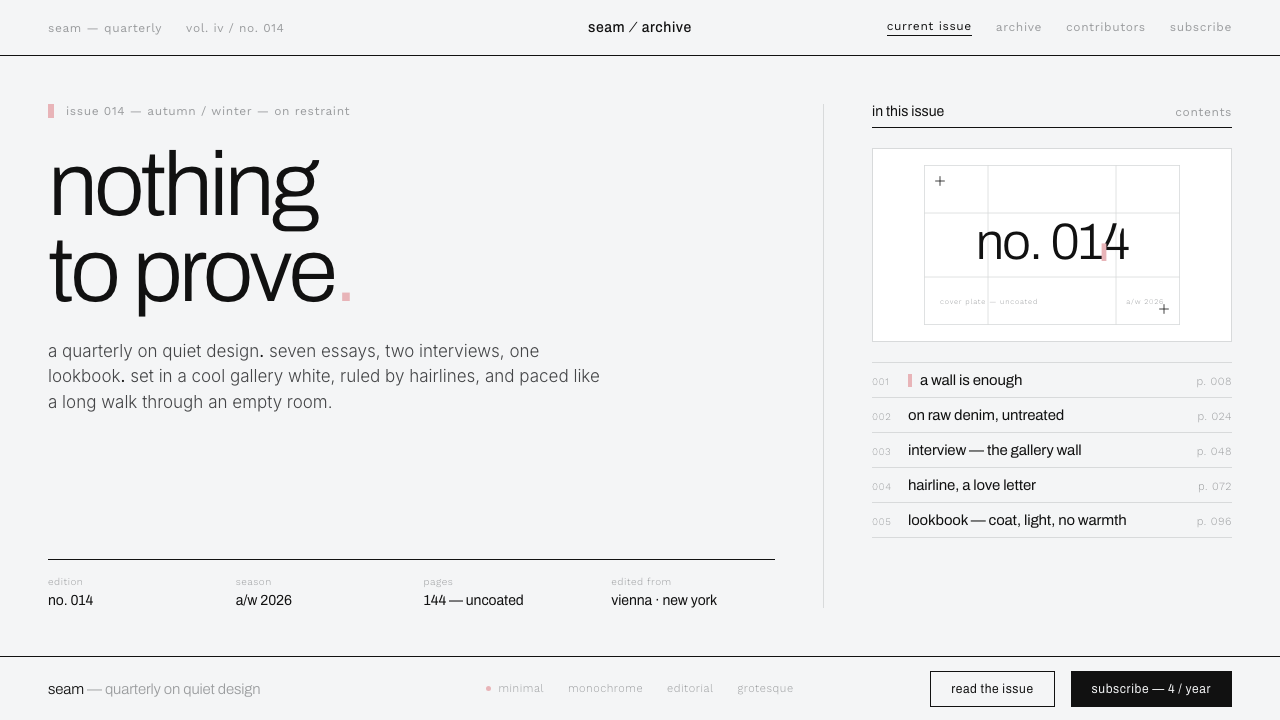 Helmut Lang MinimalismNothing to prove. Cool gallery white, 1px black hairlines, lowercase Archivo…
 Wallpaper* ArchitecturePhotography does the speaking. Gallery-white grid, Inter captions, and hairli…
 White Cube GalleryEmptiness is the medium. Cormorant labels and one terracotta plane hold the w…