What is Wallpaper* Architecture?
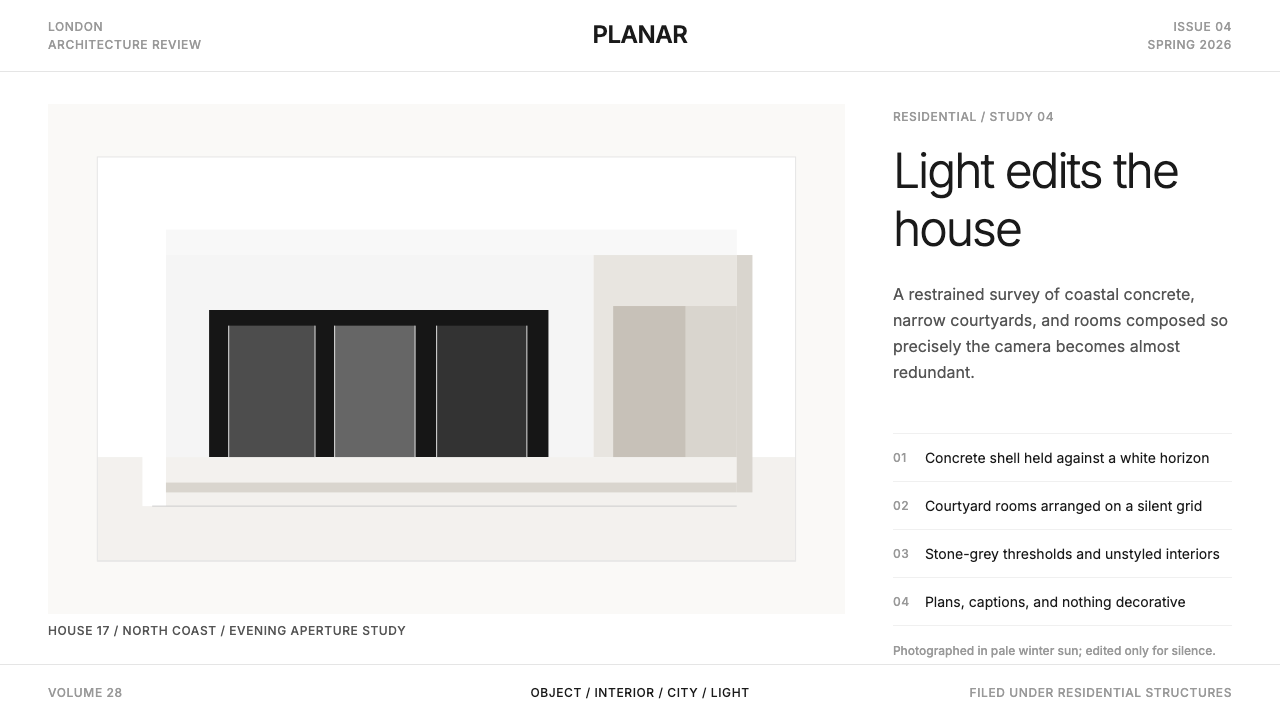
Wallpaper* Architecture trusts the photograph completely — everything else on the page steps back so the image can fill the room.
Wallpaper* Architecture in brief
Wallpaper* Architecture is the editorial design language codified by Wallpaper*, the British architecture and design magazine founded in London in 1996 by Tyler Brûlé. Its defining proposition is disarmingly simple: photography is the subject matter, and everything else on the page — type, rule lines, whitespace, caption blocks — exists only to hold the photograph in the most dignified possible frame. The aesthetic is not minimalism for its own sake; it is minimalism in service of the image.
The visual system is built on three interlocking commitments. First, the ground is gallery-white — a shade of white associated not with sterility but with the museum wall, the neutral field against which curators have always chosen to present objects of consequence. Second, type is reduced to a single sans-serif voice deployed at modest scale, so that labels and captions function as quiet attendants rather than competing voices. Third, dividers and structural lines are hairline-weight — present enough to organize the page, invisible enough to vanish from memory.
The result is a visual register that reads as both authoritative and aspirational: the page looks expensive because it refuses to be busy. This is the aesthetic of the international design quarterly, of the architecture monograph, of the luxury brand campaign that trusts its product enough to show it against nothing. Wallpaper* did not invent restraint, but it defined precisely how restraint should feel in print and on screen for the design-literate global audience that emerged in the late 1990s and 2000s.

Where does Wallpaper* Architecture come from?
Wallpaper* was founded in London in 1996 by Tyler Brûlé, a Canadian journalist and creative director who had previously worked at the BBC and launched the magazine while recovering from a gunshot wound sustained while reporting in Afghanistan. The magazine's founding premise was that architecture, interiors, travel, fashion, and product design belonged in the same conversation — that there was a single globally mobile audience of design-literate professionals who moved between cities, ate in the same restaurants, stayed in the same hotels, and wanted a publication that reflected that world back at them.
The visual language Brûlé and his art directors developed was inseparable from this editorial mission. An international design audience was assumed to be visually sophisticated and hostile to clutter. Where other lifestyle magazines of the era used heavily styled type treatments and decorative page furniture to signal excitement, Wallpaper* used their absence to signal confidence. The gallery-white page, the single typeface, the oversized photograph — these choices communicated that the content was so strong it required no packaging. The design became the brand.
The magazine's timing coincided with a significant shift in architectural photography. The 1990s saw the emergence of photographers such as Hélène Binet, Todd Eberle, and others who approached architecture with the same compositional seriousness as fine art photographers approached their subjects. Wallpaper* provided an ideal vehicle for this work: its pages were wide, its paper quality high, its commitment to full-bleed and near-full-bleed imagery absolute. The magazine and the photography evolved together, each raising the standard for the other.
By the early 2000s, the Wallpaper* aesthetic had become sufficiently influential that it began to define a broader category: the international design quarterly. Publications from Tokyo to Milan to New York adopted its grammar — white ground, serif-free type, photography-led composition — and a visual standard that had once been specific to one London magazine became the baseline expectation for design publishing worldwide. The digital era did not displace the aesthetic; it transposed it. Website layouts for architecture firms, luxury hotel brands, and high-end product companies adopted the same principles, creating a seamless visual continuum between the printed page and the screen.
What defines the Wallpaper* Architecture look?
Gallery-White Ground
The background is not simply white — it is the specific white of the contemporary art gallery, a shade associated with neutral authority rather than clinical blankness. This ground performs a curatorial function: it brackets the photograph as an object of deliberate presentation rather than casual illustration. Compared with the warm cream grounds of editorial traditions such as Bauhaus or Arts and Crafts revivals, the Wallpaper* white is cooler and more recessive, designed to disappear entirely behind the image.
Photography as Primary Carrier
In most editorial systems, photography illustrates text. In Wallpaper* Architecture, this relationship is inverted: text annotates the photograph. Images occupy the dominant share of page or screen real estate, often running to the very edge of the format with no margin relief. The photograph is expected to carry narrative, mood, and argument — the type is there to identify, not to explain. This demands photography of the highest compositional quality, which is why the style has remained inseparable from architectural and product photography of a particular seriousness.
Single Typeface, Hairline Scale
The typographic voice is deliberately monolithic: one sans-serif family used at a narrow range of weights and sizes, kept small enough to perform a labelling function without attracting attention. Headlines, if they appear as text rather than as image overlays, are set with restraint — the scale hierarchy between heading and caption is compressed compared with the dramatic contrasts typical of other editorial styles. The guiding principle is that type should be noticeable only when sought, and invisible when the photograph is demanding attention.
Hairline Dividers and Structural Silence
When structural lines appear to organize sections or separate caption blocks from image areas, they are drawn at the thinnest weight that the medium can faithfully reproduce. They function as almost-invisible scaffolding — present to the eye that looks for them, absent to the eye absorbed by the image. Borders, rules, and frames never thicken into visual weight of their own. Decorative page furniture — ornamental dividers, pull-quote punctuation, icon clusters — is entirely absent.
Expansive Negative Space
Negative space in Wallpaper* Architecture is not the residue left after content is placed — it is itself a design decision with positive intent. Large areas of unoccupied white ground signal that the content has been selected with enough confidence that it does not need to be supplemented. Margins are generous, spacing between caption and image is deliberate, and content density is kept low relative to format size. The spaciousness communicates the same values as the gallery wall: what is here has been chosen; nothing has been added to fill a gap.
Restrained, Monochromatic Palette
Outside the photography itself, color is nearly absent. Text is set in near-black or a very dark neutral. Structural lines share that same dark tone or are rendered in mid-grey. Accent colors — if used at all — are drawn from a single, muted tone applied only to functional elements such as active navigation states or linked text. The palette does not compete with the photograph; its job is to recede completely. Where Bauhaus uses color symbolically and boldly, Wallpaper* treats color as a distraction to be managed rather than a message to be sent.
Architectural Composition Logic
Layouts in this style borrow from architectural spatial thinking rather than from the conventions of magazine grid systems. The page or screen is treated as a space to be inhabited by the image, with type positioned relationally — attached to the corner of a photograph, tucked into a margin, or dropped to a footer zone — rather than organized into autonomous text columns. This produces a layout logic that feels considered rather than templated: each arrangement responds to the proportions and focal points of the specific photograph it accompanies.

Who shaped Wallpaper* Architecture?
Brûlé founded Wallpaper* in London in 1996 and served as its editor until 2002, then returned as editor-in-chief in 2007 after selling the magazine to Time Inc. and later reacquiring it. As the magazine's founding creative force, he established the gallery-white, photography-first visual language that became its signature. Brûlé's broader influence extends to the brand consultancy Winkreative and to Monocle, the magazine he founded in 2007, which applied a related but warmer and more illustrative approach to international affairs and culture.
Binet is a Swiss-French architectural photographer whose work, particularly her images of buildings by Zaha Hadid, Daniel Libeskind, and Peter Zumthor, defined the kind of photography that Wallpaper* Architecture was built to present. Her photographs treat architecture as a terrain of light, shadow, and material texture rather than as a set of objects to be documented. The relationship between Binet's compositional approach — close, abstract, light-focused — and the restraint of the Wallpaper* page layout created a visual standard for how serious architectural photography looks in print.
Vibskov, the Danish designer and artist, represents the kind of creative figure that Wallpaper* has consistently championed: someone whose practice spans fashion, installation, and performance in ways that resist categorical classification. His association with the magazine is emblematic of its editorial stance — that design is not a sub-discipline but a way of approaching the world, and that the most interesting work happens at the borders between fields. The Wallpaper* visual language was developed precisely to present this kind of practice without reducing it to a single category.
Crawford, the British designer known for interiors that emphasize human experience and sensory richness over spectacle, served as a contributing editor and reference point for Wallpaper* during its formative years. Her approach — that good design should be felt before it is seen, and that the most sophisticated interiors are those where the photography requires a second look to reveal their intelligence — aligned precisely with the magazine's editorial philosophy. Crawford's presence helped shape the standard of interior photography and presentation that Wallpaper* Architecture still models.
How do you use Wallpaper* Architecture today?
Wallpaper* Architecture translates to digital and print contexts where the visual asset — a photograph, a product render, an architectural image — is the primary argument and everything else is infrastructure. Applying it correctly means making an honest assessment of whether your visual assets are strong enough to carry the weight of this system. If they are not — if the photography is stock, generic, or compositionally weak — no amount of white space or restrained type will rescue the result. The style demands images that can stand alone.
For presentation slides, the style works best on covers and section dividers rather than content-heavy pages. A cover slide using this approach places one full-bleed or near-full-bleed architectural or product photograph on the slide, with a project name set in restrained sans-serif type at a small size in one corner. No tagline, no logo cluster, no color band. Content slides that need to carry this language should treat the slide as a diptych: one side photograph, one side text, with type kept to a minimum and all metadata — date, location, attribution — reduced to the smallest legible size. Data slides are the hardest challenge; consider using the photograph as a background at reduced opacity and overlaying the data as type, keeping chart elements to a single muted tone.
For web interfaces, the style is ideally suited to architecture firm websites, luxury product pages, portfolio platforms, and any interface where the primary conversion goal is established credibility rather than immediate action. The implementation pattern: a navigation bar that is typographic only, with no icon decoration; full-viewport hero images with a single line of type; generous vertical spacing between sections; a footer that is spare and informational. Dashboard and pricing contexts are a harder fit — the style's low information density works against the need for rapid scanning — but can be adapted by using generous whitespace to separate pricing tiers and letting feature lists breathe rather than packing them into comparison tables.
For editorial and marketing work, the style supports long-form architecture journalism, brand books, and property marketing. A Wallpaper*-derived editorial layout places the photograph in full-bleed across a spread and reserves a narrow strip at the bottom or a single outer column for caption and attribution. Body text, where it appears, is set in a narrow measure against a wide margin. Section breaks are marked by whitespace alone — no decorative rule, no ornamental drop capital. Marketing applications work well for brands with strong visual identity and product photography: a campaign page alternates between full-screen image moments and spare text screens, never placing a product name over a photograph and always letting the image precede the word.
The most common mistake when applying this style is mistaking quantity for quality — filling the white space with more images rather than fewer, better ones. A second common error is compensating for weak photography with elaborate type treatments or graphic overlays; this directly contradicts the system's logic, which assumes the image is already doing the work. A third error is importing warmth through color: adding a warm accent tone to soften the austerity results in a hybrid that satisfies neither the credibility register of the original style nor the warmth goals of the designer. If warmth is genuinely required by the context, this may not be the right system.

Wallpaper* Architecture — FAQ
How is Wallpaper* Architecture different from general editorial minimalism?
General editorial minimalism reduces visual noise in service of readability or a clean brand feel. Wallpaper* Architecture does something more specific: it subordinates every non-photographic element — type, rule, whitespace, color — to the singular purpose of presenting the photograph at maximum integrity. The hierarchy is not between headline and body text, or between primary and secondary information; it is between the image and everything else. This makes the style legible only in contexts where the visual asset genuinely deserves that priority. Applied to mediocre photography, it reads as empty rather than confident.
Can this style work for brands that are not in architecture or luxury?
Yes, but the translation requires careful judgment about what the style communicates. Wallpaper* Architecture signals authority, restraint, and confidence in the primacy of the visual. These are valuable signals for any brand whose credibility depends on being perceived as selective, expert, or ahead of trend — including technology companies with strong hardware aesthetics, premium food and beverage brands with serious product photography, and cultural institutions presenting curated programming. It is a poor fit for brands whose equity is built on accessibility, playfulness, or populist warmth, because the style's very austerity communicates exclusivity, whether intended or not.
How do you handle navigation and UI elements without breaking the aesthetic?
The key is to make all functional UI elements typographic rather than iconographic or decorative. Navigation labels are set in the same typeface as captions, at a similarly modest size. Interactive states — hover, active, selected — are communicated through weight shift or underline rather than color change. Buttons, if they must exist, are either borderless type links or simple bordered rectangles with no fill, no shadow, and no radius. The discipline is to ask, for every UI element: can this be achieved with type alone? If the answer is yes, use type alone. Icons should appear only when the function genuinely cannot be communicated through words.
Does the style work on dark backgrounds?
Wallpaper* Architecture is fundamentally a light-ground system: the gallery-white background is not incidental but structural, carrying the curatorial associations the style depends on. A dark inversion is possible — some architecture and product brands use a near-black ground with white type — but it fundamentally changes the register. Dark grounds read as dramatic and editorial-evening rather than pristine and gallery-morning. If a dark version is pursued, the same principles apply: single typeface, hairline rules, maximum image real estate, zero decorative elements. The most common failure in dark inversions is compensating for the lost airiness with additional graphic elements — which directly contradicts the system.
How does Wallpaper* Architecture relate to Swiss International Style?
Both systems use sans-serif type, rigorous grids, and restrained color. But their hierarchies are different. Swiss International Style organizes information; Wallpaper* Architecture presents images. Swiss Style treats typography as the primary organizational system, with photography as one content type among several. Wallpaper* inverts this: photography is the system's reason for being, and typography is infrastructure. Swiss Style can handle complex, multi-variable information elegantly — it was designed for it. Wallpaper* Architecture struggles with information density but excels at making a single image feel inevitable. Choosing between them is a question of what your content actually is: structured information, or a visual argument.
Related design styles
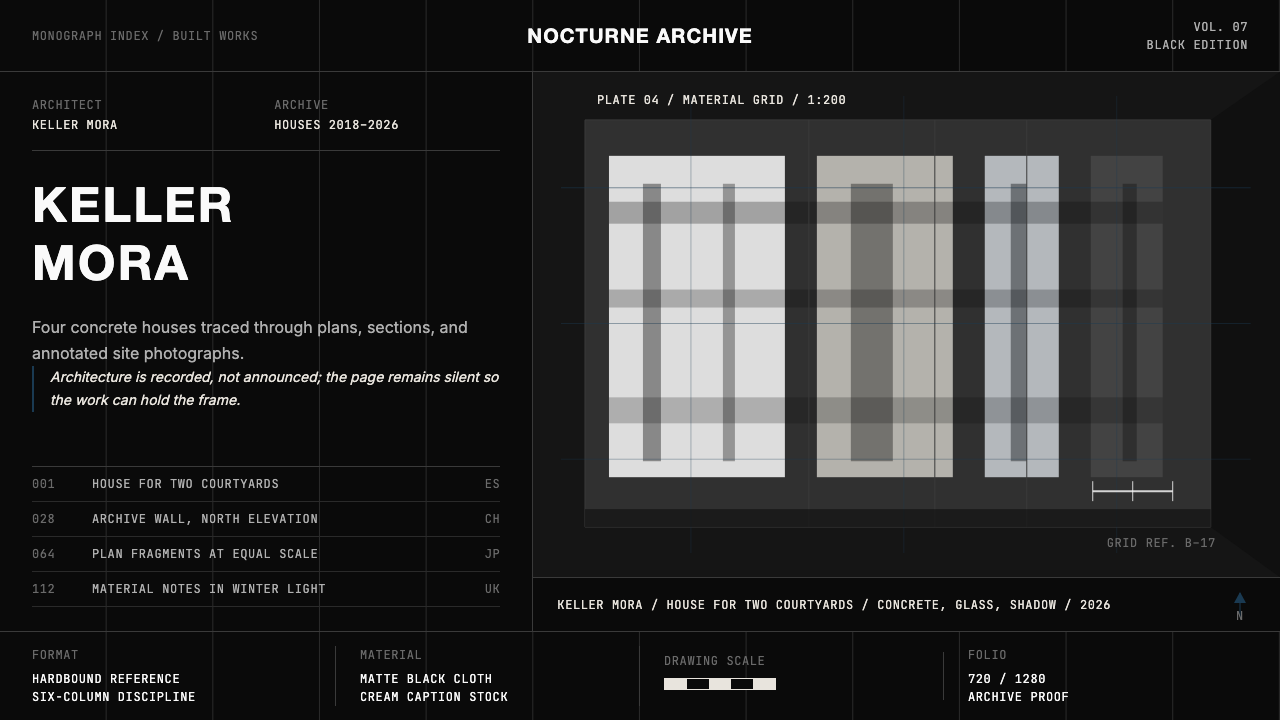 Architect Monograph (Black Edition)Architecture stays sovereign. Matte black, Helvetica caps, hairline grids, bl…
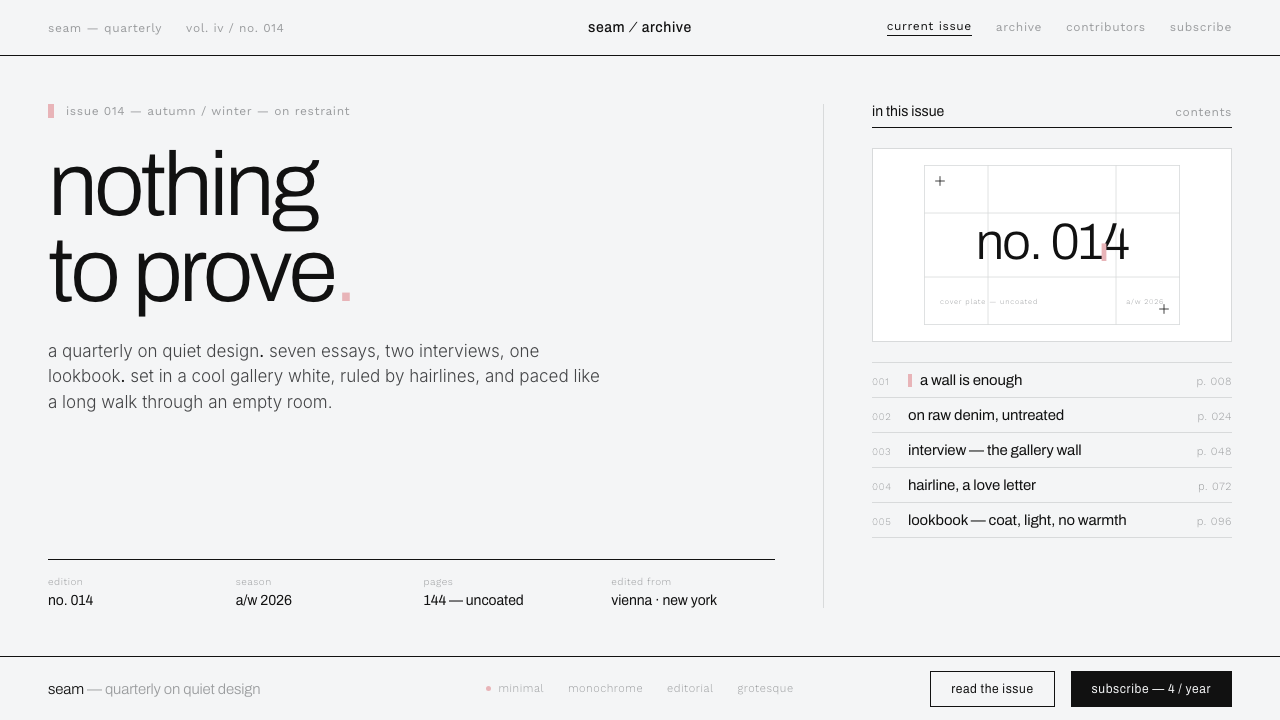 Helmut Lang MinimalismNothing to prove. Cool gallery white, 1px black hairlines, lowercase Archivo…
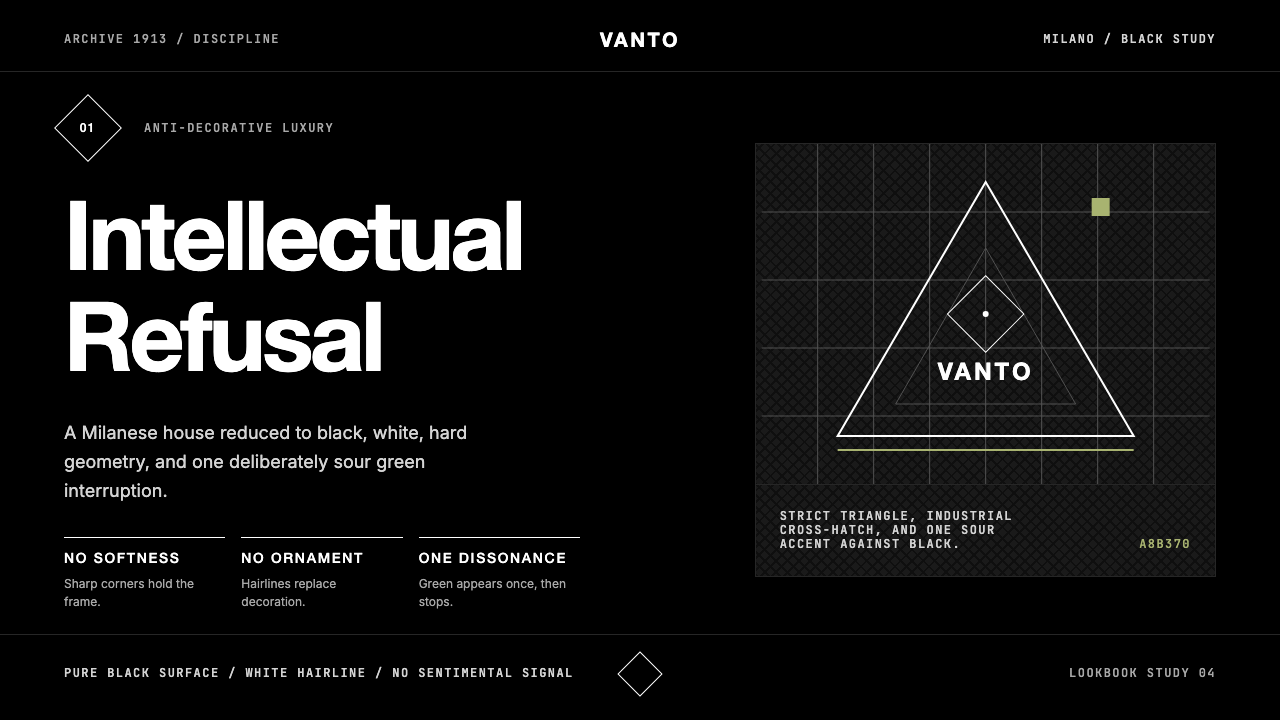 Prada Milan MinimalistLuxury refuses ornament. Pure black, austere sans, and one sour green hairlin…
 COS Gallery MinimalSilence has structure. Cool gallery white, Archivo uppercase, and concrete-gr…
 FarfetchLuxury as absence. Charcoal type, white canvas, and hairline editorial plates.
 Gestalten Design BookCoffee-table calm. Cream paper, tight sans, one saturated block, and a strict…