What is Architect Monograph (Black Edition)?
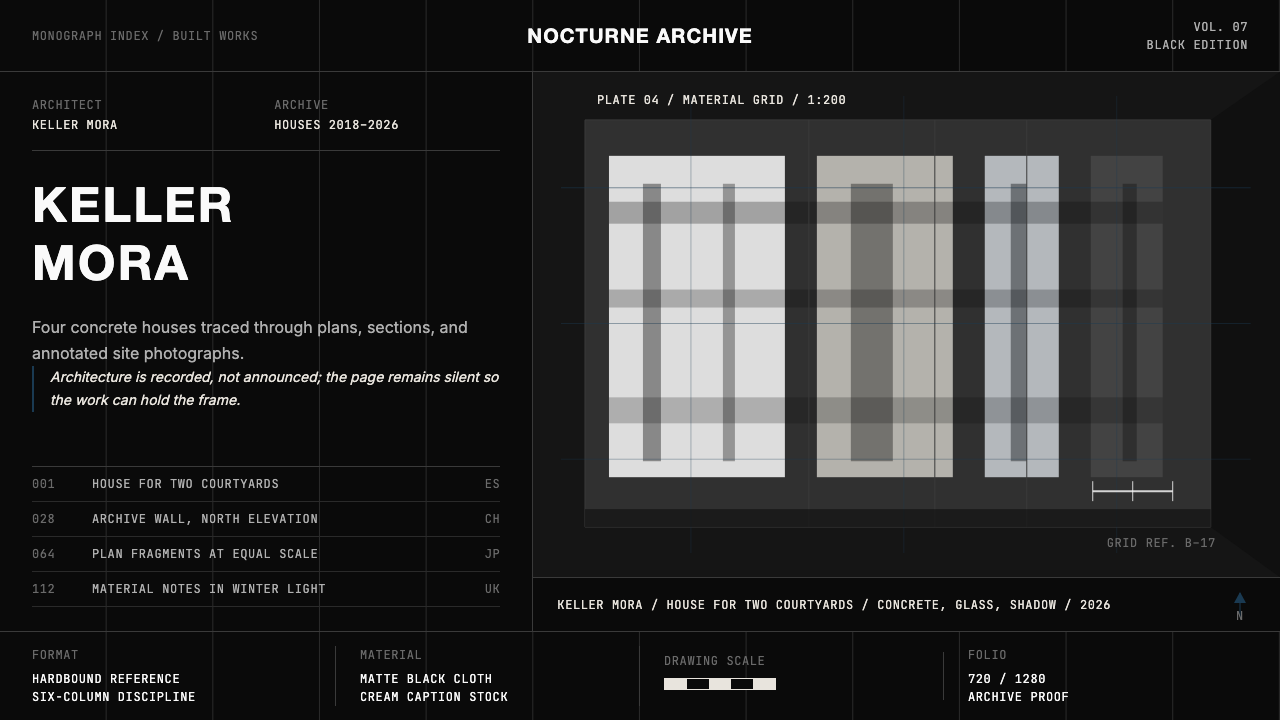
Architect Monograph channels the sovereign authority of El Croquis and Phaidon hardbacks — matte black, hairline grids, and full-bleed photography that insists architecture is the only subject worth looking at.
Architect Monograph (Black Edition) in brief
Architect Monograph is a design system distilled from the visual language of the world's most prestigious architecture publications — the matte-cloth hardbacks, the blueprint-blue plan sheets, and the austere catalog pages that define how serious architectural thought is presented to the world. It takes the editorial conventions of print monographs, which evolved over decades in Madrid, Barcelona, Zurich, and Tokyo, and translates them into a rigorous digital framework.
The palette is built around the deepest possible blacks and an off-white that reads almost like uncoated stock. A single accent — a cool, drafting-table blue borrowed from architectural blueprints — provides the only moment of color. Everything else is controlled by tone, by the weight of hairline rules against dark grounds, and by the spatial logic of full-bleed photography. There are no decorative elements; the photography itself, uncropped and unapologetic, carries all the visual energy.
What separates Architect Monograph from generic dark-mode design is its insistence on catalog-page discipline. Every typographic choice — the tight, all-caps headers, the mono-spaced captions beneath plan drawings, the restrained italic pull-quotes — comes from a functional publishing tradition. The aesthetic is not darkness for atmosphere; it is darkness as the natural condition for examining work that must be seen in its own terms.

Where does Architect Monograph (Black Edition) come from?
The architectural monograph as a serious publishing form took shape in the early twentieth century but reached its definitive visual canon in the 1970s and 1980s. Yukio Futagawa's GA (Global Architecture) series, launched in Tokyo in the early 1970s, established several conventions that persist today: the near-total dedication of the page to plans, sections, and full-bleed photographs; the elimination of anything that competes with the architecture itself; and a production quality that treated the book as a material object worthy of the buildings it documented.
El Croquis, founded in Madrid in 1982 by Fernando Márquez Cecilia and Richard Levene, brought a new graphic intensity to the form. Where earlier monographs had been sober and institutional, El Croquis introduced a more dynamic tension between text and image — long critical essays running in tight columns alongside architect interviews, drawings at varying scales intercut with atmospheric photography. The distinctive matte-black cloth cover, a consistent feature from early issues onward, became one of the most recognized objects in architectural offices worldwide. The cover's severity was not accidental: it signaled that the contents required serious attention.
The Swiss editorial tradition contributed the hairline rule and the precision grid. Publishers in Zurich and Baden had long applied the rigorous typographic discipline of Swiss International Style to cultural and academic publishing, and architecture provided an ideal subject — a field already committed to the grid as a fundamental intellectual tool. The meeting of Swiss editorial precision and the photographic ambition of Japanese and Spanish architecture publishing produced the hybrid visual language that Architect Monograph codifies.
Mònica Gili's 2G, published in Barcelona between 1996 and 2014, refined the form further toward restraint. Where El Croquis could be expressively dense, 2G committed to economy: fewer images, more considered placement, a quieter relationship between text and photograph. The magazine's design demonstrated that the monograph format's authority came not from abundance but from the confidence to leave space empty. This lesson — that negative space in an architecture publication is an editorial statement, not a failure of content — is central to the Architect Monograph system.
What defines the Architect Monograph (Black Edition) look?
Matte Black Ground
The foundational surface is a deep, light-absorbing black — not the glossy black of consumer electronics but the matte finish of cloth-covered hardbacks. This ground functions as both context and container: it makes white type and hairline rules appear to float, and it gives full-bleed photography a cinematic presence that brighter backgrounds cannot achieve. The darkness is not atmospheric decoration; it is a publishing convention that signals the seriousness of the content inside.
Hairline Grid and Blueprint Blue
Thin, precise rules — barely visible at normal reading distance but structurally present — divide the composition into the six-column cadence of a catalog page. The grid is not decorative but documentary: it performs the same organizing function as the registration lines on a set of architectural drawings. The single chromatic accent, a cool mid-range blue referencing the diazo prints of architectural blueprints, is reserved for data elements, active states, and the finest category labels — always used sparingly enough that its appearance reads as precision rather than color.
Tight All-Caps Headers
Section headings are set in compressed uppercase with tight letter-spacing — the typographic convention of the architectural index and the museum exhibition label. Capitalization is not for emphasis; it is for categorization. In the monograph tradition, all-caps headers mark the shift from reading to consulting: you scan them to navigate rather than read them for meaning. The compression and tightness signal that every square millimeter of the page is purposefully allocated.
Monospaced Captions and Italic Pull-Quotes
Technical annotations — plan references, project dates, material notes, coordinates — appear in a monospaced type that echoes architectural drawing notation. The fixed-width rhythm of these characters gives numerical data a measured, impartial quality. Against this, the occasional italic pull-quote — used to excerpt an architect's statement or a critical observation — introduces a different register: personal, argumentative, provisional. The contrast between the two type voices encodes the distinction between documentation and interpretation.
Full-Bleed Photography as Primary Element
Images in Architect Monograph do not sit inside frames or float as insets — they extend to the edges of the composition and command the full width or height of the space. This is a direct inheritance from GA Houses and El Croquis, where the photograph was treated as primary evidence rather than illustration. The consequence is that type, grids, and captions must function on top of imagery rather than beside it, requiring careful tonal judgment: text anchors at the darker regions, key structural information clears the image entirely.
Structural Negative Space
Empty space in this system is not absence — it is the equivalent of the unbuilt margin on an architectural site plan, a deliberate reservation. Wide margins, generous interline spacing, and spare column arrangements give each element room to be examined individually rather than consumed as part of a continuous visual flow. This discipline resists the natural pull of digital design toward information density; it insists that the reader pause.
Material Austerity
No gradients, no soft shadows, no ambient glow, no surface texture beyond the implied weave of the matte black ground. Interactions, if present, are indicated by crisp tonal shifts — a slightly lighter value on hover, a blue rule appearing at the active edge — not by animation or decorative transition. This austerity mirrors the architectural ethos of documenting buildings rather than selling them: the system trusts its content to hold attention without embellishment.

Who shaped Architect Monograph (Black Edition)?
Futagawa founded the GA (Global Architecture) series in Tokyo in the early 1970s, establishing the full-bleed, plan-centric monograph format that became the international standard for serious architecture documentation. His work as photographer and publisher demonstrated that the architecture book could be both a rigorous technical record and a visually powerful object. GA Houses, GA Document, and GA Architect collectively shaped the visual expectations of three generations of architects and, by extension, the design language that Architect Monograph systematizes.
Co-founders of El Croquis in Madrid in 1982, Cecilia and Levene developed the magazine's distinctive editorial identity: the matte black cover as signal of authority, the monographic issue structure dedicated to a single architect or studio, the long critical essay intercut with drawings and photographs. Their design and editorial choices were closely collaborative with the architects featured, producing a format that felt like a direct extension of each subject's working method. El Croquis issues have become primary reference objects in architecture education worldwide.
As founding editor of 2G, published in Barcelona from 1996 to 2014, Gili refined the monograph format toward maximum restraint. Where El Croquis embraced visual density, 2G committed to economy: fewer but more considered images, generous empty space treated as an editorial argument, and a quieter typographic register that foregrounded the architecture over the publication's own design identity. 2G's back issues remain influential for demonstrating that authority in architecture publishing comes from confidence in content rather than visual insistence.
The publishers and art directors working in Zurich and Baden from the mid-twentieth century onward — associated with houses including Lars Müller Publishers and Birkhäuser — applied the rigorous grid discipline and typographic precision of Swiss International Style to architecture books. Their contribution to the Architect Monograph visual language is the hairline rule, the mathematically specified column structure, and the insistence on a typeface used consistently at strict hierarchical intervals. The Swiss editorial tradition made the grid a philosophical as well as a practical tool.
How do you use Architect Monograph (Black Edition) today?
Architect Monograph is best understood as a system of documentary authority — it communicates that the content being presented has been selected, considered, and arranged with the rigor of a reference publication. Applying it correctly requires internalizing this purpose rather than simply replicating its surface characteristics. A dark background and a tight sans-serif header do not make something feel like El Croquis; the discipline of empty space, the restraint of color, and the structural logic of the grid are what produce the effect.
For presentation slides, the style excels on both cover and content pages but demands a different approach to each. Cover pages work as architectural plates: a single full-bleed photograph occupies the majority of the surface, with the title set in tight all-caps at the lower left or lower right, anchored above a hairline rule. Project or company identification appears in monospaced type at the smallest legible size. Content slides should resist the impulse to fill — one key visual per slide, supporting text as a column of no more than three or four short lines, and data presented as clean ruled tables rather than styled charts. The blue accent, when it appears, should mark a single element per slide: an active figure, a key data point, a category header.
For web interfaces, Architect Monograph is well suited to portfolios, documentation hubs, and analytical dashboards where precision and authority are the primary values. The approach: a near-black background for the base layer, off-white for primary text, and the blue accent reserved for interactive affordances and status indicators. Navigation should be minimal and typographic — tight all-caps labels, no icons beyond the simplest geometric indicators. Card components sit flush against the dark ground with no box shadows; their boundaries are implied by the hairline grid rather than made explicit by borders or shadow.
For editorial and marketing applications, the style supports strong typographic hierarchy and is particularly effective for case studies, long-form articles, and formal reports. An Architect Monograph editorial layout uses a wide outer margin for figure numbers, captions, or marginalia; the body text column is measured and unhurried; section breaks are marked by a full-width hairline rule rather than decorative ornaments. Marketing applications should be used sparingly: the style communicates seriousness and can feel cold in contexts that require warmth or urgency. It is most persuasive when the proposition is one of quality and long-term value rather than immediacy.
A common mistake when applying this style is treating the dark background as an invitation to add more visual elements — colored callouts, glowing accents, layered overlays — to compensate for the austerity. This reverses the logic of the system entirely. The dark ground in an architectural monograph is austere because the architecture fills it; in a digital application, the equivalent is content of genuine weight and visual quality. If the content does not justify the silence the style demands, the result will feel empty rather than authoritative. The other frequent error is breaking the single-accent rule: the blueprint blue works because it appears rarely; introducing a second accent color immediately undoes the precision the system is built on.

Architect Monograph (Black Edition) — FAQ
How does Architect Monograph differ from other dark design systems?
Most dark design systems treat darkness as atmosphere — a mood choice that makes interfaces feel premium or dramatic. Architect Monograph treats darkness as a publishing convention inherited from a specific cultural tradition: the matte-cloth hardback architecture monograph. The difference shows in the details. Where consumer dark modes typically use soft gradients, glowing accents, and layered depths to create richness, this system insists on a flat, non-luminous surface, a single non-warm accent, and structure derived from hairline rules rather than shadow or blur. The austerity is specific, not generic.
Can this style work for consumer-facing products, or is it limited to professional and institutional contexts?
The style is most naturally at home in professional, institutional, and B2B contexts — architecture firms, engineering practices, design studios, high-end real estate, financial services positioning toward sophistication, and cultural institutions. It can work in consumer contexts, but only when the product itself carries the weight the style implies. A luxury goods brand, a serious cultural platform, or an enthusiast community with demanding aesthetic standards can carry it. It will feel inappropriate — cold, distant, inaccessible — for products that depend on warmth, playfulness, or a wide demographic reach.
Why is the blue accent specifically described as blueprint blue, and does the exact shade matter?
The blueprint reference is semantic as well as visual. Diazo blueprints — the cyan-on-white or white-on-blue reproduction method used for architectural drawings before digital plotting — carry an association with technical precision, working documents, and the gap between a design and its realization. Using a blue in this register rather than a warmer or more saturated alternative maintains the system's documentary character. The shade should read as cool and measured — neither the vivid blue of a digital interface accent nor the deep navy of a corporate palette, but something closer to the color of a working drawing. Qualitatively: precise without being aggressive, technical without being cold.
How should data visualization be handled in this system?
Data visualization should be treated as an extension of the architectural drawing tradition: ruled, precise, and economical. Tables are preferable to charts wherever the exact value matters more than the pattern. When charts are necessary, they should use as few visual variables as possible — line charts with a single line, bar charts in a single tone with the blue accent reserved for a highlighted value, scatter plots without fill. Axes should be marked with hairline rules, labels in monospaced type. Avoid rounded bar corners, gradient fills, drop shadows on data elements, and any animation beyond the minimum needed for orientation. The guiding principle is that a chart should feel like it was designed by the same intelligence that produces engineering drawings.
Is it appropriate to mix this style with warmer or more expressive design elements for variety?
Mixing is the most common way that applications of this style fail. The authority of an architectural monograph comes from its consistency — the matte black cover is the same whether the building inside is in Switzerland or Japan, whether the architect is established or emerging. Introducing warmer tones, decorative typefaces, illustrated elements, or soft-shadow cards for variety signals that the system does not fully commit to its own logic. When variety is genuinely needed, it should be achieved through typographic contrast, tonal shifts within the dark palette, and the controlled use of full-bleed imagery rather than by importing elements from a different visual register. A layout that feels same on every page is not boring; it is reliable.
Related design styles
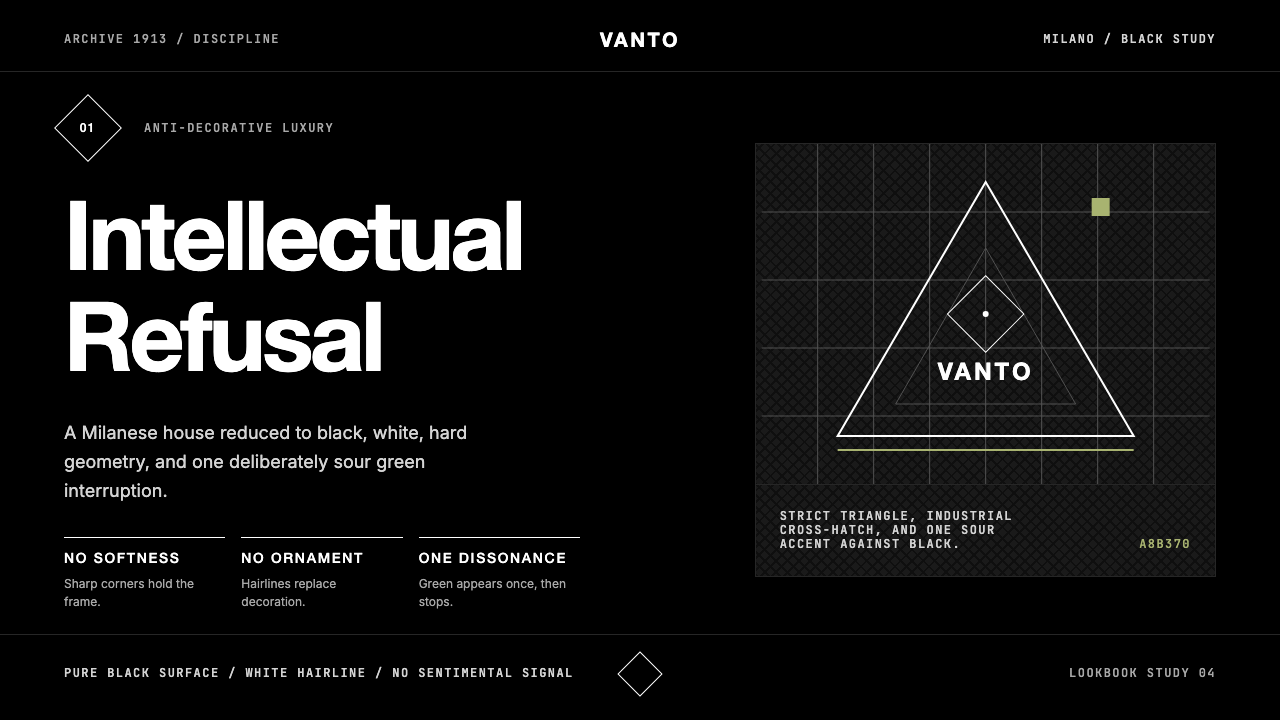 Prada Milan MinimalistLuxury refuses ornament. Pure black, austere sans, and one sour green hairlin…
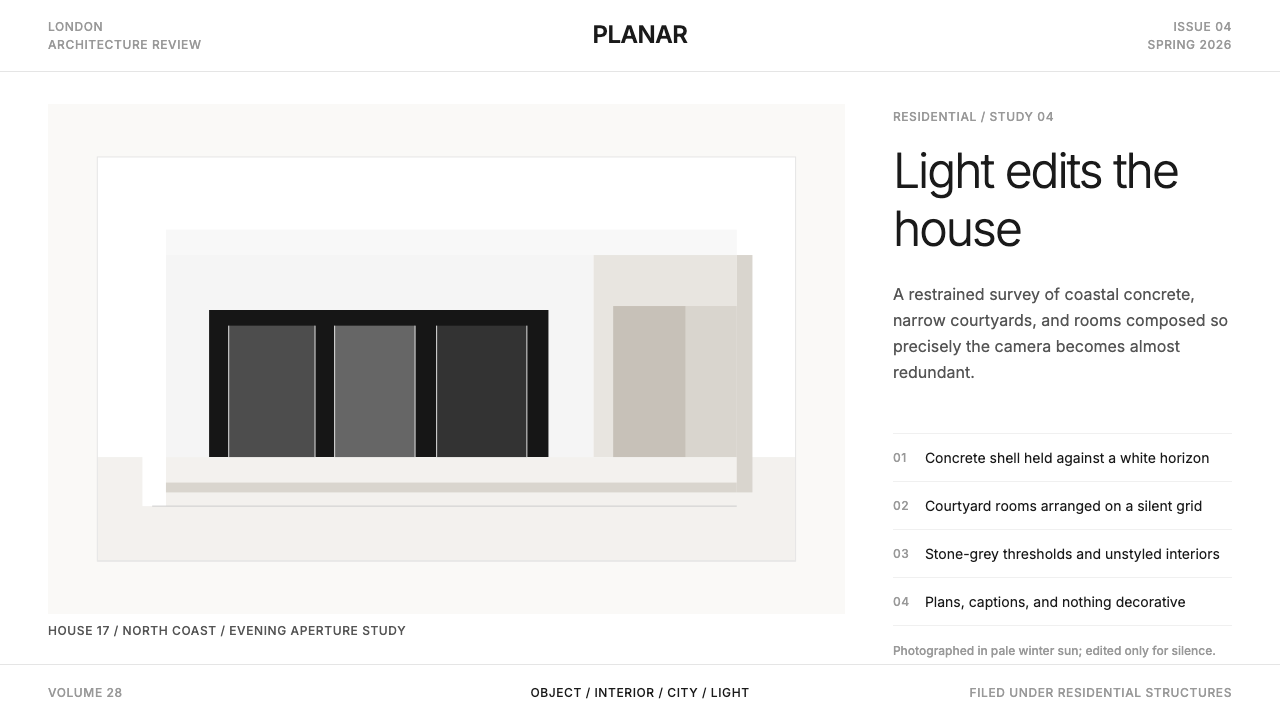 Wallpaper* ArchitecturePhotography does the speaking. Gallery-white grid, Inter captions, and hairli…
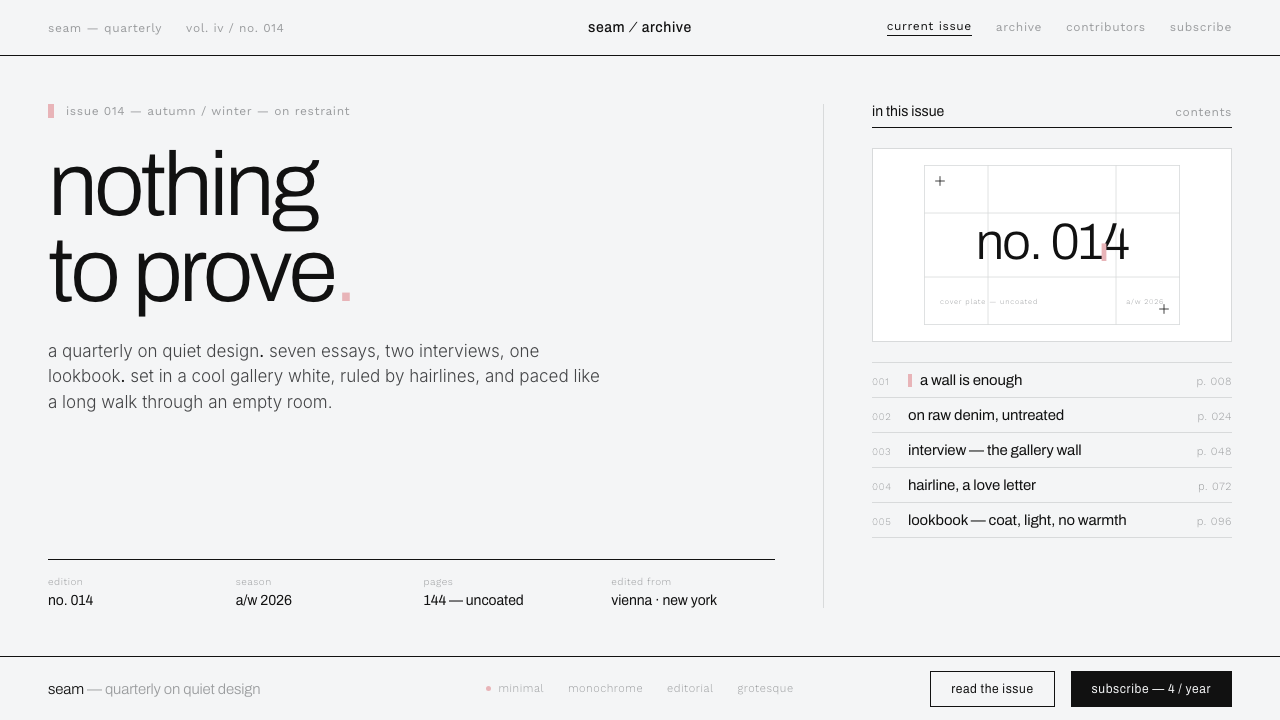 Helmut Lang MinimalismNothing to prove. Cool gallery white, 1px black hairlines, lowercase Archivo…
 ChanelLuxury needs no color. Black on white, pearl-cream warmth, geometric capitals…
 Criterion ArthouseThe case disappears. Charcoal field, off-white Archivo, hairline rules, one r…
 Gestalten Design BookCoffee-table calm. Cream paper, tight sans, one saturated block, and a strict…