What is Prada Milan Minimalist?
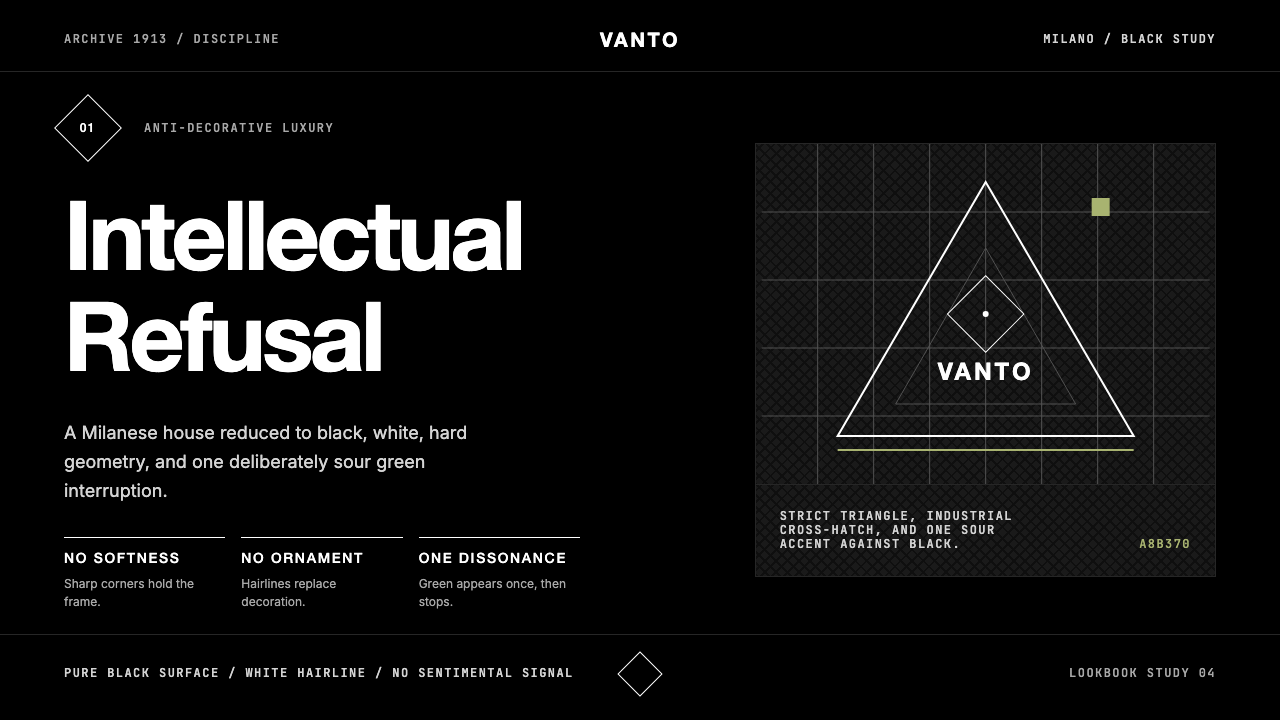
Prada built a luxury empire on refusal — no ornament, no warmth, no apology, just pure black, austere geometry, and a single deliberately ugly accent that makes you think.
Prada Milan Minimalist in brief
Prada Milan Minimalist is the visual language of one of fashion's most intellectually rigorous houses — a system built on disciplined restraint, cool geometric precision, and what Miuccia Prada herself has called 'the beauty of the ugly.' Where most luxury brands reach for warmth, gold, and softness to signal value, Prada reaches in the opposite direction: deep black grounds, pure white negative space, stark geometric sans-serif letterforms, and accents in colors that feel slightly wrong — a sour military green, a chalky dusty pink, a flat mustard yellow.
The aesthetic is not cold for the sake of coldness, nor minimal for the sake of minimalism. It is, in Miuccia Prada's framing, an intellectual argument: that genuine luxury is legible only to those willing to think rather than those who merely want to be impressed. The visual system earns its authority through what it withholds. A page, a facade, a garment — each is a composition from which every comfortable element has been deliberately removed, leaving only what is structurally necessary and conceptually precise.
In practical visual terms, the system is recognizable by its locked-down palette of near-absolute black and white, the sharp angles that refuse any corner rounding, the generous negative space that makes even a single word feel monumental, and the Saffiano leather cross-hatch texture that occasionally appears as a background field. Typography is geometric without being playful, austere without being neutral. The triangle logo badge — a recurring motif in Prada's physical and print identity — acts as a visual seal: small, dense, unmovable.

Where does Prada Milan Minimalist come from?
The Prada house was founded in 1913 by Mario Prada, who opened a leather goods shop in Milan's Galleria Vittorio Emanuele II — that glass-vaulted nineteenth-century arcade that is itself a monument to ornamental excess. Mario sold fine luggage, handbags, and accessories to a clientele of aristocrats and the upper bourgeoisie, and the brand's early identity was that of a well-made, traditionally crafted Milanese house with no particular visual philosophy beyond quality and heritage.
The transformation came in 1978, when Miuccia Prada — Mario's granddaughter and a doctorate holder in political science who had also trained at Milan's Piccolo Teatro as a mime — took over the business alongside her partner (and eventual husband) Patrizio Bertelli, who handled commercial operations. Miuccia brought to the brand something most luxury houses actively avoid: a genuine conceptual stance. Influenced by feminist theory, Marxist critique, and her own ambivalent relationship to the conventions of femininity and beauty, she began systematically stripping the brand of everything that felt decorative, reassuring, or conventionally pretty. The result was a visual and material language that felt almost confrontational: nylon backpacks rather than leather handbags, industrial fabrics rather than sumptuous ones, colors chosen for their psychological discomfort rather than their aesthetic appeal.
The visual identity crystallized through Prada's collaborations with architects and designers who shared its anti-ornamental sensibility. The most significant was the ongoing relationship with Rem Koolhaas and his firm OMA, which designed Prada's Epicenter flagship stores — in New York in 2001, in Los Angeles in 2004, and in Tokyo in 2003 in collaboration with Herzog and de Meuron. These stores applied the Prada aesthetic to architectural scale: raw concrete and resin floors, exposed structural elements, industrial lighting, display systems that refused the soft theatrical lighting typical of luxury retail. The stores were, in Koolhaas's framing, an attempt to rethink what a retail space could be — and in doing so, they gave the brand's visual system a spatial vocabulary that has influenced Prada's print and digital work ever since.
The aesthetic reached its current form across the 1990s and 2000s, as Miuccia consolidated the house's identity around a small set of recurring devices: the inverted triangle logo (itself a minimalist geometric form), the Saffiano leather texture, the restricted palette, and the deliberate deployment of 'ugly-beautiful' accent colors. Raf Simons joined as co-creative director in 2020, bringing a background in youth culture, subcultural reference, and Belgian conceptualism that deepened rather than redirected the house's intellectual posture. The visual language today is recognizably the same system Miuccia built across four decades — refined but not softened, legible but never comfortable.
What defines the Prada Milan Minimalist look?
Color System
The palette is anchored by near-absolute black and pure white, deployed in high-contrast opposition with no gradation between them. Accent colors are chosen not for conventional beauty but for a quality Miuccia Prada has described as 'ugly-beautiful' — a military green with a slightly sour, desaturated cast; a chalky pink that reads as faded rather than feminine; a mustard yellow so flat it borders on industrial. These accents appear sparingly and never in combination with one another. The effect is that each accent feels like a decision rather than a decoration — a single deliberate note in an otherwise monochrome composition.
Typography
Type in the Prada system is geometric and strictly sans-serif — letterforms that are structurally clean without any calligraphic warmth or humanist irregularity. The weight contrast is extreme: display text is set at a scale that feels almost aggressive, while body copy is set small and tight, creating a compositional tension between mass and detail. Tracking is wide on headline text, creating a sense of airy authority; body text is set with minimal spacing, dense and deliberate. Capitalization is used architecturally — full caps for labels and product names, mixed case for editorial text — as a hierarchy signal rather than an emphasis device.
Geometry and Edge
Every form in the Prada visual system has a sharp, uncompromised edge. Corners do not round; shapes do not soften; elements do not blend into one another. This commitment to the hard edge is what gives the system its characteristic feeling of industrial precision — it reads as measured and intentional rather than crafted and warm. The inverted triangle logo, the rectangular framing of product imagery, the straight horizontal rules that divide sections — all operate as geometric decisions that reinforce the system's architectural logic. Nothing is gestural; everything is resolved.
Negative Space
Negative space in the Prada system is not merely absence — it is the primary material of the composition. A single word set in a field of black; a product floating in an expanse of white; a logo placed in the lower corner of an otherwise empty page. This use of space communicates that each element is important enough to be alone, that the brand's authority does not need to be demonstrated through density or richness. The space is not relaxing — it is pressurized. The emptiness is what creates the feeling that something significant is being withheld, and that the viewer must bring their own interpretation to complete the meaning.
Texture as Structure
Unlike most minimalist systems that insist on absolute flatness, the Prada aesthetic incorporates one specific texture as a structural signature: the Saffiano cross-hatch pattern derived from the brand's iconic leather finish. When this texture appears in two-dimensional work — as a background field, a framing device, or a material reference — it functions as a tonal element rather than a decorative one. It adds density and tactility without introducing color or softness. This is the system's one concession to material richness, and its restraint is what keeps it from feeling ornamental.
Deliberate Discomfort
Perhaps the most distinctive and difficult-to-replicate quality of the Prada aesthetic is its cultivation of deliberate discomfort — the sense that nothing has been arranged to make the viewer feel immediately welcome or at ease. Accent colors that are slightly off, compositions that are slightly too bare, proportions that are slightly too extreme. This is not carelessness; it is one of the most controlled qualities in the system. Miuccia Prada has spoken of wanting to make things that initially seem ugly but reveal their intelligence over time. The visual system embeds this principle: it rewards sustained attention and resists quick consumption.
Zero Sentimentality
The Prada system contains no soft gradients, no rounded forms, no warm-toned neutrals, no imagery that invites the viewer to feel comforted or nostalgic. This total elimination of sentimental visual cues is what separates it from other luxury aesthetics that use restraint as a signal of refinement while still allowing warmth. Prada's restraint is colder: it is the visual equivalent of a critical essay rather than a beautifully bound book. The system's authority comes not from invitation but from withholding — and that withholding is total, systematic, and entirely deliberate.

Who shaped Prada Milan Minimalist?
Miuccia Prada is the architect of the brand's intellectual and visual identity. Trained in political science and mime performance, she took over the family business in 1978 and spent the following decades dismantling every assumption about what luxury should look and feel like. Her concept of 'ugly-beautiful' — the deliberate use of colors and forms that resist immediate appeal — gave the brand its most distinctive quality and continues to be the animating principle of its visual language. She is widely regarded as one of the most conceptually rigorous designers working in fashion.
The Dutch architect and OMA founder Rem Koolhaas has been Prada's most significant collaborator outside of fashion. His Epicenter store designs — beginning with the New York flagship in 2001 — translated the brand's visual principles into architectural form: raw materiality, exposed structure, anti-theatrical retail environments that refused the seductive softness of conventional luxury spaces. Koolhaas and Prada share a commitment to design as intellectual argument, and his influence is visible not just in Prada's physical spaces but in the brand's broader treatment of visual space as something to be thought rather than merely experienced.
As Miuccia Prada's partner and the business chief executive of the Prada Group, Patrizio Bertelli was instrumental in ensuring that the brand's intellectual and aesthetic commitments were commercially viable without being compromised. His aggressive expansion strategy — including the Epicenter store program, global retail growth, and the acquisition of other houses including Helmut Lang and Jil Sander in the late 1990s — gave the Prada aesthetic a global platform while maintaining the brand's refusal of mainstream luxury conventions. The tension he managed between commercial ambition and conceptual integrity is itself part of the Prada story.
Belgian designer Raf Simons joined Prada as co-creative director alongside Miuccia in 2020. His background encompasses youth subculture, Belgian conceptualism, and a career at Dior and Calvin Klein that demonstrated his ability to work within established visual systems while deepening their intellectual content. At Prada, his contribution has been less a redirection of the aesthetic than a layering of additional conceptual references — subcultural energy, archival tension — onto the system Miuccia built. The dual-creative-director model itself reflects the brand's interest in dialogue and argument as design methods.
Mario Prada founded the original leather goods house in Milan's Galleria Vittorio Emanuele II in 1913, establishing the brand's Milanese identity and its association with fine craft. His contribution to the current visual language is indirect but significant: his choice to locate the shop in one of Milan's most ornate architectural spaces — that cathedral of nineteenth-century commercial decoration — created the origin point against which Miuccia's later anti-decorative stance can be understood as a deliberate and transgressive inversion. The brand's current aesthetic only makes full sense when read against the decorative excess of its founding context.
How do you use Prada Milan Minimalist today?
Prada Milan Minimalist is among the most demanding historical style systems to apply correctly in contemporary design work, because its power comes entirely from what is withheld rather than what is shown. Applying it well requires discipline at every decision point: the willingness to leave a layout emptier than feels comfortable, to choose an accent color that is slightly wrong rather than conventionally right, and to resist the impulse to add anything that might make the composition more immediately legible or welcoming. The style rewards confidence and punishes decoration.
For presentation slides, the system works most powerfully on covers that commit fully to high-contrast austerity. A cover slide might set a single phrase in large-scale geometric type against an absolute black ground, with the event or company name set small in a corner in a slightly unsettling accent — a muted green or flat pink — and nothing else. Content slides should be treated as architectural drawings: a strict grid, two type sizes maximum, no decorative rules, no background color variations within a section. Data visualizations become geometric objects in their own right — bar charts rendered in the accent color against a black or white field, with values labeled in small tight type and no chart gridlines. The data should feel as deliberate as a Prada product shot.
For web interfaces — particularly dashboards, pricing pages, and product detail pages at the premium end of the market — the system excels when used for brands positioned around authority, intelligence, and intentional exclusivity. The approach: absolute black navigation bars, white content fields with generous top and bottom margins that exceed typical conventions, type at small sizes with very generous line height so that each word feels considered rather than crowded. Interactive states use the accent color sparingly — a single underline, a color change on a key call-to-action — rather than multiple highlight colors competing for attention. Card components have sharp borders and no shadows; dividers are fine single lines rather than colored bands. Mobile layouts are treated with the same severity as desktop: the system does not relax at smaller viewport sizes.
For editorial design and luxury marketing — campaign pages, lookbooks, print advertisements, and brand identity applications — the Prada aesthetic supports a vertical approach to hierarchy that feels more like architecture than graphic design. Full-bleed black sections alternate with full-bleed white sections, each containing a single dominant element: one image, one headline, one product. The Saffiano texture can appear as a background field to introduce material density without color. Pull-quotes are set large and tight at the edge of the layout rather than centered; captions are set very small and at a distance from the image they describe. The pacing is deliberately slow — the reader is expected to spend time with each element before moving forward.
The most common mistake when applying this aesthetic is treating it as generic dark-mode minimalism — using black backgrounds, white type, and calling it done. Authentic Prada-inflected work is distinguished not by its darkness but by its specificity: the particular quality of its accent colors (muted and slightly wrong, never vibrant), the extreme scale contrast between type elements, the commitment to leaving space that feels uncomfortably empty, and the total absence of anything designed to create visual comfort. A second common error is adding multiple accent colors — the system is built around one accent at a time. A third is using rounded corners, soft shadows, or smooth gradients anywhere in the composition. These three additions — multiple accents, rounding, and softness — collectively destroy the system's authority.

Prada Milan Minimalist — FAQ
How is Prada Milan Minimalist different from generic luxury minimalism?
Most luxury minimalism uses restraint to signal refinement while still maintaining visual comfort — soft neutrals, elegant curves, warm lighting, refined textures that invite touch. Prada's minimalism is fundamentally different: it is built on deliberate discomfort, the refusal of warmth, and the use of accent colors chosen precisely because they resist immediate appeal. Where generic luxury minimalism says 'we are refined enough not to need decoration,' Prada minimalism says 'we are rigorous enough not to need your approval.' The underlying attitude is confrontational rather than welcoming, and that confrontation is visible in every element of the visual system.
Can this style work for a light-background or brand-color layout, or does it require black?
The Prada aesthetic does function on white or near-white grounds — in fact, much of Prada's editorial and product photography uses a pure white field as the primary background. What the system requires is not black specifically but high-contrast absolute opposition between ground and figure, and total elimination of any warmth or softness in how that contrast is constructed. A white-ground version of the system uses absolute black for all type and structural elements, reserves one muted accent for selective use, keeps all edges hard, and treats negative space with the same severity as the dark-ground version. What the system cannot tolerate is a warm beige, a soft gray, or any neutral that introduces atmospheric comfort.
What kinds of products or brands should avoid this aesthetic?
The Prada aesthetic is unsuitable for any context where the primary desired response is warmth, approachability, sensory pleasure, or cultural connection. Food and beverage brands need to stimulate appetite — the Prada palette is anti-appetizing by design. Children's products, parenting platforms, and wellness applications depend on emotional warmth that this system systematically removes. Consumer finance products aimed at first-time users benefit from friendliness that this aesthetic refuses. Any brand positioning itself around community, belonging, or shared joy will find that the style's fundamental attitude of intellectual exclusivity directly contradicts those values. The system is best reserved for contexts where authority, intelligence, and intentional distance are genuinely aligned with the brand's positioning.
How do you handle imagery and photography within this system?
Photography in the Prada system is used as a geometric element rather than a narrative one. Product shots are typically set against absolute white or black, cropped to remove all environmental context, and treated with a level of precision that makes the object feel archeological — as if it is being documented rather than sold. Editorial photography follows the same logic: subjects are shot in ways that emphasize structural and geometric qualities over human warmth, often using high-contrast lighting, unexpected angles, or framing that places the figure at the edge of the composition. The system strongly resists lifestyle photography where objects or people appear in ambient, emotionally warm settings. When a human figure appears, it is as formal as a diagram.
Is the 'ugly-beautiful' accent color concept something that can be learned, or does it require subjective judgment?
It can be learned through principle, even if its execution always requires judgment. The key quality to look for in a Prada-appropriate accent is what might be called perceptual friction — a color that registers as slightly unexpected or slightly wrong in the context it occupies, without being garish or arbitrary. In practice, this means favoring colors that are desaturated or shifted slightly toward grey or brown compared to their 'correct' chromatic position — a green that reads as military rather than fresh, a pink that reads as dusty rather than feminine, a yellow that reads as mustard rather than sunny. The test is: does this color create a moment of slight pause? Does it reward attention rather than providing immediate satisfaction? If yes, it has the right quality. The specific color is less important than the quality of the pause it creates.
Related design styles
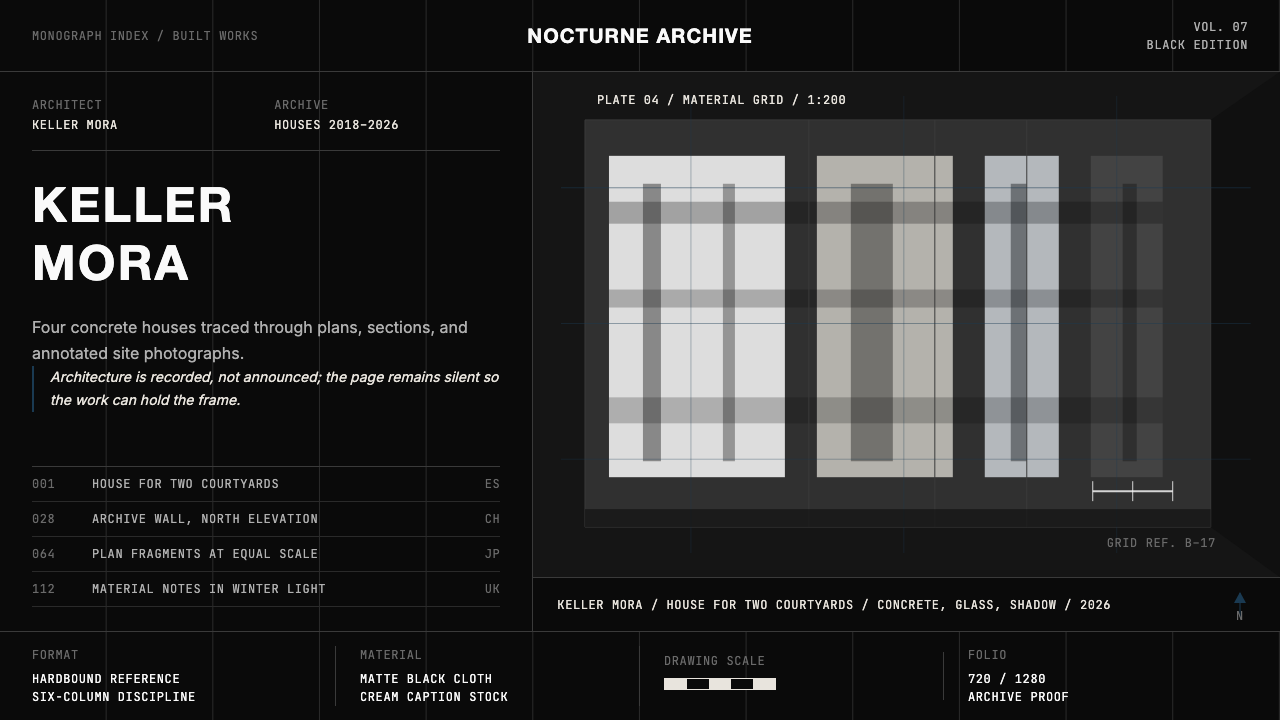 Architect Monograph (Black Edition)Architecture stays sovereign. Matte black, Helvetica caps, hairline grids, bl…
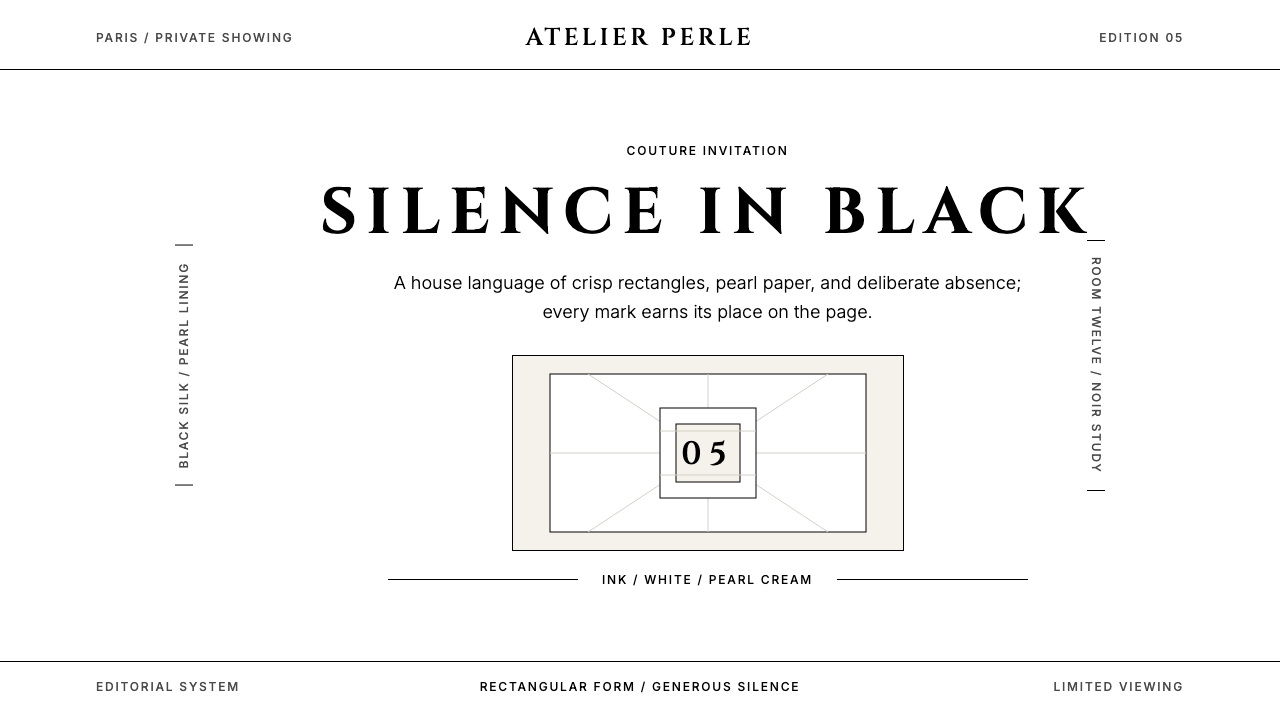 ChanelLuxury needs no color. Black on white, pearl-cream warmth, geometric capitals…
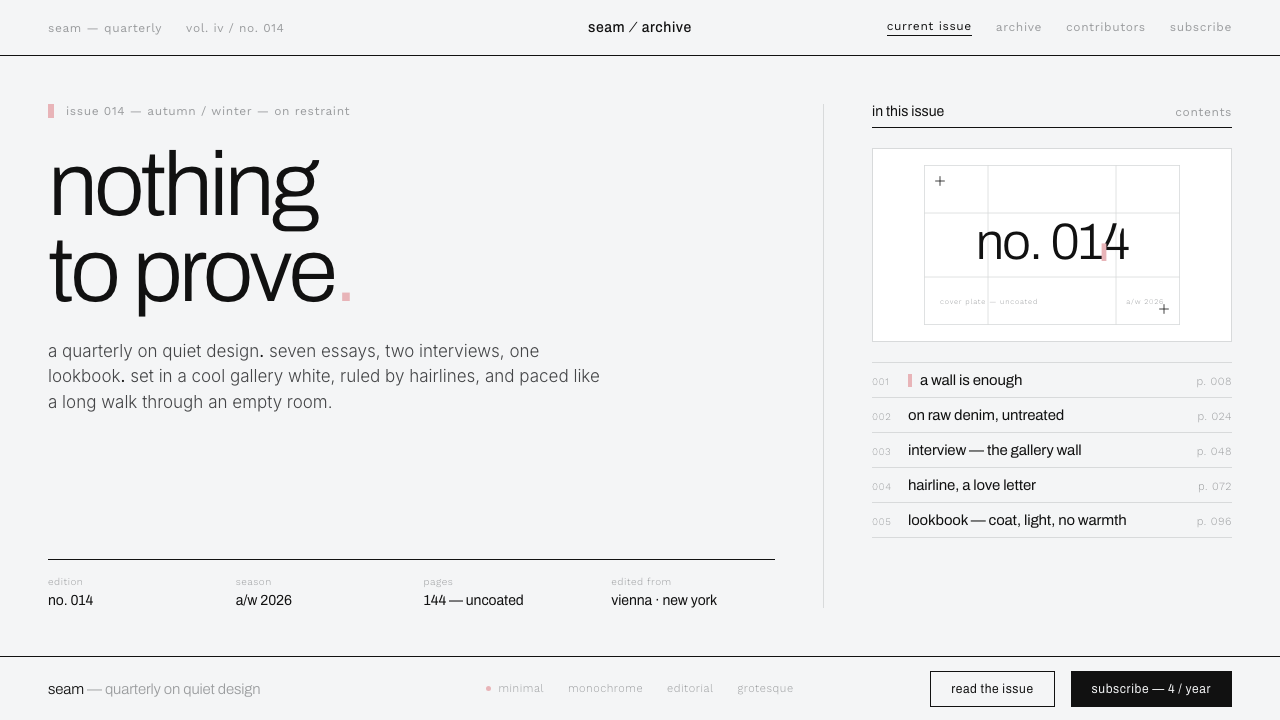 Helmut Lang MinimalismNothing to prove. Cool gallery white, 1px black hairlines, lowercase Archivo…
 Wallpaper* ArchitecturePhotography does the speaking. Gallery-white grid, Inter captions, and hairli…
 Acne Studios Pink-PaperQuiet luxury in one pink plane. Inter type floats on white with a bag-like re…
 COS Gallery MinimalSilence has structure. Cool gallery white, Archivo uppercase, and concrete-gr…