What is Chanel?
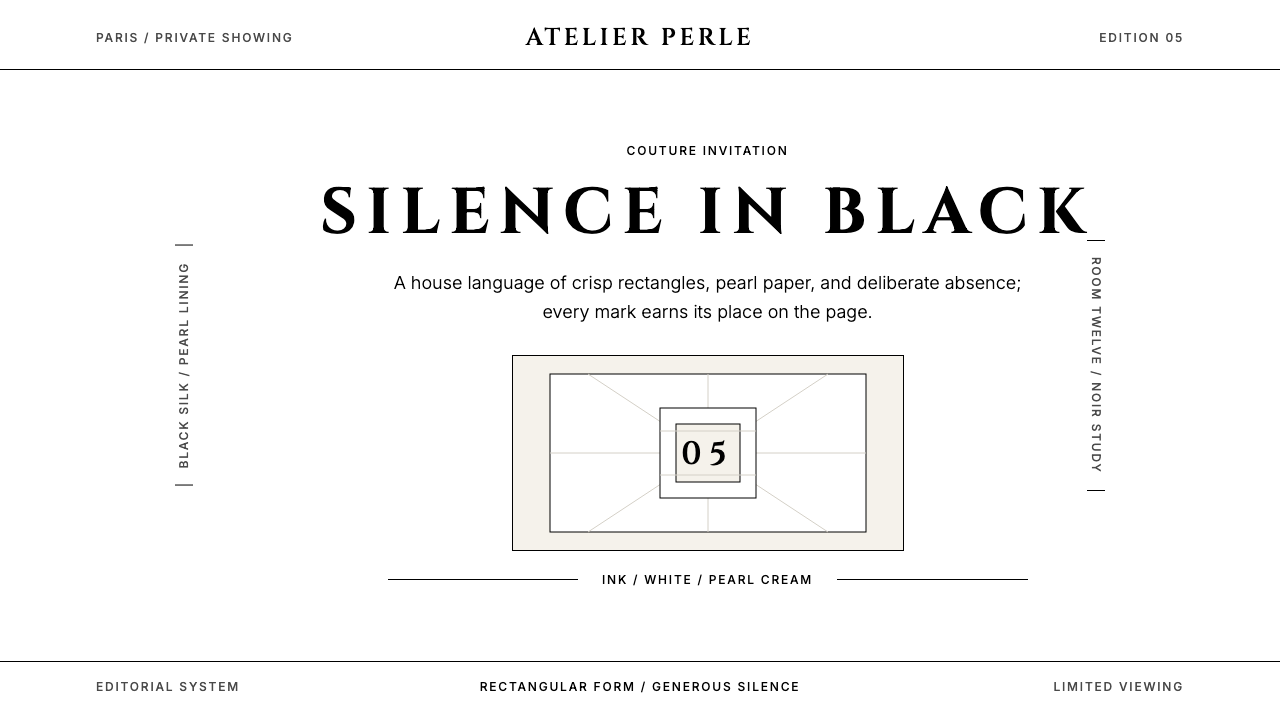
For over a century, Chanel has argued in pure black and white that restraint is the most powerful form of luxury.
Chanel in brief
Chanel's visual language is one of the most recognizable and least imitated design systems in the world — not because it is complex, but because its discipline is genuinely difficult to maintain. The house operates in a near-monochromatic palette: pure black, pure white, and the warm, slightly off-white glow of pearl-cream. Every other color is a guest, and guests rarely arrive. Geometric sans-serif capitals carry an air of aristocratic distance, spaced generously so that each letter breathes. Rectangular forms rule the composition; rounded corners and soft edges are refused as a matter of principle.
The system's power comes from what it withholds. Vast areas of white or cream are not empty — they are active. They give black-and-white fashion photography the room it needs to carry full emotional weight. They make a single interlocked double-C monogram feel like a statement rather than a logo. The restraint is not poverty of imagination; it is the cultivation of silence so that whatever does speak, speaks with absolute authority.
Unlike many luxury houses whose visual identity has drifted or been reinvented across decades, Chanel's aesthetic has remained structurally continuous since Gabrielle Chanel established it in the early twentieth century. The house treats its visual grammar as a heritage document: it can be refined, but not overwritten. This continuity is itself a form of confidence — the visual equivalent of never raising one's voice.

Where does Chanel come from?
Gabrielle Bonheur Chanel, known universally as Coco, opened her first millinery shop in Paris in 1910 at 21 Rue Cambon, then relocated to the address that would become synonymous with the house: 31 Rue Cambon. Her earliest visual instincts ran directly counter to the Edwardian fashion environment she entered — an era of elaborate lace, heavy ornamentation, and corsetry that treated the female body as an armature for decoration. Chanel stripped away the excess. She borrowed from men's workwear and sportswear, introduced jersey fabric to haute couture, and established the foundational principle that elegance is refusal.
The black-and-white palette was not accidental. In 1926, American Vogue published Chanel's little black dress — a simple, calf-length sheath in black crepe — and compared it to the Ford Model T: democratic, functional, and destined to be universal. Black had been associated with mourning; Chanel reclaimed it as the color of absolute modernity. White, specifically the creamy white of gardenia petals and freshwater pearls, served as its counterpoint — warm where black was absolute, yielding where black was final. The pairing became the house's visual signature and has never been abandoned.
The launch of Chanel No. 5 perfume in 1921 established another pillar of the visual identity: the bottle. Where competitors produced perfume in ornate, jewel-encrusted flacons, Chanel commissioned a design of almost architectural severity — a clear rectangular vessel with minimal stopper, its only decoration the name printed in unadorned capitals. The bottle made the perfume's invisible quality (scent) legible through the most visible quality of its container (form). This logic — that the container should argue for the contents through structural honesty rather than decorative elaboration — runs through every subsequent Chanel design decision.
Karl Lagerfeld, who became creative director in 1983 and held the role until his death in 2019, did not invent the Chanel visual system but proved its extraordinary durability. He worked within the existing grammar while amplifying certain elements — the oversized logotype, the high-contrast campaign photography, the use of tweed texture as a visual motif in print collateral — in ways that made the system feel contemporary without departing from its foundations. Virginie Viard, who succeeded Lagerfeld, has continued in the same spirit of custodianship. The lesson of this continuity is not that the system is inflexible, but that it is so precisely calibrated that departures are immediately legible as errors.
What defines the Chanel look?
Palette
The Chanel palette is perhaps the most disciplined in luxury fashion: pure black and pure white are the two poles, with pearl-cream occupying the only permitted middle ground. Black carries authority and finality; white provides the silence in which black can resonate; pearl-cream introduces just enough warmth to prevent the system from feeling cold or clinical. No other color holds a structural role. When color does appear — a camellia in red, a chain in gold — it functions as an object within the composition, not as a system element.
Typography
Chanel's typographic sensibility is geometric and capital-dominant. Letterforms are wide, upright, and without decorative flourishes — the kind of typeface that reads as an engraved inscription rather than a printed word. Letter-spacing is wide by convention, creating the effect of letters presented individually rather than running together in a hurry. This spacing, combined with the all-caps setting, produces the air of a declaration rather than communication. Body text, when it appears in editorial contexts, is treated with the same economy: generous line height, restrained measure, nothing competing with the imagery.
Geometric Restraint
Every structural element in the Chanel visual system tends toward the rectangle and the straight line. The double-C logo itself is an exception — two interlocking curves — but it functions as a monogram-object, not as a shaping influence on the broader layout system. Compositions favor horizontal and vertical axes. Diagonal elements are rare, and when they appear they carry deliberate tension rather than dynamism. The absence of rounded corners is consistent and principled: softness would imply approachability, and Chanel's visual posture is that of reserve, not invitation.
Whitespace as Voice
No element of the Chanel aesthetic is more distinctive or more difficult to replicate than its use of whitespace. Margins are wide — sometimes occupying more area than the content they frame. A single garment on a white ground, a single line of type on a cream field: the space around the subject is understood as part of the composition, not as unused area. This editorial generosity is inseparable from the brand's authority. Crowding implies urgency or insecurity; Chanel's whitespace implies that the subject needs no context to justify itself.
Photography and the Monochromatic Image
Chanel's campaign photography has historically favored high-contrast black-and-white imagery, even when color photography became the industry standard. When color appears, it is typically limited to the garment or the product against a neutral ground — the image is constructed so that the subject is the only saturated element. This treatment elevates the product to the status of a specimen: isolated, studied, iconic. The photographic style reinforces the palette's logic: maximum contrast between subject and ground, with nothing in between competing for attention.
The Ornament of Objects
Where the Bauhaus achieved zero ornament through geometric abstraction, Chanel achieves restraint through a more selective method: all decoration is concentrated into specific signature objects — the camellia flower, the interlocked CC, the quilted leather pattern, the chain strap — which then carry all the decorative weight of the system. Outside these objects, the visual environment is stripped clean. The result is a paradox: a system that feels simultaneously austere and richly associated, because the few ornamental elements it permits are so precisely chosen and so consistently deployed.
Scale and the Editorial Gesture
Chanel compositions are acutely sensitive to scale. A headline might occupy the full width of a spread while the body text sits in a narrow column, creating a deliberate ratio between what commands and what explains. Objects photographed at monumental scale against plain grounds take on a gravity that smaller, busier compositions cannot achieve. This is the visual grammar of the maison's editorial output: choose the single most important element, give it the most space, let everything else serve. Scale differentials are decisions, not defaults.

Who shaped Chanel?
Chanel founded her first shop in 1910 and over the following decades dismantled the prevailing conventions of women's dress — eliminating the corset, introducing jersey to couture, and establishing black as the color of modernity rather than mourning. Her instinct for visual restraint was inseparable from her social positioning: she moved in aristocratic circles and absorbed their preference for understatement over display. The visual system she established — monochromatic, geometric, spacious — was a direct expression of her belief that a woman who needed ornament to attract attention had already lost the argument.
Lagerfeld assumed creative direction of Chanel in 1983, at a moment when the house had been commercially and creatively dormant since Coco Chanel's death in 1971. He restored the brand to cultural primacy without departing from its foundational visual system, instead finding ways to amplify and contemporize the grammar — enlarging the logo, sharpening the contrast in campaigns, and demonstrating that the austere Chanel aesthetic could absorb the energy of each successive cultural decade without losing its core character. His tenure of over three decades is the most sustained argument for the system's durability.
Viard worked alongside Lagerfeld for decades as his closest collaborator before succeeding him as creative director in 2019. Her approach represents the principle of custodianship made explicit: the visual and design language she has stewarded is immediately recognizable as Chanel while demonstrating a quieter, more intimate interpretation of the house codes. Her tenure has clarified something important about the system — that it is robust enough to carry different personalities without losing coherence, provided the underlying grammar is respected.
Monroe's 1952 declaration that she wore 'Chanel No. 5 to bed' — and nothing else — is among the most economically effective pieces of brand communication in the history of luxury. It required no advertisement, no visual asset, no designed artifact: a single sentence, reported and repeated, attached the fragrance permanently to the idea of intimate glamour. The anecdote illustrates something central to the Chanel visual system's power — that restraint, strategically deployed, generates more attention than elaboration.
Newton's photography for Chanel across several decades is among the most definitive visual expressions of the house's aesthetic — not despite its provocations, but partly because of them. His images occupied the black-and-white vocabulary, the extreme contrast ratios, and the compositional severity that the brand's visual system demanded, while introducing a psychological tension that made the restraint feel charged rather than cold. Newton demonstrated that the Chanel visual system was capable of containing strong content without needing to become more decorative to do so.
How do you use Chanel today?
The Chanel aesthetic is among the most demanding historical design languages to apply correctly, precisely because its power derives from discipline rather than from any single visual element. Anyone can use black and white. The challenge is applying them with the proportion, spacing, and editorial commitment that make the system work. Before applying this style, ask what the work is arguing: Chanel's visual language is an argument for absolute confidence, and that argument only holds if the execution is itself confident.
For presentation slides, the style works best when it is allowed to be genuinely spare. A cover slide should commit to a single image — high-contrast, close-cropped, ideally monochromatic — with a short title in wide-tracked capitals and nothing else. Content slides should establish a strict horizontal rhythm: a narrow rule across the top, type aligned to a consistent left margin, and a content area that never feels crowded. Data slides work well when charts are treated as compositional objects — stripped of grid lines and axis decoration, with bars or lines in pure black against a cream ground, and a single accent element to mark the key data point.
For web interfaces, the style suits premium landing pages, editorial product pages, and any context where the brand's authority needs to be established before the user scrolls. The approach: near-white or cream background throughout, black for all text, generous padding around every element, and no color in the interface itself except for a single accent used sparingly for hover states or calls to action. Navigation should be typographic, with generous letter-spacing on wordmarks and labels. Avoid icon libraries entirely — if iconography is necessary, use custom geometric forms at monumental scale rather than small decorative icons.
For editorial and marketing work, the style supports long-format layouts where quality of reading is more important than density of information. A Chanel-derived editorial page uses a wide outer margin reserved for a single pull quote or image caption, a body column that occupies roughly half the page width, and section breaks marked by a fine horizontal rule rather than ornamental dividers. Marketing pages work well with the style's poster sensibility: a full-width image block, a centered headline in capitals with extreme letter-spacing, and a body paragraph that is intentionally brief — saying less to imply more. Campaign imagery should ideally be shot specifically for the layout, or sourced from high-contrast black-and-white archives.
The most common mistake when applying this style is filling the whitespace. The instinct to add a second color, a texture, a decorative border, or additional type elements is almost always wrong. The whitespace is not silence waiting to be filled — it is an active part of the visual argument. A second common error is using the black-and-white palette as a shortcut to elegance without committing to the typographic standards: loose letter-spacing, inconsistent type hierarchy, or mixed typeface families immediately break the system's logic. The style requires that every detail be a decision, and that every decision be the same decision.

Chanel — FAQ
How is Chanel's visual style different from generic minimalism?
Generic minimalism is defined by reduction — removing elements until the design is as simple as possible. Chanel's aesthetic is defined by authority — a specific argument that the subject is important enough to need no justification. The difference is visible in the details: Chanel compositions use specific type treatments (wide-tracked, all-caps, geometric), specific palette relationships (warm cream, not cool grey), and specific spatial decisions (editorial-scale margins, not merely adequate ones). Minimalism can be tentative; Chanel's system never is. Applying generic minimalism produces designs that feel clean; applying the Chanel system correctly produces designs that feel inevitable.
Can this style work with color photography or illustration?
Yes, but with significant constraints. Color photography can work within the system if the image is composed so that its dominant tones are near-neutral — skin, stone, cream, grey — with the garment or product as the only saturated element. The image then reads almost as a monochromatic field with a single colored object, which is consistent with the system's logic. Fully saturated color photography — bright backgrounds, multiple competing hues — is incompatible with the system and will overwhelm the typographic and spatial discipline the style depends on. Illustration is more difficult: the Chanel visual language has almost no illustrative tradition, and introducing illustration typically introduces a visual warmth or idiosyncrasy that the system actively refuses.
How does this style handle digital dark mode?
The Chanel system is fundamentally light-ground: cream and white backgrounds are not stylistic preferences but structural commitments, because the warm-cool dynamic between pearl-cream and pure black is central to how the palette feels. A true dark inversion — black backgrounds with cream or white type — is possible and produces a different but coherent reading of the system. The risk is that on a dark ground, the pearl-cream accent disappears as a meaningful distinction from white, collapsing the palette to a starker black-and-white that reads more like newspaper print than couture. If dark mode is required, a warm dark ground — very deep charcoal with a slight warm undertone — preserves more of the original palette's character than a pure black.
Does Chanel's visual style suit brands outside the luxury sector?
The style transfers most successfully to contexts where authority, precision, and a degree of exclusivity are genuine brand values — not performed, but structurally true. Premium financial services, architectural practices, independent publishers, high-end hospitality, and certain categories of professional tools can all carry the aesthetic convincingly. It fails where warmth, accessibility, or democratic inclusivity are primary values: a community platform, a children's brand, a mass-market consumer product. The tell is whether the whitespace feels confident or cold to the target audience. If the user's instinct upon seeing the design is that it is 'not for them,' the style has successfully communicated exclusivity — which is the point for a luxury house, but may be a liability for brands with different ambitions.
What is the single most important thing to get right when using this style?
Proportion. The Chanel system's authority depends on every element being given exactly the space it deserves — not more, not less. A headline that is slightly too small fails to command; a margin that is slightly too narrow reads as hesitant; a logo placed too centrally feels corporate rather than confident. The proportional relationships between type sizes, between content and margin, between the subject and the ground it occupies — these are where the style either holds together or falls apart. Unlike some historical design systems where a strong color palette or bold geometric forms can carry an otherwise weak composition, Chanel's system offers no such crutches. The proportions are the style.
Related design styles
 Prada Milan MinimalistLuxury refuses ornament. Pure black, austere sans, and one sour green hairlin…
 Acne Studios Pink-PaperQuiet luxury in one pink plane. Inter type floats on white with a bag-like re…
 Architect Monograph (Black Edition)Architecture stays sovereign. Matte black, Helvetica caps, hairline grids, bl…
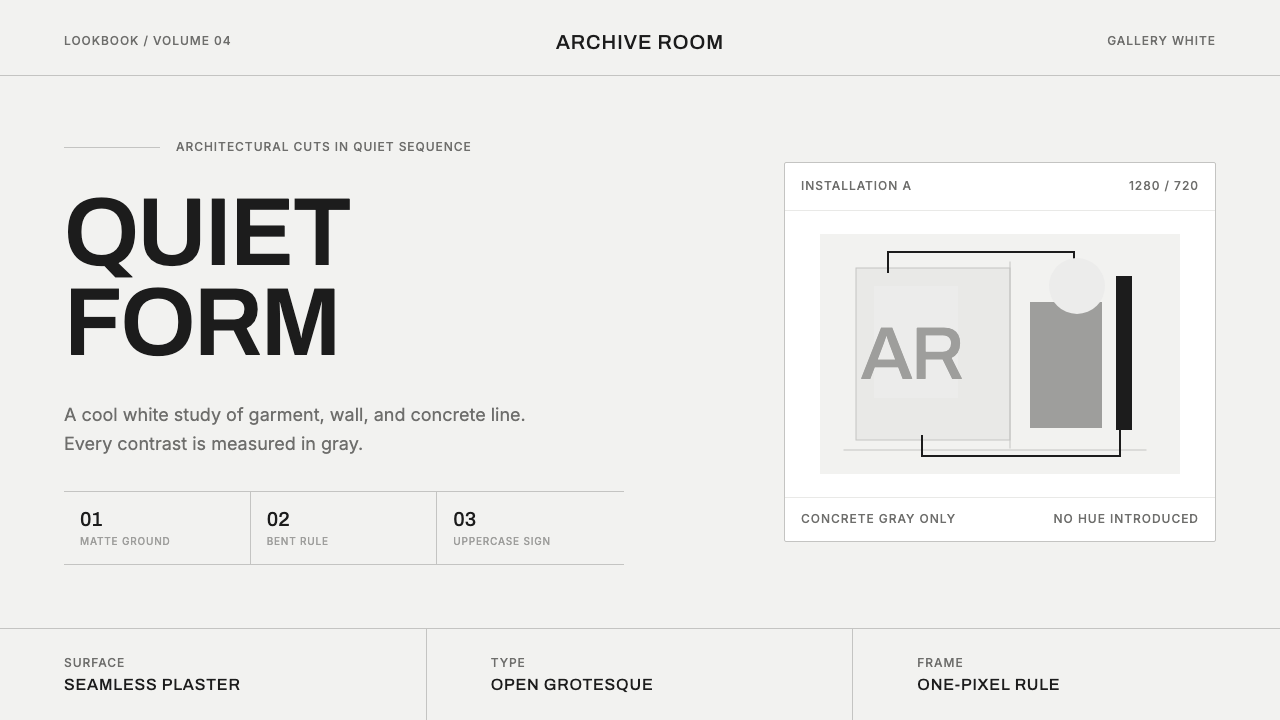 COS Gallery MinimalSilence has structure. Cool gallery white, Archivo uppercase, and concrete-gr…
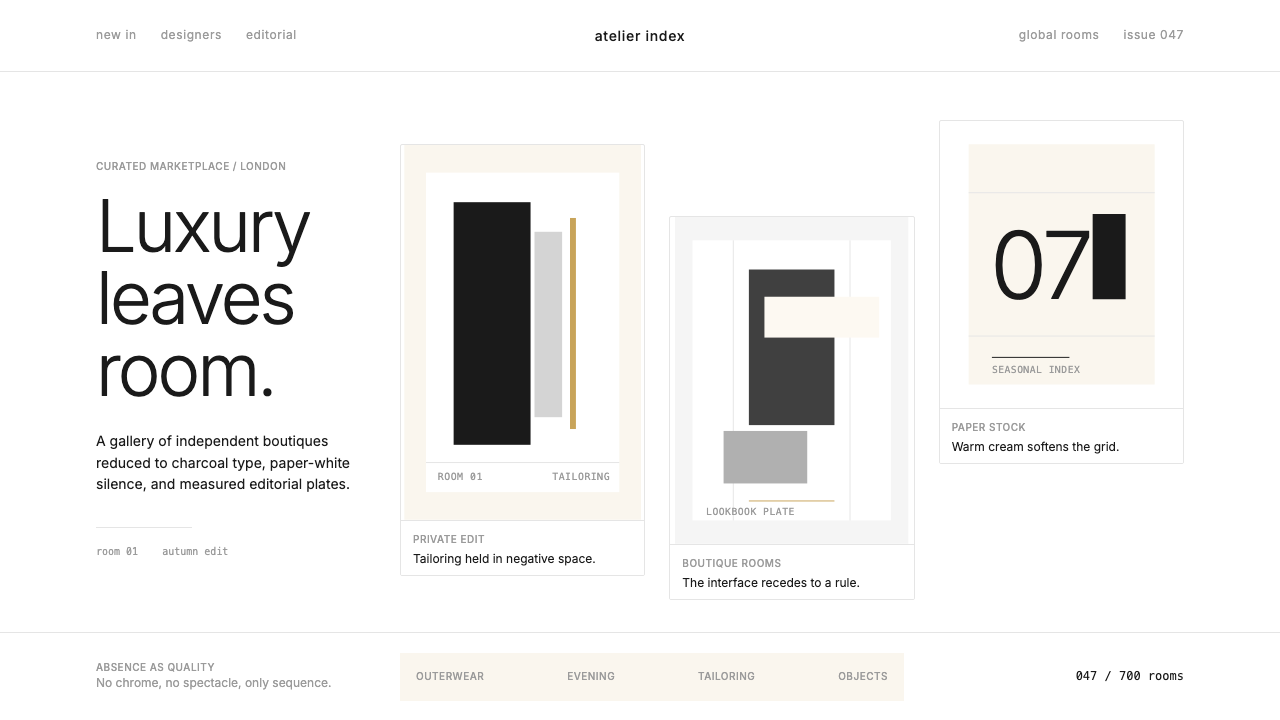 FarfetchLuxury as absence. Charcoal type, white canvas, and hairline editorial plates.
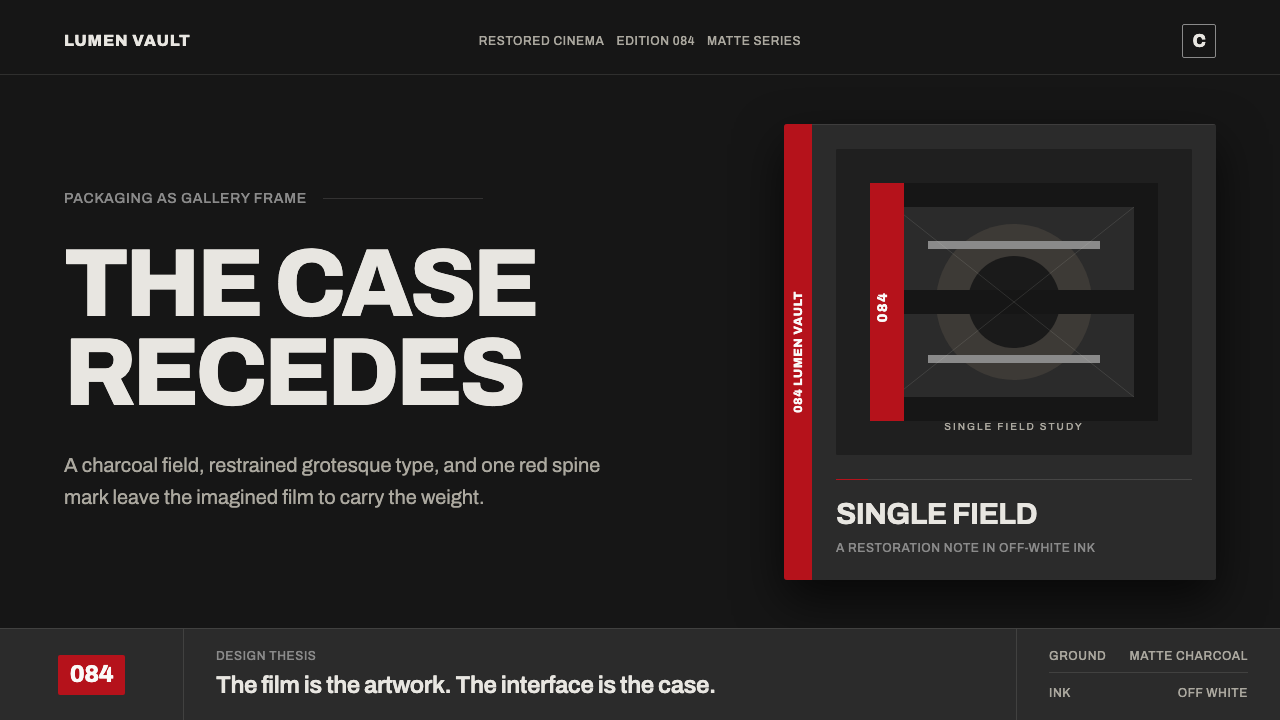 Criterion ArthouseThe case disappears. Charcoal field, off-white Archivo, hairline rules, one r…