What is Gestalten Design Book?
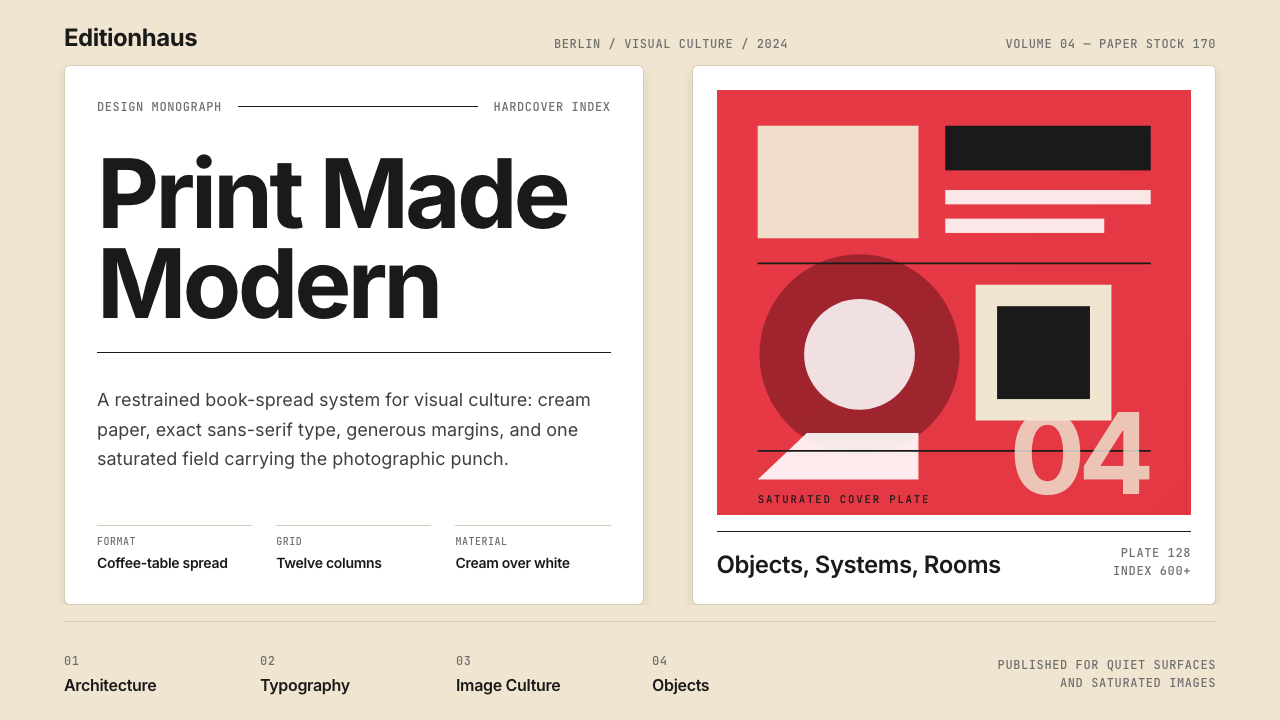
Gestalten turns the design book itself into a designed object — cream paper, restrained sans-serif type, saturated photography, and a strict editorial grid that treats every spread as a composition.
Gestalten Design Book in brief
Gestalten Design Book style describes the visual language developed by Gestalten, the Berlin-based contemporary design and visual-culture publisher founded by Robert Klanten in 1995. Over six hundred titles, Gestalten refined a house aesthetic that is immediately recognizable: cream or warm white paper grounds, clean Berlin-modernist sans-serif typography set with generous letterspacing, full-bleed saturated photography on covers, and a layout grid disciplined enough to make complex visual content feel inevitable rather than arranged.
What distinguishes this aesthetic from generic editorial minimalism is its combination of luxury material signals with rigorous typographic restraint. The style is never austere — it is warmly confident. Cream paper reads differently from stark white; it carries an association with quality printing and considered production. Saturated photography in this system is not decoration but punctuation: a single full-bleed image anchors an entire section, and the color temperature of that image is allowed to dominate the spread without competition from ornamental page furniture.
The overall effect is what might be called coffee-table modernism: a visual system designed to sit comfortably in a design-aware home or studio, signal cultural seriousness without academic stiffness, and make the act of browsing feel curated. Unlike strictly historical movements, the Gestalten aesthetic is living and contemporary — it continues to evolve through current publishing practice while remaining anchored to its founding sensibility of order, quality paper, and the primacy of the image.

Where does Gestalten Design Book come from?
Gestalten was founded in Berlin in 1995, a moment when reunified Germany was rebuilding its cultural identity and Berlin was becoming the center of a new European creative scene. Robert Klanten, who had studied at the Hochschule für Gestaltung in Hamburg, established the publisher with an editorial philosophy rooted in the Berlin modernist tradition: seriousness about craft, suspicion of decoration, and the conviction that design was a legitimate subject for high-quality bookmaking. The name Gestalten — the German word for forms, shapes, or the act of shaping — signals from the outset that the publisher's subject is design itself, treated as a first-order cultural concern.
The visual identity of Gestalten's books did not arrive fully formed but was refined through early series that established the template. The Los Logos series, which documented contemporary logo and brand mark design, became a landmark title in design publishing and established the formula: rigorous curatorial selection, restrained typography that never competed with the content, generous white and cream space, and photographic or illustrative material reproduced at the quality the subject deserved. By the mid-2000s, Gestalten had published titles covering typography, illustration, urban culture, architecture, and food — each volume adapting the house style to its subject without abandoning the underlying system.
The typographic sensibility draws explicitly on the Berlin modernist tradition that stretches from the Bauhaus through post-war German graphic design to the international corporate style of the 1970s and 1980s. Berlin has historically been a city where sans-serif type is taken seriously as a vehicle for cultural authority — from institutional signage to transit system wayfinding — and Gestalten absorbed this sensibility into its editorial voice. The choice of clean, geometrically structured sans-serif letterforms, set with disciplined spacing and clear hierarchical contrast, positions the books as objects that belong to a tradition of considered European modernist publishing.
By the 2010s and into the current era, Gestalten had expanded into lifestyle, travel, and illustrated cultural documentation, and the visual language evolved accordingly. Cover photography became more saturated and graphic — often isolating a single object or environment against a strongly colored or textured background — while interior layouts maintained the grid discipline and typographic restraint of the earlier period. The current aesthetic, crystallized roughly between 2022 and 2024, represents the mature form of thirty years of editorial refinement: a system that can absorb any visual subject and return it organized, legible, and presented with the quiet confidence of a publisher that understands that the container shapes the content.
What defines the Gestalten Design Book look?
Cream and White Paper Grounds
The foundation of the Gestalten palette is warm — cream rather than cool white. This choice is both aesthetic and material: cream paper reads as a deliberate production decision, associated with quality offset printing and books designed to last. Against this ground, black type achieves high contrast without the clinical sharpness of stark white, and photography is allowed to breathe without its edges becoming hard and institutional. The warmth of the ground calibrates the entire tonal register of a spread upward, making even austere layouts feel inviting rather than forbidding.
Restrained Sans-Serif Typography
Gestalten's typographic voice is rooted in the clean, geometrically structured sans-serif tradition of Berlin modernism. Type is used with deliberate economy: a clear hierarchy of three or four scales — headline, subhead, body, caption — defined by size and weight contrast rather than by decorative flourish. Letterspacing is generous at display sizes, giving the text a composed, unhurried quality. Body text runs in a comfortable measure that never feels compressed. The type system recedes enough to make the images the primary experience, but asserts itself clearly enough to be authoritative when the reader does engage.
Saturated Full-Bleed Photography
The most immediately striking quality of Gestalten covers — and of key interior spreads — is the use of photography at high color saturation, printed full-bleed to the edge of the page. This is not Instagram-style oversaturation but a controlled richness: colors are deeply rendered and true to the subject's inherent palette, whether that is the warm amber of a craftsman's workshop or the cold electric blue of a city at night. The full-bleed format treats the photograph as an architectural element, a wall of color and form rather than an illustration set into a field of text.
Disciplined Editorial Grid
Every Gestalten interior is governed by a grid that is felt rather than seen — a consistent set of margins, column widths, and vertical rhythm units that make the variety of content across hundreds of pages feel coherent. Images do not float arbitrarily; they occupy grid-aligned positions that create a sense of structural inevitability. Text columns align precisely with image edges. Generous outer margins are maintained even when images are large, giving the page a bordered, considered quality. The grid discipline is what separates a Gestalten spread from a casually art-directed magazine page.
Generous White Space
Negative space in the Gestalten system is not empty space waiting to be filled — it is an active compositional element that gives every image and text block room to register before the eye moves on. Spreads where a single photograph occupies two-thirds of the visible area and text occupies a disciplined column in the remaining third are common. This proportion makes the reading experience feel deliberate: each element is given its due. White space also performs a luxury signal — it communicates that no page has been crammed, that production cost was not a constraint, that the publisher's editorial confidence was sufficient to leave things out.
Curated Cover Identity
Gestalten covers function as objects before they function as titles. A typical cover commits to a single dominant image — often a photograph cropped to emphasize graphic rather than narrative content — paired with a logotype and title that are typeset with precision and placed with spatial intention. The cover does not summarize the interior; it establishes a mood and communicates the publisher's editorial confidence. The result is a cover that works as a small poster: graphic, immediately readable as to genre and register, and satisfying as a composition independent of its informational content.
Absence of Decorative Ornament
Gestalten pages contain no decorative borders, no ornamental rules, no illustrative flourishes between sections, no drop shadows on images, no gradient overlays. Dividers between sections are either invisible — managed by spatial rhythm alone — or marked by a simple typographic change or a horizontal line of minimal weight. This restraint is not poverty of imagination but editorial discipline: every centimeter of the page is in service of either the image or the text, and anything that serves neither has been removed. The discipline creates a visual environment where content carries its full weight without competing with the container.

Who shaped Gestalten Design Book?
Klanten founded Gestalten in Berlin in 1995 after studying at the Hochschule für Gestaltung Hamburg and is the primary architect of its editorial and visual identity. His approach positioned Gestalten as a publisher operating at the intersection of fine-art bookmaking and commercial design culture — high enough in production quality to sit alongside art monographs, broad enough in subject matter to reach working designers and culturally curious non-specialists. Under his direction, the publisher grew from a small Berlin operation into an internationally distributed house with a catalog spanning typography, illustration, architecture, urban culture, lifestyle, and travel. The visual language associated with Gestalten books — the cream paper, the restrained type, the full-bleed saturated covers — represents thirty years of consistent editorial vision executed under his oversight.
The visual consistency of Gestalten's output across hundreds of titles and dozens of categories is attributable not to a single designer but to a collaborative editorial and art-direction team that has maintained the house style across decades of expansion. This team manages the curatorial logic of what enters the frame — which images, which designers, which projects — and the spatial logic of how those elements are organized on the page. The team's work represents a sustained institutional practice of design editing: the application of typographic and compositional principles consistently enough to create a recognizable visual voice, flexibly enough to accommodate the full range of human visual culture as subject matter.
Gestalten's visual language is inseparable from the graphic culture of Berlin, which developed a distinct strain of modernist typography and layout through the twentieth century. From the influence of the Bauhaus — whose Berlin period under Mies van der Rohe in the early 1930s coincided with the city's peak cultural ambition before the Nazi closure — through post-war institutional design, West Berlin's counter-cultural publishing, and reunified Germany's reassertion of design as cultural identity, Berlin maintained a typographic seriousness that distinguishes it from the more decorative traditions of Munich, Vienna, or Paris. Gestalten absorbed and extended this tradition into the digital era, making it available to contemporary audiences through high-quality physical publishing at a moment when physical books were becoming increasingly premium objects.
The Los Logos series — Gestalten's ongoing documentation of contemporary logo and brand mark design — represents the title that established the publisher's international reputation and crystallized its visual approach. Beginning in the early 2000s, each volume in the series collected hundreds of examples of contemporary identity design and presented them according to the Gestalten formula: systematic curatorial organization, precise typographic labeling, and a production quality that treated graphic design artifacts as objects worthy of museum-grade reproduction. The series demonstrated that design publishing could be simultaneously reference material for practitioners and coffee-table objects for design-curious audiences, a positioning that shaped the entire subsequent Gestalten catalog.
How do you use Gestalten Design Book today?
The Gestalten aesthetic is highly transferable to designed outputs beyond the physical book because its core principles — cream-warm grounds, restrained sans-serif type hierarchy, saturated image punctuation, and generous negative space — are compositional rather than medium-specific. Applying it correctly requires understanding that the style's authority comes from restraint and proportion, not from any individual element. Adding a saturated photograph to a layout does not make it Gestalten; the photograph must be allowed to dominate a compositional zone while everything else recedes. The discipline of knowing what to leave out is as important as knowing what to include.
For presentation slides, the Gestalten approach works particularly well on covers and section-opening pages. A cover slide benefits from a full-bleed photograph or a large image block occupying the majority of the frame, with the title set in clean, generously spaced type against a cream or near-white ground — or reversed out of the image itself if the image provides sufficient contrast. Content slides should be treated as disciplined grids: no more than two or three type sizes in play at once, all aligned to a consistent column structure, with body text set at a comfortable size and line length. Data slides take on an almost editorial quality — charts and diagrams become graphic objects, styled according to the Gestalten principle that the visual encoding of information should be legible and beautiful in equal measure, with no decorative embellishment beyond what the data itself requires.
For web interfaces, the style is especially effective on portfolio pages, editorial product listings, and luxury or premium brand contexts where the user is expected to slow down and engage rather than scan and convert. The approach: establish a warm near-white or cream background, use a single clean sans-serif with three or four clearly differentiated scales, and give images significant spatial authority — large, unhurried, with generous margins on all sides. Navigation should be typographic and minimal, relying on scale and placement rather than iconographic decoration. Pricing and feature-comparison pages in this register work by treating each tier as an editorial card: disciplined internal layout, restrained use of color differentiation, no visual noise between tiers.
For editorial and marketing work, the Gestalten sensibility supports strong information hierarchy without resorting to decorative scaffolding. A long-form article layout in this style uses a carefully measured body text column, a wider outer margin for pull quotes and annotations, and section breaks indicated by spatial breathing room rather than ornamental dividers. Marketing one-pagers and brochures work well with the style's poster-like compositional logic: a dominant image establishes the page's visual center of gravity, and all type and supporting elements are organized in deliberate relationship to that center. Email newsletters and digital editorial can adapt the aesthetic by maintaining the white-space discipline and type hierarchy even when image scale is constrained by the medium.
A common mistake when applying the Gestalten aesthetic is mistaking its warmth for permissiveness. The style is warm but not casual — every element of a Gestalten page is precisely placed, and the sense of ease comes from that precision, not from looseness. Introducing multiple type families, misaligning text and image edges, or filling negative space with additional content elements breaks the system immediately. Similarly, using desaturated or low-contrast photography undermines the punctuation logic that the style depends on: images in this system need to carry visual weight commensurate with the space they occupy. When the style is reduced to its surface markers — cream background, a sans-serif — without the underlying compositional discipline, the result looks like an approximation rather than the thing itself.

Gestalten Design Book — FAQ
How is Gestalten style different from generic editorial minimalism?
Generic editorial minimalism typically means reduction — removing elements until only functional essentials remain, often resulting in a cool, neutral, slightly sterile aesthetic. Gestalten style is minimalist in its restraint but not in its temperature. The cream grounds, the saturated photography, and the spatial generosity all introduce warmth and material richness that pure minimalism avoids. The key difference is that Gestalten uses negative space to amplify what is present, whereas generic minimalism often uses it to imply that nothing more needed to be said. The result is a style that feels confident and curated rather than stripped and cautious.
Can the Gestalten aesthetic work for digital-first products without high-quality photography?
It can, but it requires rethinking the image role rather than simply omitting photography. In the Gestalten system, photography functions as a structural element — a field of color and form that anchors the composition. Without it, that structural role must be performed by another element: a large typographic display, a strongly colored geometric block, or a high-quality illustration treated with the same spatial authority a photograph would receive. The cream ground and typographic discipline can carry the system even in image-light contexts, but the composition must still contain one element of sufficient visual weight to create the center of gravity the style depends on. A page of only body text and captions, however well typeset, does not read as Gestalten.
Is the style appropriate for dark-mode interfaces?
The canonical Gestalten aesthetic is a light-ground system — the cream and white paper grounds are central to its character — and a strict dark inversion loses the warmth that defines the style. A dark adaptation is possible but should be approached as a related variant rather than a direct translation. The most successful dark interpretations maintain the typographic discipline and the single-dominant-image compositional logic while shifting the background to a deep warm neutral — charcoal with a slight amber undertone rather than pure black — and the type to cream or warm white rather than pure white. Saturated photography continues to work in this context; if anything, it gains impact against the darker ground. The critical failure mode in dark adaptation is introducing too many competing light elements, which collapses the spatial hierarchy the style depends on.
How many typefaces should a Gestalten-influenced design use?
One typeface, used at multiple weights and scales, is the correct answer. The Gestalten typographic system achieves all its hierarchy through size contrast and weight contrast within a single family — the gap between a headline set very large and light and body text set modestly in regular weight can be dramatic enough to create strong visual structure without any second typeface. A second typeface is occasionally warranted when distinguishing between the publisher's voice and quoted or cited material, but it should be introduced with caution and used sparingly. Three or more typefaces competing on the same page is incompatible with the system's logic: the discipline that makes the style feel authoritative depends on typographic consistency, and inconsistency is immediately legible as a lapse in editorial control.
What kinds of projects are a poor fit for the Gestalten aesthetic?
Projects that depend on sensory abundance, playful unpredictability, or strong cultural warmth are a poor fit. Children's products, highly saturated and decorative brand identities, gaming interfaces, food and beverage marketing that relies on organic texture and appetite appeal, and fast-paced e-commerce conversion flows all operate on principles that conflict with the Gestalten register. The style's editorial confidence and spatial discipline communicate seriousness and considered production, which is precisely wrong for contexts where the user needs to feel energized, delighted, or impulsively engaged rather than thoughtfully engaged. The aesthetic also struggles in contexts where dense information must be presented quickly — the generous negative space that defines the style is a liability in data-heavy dashboards or feature comparison tables with dozens of rows.
Related design styles
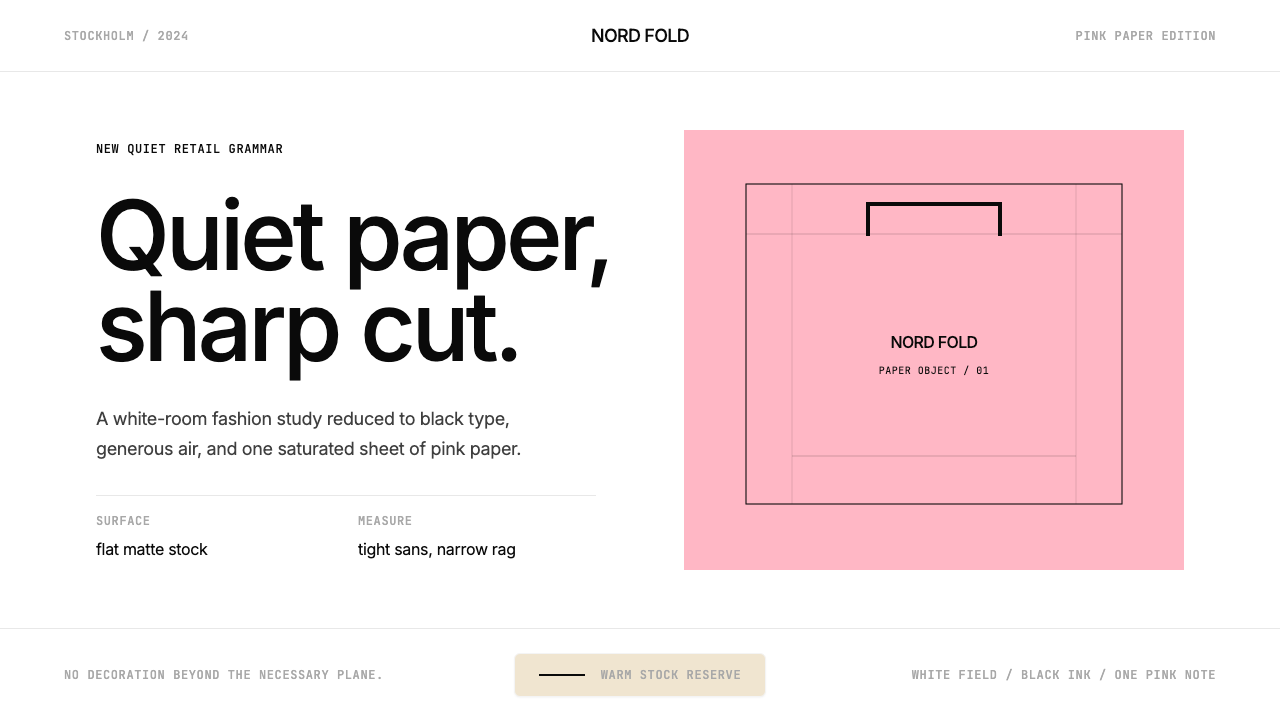 Acne Studios Pink-PaperQuiet luxury in one pink plane. Inter type floats on white with a bag-like re…
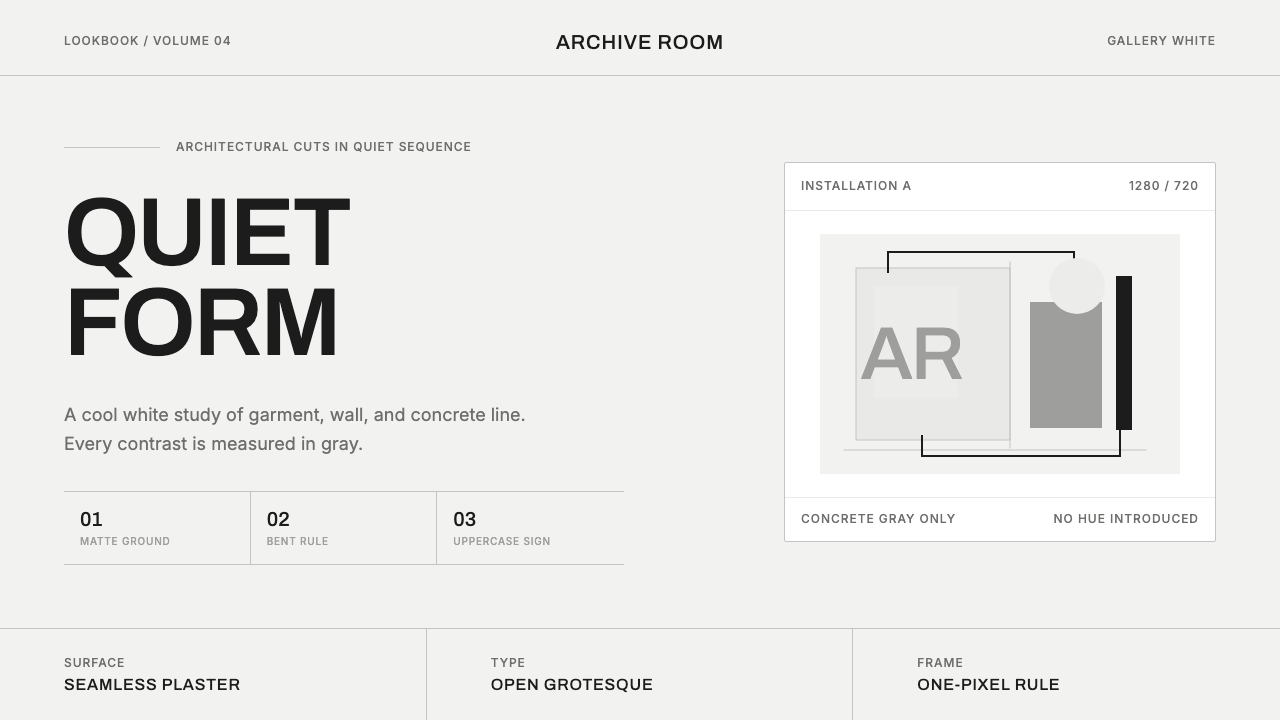 COS Gallery MinimalSilence has structure. Cool gallery white, Archivo uppercase, and concrete-gr…
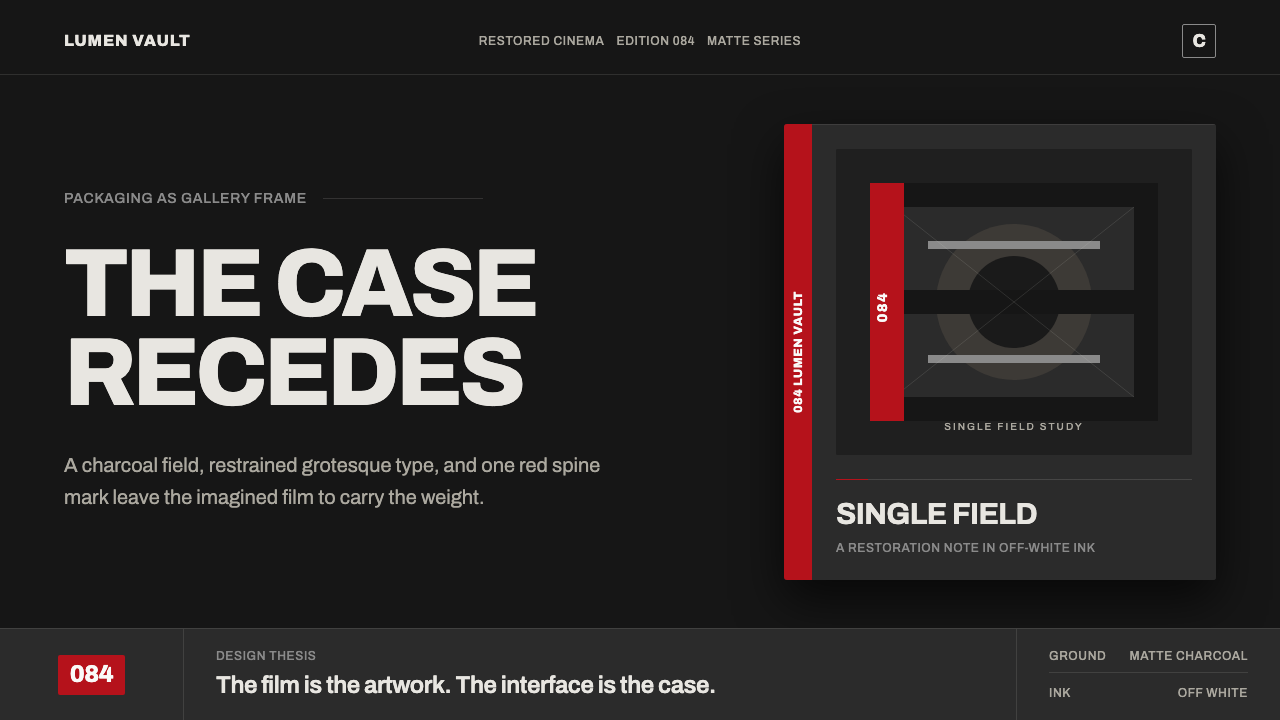 Criterion ArthouseThe case disappears. Charcoal field, off-white Archivo, hairline rules, one r…
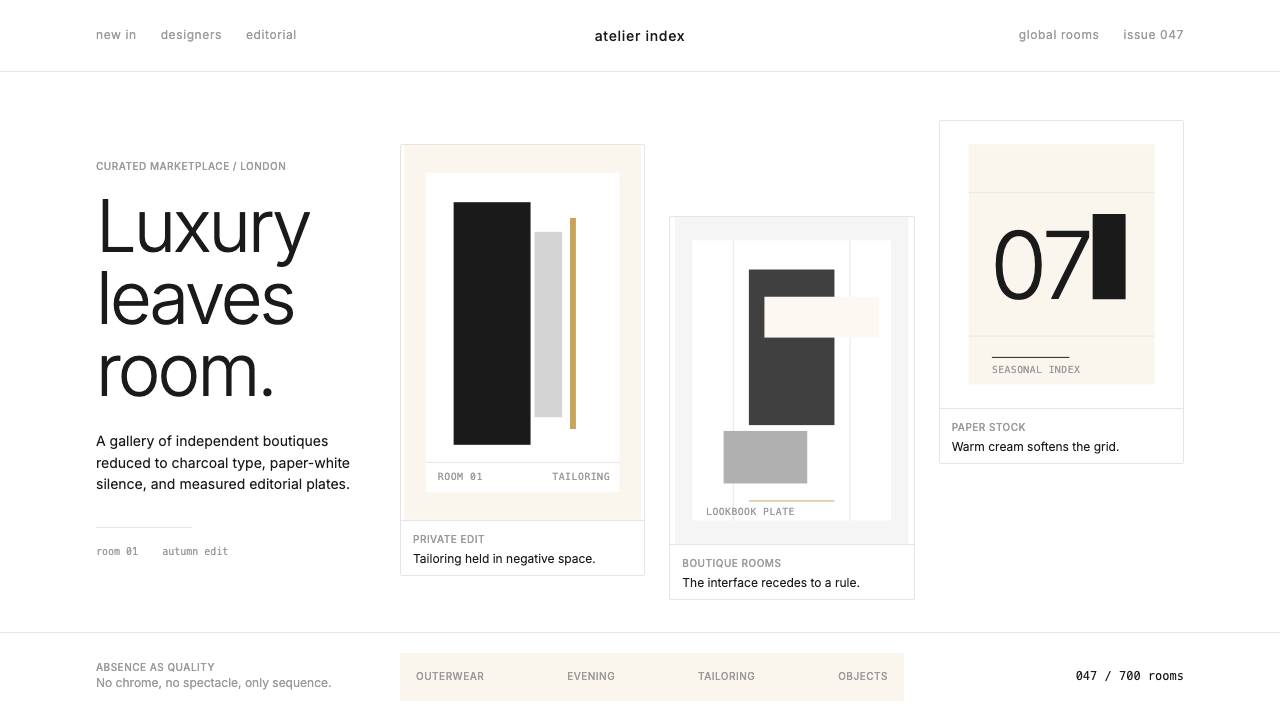 FarfetchLuxury as absence. Charcoal type, white canvas, and hairline editorial plates.
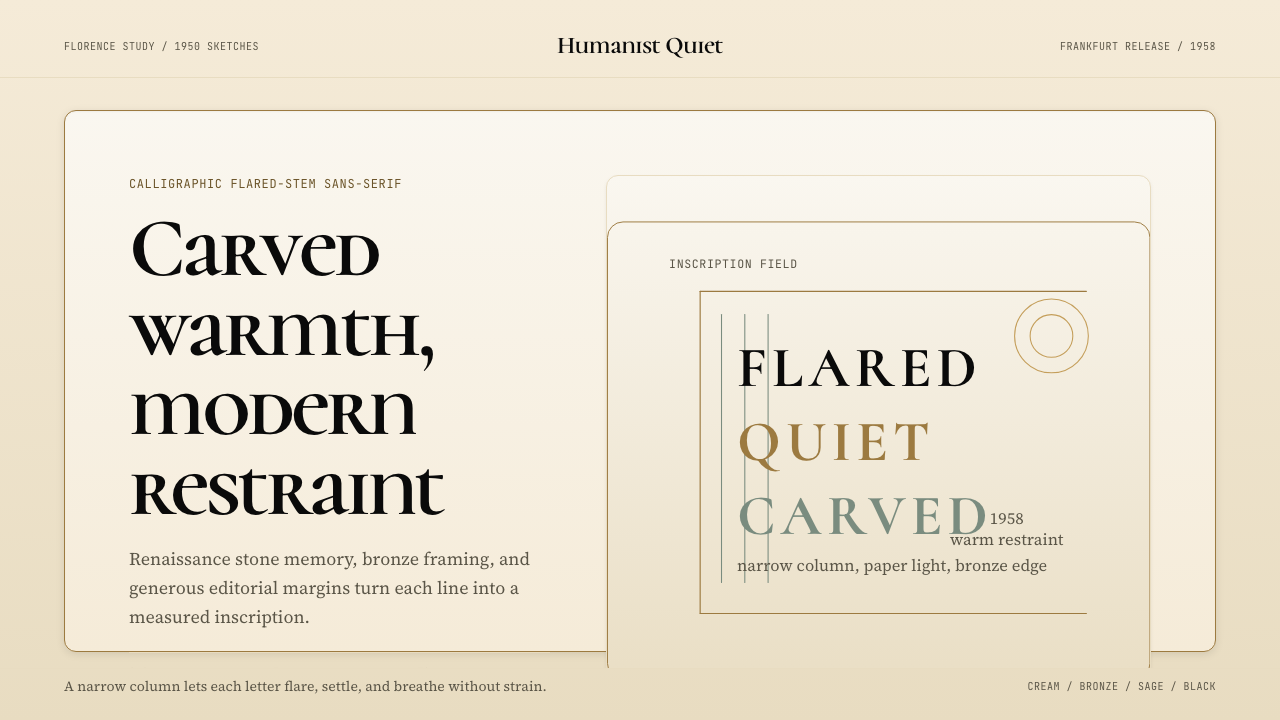 Optima (Hermann Zapf, 1958)Calligraphic calm, cut in cream and bronze. Narrow margins let the letters br…
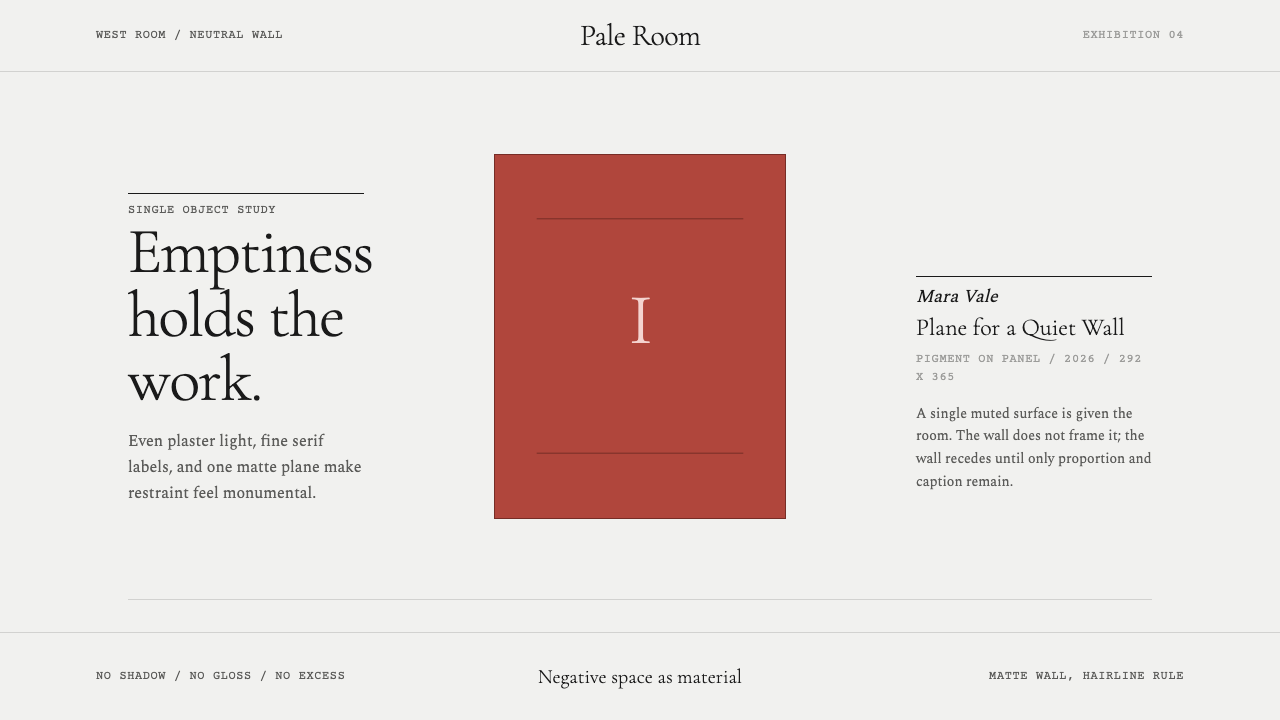 White Cube GalleryEmptiness is the medium. Cormorant labels and one terracotta plane hold the w…