What is Monocle Magazine?
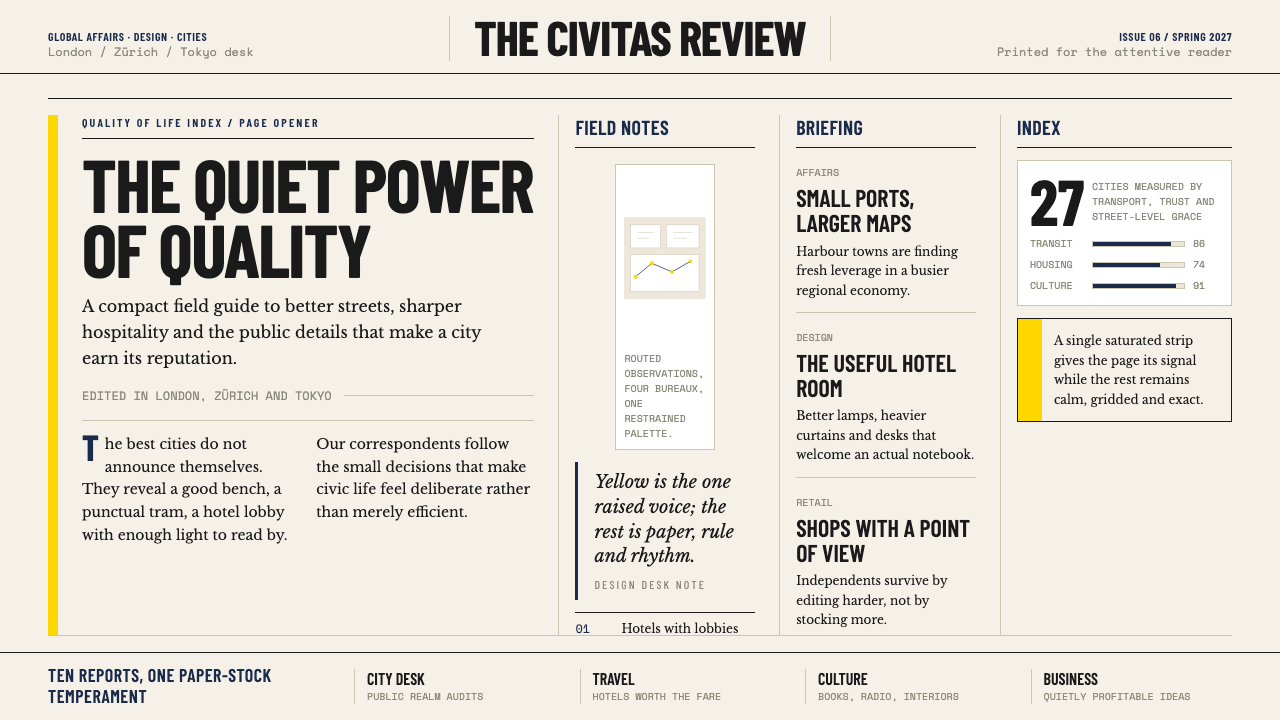
Monocle built a global design authority on a single chromatic wager — one signature yellow against warm paper, dense columns, and the quiet confidence of a publication that never had to shout.
Monocle Magazine in brief
Monocle Magazine's visual identity is one of the most precisely maintained editorial design systems of the twenty-first century. At its core, the language is defined by restraint: warm, uncoated paper tones, dense multi-column text grids, fine ruling lines that separate content zones without interrupting reading flow, and a single high-saturation yellow that functions as the publication's chromatic signature. Everything else — body text, headlines, captions, column markers — is held in a disciplined palette of deep black, navy, and warm grey.
What separates Monocle's aesthetic from generic editorial minimalism is its density. Where many premium publications use generous white space as a signal of luxury, Monocle reads almost like a broadsheet folded into perfect-bound form: columns are narrow and tightly spaced, text is set at a moderate size, and layouts assume a reader who is willing to work — who finds the act of close reading itself pleasurable. The design rewards attention rather than rewarding scrolling.
The style belongs to a tradition of European premium editorial design that treats the printed page as a serious object. Paper stock is tactile and warm-toned rather than bright white and glossy. Images are reproduced with journalistic fidelity — cropped tightly, captioned precisely, never styled into atmosphere. Typography is classical in rhythm but modern in construction, avoiding both the fussiness of purely decorative historical type and the blankness of purely utilitarian grotesque faces.

Where does Monocle Magazine come from?
Monocle was founded in London in 2007 by Tyler Brûlé, the Canadian-Swiss journalist and creative director who had previously launched Wallpaper* magazine in 1996. Wallpaper* had established Brûlé's instinct for high-production editorial design, but its acquisition by Time Warner led to creative tensions that eventually prompted his departure. Monocle was conceived as an independent response: a magazine that would handle global affairs, design, and urbanism with the same visual seriousness it applied to fashion and interiors, and that would be owned and operated without compromise from a media conglomerate.
The publication launched from Midori House in London's Marylebone neighbourhood, which functions not only as editorial headquarters but as a physical brand experience — housing a shop, a café, and a radio studio. This integration of content, retail, and place was deliberate. Brûlé and his co-founders were arguing that quality journalism and quality design were not in tension with commercial viability; they were themselves a form of product, one that deserved a correspondingly coherent physical presence. The Midori House model has since been replicated in bureau offices in Zürich, Tokyo, Toronto, and Hong Kong.
The magazine's visual identity was developed by Brûlé alongside creative director Richard Spencer Powell, who has overseen the design system since the early years. The Monocle yellow — applied to the spine, section tabs, and key typographic accents — was chosen not as a trend but as an ownership mark: a colour specific enough to be immediately recognizable on a newsstand, restrained enough to coexist with the warm paper tones and editorial density of the interior pages. It functions in much the same way a colophon or a publisher's device did in the era of fine printing: as an emblem of deliberate, consistent identity.
The design philosophy drew from the heritage of European quality press — the dense, well-proportioned columns of publications like the Neue Zürcher Zeitung, the tactile confidence of Scandinavian annual reports, and the measured elegance of mid-century Swiss editorial design — without copying any of them directly. Monocle synthesized these influences into something that felt neither nostalgic nor aggressively contemporary: a publication designed to be kept, to be read slowly, and to feel equally at home on an architect's desk or in a business-class seat.
What defines the Monocle Magazine look?
The Signature Yellow
Monocle's single saturated yellow is the most recognisable element of the design system — applied to the magazine's spine, section dividers, and key typographic accents. It operates as an ownership mark rather than a decorative flourish: precise enough to be immediately identifiable, rare enough within each spread to retain its signal value. The yellow never spreads across large surface areas; it punctuates. Everything surrounding it is held in warm neutrals, deep black, and navy blue, which allows the accent to function at maximum contrast without overwhelming the editorial content.
Warm Paper Tones and Uncoated Feel
The Monocle palette is built around the warmth of premium uncoated paper stock — a slightly cream, off-white field that reads as considered rather than clinical. This warm ground softens what might otherwise be a severe editorial system, giving it a tactile intimacy that coated, bright-white printing cannot replicate. In digital applications of the style, this warmth is preserved through off-white and warm parchment backgrounds rather than pure stark white, ensuring that the palette reads as cultivated rather than sterile.
Dense Multi-Column Grid
Monocle's layouts are structured around a tight, multi-column grid that accommodates substantial text volumes without sacrificing proportion. Column gutters are narrow, paragraph spacing is disciplined, and the overall impression is of a page that is fully in use — not empty-feeling, not crowded, but committed. Fine horizontal rules separate sections rather than white space alone, giving the layout a precision that references the traditions of quality newspaper and reference-book design. This density is itself a design statement: it assumes a reader who values content over atmosphere.
Typographic Hierarchy by Weight and Scale
The publication's type system creates hierarchy almost entirely through scale and weight contrasts, with colour entering only as a secondary marker. Section labels and standfirsts sit at a noticeably different visual temperature from body text — bolder, sometimes set in navy or warm grey rather than black — but the primary organizing principle is always size. This approach produces a reading experience that is navigable without being decorative: a reader can scan a spread and immediately identify the hierarchy without any element feeling like a design intervention rather than an editorial decision.
Journalistic Image Treatment
Photography in Monocle is treated with journalistic discipline rather than art-direction excess. Images are cropped tightly to subject, reproduced with accurate colour rather than stylised toning, and captioned with the precision of a wire service. There is no soft-focus atmosphere, no heavy post-processing, no full-bleed atmospheric spreads used as design wallpaper. Each image earns its space by carrying information. This restraint makes the layout feel authoritative — the design signals that the editorial content is the point, and visual styling exists to serve it rather than to substitute for it.
Navy and Warm Grey as System Colours
Beyond black body text and the signature yellow, the Monocle palette relies on navy blue and warm grey as its supporting system colours. Navy appears in section headings, running titles, and typographic markers — it reads as authoritative without the starkness of black used at lighter weights. Warm grey handles captions, secondary labels, and metadata, functioning as a subordinate layer that is clearly differentiated from primary content without creating harsh visual contrast. Together, these four values — warm off-white, black, navy, warm grey, and yellow — constitute the complete editorial palette.
Restrained Decorative Vocabulary
Monocle's design almost entirely eschews decorative elements. There are no illustrative flourishes, no complex border treatments, no ornamental dividers. The ruling line is the sole structural decoration — a device with clear functional purpose. Pull quotes are differentiated by scale and weight rather than by enclosing boxes or graphic devices. This restraint is not bareness; it is the confidence of a design system that trusts its proportions and typographic logic to create visual interest without requiring supplementary ornamentation. The aesthetic communicates taste through the quality of its decisions rather than their quantity.

Who shaped Monocle Magazine?
The Canadian-Swiss founder and editor-in-chief of Monocle, Brûlé had previously launched Wallpaper* magazine in 1996 before founding Monocle in 2007. His creative vision established the publication's core proposition: that rigorous global journalism and premium editorial design were not opposing impulses but a single coherent offer to a specific, discerning readership. Brûlé also founded the design and communications agency Winkreative, which has applied the Monocle visual sensibility to brand identities, airline liveries, and retail environments for international clients.
Powell has served as Monocle's creative director since the publication's early years, making him the principal custodian of its visual identity. His work on the magazine's design system — the column grid, the typographic hierarchy, the management of the signature yellow, and the overall visual standards — has kept the publication's aesthetic unusually consistent for an independent title across nearly two decades. Powell's approach demonstrates that editorial design systems can maintain integrity over long periods when guided by a single, committed creative director rather than cycled through frequent rebranding.
Giles has contributed to Monocle's expansion as a media brand beyond the print magazine — into radio, books, and seasonal specials — helping maintain the consistent application of the visual and editorial language across formats. His work illustrates the challenge of extending a tightly controlled print design system into other media, where different production constraints require interpretation rather than direct translation. Monocle's success in this expansion is partly attributable to the clarity of the underlying design principles, which can be adapted without being diluted.
The creative agency founded by Tyler Brûlé has functioned as an extended laboratory for the Monocle visual sensibility, applying its principles to clients in aviation, hospitality, retail, and city branding. Winkreative's work with carriers such as Finnair and Swiss International Air Lines demonstrates how the Monocle design logic — warm neutrals, disciplined typography, restrained colour usage, and premium material quality — can translate from editorial pages to three-dimensional environments and brand communications. The studio has effectively exported the Monocle aesthetic into a broader commercial design language.
How do you use Monocle Magazine today?
The Monocle editorial style is among the most transferable premium print aesthetics for digital applications, because its core principles — typographic hierarchy, disciplined colour restraint, journalistic image treatment, and grid density — address problems that exist equally in web design, presentation decks, and data dashboards. Applying it correctly requires understanding that the system's authority comes from its consistency and proportion, not from any single element. The yellow accent, taken alone and applied generously, produces generic warmth rather than Monocle's specific quality.
For presentation slides, the style works particularly well in business contexts where authority and credibility are primary requirements. Cover slides should treat the warm off-white or cream field as the dominant surface, with the title set in deep black at large scale and a single yellow element — a rule, a category label, a spine stripe down one edge — providing the chromatic signature. Content slides should be approached as column grids: text is set at consistent hierarchical scales, supporting data appears in clearly labelled tables or charts, and section breaks are marked by fine horizontal rules rather than decorative dividers or gradient backgrounds. Data visualisations should use the signature yellow for the primary data series, with navy and warm grey for secondary and tertiary series, keeping the overall visual temperature consistent with the editorial palette.
For web interfaces and digital dashboards, the Monocle aesthetic is well-suited to intelligence products, financial platforms, media brands, and any context where a tone of informed authority is desired. The approach: establish a warm off-white or light parchment background across the primary content surface; use deep black for all body copy; reserve the signature yellow for interactive states, notification badges, active navigation indicators, or tier differentiation in pricing tables. Navigation should be typographic — wordmarks, section labels, and breadcrumbs styled at measured weights — without icon decoration beyond simple geometric indicators. Card components should use fine borders rather than soft box shadows; inputs should have visible borders rather than ghost styling.
For editorial and marketing contexts — branded reports, white papers, event programmes, annual reviews — the style translates directly. Body text should use a moderate column width that produces comfortable reading measure rather than the full-width paragraphs common in marketing copy. Generous left or right margins accommodate pull quotes, annotations, and metadata. Section introductions benefit from a standfirst or deck set at a larger scale than body text, differentiated by weight rather than colour. Marketing pages and campaign assets can use the style's poster-like directness: large typographic statements in deep black against warm white grounds, with yellow used sparingly for a single call-to-action accent per visual unit.
The most common mistake when applying the Monocle style is treating the signature yellow as a general-purpose warm accent and using it across multiple elements on a single surface. In the source material, yellow is rare enough to carry genuine signal value; overuse converts it from a precise mark of identity into background decoration. A related error is choosing backgrounds that are either stark pure white or yellow-tinted to excess — both lose the specific warmth of the uncoated-paper reference that anchors the palette. A third common failure is substituting decorative image treatments — vignetted edges, warm filter overlays, lifestyle-catalogue styling — for the plain, journalistic image handling that gives the aesthetic its authority.

Monocle Magazine — FAQ
Is the Monocle style the same as editorial minimalism?
They share restraint but differ in density and intent. Contemporary editorial minimalism typically uses large white space, generous margins, and sparse text to signal luxury and slowness — the design itself performs leisureliness. Monocle's style is denser and more purposeful: the grid is tight, columns are narrow, and the page is fully inhabited. The restraint is in ornamentation and colour, not in content quantity. Monocle assumes an engaged, attentive reader who wants information, whereas pure editorial minimalism often prioritises mood over content. The difference is between a well-designed reference publication and a beautifully produced lifestyle object.
Can this style work in dark mode or on dark backgrounds?
With significant adaptation. The Monocle palette is fundamentally anchored to the warmth of uncoated paper — a light, warm ground is not merely a preference but a structural assumption of the entire colour system. A dark inversion is possible, but it requires rebuilding the palette around the new ground: the signature yellow, which works as a precise accent against warm white, can become overpowering on black. A workable dark variant uses deep charcoal or very dark navy as the primary surface rather than pure black, maintains cream or warm off-white for primary type, and treats the yellow as an even more restrained accent than in the light version. The result will be tonally consistent but should not be presented as a direct equivalent of the original — it is an adaptation, and the density principles need re-evaluation.
How does the Monocle style handle data and information graphics?
With the same journalistic discipline applied to photography. Charts and data graphics in the Monocle tradition are treated as informational objects, not visual entertainment: axes are clearly labelled, scales are honest, chart types are chosen for clarity rather than novelty, and the colour palette is restricted to the editorial system rather than expanded with additional hues for visual variety. The signature yellow serves as the primary data accent; navy and warm grey handle secondary series and supporting elements. The result is a data graphic that reads as part of the editorial whole rather than as a separately designed element. Infographics and illustrated explainers — common in other magazine traditions — are rare in Monocle's visual language.
What kinds of brands and products align well with the Monocle aesthetic?
Products and brands that want to signal informed sophistication rather than aspirational luxury. The Monocle style works well for financial services with a global perspective, architecture and urban design firms, quality hospitality brands, business intelligence platforms, independent publishers, and premium mobility brands — airlines, rail, automotive — that position quality and considered design as primary values. It also suits professional services firms — consultancies, law firms, talent agencies — where credibility and international orientation are core to the brand proposition. It is less suited to consumer brands that depend on sensory warmth, playfulness, or cultural specificity, and to technology products positioning themselves on speed and disruption rather than considered quality.
Why does Monocle maintain such consistent design across nearly two decades?
For two structural reasons. First, the publication has maintained the same creative director — Richard Spencer Powell — since its early years, providing continuity that is rare in magazine publishing, where design rebrands are often used to signal editorial change or advertising strategy shifts. Second, the design system itself is built on principles rather than trends: the warm paper reference, the typographic hierarchy, the restrained colour palette, and the grid density are not styles that date quickly because they are not responses to contemporary fashion. They are derived from the traditions of quality European press design, which evolved over decades to solve real problems of legibility, authority, and reproduction quality. A system built on enduring principles requires fewer updates than one built on current aesthetics.
Related design styles
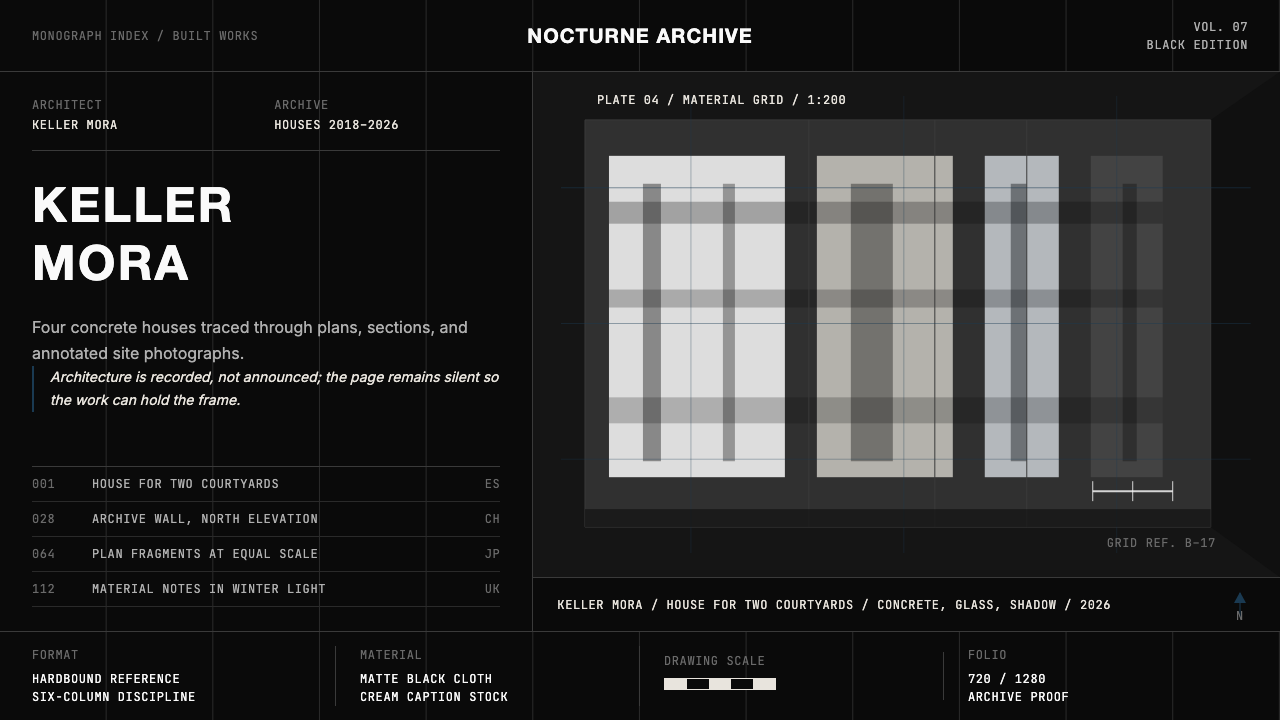 Architect Monograph (Black Edition)Architecture stays sovereign. Matte black, Helvetica caps, hairline grids, bl…
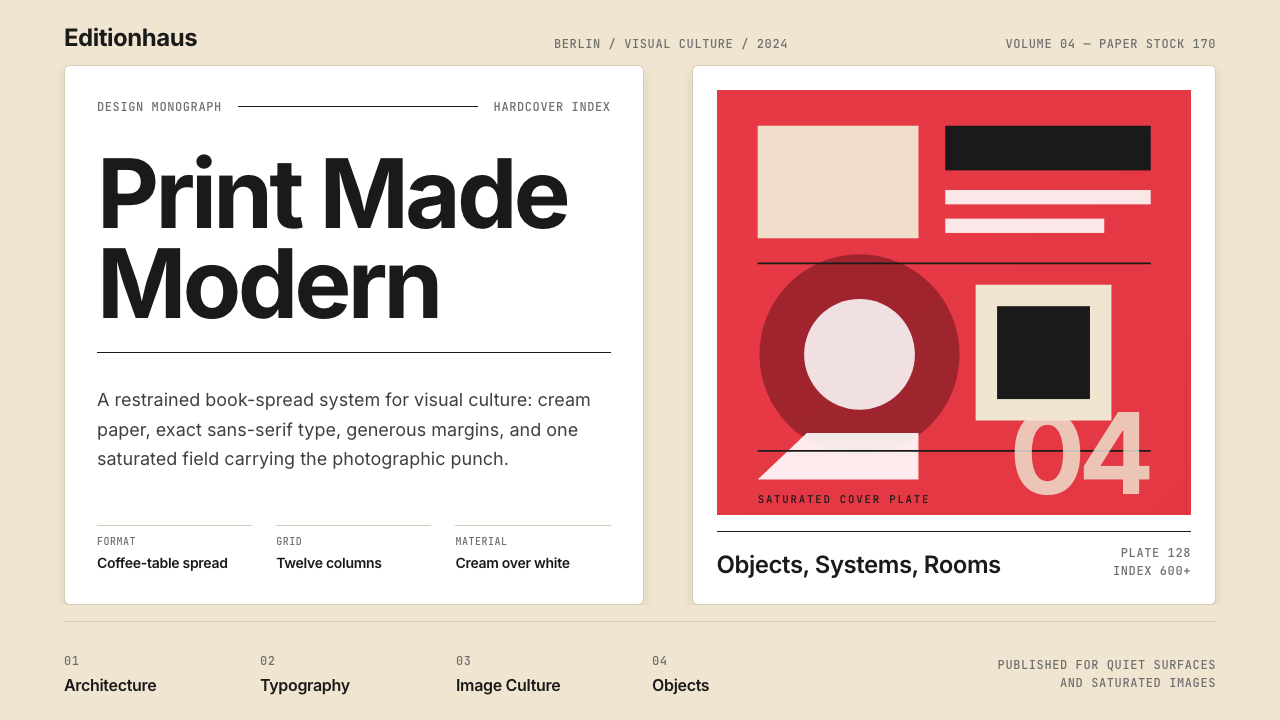 Gestalten Design BookCoffee-table calm. Cream paper, tight sans, one saturated block, and a strict…
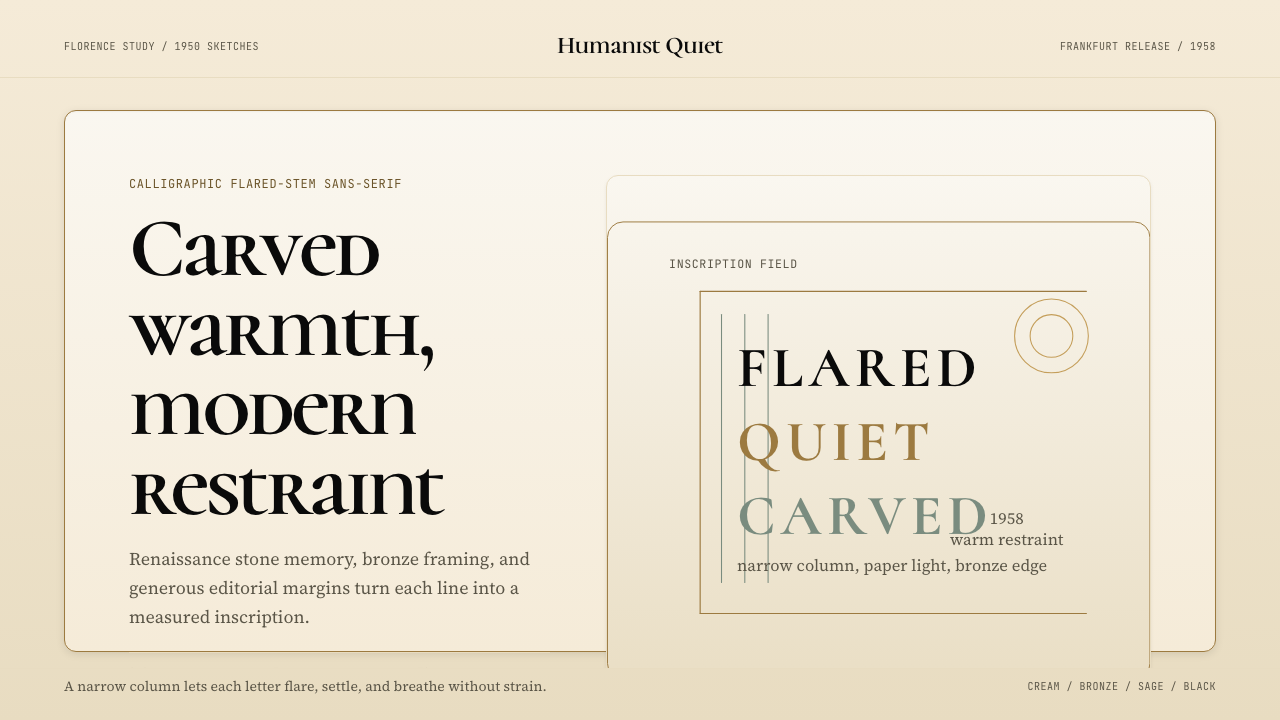 Optima (Hermann Zapf, 1958)Calligraphic calm, cut in cream and bronze. Narrow margins let the letters br…
 Wallpaper* ArchitecturePhotography does the speaking. Gallery-white grid, Inter captions, and hairli…
 Acne Studios Pink-PaperQuiet luxury in one pink plane. Inter type floats on white with a bag-like re…
 ChanelLuxury needs no color. Black on white, pearl-cream warmth, geometric capitals…