What is Optima (Hermann Zapf, 1958)?
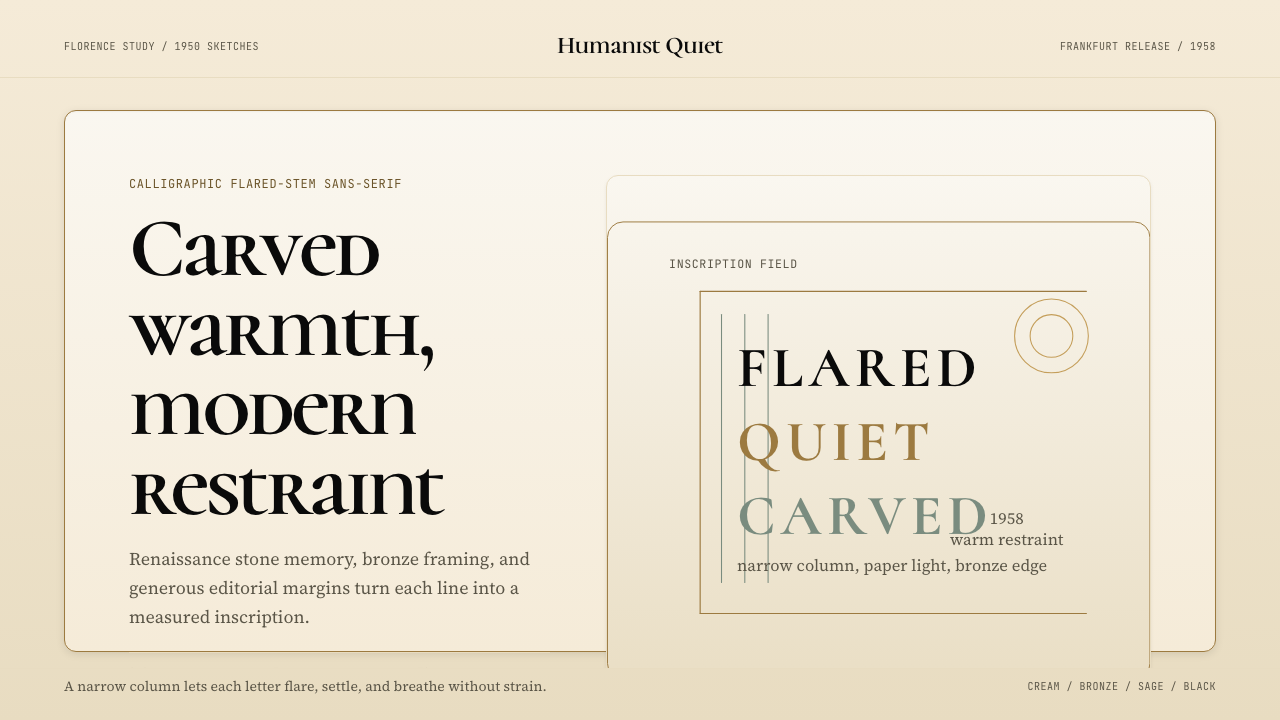
Optima is the typeface that abolished serifs without abandoning the calligrapher's hand — its flared stems carry two thousand years of Roman inscription into the modern page.
Optima (Hermann Zapf, 1958) in brief
Optima is a humanist sans-serif typeface designed by Hermann Zapf and released by the Stempel foundry in Frankfurt in 1958. Unlike geometric sans-serifs whose strokes are mechanically uniform in width, Optima's strokes taper and swell with the rhythm of a calligraphic pen: each stem widens slightly toward its terminal end, giving the letters a warmth and vitality that purely constructed letterforms cannot achieve. The typeface occupies a rare intermediate territory — indisputably a sans-serif in that it carries no true serifs, yet unmistakably humanist in that every curve and junction echoes the movements of a trained hand.
The visual character of Optima is one of quiet authority. Set in text, it reads with the comfortable familiarity of a serif face while projecting a clean, unencumbered silhouette at display sizes. Its proportions are generous without being wide, its contrast is subtle without being invisible, and its overall impression is of restraint that has been earned rather than imposed. These qualities made it an almost inevitable choice for contexts that demand dignity without ostentation: luxury goods, memorial inscriptions, museum signage, and institutional identity.
Optima belongs to a tradition of calligraphic-revival sans-serifs that sought to recover what the strict geometric sans of the early twentieth century had discarded — the historical continuity between letterforms and the human hand. Where Futura or Helvetica consciously erased that continuity, Optima made it the central argument. The result is a typeface that feels simultaneously timeless and considered, a quality that has sustained its authority across more than six decades of use.

Where does Optima (Hermann Zapf, 1958) come from?
The story of Optima begins not at a drawing board but in a church floor. In 1950, Hermann Zapf visited the Basilica of Santa Croce in Florence — the Franciscan church where Michelangelo, Galileo, and Machiavelli are buried — and found himself studying the Renaissance stone inscriptions set into the floor. These fifteenth- and sixteenth-century carved capitals displayed something Zapf had not encountered in the strict geometric sans-serifs then dominating progressive typography: their stems were not uniform in weight but flared gently at the terminals, as if a calligrapher's broad nib had been translated into stone. Zapf made sketches on whatever paper he had available, reportedly including the margins of a fifty-lire banknote, capturing the proportions and the subtle terminal flare before the detail escaped him.
Zapf had already established himself as one of the most accomplished calligraphers and type designers of his generation before he began working on Optima. His Palatino (1949) had demonstrated his mastery of Renaissance humanist letterforms in a revival serif; Optima was the logical next question: what would remain of the calligraphic tradition if the serifs themselves were removed? The answer he developed through the early 1950s was that the calligraphic gesture could survive in the modulation of stroke weight — in the barely perceptible swelling of a stem from its thinnest midpoint to its slightly heavier terminal. This modulation, absent from geometric sans and largely suppressed in transitional sans, is what distinguishes Optima from its contemporaries.
Production of the typeface was a lengthy process. Zapf worked on the design through the early 1950s, and the drawings passed through the skilled hands of August Rosenberger at the Stempel foundry in Frankfurt, who translated Zapf's calligraphic originals into precise punchcutter drawings suitable for metal type production. The typeface was released by Stempel in 1958 under the name Optima — a name chosen to reflect the designers' sense that the letterforms had reached an optimal resolution of competing demands: legibility, tradition, and modernity. In the United States it was briefly marketed under the name Cheltenham, causing some confusion, before the Optima name prevailed internationally.
Adoption was rapid in exactly the sectors one might predict. Luxury brands recognized in Optima a letterform that projected refinement without coldness; the military recognized its inscription-like dignity; memorial designers found it the only sans-serif that felt appropriate for the gravest contexts. The most famous single use is the Vietnam Veterans Memorial in Washington, D.C., designed by architect Maya Lin and unveiled in 1981, where Optima was chosen to incise the names of more than 58,000 fallen service members into the black granite wall. The choice was not incidental: the typeface's roots in stone inscription gave it a memorial gravity that no other sans-serif could have provided. This association with memory, loss, and endurance has since become inseparable from Optima's cultural identity.
What defines the Optima (Hermann Zapf, 1958) look?
Flared Terminals
The defining structural feature of Optima is the way each vertical stem widens very slightly as it approaches its terminal end — a gesture derived directly from calligraphic broad-nib writing and from the technique of Renaissance stone-cutters who gave their letters the same gentle flare. This flare is not a serif: it does not form a bracketed foot or cap. It is a modulation of the stroke itself, visible enough to register subconsciously as warmth and weight, subtle enough not to interrupt the clean silhouette of a sans-serif at normal reading sizes.
Calligraphic Stroke Contrast
Unlike the perfectly uniform stroke weight of geometric sans-serifs like Futura, Optima carries a visible but gentle contrast between its thick and thin strokes — again inherited directly from the motion of a calligraphic pen. The thickest parts of curved strokes fall at roughly the same positions they would if the letters had been written with a broad-nib pen held at a consistent angle. This contrast is far subtler than that of a Renaissance or Baroque serif, but it gives Optima a liveliness and readability in extended text that purely monolinear sans-serifs tend to lack.
Humanist Proportions
Optima's letter proportions follow the classical humanist model established by Renaissance scribes and subsequently codified in the earliest roman type designs of the fifteenth century. The capitals are not mechanically equal in width: the M and W are wide, the I is narrow, the O and C are broad and round. The lowercase has a comfortable x-height — generous enough for text legibility, restrained enough not to feel heavy. These classical proportions are one reason the face reads as refined rather than casual, even when used at small sizes in dense text.
Warm Neutrality
Optima occupies a rare position on the spectrum of typographic tone: it is simultaneously formal and approachable. It lacks the crisp institutional distance of Helvetica, the corporate rigor of Univers, and the warmth-through-nostalgia of old-style serifs. Instead it achieves warmth through the calligraphic memory encoded in its structure — a warmth that is architectural rather than sentimental. This quality makes it unusually versatile: it serves luxury brand identity, medical and scientific publishing, memorial inscriptions, and museum signage without feeling out of place in any of them.
Scale Behavior
Optima behaves differently across scales in a way that rewards deliberate sizing decisions. At large display sizes, the flared terminals and stroke modulation become clearly perceptible, giving headlines and titles a sculptural, lapidary quality — as if the letters were cut in stone. At small text sizes, these details recede and the face reads almost like a restrained, clean sans-serif with unusually good spacing. At intermediate sizes — the heading and subheading range — it is at its most versatile, bridging the display and text registers with equal authority.
Restrained Palette Affinity
The aesthetic values encoded in Optima — warmth, restraint, classical proportion, calligraphic memory — align naturally with palettes that share those qualities. Warm neutrals (cream, ivory, warm stone), muted bronze and gold accents, and sage or deep forest tones as secondary colors all resonate with the typeface's character. Loud, high-saturation color schemes tend to work against Optima by introducing an energy that the letterforms themselves resist. The typeface performs best when it is the most visually active element in a composition — which means surrounding it with quiet, dignified surfaces.
Absence of Decorative Elaboration
Despite its calligraphic origins, Optima contains no swashes, no decorative alternates, and no ornamental flourishes. The calligraphic energy is entirely structural — expressed through proportion and stroke modulation, not through added visual ornament. This restraint means that Optima pairs poorly with highly decorative surrounding elements: ornate borders, complex background patterns, or heavily illustrated contexts all compete with and diminish the typeface's particular kind of authority. Optima's natural environment is one of space, quiet material surfaces, and considered simplicity.

Who shaped Optima (Hermann Zapf, 1958)?
Zapf (1918–2015) was one of the most important typeface designers and calligraphers of the twentieth century. Self-taught as a calligrapher after reading Edward Johnston's Writing and Illuminating and Lettering, he joined the Stempel foundry in Frankfurt and went on to design some of the most widely used typefaces of the modern era, including Palatino (1949), Optima (1958), and Zapf Chancery (1979). His work consistently sought to reconcile the calligraphic tradition with the demands of industrial and later digital type production. Late in his career he collaborated with Xerox on digital typeface technology and held a professorship at Rochester Institute of Technology, ensuring that his influence extended to the generation of designers who built the typographic systems of the digital age.
Rosenberger was the master punchcutter at the Stempel foundry in Frankfurt who translated Zapf's calligraphic drawings for Optima into the precise technical drawings and physical punches required for hot-metal type production. The relationship between a type designer and a skilled punchcutter was in the pre-digital era one of the most critical in the entire process of typeface production: the punchcutter's interpretation of the designer's intentions in metal determined how the face would actually appear on the printed page. Rosenberger's ability to capture the subtlety of Optima's flared terminals and stroke modulation in metal — features that are easily lost in mechanical translation — was essential to the typeface's success.
Maya Lin (born 1959) was a twenty-one-year-old architecture student at Yale University when her design for the Vietnam Veterans Memorial was selected from among more than 1,400 entries in a national competition in 1981. Her choice of Optima for the incised names on the black granite wall was in retrospect an act of deep typographic literacy: she needed a letterform that could be cut cleanly into stone, that would read with clarity in all lighting conditions, that carried monumental weight without militaristic severity, and that honored the calligraphic tradition of Western memorial inscription without resorting to period ornament. Optima met every condition. The memorial, unveiled in Washington, D.C. in 1982, became one of the most visited monuments in the United States and gave Optima an association with remembrance and gravity that no other type commission could have provided.
Gudrun Zapf-von Hesse (1918–2019) was herself one of the twentieth century's foremost book type designers and calligraphers — a peer to her husband Hermann Zapf rather than merely a biographical companion. Her own typefaces, including Diotima (1951) and Alcuin (1991), share Optima's commitment to the humanist tradition and the integration of calligraphic memory into type structure. She outlived Hermann by four years, passing away at the age of one hundred and one. Their shared life and work represented perhaps the most sustained dual engagement with humanist calligraphic letterform design in the history of twentieth-century typography, and Gudrun's own rigorous standards are understood to have influenced the precision with which Hermann approached every design decision in Optima and his other major faces.
How do you use Optima (Hermann Zapf, 1958) today?
Optima transfers readily to contemporary design practice precisely because its authority is earned through structure rather than historical costume. Applying it correctly requires understanding what the typeface is actually doing — encoding warmth into geometry, bridging calligraphic tradition and typographic modernity, projecting dignity without distance — rather than simply reaching for it as a high-end or memorial signal. When those underlying values align with the project's values, Optima is extraordinarily versatile. When they do not, it is liable to feel miscast.
For presentation slides, Optima works with particular strength at both the cover and content levels, but the application logic differs. Cover slides benefit from the typeface's lapidary quality at large scale: a single large word or short title set with generous letter-spacing on a warm cream or warm stone background, with a muted bronze or deep forest accent element, produces a cover that reads as considered and authoritative. Content slides should be treated with discipline: Optima at heading size defines the hierarchy, body text in a complementary but subordinate face (or Optima at a lighter weight if available) handles the density, and data slides treat Optima labels as the quiet organizing layer over charts designed with restrained, muted fills rather than saturated color blocks.
For web interfaces and dashboards, Optima is well-suited to contexts where the product positions itself through craft, precision, or cultural prestige — financial wealth management platforms, premium health and science tools, cultural institutions, and luxury e-commerce. In these contexts, Optima headings over generous whitespace, with warm neutral backgrounds and carefully controlled accent tones, create the sense of considered architecture that the typeface rewards. Pricing pages benefit from the typeface's ability to confer value: a pricing tier name in Optima at a confident size reads as a considered promise rather than a commercial transaction. Navigation and interactive elements should be typographic rather than icon-heavy, leaning on the letterforms themselves to carry the interface's character.
For editorial and marketing work, the style supports strong and unhurried information hierarchy. An Optima-led article layout uses wide margins as a structural commitment rather than a decoration — the negative space is part of the argument. Section headers in Optima with ample leading above them, body text in a carefully matched companion, and call-outs or pull quotes treated as typographic punctuation rather than graphic interruptions: this approach produces layouts that feel curated rather than assembled. Marketing pages work well when they commit to the typeface's own restraint: full-width feature sections with short, confident statements in large Optima over muted photographic or material backgrounds convey luxury and intentionality without resorting to ornamental decoration.
A common and consequential mistake when applying Optima is deploying it in contexts that reward energy, urgency, or casual approachability — startup landing pages positioning for disruption, youth-facing consumer products, high-excitement entertainment contexts, or any layout where the dominant visual register is playful or loud. Optima carries a gravitas that is not adjustable: it cannot be made casual by surrounding it with informal elements. Another frequent error is crowding it — setting it too tight, too small, or in too-long lines without adequate leading. Optima's structure requires room to express itself; compressed, it loses the very qualities that distinguish it and becomes an undifferentiated sans-serif. When in doubt, add space.

Optima (Hermann Zapf, 1958) — FAQ
Is Optima a serif or a sans-serif?
Optima is classified as a sans-serif — it does not have the bracketed, horizontal serifs that define serif typefaces. However, it occupies an unusual position at the boundary because its stems flare slightly at the terminals, which gives it a visual warmth and historical resonance that strict sans-serifs lack. Some typographers use the term 'flared sans' or 'humanist sans with terminal stress' to describe it more precisely. The practical implication is that Optima behaves like a sans-serif in layout decisions (it pairs well with geometric and transitional serifs as body text companions) but reads with a warmth and formality that is more typical of serif faces.
Why does Optima feel appropriate for memorials when most sans-serifs do not?
The answer lies in Optima's origins in stone inscription. Hermann Zapf derived the typeface directly from his study of Renaissance lapidary inscriptions — letters that were designed from the outset to be cut into stone and to be read for centuries. Those original inscribed letters were themselves derived from the calligraphic tradition, which is why the flared terminals that define Optima are not a modern invention but a contemporary echo of a very old technique. When Optima is incised into stone or granite, it is doing exactly what its structural DNA was designed for. By contrast, geometric sans-serifs like Helvetica or Gill Sans have no such lineage — they were designed for print reproduction and commercial communication, and their neutrality, while a virtue in those contexts, becomes a form of blankness in memorial ones.
How does Optima differ from Palatino, Zapf's other famous typeface?
Palatino is a full serif typeface in the humanist tradition, designed to revive the warmth and calligraphic energy of the best Renaissance roman type while remaining completely legible in demanding printing conditions. Optima asks the question: what if we removed the serifs entirely but preserved everything else — the calligraphic stroke modulation, the humanist proportions, the Renaissance inscription reference? The result is a typeface that shares Palatino's warmth and historical resonance but projects a cleaner, more contemporary silhouette. In practice, Palatino is better suited to extended text in traditional publishing contexts; Optima is better suited to display, signage, identity, and contexts where a clean silhouette is important but cold neutrality would be wrong.
Does Optima work well in digital interfaces given that it was designed for metal type?
Optima translates to digital use with more grace than many typefaces of its era, for two reasons. First, its defining characteristics — the flared terminals and stroke modulation — are gentle enough that they survive screen rendering well, particularly on modern high-resolution displays; they add the intended warmth without producing the hinting artifacts that heavier detail creates in serif faces at small sizes. Second, the typeface has been carefully redigitized multiple times, most notably as Optima Nova, a comprehensive digital revision that extended the family with additional weights and refined the hinting for contemporary screen use. The main caution in digital contexts is that Optima requires slightly more letter-spacing than many comparable faces to read comfortably on screen, and that the terminal flare, which is subtle enough in print, can occasionally read as a rendering artifact on lower-resolution displays.
What palettes and materials pair most naturally with Optima?
Optima's own aesthetic values — calligraphic warmth, classical proportion, lapidary weight — point toward specific palette and material directions. Warm neutral grounds (cream, ivory, warm parchment, warm stone) work better than cool whites; the typeface reads cold and unmoored on a blue-white or cool grey ground. Metallic accents in bronze, aged gold, or dark champagne amplify the typeface's memorial and luxury associations; bright chrome or hard silver work against it. For secondary colors, muted and desaturated tones — sage green, warm slate, dusty rose, deep forest — resonate better than high-saturation alternatives. Textures that recall physical materials — laid paper, uncoated stock, stone, linen — are natural companions. The one direction Optima actively resists is the combination of high-gloss, high-saturation, and high-contrast surfaces, which produces a dissonance between the typeface's character and its environment.
Related design styles
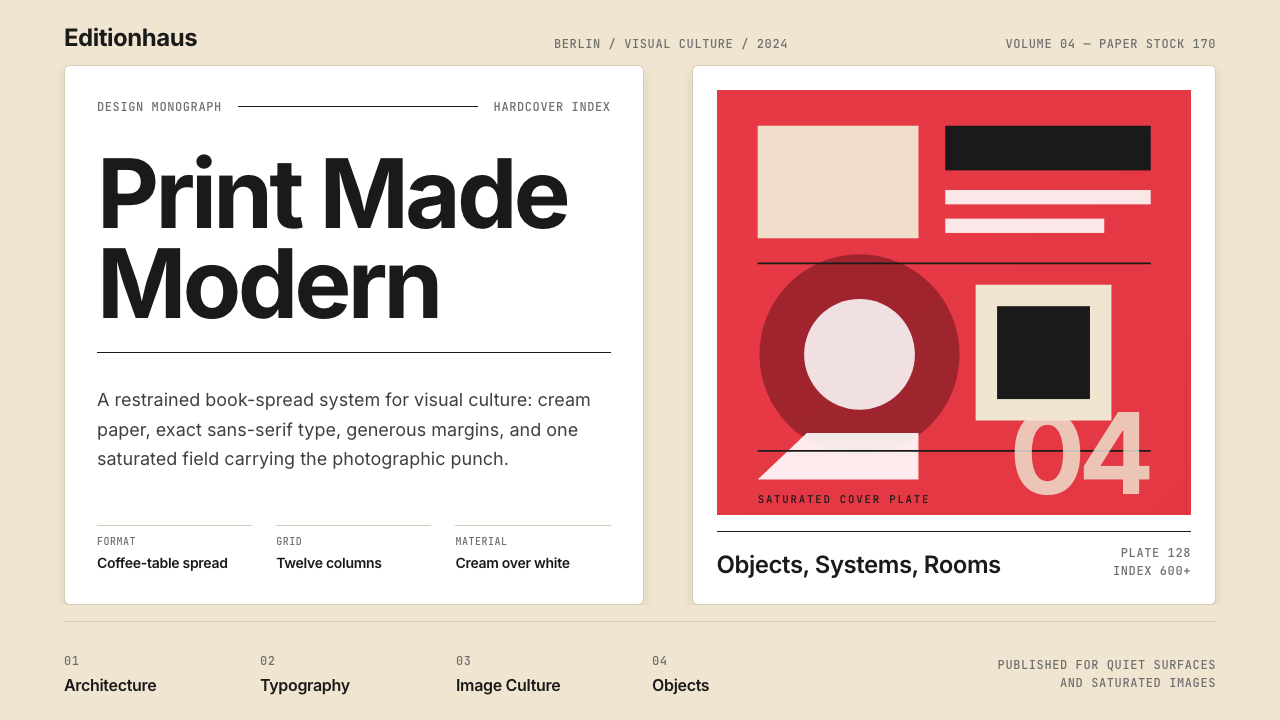 Gestalten Design BookCoffee-table calm. Cream paper, tight sans, one saturated block, and a strict…
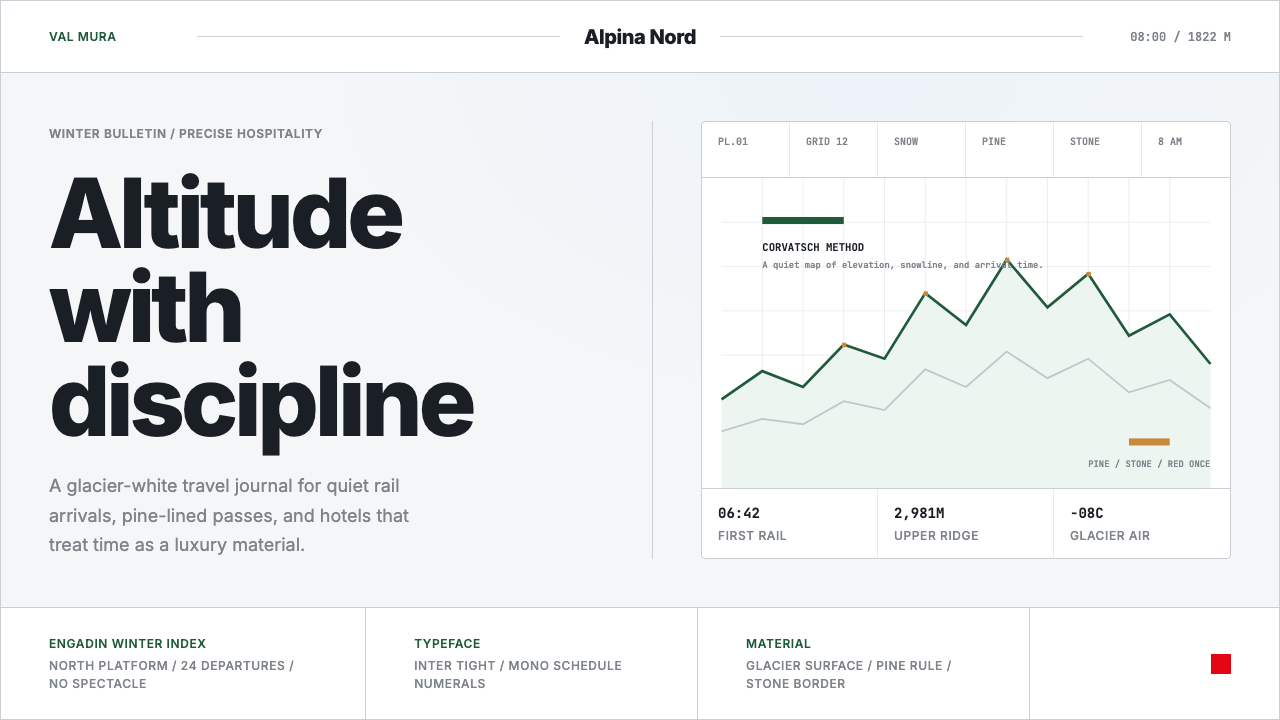 Swiss Alps GraubündenAlpine precision, restrained. Glacier white, pine rules, and tight Inter grid…
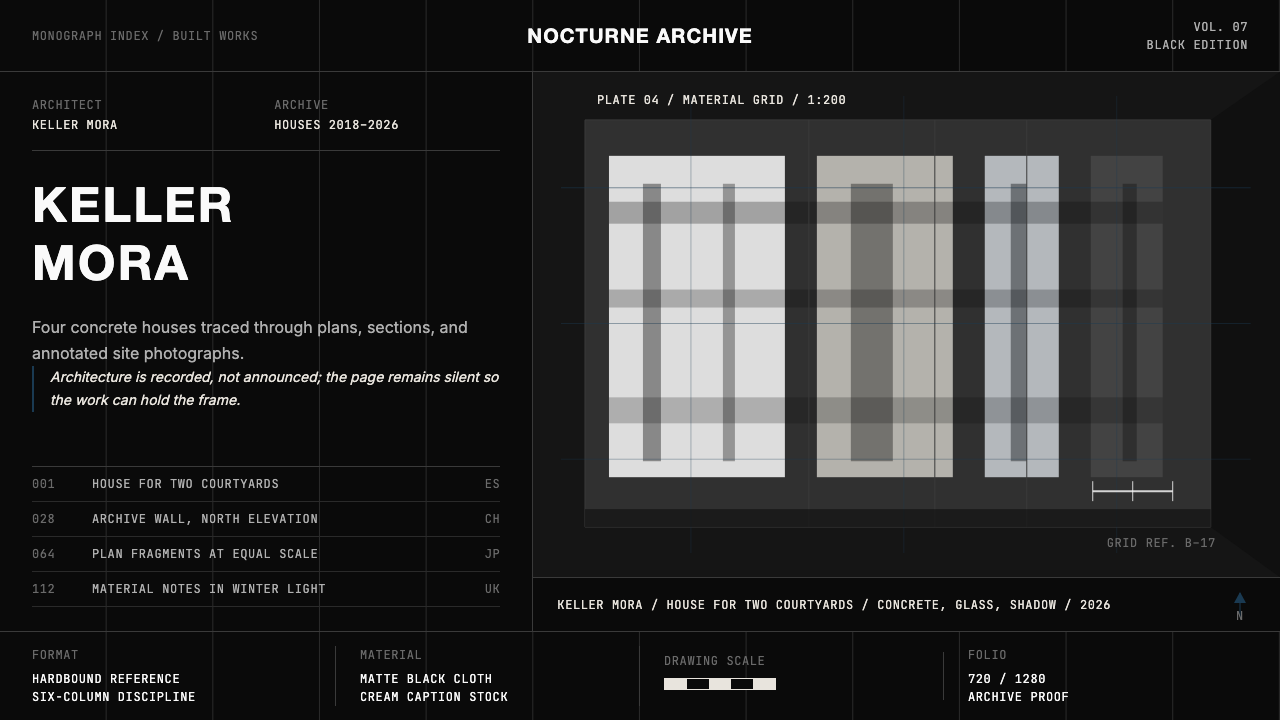 Architect Monograph (Black Edition)Architecture stays sovereign. Matte black, Helvetica caps, hairline grids, bl…
 Monocle MagazineQuiet authority. Yellow spine, warm paper and dense ruled columns speak at li…
 Wallpaper* ArchitecturePhotography does the speaking. Gallery-white grid, Inter captions, and hairli…
 Acne Studios Pink-PaperQuiet luxury in one pink plane. Inter type floats on white with a bag-like re…