What is BBC News?
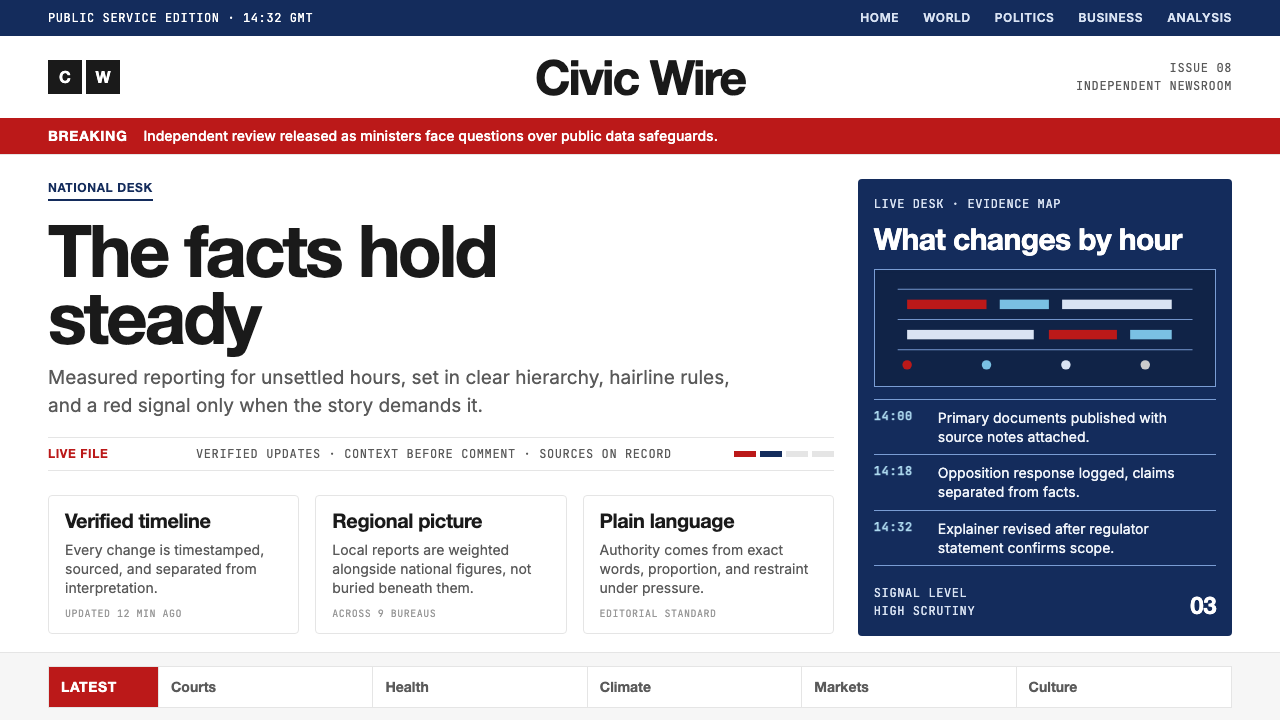
A century of public trust made visible — BBC News's deep navy, alarm red, and disciplined white space turn breaking news into institutional authority.
BBC News in brief
BBC News is the visual language of the world's most recognized public broadcaster, built on a strict three-color logic: an alarm red that marks urgency and carries the NEWS wordmark, a deep navy that anchors navigation and category structure, and white or near-white space that holds everything else. The palette is not decorative — each hue carries a precise communicative assignment and never strays from it. The result is a design system that reads as trustworthy before a single headline is absorbed.
The system's authority comes from typographic discipline as much as color. The Reith typeface family — commissioned in 2017 from the Swiss type foundry Dalton Maag — replaced decades of Gill Sans dependence with a humanist design built expressly for digital screens. Reith works from narrow mobile columns to broadcast lower-thirds to large-format editorial displays, giving the BBC a proprietary voice that is both warm enough to feel human and structured enough to feel institutional.
What distinguishes BBC News design from ordinary 'clean' or 'minimal' digital design is that every restraint is purposeful and every element carries editorial weight. Hairline rules separate sections with surgical precision. Grid columns are observed without exception. Color appears only where it signals something: danger, navigation state, category identity. The entire system is organized around the principle that a global audience reading in moments of stress or urgency should never have to wonder where to look.

Where does BBC News come from?
The BBC — British Broadcasting Corporation — was founded in London in 1922, initially as a radio consortium of six manufacturers. John Reith, its first director-general, established the foundational ethos: to inform, educate, and entertain, free from commercial and political pressure. Reith's vision of public service broadcasting shaped not only the editorial character of the BBC but also its visual and institutional identity: sober, authoritative, structured for universal comprehension rather than market segmentation.
For most of the twentieth century, the BBC's television identity relied heavily on Gill Sans — a humanist sans-serif designed by Eric Gill in 1928 that had become synonymous with British institutional identity. Gill Sans appeared on BBC presentation graphics, announcements, and lower-third captions for decades. But as television gave way to multiplatform digital publishing, the limitations of licensing a third-party typeface across an enormous and varied output became increasingly acute. The BBC needed a proprietary voice that it could own, develop, and deploy consistently from a broadcast control room to a mobile notification.
The pivotal decision came in 2017, when the BBC commissioned Dalton Maag — a Swiss-British type foundry known for its work on humanist and legibility-focused typefaces — to design the Reith family. The brief demanded a typeface that honored the warmth and legibility of the BBC's long humanist tradition while performing at every scale modern publishing required. Reith Sans and Reith Serif together form a complementary system: the sans-serif carries news headlines and navigation labels, while the serif carries long-form journalism and feature writing. The family was named in honor of John Reith, connecting the typographic modernization explicitly to the corporation's founding values.
The visual identity refinements of the 2017-to-2024 period went beyond the typeface. The BBC's distinctive blocks logo — a trio of bold rectangles housing the letters B, B, C — was sharpened and standardized across digital and broadcast contexts. The red-and-navy color system was formally codified, assigning specific roles to each hue across platforms. The resulting identity draws on a century of public trust while being genuinely optimized for the conditions of contemporary digital news consumption: fast loading, high contrast, screen-legible typography, and a visual hierarchy that works at a glance.
What defines the BBC News look?
Alarm Red
BBC Red is not a branding flourish but a functional signal: it marks urgency, identifies the NEWS logotype, and serves as the primary action color across interactive elements. Its use is deliberately restrained — the red never floods a layout but appears as an accent on headers, breaking-news banners, and the distinctive blocks logo. This economy of red means that whenever it appears, it commands immediate attention without needing to compete with other warm tones.
Deep Navy
The deep navy acts as the structural backbone of the visual system. It grounds navigation bars, category headers, and section chrome — the framing elements that tell users where they are within the editorial hierarchy. Navy communicates authority and stability without the harshness of pure black, and its depth gives editorial content on white grounds an anchoring contrast. In broadcast graphics, navy performs well against both light and dark backgrounds, making it a versatile structural tone across platforms.
Typographic Hierarchy
BBC News deploys the Reith family at multiple scales to create a hierarchy that is immediately readable at a glance. Major headlines are set large, dark, and at a weight that commands the page. Subheadings step down in size while maintaining the same humanist proportions. Body text is set at a measure and weight optimized for sustained reading on screens. Category labels and timestamps sit lighter still, handled by narrower weights or smaller sizes rather than a different typeface. The system achieves rich hierarchy from a single type family.
Hairline Grid Structure
The layouts are governed by hairline rules — extremely thin horizontal and vertical lines that divide sections, frame story cards, and define the edges of content blocks. These rules are structural rather than decorative: they create a lattice that organizes dense editorial content without consuming visual space. The hairline grid gives BBC News its characteristic quality of being simultaneously dense with information and uncluttered in appearance — a balance almost impossible to achieve without rigorous structural discipline.
White Space as Editorial Judgment
The generous white space in BBC News layouts is not passive emptiness but an active editorial tool. Story cards breathe. Headline type has room above and below it. Pull quotes and secondary items are separated by clear margins that signal their relative importance. This discipline mirrors the editorial role of a well-designed newspaper page: the space around a story tells readers how important that story is before they read its words.
Blocks Logo and Visual Identity Marks
The three bold rectangles of the BBC blocks logo are themselves a micro-exercise in the system's broader logic: maximum contrast, geometric clarity, zero decoration. The blocks appear in red against white, or white reversed out of navy or red, depending on context — never in a tertiary color, never with gradients or shadows. This consistency means the mark reads equally at broadcast resolution and at the scale of a mobile app icon. The NEWS wordmark similarly relies on weight and scale rather than any supplementary graphic device.
Color as Categorical Signal
Beyond the three anchor colors, BBC News uses a limited range of category-specific accent colors — muted, lower-saturation tones — to identify editorial verticals such as Sport, Business, Culture, and Science. These category colors are carefully chosen to remain subordinate to the primary red and navy, never competing for dominance. They function as navigational waypoints within the system, telling users at a glance which editorial territory they have entered. The underlying discipline is consistent: color signals category, not aesthetic preference.

Who shaped BBC News?
Reith was the BBC's founding director-general from 1927 to 1938 and the architect of its public-service ethos. His conviction that broadcasting should inform and educate without pandering to the lowest common denominator shaped the BBC's editorial character for a century. The Reith typeface commissioned in 2017 carries his name as an explicit acknowledgment that its visual identity is inseparable from its founding values.
The British brand identity designer Martin Lambie-Nairn is credited with modernizing the BBC's visual identity in the 1990s, most notably by developing the animated globe ident sequence that became synonymous with BBC One, and by systematizing the BBC's use of color and typography across channels. His work established the disciplines of consistency and purposeful restraint that the subsequent digital identity inherited and refined.
Dalton Maag is the Swiss-British type foundry commissioned in 2017 to design the Reith typeface family. The foundry — known for large-scale custom typeface projects for major corporations — produced both Reith Sans and Reith Serif as a complementary pair capable of handling the full range of BBC publishing contexts: broadcast lower-thirds, mobile news alerts, long-form web articles, and print supplements. The Reith commission is one of the most significant proprietary typeface projects in recent British design history.
Tim Davie became BBC Director-General in 2020 and has overseen the corporation's most significant digital transformation phase, including the consolidation of BBC News's global digital platforms and the standardization of its visual identity across an increasingly fragmented media landscape. Under his tenure, the refined blocks logo and codified color system have been extended to BBC News's streaming and on-demand contexts, reinforcing visual consistency as the organization accelerates its shift away from linear broadcasting.
How do you use BBC News today?
BBC News style translates most effectively when it is understood as a functional system rather than an aesthetic mood. The visual logic is built around three decisions made at the start of any project: which elements signal urgency (red), which elements structure navigation (navy), and which elements carry editorial content (white space and dark type). Getting these roles assigned correctly is more important than any surface-level styling choice.
For presentation slides, the system works well on both cover and content pages. A cover page benefits from a strong typographic statement in a headline-weight sans-serif against a white or navy ground, with a red accent restricted to the title word or a single horizontal rule. Content slides should treat the slide grid the way BBC News treats a news page: one reading direction, section labels set small and unobtrusive, body text generous in weight and scale but economical in volume. Data slides work best when charts are treated as editorial objects — clear labels, restrained color, values large enough to read without effort.
For web dashboards and product interfaces, the BBC News approach maps naturally onto any context where users need to orient quickly and process information under time pressure. Apply a strict column grid, hold the background white or very near-white, and use navy for the persistent navigation layer. Reserve red exclusively for alerts, error states, or primary calls to action — never as a background fill for decorative sections. Card-based layouts work well: each card with a hairline border, a category label in a small weight, a headline in a large weight, and a clearly readable body excerpt.
For editorial and marketing contexts, the style communicates institutional credibility. Long-form article layouts benefit from a narrow body-text column flanked by a wider margin reserved for captions, metadata, or pull quotes — a structure that signals editorial seriousness. Marketing landing pages can use alternating full-width sections in navy-on-white and white-on-navy to create rhythm without resorting to decorative imagery. The red accent, used sparingly on calls to action and key data points, prevents the layout from reading as flat.
A common mistake when borrowing this system is treating navy and red as interchangeable structure colors and using them simultaneously at comparable saturation across a layout. In authentic BBC News design, red and navy are never in competition: red punctuates, navy structures, and white separates them. A second frequent error is losing the hairline discipline — replacing it with heavy borders or padded card shadows that undercut the sense of editorial precision. The system's authority comes from thinness and restraint, not from visible framing effort.

BBC News — FAQ
Can BBC News style work for brands that are not news organizations?
Yes, but the values it communicates must align with the product's actual positioning. The visual system carries strong connotations of institutional authority, urgency, and public accountability. It works well for financial platforms, government services, healthcare information systems, educational publishers, and any product where users need to trust the information they are receiving. It does not translate easily to consumer brands that depend on warmth, playfulness, or personal identity — the style's precision and sobriety can register as cold or impersonal in those contexts.
How should the red accent be used without overwhelming a layout?
The key is treating red as a punctuation mark rather than a color block. In BBC News design, red appears on narrow horizontal bands, logo elements, category labels, and interactive states — never as a section background filling large areas. A practical rule: if the red occupies more than roughly one-tenth of a given view, it is probably doing decorative work rather than communicative work. Reserve it for the one or two elements on each screen that must be seen first.
Does this style support dark-mode or dark-background layouts?
A dark variant is possible but requires careful restructuring of the color roles. On a dark background, navy loses its structural contrast advantage and must be replaced by a lighter tone or white for navigation elements. Red continues to work as an accent but should be used even more sparingly — on dark grounds its saturation reads as highly aggressive. The most successful dark adaptations of this style keep the dark ground neutral and very dark, use white as the primary type color, and allow red to appear only on the most critical interactive or alert elements.
How does this style handle imagery and photography?
Photography plays an important role in BBC News design, but it is always treated as editorial content rather than decorative background. Images are cropped with editorial precision — filling a defined card or column width exactly, never bleeding freely across layouts. They appear in full color because news photography depends on realism, but they are always framed within the grid structure rather than allowed to escape it. Background-covering hero images are used sparingly and typically pair with high-contrast white type. Avoid using photography as atmospheric texture behind text — the style's precision depends on typography having a clean, unambiguous field to occupy.
What makes BBC News design feel authoritative rather than merely corporate?
Authority in this system comes from editorial discipline rather than from power signals like large logos or heavy use of black. The BBC News visual system earns trust by being consistent, legible, and free of visual noise — the user never has to decode the interface because every element does exactly one thing. The hairline rules, the restrained color palette, and the typographic hierarchy all convey the same underlying message: care has been taken here. This quality of visible care is what distinguishes authoritative design from merely formal design. Copying the surface elements without the underlying discipline produces work that looks institutional but does not feel trustworthy.
Related design styles
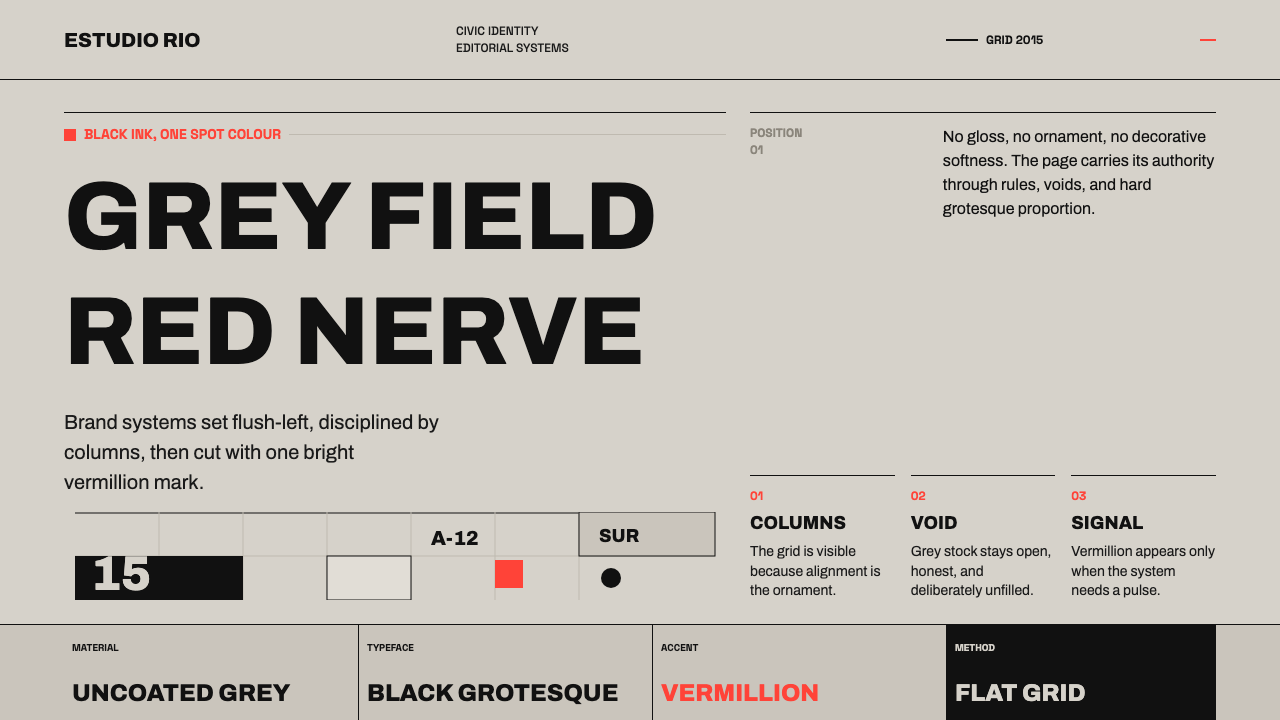 Buenos Aires Branding StudioRigour with nerve. Black grotesque on warm grey, pierced by one vermillion ma…
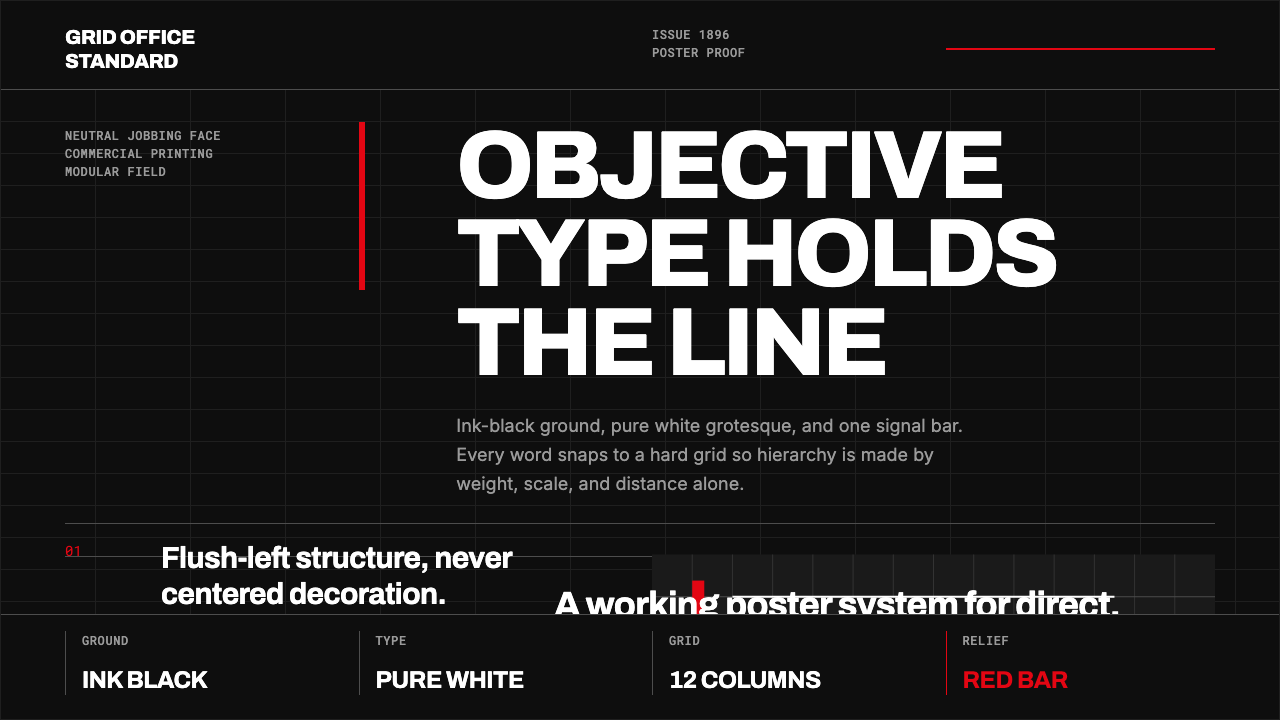 Akzidenz-Grotesk BertholdObjectivity in black ink. White grotesque type, hard grid, one rationed red b…
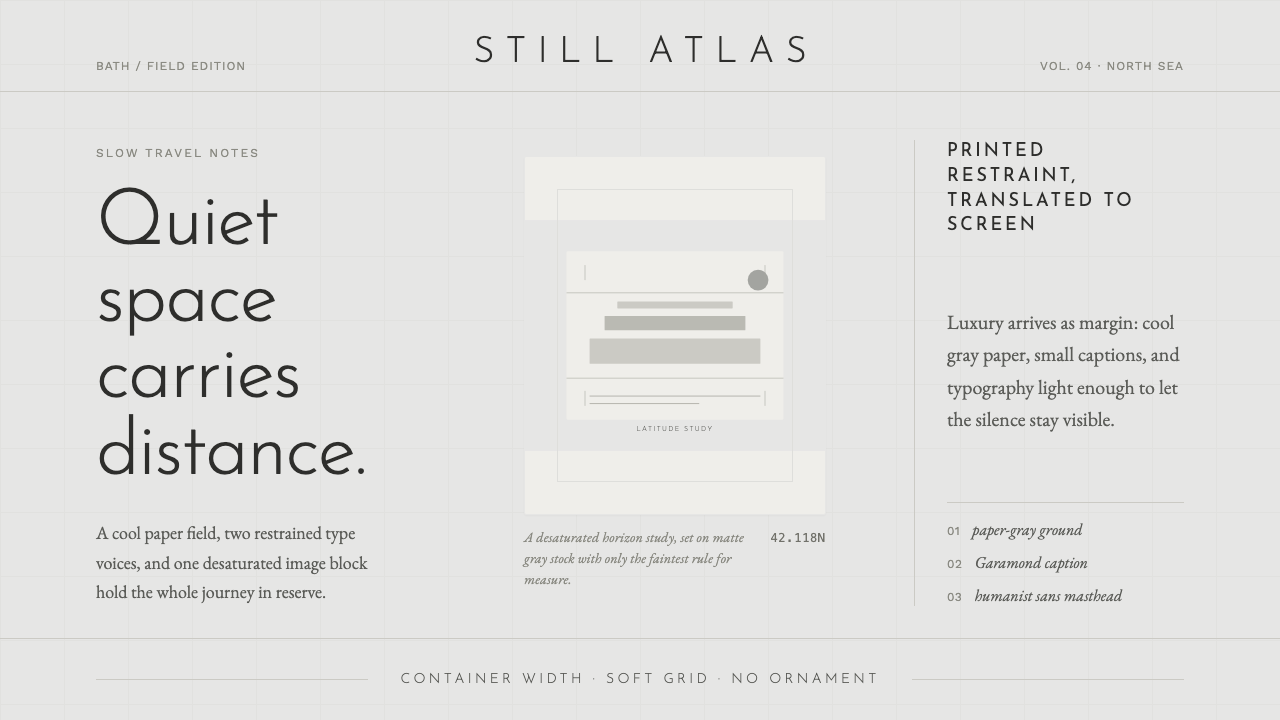 Cereal Magazine MinimalLuxury as margin. Cool paper-gray, light sans, and Garamond captions hold the…
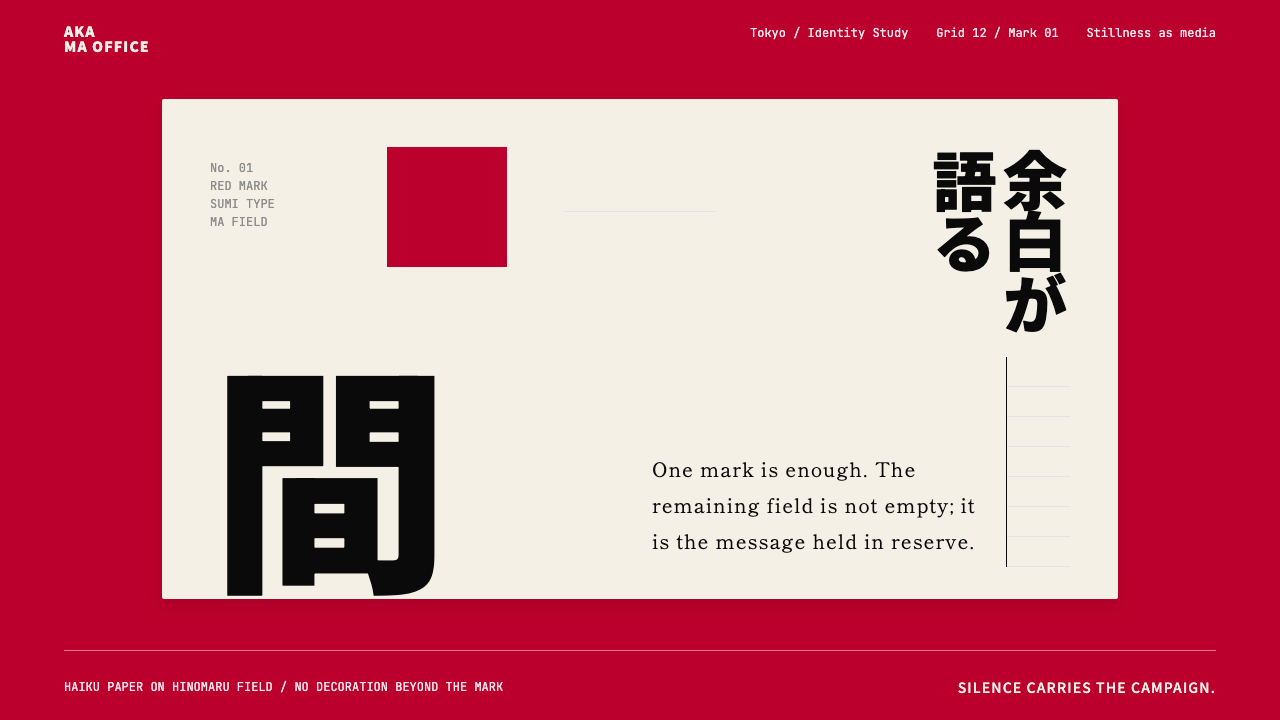 Dentsu Tokyo CreativeSilence does the selling. Hinomaru red, sumi type, and empty columns carry th…
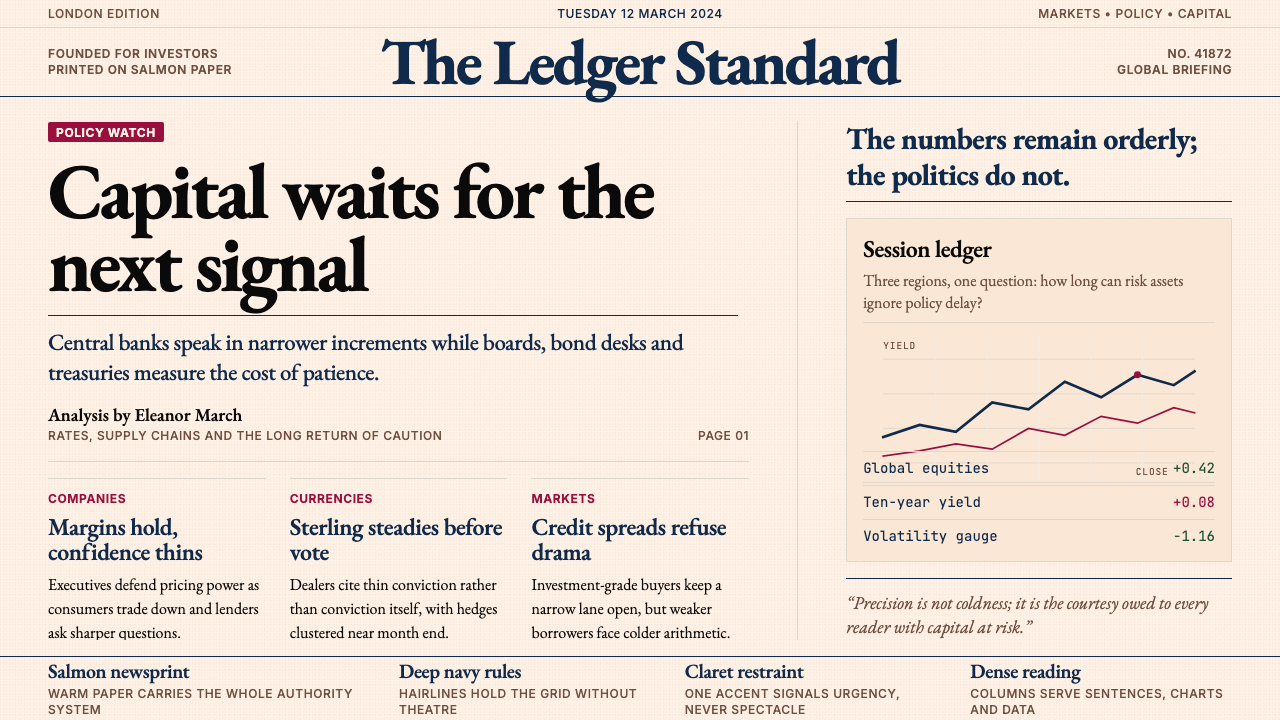 Financial Times (Pink Paper)Authority on salmon paper. Deep navy rules and claret accents discipline dens…
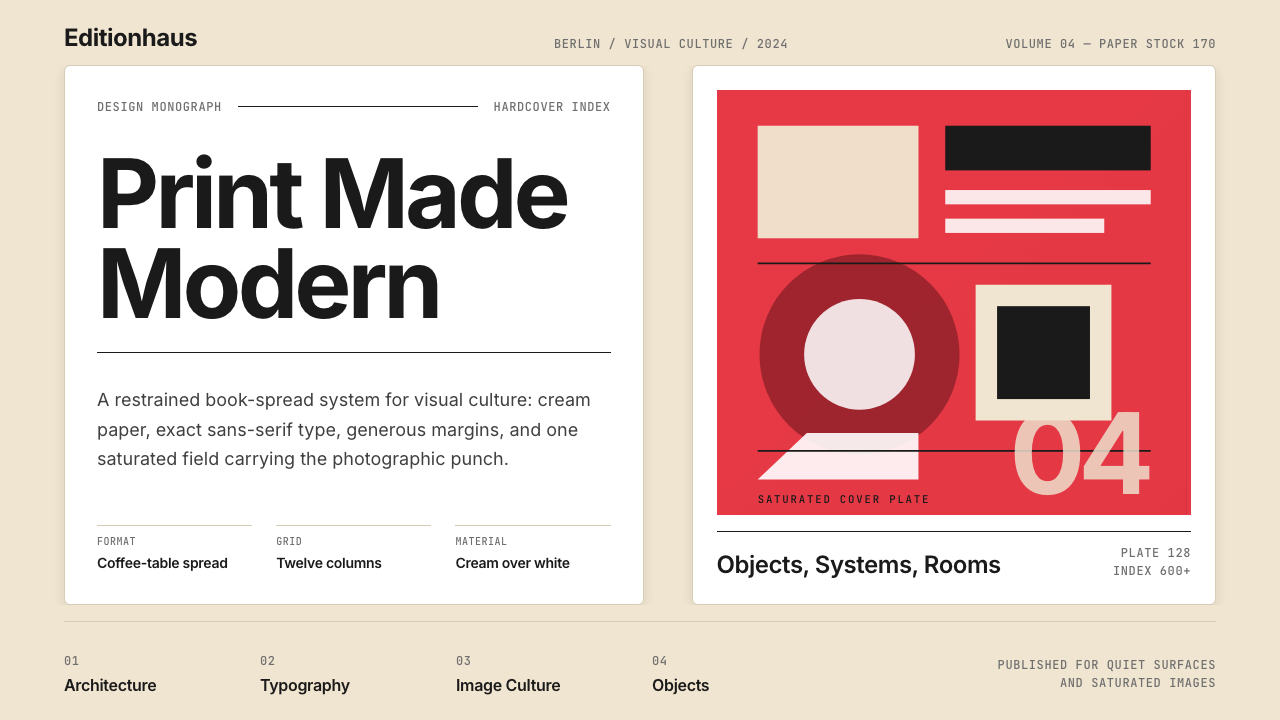 Gestalten Design BookCoffee-table calm. Cream paper, tight sans, one saturated block, and a strict…