What is Dentsu Tokyo Creative?
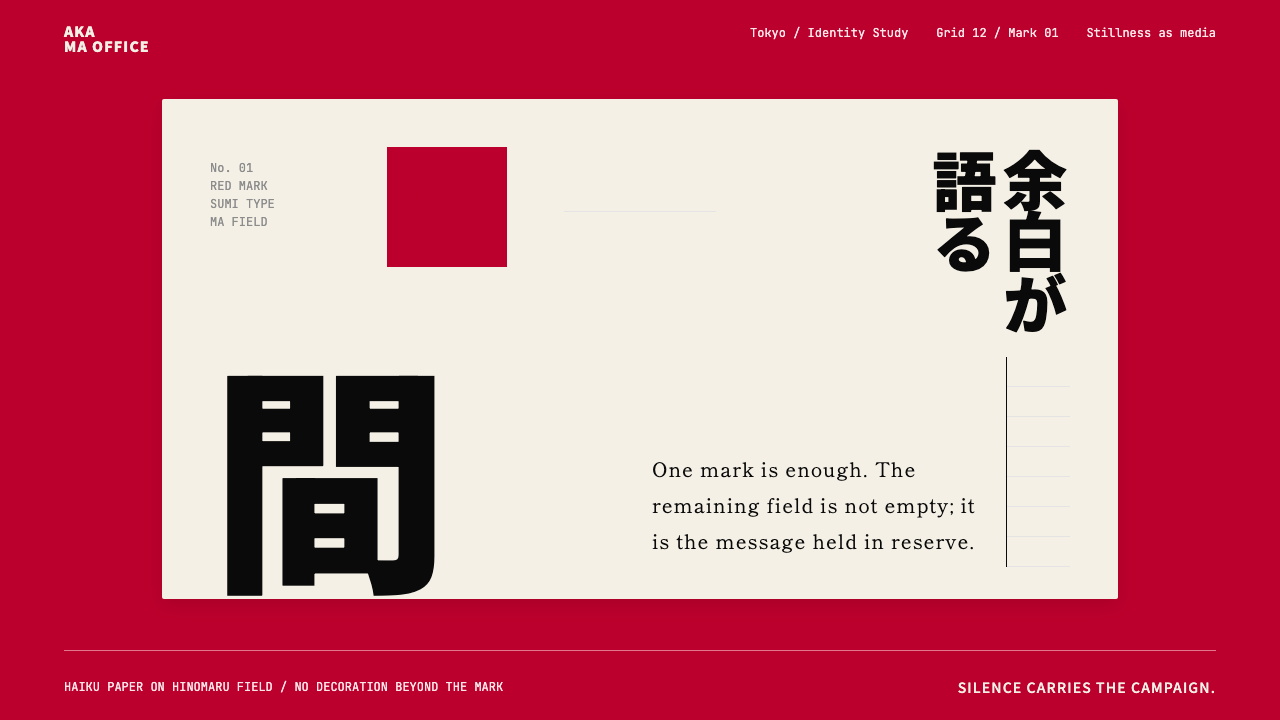
Dentsu Tokyo Creative built a visual language from almost nothing — one red mark, sumi-black type, and the silence the Japanese call ma.
Dentsu Tokyo Creative in brief
Dentsu Tokyo Creative refers to the art direction philosophy that emerged from Japan's largest advertising agency and spread to define a distinct strand of modern Japanese visual culture. At its core the system is built around three ideas that work in tension: a single bold mark that claims attention, type so controlled it borders on calligraphy, and negative space treated not as emptiness but as an active structural element. The resulting aesthetic is among the quietest in commercial advertising — and among the most authoritative.
The visual grammar centers on what practitioners call the hinomaru red: a deep, saturated crimson drawn from the Japanese flag, used with discipline as a singular focal point rather than a background or fill. Against it, sumi-black — a tone that reads more as ink than as color — carries all typographic weight. Paper white, or a white so close to unbleached paper that it carries a subtle warmth, provides the breathing field. The entire palette rarely exceeds three values: the red mark, the black text, the white ground.
What distinguishes this system from generic minimalism is its relationship to ma, the Japanese concept of meaningful interval. In music, ma is the space between notes. In Dentsu-influenced design, ma is the column left deliberately vacant, the margin that could accommodate text but does not, the half-second of visual silence before the eye arrives at the mark. This purposeful emptiness is not restraint imposed from outside the composition — it is the composition's primary argument.

Where does Dentsu Tokyo Creative come from?
Dentsu was founded in 1901 by Hoshiro Mitsunaga, initially as a news wire and advertising agency combined — a dual structure that positioned it from the start at the intersection of information and persuasion. Through the twentieth century it grew into the dominant force in Japanese advertising, representing major national accounts across every consumer category. But its aesthetic identity crystallized not through size alone, but through the influence of a generation of postwar Japanese art directors who brought a distinctly Japanese sensibility to the European modernist vocabulary they had inherited.
The broader context is Japan's postwar visual culture, which absorbed and then transformed Western modernism. Japanese designers of the 1950s through 1970s — Tadanori Yokoo, Eiko Ishioka, and others who moved between advertising, fine art, and theatrical design — developed a graphic language that owed something to the Bauhaus and Swiss International Style but was governed by different underlying principles. Where the Bauhaus rejected ornament on industrial grounds, Japanese art direction reduced imagery on philosophical grounds rooted in Zen aesthetics, the tea ceremony, and the ma concept embedded in Japanese spatial culture.
The pivotal figure in the mature articulation of this aesthetic within the corporate sphere is Kashiwa Sato, whose career from the mid-1990s onward produced a body of work — identity systems for Uniqlo, the National Art Center Tokyo, Rakuten, and other major Japanese institutions — that became the clearest contemporary expression of the Dentsu creative tradition. Sato's approach made explicit what earlier practitioners had practiced intuitively: that a single geometric mark, repeated with discipline across every surface and scale, could carry more brand weight than an elaborately detailed visual system. The Uniqlo red square and the National Art Center's circular void became the two most widely recognized examples of this reduction-to-mark principle.
Geographically, the sensibility radiates outward from Dentsu's headquarters in the Shiodome district of Tokyo — a campus designed by Jean Nouvel whose glass tower above the old Shimbashi neighborhood itself embodies a certain Japanese modernist ambition. Creative satellites in Osaka, Nagoya, and Fukuoka adapted the central aesthetic to regional registers, while international offices in New York, London, and Singapore translated it for export. The result is a style that remains recognizably Japanese even when deployed in global campaigns — in part because its foundational restraint is itself culturally specific, not easily assimilated into Western advertising conventions that treat visual abundance as persuasive virtue.
What defines the Dentsu Tokyo Creative look?
The Single Mark
The organizing principle of the system is reduction to a single geometric or semi-calligraphic mark — a circle, a square, or a kanji-derived symbol — that operates as the visual anchor for an entire identity. This mark is never decorative; it carries the full semantic and emotional weight of the brand. Its power derives from consistency and isolation: placed in white space without competition, scaled to command attention without shouting, it functions as a seal rather than a logo in the Western sense.
Ma — Productive Emptiness
Negative space in this system is not leftover area after content is placed — it is the first content decision. Columns are left vacant not because there is nothing to fill them with but because vacancy is structurally load-bearing. The eye must travel across white field before arriving at the mark; that journey is part of the communication. This treatment of emptiness as content distinguishes the style from Western minimalism, which tends to use negative space as a luxury signal rather than a structural argument.
Hinomaru Red
The chromatic signature of the system is a single deep, saturated red — associated with the Japanese national flag — that appears as a focal accent rather than a field color. In practice this red is used for the primary mark, a single rule, or a key typographic element, never as a background wash. Its restraint is what gives it authority: because red appears rarely, it commands the composition entirely when it does appear. All other colors are subordinate or absent.
Sumi-Black Typography
Type in this aesthetic is set in a tonal black that recalls the depth and saturation of traditional sumi ink — a quality that makes letterforms feel weighted and intentional rather than merely present. Japanese compositions use vertical type runs alongside horizontal Latin, creating rhythmic alternation between the two reading directions. Weight hierarchies are achieved through dramatic scale contrast and stroke contrast, not through multiple typeface families. Type columns are typically narrow and precisely regulated, with generous space around them.
Hairline Structure
Where the Bauhaus used bold rules and geometric fills to divide space, the Dentsu Tokyo aesthetic uses a single hairline — a rule so thin it barely registers as a mark — to separate sections, define columns, or frame the composition. This hairline acts more like a crease in paper than like a barrier; it suggests division without imposing it. The decision to use hairlines rather than solid bands reflects the broader preference for whispered structure over declared structure.
Grid as Discipline, Not Formula
The compositions are rigorously structured — every element occupies a considered position — but the grid is internalized rather than mechanically applied. Unlike Swiss International Style, which makes the grid visible through consistent column widths and baseline alignment, this approach uses the grid as a hidden architecture. The result can appear almost intuitive: marks and text seem to float in the white field, yet they are precisely calibrated to invisible coordinates. The discipline shows in what is not there.
Monochromatic Restraint
Beyond the focal red, the palette is effectively monochromatic: deep black, paper white, and at most one additional neutral tone. Photography, when used, is treated monochromatically — converted to high-contrast black and white or given a single-color tint — so that it integrates into the system rather than interrupting it. This chromatic discipline means that color, whenever it appears, operates as pure signal rather than atmosphere. Nothing drifts into decorative coloring.

Who shaped Dentsu Tokyo Creative?
Sato is the defining figure of contemporary Japanese corporate identity design, and the clearest single embodiment of the Dentsu creative philosophy at its most distilled. His work for Uniqlo — reducing the brand to a red rectangle containing the Japanese characters for the name — became one of the most recognized identity transformations of the late twentieth century, turning a discount retailer into a globally recognized design object. His subsequent identities for the National Art Center Tokyo, Rakuten, and Sumitomo used the same reduction principle: one mark, maximum restraint, total consistency across all surfaces.
Yokoo represents the psychedelic and countercultural dimension of postwar Japanese graphic design — an influence that may seem distant from the severe restraint of Dentsu's corporate aesthetic, but which establishes the historical baseline against which that restraint operates. His poster work of the 1960s and 1970s, combining Japanese woodblock print traditions with Pop Art and psychedelia, demonstrated that Japanese visual culture was not simply absorbing Western modernism but generating its own syntheses. His career at the intersection of advertising, fine art, and cultural provocation established the model of the Japanese art director as cultural figure.
Ishioka was the first woman to win Japan's most prestigious advertising award, working across theatrical costume design, film art direction, and corporate advertising in ways that treated each domain with equal seriousness. Her advertising work in the 1970s and 1980s — particularly campaigns for cosmetics brand Parco — introduced a confrontational, image-driven approach to Japanese advertising that challenged the prevailing preference for gentleness and indirection. Her trajectory from advertising to Hollywood costume design (she won an Academy Award for Bram Stoker's Dracula in 1993) demonstrated the internationalism latent in Japanese commercial visual culture.
Hara is the art director of Muji and the author of several books on design philosophy — including Wa, a meditation on Japanese aesthetics — that have made him one of the most articulate theorists of the minimalist sensibility underlying the Dentsu tradition. His concept of 'emptiness' as design philosophy, developed through his Muji work and writings, provides the clearest intellectual framework for understanding why the Dentsu aesthetic treats negative space as primary rather than residual. His work demonstrates that the aesthetic is not merely a house style but the surface expression of a coherent philosophical position about the purpose and limits of design.
How do you use Dentsu Tokyo Creative today?
Applying the Dentsu Tokyo Creative aesthetic requires internalizing a discipline that runs counter to most contemporary design instincts: less is not just acceptable, it is the argument. This means resisting the pull to fill empty space, to add a second accent color, to increase the number of typographic weights, or to use imagery as atmosphere. The style rewards those who can sit with near-emptiness and trust that the single well-placed mark does the work that ten decorative elements could not.
For presentation slides, the system performs exceptionally well when the content itself is substantive — strategy decks, brand reviews, investor materials, cultural or institutional reports. A cover slide in this aesthetic typically shows the mark alone, or the mark beside the title in one typographic weight, against full white or a white field with a single hairline. No background texture, no gradient, no ambient imagery. Content slides are built on a strict invisible grid: wide margins, narrow text columns, and section breaks marked by the hairline rather than a colored rule. Data visualizations should be treated monochromatically, with the single red reserved for the most significant data point or the call-to-action element — never applied across all bars in a chart for decorative consistency.
For web interfaces and digital product design, the aesthetic translates naturally to dashboards, institutional landing pages, and high-consideration product pages where authority and clarity are more important than warmth. Implement a strict grid with generous gutters, a near-white or paper-white background, and a monochromatic body that uses only deep black and mid-grey for type hierarchy. The focal red appears in one location per screen: a primary action button, an alert state, a navigational mark. Avoid using it in multiple places simultaneously, as this collapses the hierarchy that the restraint is designed to create. Card components should use defined borders rather than soft shadows; interactive states should be communicated through weight and color shift rather than blur or lift effects.
For editorial and marketing applications, the aesthetic is well-suited to cultural institutions, luxury brands, and any organization for which restraint functions as a positioning signal. An editorial layout derived from this tradition uses a single-column or narrow two-column body with a wide margin for dates, attributions, or pull quotes. Section breaks are single hairlines, not decorative ornaments. Photography, if used, is cropped to isolate geometric or structural qualities in the subject — not used as atmosphere or narrative window. Marketing materials lean on the poster logic of the tradition: a single mark at large scale, the name in controlled type below or beside it, and white field completing the composition. The headline does not need to explain the mark; the mark explains itself.
A common and damaging mistake is to treat this style as a form of sterile minimalism, stripping out color and imagery without substituting the structural intentionality that makes the original work feel considered rather than empty. Blank space in this aesthetic is never arbitrary — every margin, every empty column, every hairline is placed in precise relationship to the mark. Applying the look without the underlying discipline produces work that reads as unfinished or timid rather than authoritative and resolved. The second common mistake is using more than one focal color: introducing a secondary accent color immediately diffuses the singular authority of the red and shifts the system toward generic corporate design. If the composition calls for more visual complexity, add it through typographic scale and weight, not through chromatic addition.

Dentsu Tokyo Creative — FAQ
How is Dentsu Tokyo Creative different from Japanese minimalism in general?
Japanese minimalism is a broad cultural tendency that appears across architecture, ceramics, fashion, and product design, and is often associated with the wabi-sabi aesthetic of imperfection and transience. The Dentsu Tokyo Creative sensibility is specifically a commercial art direction tradition — it is concerned with mark-making, typographic authority, and brand legibility rather than material honesty or the beauty of imperfection. It is minimal in the sense that it strips composition to essentials, but its essential elements are bold and precise rather than rough and organic. The hinomaru red is not a wabi-sabi color; it is an assertive, flag-derived mark of identification.
Can this aesthetic work for brands that are not Japanese?
Yes, and several global brands have applied it successfully — but with an important caveat. The system derives much of its authority from cultural associations that a non-Japanese audience may not consciously recognize but still feels: the weight of sumi ink, the restraint of the tea ceremony, the spatial intelligence of traditional Japanese room design. When a Western brand applies the aesthetic, those associations are absent, and the style must carry its authority through sheer compositional discipline alone. This raises the bar: a composition that reads as assured in a Japanese context may read as merely sparse in a context where the cultural underpinnings are not in play. The style works best for non-Japanese brands when the brand itself has values — restraint, precision, intentionality — that align with the aesthetic's underlying philosophy.
Is there a dark-background version of this aesthetic?
Historically, the system is almost entirely light-ground — the white or near-white field is as fundamental as the mark itself, because the mark's authority depends on the expanse of white it commands. A dark inversion is possible but significantly changes the character of the system. On a dark ground, the focal red reads very differently — warmer and more luminous — and the hairline structures that rely on paper-white contrast must be re-calibrated entirely. The strongest dark variant keeps the focal mark as the only saturated element, uses a near-black ground rather than pure black, and relies on off-white or warm grey for typography. Pure-black grounds risk making the composition feel more like cinematic title design than corporate art direction.
How does this aesthetic handle photography and illustration?
Photography is used sparingly and always treated as a flat compositional element rather than a narrative window. When it appears, it is typically cropped to isolate geometric or structural qualities — an aerial view of a city grid, a close-up that reduces a face to planes of tone, an architectural fragment that reads as abstract shape. Photography is almost never used to create mood or tell a story; it is used as another kind of mark in the composition. Illustration is nearly absent; this tradition prefers the authority of pure type and the primary mark over any representational imagery. When illustration appears, it tends toward the calligraphic or the diagrammatic — a single brushstroke, a technical line drawing — rather than anything pictorial.
Where does this style struggle or fail?
The style's authority depends on its restraint, and restrained aesthetics struggle in contexts where communication must compete for attention — social media feeds, advertising in high-clutter environments, or any interface where the user's attention is pulled in many directions simultaneously. A single red mark on white is commanding in a gallery or a high-end publication; it disappears in a scrolling feed surrounded by full-bleed photography and bright gradients. The style also fails when applied by practitioners who understand the visual surface but not the underlying philosophy: compositions that look sparse rather than intentional, that feel unfinished rather than resolved. Finally, the aesthetic is genuinely unsuited to products and services that require warmth, emotional closeness, or cultural inclusivity — healthcare contexts, children's services, or community-oriented platforms where the severity of the system actively works against the brand's core promise.
Related design styles
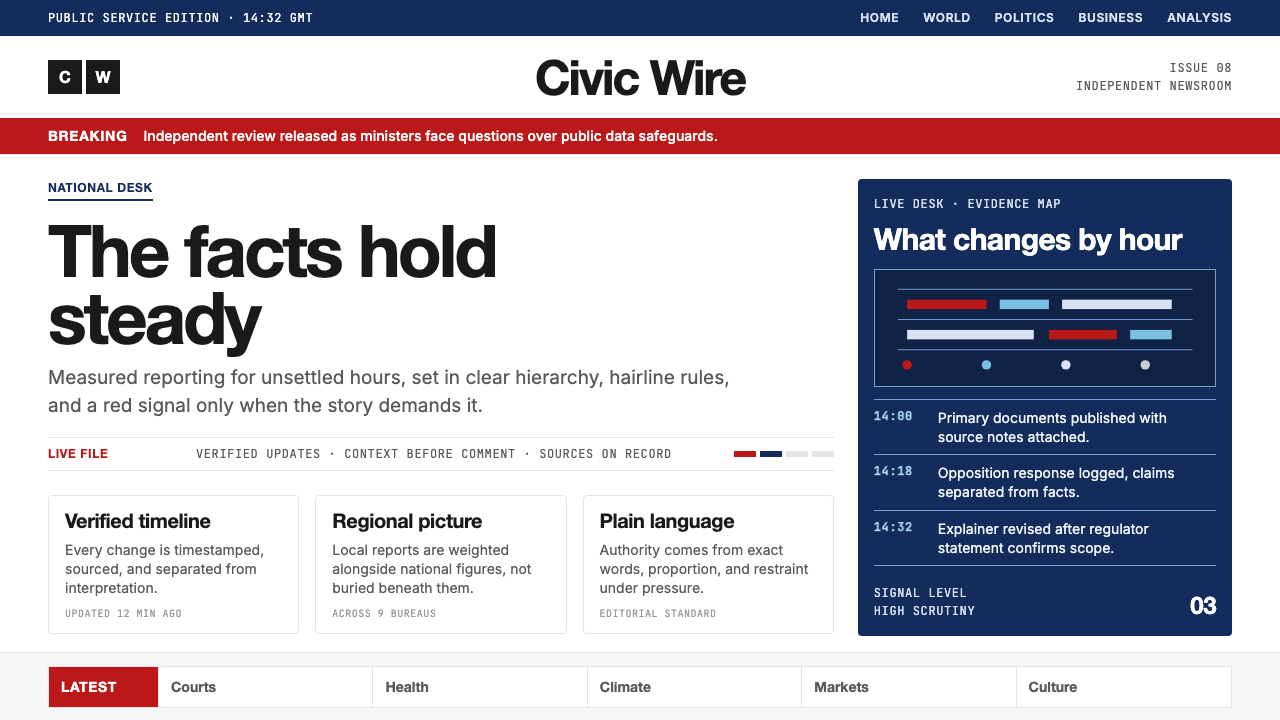 BBC NewsPublic trust, stripped bare. Red alerts, deep navy and hairline grids make ur…
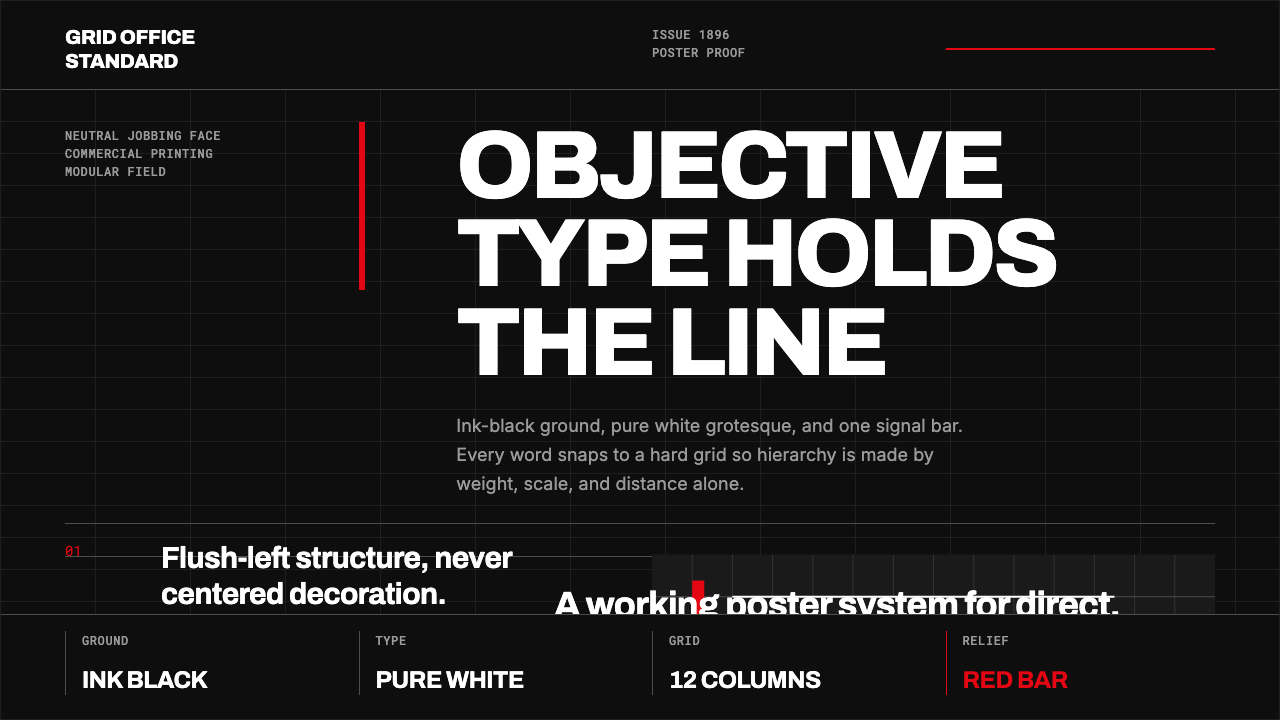 Akzidenz-Grotesk BertholdObjectivity in black ink. White grotesque type, hard grid, one rationed red b…
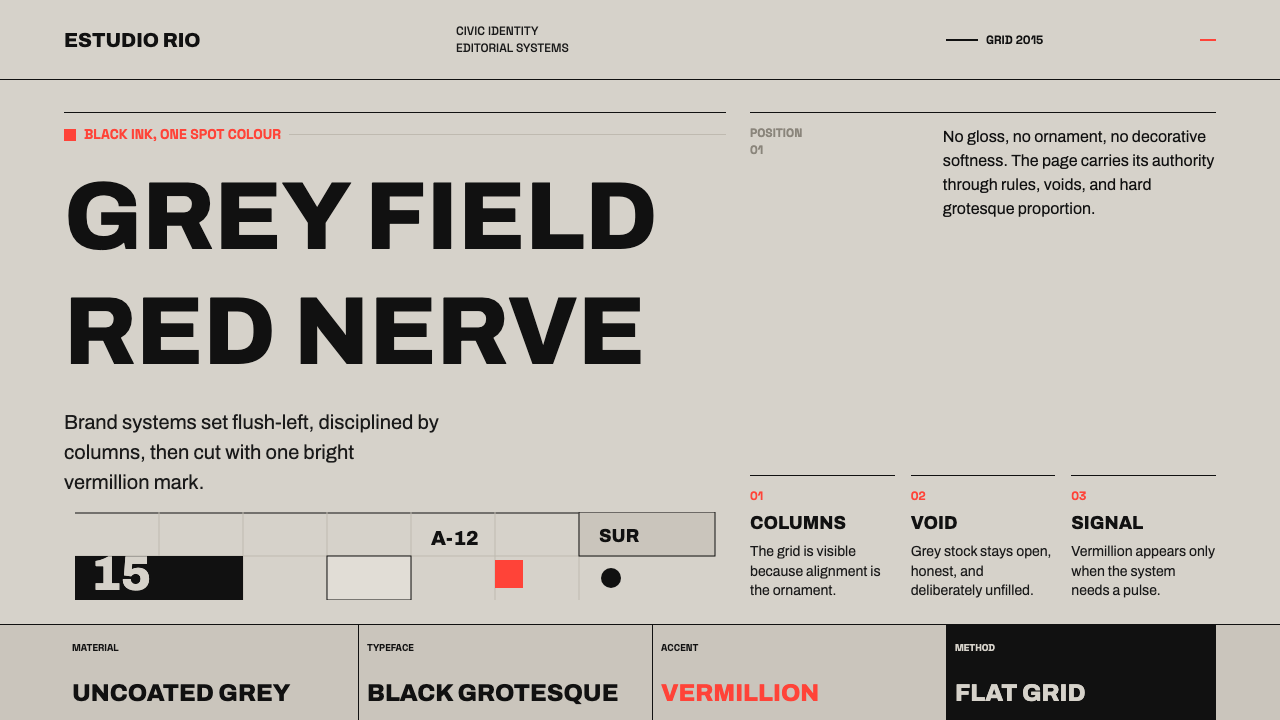 Buenos Aires Branding StudioRigour with nerve. Black grotesque on warm grey, pierced by one vermillion ma…
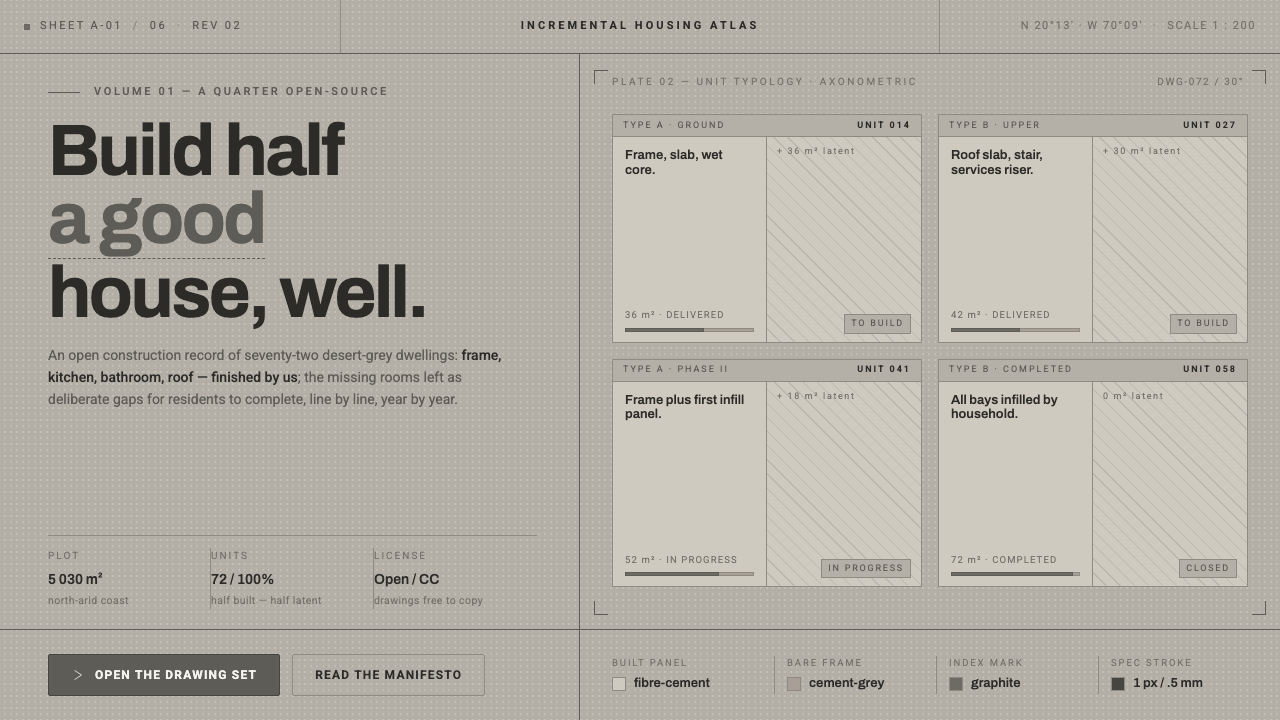 Elemental Social HousingBuild half a good house, well. Dusty cement-grey panels, hatched bare-frame g…
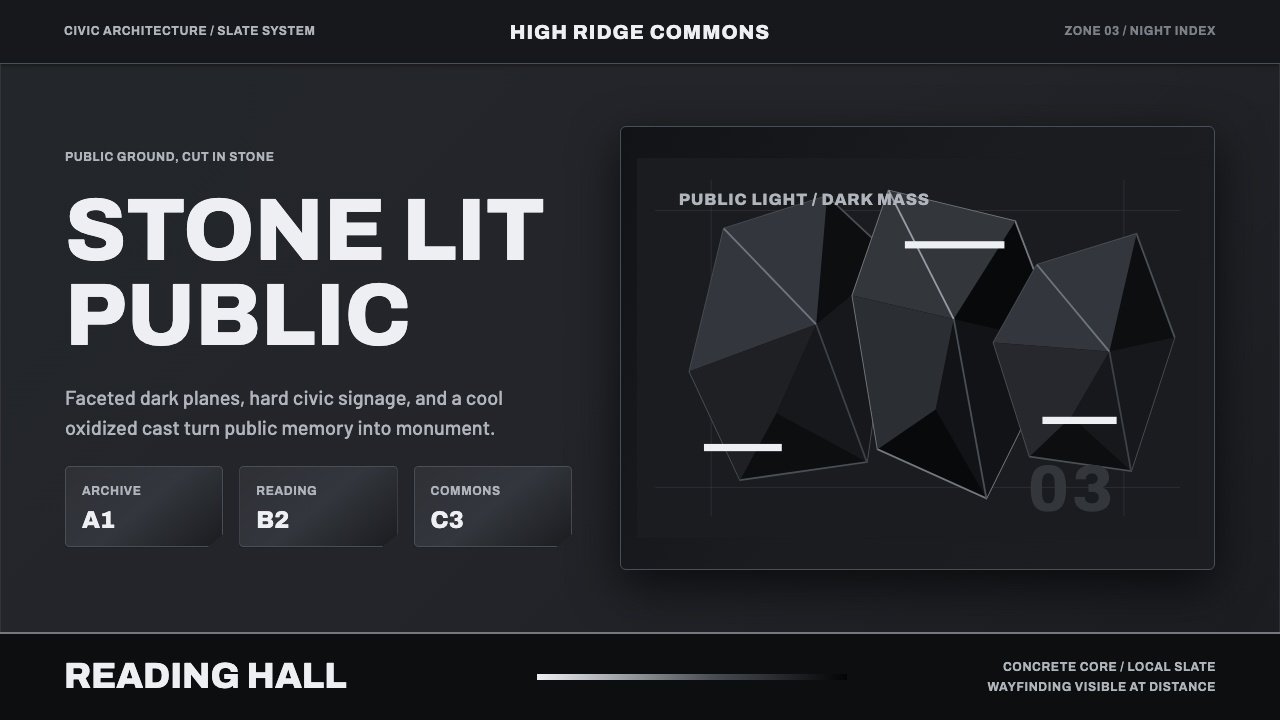 Medellín Library ParkCivic gravity in slate. Near-black planes, cool grey hairlines, and bold wayf…
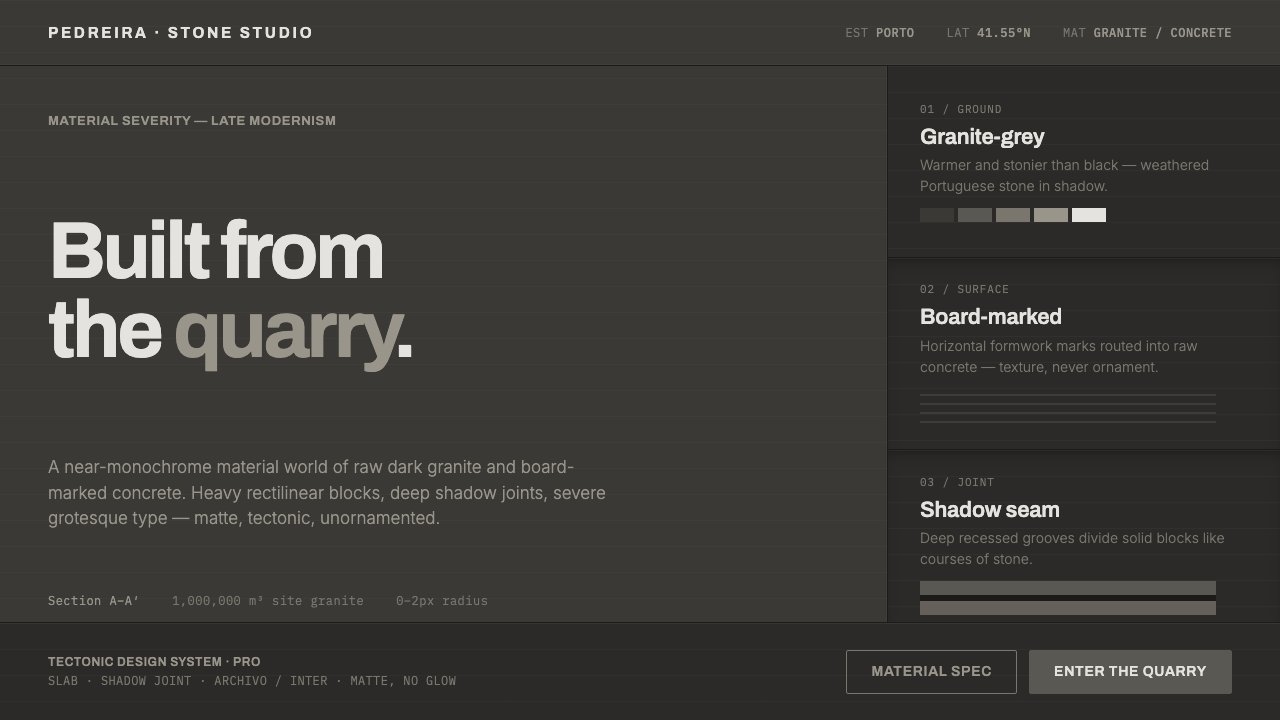 Souto de Moura GraniteArchitecture as raw matter. Dark Portuguese granite ground, board-marked conc…