What is Normcore (2014)?
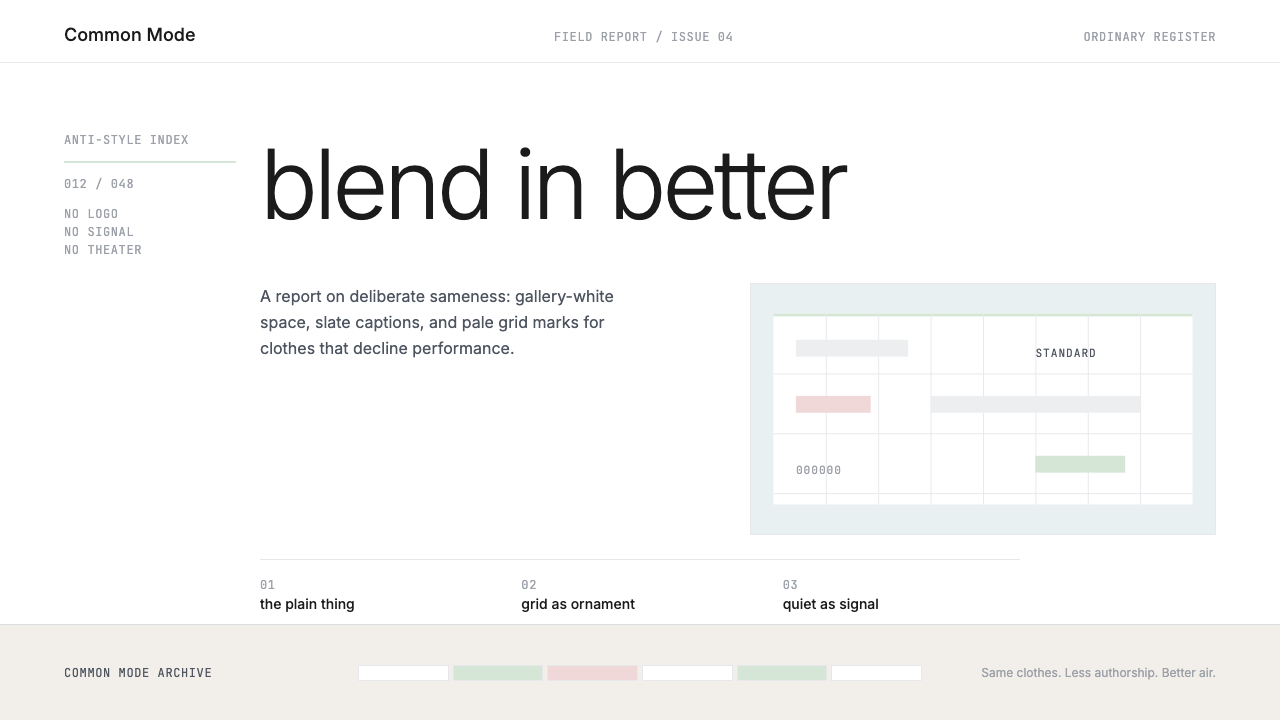
Normcore proved that the loudest statement a designer can make is choosing to say nothing at all.
Normcore (2014) in brief
Normcore is a visual aesthetic that treats deliberate plainness as a form of radical expression. Rather than competing for attention through boldness, contrast, or novelty, it achieves its effect through restraint so complete that the restraint itself becomes the message. The palette tends toward neutral whites, pale grays, and muted pastels — colors that recede rather than assert. Typography is set at low optical weight, in functional sans-serif faces, with generous spacing that reads as unhurried and undemanding. The overall impression is of something that has pointedly refused to perform.
The style takes its visual cues from institutional documents, technical manuals, and the kind of undesigned everyday object that nobody notices. This is intentional. Normcore aesthetics borrow credibility from contexts where design was never the goal — the spreadsheet, the government form, the plain cardstock business card. By applying that same resolute non-style to intentional creative work, the aesthetic makes a philosophical argument: opting out of the visual attention economy is itself a sophisticated position.
What separates normcore from careless design is precision. The spacing is measured, the type hierarchies are considered, the grid is consistent. Achieved properly, the style looks effortless in a way that is quietly difficult to pull off. The absence of decoration is not the absence of decisions — it is the product of many decisions, all made in the direction of removal rather than addition.
Where does Normcore (2014) come from?
Normcore as a named concept was born in October 2013, when the New York-based trend-forecasting collective K-HOLE published a PDF zine called *Youth Mode: A Report on Freedom*. K-HOLE — founded by Sean Monahan, Emily Segal, and others — argued that the contemporary obsession with personal branding and subcultural differentiation had become its own kind of trap. True freedom, they proposed, lay not in finding the most distinctive possible identity but in surrendering the need for distinction altogether. The document's visual design matched its argument: sparse, institutional, lifted from the language of business reports and academic papers.
The concept jumped into mainstream culture in early 2014, when journalist Fiona Duncan wrote a piece for New York Magazine observing a new kind of anti-look on the streets of downtown Manhattan — people dressed in white sneakers, plain fleeces, and Gap basics, their clothes indistinguishable from what a dad might wear to a shopping mall. The article positioned this not as a failure of taste but as a posture of studied casualness, a deliberate opting out of the fashion cycle. Almost overnight, Jerry Seinfeld and Larry David became unwitting style icons, and the white New Balance 992 became a loaded cultural object.
The broader context was the early-to-mid 2010s internet culture of what critics called peak irony — a period when every subculture and aesthetic had been catalogued, commodified, and made available for instant consumption via platforms like Tumblr and Pinterest. Against this backdrop, K-HOLE's proposal to embrace mass normality rather than fight for a unique niche felt genuinely transgressive. Choosing the unbranded, the generic, the overlooked — not out of ignorance but out of full awareness — reframed blandness as a knowingly radical act.
In visual culture, normcore's trajectory paralleled the rise of a particular mode of digital minimalism that emerged from tech product design: the stripped-back, content-first aesthetic of early Medium, early Stripe, and a generation of developer-facing tools that took pride in their lack of marketing gloss. The K-HOLE report's design sensibility — muted palette, low-contrast, institutional-feeling typography — anticipated what would become a dominant mood in web and print design through the mid-2010s and into the decade that followed.
What defines the Normcore (2014) look?
Neutral Palette
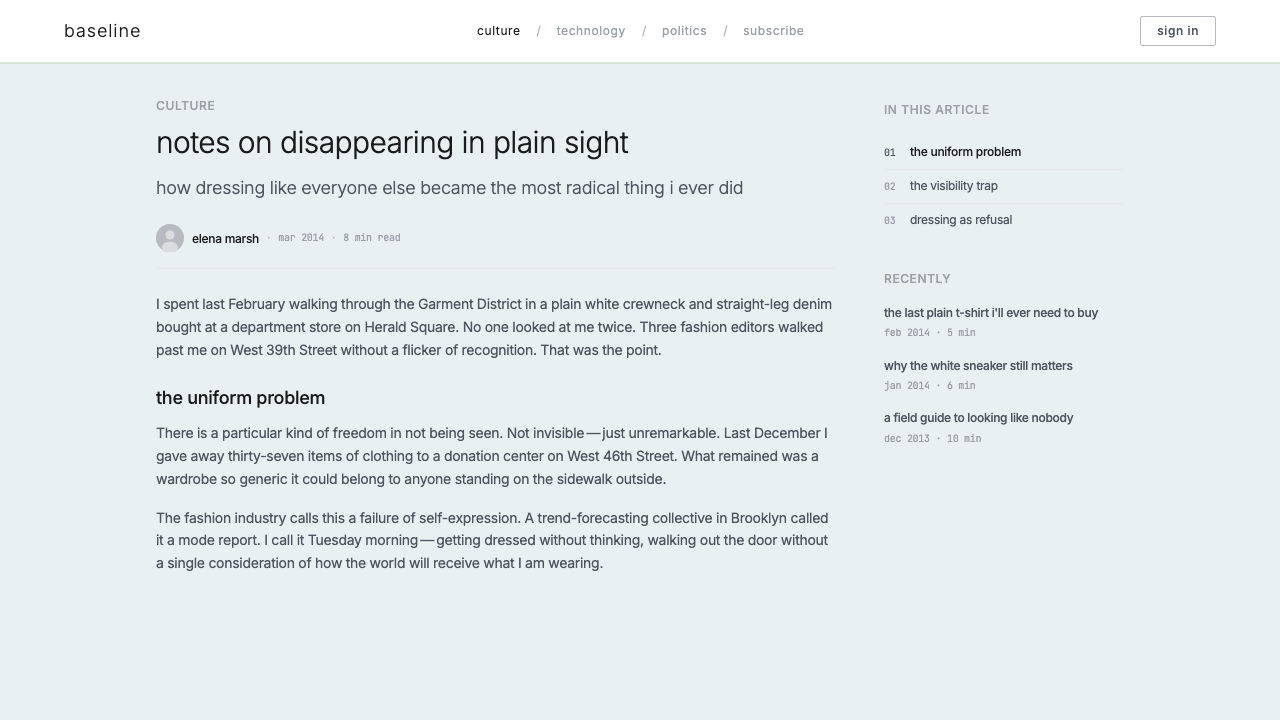
The normcore color range is deliberately undramatic: off-whites, pale grays, washed-out beiges, and the occasional muted pastel — mint, blush, or dusty lavender — deployed in small quantities. These are colors that do not compete with content. Accent colors, when they appear at all, are similarly muted: a slate blue annotation or a pale mint rule rather than a saturated pop of color. The effect is a visual temperature that reads as cool and institutional, similar to the palette of a scientific journal or a well-designed invoice.
Whisper-Weight Typography
Type is set at the lightest usable weight, conveying information without visual insistence. Body text is given room to breathe through generous line-height and comfortable measure; headlines are often only marginally larger than the text they introduce, relying on spacing and position rather than dramatic size contrast to establish hierarchy. The overall typographic register reads as functional, not expressive — it is closer to a government document than to a magazine.
Institutional Grid
The underlying structure in normcore work is orderly but not aggressive. Columns are regular, margins are generous, and elements align to a consistent rhythm without the kind of geometric precision that announces itself. The grid is felt rather than seen — it produces a sense of quiet organization without drawing attention to the organizational system itself. This differs from more rigorous grid-centric styles where the structure is part of the aesthetic statement.
Functional Flatness
Shadows, gradients, and texture are treated as noise rather than refinement. The aesthetic assumes that surfaces should be what they are — a background is flat, a card is flat, a button is flat — and that any simulation of depth or material richness detracts from the clarity of the content it frames. This flatness is not starkly geometric in the Bauhaus sense; it is more like the flat quality of a well-formatted plain-text document: everything is present, nothing is embellished.
Negative Space as Content
White space in normcore work is not merely the absence of content — it is deployed in amounts that actively communicate unhurriedness and confidence. A layout that uses twice the whitespace a conventional design would use signals that the content does not need to compete for attention; it assumes the reader will come to it. This use of space borrows from gallery and editorial conventions but strips away the luxury-brand associations those contexts usually carry.
Anti-Brand Iconography
When imagery or iconography appears, it tends toward the generic and unrefined: simple geometric indicators, unlabeled diagrams, or photographs of unremarkable everyday objects shot without art direction. The aesthetic avoids polished illustration, custom iconography, or any visual element that signals craft or originality. The aim is imagery that could plausibly have come from a stock library or a clip-art collection — chosen precisely because it makes no claim to uniqueness.
Legibility Over Expression
Every decision in normcore prioritizes the reader's ease over the designer's statement. Line lengths are comfortable, contrast is sufficient but not extreme, color is used sparingly enough that it retains informational value. Nothing competes with the text. This is a design ethic borrowed from technical writing and information design traditions, applied to contexts — marketing pages, presentations, editorial spreads — that would conventionally expect something more demonstrative.
Who shaped Normcore (2014)?
The New York-based trend-forecasting group founded by Sean Monahan, Emily Segal, and their collaborators. K-HOLE's *Youth Mode* report (October 2013) originated the normcore concept and gave it its theoretical framework: the idea that mass normality could be adopted not out of conformity but as a conscious rejection of differentiation culture. The group's reports were themselves exemplary design artifacts — distributed free as PDFs, formatted with deliberate institutional plainness, and positioned against the trend-forecasting industry's usual luxury-market assumptions.
The journalist whose 2014 New York Magazine piece, *Normcore: Fashion for Those Who Realize They're One in 7 Billion*, brought the K-HOLE concept to mainstream attention. Duncan's street-level observation — that a new mode of studied plainness was appearing in downtown Manhattan — translated an abstract theoretical proposition into something legible to a general audience. Her framing of the white sneaker and the fleece vest as loaded anti-fashion statements was instrumental in making normcore a widely understood cultural phenomenon.
Co-founder of K-HOLE and one of the primary authors of *Youth Mode*. Monahan's theoretical framing of normcore drew on concepts from sociology and cultural theory, arguing that the post-ironic embrace of mass culture was a more genuinely radical position than subcultural resistance. His subsequent writing and interviews elaborated the idea that normcore was fundamentally about adaptability — the capacity to fit in anywhere, to surrender the performance of distinctiveness, and to find that surrender liberating rather than diminishing.
Co-founder of K-HOLE whose background spanned art, branding, and cultural criticism. Segal brought a visual sensibility to the collective's work that was as important as the theoretical content: the PDF reports were carefully undesigned in a way that required active choices. Her subsequent work as a novelist and cultural commentator continued to explore the territory K-HOLE had mapped — the aesthetics of blankness, the cultural politics of refusal, and the strange appeal of the generic.
How do you use Normcore (2014) today?
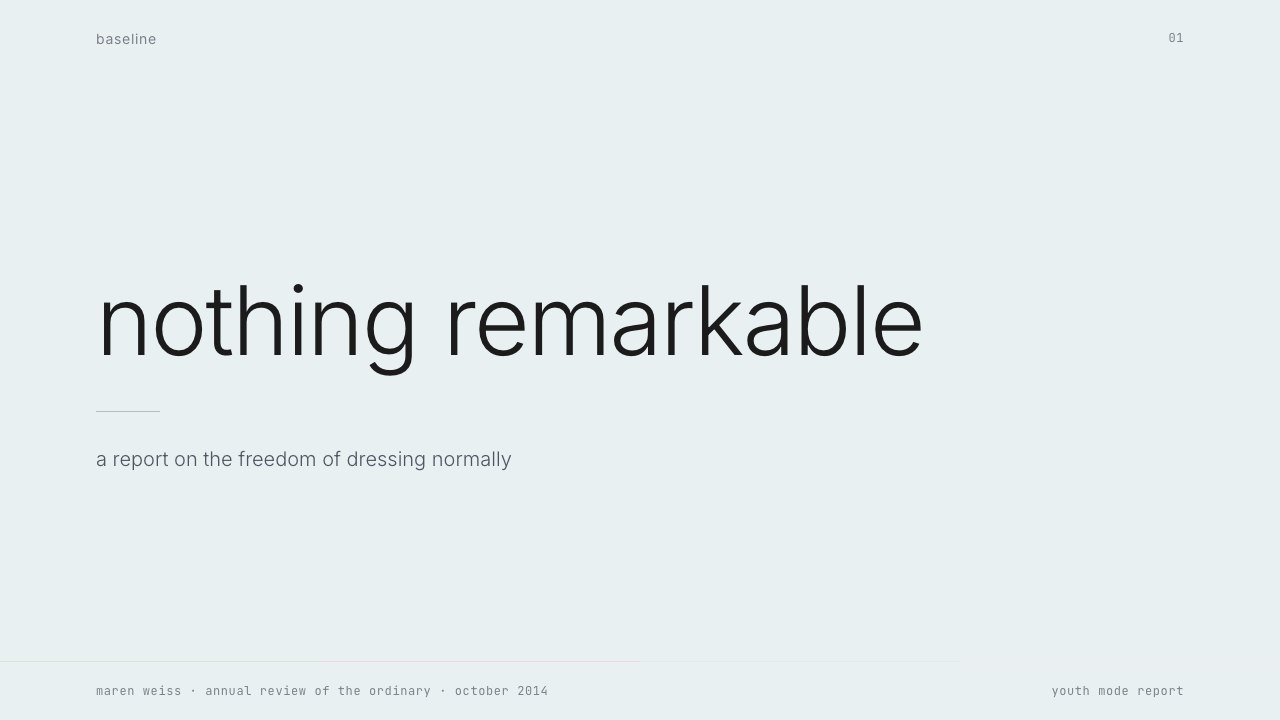
Normcore translates most naturally into contexts where the content is the authority and the design is expected to stay out of the way. This makes it well-suited to presentation slides where the credibility of the argument should not be undermined by visual theatrics. Cover slides work through studied quietness: a single short title in light-weight type against a large field of off-white, perhaps accompanied by a muted-palette rule or a small institutional logotype. Content slides benefit from the style's bias toward legibility — wide margins, comfortable reading measure, and hierarchies established through spacing rather than decoration. Data slides take on a documentary quality: charts are rendered with minimal stylistic intervention, labels are plain, and color is used only to distinguish categories rather than to make the visualization feel designed.
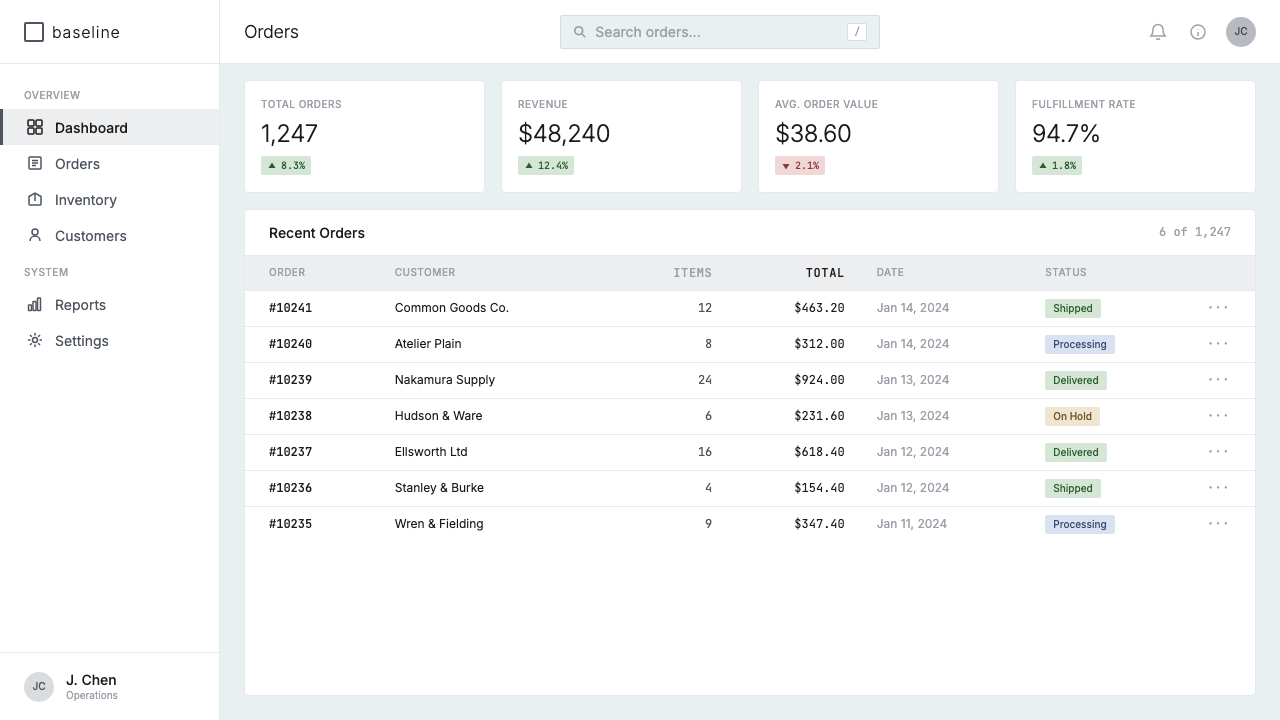
For web interfaces, the style is particularly effective on dashboards, documentation pages, and pricing tables where users need to scan and extract information quickly. The approach calls for a near-white or light gray background, body text in a neutral weight that reads effortlessly at extended lengths, and interactive elements — buttons, form inputs, toggles — that announce their function through position and label rather than through color or shadow. Navigation is typographic: links and labels without icon decoration. The result is a product that communicates competence through restraint, appropriate for developer tools, data platforms, and SaaS products aimed at professional users.
In editorial and marketing contexts, normcore works well for brands and publications that want to position themselves as intelligent, considered, and independent of trend cycles. A feature article layout in this register uses a wide-margin column format, section breaks marked by a single light rule, and pull quotes set at the same weight as body text — distinguished by their isolation in the white space rather than by any decorative treatment. Marketing pages can use the style's institutional coolness strategically: a hero section that makes its case with a single clear sentence in understated type, followed by organized content that trusts the reader to engage with the argument.
Applied to brand identity and visual systems, normcore supports organizations that want visual consistency without overt personality — research institutes, independent publishers, technology platforms that want to seem tool-like rather than consumer-facing. The system relies on typographic discipline and spatial consistency rather than a distinctive color palette or proprietary illustration style. Identity elements are plain enough to feel almost undesigned, which paradoxically makes them more durable: they do not become dated because they never claimed to be of a particular moment.
The most common mistake when applying normcore is treating neutrality as permission for sloppiness. The style requires exact spacing, careful hierarchy, and a deliberate relationship between elements; without that precision, the result reads not as confident restraint but as inattention. A second common error is introducing too many competing neutral tones — when three or four shades of beige and gray appear without clear relational logic, the visual field becomes muddy rather than calm. Normcore works best when the palette is edited to the fewest tones necessary and each is given a specific functional role.
Normcore (2014) — FAQ
Is normcore just minimalism with a different name?
The two share aesthetic territory but differ in motivation. Minimalism, as a formal design tradition, values the reduction of elements as an end in itself — the goal is elegance, purity, or formal resolution. Normcore's plainness is motivated by a cultural argument: it is a refusal of the performance of taste, not a pursuit of perfection. Minimalism often feels aspirational and expensive; normcore is deliberately adjacent to the generic and the institutional. A minimalist poster is trying to be beautiful. A normcore document is trying to look like it is not trying.
Can normcore work for a consumer brand, or is it only suited to B2B products?
It can work in consumer contexts, but the fit is specific. Normcore aesthetics suit consumer brands that want to signal intelligence, independence, or a deliberate rejection of trend-chasing — certain book publishers, independent food producers, personal finance tools, or brands positioning themselves against the noise of heavily marketed competitors. It struggles for brands that need warmth, sensory richness, or emotional accessibility: children's products, food categories where appetite appeal is paramount, or wellness contexts where softness and care are the primary signals.
How does normcore relate to the Swiss International Style or other grid-based approaches?
Swiss International Style uses similar tools — strict grids, neutral sans-serif type, generous white space — but in service of a universalist ambition: the belief that rational design systems could communicate objectively across cultures and contexts. The style is visibly precise and proudly systematic. Normcore, by contrast, is not trying to be a universal system; it is mimicking the look of things that were never designed as systems at all — the plain document, the institutional form, the unambitious template. Swiss Style is disciplined; normcore aspires to look like it was not thinking about design at all.
Why does normcore feel contemporary even though the concept is from 2013–2014?
Because the conditions that produced it have intensified rather than faded. The attention economy has become more demanding, platform visual culture more saturated, and the pressure on individuals and organizations to maintain a distinctive visual identity more relentless. Against that backdrop, the choice to appear undesigned, institutional, or generically plain reads as increasingly deliberate and even legible as a form of critique. Normcore did not peak and recede as a trend; it evolved into a persistent mode that aligns with how many digital-native organizations — particularly those in technology, research, and publishing — choose to present themselves.
What is the biggest risk when using a normcore aesthetic?
The biggest risk is that the restraint reads as absence of effort rather than abundance of confidence. A normcore layout done without precision becomes simply plain — uninviting and forgettable rather than pointedly understated. The style has no decorative elements to fall back on when the spacing is off or the hierarchy is unclear; its entire communicative weight rests on invisible decisions about proportion, spacing, and type treatment. This means normcore demands more typographic skill, not less, even as it looks simpler than more ornamented alternatives.
Related design styles
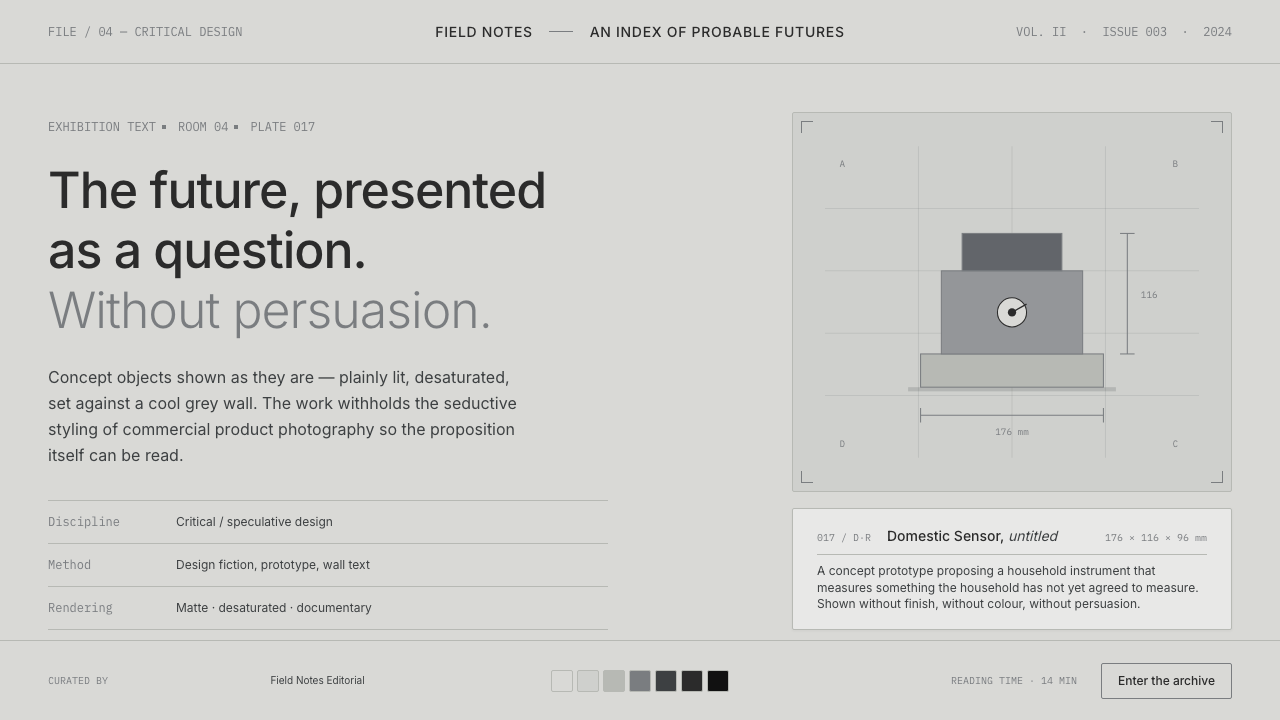 Speculative DesignRefuses to seduce. Cool-grey wall, Inter labels, matte concept objects — the…
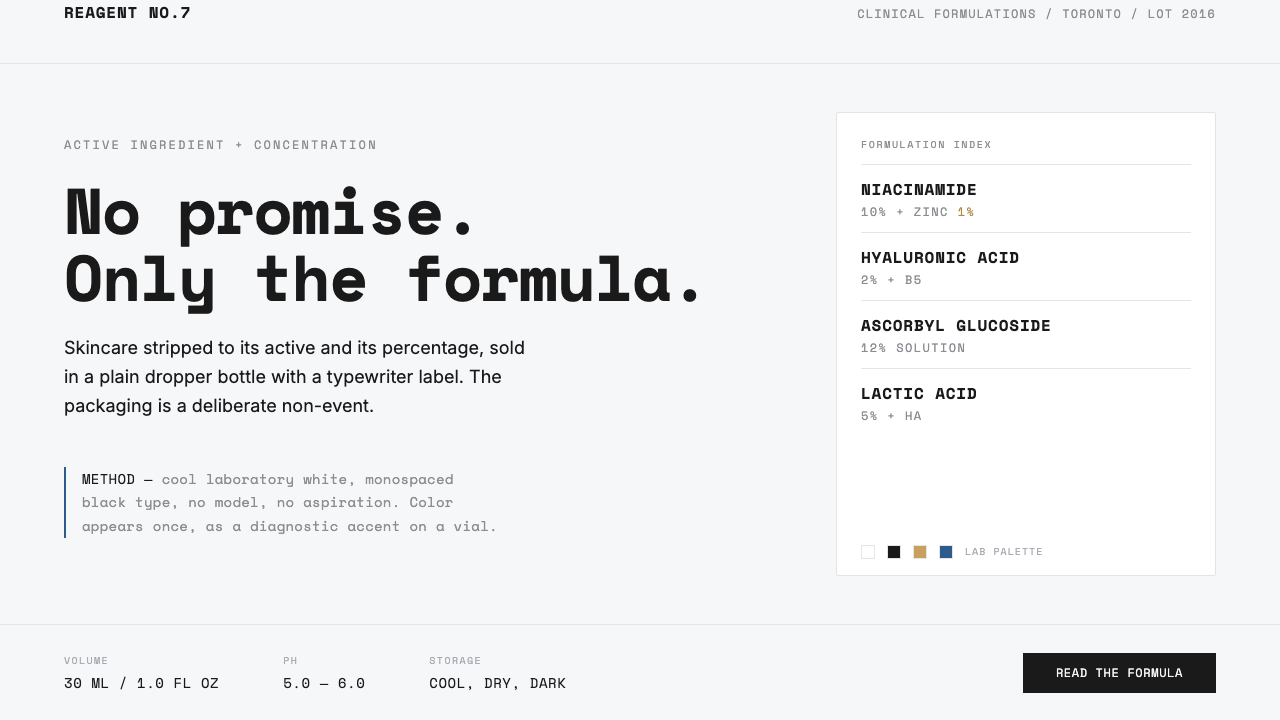 The OrdinaryNo promise, only the formula. Cool lab white, Space Mono labels, color as rar…
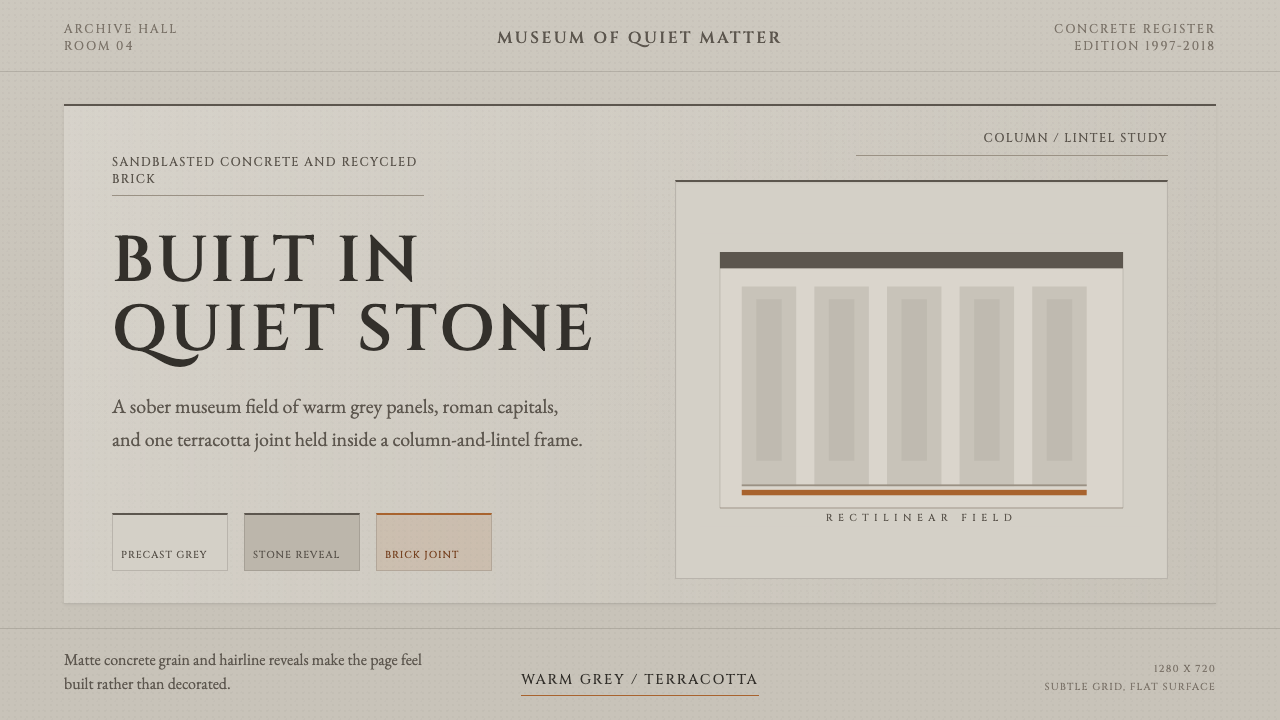 Chipperfield Museum GrayMuseum gravity, rendered quietly. Warm concrete grey, roman capitals, one ter…
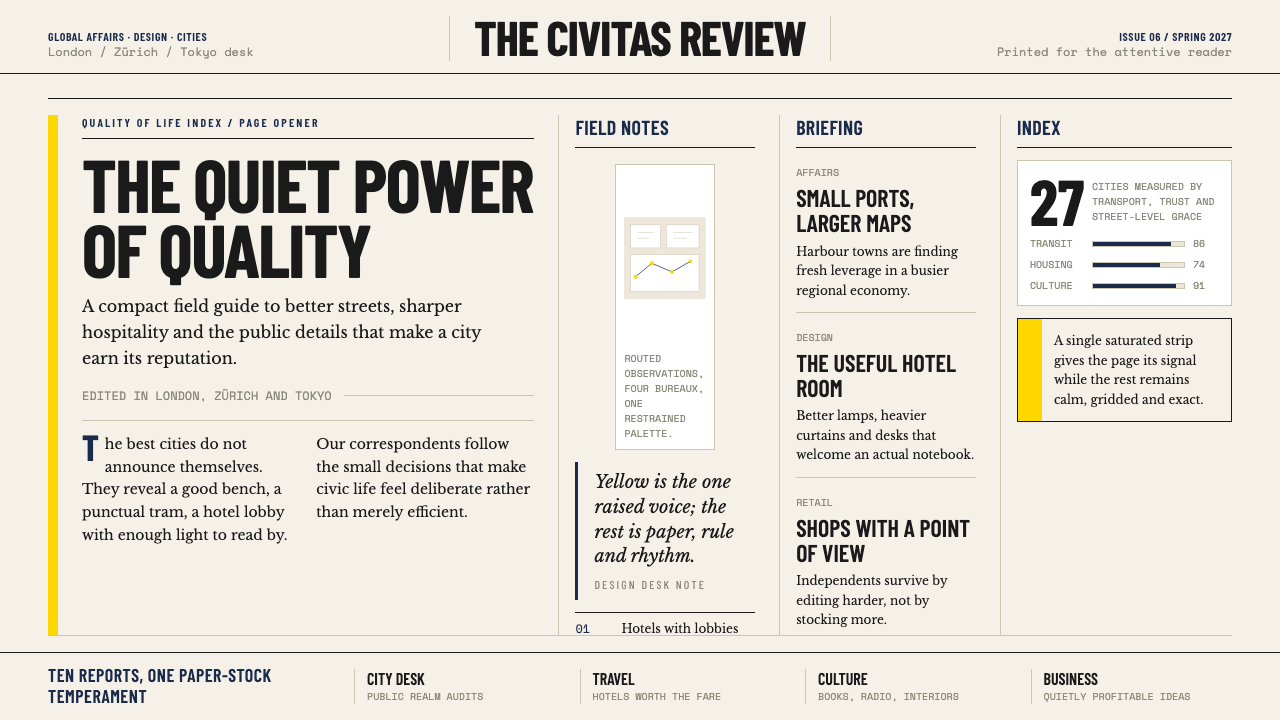 Monocle MagazineQuiet authority. Yellow spine, warm paper and dense ruled columns speak at li…
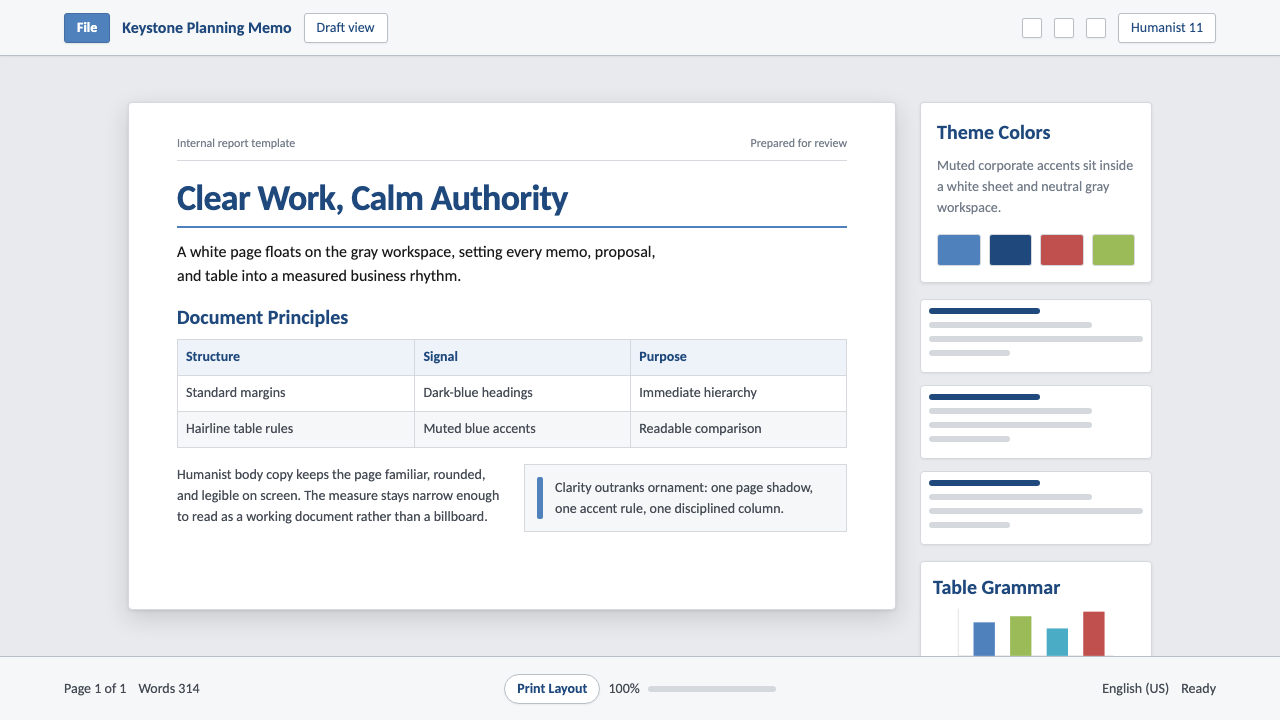 Office DocumentQuiet authority. White page sheet, muted blue rules, and humanist-sans rhythm.
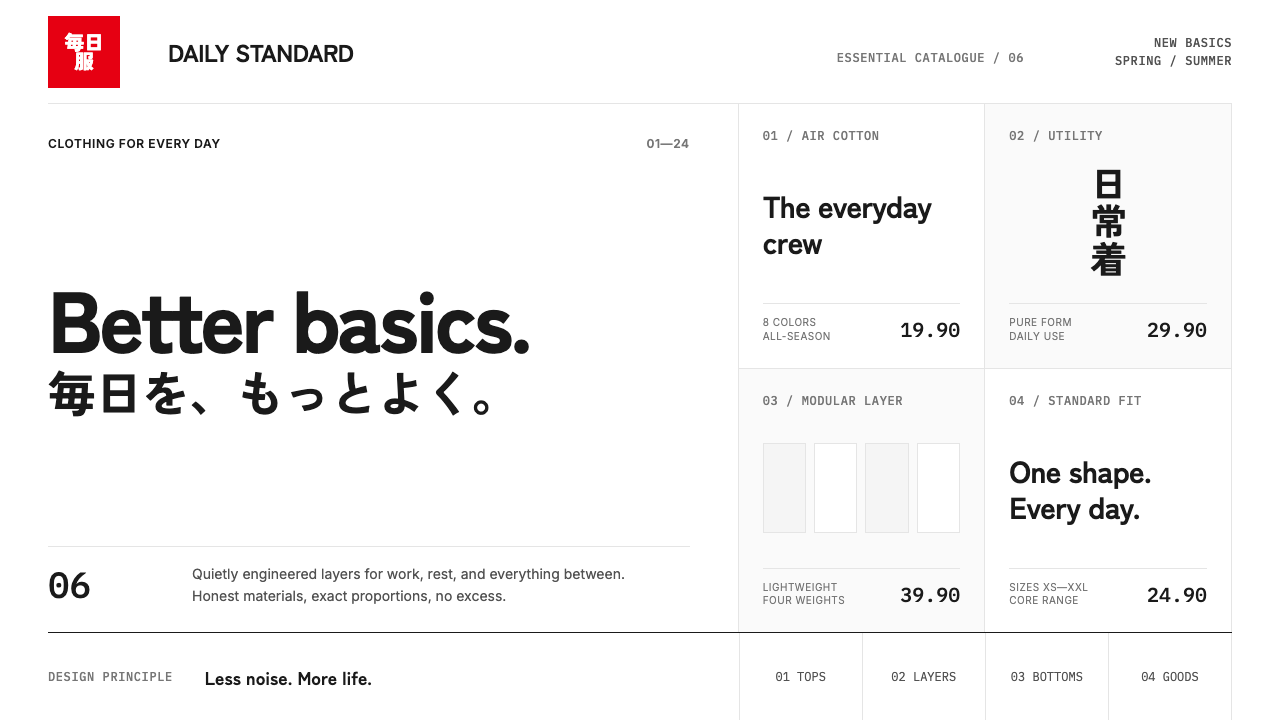 UNIQLO LifeWear (2006)Whitespace is the product. A hard modular grid and one rationed red square en…