What is Müller-Brockmann Swiss?
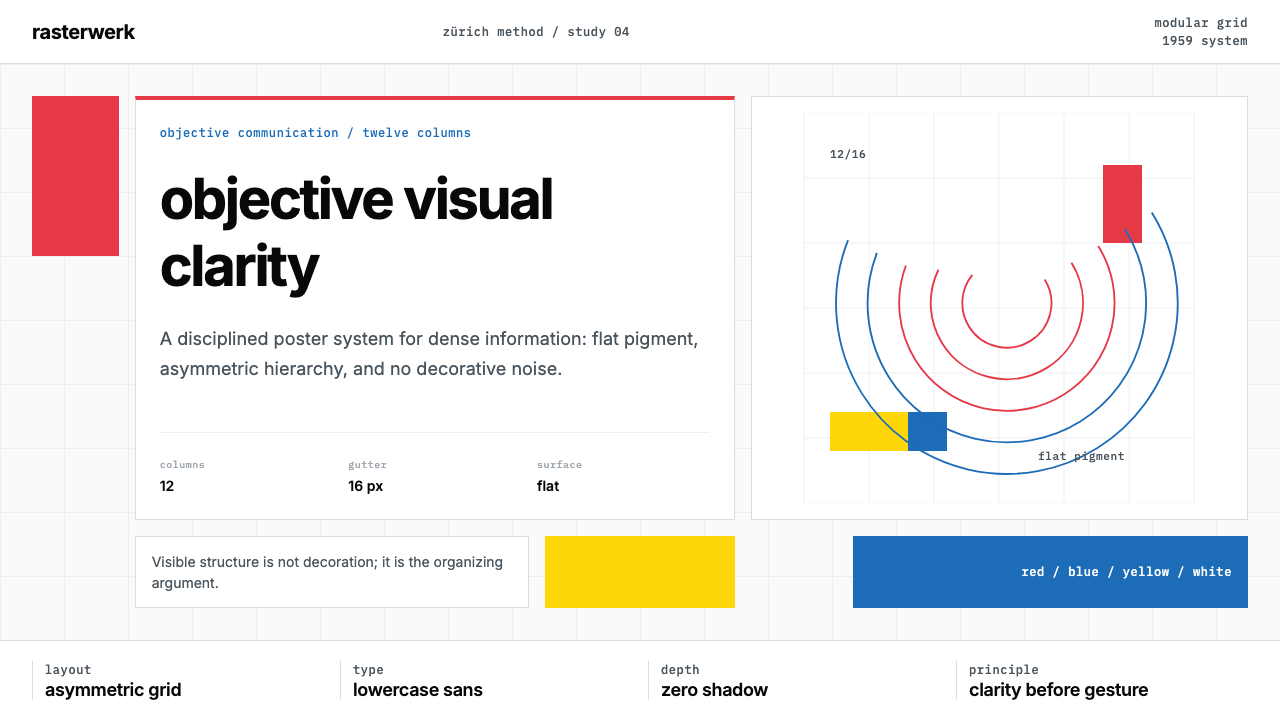
Müller-Brockmann made the grid visible — and in doing so, turned rational structure itself into a form of beauty.
Müller-Brockmann Swiss in brief
Swiss International Style, as codified by Josef Müller-Brockmann and his contemporaries in Zürich during the 1950s and 1960s, is the most disciplined and systematically articulated visual language in the history of modern graphic design. Built on the conviction that communication should be objective, clear, and free of personal expression or decorative caprice, it treats the typographic grid not as a background constraint but as the fundamental content of design itself.
Where earlier modernisms — including the Bauhaus — operated on intuition shaped by principle, Swiss Style aspires to method: every spacing decision traceable to the module, every typographic choice reducible to a small number of sanctioned relationships. The result is a visual language that appears calm and inevitable, as though the design could not have been arranged any other way. Asymmetric compositions achieve balance through mathematical proportion rather than visual guessing; text aligns to baselines and columns with millimetric consistency.
The visual vocabulary is spare: a near-white or absolute white ground, a single dominant sans-serif typeface, one or two saturated flat color accents against white, and the occasional use of concentric geometric arcs or ruled lines as structural — never decorative — devices. Photography, when present, is cropped to fit the grid precisely. Nothing floats free. Every element is positioned, measured, and justified.

Where does Müller-Brockmann Swiss come from?
The movement that would become Swiss International Style emerged from two parallel schools in postwar Switzerland: the Zürich school, centered on practitioners like Müller-Brockmann, and the Basel school, anchored by Armin Hofmann and Emil Ruder at the Basel School of Design. Both schools shared the conviction that visual communication could and should be elevated into a principled discipline, but the Zürich practitioners tended toward the poster and the public commission, while Basel emphasized typographic theory and pedagogy. Their combined influence made Switzerland the undisputed center of global modernist design through the 1960s and 1970s.
Josef Müller-Brockmann was born in Rapperswil in 1914 and trained in Zürich as a graphic designer and illustrator. His breakthrough came with the series of concert posters he produced for the Tonhalle Zürich, the city's principal concert hall, beginning in the early 1950s and continuing through 1972. These posters — most famously the Musica Viva series — are among the most analyzed artifacts in the history of graphic design. They employ concentric arcs of varying weight and density to evoke the acoustic experience of music, organizing those arcs with a mathematical precision that the viewer intuits even without measuring. The posters made visible something that had previously been felt but rarely demonstrated: that a rigorous geometric system could generate compositions of genuine expressive power.
The theoretical framework behind the practice was laid out in two landmark publications. The journal Neue Grafik, which Müller-Brockmann co-founded with Richard Paul Lohse, Josef Müller-Brockmann, Hans Neuburg, and Carlo Vivarelli in 1958, published the movement's principles in German, English, and French simultaneously, establishing an international audience. Then in 1961, Müller-Brockmann published The Graphic Artist and His Design Problems, a systematic account of his method. His definitive statement came twenty years later with Grid Systems in Graphic Design (1981), which remains in print and remains the single most cited technical reference in professional typographic practice worldwide.
The broader context was a postwar Switzerland that was simultaneously rebuilding its export economy and positioning itself as a neutral international forum. Swiss corporations — pharmaceutical, chemical, watch-making, financial — needed a visual identity that could communicate credibility and precision to audiences across language and cultural barriers. The clear, grid-governed, internationally legible aesthetic of Swiss Style was a direct answer to that demand. Karl Gerstner's work for Geigy pharmaceutical and Müller-Brockmann's corporate campaigns demonstrated that the same principles that produced beautiful concert posters could produce equally coherent annual reports and product branding — a proof of universality that confirmed the style's dominant position through the end of the twentieth century.
What defines the Müller-Brockmann Swiss look?
The Mathematical Grid
The grid in Swiss Style is not a guide or a suggestion — it is the architecture of the page. Müller-Brockmann advocated for a modular grid whose proportions are calculated before a single element is placed, with column widths, gutter measurements, and row intervals all derived from a shared unit. Every element — headline, body text, caption, photograph, rule — aligns to this structure. The visible order that results is not imposed on content but generated from within it.
Typographic Hierarchy by Measure
In Swiss Style, hierarchy is established through size and weight differentials within a single typeface family, not through multiple faces or decorative devices. A headline sits at a significantly larger scale than subheadings, which sit at a significantly larger scale than body text. Each step in the hierarchy is deliberate and mathematically proportional. Color is rarely used to distinguish hierarchy — structure and scale do the work that decoration performs elsewhere.
Flat Saturated Accents on White
The characteristic color gesture of Swiss Style is a field of saturated, unmodulated color — typically a strong red or a clear blue — placed as a flat block against a white or near-white ground. There are no gradients, no tints, no shadows within the color field itself. The saturation is high enough that the color reads as a structural element, not as decoration. Secondary palettes are rare; the accent color chosen for a given project is typically used consistently throughout, reinforcing system coherence.
Geometric Structural Elements
Müller-Brockmann's most distinctive contribution beyond the grid is the use of concentric arcs, ruled horizontal lines, and bold geometric shapes as expressive structural devices. In his concert posters, concentric arcs of increasing density create a sense of acoustic accumulation — structure that also carries meaning. In more strictly typographic work, a single bold rule or a pair of vertical lines can organize a layout and carry visual weight without any decorative intent. Geometry is always working, never simply present.
Objective Typography
Emil Ruder and Müller-Brockmann both argued that typography should be neutral enough to communicate content without calling attention to itself. The typeface should have no personality that competes with the message. This led Swiss practitioners to favor clean, upright, geometrically regular sans-serif letterforms — typefaces that read as institutional rather than expressive. Text is set with even word spacing and careful tracking; rivers in justified setting are considered a failure of craft.
Photography as Grid Element
When photography enters Swiss Style layouts, it is treated as a rectangular block that occupies grid columns precisely, with no feathered edges, no vignettes, no free-form cropping. High-contrast black-and-white photography was preferred for its graphic clarity and its compatibility with the surrounding typographic elements. Color photography, when used, is cropped and scaled to fit the module, not the other way around. The photograph is a structured element, subject to the same discipline as the text.
Total Rejection of Ornament
Swiss Style carries forward the Bauhaus anti-ornament position and applies it with even greater consistency. Decorative borders, flourishes, illustrative ornaments, gradient backgrounds, and drop shadows that exist purely to add visual interest are entirely absent. Where a border appears, it is a structural rule — marking a boundary that the grid requires. Where a line appears, it is a grid line made visible. The discipline is not aesthetic minimalism in the contemporary sense; it is an ethical position about the purpose of design.

Who shaped Müller-Brockmann Swiss?
Müller-Brockmann (1914–1996) is the central figure of the movement. His concert posters for the Tonhalle Zürich — particularly the Musica Viva series produced between 1950 and 1972 — became canonical demonstrations that mathematical structure and visual emotion were not opposites. His books, including The Graphic Artist and His Design Problems and Grid Systems in Graphic Design, systematized the method and gave it an international audience. His insistence that design should serve communication rather than express the designer's personality remains the defining ethical position of the Swiss school.
Hofmann taught at the Basel School of Design from 1947 and developed a parallel pedagogical tradition that placed equal emphasis on visual tension, contrast, and the expressive potential of the letter as form. His 1965 book Graphic Design Manual: Principles and Practice is the Basel counterpart to Müller-Brockmann's grid publications — rigorous, systematic, and deeply committed to the idea that visual training precedes stylistic preference. Hofmann's influence spread globally through the many international students he trained, including American designers who brought Basel methodology to Yale and other institutions.
Ruder was Hofmann's colleague at Basel and the movement's leading typographic theorist. His 1967 book Typography: A Manual of Design argued that type's purpose was the communication of language, and that any typographic decision that impeded reading — through decorative distraction, inconsistent spacing, or visual noise — was a failure of purpose. Ruder's analysis of white space as an active element, not an absence, was particularly influential, and his thinking about the relationship between typeface, column width, and reading rhythm continues to underpin serious typographic practice.
Gerstner was the movement's most systematic thinker. His 1964 book Designing Programmes proposed that graphic design problems could be solved through the construction of a program — a rule-set that generates all valid solutions rather than prescribing a single answer. He applied this thinking to corporate identity work for companies including Geigy pharmaceutical, demonstrating that the Swiss method scaled from the single poster to the complex multi-application brand system. Gerstner's work bridges Swiss Style and the later development of design systems methodology in digital product design.
Lohse was a painter and graphic designer who co-founded the journal Neue Grafik with Müller-Brockmann in 1958. The journal, published simultaneously in three languages until 1965, was the primary vehicle through which Swiss Style reached an international professional audience. As a painter, Lohse developed serial and modular color systems that paralleled the movement's typographic concerns — demonstrating that the same systematic thinking applied equally to fine art and commercial design, a continuity the Swiss school held as a matter of principle.
How do you use Müller-Brockmann Swiss today?
Swiss International Style is one of the most reliable and transferable visual systems for contemporary professional design, because its underlying logic — grid before decoration, hierarchy through measure, one strong accent against white — produces legible, authoritative results across an unusually wide range of applications. Applying it correctly, however, requires internalizing the method, not borrowing the surface. The test is always whether the structure could be explained in systematic terms: if elements are placed by eye rather than by module, the system is being imitated, not applied.
For presentation slides, the Swiss method produces results that are simultaneously bold and calm. A cover slide benefits from a single large geometric element — a bold horizontal band of saturated color, or a field of concentric arcs — anchoring the composition while a left-aligned title in a single weight occupies the upper portion of the grid. Content slides should be strictly columnar: text blocks occupy one, two, or three columns with no orphaned elements; a single strong rule or thin line can separate sections where vertical rhythm demands it. Data visualization slides become their own form of grid: bar charts whose bar widths correspond to column widths, pie charts reduced to clean circular arcs, all labeled in a single typeface at two sizes only.
For web user interfaces — particularly dashboards, analytics tools, pricing pages, and documentation systems — the Swiss method translates directly into component architecture. Define a twelve-column grid and make it the single source of spatial truth. Backgrounds should be white or very near white; all body text in a dark neutral; one saturated color reserved exclusively for interactive states, selected values, and primary calls to action. Cards and containers are bordered or elevated with a minimal structural shadow rather than the ambient soft shadows common in consumer interfaces. Navigation is typographic, not icon-driven: labels at consistent weight and scale, with visual emphasis created by size and position rather than color or decoration.
For editorial layouts and marketing materials, the Swiss system provides what most editorial design lacks: genuine hierarchy. A long-form article layout built on Swiss principles uses a narrow primary text column, a wide outer margin reserved for pull quotes, captions, and section markers, and section breaks marked by a single bold rule rather than decorative ornament. Full-width feature blocks — alternating between a white ground with dark type and a saturated accent ground with reversed type — create rhythm without novelty. Marketing pages derive poster-like impact from disciplined restraint: one primary message, one saturated color accent, one typographic scale differential between headline and supporting text.
The most common mistake when applying Swiss Style is mistaking cleanliness for emptiness and compensating with additional elements. The white space in a Swiss layout is not wasted space — it is structural space, held in reserve to give the weighted elements their authority. A second common error is applying the style's rationalist surface without its underlying grid: aligning elements visually rather than mathematically produces layouts that look like Swiss Style from a distance but lack its characteristic inevitability up close. A third mistake is using the accent color in too many roles — as background, as type color, as border, and as button state simultaneously. The accent color works because it is rare; multiplying its uses dilutes exactly the contrast that makes it effective.

Müller-Brockmann Swiss — FAQ
How is Swiss International Style different from Bauhaus?
Bauhaus and Swiss Style share the rejection of ornament and the commitment to sans-serif typography, but they operate differently and feel different. Bauhaus is bolder, more symbolic in its color use, and more willing to use primary colors expressively — its work often has a confrontational, political energy. Swiss Style is more systematic, more typographically rigorous, and more committed to the mathematical grid as a precondition for every layout decision. Where Bauhaus designs feel composed, Swiss designs feel constructed. Swiss Style is also more neutral in color: it uses color to structure, not to symbolize, and it incorporates photography in a way that Bauhaus practice rarely did.
Does Swiss Style require photography, or can it work purely typographically?
Swiss Style works equally well — and often more powerfully — without photography. Müller-Brockmann's most celebrated work, including the Musica Viva concert poster series, is almost entirely typographic and geometric, with no photographic content. The style's grid-based discipline and its use of geometric structural elements provide more than enough visual material for a complete composition. Photography, when included, must be disciplined enough to behave as a grid element; if the available photography does not meet that standard, working without it produces more coherent results.
Can Swiss Style accommodate more than one accent color?
Historically, Swiss Style work tends to commit to a single accent color per piece or per campaign, and that restraint is part of what gives the accent its structural power. Two accent colors are possible but require careful management: they should be used to mark a genuine categorical distinction — primary action versus secondary information, for instance — not simply to add visual variety. Using two saturated colors without a clear semantic reason undermines the clarity that the style exists to produce. Three or more accents move the work away from Swiss Style and toward a different visual logic entirely.
Is Swiss Style suitable for brands that want to feel warm or approachable?
Swiss Style is not naturally warm. Its white grounds, mathematical spacing, and objective typography communicate precision, authority, and rational clarity — values that suit financial, analytical, pharmaceutical, technical, and educational contexts very well. For brands where the primary emotional register is warmth, softness, or organic human presence — food, wellness, children's products, community-oriented services — the style's rationalist severity tends to create a mismatch between visual tone and brand promise. It is possible to soften Swiss Style slightly through more generous spacing and a warmer accent color, but the underlying structure remains cool; brands that need genuine warmth are usually better served by a different visual system.
What makes a Swiss Style application feel authentic versus superficial?
Authentic Swiss Style work has a quality of inevitability: every element feels as though it could not be placed anywhere else. This quality comes from building the layout on a genuine modular grid and making every sizing and spacing decision in relation to that grid — not from choosing the right typeface or the right color. The superficial version has the visual markers — white ground, sans-serif type, a saturated block — but the spacing is arbitrary, the proportions are inconsistent, and the overall composition lacks the internal logic that makes the style feel resolved rather than assembled. The discipline required is mostly invisible in the finished work, which is precisely what makes it hard to fake.
Related design styles
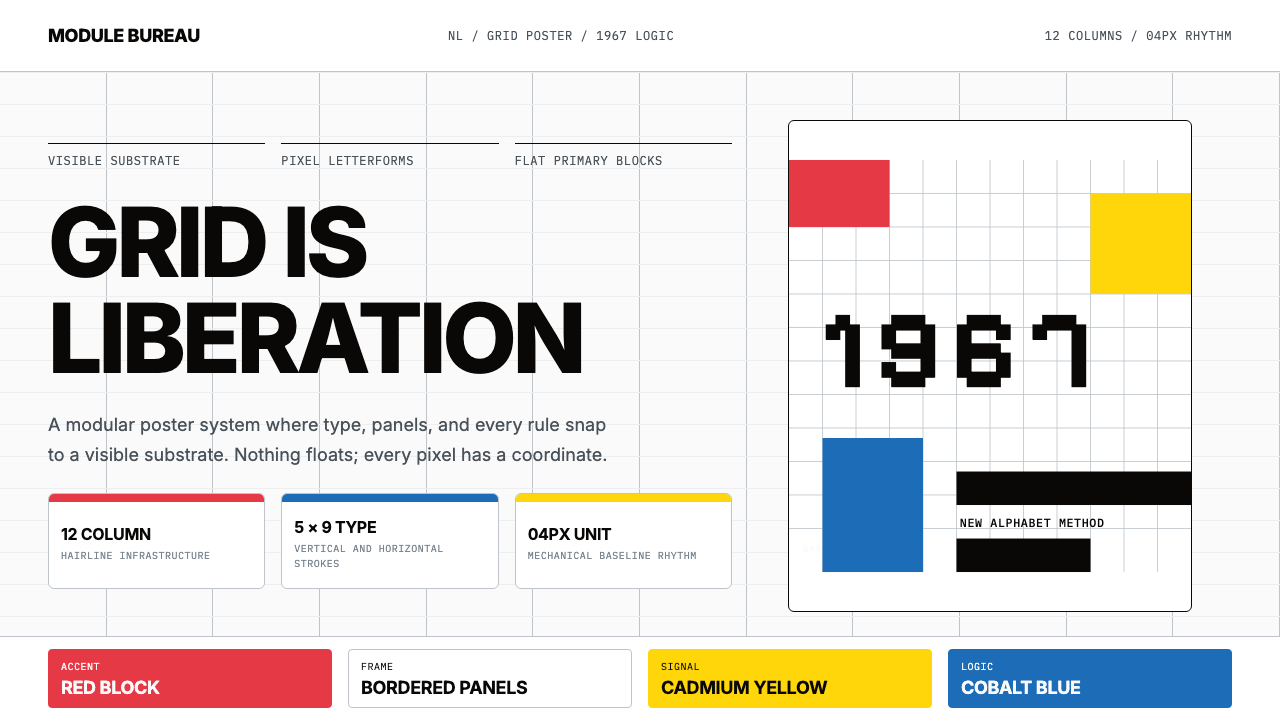 Wim Crouwel GridGrid becomes freedom. Cobalt, red and yellow blocks lock Inter type to a 12-c…
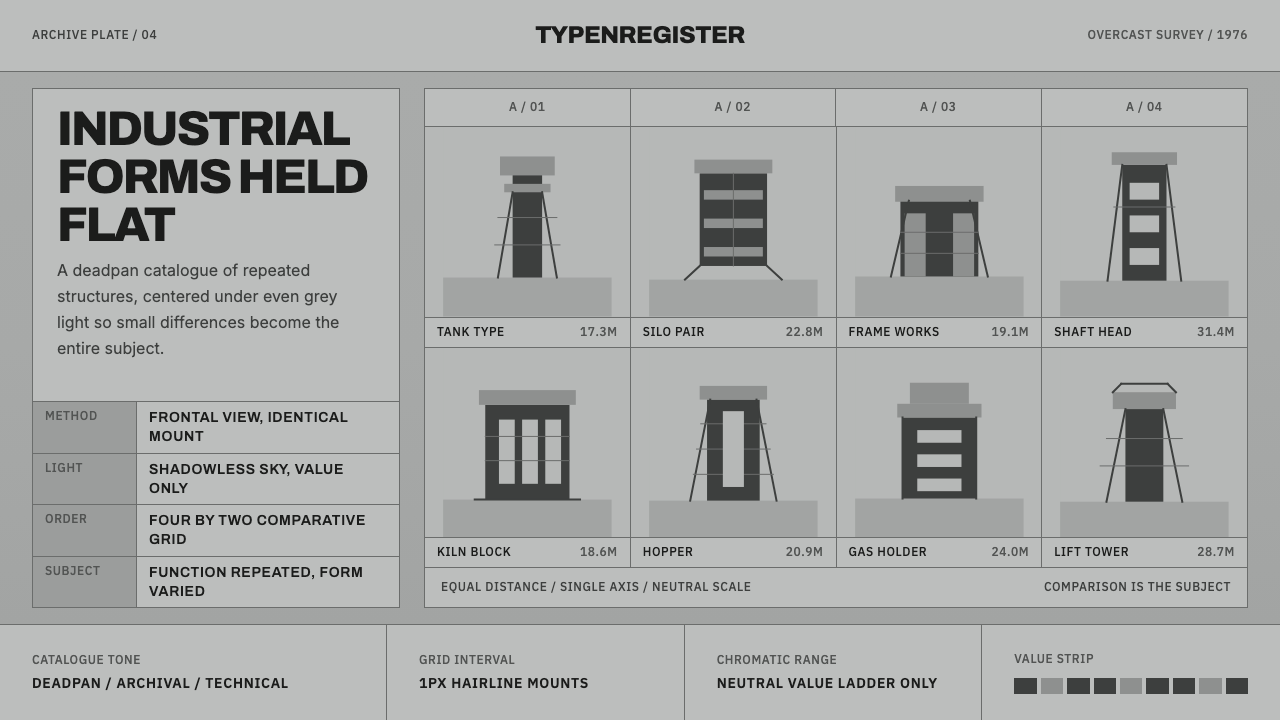 Bechers Industrial TypologyDeadpan order. Mid-grey ground, Archivo labels, and strict hairline grids rev…
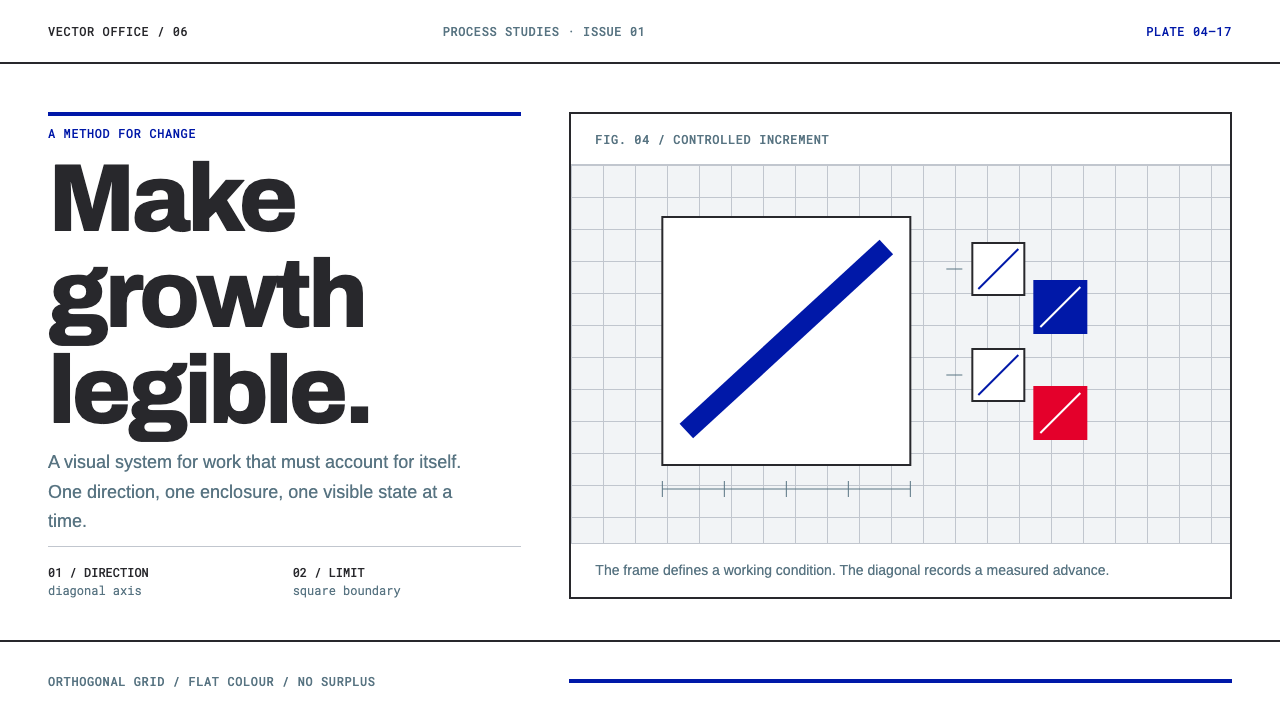 Anton Stankowski ConstructiveProcess becomes visible. Flat blue diagonals and hard square rules make chang…
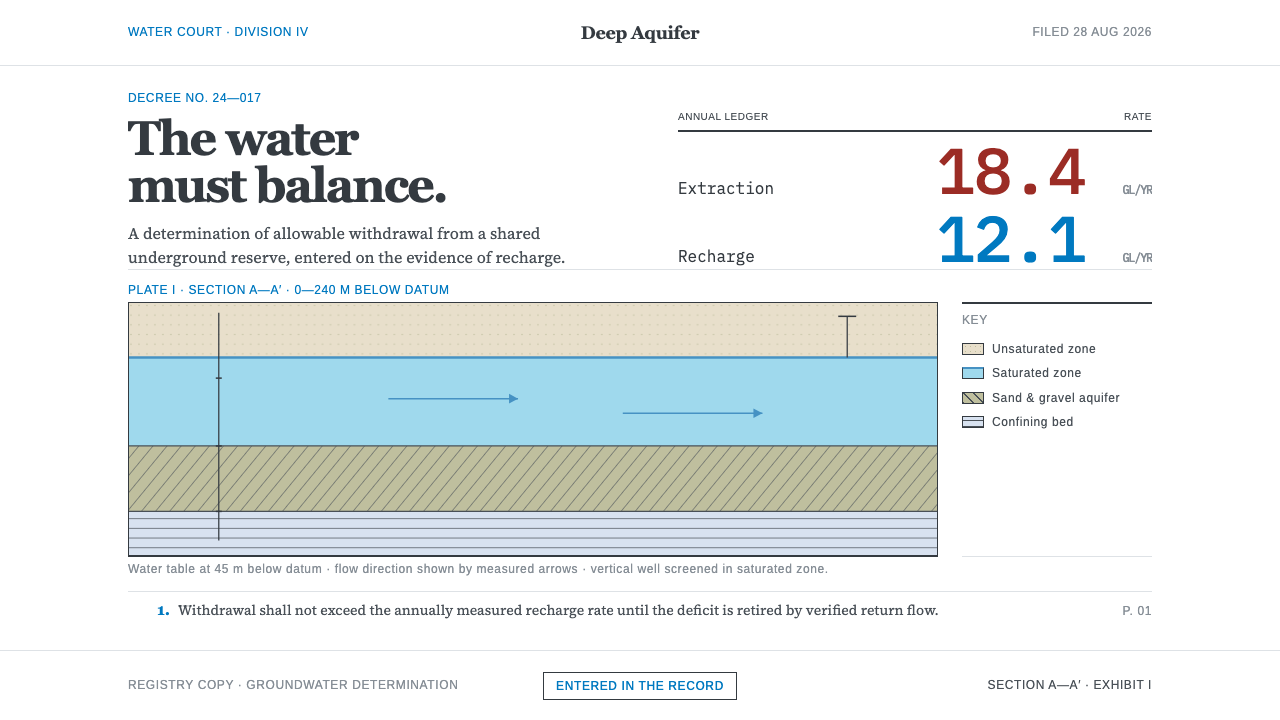 Deep Aquifer Water CourtRestraint makes the deficit undeniable. White bond, book serif, and a keyed a…
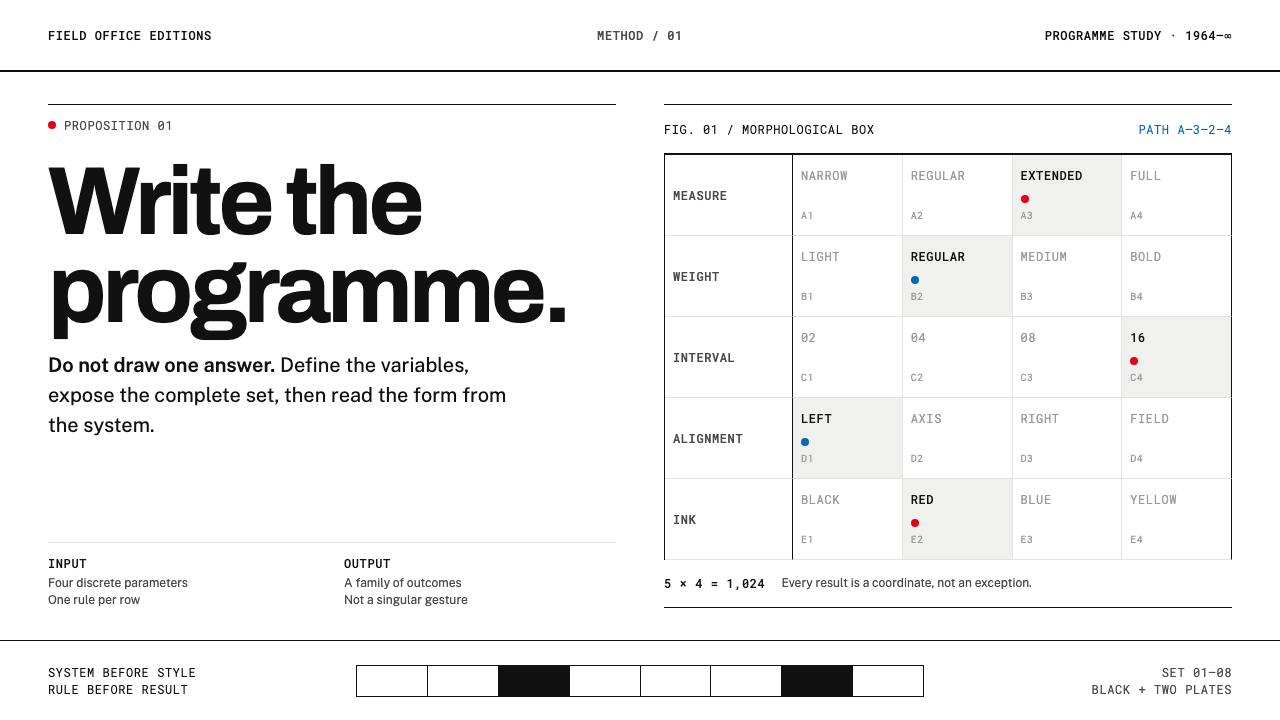 Karl Gerstner ProgrammesDesign becomes a programme. Black hairlines and a strict matrix turn paramete…
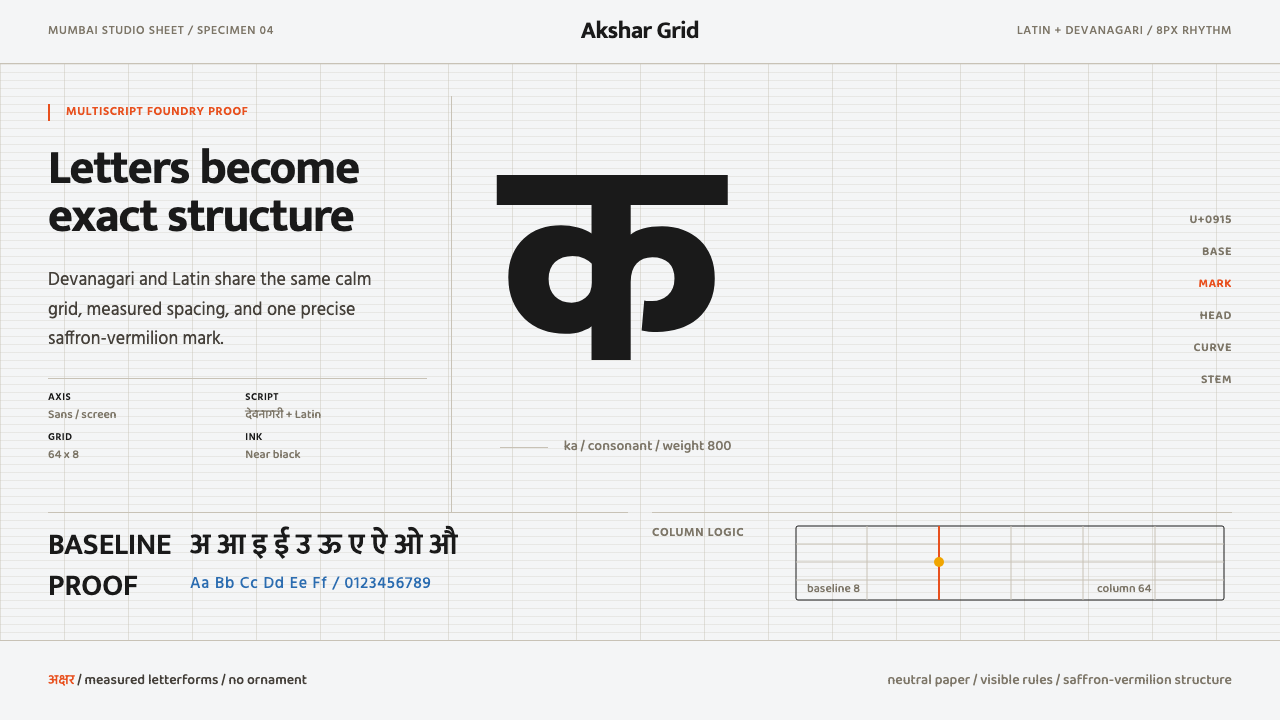 Modern Devanagari TypeType is the subject. Warm off-white grid, giant glyphs, one saffron-vermilion…