What is Wim Crouwel Grid?
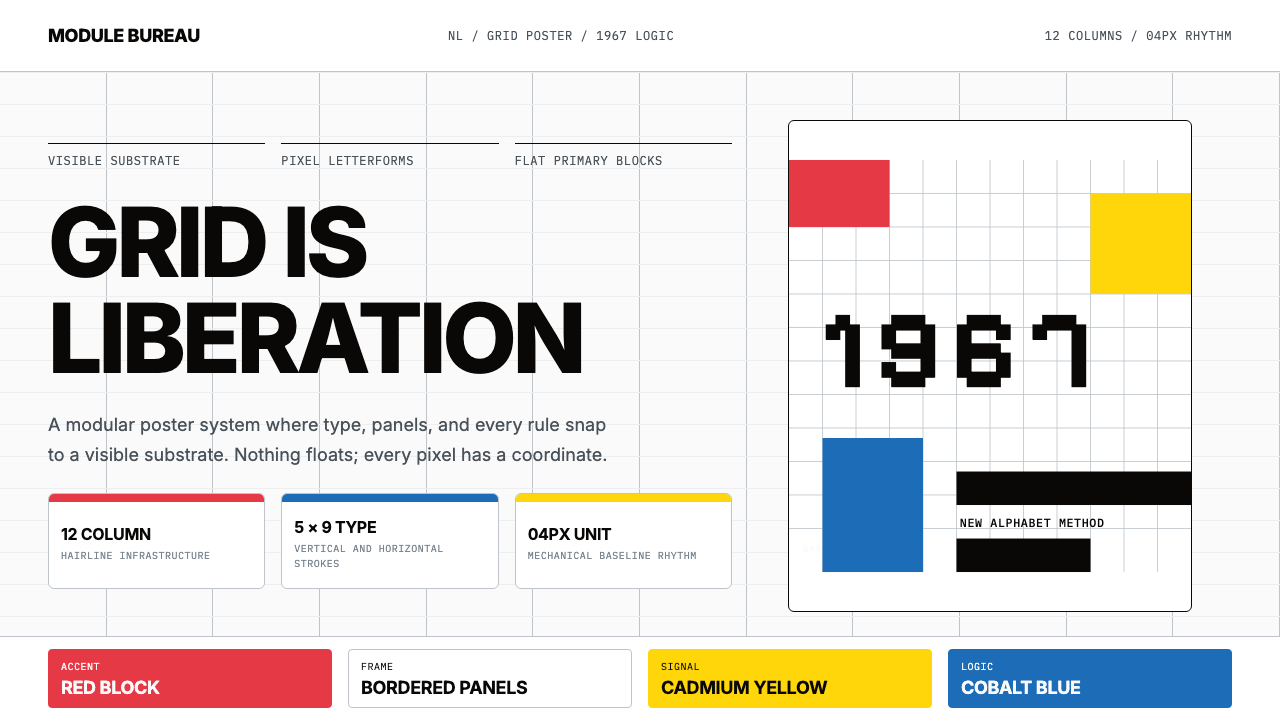
Wim Crouwel turned the grid from a tool into a conviction — proving that absolute structure, far from imprisoning a designer, is the only thing that sets one free.
Wim Crouwel Grid in brief
The Wim Crouwel Grid style is a design system rooted in the Dutch modernist tradition of the 1960s and 1970s, built around the principle that every element on a surface — type, color, rule, margin — must submit to a single underlying geometric order. It inherits from Crouwel's decade-long collaboration with the Stedelijk Museum in Amsterdam, where he produced catalogues, posters, and announcements of extraordinary disciplinary consistency: strict column grids, weight-bearing white space, flat saturated primary accents deployed with surgical economy, and typography treated as a structural rather than decorative element.
At the center of the style sits the grid as philosophical commitment rather than mere layout aid. Crouwel famously stated that the grid is not a limitation but a liberating framework — once the constraints are accepted and internalized, every decision within them is made faster and with greater coherence. In practice this means absolute alignment to column boundaries, no decorative flourish that breaks the horizontal or vertical rhythm, and a typographic hierarchy established entirely through scale and weight rather than color or ornamentation. The visual result is austere, deliberate, and instantly readable.
The style shares ancestry with Swiss International Style but diverges in temperament. Where Swiss Style tends toward cool neutrality and universal applicability, the Wim Crouwel Grid carries a more assertive, almost confrontational clarity — a quality directly traceable to Crouwel's 1967 New Alphabet, in which he reduced letterforms to pure horizontal and vertical strokes on a five-by-nine pixel grid. That exercise, designed to anticipate the constraints of cathode-ray tube displays a decade before personal computers existed, distilled his entire design philosophy: accept the grid as given, work within it without apology, and discover that constraint is generative.

Where does Wim Crouwel Grid come from?
The story of the Wim Crouwel Grid begins in 1963, when Crouwel co-founded Total Design in Amsterdam — the Netherlands' first multidisciplinary design studio, operating on the principle that visual identity should be systematic rather than intuitive. The studio brought together architects, typographers, and graphic designers under a single methodological roof and took on clients whose communication demands required genuine consistency across dozens or hundreds of printed artifacts. The approach was professional in the most radical sense: design as a discipline with verifiable principles, not a craft governed by individual taste.
Crouwel's appointment as visual identity designer for the Stedelijk Museum — Amsterdam's leading contemporary art and design institution — gave his grid philosophy its most sustained and visible platform. Beginning in the mid-1960s and continuing through the 1970s, he designed an unbroken series of exhibition catalogues, invitations, posters, and printed ephemera using the same structural logic: a strict multi-column grid, Akzidenz-Grotesk or similarly neutral grotesque type, white or near-white grounds, and carefully rationed primary color blocks. The body of work is remarkable not because each piece is individually brilliant but because the system is coherent across hundreds of pieces produced over more than a decade.
The 1967 New Alphabet was the theoretical apex of Crouwel's grid thinking. Concerned that digital display technology — then in its earliest, crudest form — would degrade conventional letterforms into illegibility, he designed a complete alphabet using only horizontal and vertical strokes on a rigidly regular matrix. The result was not intended for immediate commercial use; it was a demonstration that legibility and beauty were achievable within absolute constraint. The New Alphabet attracted wide attention in design circles, was exhibited internationally, and has been periodically revived — most famously on the cover of Joy Division's 1988 compilation Substance, designed by Peter Saville.
The intellectual context for Crouwel's work was the postwar Dutch design culture, which had absorbed both the Swiss International Style arriving from Zurich and Basel and a native tradition of rigorous craft in printing and typography. The Netherlands had one of Europe's most sophisticated printing industries, and Dutch designers were deeply familiar with the technical possibilities and constraints of letterpress, offset lithography, and early phototypesetting. Crouwel's grids were not abstract idealism; they were grounded in an intimate knowledge of how ink behaves on paper, how column measures affect reading comfort, and how a modular system scales from a small invitation card to a full-scale exhibition catalogue without losing coherence.
What defines the Wim Crouwel Grid look?
The Sovereign Grid
The defining characteristic is an unwavering commitment to a strict column grid, typically twelve columns with consistent gutters and a fixed baseline rhythm. Every element — headline, caption, image, color block, rule — aligns to this underlying structure without exception. The grid is not a starting point from which rules are selectively broken for visual interest; it is the permanent governing logic. The discipline produces layouts that feel inevitable rather than designed, as if the content has been allowed to find its own correct position.
Primary Color as Function
Color in this system is restricted to a tight palette of saturated primaries — cobalt blue, pure red, and clear yellow — deployed against white or near-white grounds. These colors are never decorative; each appears because it performs a structural or hierarchical task: differentiating a category, marking a section boundary, drawing attention to a single datum. The colors are used one at a time, or in carefully considered pairs, never all simultaneously at full saturation. White space itself is treated as a fourth color — active, structural, and never treated as mere absence.
Typographic Structure Without Ornament
Typography in this system is treated as architecture. Hierarchy is established through scale and weight contrast alone — a headline might be dramatically larger than the body text with which it shares a column, creating tension and reading direction through proportion rather than through color changes or decorative separators. Neutral grotesque typefaces are preferred because they impose no personality of their own, allowing the structural logic to remain visible. Tracking and leading are set with the same rigor as column widths — not approximated, but determined.
Hairline Rules and Hard Edges
Where rules appear — horizontal dividers, column separators, frame lines — they are as thin as the printing medium will allow, reducing the rule to pure concept rather than visible mass. The contrast between these hairline elements and the dense blocks of type or solid color panels is a key aesthetic tension in the system. Edges throughout are hard: color meets color or color meets white at a clean boundary, with no softening transition. This hardness is not severity for its own sake but a consequence of treating the surface as a rational system rather than a perceptual illusion.
Modular Panels
Content is organized into modular rectangular panels that occupy whole column units or multiples thereof — never arbitrary widths. A text block might occupy three columns, an image five, a color accent bar one. The modularity means any element can be repositioned or resized within the grid without disrupting the underlying logic, and different pages or slides in a system can vary considerably in content while remaining visually unified by the same structural language. This quality makes the style particularly suited to information-dense environments where variety in content must coexist with systemic consistency.
Flatness and Literal Surfaces
No element in this system simulates depth, texture, or material. There are no shadows, no gradients, no layered transparency effects that suggest one element exists above or below another. Color panels are flat. Type has no drop shadow. The surface of the composition is exactly what it appears to be — a flat plane organized by rational rules. This literalness is not a limitation; it is the logical endpoint of the grid philosophy. When you have accepted the grid as the source of all order, you need nothing else to create hierarchy or structure.
Systematic Repetition
The power of this style is cumulative. A single poster designed according to its logic may look rigorous; a catalogue of forty pages, or an exhibition program spanning a decade, reveals the true character of the system. Repetition is not laziness — it is how the grid proves its thesis. When the same structural logic appears across different formats, scales, and content types while maintaining its internal consistency, it demonstrates that the system is genuinely modular and genuinely rational, not merely the result of one designer's particular preferences applied to one particular problem.

Who shaped Wim Crouwel Grid?
Crouwel (1928–2019) was the central figure of postwar Dutch graphic design and the originator of the visual philosophy this style is named for. Trained in fine arts in Groningen and Amsterdam, he co-founded Total Design in 1963 and led its work for the Stedelijk Museum across two decades. His 1967 New Alphabet demonstrated that a complete typographic system could be built from horizontal and vertical strokes alone — a radical proposition that anticipated digital typography by a full decade. He was a consistent and articulate advocate for design as a rational, systematic discipline, famously resistant to expressive or personal approaches, and his debates with Jan van Toorn on the social responsibilities of design remain among the most significant exchanges in twentieth-century design discourse.
A co-founder of Total Design alongside Crouwel, Wissing contributed to establishing the studio's reputation for rigorous systematic identity design in the 1960s and 1970s. His work helped demonstrate that the Total Design approach — treating visual identity as a programmable system rather than a collection of individual artifacts — was viable across large institutional clients with complex communication needs. His contribution to the studio's foundational years shaped the professional context within which Crouwel's grid philosophy could be developed and applied at scale.
As director of the Stedelijk Museum from 1963 to 1985, De Wilde was the institutional patron whose sustained confidence in Crouwel's approach made the extended Stedelijk visual identity project possible. A director willing to commission genuinely systematic design over two decades is as important to the resulting body of work as the designer who executes it. De Wilde's consistent support for Crouwel's rigorous, unglamorous, and occasionally controversial grid-based approach — at a museum whose programming was adventurous and internationally prominent — stands as a model of enlightened institutional patronage.
Another founding member of Total Design, Suyling was part of the core group that established the studio's working methodology and client base during its formative years. The studio's collective model — in which projects were approached as shared intellectual problems rather than individual authorial statements — was central to developing the kind of systematic thinking that Crouwel's grid philosophy embodies. Suyling's participation in building that collaborative professional culture contributed to the environment in which the Wim Crouwel Grid approach could be articulated, tested, and refined over time.
How do you use Wim Crouwel Grid today?
The Wim Crouwel Grid is among the most structurally coherent historical styles available to contemporary designers, precisely because its logic is architectural rather than decorative. Applying it well requires genuinely committing to the underlying grid — not using it as a loose guide while allowing exceptions wherever they seem convenient. The discipline of the style is also its creative engine: once you accept that every element must align and that color must serve function rather than atmosphere, a large number of compositional decisions resolve themselves, leaving you free to focus on hierarchy and proportion.
For presentation slides, this style works with particular force on cover and section divider pages. A cover in this mode uses the grid to organize a single bold typographic statement — the title at a scale that commands the space — flanked by a column-width color panel in a single saturated primary. Content slides benefit from the style's information architecture strengths: each data point or text block occupies a defined column unit, visual weight is distributed across the grid rather than centered, and one restrained primary-color accent marks the single most important element on the page. Data visualization slides become diagrammatic objects — charts are treated as flat geometric constructions whose bars, segments, or lines inherit the grid's column structure, with color used to distinguish categories rather than to decorate.
For web interfaces and dashboards, the style is especially well matched to environments where dense information must be quickly navigated. The approach is to establish a strict column grid at the layout level, assign each major information category to a fixed number of columns, and use color only to encode state or priority — an alert condition, an active selection, a primary call to action — rather than to create visual warmth or personality. Cards and panels have hard edges and no shadows; borders replace shadow as the mechanism that separates one region of the interface from another. Navigation is typographic: labels and numerals, not icons; horizontal rules, not chevrons.
For editorial design and marketing materials, the style's poster heritage gives it natural authority in contexts where a single strong visual statement must carry a page. A magazine feature applying this approach would use a narrow body-text column set at a consistent measure, a wide outer margin reserved for captions, pull quotes, or section labels, and section breaks marked by a full-width solid rule rather than decorative ornaments. Marketing pages work well with alternating full-width blocks — white ground for body content, a saturated primary for feature callouts — with type set large enough that the typographic structure is itself the visual. Color shifts between blocks are hard cuts, never gradients.
A common mistake when working in this style is interpreting the primary-color palette as permission to use all three colors freely and simultaneously. Authentic Wim Crouwel Grid work is far more austere: one primary is selected as the accent for a given project or document, and that color appears only at functional moments — a section header, a key data point, a single interactive element. The second and third primaries, if they appear at all, play subordinate structural roles. A related error is allowing the grid to become visible in the final output — adding column guides or structure lines as decorative elements rather than letting the invisible logic of the alignment speak for itself. The grid should be felt, not seen.

Wim Crouwel Grid — FAQ
How is the Wim Crouwel Grid different from Swiss International Style?
Both traditions share a commitment to the grid, neutral grotesque typography, and rational organization. The key differences are in temperament and color. Swiss International Style — as practiced by designers such as Josef Müller-Brockmann — tends toward a cooler, more universal neutrality, uses photography extensively, and applies color quite sparingly. The Wim Crouwel Grid is more assertive in its primary-color use, tends toward bolder typographic scale contrasts, and carries the particular clarity of Dutch printing culture rather than Swiss neutrality. Crouwel was also more theoretically radical: his New Alphabet represented a willingness to push the grid logic until letterforms themselves were transformed, which goes beyond what most Swiss Style practitioners attempted.
Does this style work for dark-background layouts?
The canonical Crouwel palette is light-ground: white or near-white backgrounds are the historical norm. A dark inversion is possible and has precedent in contemporary applications of the style, but it requires particular discipline. On a dark ground, saturated primary yellow tends to become visually dominant and can overwhelm the structural clarity the style depends on. A dark variant of this style works best when it commits to a single primary color as the foreground accent — typically a warm red or a cool cobalt — and reserves the others entirely for typographic or structural roles. The grid logic should remain equally strict; it is the surface, not the structure, that changes.
Can this style accommodate photography and imagery?
Yes, but with strict conditions. In the Crouwel tradition, photography is treated as a flat rectangular element that occupies a defined number of column units — it is cropped to fit the grid, not allowed to break free of it. Images are used for documentary or informational purposes rather than atmospheric effect; they are not blurred, vignetted, or treated with overlays that soften their edges. If color is an issue — if a photograph's color palette conflicts with the primary-color system — high-contrast black-and-white treatment resolves the conflict while reinforcing the flat, diagrammatic quality of the overall composition. The photograph becomes another geometric element on the grid, not a window into a separate visual world.
Is the New Alphabet typeface required to use this style?
No. The New Alphabet was a theoretical demonstration, not a commercially deployed typeface, and Crouwel's own Stedelijk Museum work used conventional grotesque typefaces — Akzidenz-Grotesk being the primary choice. The style calls for a neutral, geometric grotesque type that imposes no personality and allows the structural logic of the grid to dominate. The New Alphabet's underlying principle — that letterforms should submit fully to grid constraints — is what matters, not the specific typeface. Using the New Alphabet as a display element is a legitimate homage, but it is the structural discipline and not any particular typeface choice that defines the system.
What kinds of products or contexts does this style suit least?
The Wim Crouwel Grid is optimally suited to contexts where rational clarity, systematic trustworthiness, and information density are valued: institutional identities, data products, analytical dashboards, exhibition materials, and platforms positioning themselves as precise and principled. It is poorly suited to products that depend on warmth, organic texture, sensory richness, or cultural intimacy — food brands, children's products, wellness applications, social platforms, and any context where the designed surface should feel inviting and human rather than logical and structural. The style's austerity, which is its greatest strength in information-dense environments, can read as cold, institutional, or alienating in consumer emotional contexts. The most important question before applying it is whether the product's values and the style's values actually align.
Related design styles
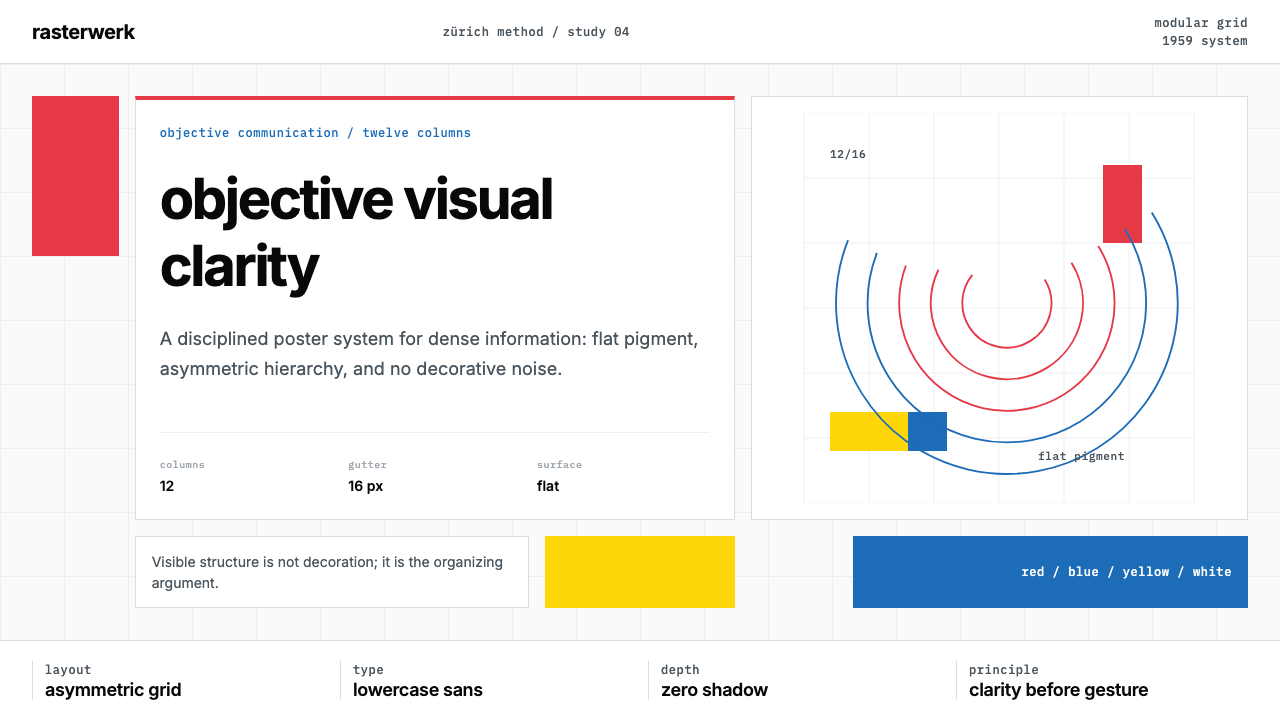 Müller-Brockmann SwissClarity is the system. Inter grids, red-blue blocks, and concentric arcs make…
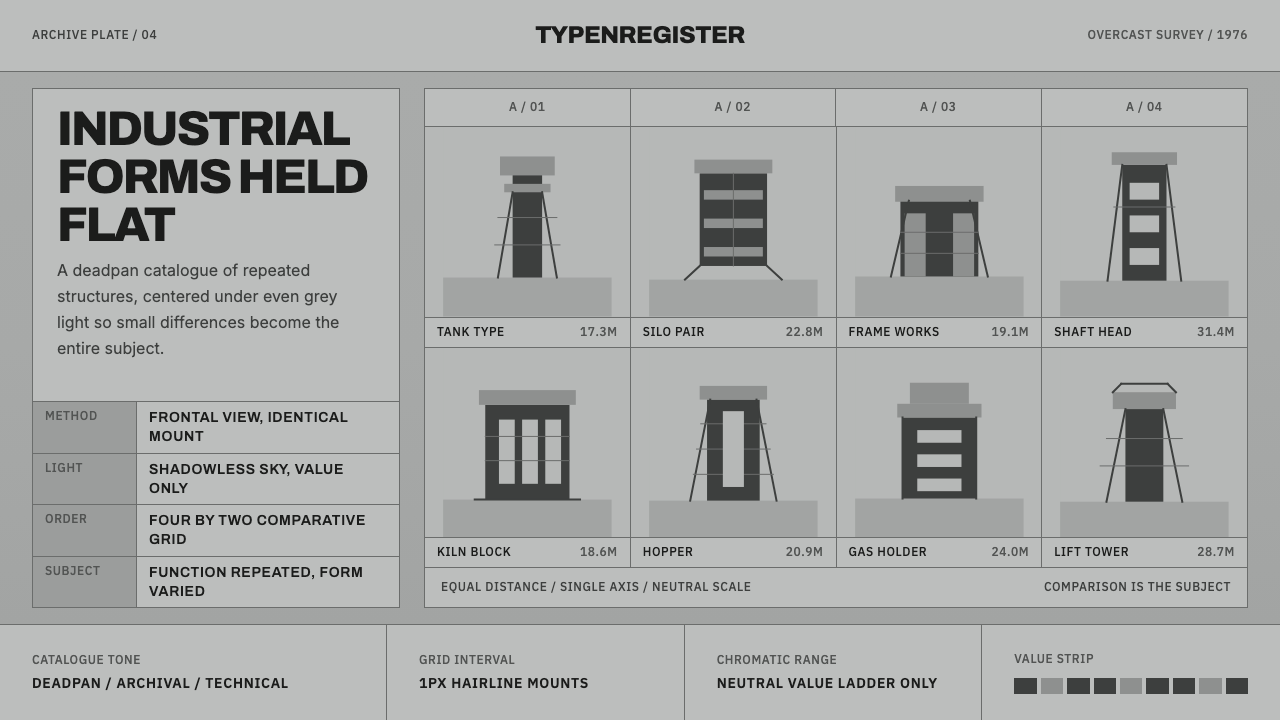 Bechers Industrial TypologyDeadpan order. Mid-grey ground, Archivo labels, and strict hairline grids rev…
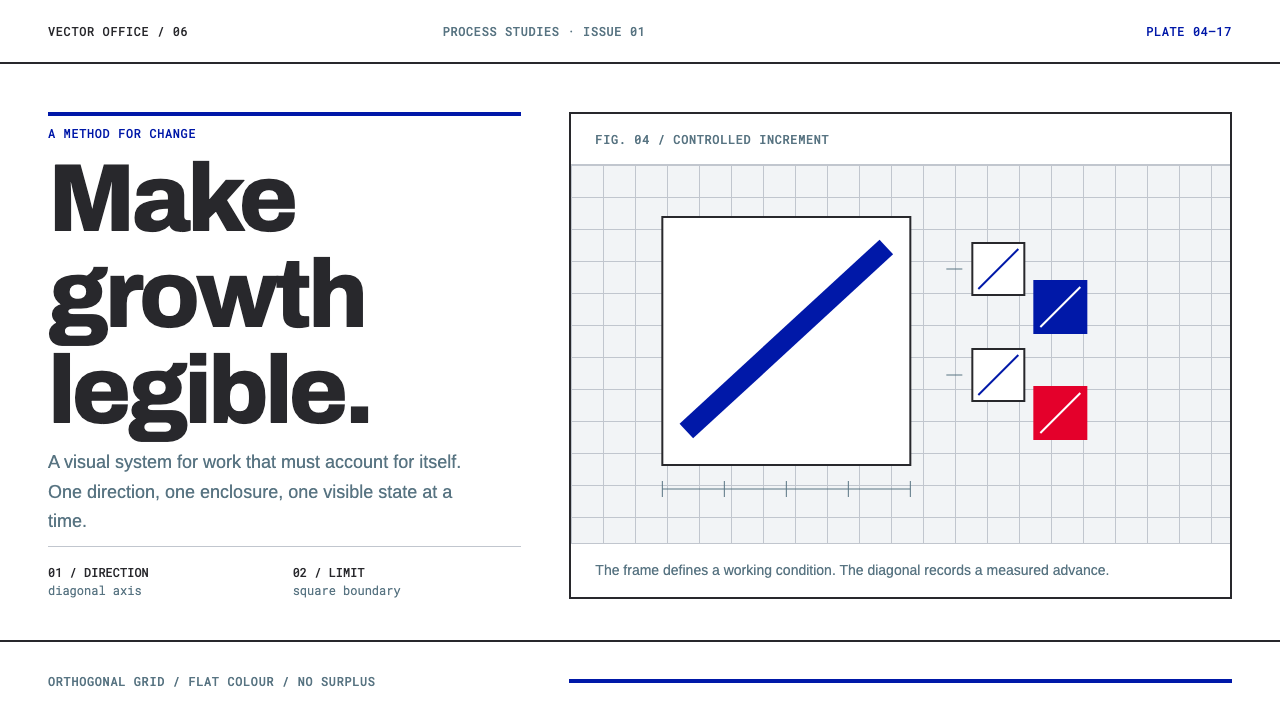 Anton Stankowski ConstructiveProcess becomes visible. Flat blue diagonals and hard square rules make chang…
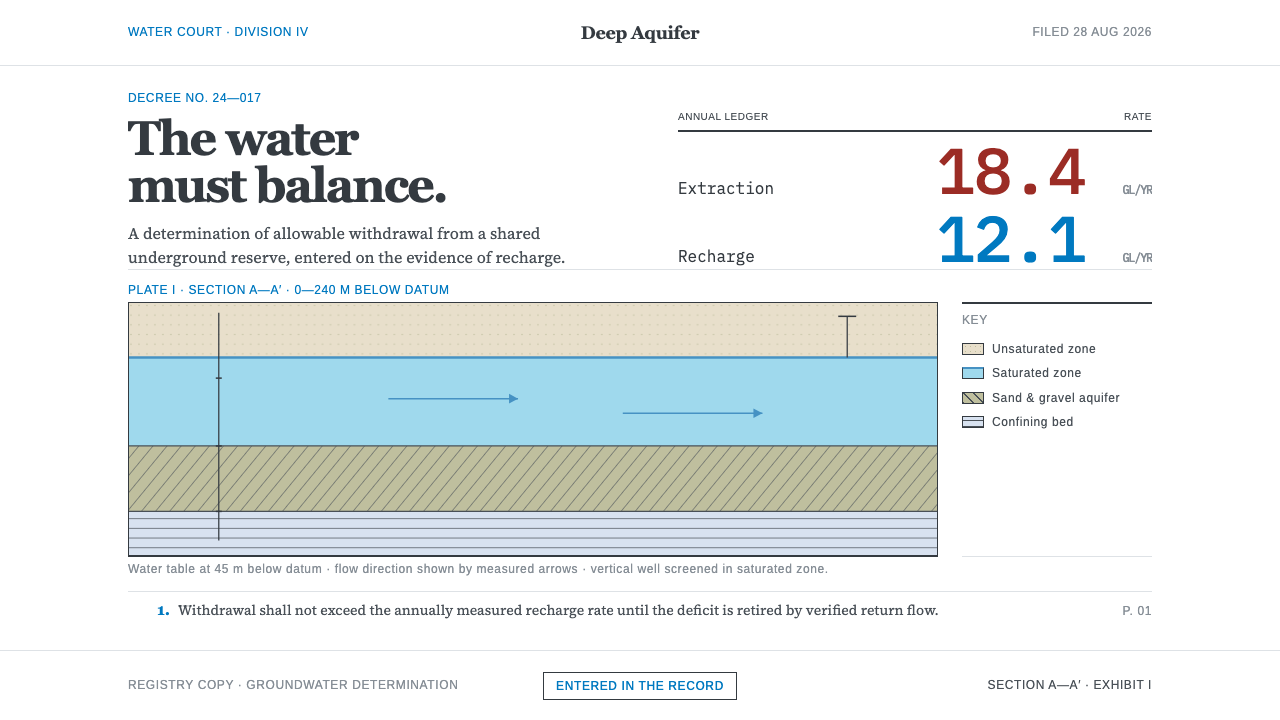 Deep Aquifer Water CourtRestraint makes the deficit undeniable. White bond, book serif, and a keyed a…
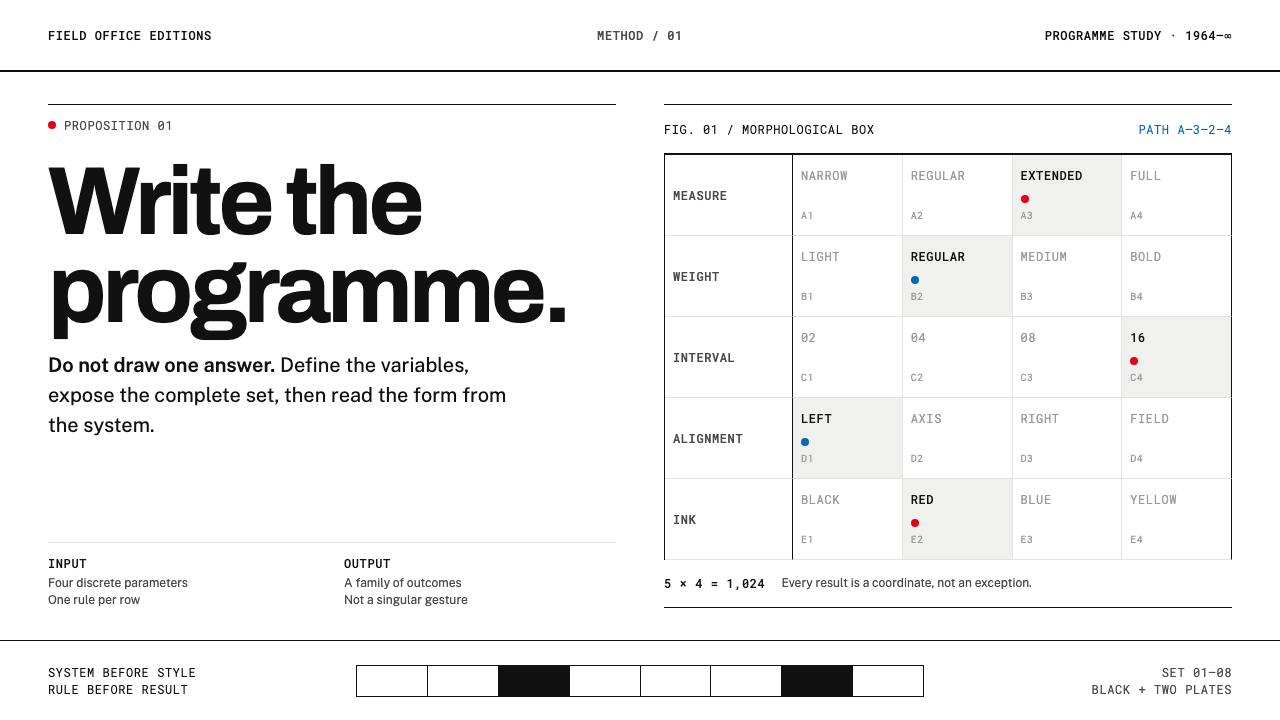 Karl Gerstner ProgrammesDesign becomes a programme. Black hairlines and a strict matrix turn paramete…
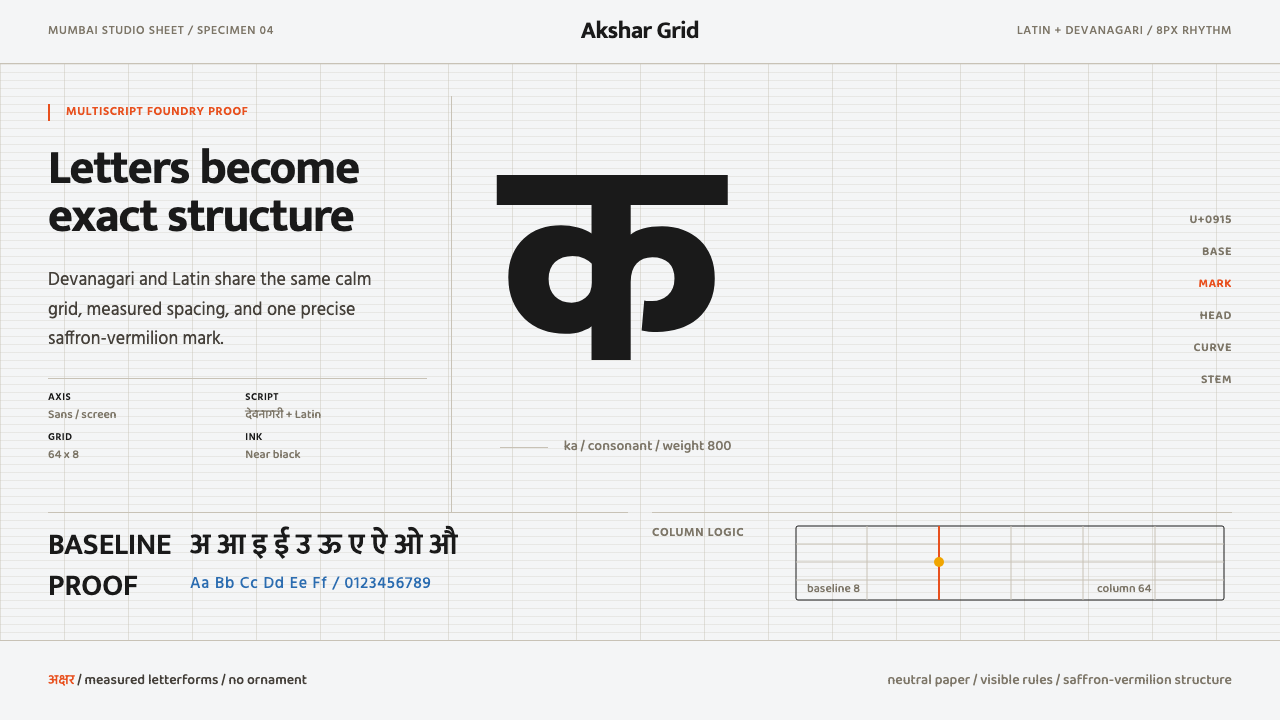 Modern Devanagari TypeType is the subject. Warm off-white grid, giant glyphs, one saffron-vermilion…