What is Icelandic Basalt Volcano?
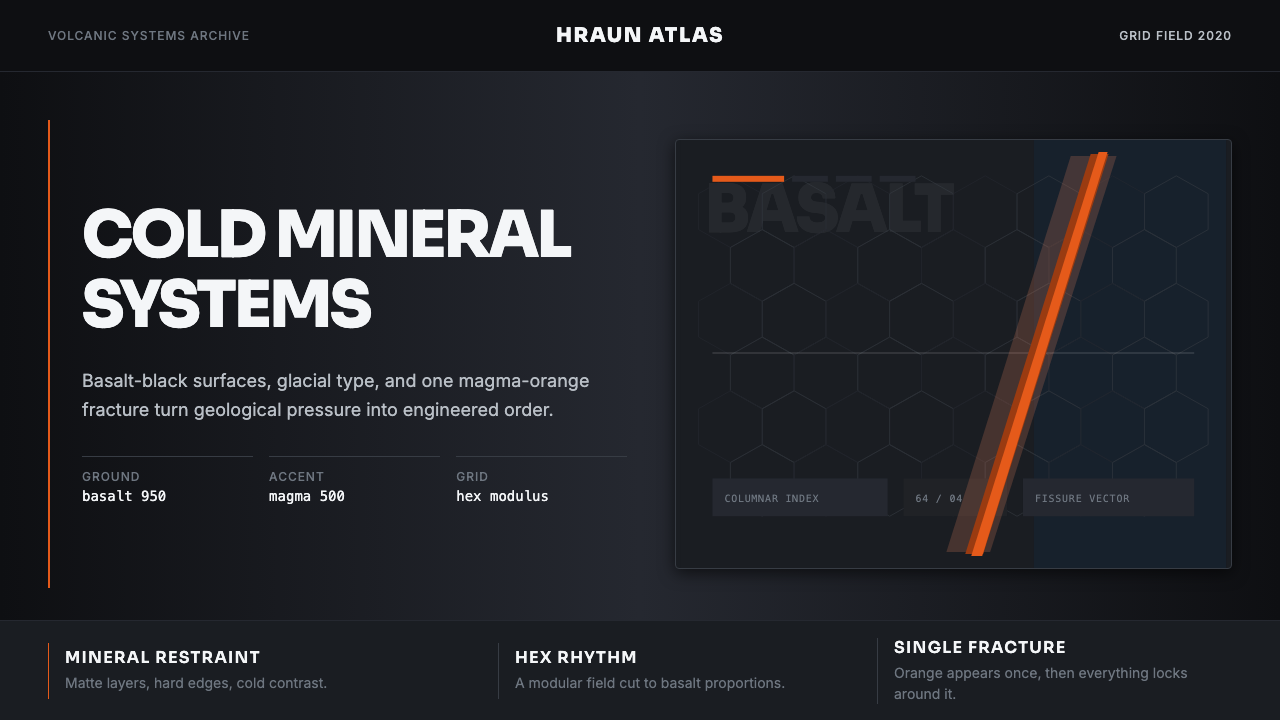
Iceland's volcanic geology — hexagonal basalt columns, fissuring lava, and glacial-cold silence — forged a design language harder and more elemental than any Scandinavian minimalism that came before it.
Icelandic Basalt Volcano in brief
Icelandic Basalt Volcano is a contemporary design system that draws its entire visual logic from the geological character of Iceland: the interlocking hexagonal columns of Reynisfjara's black-sand beaches, the incandescent fissures of the Fagradalsfjall eruptions, and the stark contrast between mineral darkness and glacial white that defines the island's landscape at every scale. Where Scandinavian minimalism softens and invites, this system is cold, structural, and unyielding — a design language shaped by forces far older than human intention.
The aesthetic is fundamentally dark. Deep mineral black surfaces dominate, interrupted only by a single, controlled accent the color of cooling magma — a vivid orange-red that reads as geological heat rather than decorative warmth. Glacial white appears as a counterpoint, as cold and precise as the ice that covers much of Iceland's interior. The result is a palette with the contrast ratio of a volcanic landscape at midnight: absolute in its darks, startling in its highlights, with no comfortable middle ground.
The structural language is hexagonal. Iceland's basalt columns — formed when lava cools slowly and contracts into near-perfect six-sided prisms — provide the grid module. This is not decoration borrowed from nature but a structural principle directly derived from geology: the hexagon is the form that lava itself produces when physics and chemistry resolve into equilibrium. Layouts built on hexagonal grids feel simultaneously natural and engineered, organic in origin but rigorous in execution.
Where does Icelandic Basalt Volcano come from?
Iceland's design culture emerged slowly from geographic isolation. For much of the twentieth century, the island's small population — concentrated in Reykjavik and a handful of coastal towns — produced craft and visual culture shaped more by the landscape than by European movements. The volcanic terrain, the perpetual tug between darkness and light across the seasons, and the physical rawness of basalt, ice, and geothermal steam became the ambient visual vocabulary of Icelandic makers long before those qualities were theorized as design principles.
The post-Eyjafjallajökull design wave — named informally after the 2010 eruption that grounded European air traffic and pushed Iceland to global attention — marked a turning point. A generation of Reykjavik designers, architects, and visual artists who had trained at the Iceland Academy of the Arts and at schools in Copenhagen and Helsinki returned home to find that the landscape they had always lived within was suddenly legible to the world as an aesthetic. Studio Granda, founded by Margrét Harðardóttir and Steve Christer, had already been developing an architecture of monolithic materiality — buildings that looked as though they had been carved from the same basalt as the cliffs around them. Their practice gave younger designers a visual precedent for treating geology as design logic rather than as scenery.
Olafur Eliasson, the Danish-Icelandic artist whose large-scale installations have made the physics of light, water, and geometry into gallery experiences, contributed a different lineage. His work — particularly the geometric light chambers and the systematic manipulation of natural phenomena into structured visual fields — demonstrated that Iceland's elemental vocabulary could sustain rigorous conceptual ambition without resorting to nostalgia or folklore. Eliasson's influence on the design system is visible in its treatment of the single accent color: a precise, almost scientific deployment of one vivid hue against an otherwise achromatic field, replicating the effect of a fissure glow in a dark landscape.
The outdoor apparel brand 66°North, founded in 1926 and reinvented in the early 2000s as a premium global identity, provided the commercial precedent. Their visual system — built on stark photography, engineering-derived typography, and a palette that never softened the harshness of the North Atlantic environment — showed that Iceland's geological severity could anchor a product identity legible to international markets without domesticating it. The brand's refusal to aestheticize discomfort, to make the cold seem cozy, became a template for how a design system rooted in volcanic geology might behave in the marketplace. Þorvaldur Skúlason, the painter whose stark Icelandic landscapes reduced the island's terrain to near-abstract masses of dark rock and pale sky, contributed to the art-historical foundation that gave the design system its legitimacy as a visual tradition rather than a commercial invention.
The contemporary iteration of the system — as a formalized digital design language — emerged from the synthesis of these influences in the 2010s and 2020s, as Icelandic digital studios began applying the geological vocabulary to interface design, data visualization, and brand identity for global technology clients. The hexagonal grid module crystallized as the system's signature structural device, functioning simultaneously as a reference to basalt columns, a nod to the geometric formalism of Northern European modernism, and a practical scaffolding for organizing modular digital interfaces.
What defines the Icelandic Basalt Volcano look?
Palette and Tonal Register
The palette operates at the extremes. Deep mineral black — not the warm black of ink nor the neutral black of a printer default, but the matte, absorptive black of basalt stone — forms the dominant ground. Against it, a single magma accent introduces the only warm chromatic note in the system: the orange-red of cooling lava as seen in long-exposure photography of active fissures. Glacial white and near-white provide the typographic field and structural highlights. The system deliberately refuses any middle chromatic territory — no muted greens, no atmospheric grays-blues, none of the softening that Scandinavian palettes typically permit. The result is maximum geological contrast: darkness interrupted by fire.
Hexagonal Grid Structure
The hexagon is both the structural and symbolic center of the system. Unlike rectangular grids, which impose a human logic of right angles and cardinal directions, hexagonal grids carry the authority of natural formation — they are the shape that basalt columns and honeycomb both arrive at independently, through processes of thermal contraction and material efficiency. In the design system, the hexagonal module governs spatial organization: elements align to hexagonal cells, icons and data units are framed within hexagonal containers, and the negative space between tiled hexagons creates a secondary visual rhythm. This grid does not feel imposed from outside; it feels as though it was already there, waiting to be discovered.
Surface Texture and Material Suggestion
Surfaces in this system do not simulate material — they suggest geological properties through visual weight and density rather than through imitative texture. The dark ground reads as stone because of its opacity and the way light interacts with its edges: hard, uncompromising, without the diffuse softness of fabric or the reflective shimmer of plastic. Where surface variation occurs — in background treatments or structural dividers — it is achieved through tonal shifts of near-identical dark values rather than through added texture. The effect is that of surfaces caught under low-angle raking light: revealing structure through shadow without introducing naturalistic detail.
Typographic Temperature
Type in this system carries a cold, engineered quality. Weight is used to establish hierarchy without warmth — heavy type anchors structure the way a column of basalt anchors a cliff face, through mass rather than invitation. Letterforms tend toward geometric construction: the same underlying logic that generates hexagonal modules governs the preference for type whose skeletons are built on circles, straight strokes, and right angles rather than the calligraphic curves of humanist typefaces. Spacing is generous at macro scale and precise at micro scale — the white space around a headline should feel like the silence of a volcanic plain, not the cozy margin of a printed book.
The Singular Fissure Accent
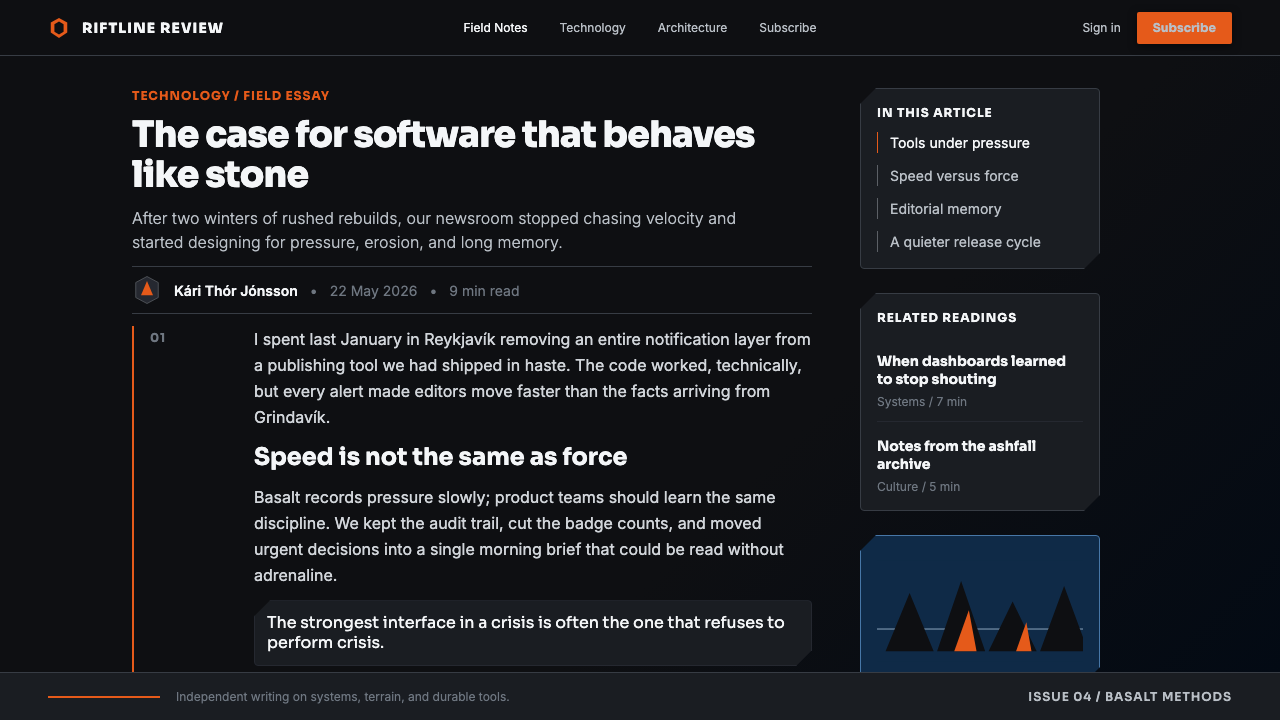
The most distinctive visual decision in the system is the use of a single, carefully constrained accent color that evokes molten rock. This accent appears sparingly — as a glow at a component's active state, as a data highlight in an otherwise monochromatic visualization, as a call-to-action element that stands out precisely because everything around it is dark and mineral. The discipline of restricting warmth to a single channel replicates the geological reality of Iceland: cold, dark stone punctured at rare intervals by intense, localized heat. When this accent is overused — when it appears too frequently or at too large a scale — the entire logic of the system collapses; the geological tension that gives the accent its power requires that darkness remain dominant.
Geometric Precision Without Softening
Edges in this system are decided, not softened. Where many contemporary dark interfaces rely on rounded corners, soft shadows, and graduated blurs to create depth and approachability, this system insists on the hardness of geological forms: edges are cut, not smoothed; depth is created through layering of opaque surfaces rather than through transparency or blur. This is not severity for its own sake — it is a formal commitment consistent with the source material. Basalt does not round its corners. Lava fissures do not graduate to soft boundaries. The precision is geological, not mechanical.
Data and the Volcanic Sublime
The system has a particular affinity for data-dense environments. Hexagonal grids naturally accommodate irregular datasets — each cell can hold a unit of information, and the grid's visual rhythm absorbs density without feeling cluttered in the way rectangular layouts do. When visualizing data — topographic maps, seismic readings, environmental monitoring — the volcanic palette gives numbers a physical weight that abstract charting conventions lack. The dark field lets data points glow rather than sit passively on a white ground, and the single accent color can mark outliers or critical values with the intensity of an actual geological event.

Who shaped Icelandic Basalt Volcano?
The Reykjavik architecture practice founded by Margrét Harðardóttir and Steve Christer established the foundational aesthetic logic that the Icelandic Basalt Volcano design system inherits: an insistence that the built environment should participate in, rather than contrast with, the geological character of its site. Their Reykjavik City Hall — set into the water of Lake Tjörnin, its volcanic stone facades absorbing light rather than reflecting it — became a key reference for how mineral darkness could serve as a primary design material rather than a background condition. Studio Granda's work gave the design system its architectural seriousness.
The Danish-Icelandic artist's large-scale installations — from the indoor sun of The Weather Project at Tate Modern to the geometric light chambers of his studio practice — provided the design system's conceptual framework for using a single intense accent against an otherwise achromatic field. Eliasson's systematic interest in how natural phenomena could be abstracted into repeatable visual structures, combined with his deployment of hexagonal and geometric modules in sculptural installations, directly influenced the hexagonal grid and accent-as-phenomenon principles that define the system's most distinctive characteristics.
The Icelandic graphic designer and art director represents a generation of Reykjavik visual practitioners who brought the island's geological visual sensibility into commercial and cultural communication. Her work in editorial design and cultural identity — consistently rooted in the dark tonal register and structural rigor of Icelandic material culture — helped establish that the volcanic aesthetic was not merely a landscape response but a fully developed design language capable of sustaining complex information hierarchies and serving global audiences without losing its geographic specificity.
The twentieth-century Icelandic painter who reduced Iceland's volcanic terrain to near-abstract fields of dark basalt and pale sky gave the design system its fine-art historical legitimacy. Skúlason's landscapes, painted in the mid-twentieth century, demonstrated that Iceland's geological extremity could sustain serious visual inquiry rather than simply function as dramatic backdrop. His reduction of the island's complexity to a few high-contrast tonal relationships — deep earth against luminous sky, dark rock against pale ice — prefigured the palette decisions at the core of the contemporary design system.
The Icelandic outdoor brand, founded in Reykjavik in 1926 and redesigned for global markets in the early twenty-first century, established the commercial template for translating volcanic geology into a sustainable product identity. Their refusal to soften the harshness of the North Atlantic climate — in photography, in typography, in the palette's exclusion of warm intermediary tones — demonstrated that an uncompromising dark aesthetic could carry aspirational value rather than feeling merely austere. The brand's identity work proved that geological severity was a viable commercial position, not just an art statement.
How do you use Icelandic Basalt Volcano today?
Applying the Icelandic Basalt Volcano system correctly requires accepting its foundational premise: darkness is not a constraint to work around but the primary design material. The system does not ask you to choose between dark and light — it establishes darkness as ground and asks you to introduce structure, hierarchy, and calls-to-action within that ground. Designers accustomed to building on white or near-white backgrounds will need to invert their habitual assumptions about contrast, legibility, and visual weight before the system begins to cohere.
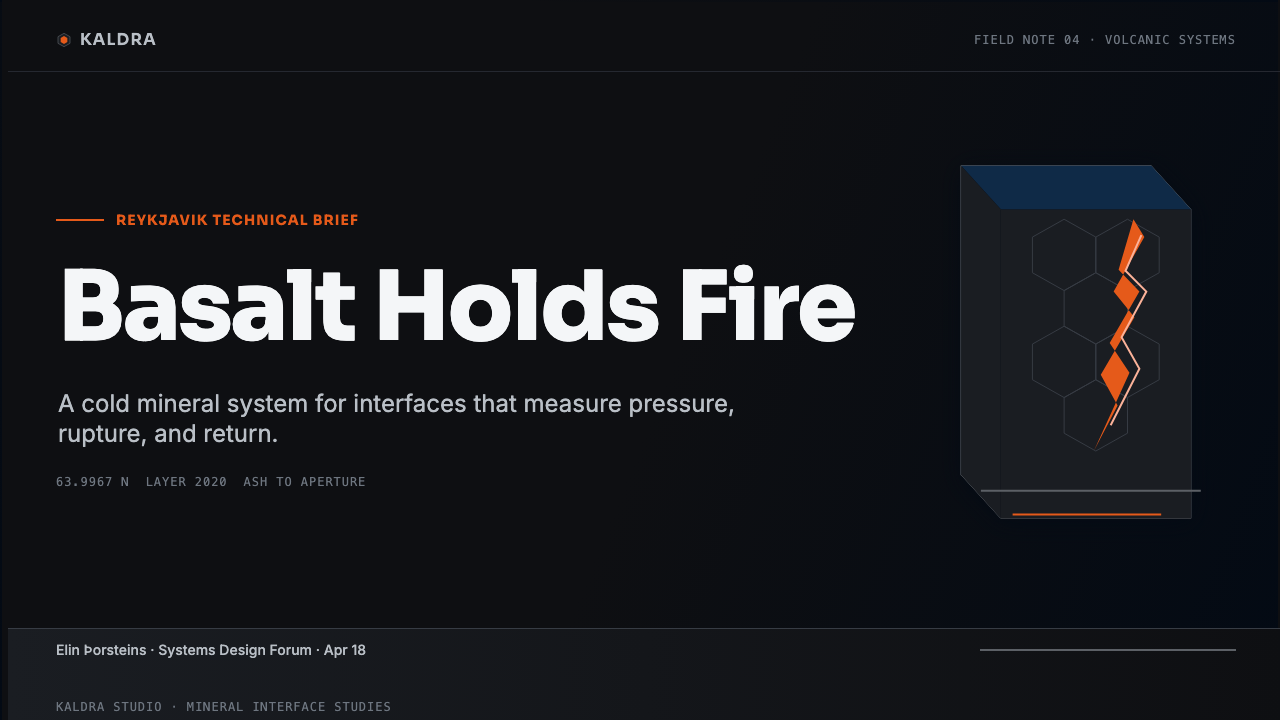
For presentation slides, the system excels at data-heavy and technical communications where authority and precision are desired. A cover slide benefits from the full geological treatment: a dark mineral ground, the title set in cold, heavy type at generous scale, and a single hexagonal graphic element — perhaps a tiled column array or a fissure-line motif — providing visual structure without decoration. Content slides should use the hexagonal module to organize information: text blocks, data cells, and visual elements aligned to the hexagonal grid feel systematically integrated rather than arbitrarily placed. Data slides are where the system's power becomes most apparent: bar charts and network graphs rendered against a dark field, with the magma accent marking the most important data series or critical threshold, have a visual intensity that white-ground equivalents cannot achieve.
For web interfaces and dashboards, the system is suited to applications where the data itself is the product — monitoring tools, analytics platforms, geospatial applications, and any interface that needs to communicate measured, technical information at high density. The hexagonal grid maps naturally to dashboard card layouts: information units tile into a continuous field that reads as systematic rather than assembled. Interaction states — hover, active, selected — are where the magma accent earns its position: a single element glowing against the dark field communicates activation more immediately than any color change on a light background could.
For editorial and marketing applications, the system works best when the subject matter carries natural associations with the geological vocabulary: environmental technology, materials science, architecture, outdoor and performance products, and any brand positioning itself as elemental, enduring, or engineered from first principles. A marketing page in this system uses full-width dark sections alternating with near-white data or feature blocks, with the hexagonal motif appearing as a background texture or structural organizer rather than as a headline graphic. The single accent color should appear no more than once per viewport — as a button, a highlighted figure, or a featured data point — to preserve its significance.
The most common failure mode when applying this system is treating the dark palette as permission for general moodiness: adding blue-tinted dark backgrounds, introducing multiple accent colors to create variety, or softening edges with diffuse shadows to make the interface feel friendlier. Each of these moves dissolves the geological logic that gives the system its identity. The palette should be cold, not atmospheric. The accent should be singular and restrained, not colorful. Edges should be decided, not rounded into approachability. If the result feels severe, that severity is correct — the Icelandic landscape is severe, and the design system is honest about its source.
Icelandic Basalt Volcano — FAQ
How does this system differ from other dark-mode design systems?
Most dark-mode design systems are inverted versions of light-mode systems: they swap a white background for a dark one and adjust contrast ratios accordingly, but the underlying visual logic remains the same. The Icelandic Basalt Volcano system is not an inversion — darkness is its native state, and every decision flows from that premise. The hexagonal grid, the single accent color, the hard-edged surfaces, and the cold typographic register are all expressions of a coherent geological metaphor, not accommodations made to a dark background. This gives the system a visual consistency that purely functional dark modes lack: it has a point of view, not just a palette swap.
Can the hexagonal grid be adapted for content that isn't data-centric?
Yes, with some adjustment of scale and density. The hexagonal grid works for data-dense applications at small cell sizes, but at larger scales it becomes a compositional organizing device rather than a data container. A full-page hexagonal background grid at low opacity provides structural rhythm for editorial or narrative content without requiring every element to snap to hexagonal alignment. The grid can also appear as a motif in isolated regions — a header background, a feature section divider — while the rest of the layout operates on a conventional column grid. The key is that the hexagonal element should feel geological and inevitable, not decorative and applied.
Is this system appropriate for consumer-facing products, or only technical and industrial applications?
The system's severity makes it best suited for consumer contexts where the product's values align with geological or engineering qualities: cold-weather gear, environmental technology, precision instruments, architecture and materials brands, and cultural institutions with a connection to natural phenomena. It struggles in consumer contexts that call for warmth, playfulness, or organic comfort — food, children's products, wellness, and anything where the user experience depends on feeling welcomed rather than impressed. The test is whether the product's own character is cold-precise-enduring, or warm-organic-approachable. If the former, the system is a genuine match; if the latter, it will feel like a costume.
What happens if the magma accent is used too liberally?
The system depends on scarcity for its accent to carry meaning. The magma color works because it is the only warm element in an otherwise cold, mineral environment — its appearance reads as an event, the way an actual lava fissure is an event in a landscape of stone. When the accent appears multiple times per screen, on large areas of background, or in low-importance interface elements, the geological metaphor dissolves and the interface reads as a merely fashionable dark design with orange accents. The discipline required is similar to the geological reality: Iceland has fire beneath it, but the surface is mostly stone. The design should be mostly stone.
How should accessibility be handled given the system's extreme contrast approach?
The system's high-contrast foundation — deep black ground against cold white type — actually exceeds standard accessibility contrast requirements for text, which is one of its practical strengths. The challenge is the accent color: orange-red at full saturation against a deep black background achieves excellent contrast for large text and graphic elements, but may need careful calibration for small text or interactive states where precision is required. The hexagonal grid structure, when used for data visualization, should rely on more than color alone to encode information — position, size, and texture pattern should carry the data meaning independently, with the accent serving as emphasis rather than as the sole distinguishing mark.
Related design styles
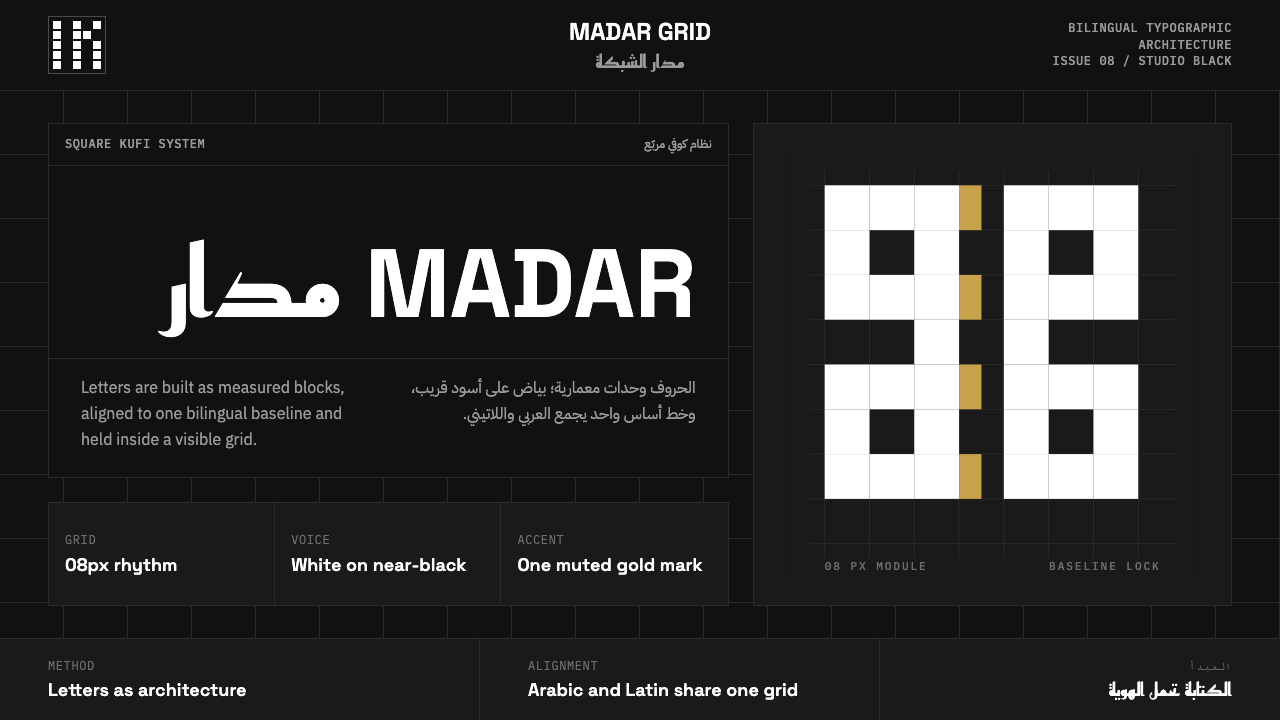 Modern Kufi BrandingRestraint becomes architecture. White Kufi blocks on near-black obey a biling…
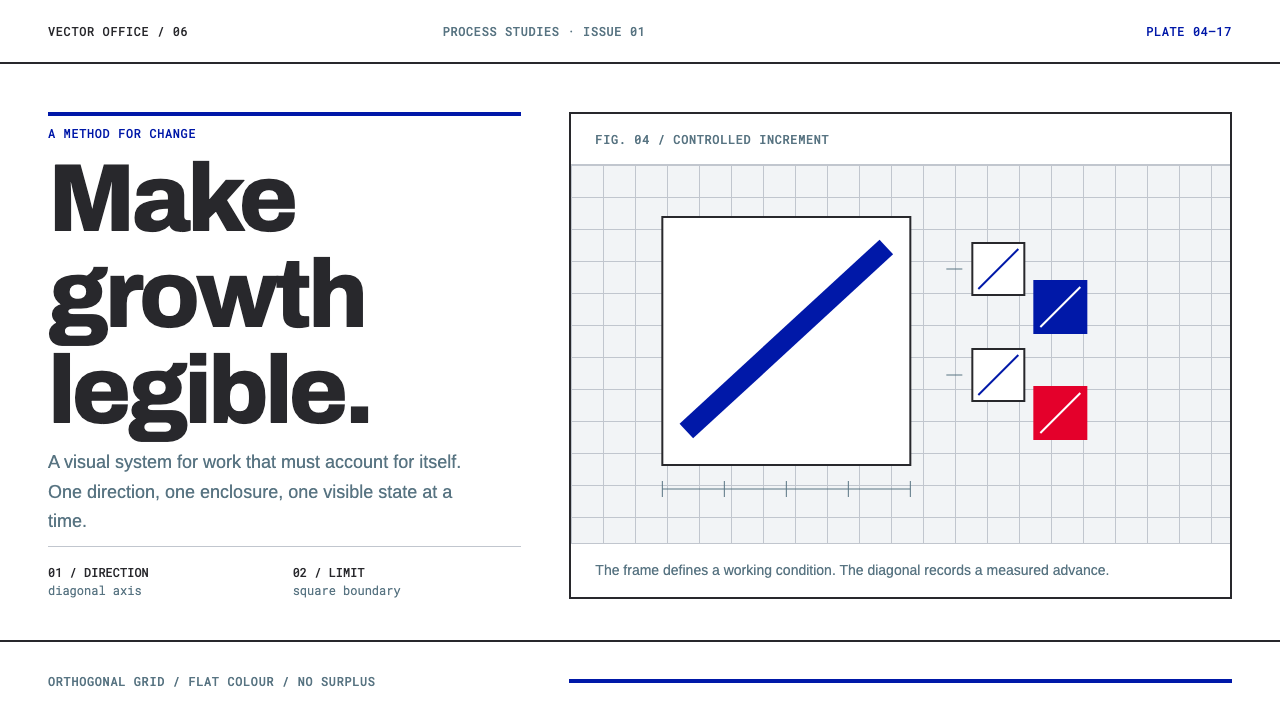 Anton Stankowski ConstructiveProcess becomes visible. Flat blue diagonals and hard square rules make chang…
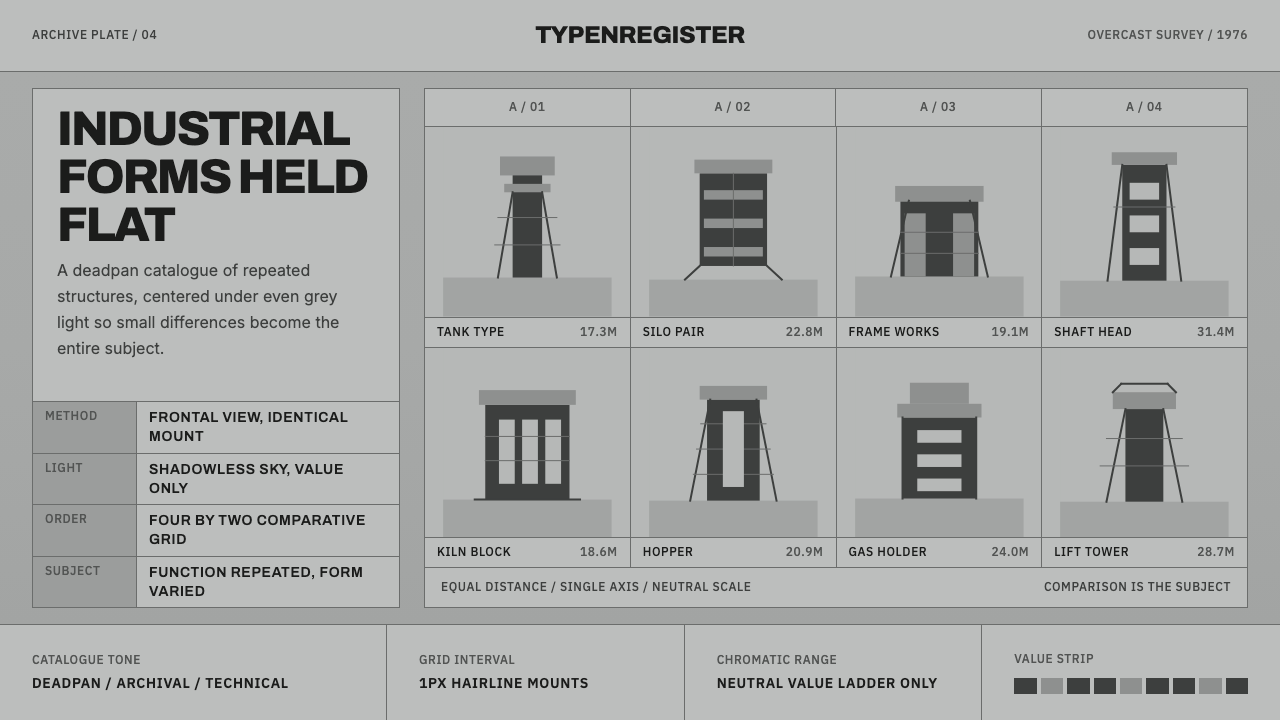 Bechers Industrial TypologyDeadpan order. Mid-grey ground, Archivo labels, and strict hairline grids rev…
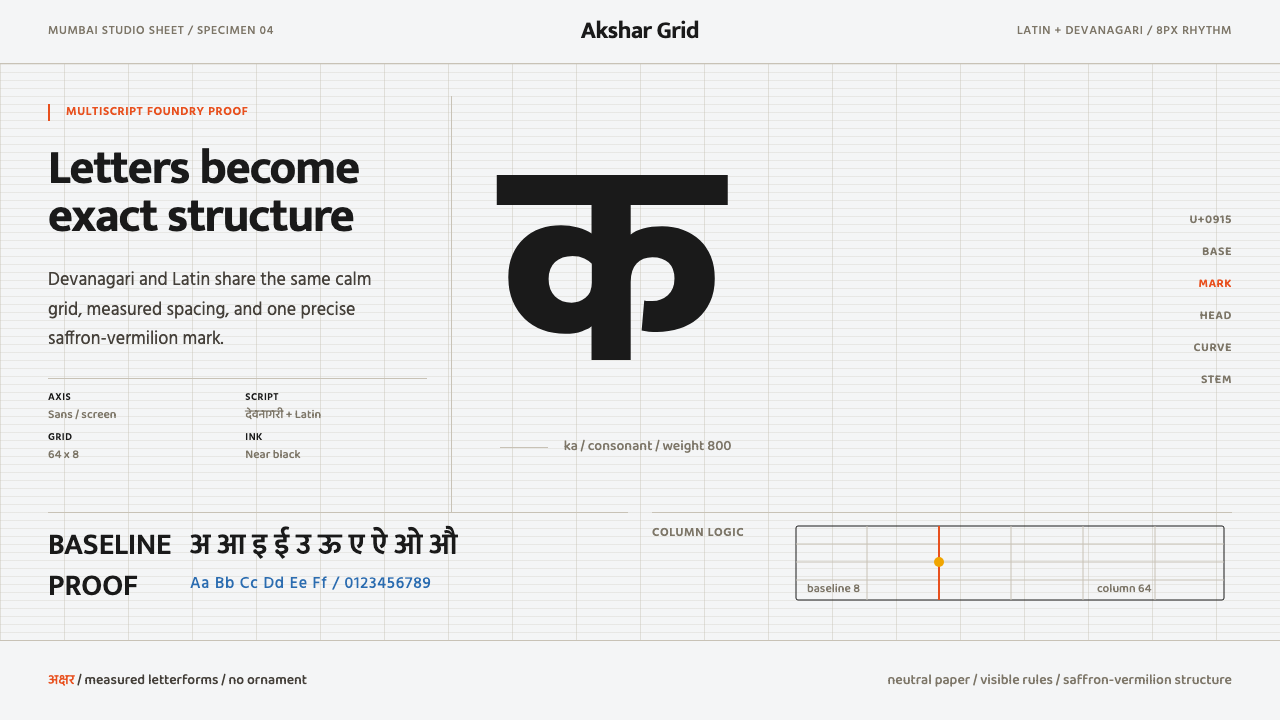 Modern Devanagari TypeType is the subject. Warm off-white grid, giant glyphs, one saffron-vermilion…
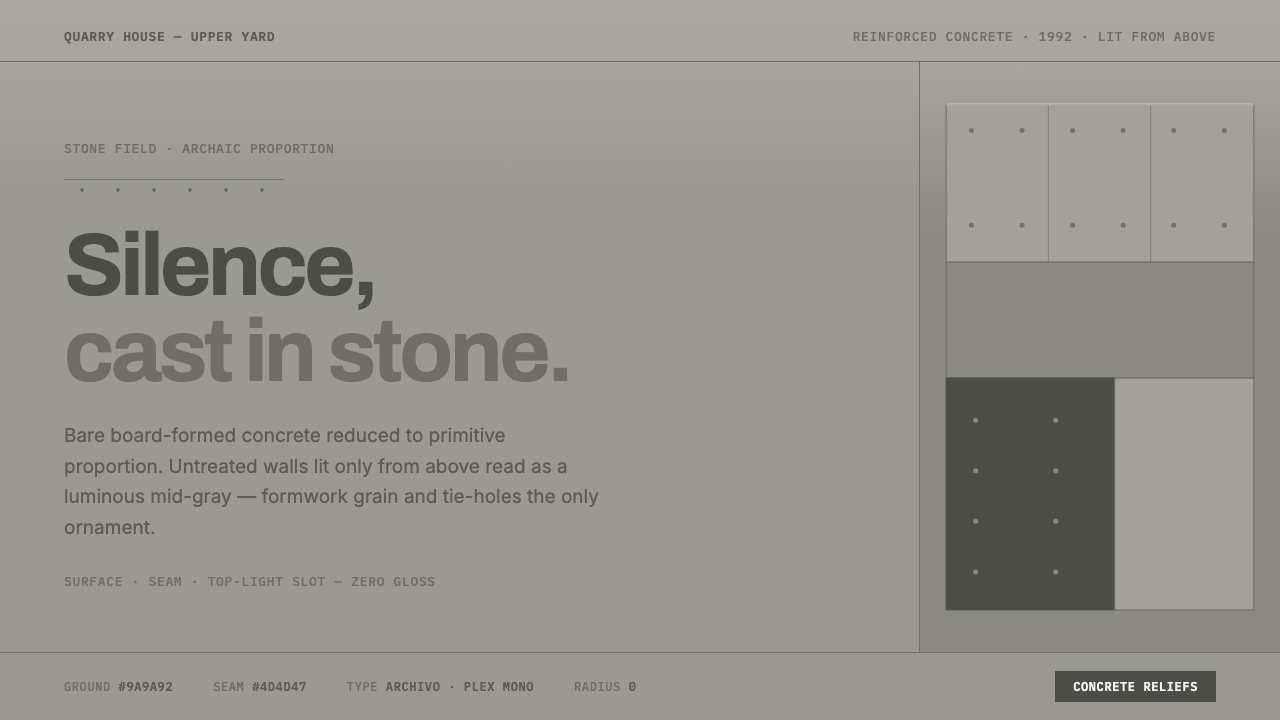 Peter Märkli Concrete ReliefsSilence cast in stone. Luminous mid-gray concrete, hairline formwork seams, t…
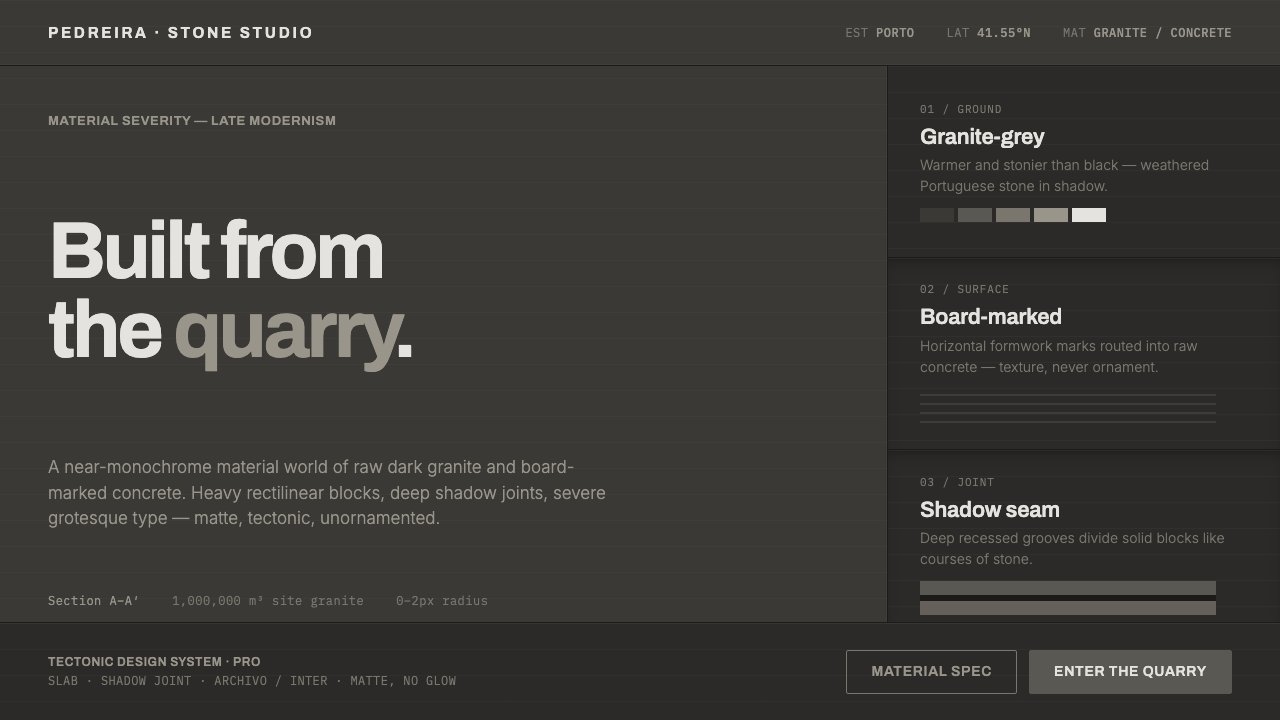 Souto de Moura GraniteArchitecture as raw matter. Dark Portuguese granite ground, board-marked conc…