What is Supabase Postgres Green (2024)?
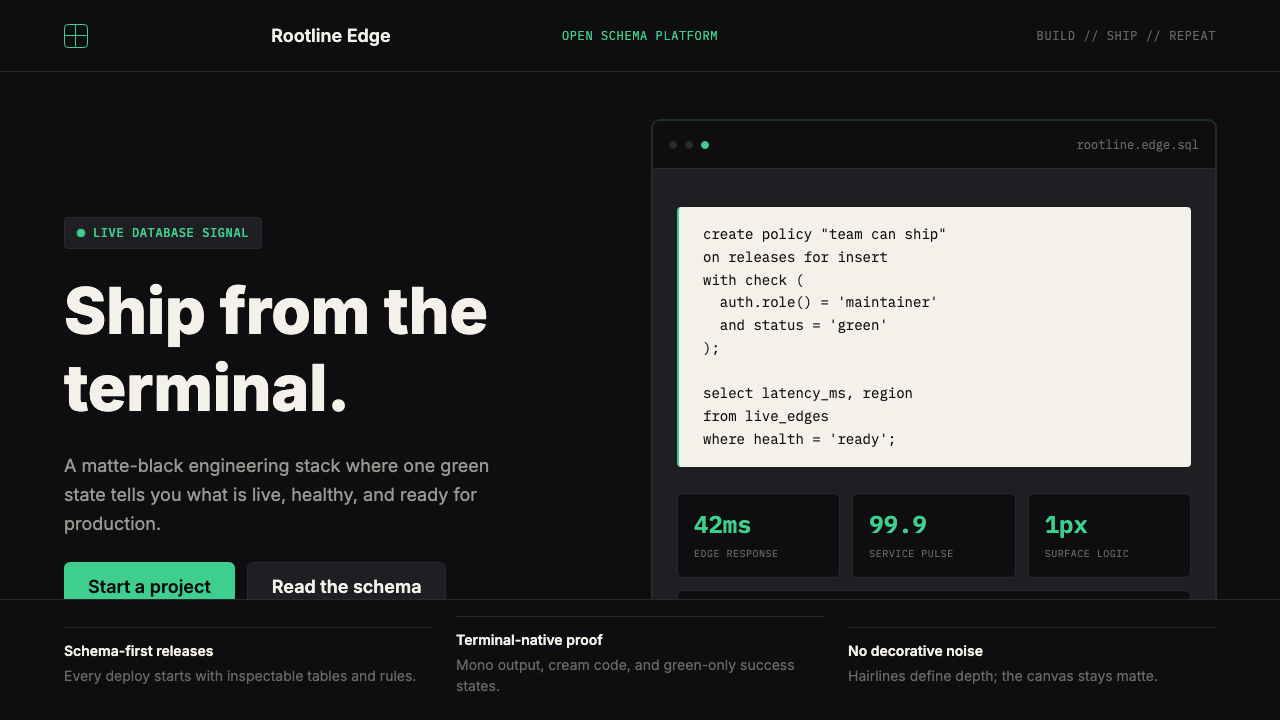
Supabase Postgres Green is the design language of the open-source Firebase alternative that chose darkness, a single electric accent, and the quiet confidence of a terminal window over everything the pastel SaaS world had agreed to take for granted.
Supabase Postgres Green (2024) in brief
Supabase Postgres Green is the visual identity system that Supabase — a developer-tools company offering a Postgres-powered backend-as-a-service — refined into its mature form across roughly 2022 to 2024. The system is anchored by a matte-black canvas, a single electric green that functions as the brand's sole signature hue, and a strict two-typeface hierarchy in which a humanist sans-serif handles editorial prose while a monospaced workhorse handles all code, CLI output, and data. Every other variable — border expression, shadow, motion, illustration — is subordinated to the logic of a terminal environment.
The overarching aesthetic proposition is one of antithesis. At a moment when the dominant visual language of developer-facing SaaS products converged on softness — light backgrounds, lavender gradients, rounded cards, and friendly illustration — Supabase moved in the opposite direction. The matte-black field reads less like a design decision about color and more like a philosophical stance: seriousness, precision, and the idea that a tool intended for people who write SQL at midnight should look like the environment they already live in.
Visually, the system is exceptionally taut. The electric green appears almost nowhere except as a signal: a status indicator, a call-to-action button, a pulsing connection dot. All other work is done in gradations of near-black, slate, and carefully stratified whites. The result is a palette that feels not sparse but loaded — each appearance of the green carries informational weight that it would lose if used more broadly.
Where does Supabase Postgres Green (2024) come from?
Supabase was founded in 2020 by Paul Copplestone and Ant Wilson, both of whom had backgrounds in building developer infrastructure. The company's stated mission was to be the open-source alternative to Google Firebase — meaning a suite of backend services (authentication, real-time subscriptions, storage, edge functions) built on top of PostgreSQL, the battle-tested open-source relational database that Supabase chose to treat not as a commodity layer but as the product itself. The Postgres elephant, a heritage symbol from the PostgreSQL project, was adopted as a quiet brand mark — worn not as a mascot but as a statement of lineage.
The company was remote-distributed from the outset, with founding operations nominally in Singapore, engineering concentrated in San Francisco and London, and contributors spread across dozens of countries. This global, asynchronous structure shaped the product's communication instincts: documentation had to be extraordinarily clear, UI states had to be immediately legible without verbal explanation, and the visual environment had to feel familiar to developers regardless of their cultural context. A terminal aesthetic travels well because the terminal is itself a global visual vernacular among software practitioners.
The visual identity was not established at founding — early Supabase adopted the relatively neutral conventions of the developer-tools category. The more distinctive matte-black and electric-green identity solidified as the product matured and as a small design team, led in significant part by Jonny Summers-Muir and informed by community feedback, began treating the interface itself as a brand surface rather than a neutral container. Tyler Shukert contributed substantially to design system thinking in this period, working to make the interface coherent across an expanding surface area of dashboard panels, documentation, and marketing materials.
The Postgres Green is not an arbitrary choice of hue. The specific quality of green chosen — electric, slightly acid, carrying a quality of luminescence that reads as a screen glow rather than a natural pigment — deliberately evokes cathode-ray tube terminal displays and the phosphorescent readouts of early computing. This is green as cultural shorthand for machine intelligence and command-line authority, not green as nature or growth. The lineage runs through the monochromatic green screens of the 1970s and 1980s, through the green text on black that became a cultural cipher for hacker culture, and into the present moment where Supabase reactivates the association to signal that its product belongs to a lineage of serious technical infrastructure.
What defines the Supabase Postgres Green (2024) look?
Dark Ground
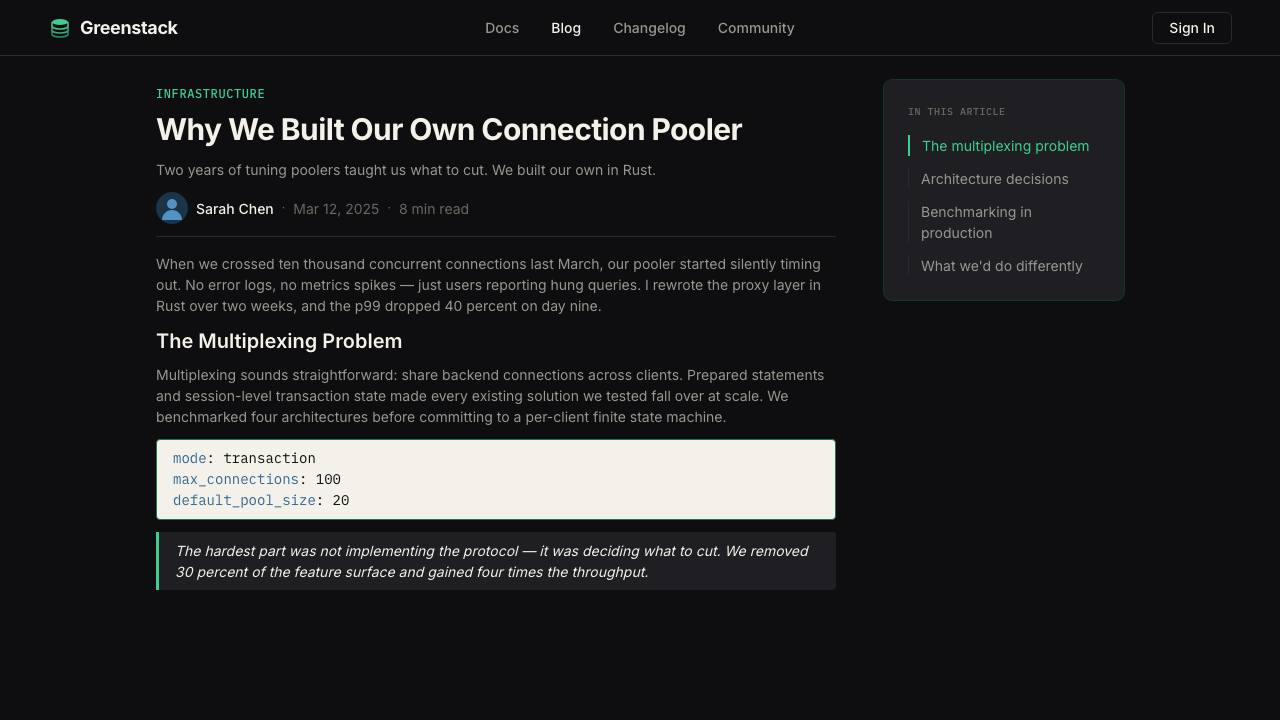
The matte-black background is not simply a dark mode toggle — it is the primary field from which all other elements are read. It is deep without being void, carrying a slight warmth that prevents it from reading as pure neutral. This quality means the electric green accent can vibrate against it with maximum contrast while still feeling like it belongs to the same surface. The dark ground also makes monospaced code blocks legible without a secondary background treatment — the field itself is the code environment.
Electric Green Signal
The electric green functions as a signal color, not a palette color. It appears at interactive boundaries: buttons that confirm an action, indicators that a service is connected and healthy, highlighted syntax in a code block, the blinking cursor of an active input. The color carries a quality of luminescence — as though it is emitting rather than reflecting light — that reinforces its role as status information. Because it appears rarely, it retains full semantic weight every time it shows up.
Type Hierarchy
The system uses two typefaces to create a clear semantic split. The humanist sans-serif handles all editorial content — marketing prose, UI labels, navigational items, documentation body copy — and brings a quality of legibility and human warmth that prevents the dark environment from feeling cold. The monospaced typeface handles all code, SQL snippets, CLI commands, API responses, and log output. This split is never mixed: editorial text does not appear in mono, and code does not appear in the humanist face. The boundary between them is the boundary between explanation and execution.
Surface Stratification
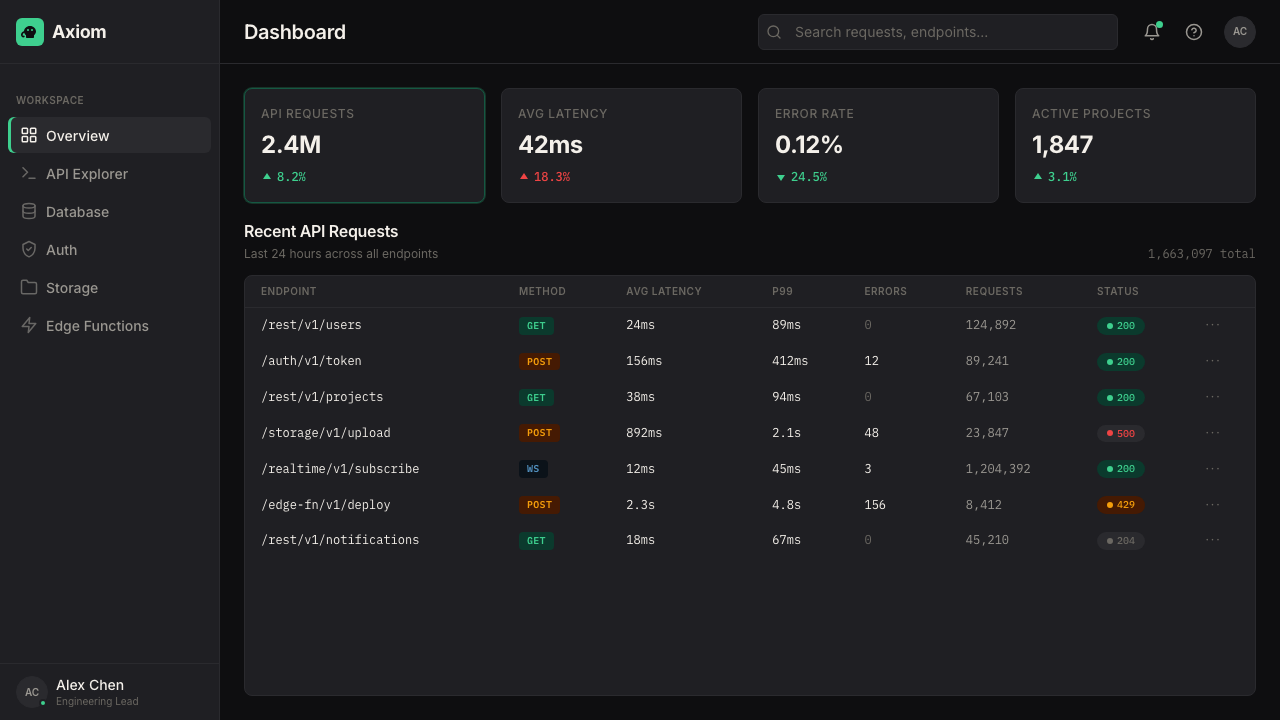
In the absence of color to create hierarchy, the system relies on carefully graduated surface values — distinctions between the base field, card surfaces, panel backgrounds, hover states, and active selections — all rendered as very slight shifts in darkness or lightness. These stratifications are disciplined: there are only a few distinct surface levels, and each has a consistent role. Hair-thin borders reinforce separations that the surface values alone might not sustain at high ambient brightness.
Edge Glow
A distinctive technique in the system is the use of very subtle edge glows — slight luminous halos applied to card borders or panel edges — that make components read as slightly elevated without introducing the softness of drop shadows. These glows are restrained to the point of near-invisibility at normal viewing distances; they register as depth rather than as a specific visual effect. The technique borrows from the visual grammar of illuminated screen bezels and reinforces the terminal-screen metaphor.
Zero Decoration
Illustration, iconography, and decorative graphic elements are used with extreme restraint. When icons appear, they are geometric and line-weight consistent — never playful, never filled with secondary color, never illustrative. Marketing surfaces occasionally employ circuit-board-derived line art or abstract topographic patterns, but these serve as textural backgrounds rather than focal illustrations. The Postgres elephant appears as a mark of heritage, not as a character with personality. The overall position is that decoration competes with information, and in a tool used for managing databases, information always wins.
Motion as State Change
Animation in the system is strictly functional. Transitions communicate state changes — a connecting indicator pulses, a loading spinner turns, a modal slides in — rather than adding expressive delight. Durations are short and easing curves are close to linear, reflecting the expectation that developers interacting with infrastructure tooling want immediate feedback, not choreographed moments. The single exception is the occasional use of a gently pulsing green dot, which persists as an ambient signal that a connection is live — the one animation that is allowed to be noticed.
Who shaped Supabase Postgres Green (2024)?
Co-founder and CEO of Supabase, Copplestone drove the product philosophy that placed PostgreSQL at the center of the platform rather than treating it as an implementation detail. His background in building developer tooling informed the decision to expose database primitives directly rather than abstracting them away — a choice that shaped the visual identity in turn, since a product built on raw SQL and direct database access has a visual register very different from one built on magic abstractions. Copplestone's public-facing communication style — direct, technically precise, often written in the voice of a developer talking to peers — influenced the content tone that the visual identity had to support.
Co-founder and CTO, Wilson's engineering philosophy emphasized open-source transparency and community participation. His influence is visible in the way the Supabase visual identity treats the database log and the dashboard status panel as first-class design surfaces — not as behind-the-scenes utilities but as the central communicative interface of the product. The decision to surface raw SQL responses and live query logs prominently in the interface, rather than abstracting them into friendlier formats, is both an engineering stance and a visual one, and it required a design system that could make raw technical output legible and even beautiful.
Summers-Muir was a key figure in shaping the Supabase visual identity during the period when it transitioned from a functional but undistinguished early-stage look to the more codified matte-black and electric-green system. His contribution was not simply the selection of a color or typeface but the articulation of a visual philosophy — that the interface should feel like an environment a developer already inhabits, not a consumer product trying to be approachable. This shift required making difficult decisions about restraint: resisting the temptation to add warmth through illustration, to soften edges through rounded corners, or to signal ambition through gradient fills.
Shukert contributed to the Supabase design system in a period of rapid product expansion, when the challenge was scaling a visual identity across an increasingly complex surface area — dashboard panels, documentation, authentication flows, storage management, edge function tooling, and a growing library of community-created extensions. His work on systematizing the design language ensured that elements introduced for new features felt native rather than bolted on, and that the terminal-aesthetic vocabulary remained coherent as it was applied to UI contexts its originators had not anticipated.
How do you use Supabase Postgres Green (2024) today?
Applying Supabase Postgres Green correctly requires understanding that the style's visual authority comes entirely from discipline — from what is refused rather than what is added. The dark field and single accent color create the system's characteristic tension only when both are held consistently. A layout that drifts toward mid-gray backgrounds, or that introduces a second accent color to handle additional hierarchy, immediately loses the terminal-environment logic that gives the style its distinctiveness.
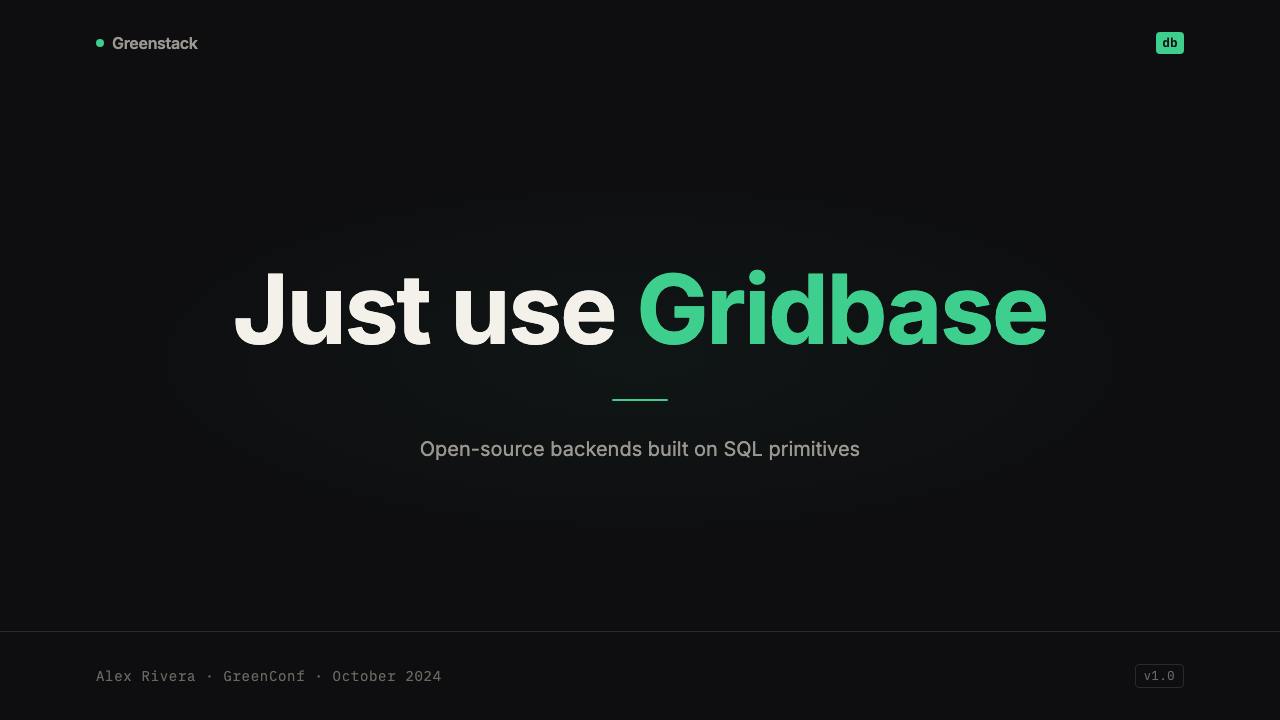
For presentation slides, the style works best when treated as a command-line interface with narrative intent. Cover slides should be nearly empty: the title in the humanist typeface against the dark ground, the electric green reserved for a single element — a status badge, a logo glow, an underline on a key term. Content slides should adopt a log-output aesthetic: text aligned to a left baseline, code blocks given prominent but unstyled treatment, visual separation achieved through spacing alone rather than through divider lines or card backgrounds. Data slides are where the style earns its keep — charts and diagrams rendered in the dark-ground palette, with the electric green used to highlight the data series that matters, and all other series rendered in the neutral stratification.
For web interfaces, the style maps naturally onto dashboard products, database management tools, and any interface whose primary users are developers or data practitioners. Navigation should be typographic and unadorned. Cards should use the edge-glow technique rather than drop shadows; borders should be hair-thin and near-invisible rather than decorative. Empty states and loading states are opportunities for the style to shine — a pulsing green dot or a simple monospaced waiting message is more fitting than an illustrated empty-state graphic. Error and warning states should use the electric green sparingly for confirmation and a warm-shifted neutral for destructive warnings, avoiding the cliché of traffic-light color coding.
For editorial and marketing work, the style supports technically credible long-form content without visual fatigue. Documentation pages should treat code blocks as first-class layout elements — no smaller than body text, given their own subtle surface stratification, with syntax highlighted using the electric green for keywords and neutral whites for literals. Marketing pages can amplify the style through scale: a full-width hero on the dark ground with a single electric-green headline creates immediate recognition. Testimonials and case studies benefit from the monospaced type treatment — a pulled quote in monospaced face creates the visual impression of a log entry and reinforces the idea that these are peer endorsements from practitioners, not consumer marketing.
The most common mistake when applying this style is treating the dark background as a dark-mode equivalent of an ordinary light-background design — inverting colors, softening shadows, and adding glows without understanding the terminal logic that makes those choices coherent. A genuine terminal aesthetic has no soft shadows, no gradients, no playfully rounded corners, and no illustration. The second most common mistake is reaching for a second accent color to handle hierarchy that the stratification system should be managing. If the layout requires a warm amber for warnings and a blue for links and the electric green for actions, the palette has lost its discipline. All three roles should be resolvable through neutral surface values, scale, and selective use of the single accent.
Supabase Postgres Green (2024) — FAQ
Is Supabase Postgres Green a dark mode, or is the dark background its definitive form?
The dark background is definitional, not optional. Supabase offers a light mode for users who need it, but the light mode is not where the brand identity lives — it is a usability accommodation. The electric green signal color, the edge-glow technique, the terminal-environment metaphor, and the hierarchy built on surface stratification rather than color all depend on the dark field for their meaning. A light-background application of the style produces something that resembles many other developer-tools brands; the dark ground is what makes it legibly Supabase.
Why does Supabase use the Postgres elephant as a brand element rather than developing its own mascot?
The adoption of the Postgres elephant is a brand argument, not a design limitation. Supabase's positioning is that it is a serious Postgres-powered platform — not a layer that happens to use Postgres underneath, but a product whose identity is entangled with the database itself. Foregrounding the Postgres elephant signals to the developer audience that this is infrastructure, not consumer software. It also communicates something about the company's values: an openness to the existing open-source community's symbols rather than building a proprietary brand mythology from scratch. The elephant appears as a mark of lineage, worn quietly rather than performed loudly.
How does the style handle the tension between being developer-focused and being a product that also needs to be sold to non-technical stakeholders?
The Supabase visual identity resolves this tension by making technical authenticity the primary value, and trusting that non-technical stakeholders will read technical credibility as a signal of quality. A matte-black interface with monospaced type and no friendly illustration reads as serious and competent to a CTO; it reads the same way to a VP of Engineering who may have less Postgres fluency but understands the register. The style does not attempt to be approachable to all audiences simultaneously — it commits to one, and benefits from the halo effect that commitment creates. Marketing materials soften the terminal aesthetic slightly for broader audiences, but the core product identity is never compromised.
What distinguishes authentic use of this style from a generic 'dark mode developer tool' look?
The generic dark-mode developer aesthetic typically involves a dark background with multiple accent colors, rounded cards with subtle drop shadows, and a combination of icon-heavy navigation and illustrated empty states. Supabase Postgres Green diverges on every one of these conventions. It uses one accent color, not several. It uses edge glow rather than drop shadow. It has essentially no illustration. Its navigation is typographic rather than icon-dependent. The result is a visual density and a sense of precision that generic dark-mode interfaces do not achieve. The key diagnostic is the single accent: if a layout using this style requires a second color to solve a hierarchy problem, the layout is solving the problem incorrectly.
Is this style suitable for non-developer-facing products, such as consumer apps or marketing sites in unrelated industries?
The style carries strong connotative baggage that does not travel well outside the developer and technical infrastructure context. The electric green on matte black is immediately legible as a signal from the world of terminals, command lines, and server infrastructure. In a wellness app, a food brand, or an entertainment product, the same combination would read as misaligned — technically competent but emotionally incorrect. The style works in fintech and data analytics contexts where technical authority is a desired association, and in certain creative-technology or audio-visual production contexts where the terminal aesthetic has been absorbed into subculture iconography. Outside these zones, it is worth asking whether the visual authority the style confers is actually the authority the product needs.
Related design styles
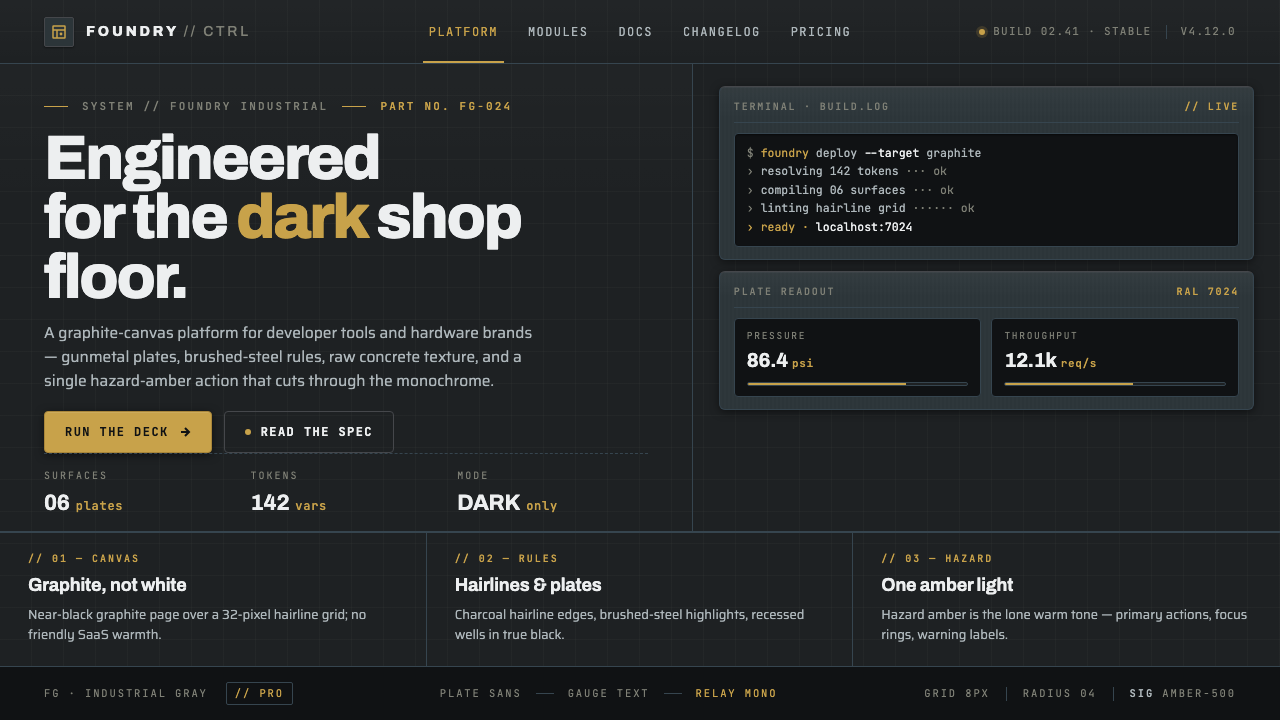 Foundry Industrial GrayBuilt for the dark shop floor. Graphite canvas, hairline plates, mono labels,…
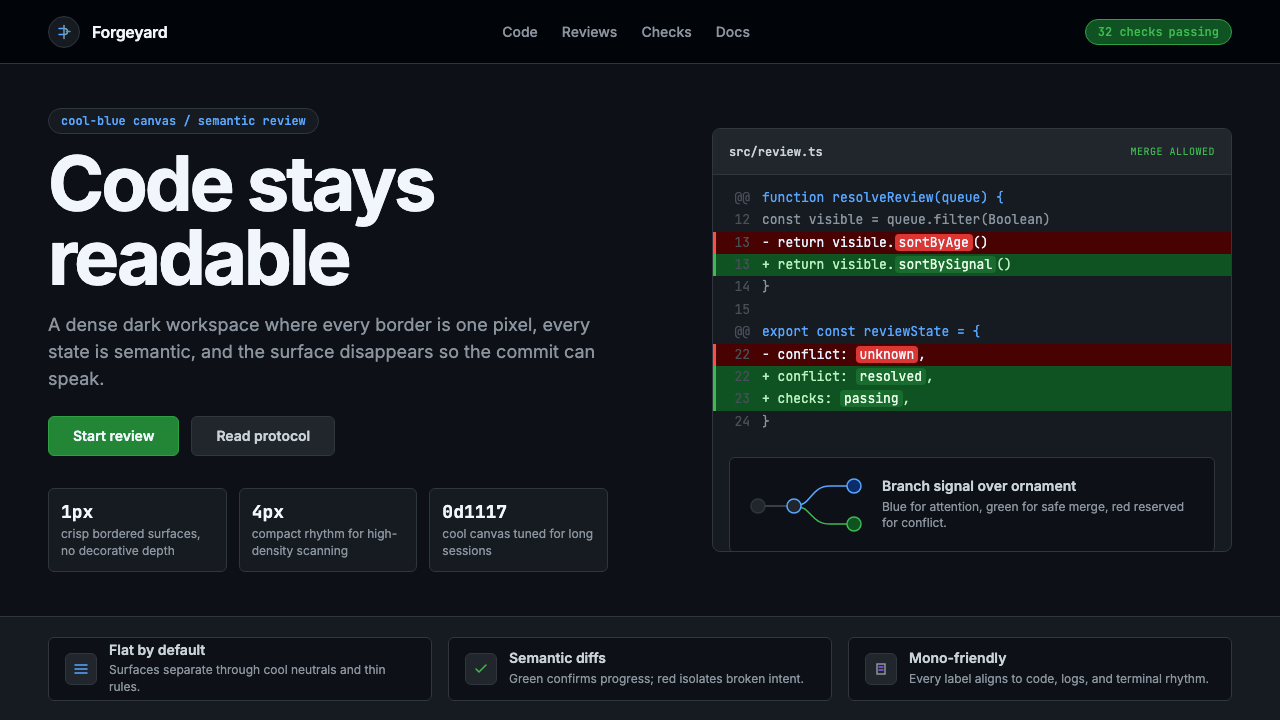 GitHub DarkCode-first darkness. Cool-blue canvas, 1px borders, green/red diff lines.
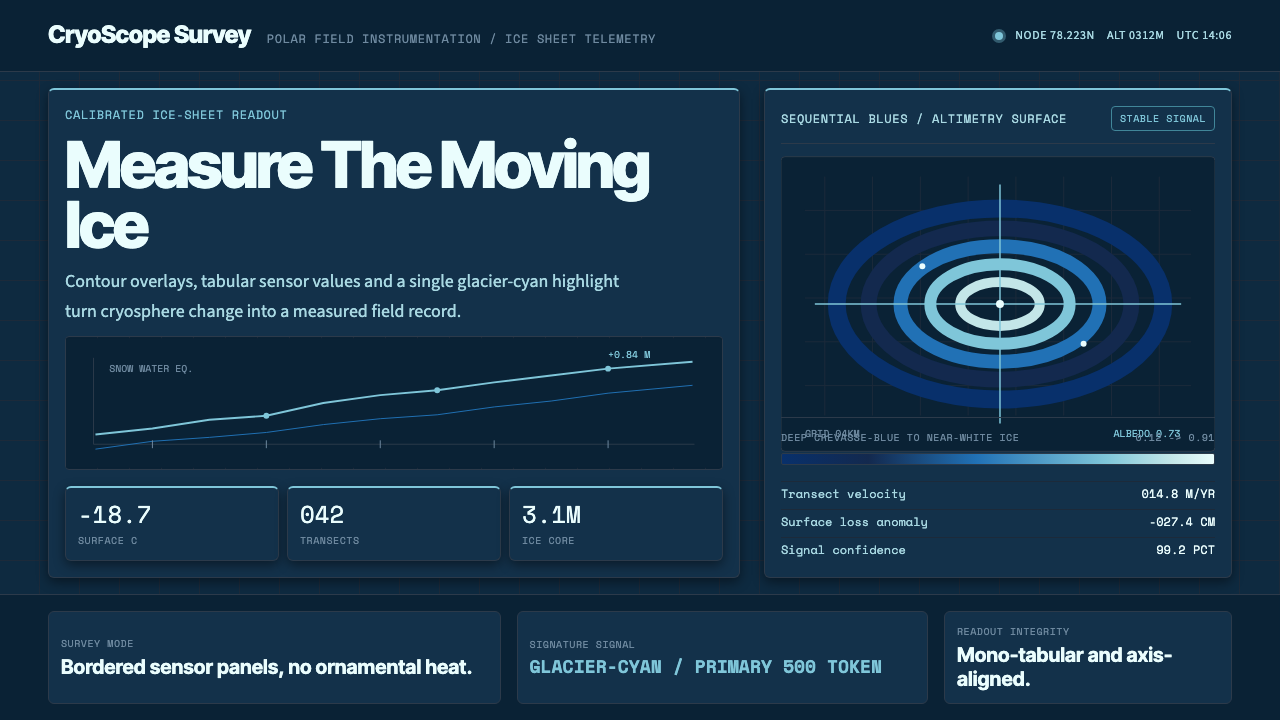 Glacier Arctic SurveyCold precision. Crevasse-blue panels, cyan readouts and contour grids calibra…
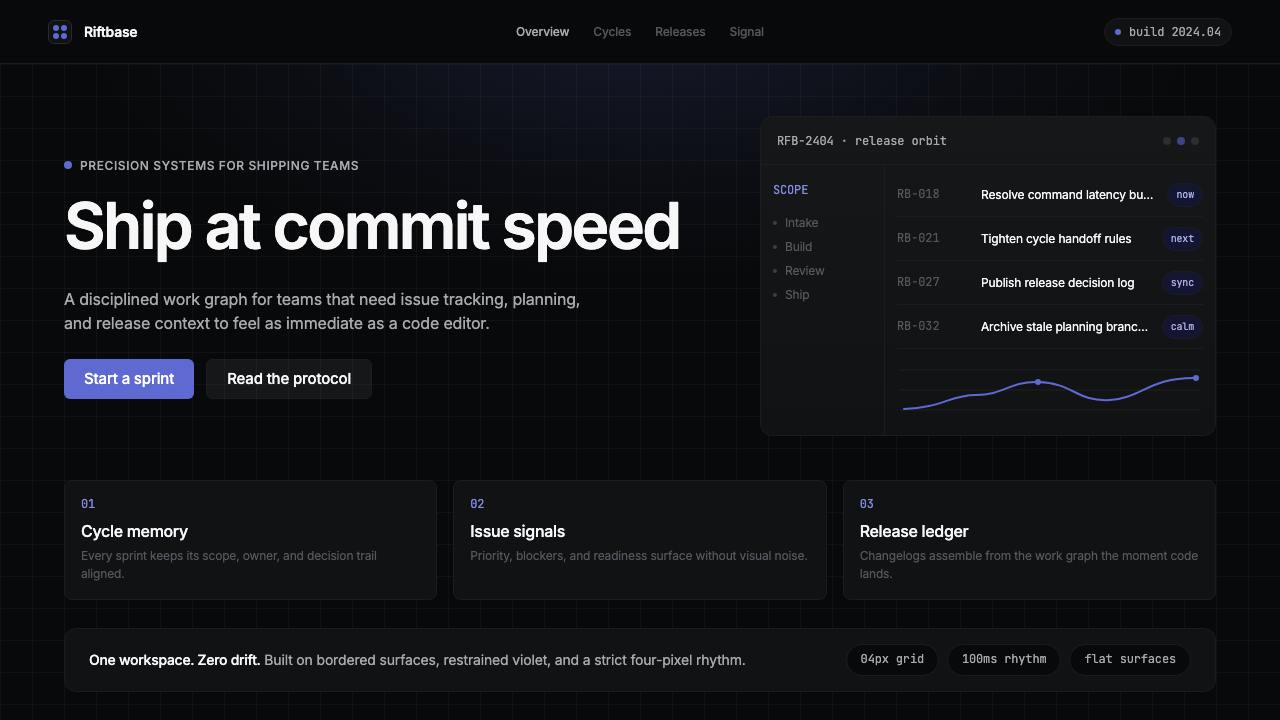 Linear 2024Precision down to the millisecond. Near-black, indigo-violet accents, Inter D…
 Cron CalendarDesigner-tech restraint. Purple wash, ink grid, mono shortcuts, surgical even…
 Arc'teryx Technical OutdoorEngineered, never ornamental. Glacier silver grid, mono specs, one acid-green…