What is Linear 2024?
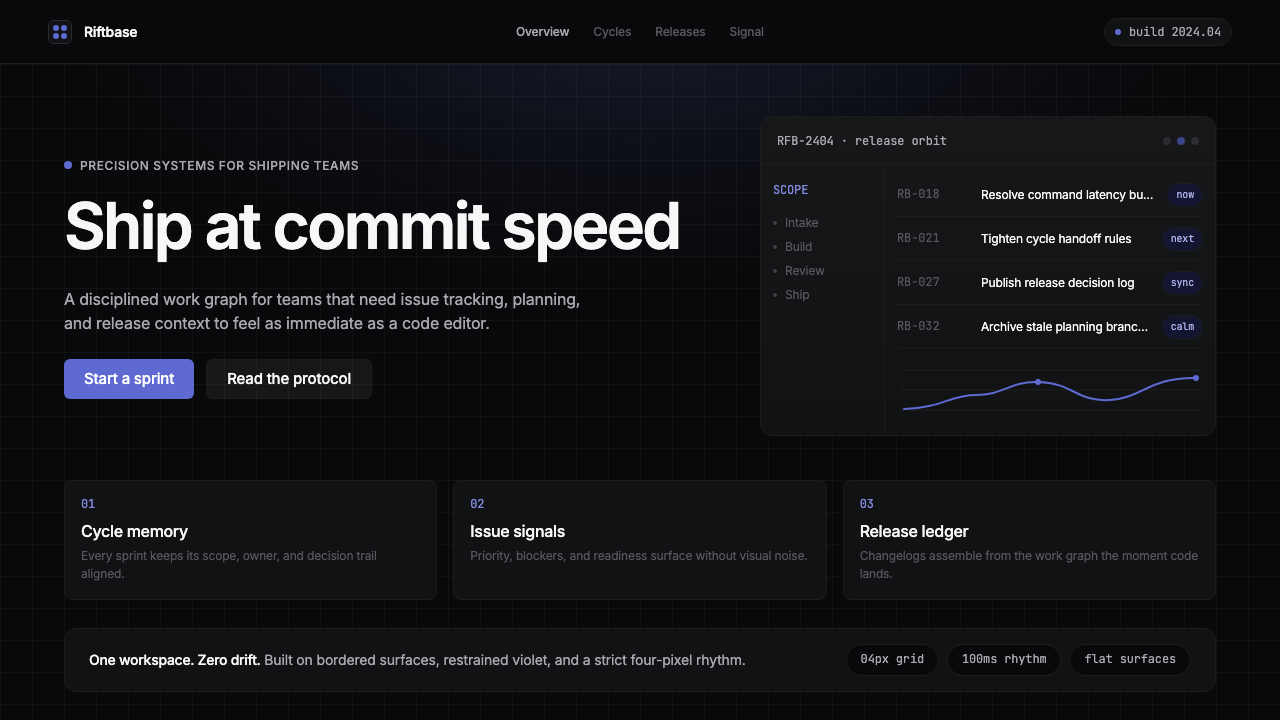
Linear turned project management software into a design benchmark — proving that extreme precision, near-darkness, and a single restrained accent color can define an entire era of developer-tool aesthetics.
Linear 2024 in brief
Linear 2024 is the visual language of Linear, a project-management tool that became the most-imitated interface in the SaaS industry over the 2022–2024 period. Its defining qualities are a near-black background of extraordinary depth, restrained indigo-violet accents deployed with surgical precision, clean geometric typography, and animations timed so exactly they feel engineered rather than designed. The system is built on a single conviction: density and elegance are not in conflict.
What separates Linear's aesthetic from ordinary dark-mode design is its rejection of atmospheric decoration. There are no gradients on UI surfaces, no glowing halos around elements, no layered blurs softening the space. Every surface is flat and intentional. Depth is communicated through subtle tonal steps between background layers rather than through shadows or lighting effects. The result is an interface that reads more like precision engineering than consumer software.
The style has spread far beyond Linear itself. By 2024, the visual grammar of near-black grounds, cool violet or indigo accents, tight geometric type, and sub-one-second micro-animations had been adopted — often explicitly — by dozens of developer tools, infrastructure products, and SaaS dashboards. Recognizing Linear 2024 as a distinct aesthetic vocabulary, rather than simply as one company's interface, reflects how completely its design principles have propagated through the industry.

Where does Linear 2024 come from?
Linear was founded in San Francisco in 2019 by Karri Saarinen and Tuomas Artman. Saarinen had served as design system lead at Airbnb, where he worked at the intersection of engineering culture and product design. Artman brought a deep engineering sensibility from his own background. The two founders shared a frustration with existing project-management tools — tools that had accumulated decades of feature clutter, inconsistent interaction patterns, and interfaces designed for breadth rather than speed. They wanted to build something that felt like it was made by and for software engineers: fast, precise, and stripped of everything unnecessary.
The visual language that emerged drew on a confluence of influences. Swiss typography — with its commitment to clean grid systems, restrained type hierarchies, and the removal of decorative elements — provided a structural foundation. The developer-tool minimalism already present in command-line interfaces and early code editors (where darkness serves both contrast and focus) shaped the decision to build around a near-black ground. Finnish design sensibility, part of Saarinen's background, contributed an emphasis on honest material treatment and purposeful restraint that distinguished Linear's aesthetic from the more theatrical dark-mode designs that had become common in consumer applications.
The current visual language stabilized roughly between 2022 and 2024, as Linear moved from a narrow audience of early adopters into a broader professional market. The indigo-violet accent — cool enough to avoid warmth, saturated enough to carry attention precisely where needed — became the signature mark of the system. Aaron Iker, whose motion and interaction design work contributed directly to the product, played a significant role in defining the micro-animation language: transitions timed in the tens of milliseconds, entrance and exit curves that feel instantaneous but are perceptibly smooth.
By the time the style reached its mature form, it had become something larger than a single product's interface. Design communities began identifying the aesthetic as a category — sometimes called the 'Linear aesthetic,' sometimes 'dev-tool minimalism' or 'dark precision UI.' The imitation it attracted was the sincerest form of validation: competitors, tools built on different product premises, and even non-developer SaaS products began adopting its visual grammar as a signal of seriousness, technical credibility, and modern taste. Linear 2024 thus occupies an unusual position in design history: it is both a specific product interface and a movement that exceeded its origin.
What defines the Linear 2024 look?
Near-Black Ground
The background is not pure black but a very deep, slightly warm or neutral dark tone that avoids the harshness of absolute black while still reading as darkness at any ambient light level. This near-black serves multiple purposes simultaneously: it reduces eye strain during extended use, it makes cool-toned accents vibrate with quiet intensity, and it communicates seriousness without the theatrical quality of full-black. The difference between the page ground and elevated surface layers is communicated through minimal tonal steps — barely perceptible in isolation but immediately readable in context.
Indigo-Violet Accent
A single cool accent in the indigo-to-violet range is the system's primary color vehicle. It is used with exceptional restraint — interactive states, the current active item in a list, a progress indicator — and almost never applied as a background fill on large surfaces. The hue sits between blue and purple, cool enough to feel technical and precise rather than warm or friendly. Its saturation is calibrated so that it reads clearly against the near-black ground without creating visual fatigue. This is not a multi-color accent system; the discipline of a single accent is fundamental to the style's coherence.
Zero Decorative Surface
No gradients appear on any UI surface — not as background fills, not as button states, not as panel treatments. Every surface is flat and mono-tonal. Where depth is required, it is achieved through the tonal-step system between layers rather than through lighting simulation. Borders, when they appear, are hairline-thin and used to separate content regions rather than to frame or decorate them. This zero-decoration discipline extends to iconography: glyphs are outline-weight geometric forms with no fills, no perspective tricks, no decorative detail beyond what the shape minimally requires to be recognizable.
Typographic Density
Linear's typography is built for information density rather than spacious readability. Type sizes step down tightly across hierarchical levels — headlines are noticeably larger than metadata, but the range between them is compressed compared to consumer product conventions. Line spacing is close, allowing more information per viewport. The typeface leans geometric — clean, regular, and modern — with a neutral character that does not compete with content. The result is that a Linear-style layout holds more information per unit of space than most contemporary SaaS interfaces, and does so without feeling cluttered because the hierarchy is unambiguous.
Millisecond Motion
Animations in the Linear system are timed with unusual precision — transitions are short enough to feel instantaneous, but long enough that their easing curves are perceptible on close inspection. This approach treats motion as a form of feedback rather than a form of decoration: an element entering or exiting communicates a state change, not a brand personality. There are no looping ambient animations, no idle-state motion, no scroll-triggered flourishes. Everything moves because something happened, and it stops moving the moment the event is complete.
Structural Elevation Model
Rather than using drop shadows or glow effects to indicate that a panel or modal sits above the base layer, the Linear system communicates elevation purely through the tonal-step hierarchy — each higher layer is a fraction lighter than the layer below. This means depth is a property of the surface itself, not of any effect applied to it. Modals and popovers therefore appear clearly differentiated from their context without any shadow casting, creating an effect that feels simultaneously flatter and more precise than shadow-based elevation models.
Command-Palette Centrality
The command palette — a keyboard-invoked overlay listing all available actions, searchable by typing — is not just a feature of Linear but a statement about its design philosophy. By treating the command palette as a primary navigation surface rather than a secondary power-user shortcut, the interface signals that efficiency and keyboard fluency are first-class values. Visually, the command palette embodies the aesthetic in concentrated form: dark floating surface, geometric type, a single accent on the active selection, zero decorative framing.

Who shaped Linear 2024?
Saarinen co-founded Linear and served as its chief design driver. His prior role as design system lead at Airbnb gave him both deep familiarity with the mechanics of large-scale design systems and a clear view of what those systems often got wrong — accumulated complexity, inconsistency under the surface, interfaces designed for feature breadth rather than task speed. At Linear, he channeled those observations into a system built from the opposite set of constraints: every decision justified by use, every visual element earning its presence. Saarinen's Finnish design background — with its emphasis on functional honesty and quiet material confidence — is evident in the aesthetic's particular tone of restraint.
Artman co-founded Linear and brought the engineering-first perspective that shaped the product's relationship to performance and precision. His technical background meant that aesthetic decisions in Linear were consistently stress-tested against the question of whether they could be implemented with the performance characteristics the team considered non-negotiable — sub-hundred-millisecond response times, smooth animation at any frame rate, interfaces that never visually stall. This engineering constraint influenced the aesthetic directly: effects that degrade gracefully are preferred over effects that are striking but expensive, which is part of why the system avoids gradients, blur layers, and complex shadow stacks.
Iker's work on Linear's motion and interaction design gave the product its distinctive animation vocabulary. The micro-animations he developed — transitions measured in tens of milliseconds, easing curves that feel physically grounded rather than programmatically linear — became one of the most-discussed and most-imitated aspects of the Linear aesthetic. His work demonstrated that motion quality in a dark, precision-focused UI is not a luxury but a core component of the experience: the difference between an interface that feels engineered and one that merely looks engineered.
While not a person, the Swiss International Typographic Style — developed in Switzerland from the 1950s onward and characterized by mathematical grid systems, neutral sans-serif typefaces, and the removal of decorative elements from information design — is a direct ancestor of Linear's visual language. Linear 2024 inherits its commitment to grid discipline, its preference for type hierarchies built on weight and size rather than decoration, and its underlying conviction that information should be organized to serve the reader's efficiency rather than the designer's expressiveness. Understanding this lineage helps explain why Linear's restraint feels principled rather than merely minimal.
How do you use Linear 2024 today?
Linear 2024 translates well to presentation slides when the goal is to project technical authority and precise thinking. A cover slide built in this style uses a near-black ground with the title set in clean geometric type at high weight — occupying a confident left-aligned or center position — and a single indigo or violet accent element used sparingly: a thin rule, a highlighted keyword, or an active state on a UI screenshot. Content slides should resist the temptation to fill space: generous margins, a strict two- or three-level type hierarchy defined only by size and weight, and no decorative dividers or border elements. Data slides benefit from the style's diagrammatic quality — charts and graphs become precision instruments, with axis labels in a lighter tonal step, data marks or bars using the accent color only for the primary data series, and all supporting elements in a restrained neutral.
For web UI applications, the style is most naturally suited to dashboards, analytics views, developer tooling interfaces, and pricing pages where the audience already expects information density and keyboard fluency. The implementation discipline is strict: establish a clear elevation hierarchy using tonal steps rather than shadows; use the accent color for interactive and active states only, never for decoration; keep iconography outline-weight and geometric; and ensure that every interactive element has a motion response short enough to feel instantaneous but smooth enough to feel physically grounded. Navigation structures should be typographic and compact — sidebar labels with no icon embellishment, breadcrumbs in a lighter tonal step, command-palette invocation as the primary search surface.
Editorial and marketing applications require adapting the style's density to contexts where a single message — rather than a complex information space — is the primary goal. A marketing page in this language works through alternating full-width sections: a dark near-black section with a large headline and a single accent-colored word or phrase, followed by a slightly elevated dark section with supporting body text at comfortable reading density. Feature callout blocks use the elevation model to distinguish them from surrounding content without adding borders or drop shadows. Motion enters through subtle entrance animations timed to scroll position — brief, directional, and never decorative.
When applied to editorial long-form content, Linear 2024 demands careful attention to reading comfort. The style's preferred tight line spacing and high information density work well in short-form contexts but can create fatigue in extended prose. The adaptation is to increase line spacing on body text while maintaining the tight spacing in metadata, captions, and labels. The near-black ground should be lightened slightly or replaced with a very deep neutral that has more perceptible warmth — this single adjustment makes sustained reading substantially more comfortable without breaking the visual language.
The most common mistake when applying Linear 2024 is misunderstanding the accent color's role. Designers accustomed to systems with multiple brand colors sometimes introduce secondary accent colors, gradient highlights, or colorful data visualizations in hopes of adding vibrancy to the otherwise restrained palette. This breaks the system fundamentally: the entire visual logic depends on the single cool accent being the only source of color energy in the composition. A second accent color doesn't complement the first — it competes with it and destroys the hierarchy that the first accent was doing the work of establishing. The correct response to a layout that feels too austere is not to add color but to examine whether the typographic hierarchy, the spacing scale, or the tonal step model is working hard enough.

Linear 2024 — FAQ
Is Linear 2024 just dark mode with a purple accent?
The description is accurate on the surface but misses what makes the style distinctive. Dark mode as a category simply means a light-on-dark color scheme; it says nothing about the quality of surface treatment, the discipline of the accent color, the density of the type system, or the precision of the motion language. Linear 2024 is a complete, internally consistent visual system in which every element is in a specific relationship with every other element. The near-black is a particular tone chosen for reasons of visual comfort and accent legibility, not as a generic inversion. The indigo-violet accent is used according to strict constraints that prevent it from appearing as decoration. The result feels qualitatively different from most dark-mode interfaces — more engineered, less atmospheric — and that difference is the style.
Can this style be used for consumer-facing products, or is it only suited to developer tools?
The style can be used for consumer-facing products, but the fit depends heavily on what values the product communicates. Linear 2024 is effective wherever technical credibility, precision, and efficiency are aspirational qualities for the user — productivity apps, financial tools, professional creative software, and platforms where the audience self-identifies as technically sophisticated. It is poorly suited to products whose value proposition depends on warmth, approachability, sensory richness, or emotional intimacy — food and hospitality, health and wellness, children's products, or social platforms built around casual sharing. The most revealing question is whether the aesthetic's particular kind of seriousness matches what the user wants to feel while using the product.
How does Linear 2024 relate to earlier dev-tool aesthetics like terminal interfaces and code editors?
There is a direct lineage. Terminal interfaces and early code editors established the foundational premise: a dark ground reduces eye strain during extended use, monospaced type organizes dense information efficiently, and the absence of decorative chrome keeps focus on content. What Linear 2024 adds to this foundation is design intentionality — the near-black is not simply the default terminal color but a specific tone calibrated for legibility; the typeface is not monospaced but a geometric proportional design chosen for its neutral authority; the accent color is not the legacy green or amber of command-line culture but a cool contemporary hue. Linear translates the functional logic of developer tools into the visual language of modern product design without losing the efficiency values that made the source aesthetic credible.
What happens when the Linear 2024 style is applied to light-mode contexts?
A light-mode adaptation is possible but requires genuine re-derivation rather than a simple color inversion. The near-black ground becomes a near-white or very light neutral; the indigo-violet accent retains its hue but needs its lightness adjusted to maintain legibility and contrast against the light ground; the tonal-step elevation model inverts so that higher layers are slightly darker rather than slightly lighter. The resulting aesthetic shifts character substantially — it loses some of the precision-engineering quality that the dark ground communicates and gains a cleaner, more approachable tone. It can still work well for the same categories of products, but it reads differently: less like a technical instrument, more like a refined professional tool. Designers who want the full Linear 2024 effect should commit to the dark ground rather than attempting to port the system to light mode.
Is there a risk of looking derivative if this style is used in 2025 and beyond?
The risk is real and worth taking seriously. Because Linear 2024 was so widely imitated, the visual vocabulary is now strongly associated with a specific era and a specific product origin. Using it without differentiation risks the product reading as a generic entry in a crowded category rather than as a confident design choice. The productive response is not to avoid the style but to understand what problem it was solving and to apply those underlying principles with a layer of additional specificity — a particular typographic choice, a distinctive approach to data visualization, a motion language tuned to the product's specific interactions. The best successors to influential styles are not copies but responses: work that understands why the original made the decisions it made and applies that understanding to produce something that is recognizable in lineage but not interchangeable in identity.
Related design styles
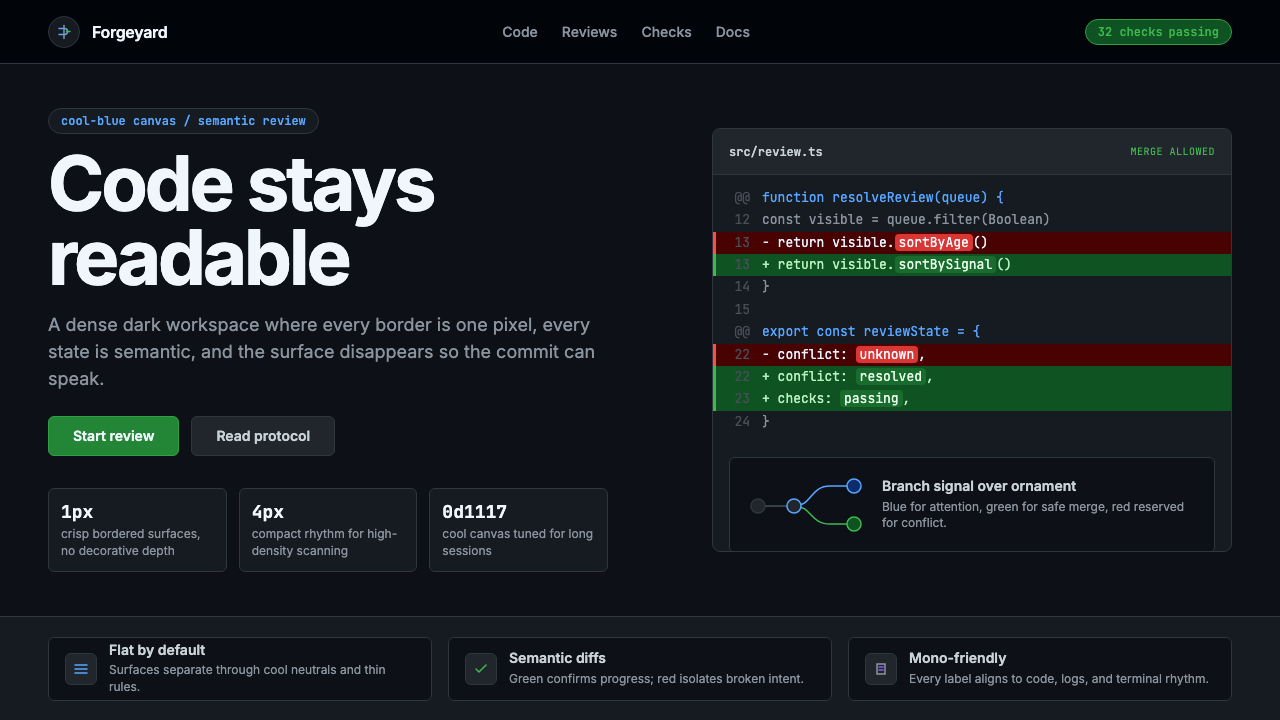 GitHub DarkCode-first darkness. Cool-blue canvas, 1px borders, green/red diff lines.
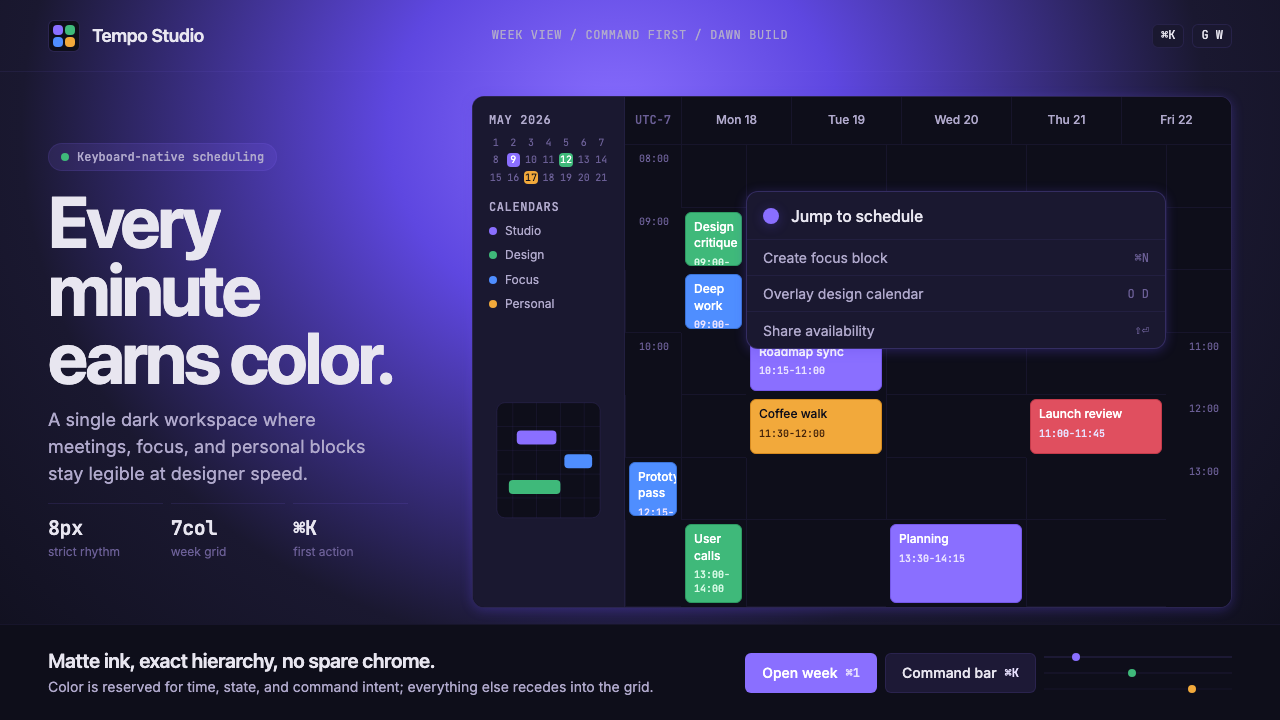 Cron CalendarDesigner-tech restraint. Purple wash, ink grid, mono shortcuts, surgical even…
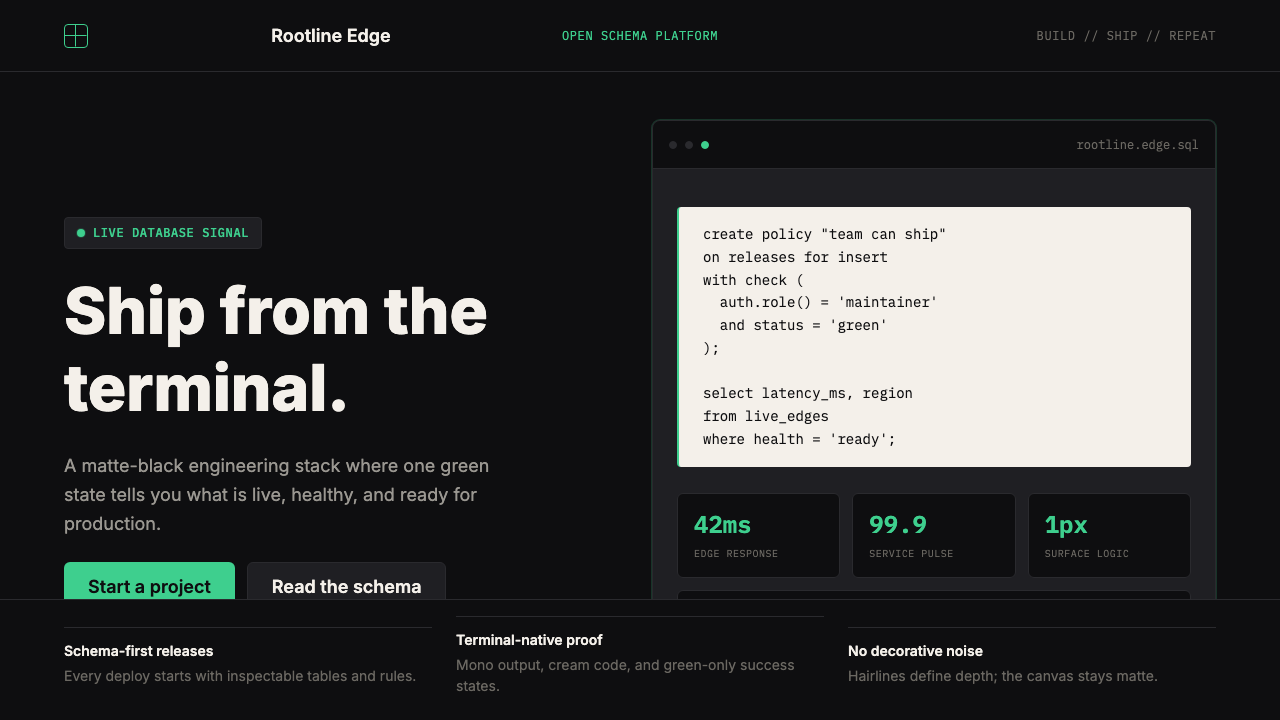 Supabase Postgres Green (2024)Midnight-terminal confidence. Matte black, Inter, mono code, and one electric…
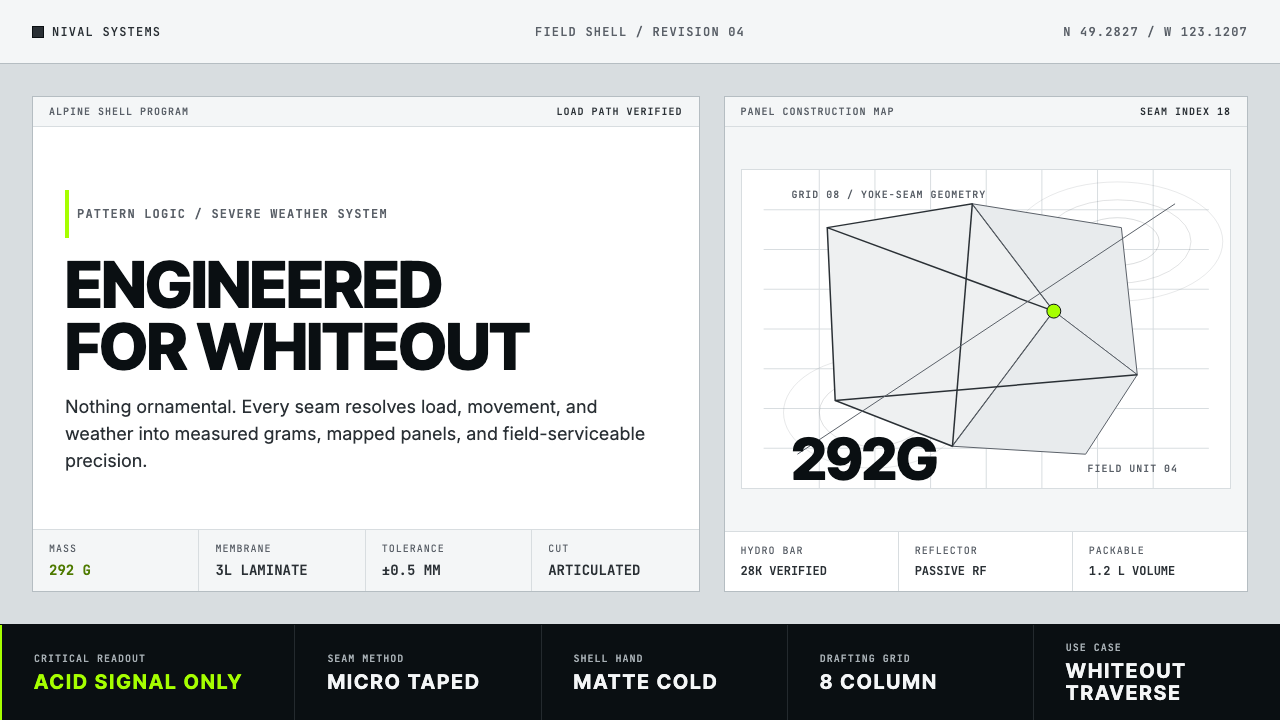 Arc'teryx Technical OutdoorEngineered, never ornamental. Glacier silver grid, mono specs, one acid-green…
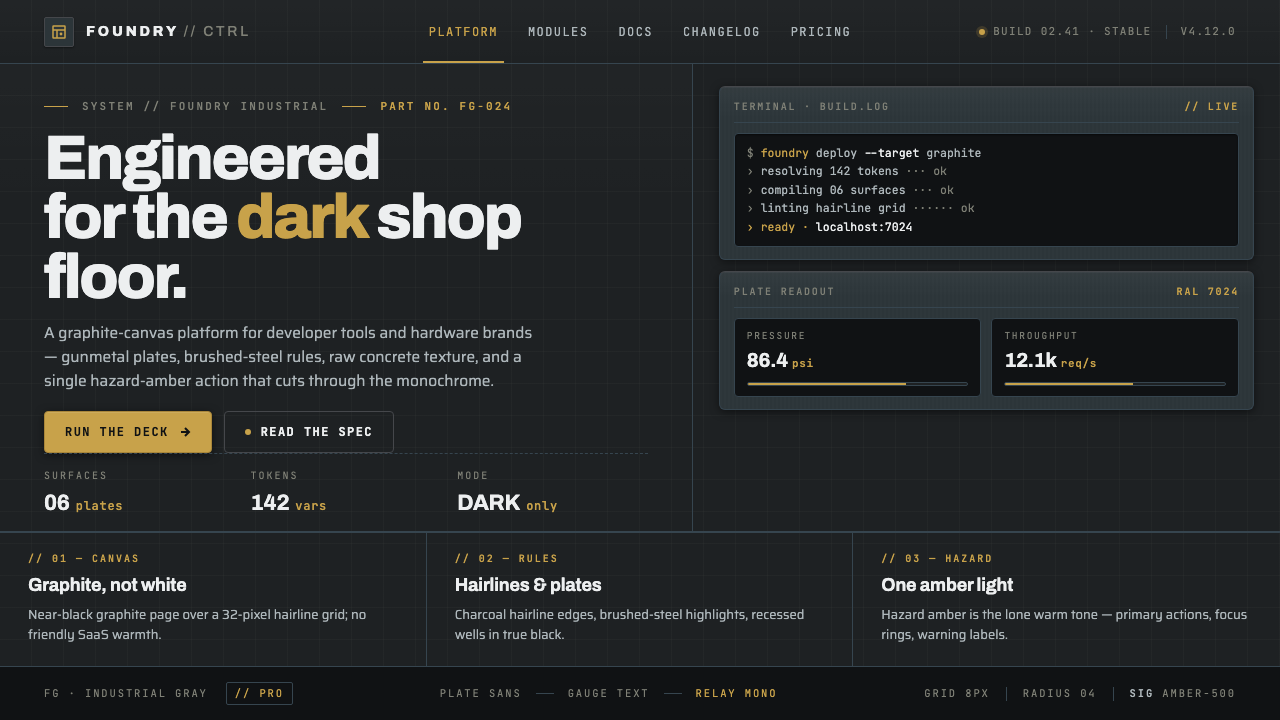 Foundry Industrial GrayBuilt for the dark shop floor. Graphite canvas, hairline plates, mono labels,…
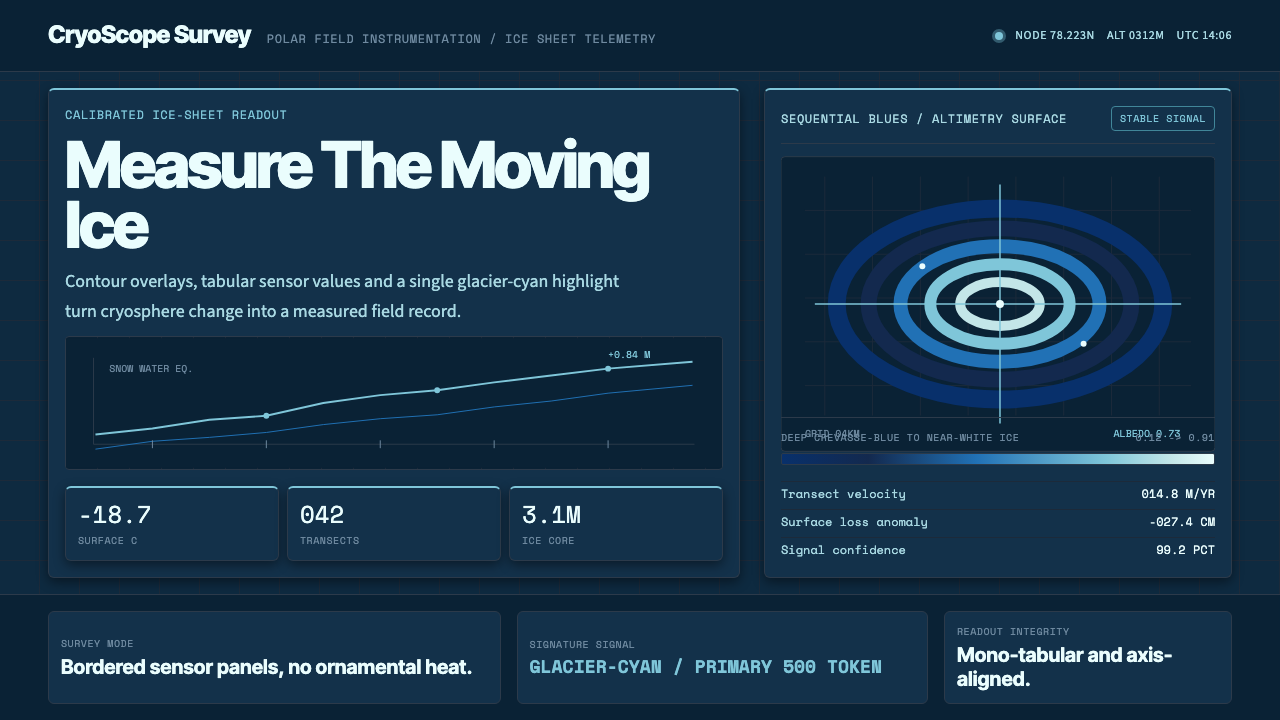 Glacier Arctic SurveyCold precision. Crevasse-blue panels, cyan readouts and contour grids calibra…