What is Arc'teryx Technical Outdoor?
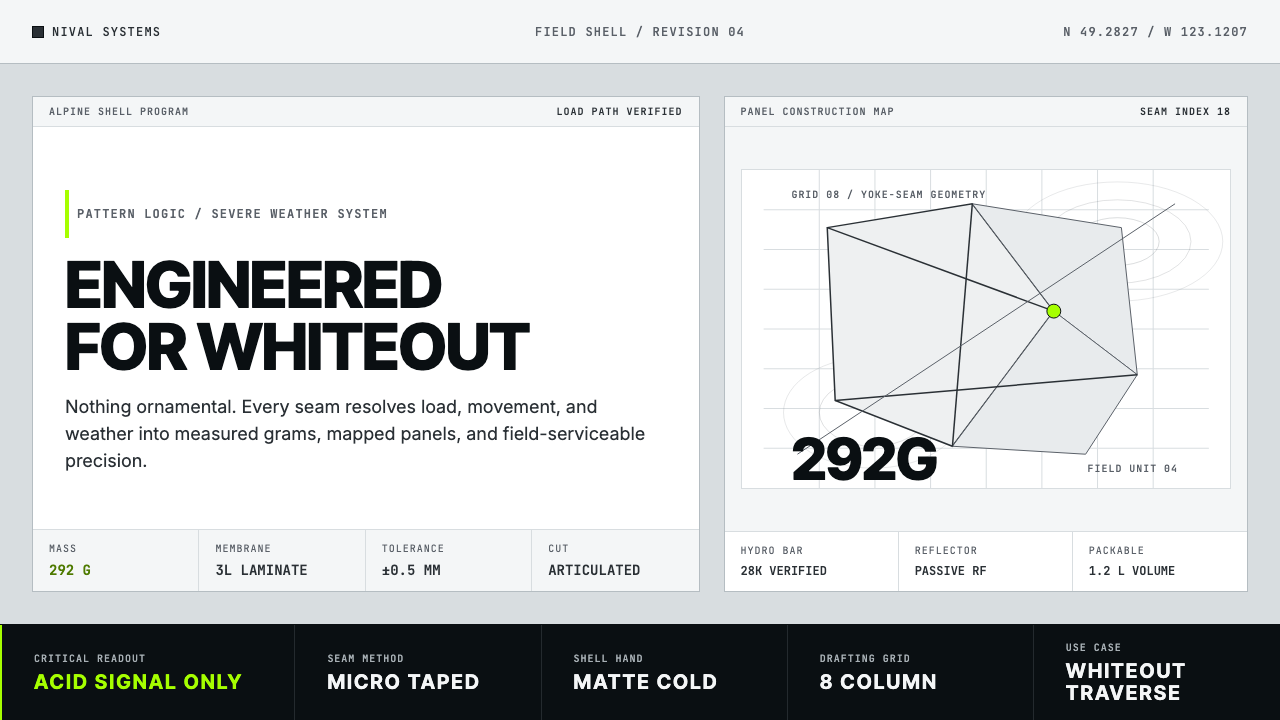
Arc'teryx built a visual language where every element earns its place — glacier-cold grounds, hairline geometry, and a single electrified accent that reads like a safety beacon on a white slope.
Arc'teryx Technical Outdoor in brief
Arc'teryx Technical Outdoor is a design aesthetic derived from the visual language of high-performance alpine equipment — a language that treats engineering specifications, panel-construction geometry, and certification marks as the entirety of its decorative vocabulary. The palette is relentlessly cool: glacier silver and deep slate anchor the ground, while a single acid-green or glacier-blue signal accent appears in exactly one place, functioning the way a hazard light functions on a mountain ridge.
The typographic posture is monospace and specification-driven. Text is laid out as if it belongs in a technical data sheet rather than a lifestyle advertisement — weight in grams, Gore-Tex layer count, seam-tape coverage expressed as precise labels in compact, uniform letterforms. Nothing is set in a warm, humanist face; the tone is that of an instrument panel. Whitespace is structural, not decorative: it separates data fields rather than softening atmosphere.
What distinguishes this aesthetic from generic minimalism is its systematic relationship to function. Hairline rules map seam lines and panel cuts. Grid structures echo the modular construction of a shell jacket. The restraint is not fashionable emptiness but the discipline of a product that cannot afford unnecessary weight. Every visual decision is justified by the same logic that governs the gear itself: if it does not contribute to performance, it does not belong.

Where does Arc'teryx Technical Outdoor come from?
Arc'teryx was founded in 1989 on the Coast Salish territory of Vancouver, British Columbia, by Dave Lane and Jeremy Guard. The company took its name from Archaeopteryx lithographica, the prehistoric transitional fossil between dinosaurs and birds — a deliberate signal that the founders saw themselves as engineering a category that had not yet fully existed. From the beginning, every design decision was tested against the demands of technical alpinism: routes on glaciated peaks where gear failure is not an inconvenience but a consequence.
The early visual language followed directly from the product philosophy. Arc'teryx had no history of lifestyle branding to inherit and no aesthetic tradition to negotiate with. The design vocabulary emerged from the objects themselves — the silver-gray of waterproof membranes, the dark seam tape along panel joins, the Velcro storm flap annotations, the RECCO reflector patches that appeared in exactly one place. When the brand eventually needed a visual identity that extended beyond hangtags, it simply codified what the product had already established: cool grounds, technical annotation, functional accent.
The Veilance line, launched in 2009, marked the moment the aesthetic became self-consciously urban without abandoning its technical basis. Conroy Nachtigall, who led design at Arc'teryx through a formative period, helped articulate a design language that could move from Whistler couloirs to Vancouver meeting rooms without changing register. The same hairline geometry, the same monospace annotation logic, the same solitary accent — now deployed on merino-shell hybrid garments worn in cities. Veilance proved that the aesthetic was structurally coherent enough to survive the removal of the mountain.
The broader techwear movement — whose other key voices include Errolson Hugh's Acronym studio and Salomon's S/Lab performance line — absorbed and amplified this language through the 2010s. The gorpcore phenomenon of the early 2020s brought technical outdoor aesthetics into mainstream fashion discourse, and by the mid-2020s the Arc'teryx visual system had become a cultural reference point, reproduced across product categories that had nothing to do with alpine performance. The aesthetic had achieved what the Bauhaus achieved in another era: a design vocabulary so internally consistent that it generates recognition even in entirely new contexts.
What defines the Arc'teryx Technical Outdoor look?
Color System
The palette is organized around three roles, not three hues. The ground is always cool and recessive — glacier silver, cloud white, or a near-black slate that reads as a dark-mode ground. The structural layer uses mid-tone grays to articulate panel divisions, annotation fields, and secondary typography. The signal accent — acid green, glacier blue, or a sharp safety orange — appears in one location per composition, functioning as the single navigational beacon. Warm colors are absent by principle; the entire system reads as if it were calibrated under overcast alpine light.
Typography as Specification
Type is treated as data annotation rather than expression. Monospace or condensed sans-serif letterforms dominate, chosen because they evoke engineering documents, terminal output, and gear specification sheets. Labels are compact, tightly tracked, and arranged in tabular structures. There is a deliberate tension between the microscopic scale of annotation text and the occasional large-scale typographic element — a product number set at display size, a weight-in-grams figure used as a hero graphic. Italics and decorative variants are avoided; the system trusts scale and weight contrast to do all organizational work.
Hairline Geometry
The structural vocabulary is built from lines so thin they read as precision measurements rather than graphical decoration. These hairline rules — horizontal, vertical, and occasionally diagonal — map panel boundaries, separate data zones, and create grid scaffolding across the composition. They reference the construction lines of a technical sewing pattern or an engineering blueprint. Where shapes occur, they are rectangles and parallelograms associated with gear panels, never curves or organic forms. The geometry is always cool, angular, and explicitly constructed.
Information Density
Arc'teryx design is unapologetically data-rich. A single product page or layout might contain material composition percentages, certifications, weight specifications, and construction annotations — all treated as design elements rather than legal footnotes. This density is not clutter; it is organized into tight hierarchical zones with clear visual separation. The effect communicates both technical authority and earned trust: a brand that shows its specifications publicly is a brand confident its specifications will impress. Negative space is used to make high-density zones legible, not to replace them.
Single Signal Accent
Perhaps the most disciplined and recognizable feature of the aesthetic is the strict use of one accent color per composition. In an alpinist context, this mirrors the function of a safety signal — a vivid color that exists purely to be found in an emergency. Applied to visual design, the same logic governs: the accent marks the one thing that must be acted upon, the primary call to action, the critical measurement, the key navigation element. It is never used decoratively and never repeated. When the eye finds the acid-green tab or the glacier-blue status indicator, it has found the functional center of the layout.
Material Referencing
Textures and surfaces, when they appear at all, are drawn from actual gear materials: the subtle grid weave of ripstop nylon, the matte sheen of a laminated membrane, the mechanical regularity of a load-bearing webbing pattern. These references are never decorative simulations of natural materials. They do not evoke wood grain or leather; they evoke constructed systems designed for controlled performance. Used at low opacity as background texture or as a structural motif, they reinforce the gear-culture credibility of the composition without overpowering the information layer above.
Dark-Mode Discipline
The aesthetic operates with equal authority in both light and dark configurations. The dark variant — near-black ground, light annotation text, single acid-green or glacier-blue accent — is arguably more natural to the system, evoking night operations, altimeter readouts, and GPS device interfaces. When switching between modes, the signal accent remains constant and the structural hairlines simply invert. The absence of warm tones ensures that neither mode reads as domestic or comfortable; both read as operational. This environmental neutrality is rare among established design systems and is one reason the aesthetic translates across digital products ranging from professional dashboards to outdoor navigation apps.

Who shaped Arc'teryx Technical Outdoor?
Co-founders of Arc'teryx in 1989, Lane and Guard established the engineering-first philosophy that still governs the brand's visual approach. Their insistence on resolving every design problem through technical innovation rather than conventional craft or aesthetics created a company culture in which the product's own requirements became the design brief. The visual language that emerged — cool, technical, specification-annotated — was not designed by a branding agency; it was extruded from a product development process that had no tolerance for unnecessary elements.
Nachtigall led design at Arc'teryx through a critical period in the brand's maturation, helping to articulate and systematize the visual language beyond gear tags and product photography. His work involved translating the implicit logic of product construction — panel maps, material layering sequences, load-distribution geometry — into a coherent graphic language that could operate across retail environments, digital surfaces, and brand communications. The Veilance line, which he helped develop, demonstrated that the technical outdoor aesthetic was capable of carrying urban and luxury-adjacent contexts without softening.
The co-founder of Acronym — Arc'teryx's most technically extreme adjacent label and an independent studio — Hugh is perhaps the most articulate theorist of the techwear aesthetic that Arc'teryx visual language helped originate. His design practice extends the same principles into fashion: modularity, system thinking, single-signal accent color, typographic annotation, and the absolute subordination of aesthetics to engineered function. Hugh's public statements about design have been widely cited as a theoretical framework for the broader movement, making him the closest analogue to a movement ideologist within the technical outdoor design world.
The S/Lab performance division of Salomon — the French alpine equipment company with roots in 1947 Annecy — developed a visual identity running in close parallel to Arc'teryx: the same restricted cool palette, the same monospace annotation logic, the same single-accent discipline. S/Lab's design emerged from the requirements of elite trail-running and ski-racing where weight, aerodynamic construction, and material transparency are non-negotiable. Together with Arc'teryx and Acronym, Salomon S/Lab established the visual coordinates of what became recognizable as the techwear aesthetic movement across the 2010s and 2020s.
How do you use Arc'teryx Technical Outdoor today?
Arc'teryx Technical Outdoor is a high-discipline system that rewards precision and punishes approximation. Before applying it, establish the three-role color structure: ground, structure, and signal. The ground is chosen from the cool-neutral range — silver-white, cloud gray, or near-black slate depending on whether the execution is light or dark mode. The structural layer uses mid-tone grays to define zones, borders, and annotation fields. The signal accent is selected once and applied once. If you find yourself using the accent color in two locations, you have broken the system's most fundamental rule.
For presentation slides, the aesthetic works powerfully on both cover and content pages. A cover should establish the compositional logic immediately: a near-full-bleed cool ground, a product or data visualization treated as a technical object rather than a hero image, a title set in a compact sans-serif at high contrast, and the signal accent appearing in exactly one typographic or graphical element — perhaps the category label, perhaps a version number. Content slides should function as data sheets: tabular organization of information, hairline rules separating fields, annotation text at small scale alongside feature callouts at display scale. Data slides take on a schematic quality — charts become engineering diagrams, with bar fills drawn from the structural gray range and one accent-colored series marking the primary variable.
For web interfaces and dashboards, the system is particularly well-adapted to environments where operators need to scan high-density information quickly. The approach: set the background to the cool ground tone, define a strict grid with visible hairline column rules, use the structural gray range for card borders and dividers, and reserve the signal accent exclusively for interactive states — hover, selected, active alert. Navigation should be typographic, using compact monospace or condensed labels rather than icon sets. Status indicators, notification badges, and progress meters are the natural home of the signal accent; using it anywhere else dilutes its attention-directing function. Pricing pages benefit from the tier-differentiation logic: each pricing column is anchored by structural gray, and the recommended tier — and only that tier — receives the accent color on its header.
For editorial layouts and marketing materials, the aesthetic supports strong information hierarchy without sacrificing the engineered severity that gives it authority. An editorial layout in this mode uses a narrow body-text column with a generous technical margin for specifications, cross-references, and pull-data. Section breaks are marked by hairline horizontal rules, never by decorative ornaments or abstract dividers. Marketing pages work best when they adopt a poster logic: full-bleed cool-ground panels alternate with near-black panels, body copy is compact and specification-rich, and the single call-to-action element is the one place the signal accent appears. Photography, when used, is treated as a technical object — high-contrast, tightly cropped, ideally set against the cool ground rather than contained in rounded cards.
A common and costly mistake is distributing the signal accent across multiple elements in the name of visual interest or brand reinforcement. This destroys the navigational logic that makes the system effective. A second common mistake is warming the palette with off-whites that carry a yellow or beige cast — the visual system depends on the ground reading as genuinely cool and neutral, not as parchment or cream. A third mistake is using a humanist or serif typeface in the belief that it adds approachability; the appropriate typeface is always on the technical, engineered side of the spectrum, and softening the typography softens the entire system's authority. If warmth or approachability are genuine requirements for the project, this aesthetic is the wrong choice — it should not be diluted but replaced.

Arc'teryx Technical Outdoor — FAQ
How is Arc'teryx Technical Outdoor different from generic minimalism?
Generic minimalism reduces elements in the service of calm and openness. Arc'teryx Technical Outdoor reduces elements in the service of precision and operational clarity — and replaces what it removes with data, annotation, and specification. A minimalist layout might have one sentence of body copy with generous whitespace; a technical outdoor layout at the same element count would have that same sentence plus a weight specification, a material code, and a hairline grid, all organized into a tight tabular field. The emotional register is also different: minimalism aspires to tranquility, while technical outdoor design aspires to the functional confidence of a well-engineered instrument.
Can this aesthetic work for products unrelated to outdoor sports?
Yes, with intentionality. The aesthetic's values — precision, transparency of specification, zero decorative waste, operational clarity — transfer well to any product category that shares those values: financial analytics tools, professional hardware, medical devices, developer-facing software, and performance audio equipment, among others. It transfers poorly to categories where warmth, narrative richness, or cultural belonging are primary values — consumer food brands, children's products, wellness applications, and anything relying on organic texture or lived-in familiarity. The test is whether the product genuinely benefits from communicating precision and engineered confidence. If it does, the aesthetic will feel native; if it does not, it will feel cold and alienating.
The design calls for a single accent color — how do I choose which one?
The choice is governed by the signal function the accent needs to perform and the ground it sits against. Acid green reads as the most urgent and technical — it is the classic techwear signal, associated with night-vision optics, safety marking, and alpine emergency equipment. It works on both light and dark grounds but can dominate aggressively if the composition is not well-controlled. Glacier blue is cooler and more precise, reading as instrument-grade rather than emergency-grade; it suits dashboard interfaces and analytics products where calm authority is needed. Safety orange or warm amber provide a slight departure from the cold system and work well when the content involves physical products or real-world performance data where a small degree of energy is appropriate. Whatever the choice, it must be the only warm or vivid element in the composition.
How should photography be used within this system?
Photography in the Arc'teryx technical outdoor system is treated as a technical object, not a lifestyle window. The preferred treatment is high-contrast, tightly cropped, and either set directly on the cool ground or silhouetted against it. Imagery showing gear or product should emphasize construction detail — seam lines, material texture at close range, hardware in use — rather than aspirational scenery or human lifestyle. When human figures appear, they are typically shown in active functional contexts, often partially cropped to emphasize gear and movement rather than face and expression. Softbox portraiture and warm-toned lifestyle photography are inconsistent with the system and should be avoided. Monochrome or near-monochrome treatments, with the signal accent appearing in a single detail element, can be particularly effective.
Is this aesthetic suitable for dark mode as a default, or should light mode be primary?
Unlike many design systems where dark mode is an afterthought or inversion, the Arc'teryx technical outdoor aesthetic is genuinely bicultural — both modes are structurally native. The light mode, with its glacier-silver or cloud-white ground, emphasizes the documentation and specification character of the system, reading as a technical data sheet or product page. The dark mode, with its near-black slate ground, emphasizes the instrument and operational character, reading as a GPS interface, altimeter display, or night-operations dashboard. The choice should be driven by context: light for editorial and print-adjacent applications, dark for ambient-light-variable interfaces and professional dashboards. Products that must work in both should ensure the signal accent is equally vivid against both grounds — typically this means the acid-green or glacier-blue choice, both of which are viable at high contrast on dark or light backgrounds.
Related design styles
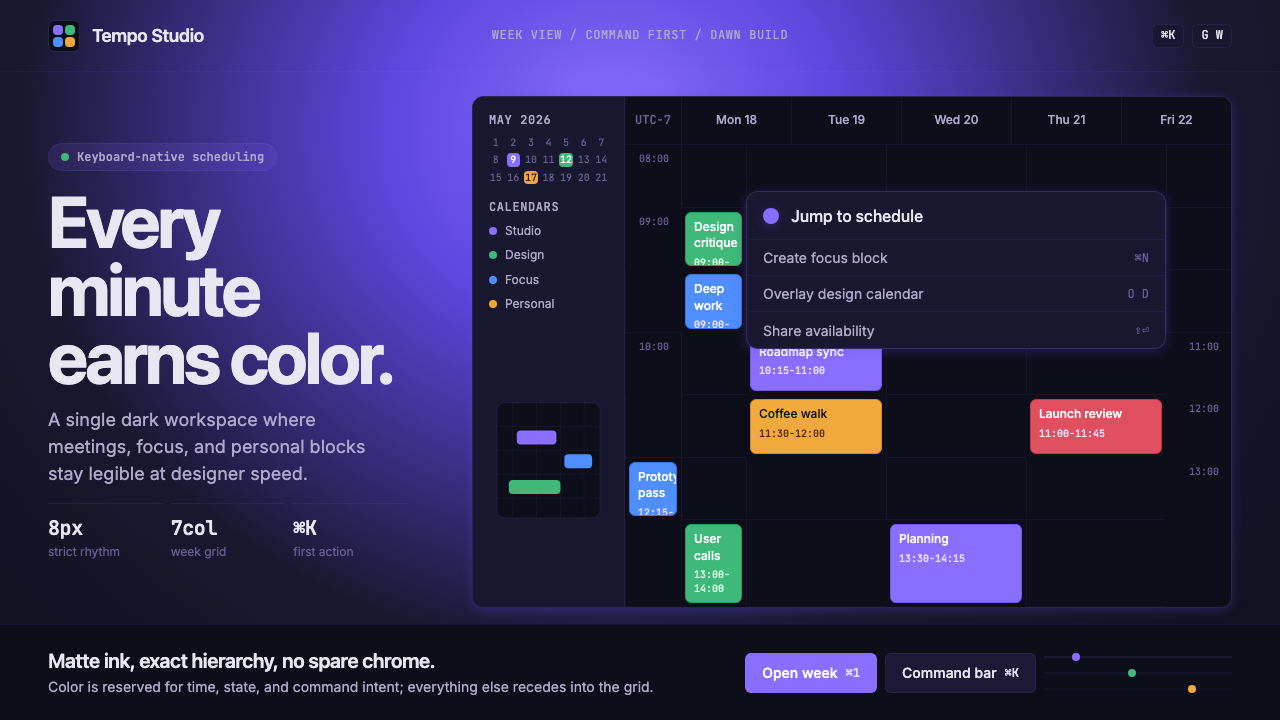 Cron CalendarDesigner-tech restraint. Purple wash, ink grid, mono shortcuts, surgical even…
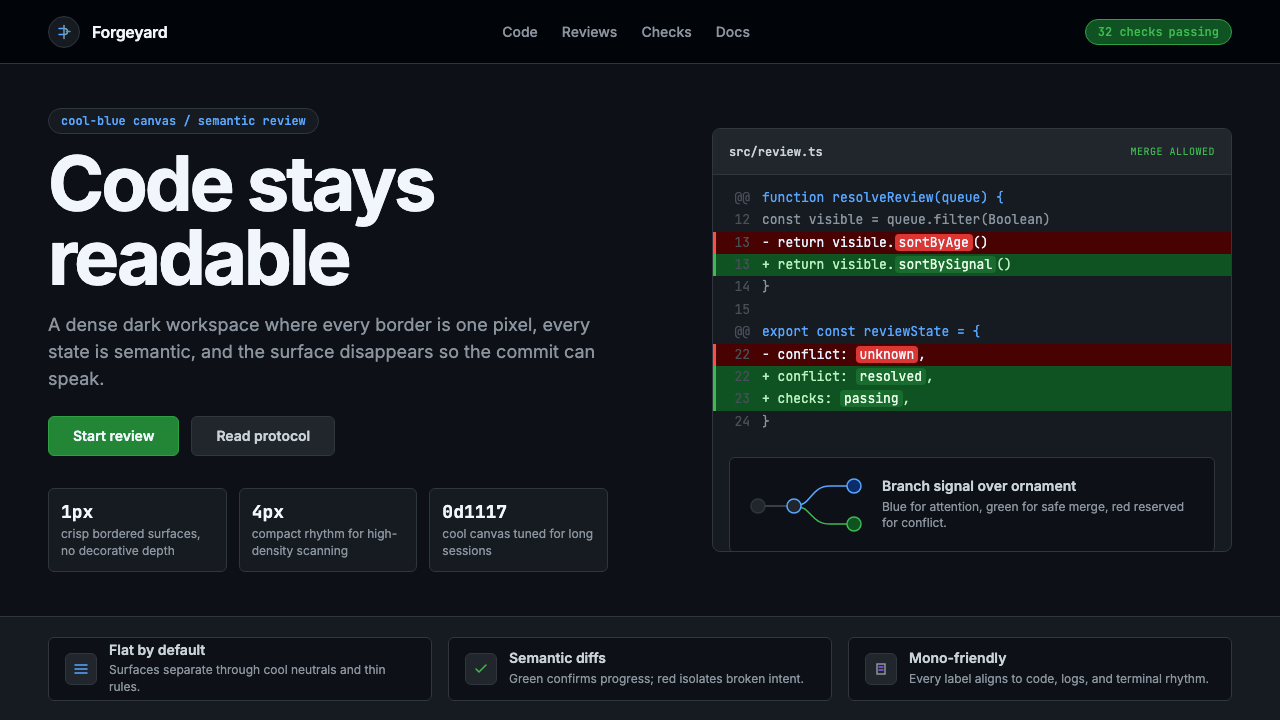 GitHub DarkCode-first darkness. Cool-blue canvas, 1px borders, green/red diff lines.
 Linear 2024Precision down to the millisecond. Near-black, indigo-violet accents, Inter D…
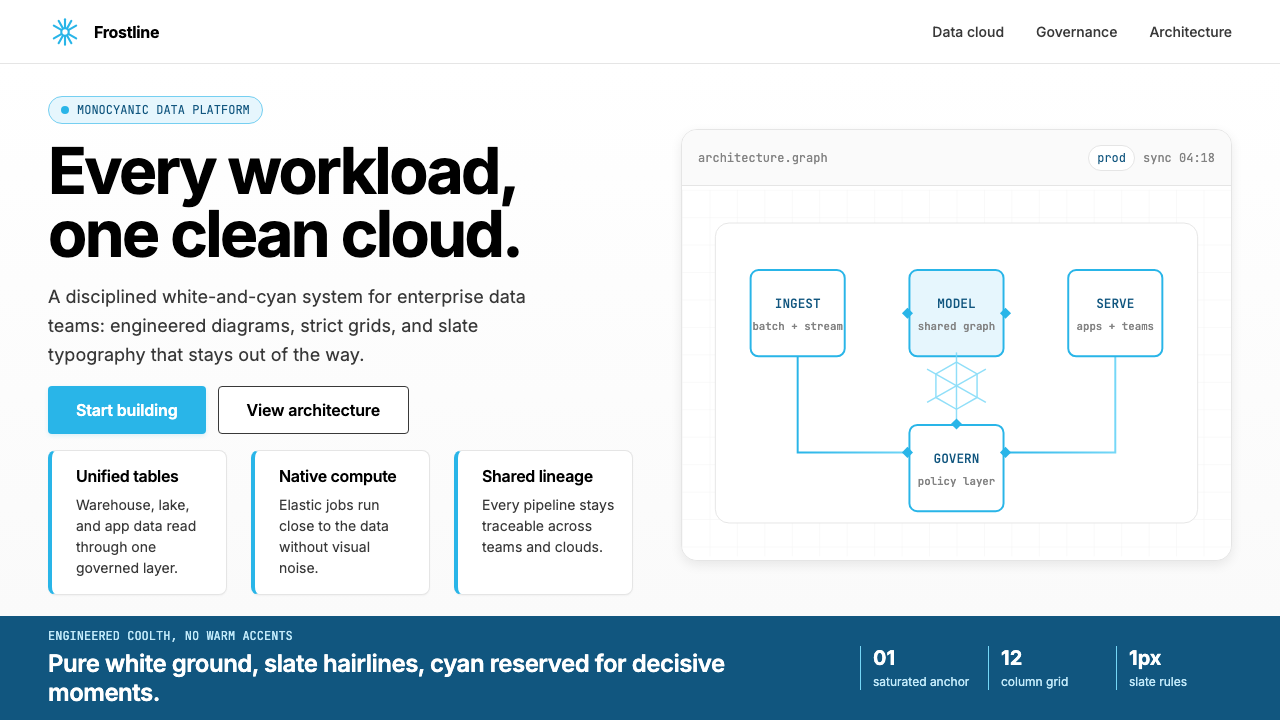 Snowflake Data CloudCool precision wins. Icy cyan, Inter grids, and hex data diagrams stay engine…
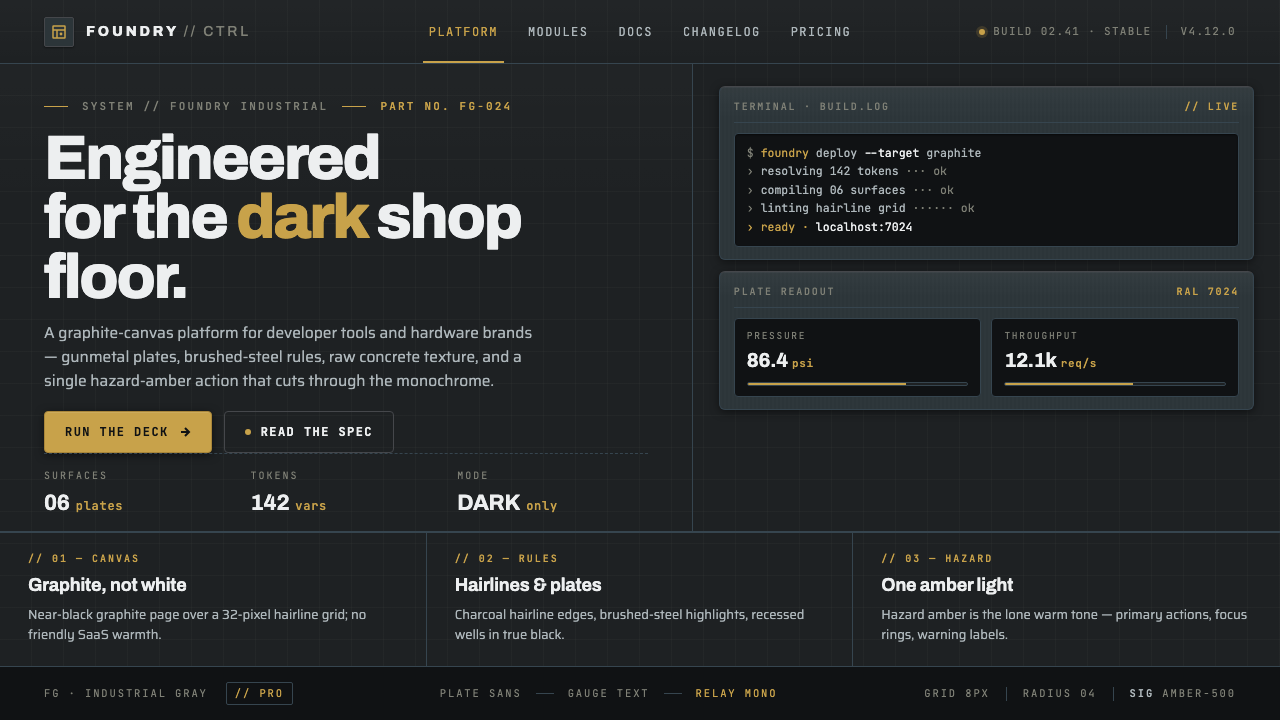 Foundry Industrial GrayBuilt for the dark shop floor. Graphite canvas, hairline plates, mono labels,…
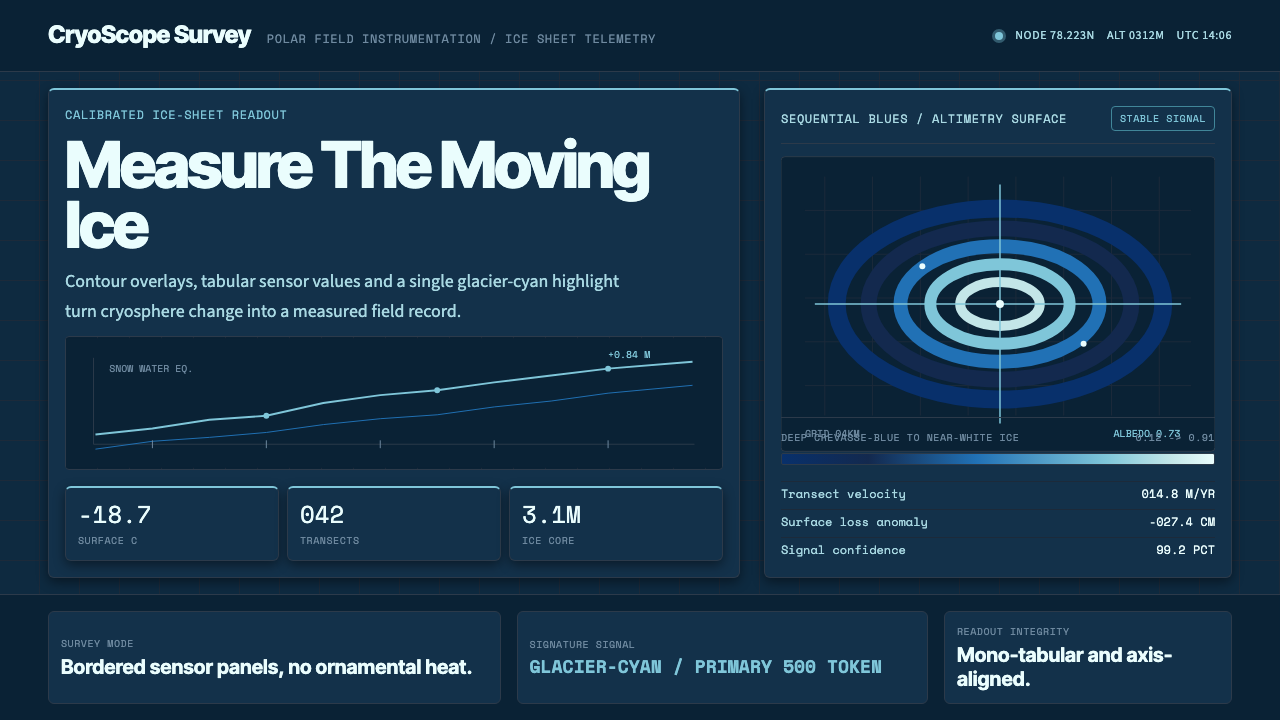 Glacier Arctic SurveyCold precision. Crevasse-blue panels, cyan readouts and contour grids calibra…