What is Snowflake Data Cloud?
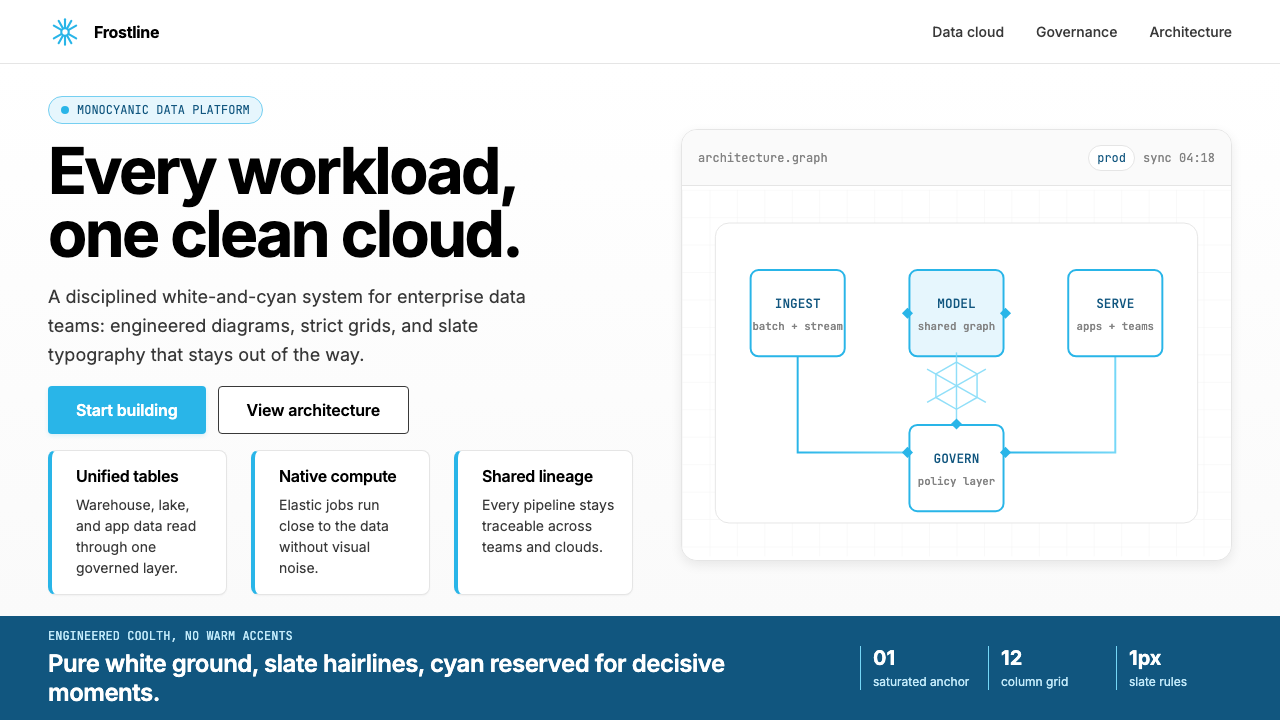
Snowflake built an enterprise data cloud on a single icy cyan and the discipline never to use a second saturated color.
Snowflake Data Cloud in brief
The Snowflake Data Cloud visual system is a study in deliberate restraint. Where most enterprise software brands rely on a palette of competing accent colors, Snowflake commits entirely to a single saturated brand anchor — a cool, luminous cyan — and pairs it with pure white grounds, near-black slate text, and the geometric hexagonal snowflake mark that appears on every surface. The result is not minimalism for its own sake, but a precisely engineered visual language designed to communicate reliability, precision, and scale.
The aesthetic rejects warmth. There is no cream, no off-white, no ambient gradient, no illustrative mascot. The visual system is grounded in generous whitespace, thin structural hairlines, and a strict modernist sans-serif that keeps reading effortless at every scale. Abstract data-architecture diagrams — stylized hexagonal node-and-edge networks — replace stock photography throughout marketing and documentation, reinforcing the sense that this is a brand built by engineers for engineers.
What distinguishes the Snowflake style from generic tech minimalism is its commitment to geometric identity. The snowflake mark is not merely a logo; it is a repeating motif that propagates into diagrams, grid patterns, and decorative dividers. The hexagonal grid becomes the connective tissue of the brand, evoking the crystalline structure of ice while simultaneously referencing the distributed-node topology of cloud data infrastructure. Cold precision and technical credibility are the constant messages.

Where does Snowflake Data Cloud come from?
Snowflake was founded in 2012 in Bozeman, Montana — an unlikely birthplace for a technology company that would eventually become one of the most valuable cloud platforms in history. Three data warehousing veterans, Benoit Dageville, Thierry Cruanes, and Marcin Zukowski, conceived a cloud-native architecture that separated compute from storage at a time when on-premise data warehouses still dominated enterprise infrastructure. The company operated in stealth for two years before emerging to a market increasingly ready for a cloud-first approach to data.
The visual identity that would become globally recognized crystallized alongside the company's growth into a platform business. By the time Frank Slootman joined as CEO in 2019, Snowflake was preparing for what would become the largest software IPO in history when it went public in September 2020, raising nearly four billion dollars on its first day of trading. The visual language needed to communicate not merely a product, but an ecosystem — the Data Cloud — a shared infrastructure where organizations could exchange and monetize data across company boundaries. The brand had to feel at once technically authoritative and categorically new.
The current visual system, refined through approximately 2022 to 2024, reflects the shift from a data warehouse product to a multi-cloud data platform. The geometric snowflake mark, the monochromatic cyan palette, and the hexagonal data diagram language all emerged from a brand identity effort designed to signal architectural elegance and engineering rigor. The choice of cyan as the sole saturated color was deliberate: unlike the warmer blues common in enterprise software, cyan reads cold, precise, and digital — closer to the color of a data center's LED indicators than to the reassuring blues of legacy IT brands.
The surrounding landscape of cloud data competitors shaped the identity by contrast. Amazon Web Services anchors on orange; Google Cloud uses a multicolored primary palette; Microsoft Azure deploys a range of blues; Databricks built around a high-energy red. Snowflake's decision to occupy the cool, restrained end of the spectrum — a single engineered cyan against fields of white — established a visual territory that no other major data platform had claimed. In a category defined by complexity, Snowflake made visual simplicity its competitive differentiator.
What defines the Snowflake Data Cloud look?
Monochromatic Cyan Accent
The entire system operates from a single saturated color: a cool, luminous cyan that functions as brand anchor, interactive indicator, and compositional focal point simultaneously. Every other element — backgrounds, body text, structural lines, diagrams — exists in achromatic territory. This discipline creates an immediate hierarchy: wherever cyan appears, the eye goes first. The restraint is total; no second saturated hue is permitted to compete.
Geometric Snowflake Identity
The hexagonal snowflake mark functions as more than a logo — it is a generative visual grammar. The six-sided symmetry propagates outward into data diagrams, grid overlays, decorative dividers, and background textures. This self-similar repetition ties every designed surface back to the same crystalline geometry, giving the brand a coherence that persists across formats and scales without requiring the literal mark to appear on every element.
Pure White Grounds and Generous Whitespace
The default background is pure white — not ivory, not warm off-white, not gray. This coldness is intentional: it amplifies the luminosity of the cyan accent and sharpens the contrast of slate-toned text. Layouts commit to generous whitespace, treating empty space not as something to fill but as a structural element that isolates and elevates each piece of content. The cumulative effect is an impression of clarity and engineered precision.
Abstract Data-Architecture Diagrams
Photography is systematically displaced by a proprietary diagram language: stylized node-and-edge networks, hexagonal cluster maps, and abstract flow charts rendered in the brand's achromatic palette with cyan highlights on active nodes or critical paths. These illustrations serve as both technical explanation and brand expression, reinforcing the sense that the company's product is architecture — invisible, distributed, and geometrically elegant — rather than any single tangible artifact.
Strict Modernist Typography
The typographic system rests on a single geometric sans-serif family deployed across all weights and sizes, with no decorative alternatives introduced for headlines or pull-quotes. Hierarchy is established through scale and weight contrast alone. Type is set with comfortable reading measure on a generous leading, giving dense technical content room to breathe. The overall effect is clinical and precise — perfectly matched to an audience of data engineers and enterprise architects.
Hairline Grid Structure
Layouts are organized by a visible but unobtrusive grid of thin slate-colored lines that divide space into columns, rows, and data cells without competing with content. These structural hairlines — used in data tables, pricing grids, and dashboard interfaces — serve the same function as the thin lines in a ledger or circuit diagram: they organize information spatially while signaling the systematic, rule-governed nature of the underlying data. The grid is never hidden and never apologized for.
Engineered Flatness
Shadows, where they exist, are subtle and functional — used to establish card elevation or interactive depth — rather than decorative or naturalistic. Gradients are limited to contained, purposeful applications such as loading states or subtle background washes, never applied as general visual enrichment. Illustrations are flat-rendered. The overall surface is not austere; it is meticulous. Every depth cue is a decision, not a default.

Who shaped Snowflake Data Cloud?
Dageville, formerly a principal engineer and architect at Oracle, co-founded Snowflake with the technical conviction that a cloud-native architecture separating compute from storage could outperform anything built on legacy on-premise assumptions. His engineering philosophy — that the data platform should be invisible infrastructure, not a product users wrestle with — directly shaped the brand's visual emphasis on clarity, precision, and the absence of friction. The aesthetic language of engineered simplicity mirrors the architectural principles he embedded in the platform itself.
Cruanes, also an Oracle veteran, brought deep expertise in database engine design and query optimization to Snowflake's founding team. His focus on the mathematical underpinnings of data processing — the relationship between parallelism, partitioning, and performance — is reflected in the brand's affinity for grid structures, node-and-edge diagrams, and the visual language of distributed systems. The hexagonal cluster diagrams prominent in Snowflake's marketing materials are, in a sense, visualizations of the architectural problems he spent his career solving.
Zukowski brought the research perspective of a database academic — his doctoral work at CWI Amsterdam on vectorized query execution influenced the design of analytical database engines across the industry. His presence on the founding team gave Snowflake intellectual credibility in academic and research circles, and this positioning as a rigorously principled engineering endeavor rather than a pure commercial venture is part of what the visual language communicates. The brand reads like peer-reviewed work: structured, cited, reproducible.
Slootman joined as CEO in 2019, bringing the operational intensity and enterprise sales discipline he had previously applied at ServiceNow and Data Domain. Under his leadership, Snowflake executed the largest software IPO in history in 2020 and expanded the brand's positioning from data warehouse to Data Cloud — a much larger category claim. The visual system's shift toward ecosystem-scale diagrams and its emphasis on network and connectivity imagery reflects the brand narrative Slootman drove: Snowflake is not a product you buy, but infrastructure you plug into.
How do you use Snowflake Data Cloud today?
The Snowflake Data Cloud visual system transfers well to any context where cold authority, technical precision, and enterprise credibility are the desired emotional register. The key to applying it correctly is understanding that the system's power comes from discipline, not decoration: a single saturated color, geometric consistency, pure white grounds, and the willingness to let whitespace carry as much weight as content. Mimicking the aesthetic without respecting the restraint produces something that looks neither tech-polished nor intentionally designed.
For presentation slides, the style suits both cover and content pages in distinct ways. A cover slide benefits from a bold geometric composition: the snowflake motif or a hexagonal grid element in the brand cyan anchors one quadrant while the title sits in high-contrast type against a pure white or deep slate background. Avoid centering everything — the asymmetric, grid-anchored layout is part of the visual identity. Content slides should be treated as data surfaces: one or two text hierarchies defined purely by size and weight, no decorative dividers, and any charts or diagrams rendered as clean flat objects in the achromatic palette with cyan reserved for the most critical data series or call-to-action annotations. Data slides — pipeline architecture overviews, query performance comparisons, cluster topology maps — are where the style is most at home: use node-and-edge diagrams with thin hairline connectors and hexagonal node shapes, keeping the color logic consistent throughout.
For web interfaces, the system is especially well-matched to dashboards, data catalog pages, and pricing tables where hierarchy and scannability are primary concerns. Establish a strict column grid; keep backgrounds pure white; use near-black for all body text and label copy; reserve the brand cyan exclusively for active states, selected items, primary buttons, and data highlights. Card components should have minimal shadow depth — just enough to establish layer separation — rather than the deep atmospheric shadows common in softer consumer interfaces. Navigation should be type-driven, with no icon decoration beyond clean geometric indicators. Data tables benefit from the thin slate-line grid structure, which makes dense rows of figures legible without visual noise.
For editorial and marketing applications, the style supports a poster-like boldness that works well in conference materials, industry reports, and demand-generation campaigns. Full-width feature sections can alternate between a pure white ground with cyan accents and an inverted deep slate ground with white type and cyan highlights — this creates visual rhythm without introducing any new colors. Section headers benefit from the typographic scale contrast the style endorses: large, weight-forward headers against tight body copy. Infographics and data visualizations should follow the diagram language: flat rendering, hexagonal or circular node shapes, thin connectors, and a consistent rule that cyan marks the most important element in any given graphic.
A common mistake when applying this style is importing color habits from other enterprise tech brands. The temptation to add a warm amber for warnings, a green for success states, or a purple for premium tiers must be resisted — each addition dilutes the identity and undermines the authority that comes from visual commitment to a single accent. If a second color is genuinely necessary for a semantic purpose such as error states, use a muted, desaturated variant so it reads as utilitarian rather than expressive. Similarly, resist the urge to warm the backgrounds or introduce textural gradients for visual richness: the coldness and flatness are not limitations, they are the message.

Snowflake Data Cloud — FAQ
Can the Snowflake style work on dark backgrounds?
Yes, and it is one of the style's more natural inversions. A deep slate or near-black background with white type and cyan accents reads as a night-mode extension of the same logic rather than a departure from it. The key is maintaining the same discipline: cyan remains the only saturated color, whitespace is preserved, and the hexagonal diagram language carries through unchanged. Avoid adding warm tones — the temptation to soften a dark layout with amber or gold accents works against the cold precision that defines the identity. A well-executed dark variant should feel like switching a data terminal to night mode, not like a different brand.
How should data visualizations be colored in this style?
The preferred approach is to use the brand cyan as the primary data series color, with secondary series rendered in stepped lightness values of the same hue or in muted slate tones, so that the overall chart reads as achromatic with cyan emphasis rather than as a multicolored graphic. For categorical data with more than two or three series, resist the temptation to introduce arbitrary accent colors; instead, use varying opacity levels of the cyan or systematic gray steps. Reserve any saturated color departure — such as a muted red for an alert threshold line — for strictly semantic purposes, and ensure it appears only once across the entire visualization.
Is this style appropriate for consumer-facing products, or only enterprise?
The Snowflake style is architected for enterprise and technical audiences, and it carries unmistakable signals of that positioning: cold color temperature, geometric abstraction, information density, and the absence of warmth or playfulness. Applied to consumer products — especially in categories involving food, wellness, children, or personal finance — the coldness reads as clinical or even uninviting rather than prestigious. The style works well in any context where the user's mental model is professional and analytical: developer tools, analytics platforms, infrastructure dashboards, financial data terminals, and B2B SaaS products. For consumer contexts, consider whether the target user wants to feel informed and in control (compatible with the style) or relaxed and welcomed (incompatible).
What is the difference between using this style and generic tech minimalism?
Generic tech minimalism typically means white backgrounds, system sans-serif type, and reduced visual clutter — it is a default, not a design system. The Snowflake style is a specific, principled identity with three distinguishing commitments: a single saturated brand anchor color that cannot be augmented, a geometric motif (the hexagonal snowflake) that must propagate consistently through diagrams and decorative elements, and a preference for abstract data-architecture illustration over photography or friendly illustration. Generic minimalism can apply to almost any product; the Snowflake style communicates a specific worldview — engineered, distributed, data-centric — that only fits contexts where that worldview is authentic.
How does this style handle human imagery and illustration?
The canonical approach is to avoid representational human photography entirely in product and marketing contexts, substituting abstract data-architecture diagrams. When people must appear — in case study photography, event marketing, or human-interest editorial — the photographic treatment should match the brand's cold precision: high contrast, neutral or cool color grading, professional context, and integration into the layout as flat-cropped elements rather than expressive focal points. Illustration should always be geometric and diagrammatic rather than organic or character-driven. Any figurative element in the Snowflake style is a data point with a human attached, not a story told through a face.
Related design styles
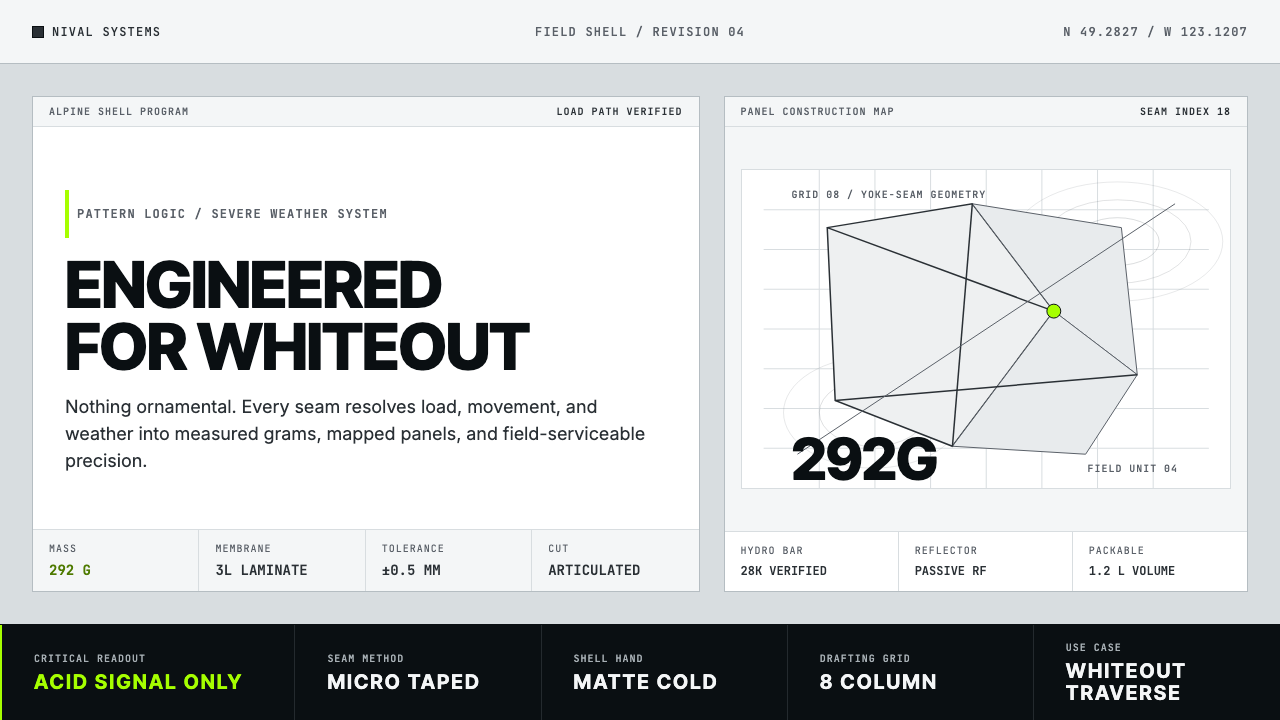 Arc'teryx Technical OutdoorEngineered, never ornamental. Glacier silver grid, mono specs, one acid-green…
 Cron CalendarDesigner-tech restraint. Purple wash, ink grid, mono shortcuts, surgical even…
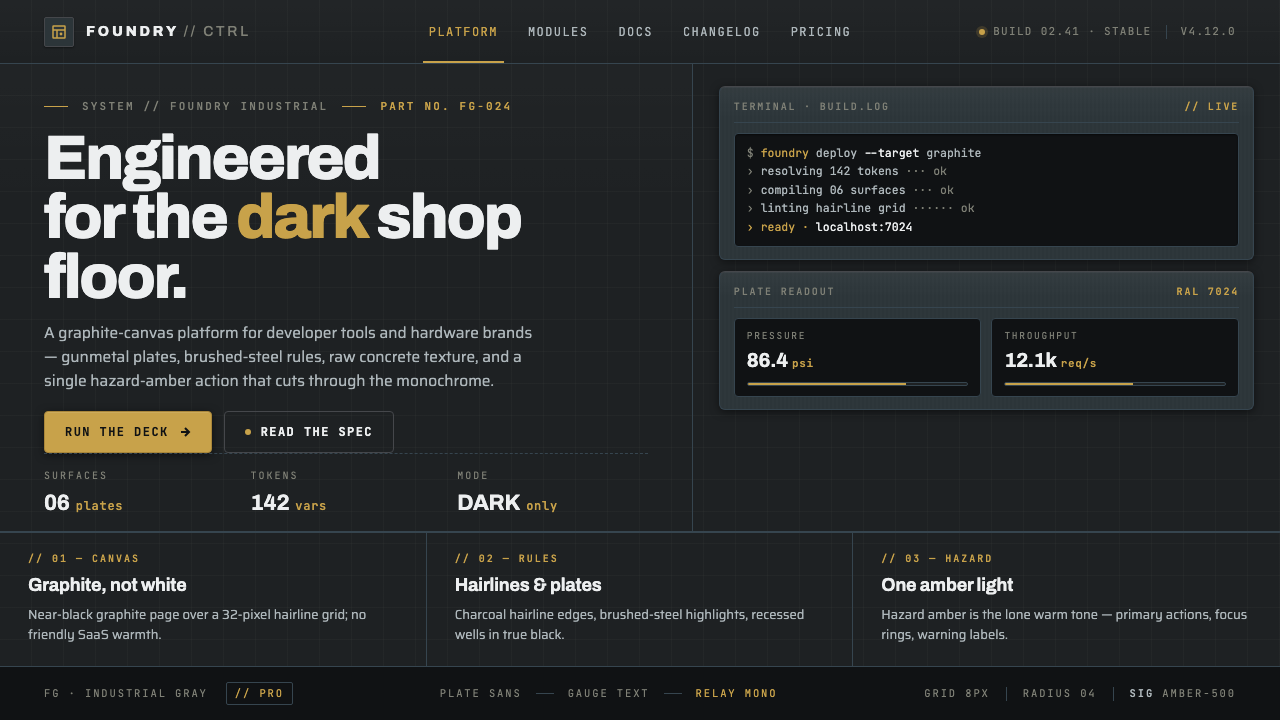 Foundry Industrial GrayBuilt for the dark shop floor. Graphite canvas, hairline plates, mono labels,…
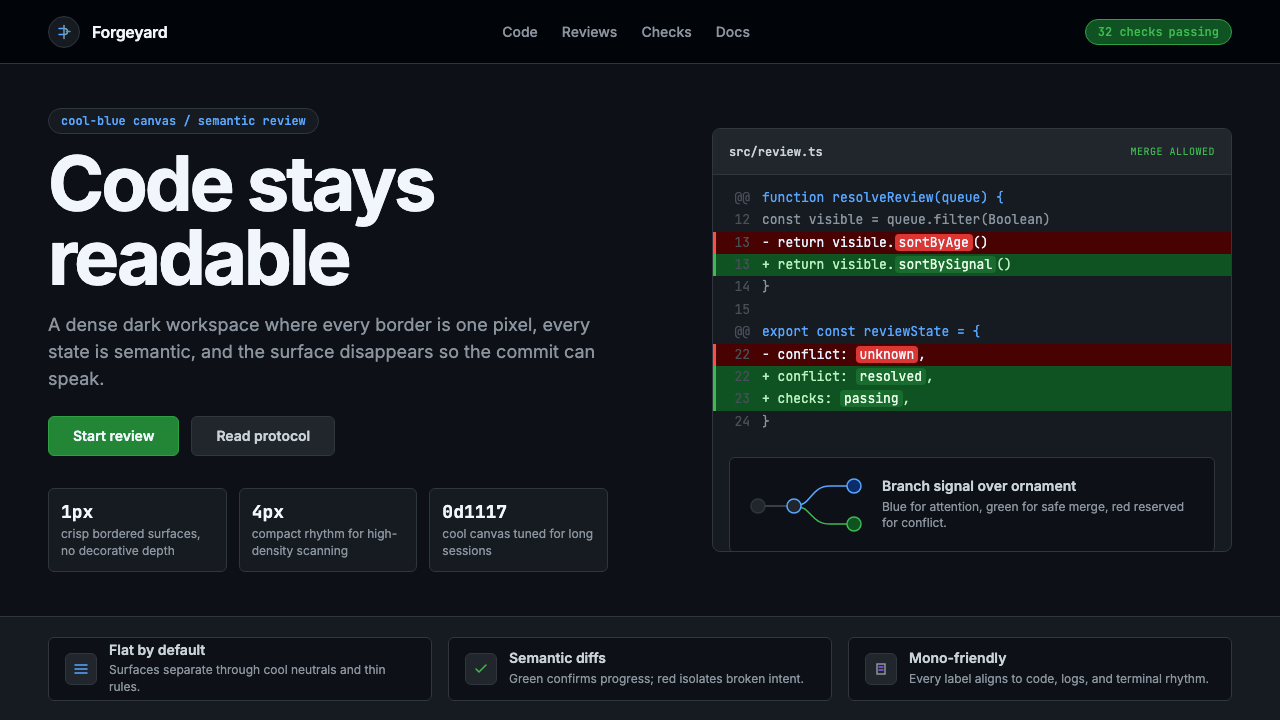 GitHub DarkCode-first darkness. Cool-blue canvas, 1px borders, green/red diff lines.
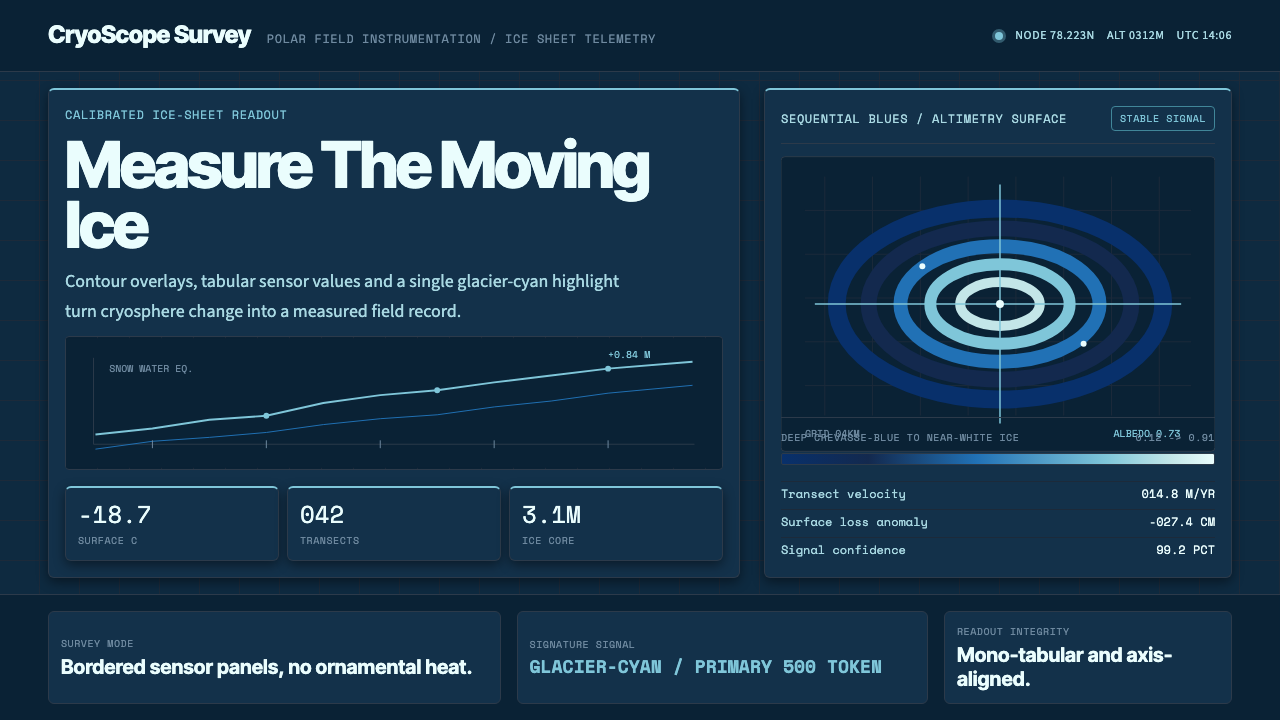 Glacier Arctic SurveyCold precision. Crevasse-blue panels, cyan readouts and contour grids calibra…
 Linear 2024Precision down to the millisecond. Near-black, indigo-violet accents, Inter D…